other player

Some questions (and answers) about Mark Walter selling the Lakers

In 2012, on the day after Mark Walter and his partners bought the Dodgers, I sat next to Walter in a conference room. To the sports fan, Walter was virtually anonymous: a super rich guy who had made his money running investment and insurance companies.

Walter’s purchase valued the Dodgers and its related assets at a then-record $2.15 billion. That value stunned the sports world. Mark Cuban had bowed out of the bidding, believing the Dodgers were not worth even $1 billion.

I asked Walter why he believed it made business sense to pay three times as much as any major league team had sold for.

“I think you have a few moments in life where you have the opportunity to own an asset and really be a custodian of something that should be multigenerational and iconic,” he said then. “I understand it’s a lot of money. But it’s not as if you can go buy another one tomorrow. … We hope we never, ever are going to sell it.”

That was essentially the point that someone who travels within the inner circles of pro sports made to me Wednesday morning, as news broke that Walter had sold the Lakers to Bob Iger, the former Disney chief, and Joshua Kushner.

The Steinbrenner family has owned the New York Yankees for 53 years. Jerry Jones has owned the Dallas Cowboys for 37 years. The Buss family owned the Lakers for 46 years.

These trophy assets are few and far between. Walter had agreed to sell the Lakers after less than one year of ownership — and not through a comprehensive bidding process, but to an inquiring caller during the weekend?

“This has more red flags than a May Day parade,” an industry insider said, speaking on condition of anonymity so as not to jeopardize his professional relationships.

The deal, which valued the Lakers at $12.5 billion, was motivated by the spiraling price for an NBA expansion team in Las Vegas, according to ESPN’s Ramona Shelburne. After all, if Iger and Kushner might have to pay $10 billion for a startup team, why not call and see if Walter might accept a bit more for one of the marquee franchises in American sports?

Was this a blind call or was Walter looking to sell?

“It was suggested to us that maybe Mark Walter would be interested in selling his stake in the Lakers,” Iger told the California Post.

What did Dodgers president Stan Kasten have to say about that?

“I never knew that. He never said that to me,” Kasten said. “I think he was surprised by it. That’s what he has expressed to me. Mark had no plan to do this. This just came up, and he thought about it and said yes.”

Why might Walter have been interested in selling?

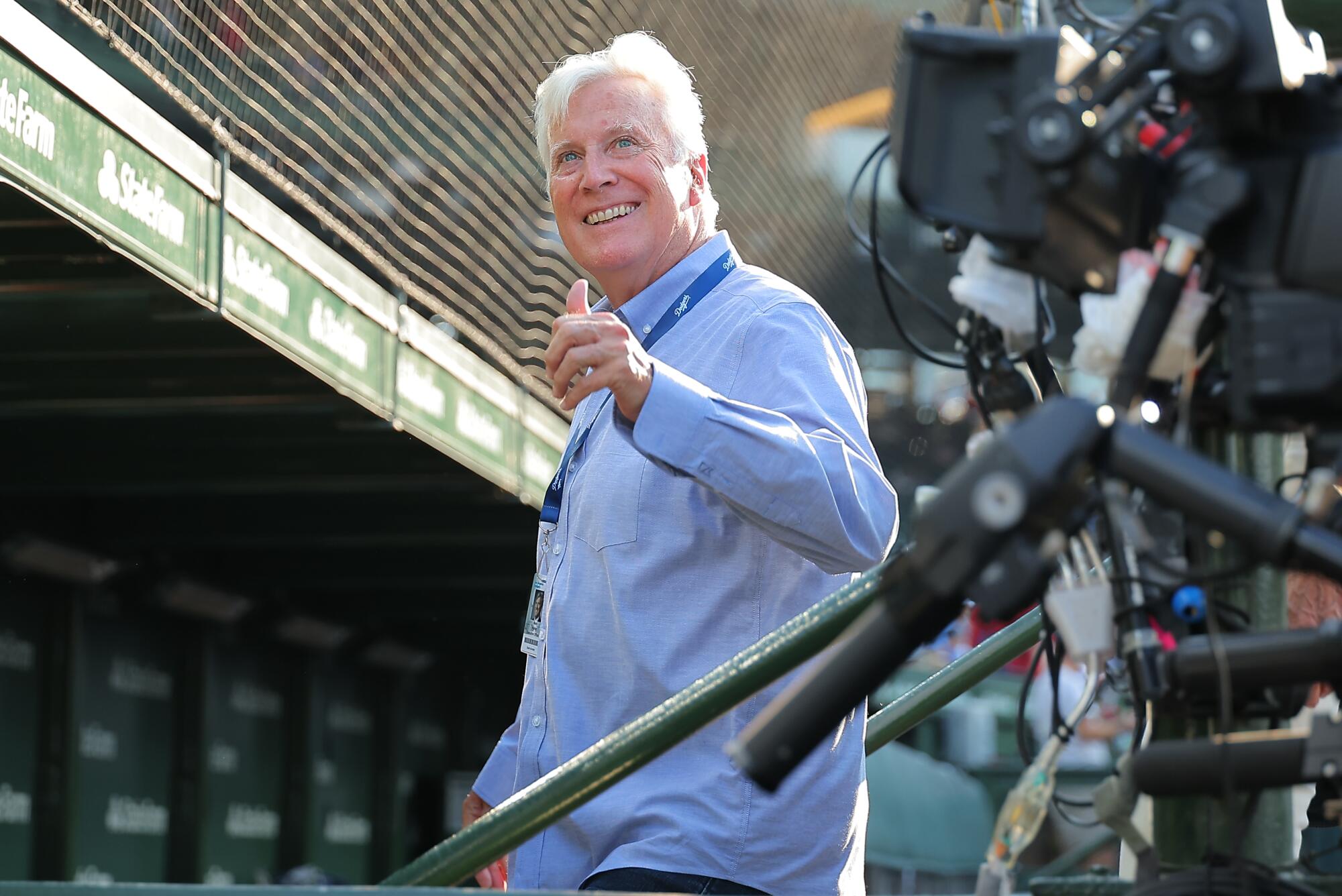
Mark Walter, chairman and controlling owner of the Dodgers, acknowledges a fan before a game in Chicago on Aug. 4.

Mark Walter acknowledges a fan before a game against the Cubs in Chicago this month.

(Melissa Tamez / Associated Press)

Only he can say for sure, but his companies are under federal investigation for failing to disclose and properly account for billions of dollars of loans among related entities. Bloomberg reported Wednesday that Walter’s holding company is trying to raise money that could help pay off or at least pay down those loans, and the Financial Times reported that company assets could be sold or restructured.

No charges have been filed, and investigations can conclude without charges. No allegations of wrongdoing have been made against Walter.

Is there a baseball angle to this?

Among the investment firms Walter’s holding company approached about “deals to raise cash,” according to Bloomberg: the asset management firm owned by New York Mets owner Steve Cohen.

Cohen’s firm passed, according to the Financial Times.

When Walter and his partners bought the Dodgers, the runners-up: the bid team of Cohen and Los Angeles Times owner Patrick Soon-Shiong.

“No, that never came up. And Mark and I discussed it,” Kasten said. “So, no, we don’t have any reason to think that. I certainly have no reason to think that.”

What does Walter’s sale of the Lakers mean for the Dodgers?

“It means nothing for the Dodgers,” someone who speaks regularly with Walter said, speaking on condition of anonymity. “He owned them long before the Lakers and will own them long after.”

If Walter should later sell the Dodgers, what might have the greatest impact on the team?

Shohei Ohtani has an out clause in his contract if Mark Walter sells the team.

Shohei Ohtani has an out clause in his contract if Mark Walter sells the team.

(Eric Thayer / Los Angeles Times)

Shohei Ohtani’s 10-year, $700-million contract with the Dodgers includes an unusual escape clause: If Walter is no longer the controlling owner, or if Andrew Friedman is no longer running the Dodgers’ baseball operations department, Ohtani can opt out of the contract.

Would he?

Way too soon to tell. If major league owners get their way in collective bargaining, the proposed salary cap would mean Ohtani at $70 million could eat up just about one-third of any team’s payroll. And, in his third year with the Dodgers, he has yet to complete a full season as a pitcher, and a left knee in which manager Dave Roberts says Ohtani suffers from “wear and tear” could make him less of a two-way player as the contract winds down.

On the other hand, playing salary might be less of an issue for him than for any other player in baseball. Ohtani is making more than his annual salary from sponsorships and endorsements — an estimated $125 million this year — and he famously deferred $68 million of each year’s salary so the Dodgers could spend more freely on players that could help him and the team win. After six losing years with the Angels and two World Series championships in two years with the Dodgers, a losing team might not entice Ohtani, no matter how much room it might have under a proposed cap.

Iger used to run Disney. How did Disney’s experience owning the Angels and Mighty Ducks go?

Disney chairman Michael Eisner and NHL commissioner Gary Bettman blow duck calls announcing the name of the team in 1993.

Disney chairman Michael Eisner, left, NHL commissioner Gary Bettman, NHL chairman Bruce McNall and Mighty Ducks chairman Jack Lindquist blow duck calls announcing the name of the team in 1993.

(Doug Pizac / Associated Press)

Disney dressed the Angels in uniforms derided by one player as “pinstripe pajamas,” put cheerleaders on the dugout roof and installed a loud “countdown to first pitch.” This all seemed awful at the time but, given the plagues of in-game hosts and teams sporting jerseys in colors far beyond home white and road gray, perhaps Disney was just ahead of its time. And, for the first few years of the franchise, Mighty Ducks gear was some of the hottest merchandise in American sports.

Ultimately, Disney wanted the Angels and Mighty Ducks to launch an “ESPN West” regional sports channel. When that channel collapsed, Disney no longer needed the teams and eventually sold them. The Angels were such a minimal part of Disney’s portfolio that then-chief executive Michael Eisner showed up in the clubhouse and the players had no idea who he was.

Who owned the Angels when they won their only World Series championship?

Angels players wave to fans during the World Series title parade in Anaheim in 2002.

Angels players wave to fans during the World Series title parade in Anaheim in 2002.

(Jean-Marc Bouju / Associated Press)

Disney. The company hired an investment banker to sell the team in the final month before the Angels won the 2002 World Series and agreed to sell to Arte Moreno in the first month of the following season.

One more try: Why did Walter really sell the Lakers?

“I think it was opportunistic and he found something that made sense to him,” Kasten said. “Mark’s a very sensible guy. But that’s really the only way I can explain it.

“You’ll have to talk to Mark about a more in-depth explanation, and good luck.”

Times staff writer Maddie Lee contributed to this report.
Source link

Memo Ochoa wants to play his best for Mexico at one last World Cup

Guillermo “Memo” Ochoa has experienced nearly everything a Mexican soccer player could imagine. World Cups, titles, criticism, adulation, impossible saves and nights when he practically carried the weight of an entire national team on his own. But at 40, the legendary Guadalajara-born goalkeeper seems to be looking toward the end of his career with a different kind of calm. No drama. No exaggerated nostalgia. Like someone who knows exactly what he has achieved and what he still wants to give to Mexican soccer before saying goodbye.

The Mexican goalkeeper recently confirmed that the 2026 World Cup will be the last of his career with the Mexican national team and likely also as a professional soccer player, thus closing a career that will place him on a list reserved for few names in soccer history.

If he manages to play at least one minute in this summer’s tournament hosted by Mexico, the United States and Canada, Ochoa will have appeared in six World Cups — a feat he would share only with figures like Lionel Messi and Cristiano Ronaldo. Though the goalkeeper himself makes it clear that he never puts himself on the same level as those legends.

“Being on that exclusive list would of course be fantastic on a personal level, but it would be even nicer and more interesting if people remember in the future that a Mexican shares that list with them,” Ochoa said.

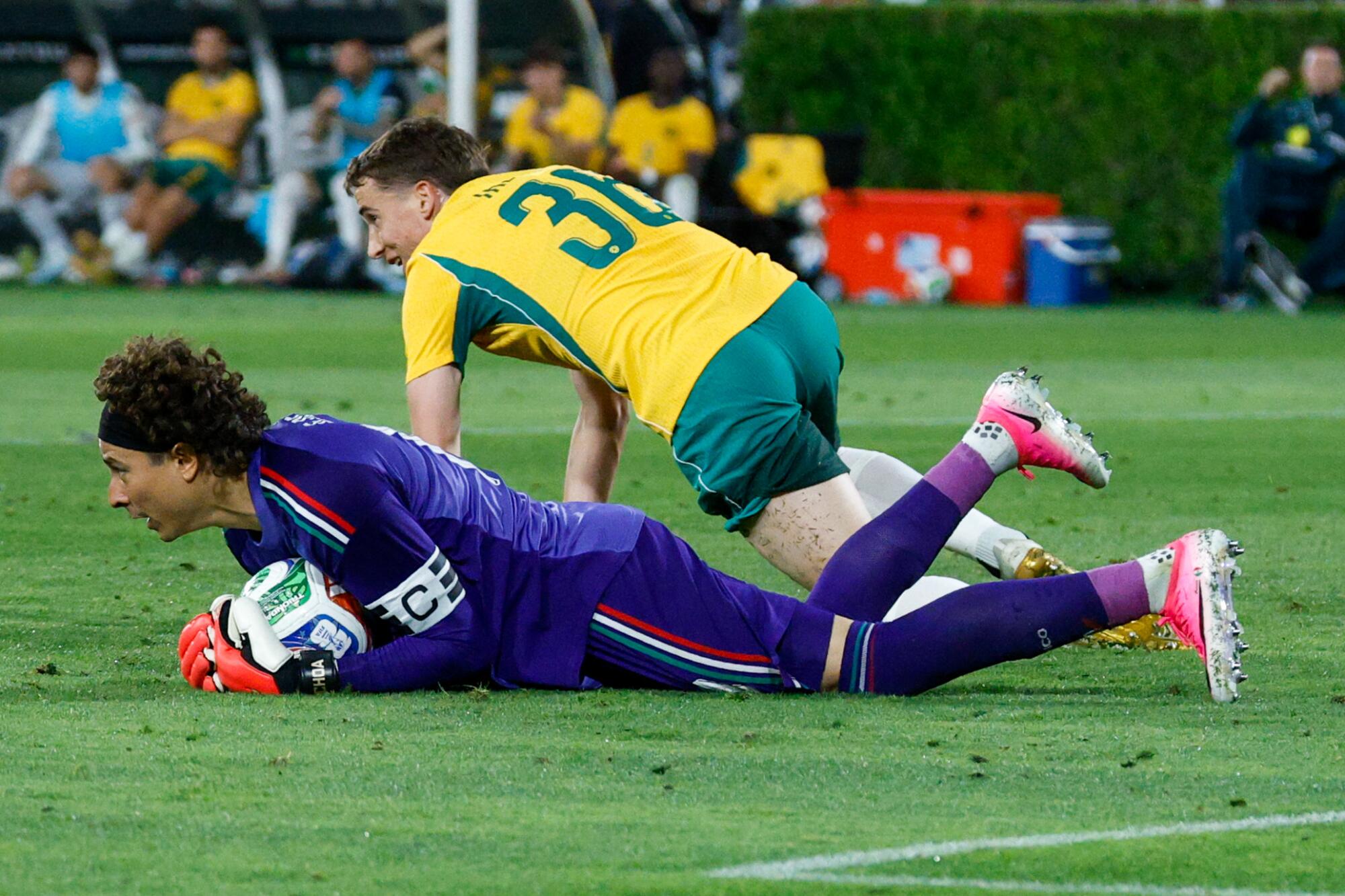
Mexican goalkeeper Guillermo Ochoa lays down and collects the ball during a friendly against Australia.

Mexican goalkeeper Guillermo Ochoa lays down and collects the ball during a friendly against Australia at the Rose Bowl on May 30.

(Ronaldo Bolanos/Los Angeles Times)

“They’re light years ahead of me in terms of what they’ve done in their careers, the goals they’ve scored, the titles they’ve won. I don’t compare myself to them at all. But the best thing would be if, one day, we could see a Mexican on that list.”

After being left out of some recent call-ups with the Mexican national team and facing doubts about his future beyond the 2022 World Cup in Qatar, the veteran goalkeeper found a second soccer life in Europe.

First came the opportunity to play in Italy’s Serie A with US Salernitana 1919 and later he continued his career in Cyprus with AEL Limassol, staying physically sharp and keeping alive the possibility of reaching another World Cup.

“After the World Cup in Qatar, I thought to myself, ‘Let’s see what happens.’ Then the chance to play in Italy’s Serie A came up and I thought, ‘I’m not that far off anymore; I’m very close to the next World Cup,’” said Ochoa, who previously played for Club América.

“That’s when my mind said, ‘I can make it, I feel good, I’m in good shape, let’s go for it.’ But this is going to be my last one. Now there’s no turning back.”

Mexican goalkeeper Guillermo Ochoa directs his teammates during a corner kick against Australia at the Rose Bowl.

Mexican goalkeeper Guillermo Ochoa directs his teammates during a corner kick against Australia at the Rose Bowl on May 30.

(Ronaldo Bolanos/Los Angeles Times)

Ochoa spoke about the announcement without a solemn tone. His history with Mexico spans practically an entire generation of fans. He made his professional debut with Club América in 2004 and appeared in his first World Cup two years later in Germany. Since then, he has gone from a young backup to an absolute icon for El Tri on the World Cup stage.

During the 2014 World Cup in Brazil, he delivered perhaps the most iconic performance of his career, becoming a hero against the host nation and stopping everything Neymar and company threw at him in Fortaleza. Four years later, in Russia, he delivered another memorable night in Mexico’s victory over Germany, stopping the reigning world champions. And in Qatar, he added another iconic moment by stopping Polish star Robert Lewandowski’s penalty kick.

Now, as Ochoa prepares for what could be his final World Cup on home soil, he insists that the goal is to maintain that level of excellence.

“That’s the standard, that’s the bar,” he said of his historic performances. “The intention is to be at that level. If I’m on the field, I have to do it. I have to be ready to perform at that level. And if I’m not called upon to do so, I’ll help and support.”

Because although his name remains one of the most important in the recent history of Mexican soccer, the starting spot no longer belongs to him. Mexican coach Javier Aguirre has publicly insisted that Ochoa will have to compete for minutes like any other player.

“I have to earn it,” Ochoa recently told reporters.

Meanwhile, the veteran goalkeeper also enjoys the chance to look back and laugh at all the stories from his nearly two decades of World Cup training camps.

Because behind the serious figure who stands between the posts lies a player who has experienced practically everything at the World Cups.

“We’ve been through it all,” he recalled with a laugh.

He spoke of animals climbing through the windows at training camps and impromptu matches on Brazilian beaches.

“In South Africa, we had to use golf carts. You have no idea the races we had in those carts that people didn’t see. We ended up with the carts overturned all over the training camp,” he recalled. “In Brazil, we’d have friendly matches on the beach after some games. It’s been so many years that it’s not hard to remember so many things — good, bad, silly — but it’s been a lot of fun.”

The combination of longevity, outgoing personality and historic performances made Ochoa one of the most recognizable Mexican soccer players of the last two decades. For many fans outside Mexico, the surname Ochoa is synonymous with the World Cup.

Mexican goalkeeper Guillermo Ochoa plays a ball during a training session on March 26.

Mexican goalkeeper Guillermo Ochoa plays a ball during a training session on March 26.

(Marco Ugarte / Associated Press)

Even among international fans, there is special recognition of the Mexican goalkeeper due to his ability to rise to the occasion on the biggest stages.

But far from getting caught up in nostalgia, Ochoa is beginning to envision what comes after retirement.

While he admits it will be practically impossible to completely detach himself from soccer, he said there are important things to accomplish off the field.

“Stepping away from soccer is difficult. My name and my image are associated with soccer,” he acknowledged.

“There are many projects ahead. I’m someone who likes to make long-term agreements and plans. When you share values and goals, it’s easier to work together.”

For now, however, he said his full focus is solely on the World Cup.

“We can’t get distracted by other things,” he said. “The least the national team and the upcoming tournament deserve is for us to be 100% focused on that.”

Mexico arrives at the World Cup with enormous expectations and a lot of pressure as one of the tournament’s hosts. And although the spotlight will naturally fall on a new generation of players, Ochoa represents a bridge between different eras of Mexican soccer.

From the young, long-haired goalkeeper who appeared in Germany 2006 to the veteran leader who now seeks to cap his career at home, Ochoa has built a career that would be difficult for any Mexican soccer player to replicate.

An imperfect career, yes, but also one of profound resilience.

It is fitting that his farewell comes with one more World Cup — the stage where he became a legend.

Source link