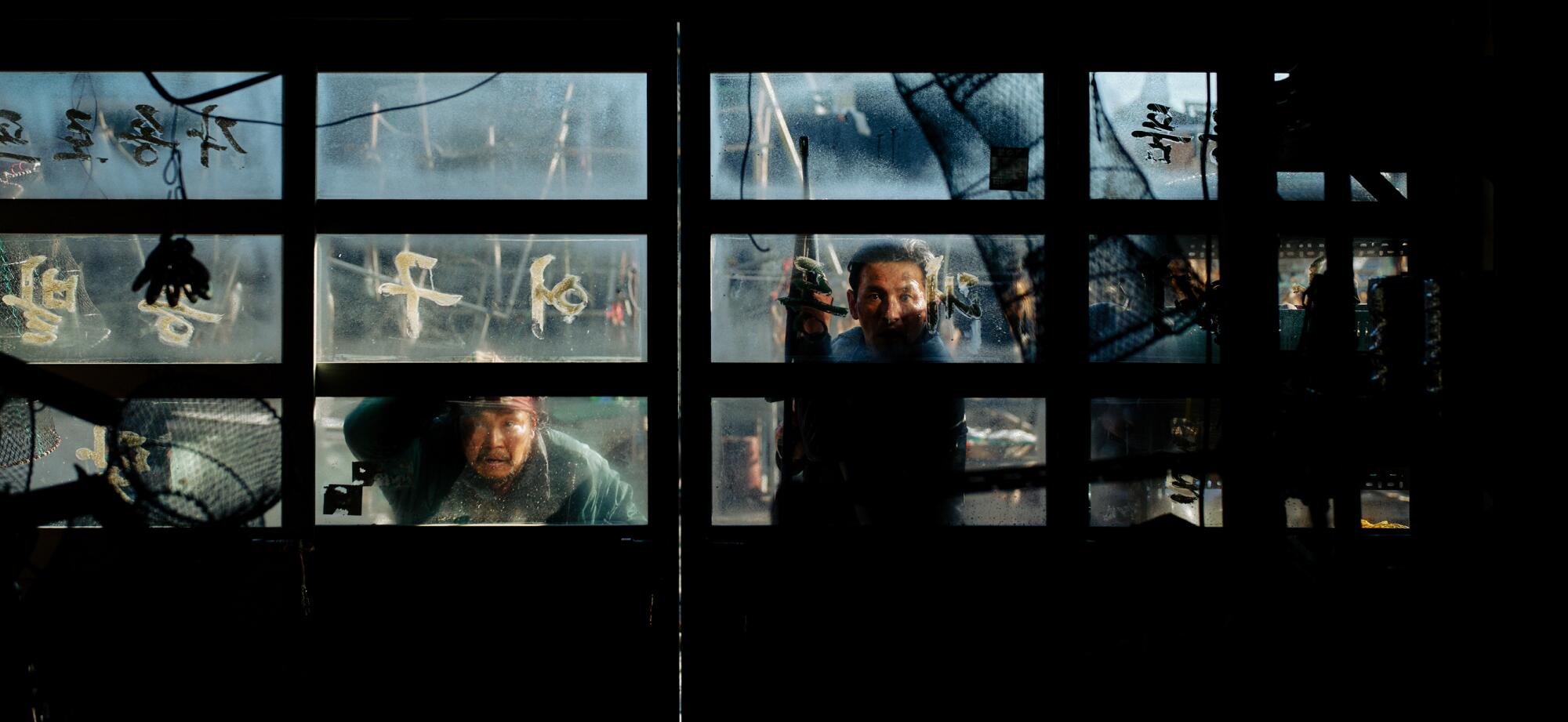
Cannes 2026: Korea’s Na Hong-jin on his new sci-fi thriller ‘Hope’
CANNES, France — The movies of Na Hong-jin aren’t hard to love — they’re as obsession-worthy as the stylish rigor with which they are made. His 2008 debut, “The Chaser,” found new febrility in the post-Fincher serial killer thriller. “The Wailing” somehow added ghosts, demon-possessed children and inky black crows to the mix with a near-crazed sense of showmanship.
That was 10 years ago. Na, 51, now sits on the other side of a project that has consumed him for years, a sci-fi action film called “Hope” that arrives with expensive CGI, a pair of A-list stars (Michael Fassbender and Oscar-winner Alicia Vikander) and James Cameron-sized franchise ambitions. It will undoubtedly make Na’s gallows-humor-inflected brand more global, even if it lifts him out of the cult niche that’s nourished him to date.
Cannes is an unlikely place to launch “Hope.” That could be seen as a sign that the festival’s increasing accommodation of blockbuster bigness doesn’t need Hollywood. Na sits in the corner of a Côte d’Azur waterfront lounge on a glorious midday, the sky an almost abstract blue. He tugs at his goatee distractedly. His world premiere is tonight.
Neon, the distributor currently enjoying a six-year Palme d’Or winning streak, will release “Hope” in America sometime after its summer bow in Na’s native South Korea. The following conversation has been edited for length and clarity. It also contains significant spoilers.

A scene from the movie “Hope,” directed by Na Hong-jin.
(Neon)
When did you realize that you had a big sci-fi alien monster movie in you?
The idea came to me in 2017 in Seoul. The premise started off with somebody watching news in a diner or a small restaurant. It was that image that I had in my head. So I started developing that initial image in more detail. By 2018, I was able to write my first draft.
“Hope” brings to mind several genre classics, from “Jaws” and John Carpenter movies like “The Thing,” to something more homegrown such as Bong Joon Ho’s “The Host.” Were those inspiring to you?
I must have looked all the genre films that I could find, including the ones you mention, before I went into filming. And, as I hope you noticed, I was looking more at films from before 2000 and I tried to reflect that look.
It seems like you’re using Cannes as a moment to pivot or reinvent yourself. Is that intentional?
I didn’t intend for this to be a turning point in terms of style or direction going forward. I never thought of it that way. What I really dwelled on was thinking about how to tell this story in a way that was approachable and entertaining for people.
Why did you set the story in the demilitarized zone?
If you look at it from a universal perspective, what happens in this very shabby, humble, small, insignificant space potentially creates an impact that can go on infinitely. I think none of the characters in the film do anything with any malice. I guess the underlying story I want to tell is that there is no reason for evil intention behind anything, but innocent acts can build up to something tragic.
Michael Fassbender and Alicia Vikander are wonderful surprises in the movie as some rather dignified aliens. What led you to them?
When I was casting the alien roles, I had a bigger story in mind. I don’t know whether there’ll be a sequel after this one, but if so, that sequel is going to be centered around them. So picking the right actors was very important for me. We asked them to learn this invented alien language, which they prepared and came onto set knowing.
How important to you is comedy and releasing tension with laughs?
Very. I try to really think it through and if it comes out the way I intended, that gives me such a thrill. I tried to incorporate it in many places.
A lot of the movie feels like a virtuoso chase sequence, people barreling down the road, guns blazing. But it took me a minute to realize that the more interesting question is: Who’s doing the chasing? Is “Hope” meant to make us examine our own violence?
Yes, very much so. And two of the major chase scenes were designed so that what starts off as righteous somehow tilts toward being unjust. I wanted the action to bring up that transition in perspective.
You’ve premiered at Cannes before but, in a way, it feels like the wrong festival for a movie like this. You’re laughing because I think you agree with me.
It goes without saying. I’m incredibly nervous. And I feel so grateful that you’re treating me so nicely and gently.

A scene from the movie “Hope,” directed by Na Hong-jin.
(Neon)
Why did it take you 10 years to make this film?
There was a pandemic in the middle of that. But except for the pandemic where everything stopped, I was working my ass off before and after. It still took this long. I’m a little concerned myself, like: How did this happen?
With “Hope,” are you saying goodbye to the filmmaker you once were?
Not at all. Throughout the entire process of making this film, I was bloodthirsty. I was thirsting for blood. I have another script written already.
And maybe now it’ll go faster because there won’t be a pandemic. Are you hoping that this movie is going to have an impact on the Korean film industry?
It’s not my place to say that. I’m not sure. I want things to be freer.
Would it be a mistake to read this film as an allegory for what’s happening now in the world? Is it a plea for understanding?
I don’t regard it as a plea for understanding. Rather, let’s hope people will be able to relate to it and be empathetic about the story and realize for themselves, understand for themselves. Maybe there’s something more to it, but you take away what you will from that.
Your dark humor flares on occasion. Did you make it a point to try to preserve that?
Well, you can’t just do something like this without having that. It’s not fun.
This doesn’t feel like an “Avatar”-style film. There’s an openness to it, a sense of exploration. Do you believe in heroes?
I do believe in heroes, but, as I tell in the story, anyone can be a hero.