Longtime film academy chief executive Bruce Davis dies at 83
Bruce Davis spent more than two decades as the motion picture academy’s chief executive. Even when he retired in 2011, it was not because he didn’t still love the work. In fact, he kept at it in retirement, retaining an office at the Pickford Center for Motion Picture Study where he focused on writing a definitive history of the early days of the Oscars.
“I don’t think I’ve been bored for a minute in 30 years here,” Davis told the Associated Press upon leaving the academy. “I feel like such a rube sometimes. To this day, when I get out of the car on Oscar night and step up there onto that carpet, you get that rush of energy. The lights are popping — not that anybody’s aiming at me — but still I think it’s one of the great rushes, emotionally speaking, that a person can have.”
Following a battle with leukemia, Davis died Saturday. He was 83.
Davis’ career at the academy was, according to wife Joann, partly a matter of being in the right place at the right time.
“Not that he wasn’t really good at what he did,” she says by phone. “But he was also a lucky man.”
Davis was working as chair of the theater department at Juniata College in Pennsylvania when he and Joann loaded all of their belongings atop their Mazda GLC and headed to Los Angles in pursuit of Hollywood dreams. Davis had been working on a few screenplays while teaching, and his agent told him needed to move closer to the action to network and take meetings.
“Neither of us had jobs when we left Pennsylvania,” Joann says. “We just bit the bullet and drove out. It was a leap of faith.”
Shortly after arriving, Davis met someone at a party whose wife worked at the motion picture academy. That soon led to Davis taking a job arranging lectures and seminars and, later, overseeing the organization’s public programming.
Davis became the academy’s seventh executive director in 1989, leading it through a sizable expansion of staff, relocating the academy’s Margaret Herrick Library to the Beverly Hills Waterworks building in 1991 and setting up its film archive at the Pickford Center for Motion Picture Study in 2002.
“Bruce would drive back and forth to work and see that Waterworks building at the time that they were looking for places for the library to expand,” Joann says. “And one day, it just occurred to him that maybe that would be a building, and so initiated conversation with Beverly Hills. It was kismet.”
Davis had hoped to build an academy museum next to the Pickford, convincing the group’s board of governors to purchase a nearby 3.5-acre site in 2006 for a reported $50 million, but the 2008 recession derailed those plans. His successor, Dawn Hudson, led the push to partner with the Los Angeles County Museum of Art, eventually building the museum at the former May Co. building at Wilshire and Fairfax. It opened in 2021.
Davis was also instrumental in doubling the Oscars’ best picture category from five nominees to 10 in 2009, establishing the preferential ballot system that determines the academy’s top prize.
“That way, best picture reflects the choice of the greatest number of people,” Davis told The Times.
Davis’ Oscar book, “The Academy and the Award,” was first published in 2022, long after he originally anticipated it would hit stores.
“He thought a couple months of research, a couple more months to write it, and voila, in two years, he’d have it done,” Joann says. “But he kept finding new things he wanted to explore.”
Shortly before it published, Davis told The Times that he hoped the book would dispel myths surrounding the Oscars, including Susan Orlean’s assertion in her Rin Tin Tin biography that the dog received more votes than any male actor at the first Academy Awards and that Bette Davis gave the golden statue its nickname because its backside mirrored that of her then-husband Harmon Oscar Nelson.
“There’s a lot of nonsense out there,” Davis said, “and the real story is almost always more interesting.”
“He was deeply committed to preserving the academy’s history, establishing dedicated homes for our library and film archive, and relaunching the concept of creating a museum,” current academy CEO Bill Kramer and President Lynette Howell Taylor said in a statement. “He had a profound love for the academy.”
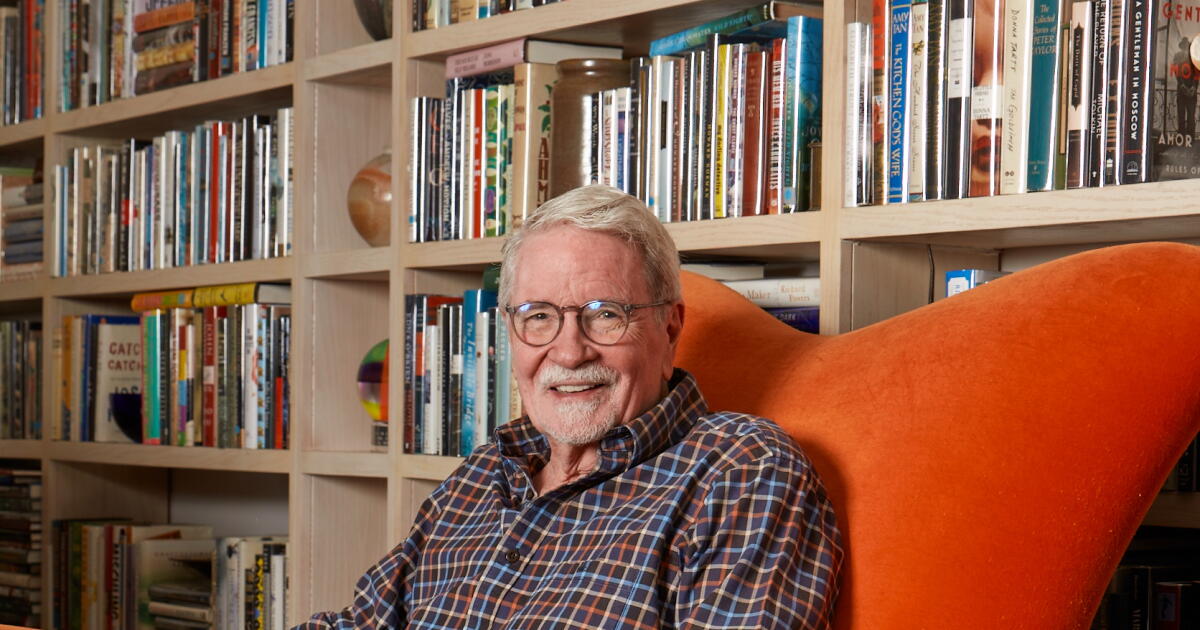
Davis loved to read and collect books, devouring anything from John Updike and Margaret Atwood, among other authors, a passion that necessitated having bookshelves in every room of his home. Language itself was an obsession, with many family dinners ending with Davis pulling out his unabridged Oxford English Dictionary to share the derivation of a word.
“He was a really fascinating guy,” Joann says.
Perhaps the only thing Davis didn’t like about the Oscars was the ceremony’s annual in memoriam segment, which pays tribute to those who died in the previous year.
“It is the single most troubling element of the Oscar show every year,” Davis told the Associated Press, “because more people die each year than can possibly be included in that segment.”
Next year’s ceremony now has one certain addition.
In addition to Joann, Davis is survived by four daughters: Brangien Davis, Alexandra Davis, Archer Davis and Roxanne Davis.