Former Dodgers pitcher Trevor Bauer will pitch for a U.S. team for the first time since 2021 when he serves as the opening day starter for the Long Island Ducks of the independent Atlantic League later this month.
Since his last MLB start, on June 28, 2021, Bauer has been accused of sexual assault by four women. He denies all the allegations and has never been charged with a crime.
After Bauer served a 194-game suspension for violating the league’s sexual assault and domestic violence policy, the Dodgers severed ties with the 2020 National League Cy Young Award winner on Jan. 6, 2023, less than two years after signing him to a three-year, $102-million contract.
“We are excited to welcome Trevor to Long Island,” Michael Pfaff, Ducks president and chief business officer, said in a Thursday news release announcing Bauer’s signing. “His talent and knowledge will be important additions to our ballclub, and we are happy to offer him this opportunity to showcase his talents to MLB clubs while giving fans unprecedented access to Ducks baseball.”
According to the release, “Bauer will be ‘Mic’d Up’ for all games and practices for the purposes of content creation to be featured on his and the team’s social media and streaming outlets.”
The Ducks did not immediately respond to further questions from The Times regarding Bauer’s signing.
Bauer is expected to start when the team opens the season at home April 21 against the Hagerstown Flying Boxcars.
“I’m looking forward to competing in front of U.S. fans again this season,” Bauer said in a statement released by his new team. “The Ducks have had some incredible players come through their organization, and I’m excited to be part of that tradition.”
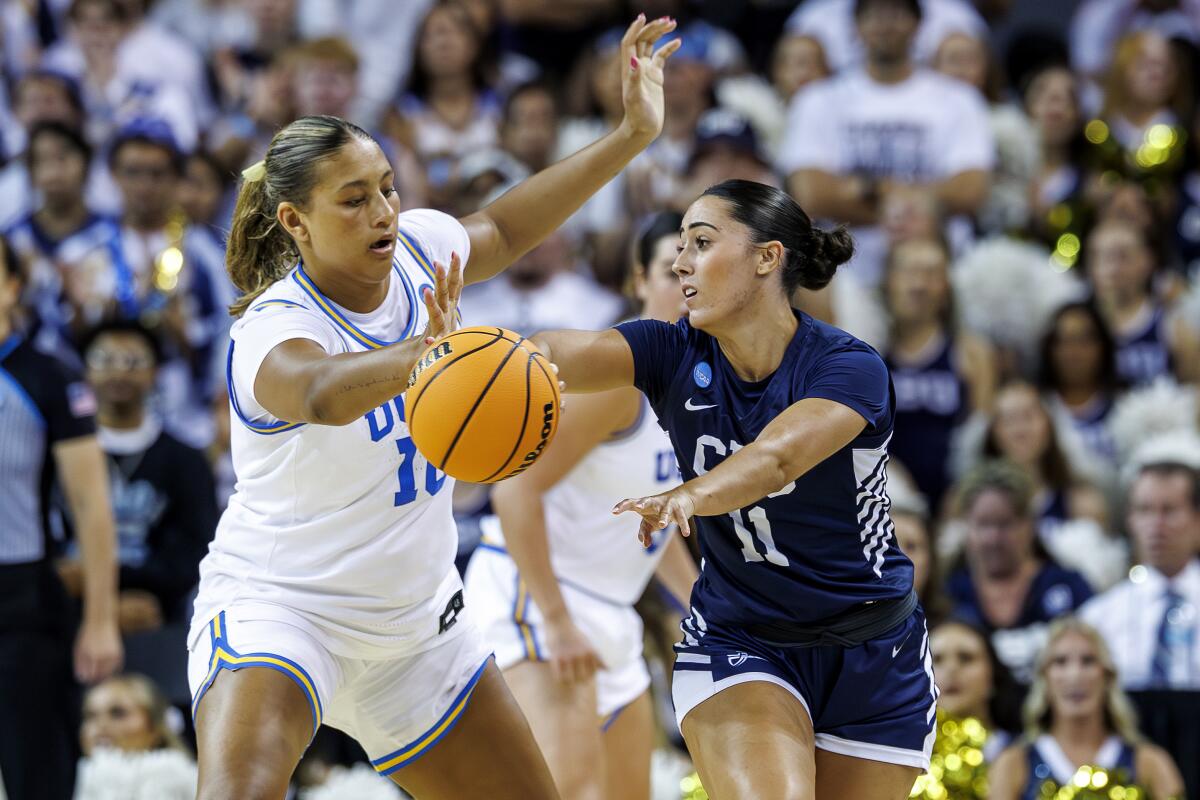
With just over five minutes left in UCLA’s first-round win over California Baptist on Saturday, freshman Sienna Betts took a shot. She missed. She grabbed the rebound. She missed again. Then, she put it in the basket.
On the bench, her older sister, Lauren Betts, was laughing. No. 1 seed UCLA was up big late, the Bruins were going to advance and Lauren was getting joy from seeing her sister succeed — and fail.
“I’m like, Sienna, just make the shot, and she’s laughing; she’s not serious,” Lauren said.
The sisters recorded double-doubles during the 96-43 win that secured the Bruins a second-round date with Oklahoma State. Sienna had 10 points and 12 rebounds, six of them offensive, and Lauren had 22 points and 10 rebounds.
UCLA freshman forward Sienna Betts plays tight defense on California Baptist guard Sofia Alonso during the Bruins’ first round NCAA tournament win Sunday at Pauley Pavilion.
(Gina Ferazzi/Los Angeles Times)
“She is so hard on herself and she’s so driven, I think her humor is actually a saving grace for her,” UCLA coach Cori Close said of Sienna. “It’s sort of a light moment. It’s laughter. Because when she’s not smiling and bringing joy, she’s usually beating herself up for a mistake. As she continues to grow in that, I hope it doesn’t have to be her escape, but I just have absolutely enjoyed Sienna so much.”
The sisters have only this season to play together before Lauren, a senior, graduates. They played just one season together in high school in Colorado, and this season might be the last time they are ever on the same team.
“It’s this weird thing, on the one hand, I want them to enjoy this connection they have,” Close said. “I want them to enjoy this year. They will look back on this year and just really treasure it.
“Simultaneously, I want to especially treat Sienna on her own journey, and to not make her feel like she’s in the shadows of anything that Lauren is doing.”
Sisters have posted double-doubles in the NCAA tournament before. At Stanford, Nneka and Chiney Ogwumike did it multiple times in the early 2010s. In the 1980s, USC twins Pamela and Paula McGee averaged double-double their senior years.
But it’s a rarity, and one that could only happen this season for the UCLA sisters.
Sienna, though, didn’t want to make a big deal of it. Sitting to the side in the locker room after the win over California Baptist, she was critical of her own game, just the way Close expected.
“I’m trying to focus more on just that game and just taking what we can learn from our mistakes in the first half, especially, and trying to move on,” Sienna said. “But, I mean, I think in an hour, I’ll take that in and be more excited about that.”
Lauren said she thought Sienna played one of her better games of the season.
“Honestly, besides her scoring, I thought her defense was a lot better today and I know that’s something she wanted to get better at,” Lauren said Saturday. “She was just really proud of her slides. Like she didn’t say anything about her points. She was like, I’m so glad that I can guard them. I worked so hard on that.”
Sienna has had back-to-back strong efforts, with 14 points against Iowa in the Big Ten tournament championship game two weeks ago. She has done so without being hounded by her big sister.
“I think [Lauren] respects my boundary to figure it out on my own,” she said.
Lauren, meanwhile, has averaged 16.5 points and 8.7 rebounds per contest this season. The projected WNBA lottery pick is considered one of the best centers in the nation.
UCLA center Lauren Betts drives to the basket under pressure from California Baptist forward Grace Schmidt during the NCAA tournament on Saturday at Pauley Pavilion.
(Gina Ferazzi/Los Angeles Times)
“I love the moments you catch when they have a connection and an eye contact or a smile that is different than everybody else because they are sharing it as sisters and I just think how special that is,” Close said. “That’s so wonderful.”
Charlisse Leger-Walker played with her sister, Krystal Leger-Walker, at Washington State for two seasons. There, the duo shared time in the backcourt for an up-and-coming Cougars squad.
“It’s just a different connection,” Charlisse Leger-Walker said. “Out there, you have someone who is your blood and unconditional love and support. And it’s just awesome to be able to see [Lauren and Sienna] in their journey, and have so much success early.”
Sienna will carry the torch for the Bruins beyond this season when the majority of the veteran roster graduates and many go pro.
That’s when she could be the face of the program on her own. But first, she is working to extend an NCAA tournament run alongside her sister.
“I want Sienna to feel like she’s Sienna,” Close said. “She’s not Lauren’s sister. She can enjoy that, but for our team, she’s Sienna Betts.”
HomeExecutive InterviewsIran Conflict Sparks Risk, And Opportunity, For Egypt: CIB CEO Hisham Ezz Al-Arab
As the regional conflict involving Iran intensifies and shipping through the Strait of Hormuz has nearly come to a halt, business leaders across the Middle East are considering both the risks and potential opportunities. Hisham Ezz Al-Arab suggests that some oil shipments might shift to the Suez Canal.
As CEO and board member of Commercial International Bank (CIB), Egypt’s largest private-sector bank, Hisham Ezz Al-Arab sees first-hand how the war is shaking regional financial markets, disrupting emerging economies, and putting pressure on currencies as investors rush toward safe-haven assets.
Global Finance:How is the current war on Iran affecting the economies and the financial sector of the region?
HishamEzz Al-Arab: The region faces a lot of uncertainty as markets react more strongly than they did during last June’s 12-day war. Oil prices crossed the $100/bbl mark for the first time since 2022 as a result of the closure of the Strait of Hormuz, which controls around 25% of global oil and 20% of gas shipments, in addition to refineries that shut down due to security risks. This poses a key risk on GCC countries, particularly Qatar and Kuwait with both high oil production and reliance on the Strait of Hormuz, as well as increased freight and insurance costs.
GF:What is the impact on Egypt?
Ezz Al-Arab: In the short term, the situation impacts Egypt in terms of the uncertainty. Emerging markets — including Egypt — have seen major portfolio outflows, particularly placing pressure on the Egyptian pound and reversing its progress against the US dollar over the past year to reach an all-time low. This has subsequently triggered a hike in safe-haven assets, including USD and gold, as risk-averse investors have reallocated their investments from emerging markets. In the long term, risks include inflation re-accelerating and Central banks keeping rates on hold.
GF: What is your take on the currency adjustment?
Ezz Al-Arab: I think the central bank (CBE) is doing an excellent job with its flexible approach to managing the exchange market, particularly regarding cash repatriation. With a significant volume of carry trades being unwound — estimated at roughly $7 billion–$8 billion out of a total $35 billion–$40 billion — the CBE has allowed the pound to move from approximately 47 to 53 EGP per dollar. In the past, this was not possible. We had fixed rates, which drove capital away, rather than retaining it. The shift to a flexible exchange rate framework has proven to be a critical tool in absorbing external shocks, and I think the CBE will not hesitate to let the pound gradually drift as long as more money is coming out.
GF:Can you see some opportunities for Egypt?
Ezz Al-Arab: I believe the conflict provides an opportunity for Egypt as it hosts alternatives to the Hormuz Strait: The Sumed pipeline (2.5mb/d capacity), as well as being a possible bridge to Saudi Arabia’s Red Sea pipelines (5mb/d capacity). This places Egypt as a strategic partner in the current crisis as well as provides the country with preferential access to a congested oil market.
Additionally, the situation will positively impact the Suez Canal. The ships that used to go through the Strait of Hormuz to reach Gulf nations will likely now unload in Jeddah and Yambu on Saudi Arabia’s Western coast. So whatever is coming from Europe will now go through the Suez Canal with a lower risk, as well as all the traffic coming to Saudi or out of Saudi, even in terms of oil or products. Another potential upside is that recent regional tensions may prompt some travelers to consider alternative destinations, and Egypt remains well-positioned given the strength and diversity of our tourism sector.
GF:How is the situation affecting the 3 million Egyptians employed in the Gulf, especially in Saudi Arabia and the UAE?
Ezz Al-Arab: I think whoever doesn’t have a second residence in Egypt will start to think about buying one, and that should have a positive impact on demand for real estate. But on the other hand, we wouldn’t like to see the economy in the GCC being impacted because potential job losses or an exodus of workers could ultimately lead to a decline in remittances.