opponent

El-Sayed’s primary opponent endorses his Trump-backed rival

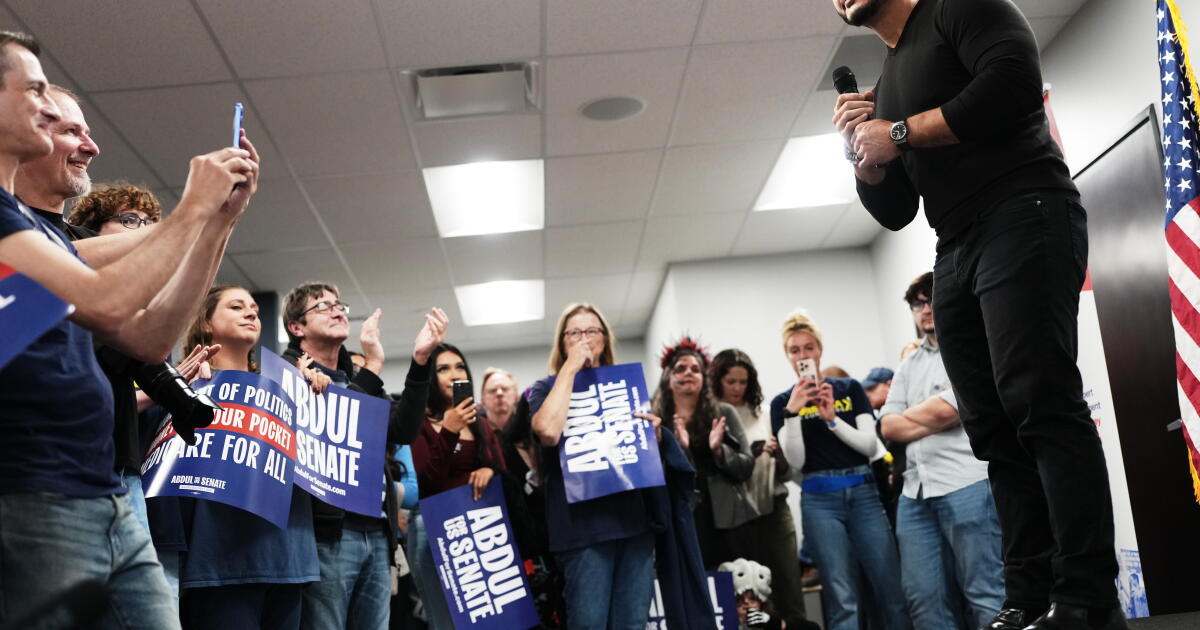
Michigan Democrat Abdul El-Sayed’s former opponent in the U.S. Senate primary, Rep. Haley Stevens, stunned party officials Sunday by endorsing his Republican rival, Mike Rogers, after Democratic tensions boiled over days before the election that could determine the balance of power on Capitol Hill.

Stevens endorsed Rogers after attending a Detroit church service with him. The remarkable show of support for the President Trump-backed candidate in the tightly contested race comes after she was uninvited to a joint event the same day with El-Sayed, who defeated the congresswoman by a slim margin in the August primary.

“Our Democratic nominee for Senate said I was no longer welcome in his campaign and that I should stay away,” Stevens said in a video announcing the endorsement. “And he’s right. And that’s why I am endorsing Mike Rogers for the United States Senate today.”

El-Sayed dismissed the endorsement when asked about it by reporters later Sunday, saying he’s focused on issues voters care about, such as the high cost of living.

“At the end of the day I actually don’t think about Haley Stevens,” he said, adding later: “None of this matters.”

Michigan Democratic leaders were left shocked. With just less than 48 hours to go before election day, a party that had spent months trying to unite behind its Senate nominee was suddenly grappling with an extraordinary defection in one of this year’s most important races.

Tensions between the two Democrats have festered since the primary. Stevens is a staunch supporter of Israel, while El-Sayed is a fierce critic of the U.S. ally. He has also been criticized by some in the community for past remarks regarding a Michigan synagogue attack and for appearances with controversial streamer Hasan Piker.

El-Sayed, a former Michigan public health official, is facing Rogers, an ex-congressman, for the seat held by the retiring Democrat, Gary Peters. Keeping Michigan in Democratic hands is vital to the party’s effort to win a majority for the final two years of Trump’s second term.

Stevens and El-Sayed were originally scheduled to attend church together, along with other Michigan and national Democrats, including South Carolina Rep. James E. Clyburn. Democrats hoped it would be a show of unity as they worked to boost turnout in the Detroit area, where concerns have lingered about enthusiasm among Black and Jewish voters in key Democratic strongholds.

Instead, Stevens swayed to gospel music alongside Rogers in the pews at Perfecting Church, while El-Sayed was a few miles away at a different house of worship campaigning alongside prominent Democrats, including Clyburn.

Stevens’ top aide resigns

After the church service north of Detroit, where Stevens and fiance Jason Turkish worshiped with Rogers and his wife, Kristi, the congresswoman told reporters, “I’m not turning my back on Democrats. It is this one vote.”

Rogers, standing beside her, said he was “honored” by her support.

Their appearance came days after Stevens publicly reaffirmed she would vote for El-Sayed. It also led her longtime chief of staff to resign, with a number of staff members expected to follow soon, according to a person familiar with the developments who spoke on condition of anonymity to discuss internal matters.

“We are shocked and heartbroken,” the aide said in a statement.

The state party chair, Curtis Hertel, said Stevens’ endorsement “shows that she has abandoned everything she claims to care about.”

“We reject the attempts by Stevens and bad-faith actors to divide our party and undermine our momentum,” Hertel wrote, adding that they won’t let such eleventh-hour “distractions” deter the campaign. Hertel later wrote that Stevens “is not a current member of the Michigan Democratic Party, nor will she be in the future.”

Senate Democratic leader Chuck Schumer, who supported Stevens in the primary, denounced her endorsement of Rogers.

“This is a despicable betrayal from Rep. Stevens,” Schumer, of New York, wrote in a social media post.

Dingell disinvited Stevens after it became ‘distracting’

Among the Democrats who joined El-Sayed at church Sunday morning were Rep. Debbie Dingell of Michigan, Sen. Angela Alsobrooks of Maryland and state Sen. Mallory McMorrow, who dropped out of the Senate primary before voting began.

Dingell, a senior Democratic figure in the state who helped organize the planned joint appearance, said she asked Stevens not to attend and that Stevens told her she would abide by that.

“I’m the one who pulled it because it had become way too distracting,” Dingell said a telephone interview Sunday before Stevens’ appearance with Rogers. “This is not how I was going to spend my weekend before the election, to be perfectly frank.”

In the August primary, Stevens defeated El-Sayed in Wayne County, which includes Detroit, and neighboring Oakland County, drawing support from Black and Jewish voters who are important parts of the Democratic coalition.

Early voting for Tuesday’s election has been underway since Oct. 24. As of Friday, more than 1.8 million people had already voted in Michigan.

How did we get here?

The Democratic primary was among the most bitter this year. Each candidate accused the other of making personal attacks. Tens of millions of dollars in outside spending poured into the race, including from the super PAC affiliated with the American Israel Public Affairs Committee, known as AIPAC, which backed Stevens. El-Sayed took particular offense to an outside group’s ad accusing him of disrespecting women.

Although Stevens pledged after the primary to help El-Sayed however she could, the two have not appeared together publicly since a unity breakfast two days after his primary win.

Last week Stevens’ fiance told the Detroit News that he would vote for Rogers. Stevens later appeared on CNN to reaffirm her support for El-Sayed but urged his campaign to “shut out the hate and call it out.”

But on Friday, after the Associated Press reported on the planned joint appearance, Stevens released a lengthy statement calling on El-Sayed to condemn an ad by an independent left-wing group that linked U.S. support for Israel to high grocery prices.

“Abdul promises to get money out of politics,” Stevens wrote. “He can begin by getting Israel out of his explanation for everything Michigan cannot afford.”

El-Sayed then responded: “So while Congresswoman Stevens seems intent on relitigating a primary that ended three months ago, let’s all focus on the task at hand.”

He made clear the ad was not made by his campaign and said “I do not agree with the contents of that ad.”

The Michigan-born Democratic nominee, meanwhile, has been the frequent target of Islamophobic attacks, including from Trump. At a rally last weekend, Trump called El-Sayed a “jihadist,” adding: “He would be the only senator that will have to go through a metal detector before he’s allowed to go into the Senate.”

Trump and Republicans revel in the discord

Trump praised Stevens in a social media post, saying she was “a Highly Respected Democrat” and that her support from Black and Jewish voters in Michigan is “virtually unprecedented.”

“Haley said what few people are willing to say. She showed great and almost unprecedented loyalty to the Great People of Michigan with what she did,” Trump wrote. “It’s a thing called bravery, and few people have it like just displayed by Congresswoman Haley Stevens!”

Appearing with Trump in Iowa for a campaign rally, House Speaker Mike Johnson (R-La.) said that he spoke to Stevens after she endorsed Rogers. Johnson said he “encouraged her to stay safe and keep speaking the truth.”

Stevens is not seeking reelection to her House seat Tuesday.

A spokesman for the Republican National Committee, Hunter Lovell, said Democrats who feel abandoned by El-Sayed “have a home” with Rogers.

Cappelletti, Williams and Householder write for the Associated Press. Cappelletti reported from Washington.


Source link

L.A. city charter amendments, ballot measures: Last-minute guide

Voters in the city of Los Angeles will consider eight ballot measures covering everything from taxes and fire resources to governance of airports and the port and the quality of parks.

L.A. City Measure FD

The basics

Measure FD would increase sales taxes by 0.5% to provide additional funding for the city Fire Department. The measure would raise an estimated $345 million annually. Under the plan, the city’s retail sales tax would increase from 10.25 cents per dollar spent to 10.75 cents per dollar spent.

Impact

The ballot initiative was spearheaded by the United Firefighters of Los Angeles City Local 112, the union representing rank-and-file firefighters, which has long argued that the department is underfunded. It claims decades of neglect have left the department understaffed and under-resourced.

Critics point out that this would be the third sales tax hike since 2024, following L.A. County hikes for homelessness (Measure A in 2024) and healthcare (Measure ER in the June 2 primary). The Howard Jarvis Taxpayers Assn. estimates that Measure FD will cost an average of $86 per person and $345 for a family of four in additional sales taxes each year.

Read more:

Proposition TE

The basics

Proposition TE would carve out a five-year exemption from L.A.’s “mansion tax” for Pacific Palisades homes damaged or destroyed in the 2025 wildfire, sparing sellers six-figure transfer bills on high-end properties. The mansion tax levies a 4% transfer tax on all L.A. property sales above $5.4 million and a 5.5% tax on sales above $10.9 million. At the current level, if a Pacific Palisades resident who lost their home in the fire sold the vacant lot for, say, $6 million, they would owe $240,000 in transfer taxes.

The impact

Supporters say fire survivors shouldn’t owe hefty taxes when selling burned-out lots, arguing the break offers basic fairness for families facing insurance shortfalls and steep rebuilding costs. Opponents warn the exemption covers wealthy landlords and investors as well as homeowners, creating a “loophole for the ultrawealthy” and stripping millions annually from the mansion tax’s homeless and affordable housing programs.

Charter Amendment LA

The basics:

Charter Amendment LA would change the way public works are administered in Los Angeles, allow the city to lease its underused land to tenants and open the door to greater city involvement in business enterprises. It also would ease some competitive bidding rules.

The impact

The proposed changes to the Los Angeles City Charter are intended to more efficiently deliver basic city services and speed repairs to deteriorating infrastructure such as streets in need of repaving, unsafe sidewalks and broken streetlights.

Charter Amendment PL

The basics

Charter Amendment PL would tweak L.A.’s Planning Department, promising faster decisions, clearer rules and more consistent oversight of development citywide. Seven volunteer Area Planning Commissions would be replaced by a single Neighborhood Appeals Board, cutting costs and standardizing rulings on liquor licenses, hillside homes and small-business projects.

The measure would let the City Council raise building height limits, set strict timelines on planning votes and automatically approve some amendments, opening the door to taller towers and speedier permitting.

The impact

Homeowners, developers and businesses have complained that navigating the Planning Department can be complicated and confusing. These changes aim to streamline how permits and projects move through the department.

Charter Amendment EE

The basics

Charter Amendment EE would cut the number of required L.A. City Council meetings from three to one weekly while reshaping ethics rules, watchdog powers and referendum signature thresholds.

The impact

Supporters call three weekly meetings inefficient and costly, arguing fewer full sessions would free council members to work in their districts and steer more detailed public debate into committee hearings. Opponents warn EE would shrink public access, rush deliberations and effectively neuter referendums, casting the ethics and oversight tweaks as modest cover for a deeper retreat from transparency.

Charter Amendment PRK

The basics

Charter Amendment PRK would double the minimum budget allocation set aside for the Department of Recreation and Parks, which oversees the upkeep of green spaces, playing fields and senior centers. It is not a new tax or bond.

The impact

Supporters say that the change will allow the city to give Angelenos the park and recreation services they deserve. Critics contend it will tie the hands of the city’s elected officials, forcing them to cut other services to make room for additional park funding.

Charter Amendment PRT

The basics

Charter Amendment PRT would change the composition of the Los Angeles World Airport’s board of commissioners, which oversees Van Nuys and Los Angeles International airports. It would require that two of the seven board members live in Van Nuys and three live around LAX — a footprint that the amendment does not define. As for the Port of Los Angeles, the amendment would require the Los Angeles Board of Harbor Commissioners to annually allocate a portion of the harbor’s operating income to investments in waterfront public access projects. It also would broaden public insight into how lease agreements with the port affect the local workforce by adding employment reporting requirements for any leaseholder extending a lease or any lease applicant.

The impact

The measure was developed through a reform effort started after a series of scandals. Backers say it will boost public accountability. There was initial pushback among some terminal leaseholders at the Port of Los Angeles.

Charter Amendment SC

The basics

Charter Amendment SC aims to clarify campaign finance rules for candidates running for a seat on the L.A. Unified Board of Education, which overseas the school district and around 350,000 students.

The impact

Repetitive language in the Los Angeles City Charter would be deleted and the charter would make clear that the same campaign finance rules apply to both mayoral candidates and Board of Education candidates, except in certain instances, the measure says. Among those requirements are rules governing campaign contribution limits, filing deadlines, public disclosures and fundraising windows.

Source link

California Prop. 3 last-minute guide: The other tax-the-rich measure

There has been much debate about efforts in California to tax the rich. But almost all of it centers around Proposition 40, the heavily contested billionaire tax, and two countermeasures, Propositions 41 and 42.

But there is another ballot measure that also would tax California’s wealthiest citizens that is getting far less attention — and has even garnered support from some billionaires who oppose Proposition 40.

The basics

Proposition 3 would make an expiring state income tax on high earners permanent.

The impact

Tax rates for the top 2% of earners would remain as they are. Income brackets rise with inflation, but last year the top 2% of taxpayers earned at least $371,000 for single filers and $743,000 for joint filers. Money generated by Proposition 3, like the current tax, would flow to education, with 89% going to K-12 schools and 11% to community colleges.

Dig deeper

In 2012, California voters approved a temporary increase in the income tax rate for the top 2% of California earners. In 2016, voters approved another extension through 2030. Proposition 3 would make the additional levy permanent.

Backers say the measure is crucial to maintain education funding levels and predict there would be grave problems if the measure is not approved. The state could expect to lose $5 billion to $15 billion annually in tax revenue starting in 2031, according to estimates from the Legislative Analyst’s Office.

Opponents say taxes are already too high and the state should focus on cutting waste.

More reading

What to know about Prop. 3 (L.A. Times)

How Prop. 3 fared in Berkeley poll (L.A. Times)

Prop. 3 ballot language (California secretary of state)

Inside the Prop. 3 campaign (EdSource)

Source link

World Series Game 2: Brewers rally from 4 runs down to beat Rays

Sal Frelick tied the score with his first home run in three months, Cooper Pratt hit a go-ahead single in the seventh inning and the Milwaukee Brewers stunned the Tampa Bay Rays 5-4 on Saturday night for a 2-0 World Series lead by overcoming a four-run deficit for the second time in the postseason.

Tampa Bay, which won the AL pennant by forcing opponents into mistakes, committed one error, made two other misplays that could have been charged as errors and had a runner thrown out at the plate.

Down 4-0 in the first inning, Milwaukee rallied for its seventh comeback win of this postseason. The Brewers also rebounded from a 4-0 deficit to beat the Dodgers 6-4 in Game 4 of the NL Championship Series, completing a four-game sweep.

After losing Friday’s opener 3-2, the Rays burst ahead against rookie Logan Henderson, but the Brewers started to claw back with two runs in the bottom half against Tampa Bay ace Drew Rasmussen.

David Hamilton cut the deficit to 4-3 with a run-scoring grounder in the fourth and Frelick capped a nine-pitch at-bat against Ian Seymour in the sixth by driving a fastball over the center-field fence.

Frelick had gone 103 plate appearances without a home run since his July 11 drive off Pittsburgh’s Braxton Ashcraft and had not gone deep against a lefty pitcher since opening day against Tyler Gilbert of the Chicago White Sox. Frelick sped around the bases in 18.72 seconds, half the time of some theatrical trots this postseason.

Screaming fans at the second game of Milwaukee’s first World Series since 1982 were fired up during the seventh-inning stretch, dancing to the “Beer Barrel Polka” played by Mike Schneider, an accordionist from Clinton, Wis.

Brice Turang doubled against losing pitcher Tyler Wells on the second pitch of the bottom half, advanced on Garrett Mitchell’s flyout to right and scored when Pratt, a 22-year-old who debuted in June, looped a sinker from Kevin Kelly into short right field.

Abner Uribe pitched 1⅓ hitless innings for the win.

Jonny DeLuca doubled off Aaron Ashby starting the ninth, then Victor Mesa Jr. struck out when he couldn’t check his swing. Pinch-hitter Ben Williamson’s groundout advanced the runner and Yandy Díaz struck out when he couldn’t check his swing on a full-count pitch.

Ashby has three saves in the postseason while not allowing a run.

Milwaukee won its seventh straight game, becoming the fifth team to twice overcome four-run deficits for victories in a single postseason and the first since Philadelphia in 2022.

Game 3 of the matchup between teams seeking their first title is Monday night at Tropicana Field in St. Petersburg, Fla. where the Brewers last played in 2023.

Of the 57 previous teams to take 2-0 World Series leads, 46 claimed the championship.

Tampa Bay took a 4-2 lead in the highest-scoring Series first inning since 1993’s Game 4 as teams combined for seven hits, tying the most in an opening inning.

Still, Milwaukee improved to 13-0 in games started by Henderson, dating to his 2025 debut. He followed Jacob Misiorowski in the Brewers’ rotation, the first time teammates 24 or younger started the first two games of the Series since Cincinnati’s Gary Nolan and Ross Grimsley in 1972.

Henderson started on 11 days’ rest and struggled as the Rays fouled off 13 of 35 pitches in the first. He gave up four runs — three earned — in three innings.

Given an extra day of rest, Rasmussen gave up three runs and six hits over 3⅔ innings in his shortest start since July 9.

Pratt made his fourth error of the postseason at shortstop, the Brewers’ ninth in 10 games, bouncing his throw past first baseman Jake Bauers on a leadoff grounder by Díaz. Chandler Simpson and Junior Caminero followed with RBI singles, and Liam Hicks hit a two-run homer.

Jackson Chourio and Bauers started the bottom half with singles and first baseman Jonathan Aranda allowed Contreras’ one-out foul pop to bounce out of his mitt near netting in front of the seats.

With Bauers running on a full-count pitch, Contreras bounced an RBI single to the left of second baseman Richie Palacios, who had taken a step toward the base. Mitchell’s two-out single cut the deficit to 4-2.

Hamilton hit an RBI grounder in the fourth that bounced under Aranda’s legs for an error.

Chourio threw out Hicks from left for the final out of the sixth when third base coach Brady Williams waved the slow-footed catcher to try to score from second on Mesa’s single.

Blum writes for the Associated Press.

Source link

California’s Prop 45 aims to speed construction projects. Opponents say data centers will benefit

When a county judge put the brakes on what would be the largest data center in California, ruling the whole project needed extensive environmental review, Kristian Salgado was relieved.

The community organizer lives in Imperial County, where the nearly one-million-square-foot facility was proposed. The rural county near the Mexico border struggles with bad air pollution and has one the state’s highest rates of asthma hospitalization for kids, according to the National Institute of Environmental Health Sciences. One of Salgado’s nephews lives right next to the site and struggles with the respiratory disease.

“It just seemed very unusual that a project of this scale, with that many backup generators could be permitted without requiring any further [analysis] of what that would mean for residents,” she said.

Now, Salgado and others who share her concern believe Proposition 45 on the November ballot could roll back their wins. The initiative changes the California Environmental Quality Act, or CEQA, a law intended to inform decision makers and the public about a project’s possible environmental impacts — and mitigate them to the extent possible.

Supporters say Prop 45 will speed up environmental review for essential housing, transportation, water, health, education and other projects, cutting costly delays and passing the savings on to consumers. Opponents say it not only weakens environmental protections for many developments, but will cover potentially polluting ones — including data centers. The Yes on 45 campaign forcefully rejects the data center claim, but independent legal experts are divided.

At the heart of the debate is the definition of one of the categories covered by Prop 45: “broadband internet access projects” or “mass-market retail service … that provides the capability to transmit data to, and receive data from, all or substantially all internet endpoints.”

Dan Dunmoyer, president and chief executive of the California Building Industry Assn., which supports the proposition, was adamant: “We specifically excluded data centers” when crafting the measure.

Yet the proposition expressly names certain excluded projects: nuclear energy, high-speed rail, jails and Delta conveyance facilities. Data centers aren’t among them.

Dunmoyer maintains that even if they’re not explicitly listed, data centers just don’t fit the measure’s definition.

In a Daily Journal op-ed, Rachelle Chong, a former Federal Communications Commission member, similarly argues that the definition refers to internet access bought from a provider like AT&T or Comcast. “A conventional data center ordinarily performs an entirely different function,” she wrote, arguing data centers aren’t in play.

But land use attorneys Matthew McKerley and Richard Frank, in another op-ed, say many modern data centers fit the bill because they house equipment used to transmit consumer data to and from the internet.

They also highlight conspicuous campaign finance contributions, including $250,000 from Prologis, which developed two data centers in San Jose.

Ethan Elkind, director of the climate program at UC Berkeley Law, said data centers will argue they fit the definition — and then it will be up to the courts to decide.

“Anyone telling you that it’s definitely not going to be data centers, they cannot read the future,” he said. “The way they’ve written the language, they can’t provide 100% assurance.”

Eric Biber, a UC Berkeley law school professor with expertise in environmental law, pointed to language in the measure requiring it to be interpreted broadly “to afford the fullest possible weight to the interest of, and the approval and realization of, essential projects.” In a blog post, he called it “a thumb on the scale” that could lead courts to conclude that projects should be covered when their eligibility is in doubt.

But Ryan Thomason and J. Scott Miller, partners at the law firm Mitchell Chadwick with CEQA expertise, think it’s likely courts would rule otherwise. In an article, they note that the definition used in the measure hews closely to another section of California law, which distinguishes providing internet services from offering content, services and applications online. “Courts generally interpret identical language in related statutes to have the same meaning,” they write.

Dunmoyer, of the California Building Industry Ass., stressed that the measure doesn’t overthrow local zoning rules.

Opponents are “making it sound like in your backyard will be a data center,” he said. “Well, that doesn’t happen at all by this initiative. That has to happen by a county board of supervisors voting to put a data center in your backyard. And if they decide to do that, this initiative does nothing to expedite that CEQA review.”

But what if local officials run afoul of their constituents? In the case of the Imperial Valley Data Center Campus, the roughly 75 acres of unincorporated land where it would go had already been zoned for data centers. As a result, county officials said they had the power to move forward with the facility for artificial intelligence computing infrastructure without city approval.

They granted the project an exemption from the state environmental review.

Then came the backlash. Residents spoke out at public meetings, rallied on the streets, circulated a petition and formed a community organization. The city of Imperial and the Sierra Club sued. In the wake of the outrage, the county walked back its decision, declaring a moratorium on data centers. (The developer sued the county over the ban, and the county recently rescinded it following a court order.)

If Prop 45 passes — and data centers are covered by it — Eric Biber, of UC Berkeley Law, told The Times that such a moratorium wouldn’t be possible. That’s because the measure prevents state and local officials from changing the rules for a project once its application is submitted, he said. So if a community didn’t have a moratorium in place and its zoning laws allow a data center, “They’re done,” said. Existing bans aren’t expected to be affected.

Attorneys for the No on Prop 45 campaign argue that it could have real-world impacts for the Imperial Valley facility, saying the developer could claim the new rules apply. For instance, the measure would prevent courts from overturning approvals of qualifying projects because of CEQA violations. Courts would only be able to halt the affected portion of the project while the issue is fixed.

Sebastian Rucci, principal developer of the Imperial Valley data center, said he will fight for his project to move forward and that there’s an environmentally sound way to do it. He said he’s willing to negotiate and mitigate where necessary — but will not go through the CEQA process. If push comes to shove, he said he’ll move the project elsewhere. California could “get in the game” or be left in the dust, he said.

Imperial Valley Computer Manufacturing, the company behind the project, says it will create at least 100 permanent jobs and generate $28.7 million in annual property tax revenue.

CEQA requirements “are not about the environment,” Rucci said. “They may be for some, but they’re not for many. For many, they are about killing things.”

Source link