opening

Has Russia’s fuel crisis given Iranian oil an opening in Central Asia? | US-Israel war on Iran News

Countries in Central Asia have begun buying oil from Iran as the Russian fuel supplies they have long depended on run dry amid Ukraine’s mounting attacks on Russian energy infrastructure to degrade Moscow’s war effort.

In August, Tajikistan announced it was receiving oil and petroleum products from Iran as Dushanbe faces uncertainty over its fuel supply from Russia. Tehran also agreed to establish a joint refinery in Kyrgyzstan in August, and supply the country with crude oil.

Recommended Stories

list of 3 itemsend of list

Moscow has been facing fuel shortages due to Ukrainian drone strikes on its refineries as Russia’s war on its neighbour continues to rage.

Can the Russian fuel crisis give Iran a new oil opening in Central Asia?

Here’s what we know:

Which Central Asian countries have been affected by Russia’s fuel crisis?

Ukraine’s offensive against Russian energy infrastructure has caused panic across Central Asian countries like Tajikistan and Kyrgyzstan, which are dependent on Moscow for oil and petroleum products.

Tajikistan has traditionally sourced up to 80 percent of its petroleum products from Russia. Kyrgyzstan also relies on petroleum product imports, sourcing more than 90 percent of its petrol from Russia.

“They’ve been hurt the most,” Galiya Ibragimova, a Moldova-based expert on Central Asia with Carnegie Politika, which has its headquarters in Berlin, told Al Jazeera in an interview in August.

Kyrgyzstan is a member of the Eurasian Economic Union, the free trade bloc of five former Soviet nations dominated by Russia and the Kremlin’s political decisions.

Tajikistan is not a member of the group, but it bought discounted Russian fuel as “payment for political loyalty, not because [Russian President Vladimir] Putin is so kind”, Ibragimova added.

Kazakhstan, meanwhile, boasts three giant, Soviet-era oil refineries. Still, fuel prices in the country have increased by 15.6 percent this year, the UlusMedia website reported on July 10.

Uzbekistan, on the other hand, is less dependent on Russian energy, with domestic production capable of reaching 100,000 tonnes of petroleum products per month, satisfying most of the country’s needs. But due to the increase in oil demand from its regional neighbours, Uzbekistan has also been forced to diversify its imports and has begun striking deals with countries like Georgia and Iraq.

Why is there a fuel crisis in Russia?

Russia has been facing a severe fuel deficit as Kyiv’s drone strikes – launched in an effort to degrade Moscow’s ability to maintain its ongoing invasion of Ukraine – have knocked out an estimated quarter to half of its total oil refining capacity.

To tackle the problem, Russia has imposed fuel rationing. Sales are often limited to about 20-30 litres (about 5-8 US gallons) per vehicle, and drivers must pump fuel strictly into vehicle tanks. Filling jerry cans is largely prohibited.

Earlier, the government banned petrol and jet fuel exports. Officials are now weighing a ban on diesel exports, too. Authorities have loosened fuel-quality regulations, temporarily allowing lower-grade fuel for the domestic market.

A state of emergency has also been declared in Russian-occupied Crimea, which Moscow annexed from Ukraine in 2014. A Russian-owned oil firm in India, Nayara Energy, has reportedly sold petroleum to Russia.

While Russian President Putin acknowledges the crisis, he appears reluctant to end the war on Ukraine and insists the situation is under control.

“These attacks on our facilities certainly create problems – that is obvious. We are currently seeing a certain shortage, though I would say it is not critical,” he said earlier this year.

“First and foremost, we have to rapidly and significantly increase production of air defence systems that are most in demand. We must also continue to improve them… Repairs at refineries must be completed more quickly.”

So, how is Iran helping Central Asia?

Amid Russian fuel shortages, Central Asian countries like Tajikistan have begun striking deals with Iran.

In August, Tajikistan’s Energy and Water Resources Ministry told the Asia-Plus news agency that the country is receiving oil and petroleum products from Iran. The ministry has not disclosed the route used to transport the products, but Tajikistan expects to receive 2.55 million tonnes of oil and petroleum products from Iran.

Besides Tajikistan, Iranian President Masoud Pezeshkian welcomed a proposal from Kyrgyzstan in August to establish a joint refinery in the Central Asian country, according to a report by Iran’s Tasnim news agency,

Under the agreement, Pezeshkian said, “The crude oil needed by the refinery can be supplied by Iran, and the products can be divided between the two sides.”

Will exporting oil to Central Asian countries help Iran?

The United States and Israel’s war on Iran has affected Tehran’s oil revenues. Data released by the government-administered Statistical Center of Iran in September showed that gross domestic product (GDP) shrank by 10.1 percent year-on-year between March 21 and June 20, the first quarter of the Persian calendar.

Tehran’s ability to sell crude has also been dramatically curtailed by the US naval blockade of Iran’s ports, imposed for most of the war, which began in late February.

Iranian crude and condensate loadings collapsed from about two million barrels per day (bpd) in March to roughly 740,000bpd in July and just 220,000-255,000bpd in August, according to estimates from Kpler and Vortexa.

TankerTrackers.com told the Reuters news agency in September that 29 tankers, carrying 36.11 million barrels of crude, were trapped in the Strait of Hormuz. Meanwhile, Vortexa estimated that total Iranian crude afloat had fallen from 135 million barrels at the end of July to 107 million barrels by late August.

Amid these challenges, Iran has been scrambling to find new countries to trade oil with. Russian fuel shortages have opened up new opportunities for Iran in Central Asia, at least in the short term, according to analysts.

How does Iranian oil reach Tajikistan and Kyrgyzstan?

Iran does not share a border with either country.

To get to Tajikistan, Iranian “oil and refined products have to cross Turkmenistan and Uzbekistan by rail”, said Frederic Schneider, a nonresident senior fellow at the Middle East Council on Global Affairs.

To get to Kyrgyzstan, Iranian oil would also need to pass through Turkmenistan and Uzbekistan.

Is trading oil with Iran logistically sustainable for Central Asia?

It is unlikely, Schneider said.

“This opportunity [for Iran] depends on Ukraine continuing to hit Russian refineries, which seems unlikely, both given the waning of Ukraine’s strike capability and the US government’s demand to stop the attacks as they put too much strain on global oil markets,” he told Al Jazeera.

He noted that US President Donald Trump has pressed his Ukrainian counterpart, Volodymyr Zelenskyy, repeatedly in September for an “energy truce” with Russia, since diesel prices have become a political problem for Trump ahead of the November midterm elections in the US.

“Those truces have so far collapsed within hours, but the direction is clear. Once the strikes stop, or once Russia repairs its plants, Russian fuel will come back to Central Asia duty-free under Eurasian Economic Union arrangements, and Iran will struggle to compete on price,” he said.

Logistics also favour Russia with respect to importing oil to countries like Tajikistan and Kyrgyzstan, he said.

Unlike Iran, Russia shares a border with both.

“Tajikistan’s own request [for oil] would need around 51,000 rail tank cars, and its main refinery at Dangara has never operated commercially at scale. Russia, by contrast, has decades’ worth of logistics infrastructure, pipelines, rail links, and supply contracts into the region,” Schneider said.

Is Central Asia a big enough market to compensate for Iran’s Hormuz losses?

No, according to Schneider.

Tajikistan’s total demand, Schneider said, was about 50,000bpd.

That is a drop in the ocean compared with the 1.7 million bpd Iran exported by sea a year ago. China reported $9.96bn in two-way trade with Iran in 2025, a figure that does not include some $31.2bn in Iranian oil shipments, according to the US-China Economic and Security Review Commission.

“This suggests that Central Asia can be a useful outlet for Iranian diesel and gasoline, but it cannot replace the Chinese market,” Schneider said.

For Tehran, Central Asia’s importance depends on how the US-Israel war on Iran develops, he said, adding that Tehran also needs to stay on good terms with Russia, with which it has a deep strategic partnership.

“Iran cannot afford to be seen as poaching Russian customers too aggressively, so it will present itself as a stopgap supplier, which, again, limits how much it can earn there,” he said.

What other risks does Central Asia face in buying Iranian oil?

Schneider warned that Central Asian nations could be hit with Washington’s secondary sanctions on Iran.

“Legally, US secondary sanctions apply to any foreign company or bank that conducts a significant transaction in Iranian petroleum, wherever it is based, and the Treasury expanded the list of sanctionable conduct in August. A Treasury official has already warned publicly that anyone in this trade ‘incurs that risk themselves’,” he noted.

But Schneider said that, politically, the US sanctioning Central Asian governments is unlikely.

“Central Asia is the arena of a new ‘Great Game’ between Russia, China and the United States, and Washington is courting the region harder than at any point since the 1990s, chiefly for its critical minerals. Kazakhstan alone holds about half of the minerals the US classifies as critical, including uranium and tungsten,” he said.

“Sanctioning a Central Asian government for buying fuel from Iran would push them straight back into closer ties to Russia and China,” he noted.

“What I would expect instead are targeted designations of individual traders, rail and logistics operators and smaller banks, combined with quiet pressure on the region’s correspondent banks. That alone is enough to raise the cost and slow the trade, but will come at the price of these countries redoubling their efforts to decouple economically and financially from the US.”

Source link

The Prem: Harlequins 17-33 Bath: Carreras magic lights up opening night win Bath

The Prem

Harlequins (10) 17

Tries: Porter, Cunningham-South, Delgado Cons: Slevin

Bath (28) 33

Tries: Du Preez, Cokanasiga, Carreras, Frost, Richards Cons: Russell 4

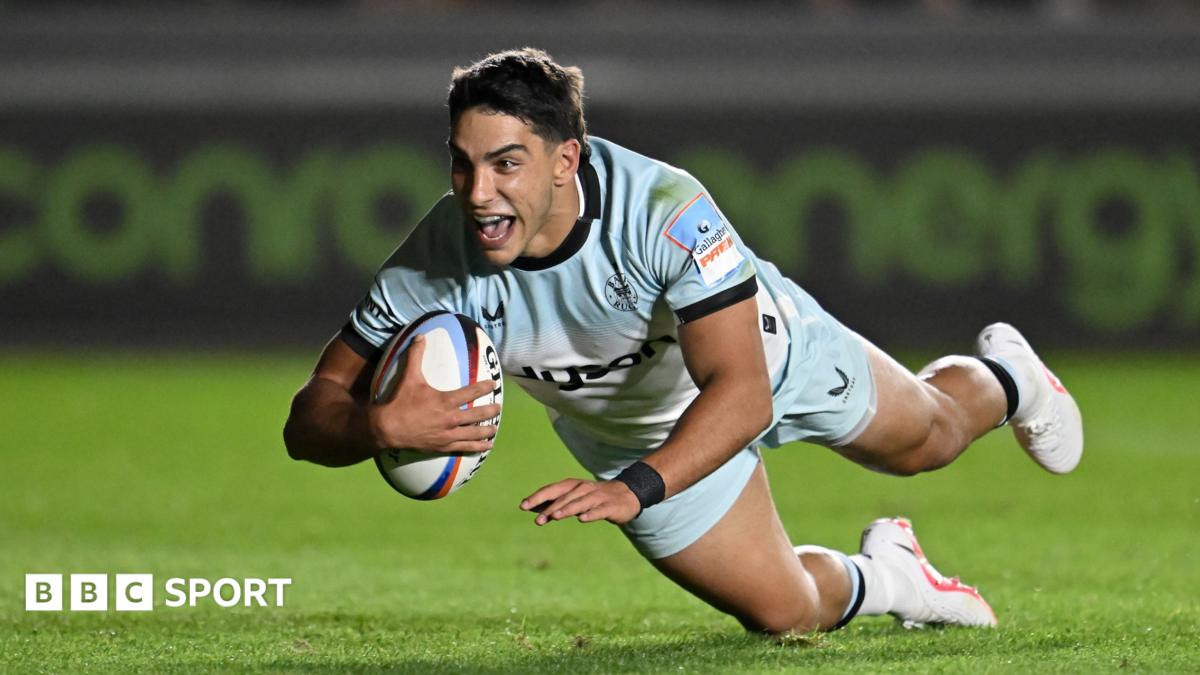
A terrific try from full-back Santiago Carreras was the highlight of Bath’s opening night 33-17 bonus-point victory over Harlequins.

The Argentina international intercepted a Tyrone Green pass with his boot, kicking the ball into the air before collecting it one-handed before it went out of play and smoothly accelerating away to score under the posts in a real moment of magic.

Dan du Preez, Joe Cokanasiga and Dan Frost added first-half tries for Bath who led 28-10 at the break, with Will Porter and Chandler Cunningham-South replying for Quins.

Pedro Delgado reduced the gap to 11 points early in the second half but Ewan Richards’ late try ensured it would be Bath who started the new season with a win.

More to follow.

Harlequins: Green; Anderson, Beard, Bradley, Murley (c); Slevin, Porter; Hobson, Walker, Delgado, Dun, Browne, Kenningham, Evans, Cunningham-South.

Replacements: Riley, Wenger, Johnson-Holmes, Treadwell, Petti, Friday, Bellamy, Isgro.

Sin-bin: Riley (53)

Bath: Carreras; Cokanasiga, Lawrence, Ojomoh, De Glanville; Russell, Carr-Smith; Obano, Frost, Stuart, Hill, Ewels (c), Bayliss, Underhill, Du Preez.

Replacements: Tuipulotu, Kirk, Griffin, Richards, Pepper, Van der Linde, Redpath, Reid.

Referee: Karl Dickson

Source link

DR Congo and Ivory Coast top Africa Cup of Nations qualifying opening wins | Football

DR Congo beat Equatorial Guinea, while Ivory Coast cruise by Ghana and Cameroon beat Comoros as AFCON qualifiers begin.

The Democratic Republic of the Congo followed up their World Cup exploits ⁠with a 2-0 ⁠home win over Equatorial Guinea on the opening day of the group qualifiers for next year’s Africa Cup of Nations.

Captain Chancel ⁠Mbemba headed home the opening goal in the fourth minute, and Yoane Wissa added a second 18 minutes from time in Kinshasa on Thursday, although ⁠the scoreline might have been more emphatic after they twice struck the woodwork and also had two efforts ruled offside.

It was the first game for the Congolese after advancing through the first phase of the World Cup for the first time ‌and running England close in their last-32 tie in Atlanta in July.

However, there was no opportunity for home supporters to celebrate their achievement as the size of the crowd at the Stade des Martyrs was restricted to 20,000 after sanctions for fan violence that followed defeat by Senegal in World Cup qualification one year ago.

Mauritania and Namibia were also winners ⁠in Thursday’s early games, while Libya netted a last-gasp penalty ⁠to salvage a 2-2 draw at home to Botswana behind closed doors in Tripoli, where the stadium was also banned because of previous supporter violence.

Botswana striker Tumisang Orebonye scored a double ⁠in the first half to put his side on course for a rare away win before Maruwan Alhibeeshi thrashed ⁠home from the edge of the area to ⁠pull one back in the 87th minute.

Botswana substitute Mothusi Cooper gave away a stoppage-time penalty with a clumsy challenge, allowing Ezoo El Mariamy to rescue a draw.

Mauritania won 3-1 over the Central ‌African Republic in Casablanca, Morocco, which included a superb chipped effort over the goalkeeper from Dawda Camara, while Bethuel Muzeu scored the only goal as Namibia ‌edged ‌Congo.

Ivory Coast beat Ghana 2-0 in a derby in Bouake in a Group C encounter.

A stunning strike from Malick Yalcouye opened the scoring from outside the box in the first half, although the Ghana keeper, Lawrence Ati-Zigi, will feel he should have done better at his near post.

Franck Kessie gave the Black Stars stopper no chance as he sent his opponent the wrong way with a side-footed second-half penalty.

Ghana, who failed to qualify for the 2025 edition of AFCON, are left to reflect on a match where they failed to register a shot on target until the 75th minute. They also conceded 61 percent of possession to their hosts.

Cameroon beat Comoros 3-1, while Tunisia were held to a 1-1 draw by Uganda in the pick of the other ties.

Source link

Presidents Cup: US edge opening session against International team

The United States began their bid to win an 11th consecutive Presidents Cup by opening up a 3-2 lead over the International team at the end of Thursday’s fourballs matches at Medinah Country Club in Illinois.

Justin Thomas and rookie Jackson Koivun put the first point on the board for Brandt Snedeker’s American team with a resounding 4&3 win over Canada’s Corey Conners and Colombia’s Nico Echavarria.

World number one Scottie Scheffler, who was partnered with his long-time friend Sam Burns, took the 17th hole and held on to close out their victory over Min Woo Lee and Sungjae Im, who were left to rue several missed putts down the stretch.

And two-time major champions Wyndham Clark and Collin Morikawa ensured the US would take an advantage into Friday’s five foursome matches.

Clark and Morikawa led from the opening hole against Australia’s Adam Scott and reigning Open champion Ryan Fox before completing their 3&2 success with two holes to spare.

“A session win is a session win; we’re going to take it any way we can get it,” said Snedeker.

However, Geoff Ogilvy’s International side will head into the alternate shot format on Friday with optimism of remaining in contention to claim only their second ever triumph in the biennial contest, some 28 years after their first in 1998.

Japanese duo Hideki Matsuyama and debutant Ryo Hisatsune recorded a 3&1 success over Cameron Young and Xander Schauffele, while Kim Si-woo and Tom Kim always looked comfortable in their 3&2 win over Chris Gotterup and Patrick Cantlay.

The five foursome matches scheduled to take place on Friday will be followed by two sessions on Saturday, split between four four-ball matches in the morning and four foursomes in the afternoon.

All 12 players on each team will then compete in the singles matches on Sunday, with 15½ points required for overall victory.

Source link

First impressions of the Lucas Museum on opening day

After more than two decades of planning and years of building, the Lucas Museum of Narrative Art opened to the general public Tuesday, and a vast campus that had been nearly empty for weeks of press previews filled to capacity with eager fans, including some who traveled across oceans to see what all the hype is about.

Actor D’Arcy Carden stopped by early, beating the cadre of guests crowding the main plaza beneath the now-famous oculus of the 300,000-square-foot Ma Yansong-designed building. A Stormtrooper drove by on a flatbed truck, shortly before R2-D2 greeted visitors in the courtyard, wearing an official staff badge. (The line for a selfie with the droll droid stretched as far as the eye could see.) Museum leaders have long said that “Star Wars” artifacts account for about 7% of the 100,000 square feet of gallery space, but one worker quipped 90% of opening-day attendees likely had a vested interest in the franchise.

This proved true, for the most part: Many visitors clearly knew and loved “Star Wars,” and Princess Leia buns and Yoda ears abounded. (Two Padmé Amidalas ran into each other, and according to a restaurant worker, one brave soul showed up in “Star Trek” gear.)

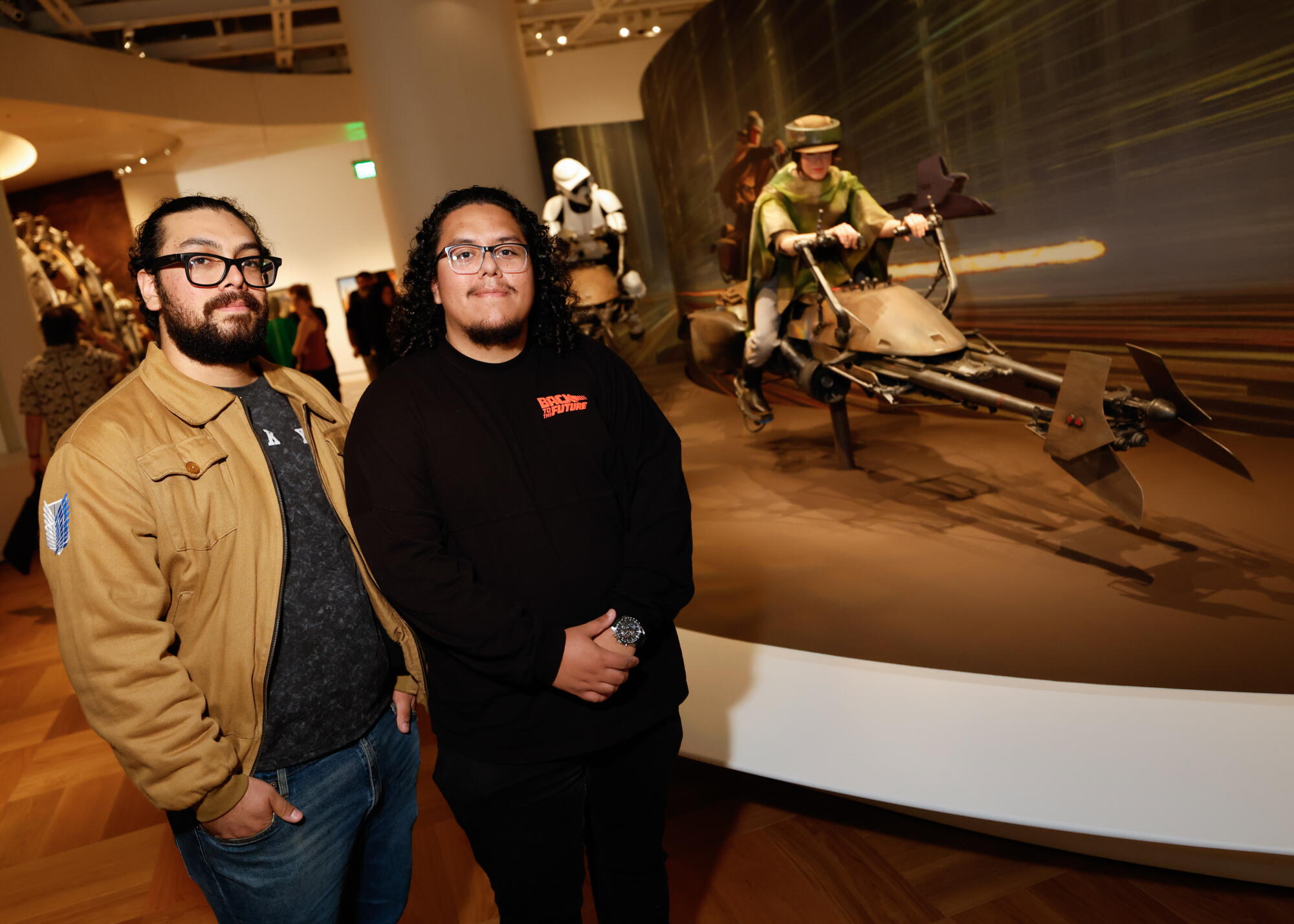
Two men pose in a "Star Wars" gallery.
David Perez, 27, (right) donned his “Back to the Future” gear, hoping to see art from the movie. But he and his brother Carlos Perez, 28, (left) were quite pleased with the “Star Wars” artifacts in the Cinema section.

(Carlin Stiehl / For The Times)

Still, the museum, as its famous co-founder George Lucas has repeatedly said, is about more than just one story, however beloved. That sentiment cropped up repeatedly in interviews, too: Early guests seemed to believe the museum’s brochure, which notes that the galleries are about the “narrative art” of illustrating stories.

Co-founders Lucas and businesswoman Mellody Hobson (also Lucas’ wife) gave remarks early Tuesday to the first 100 visitors, consisting of students from USC, Los Angeles Technology Center, Otis College of Art and Design and Los Angeles City College, who were all handed free tickets.

An exterior view.

A yellow Naboo N-1 Starfighter hangs above the education lobby, across from the main plaza, guarding the research library.

(Carlin Stiehl / For The Times)

“I’ve spent more than 50 years collecting the work of artists who don’t always get their due — illustrators, cartoonists, muralists, painters — because I believe their images are as vital as any other art form,” Lucas said. “They deserve to be in a museum.”
“This is a museum of the ‘people’s art’ — the images are illustrations of the beliefs we live with every day,” said Hobson, “and for that reason, this art belongs to everyone.”

Later that day, The Times asked visitors to share their impressions of a museum that, until now, has lived largely in the imaginations of fans and in abundant social media posts online. The museum has drawn loads of applause but also plenty of criticism, mostly for its lack of context via wall text, and for displaying art that not everyone agrees should be elevated.

Do the people love the “people’s art”?

Responses have been edited for length and clarity.

Alden Chang stands on the sculpture garden back lawn of the Lucas Museum, posing with a handmade sign.

Alden Chang and his wife flew 6,800 miles from Taiwan to thank George Lucas for creating the “Star Wars” films and franchise. Chang told The Times that he also wrote an academic paper examining “Star Wars” fan culture in Taiwan.

(Carlin Stiehl / For The Times)

Alden Chang, 32, green product engineer from Taiwan

You flew all the way from Taiwan, just for this?

Chang: Yeah, halfway across the world to meet George Lucas and Miss [Mellody] Hobson.

Did you get to meet them?

Chang: Yeah, I just shook hands with them this morning. It’s like a dream come true.

How long ago did you and your wife get here, and how long are you staying?

Chang: For eight days. We came here on Sept. 18.

Is this the highlight of the trip?

Chang: Sure. [Laughs.] It’s my main mission and my main goal.

(Later, in an email, Chang told The Times that he also wrote an academic paper examining “Star Wars” fan culture in Taiwan.)

Two men stand with a picture of Snoopy.

Friends Robert Meier, left, and Marc Downing used to work as ushers at the Music Center together. Growing up, Marc rode his bike where the Lucas Museum now stands.

(Carlin Stiehl / For The Times)

Marc Downing, 71, retired, from Exposition Park and Robert Meier, 70, educator, from Highland Park

Downing: I go to all the museums. This was the newest museum, so I had to come and see this.

How does this compare to the other L.A. museums?

Downing: This is ultra modern, ultra space-future. I’m glad the museum is here; highly recommend it. And I’m proud that it’s in my city, and I’m glad that it’s in the neighborhood that I grew up with.

What made you want to be a member of the museum, Robert?

Meier: It’s giving to the neighborhood. I’ve admired George Lucas — I used to have a relative in Marin County, and growing up, we’d go to lunch, and I’d see George Lucas and his family. We’d be at the same restaurant together.

Downing: Well, speaking of this neighborhood: This used to be a parking lot. I remember it very well. And I used to come here and ride my bike in this neighborhood as a kid.

A man sits on a curved wooden bench in a museum.

C.S. Lee sits on a bench at the south viewpoint of the museum, gazing out onto the sculpture garden below. “This is why you live in Southern California. This is why you live in L.A.: for days like these.”

(Carlin Stiehl / For The Times)

C.S. Lee, 54, actor, from Koreatown

Lee: “Star Wars” was the very first movie I ever saw in my life as a 4-year-old when I immigrated here from Korea. We landed in Hawaii, in Waikiki Beach. Our family friends took us to a drive-in movie cinema place, and they said, “You want to come see a movie?” And it was “Star Wars” and “King Kong,” double billing. And my mom said when I saw the screen, my eyes popped out of my head because I’d never seen a movie before.

How do you think “Star Wars” impacted how you saw narrative and story?

Lee: I think I carried that all through my life: the story of “Star Wars.” I was like, “Oh, the good guys won!” And it was such an uplifting thing for me to hold on [to] all these years.

What did you think about the rest of the museum?

Lee: It’s so beautifully done: all the curves, all the light. You got the wind coming through the trees that they planted. I mean, honestly, I was just looking out, thinking to myself, “Wow, this is why you live in Southern California. This is why you live in L.A.: for days like these.”

The view of the sculpture garden and grounds beyond that C.S. Lee was contemplating from the south viewpoint.

The view of the sculpture garden and grounds beyond that C.S. Lee was contemplating from the south viewpoint.

(Carlin Stiehl / For The Times)

What about the building itself?

Lee: We rarely get to see architecture like this. But I think it’s good for people to see the artistry and the imagination of what people can build.

Janet Jacobs, 62, architect and Hanjin Jacobs, 25, audio equipment manufacturer technician, mother and son on a family trip from Portland (pictured at the top of the story)

I see you’re wearing a “Star Wars” T-shirt.

Janet: Yes, I am — actually from 1977.

Wow, really?

Janet: Yeah, I’ve had it for that long [laughs].

What was your overall takeaway from the museum?

Janet: I know George Lucas wanted to create this museum in a different way, like he didn’t have a sequence of events or a roadmap, he just wanted people to experience it the way they wanted to, so that’s all great. We do wish some of the things were explained a little more. Like, I know who Ralph McQuarrie is; [my kids] do not. So that would’ve been nice. Like in a typical museum, you do have a little blurb.

[My son] brought up a really good point: how ironic it is that it’s about storytelling, but yet there seems to be no storyline.

Two people hang loose in front of a KAWS sculpture.

Andrew Liu, left, and Matthew Haak hang loose in front of a KAWS sculpture. They actually didn’t know it was opening day, but were happy to be there anyway.

(Carlin Stiehl / For The Times)

Matthew Haak, 26, architectural designer, and Andrew Liu, 26, behavioral therapy assistant, both from University Park

Haak: We are not “Star Wars” fans. I haven’t watched a single “Star Wars” movie. I’ve somehow evaded them my entire life.

So, if not for “Star Wars,” why did you come out today?

Haak: I’ve been watching this building being constructed for the past two years. I’m just geeking out over the organic curvilinear forms. Not a single hallway has been straight. And they even have real expensive details, like light coves on the base [of the wall]. All of these things really stand out to me. Also, curved walls like this are so expensive; architects never get a budget to do stuff like that.

I was just surprised: It’s not just “Star Wars” stuff. There’s so much art; it’s so cool.

A woman dressed as Padmé Amidala in front of a statue of Princess Leia.

Nicole Garcia — dressed as Padmé Amidala in her lakeside gown — poses in front of a statue of Princess Leia.

(Carlin Stiehl / For The Times)

Nicole Garcia, 24, cosplayer/costumer from Corona and Veronica Antonucci, 40, administrative assistant from Orange County

So, this might be an obvious question [given their fun outfits], but what brought you guys out today?

Antonucci: This little thing called “Star Wars”!

Garcia: Growing up with “Star Wars,” I always loved all the pieces, knowing that, for example, there’s miniature pieces that look just huge on-screen, and seeing them in-person is just, like, I want to shrink myself down and just be there.

Antonucci: It’s also amazing that it’s not just “Star Wars,” and it’s also so much more that everyone should come out and see.

Is there anything else you were particularly excited to see?

Garcia: I was shocked to see “Fritz the Cat.”

Antonucci: I was really excited to see the Frida [Kahlo]. I didn’t know she was gonna be here, so I think when I saw her, I gasped.

Is there anything else you’d like to add?

Garcia: I just hope the future generations of kids come back to see this, growing up with museums more often, and just learning how to make art — like, physically make art — and be inspired.

Antonucci: Actually, we talked about feeling jealous of all the kids who are going to be here on their school field trips, because we didn’t get to experience this.

Two women stand beside a Norman Rockwell painting.

Nikki Foster, left, loves a good field trip. She texted her group chat to visit the museum, and her bestie, Shalonda Dean, responded, so they both cleared their calendars for the visit.

(Carlin Stiehl/For The Times)

Shalonda Dean, 47, consulting business founder and president, and Nikki Foster, 45, live event production executive, both from Beverly Hills

You both gravitated toward Norman Rockwell’s “The Problem We All Live With” — why did it stand out to you?

Dean: Being a Black woman, I can identify with this little Black girl. Even in 2026, I think this painting depicts a lot of what Black women are going through today, whether it be in the workplace, navigating motherhood, navigating life. And I think this is an example of the barriers that we’re constantly breaking through every day, even today.

Foster: I’ve never seen it in person until now. So when we saw it, we were like, “It’s here, it’s here!” Just to be able to lay our eyes on it, and not have to go to another country, another state — here in Los Angeles. This is divine. It’s a divine day.

A man in a black suit on a wooden bench.

“I love meeting people,” Vincent Zabierowski said. “People are my main inspiration. I’m very lucky I get to be in a place where people want to be, and people want to soak up all that creative energy and just experience art.”

(Carlin Stiehl / For The Times)

Vincent Zabierowski, 23, host at the Skywalker Grill and freelance illustrator, lives near Downtown L.A.

As an artist yourself, what are your favorite pieces in the museum?

Zabierowski: I love a lot of the things that are in the graphic novel collection, like the Jack Kirby, the Garfields. My favorite is the Art Nouveau artist Alphonse Mucha. The Diego Rivera mural, that one was really amazing — and just the history here, having it be in L.A.

How does your work as an illustrator inform how you see these pieces?

Zabierowski: When I was going through it with some of my co-workers, I would [ask] “Do you know why they use a blue pencil?” And it’s because, when you take a photograph or a scan, that blue pencil disappears. So it was just really cool to see the behind-the-scenes and understand.

So seeing those blue pencil marks tells you that a piece is real?

Zabierowski: A person made it! I feel like a lot of people see artwork in textbooks, or they see artwork on their phones, or they see artworks on posters, and it takes a lot of skill and intelligence and training to be able to do those pieces of artwork.

Source link

US, Iran hold mediated UNGA talks on ending war, opening Strait of Hormuz | US-Israel war on Iran News

The United States and Iran have engaged in hours of indirect talks through mediators on the sidelines of the United Nations General Assembly (UNGA) in New York, but accounts differed over whether officials from the two countries met directly.

US special envoy Steve Witkoff said mediators had “shuttled between” the American and Iranian delegations throughout Tuesday.

Recommended Stories

list of 4 itemsend of list

“Today, on the sidelines of the United Nations General Assembly, we engaged in lengthy talks with the Iranian delegation through the mediators, who shuttled between the two sides throughout the day,” Witkoff said in a post on X.

“They successfully completed a round of discussions that we hope will prove constructive and promising. The mediators will continue their work.”

US President Donald Trump gave a more direct account, saying Witkoff and Jared Kushner had held a three-hour meeting with Iranian officials.

“They had a very good meeting, a very productive meeting,” Trump told reporters at the UN, adding that he believed there was “a lot of momentum” towards an agreement. Trump later said talks were continuing and that he believed a settlement would eventually be reached.

Al Jazeera’s Kimberly Halkett, reporting from Washington, said Trump’s initial comments had created confusion over who had participated. She said the White House later clarified that Trump had not attended and that Witkoff and Kushner represented the US side.

Al Jazeera’s Tohid Asadi, reporting from Tehran, said state media had confirmed a meeting between Iranian Foreign Minister Abbas Araghchi and Witkoff after weeks without direct contact.

“This latest meeting was held at the request and insistence of the American side, and was aimed at conveying Iran’s messages and conditions, particularly around reopening the Strait of Hormuz,” Asadi reported.

Iranian state media said those conditions included lifting the US naval blockade, releasing frozen Iranian assets and ending the war on what Tehran describes as the “resistance” fronts.

Asadi also reported that an Iranian security source told Al Jazeera there could be room for further diplomatic engagement if Washington met Iran’s conditions and commitments.

The contacts came after a senior Iranian official told the Reuters news agency that Tehran’s delegation in New York had full authority to pursue diplomacy and described the UN gathering as a “golden opportunity” for Washington to return to negotiations.

The official said Iran had submitted its latest proposal to Washington through mediators on September 16 and that details of a possible agreement to end hostilities could be discussed in New York.

The official also said Iran could reopen Hormuz within seven days if the US eased military pressure and lifted its blockade of Iranian ports.

Regional powers push for de-escalation

The indirect talks have been accompanied by a broader diplomatic effort involving the Gulf and other regional states.

Qatar said it was working with Pakistan to reduce tensions between Washington and Tehran, safeguard freedom of navigation through the Strait of Hormuz and promote regional stability.

Qatar’s Prime Minister and Foreign Minister Sheikh Mohammed bin Abdulrahman bin Jassim Al Thani also met Araghchi in New York on Tuesday.

Qatar’s Ministry of Foreign Affairs said they discussed developments in the region, efforts to de-escalate tensions and ways of creating conditions for dialogue.

Oman has also been involved in maritime diplomacy over the waterway, having previously discussed maritime arrangements with Tehran aimed at facilitating navigation through the strait.

Trump also met leaders and senior officials from Gulf Cooperation Council states, Turkiye, Jordan, Syria and Iraq on Tuesday to discuss Iran and regional security.

Reuters reported that a Qatari proposal for a common security framework involving Iran and Gulf states was among the issues under consideration, with one regional source saying Tehran was reviewing it.

Qatar has not made the proposal public.

US President Donald Trump (C) attends a Gulf Cooperation Council (GCC) multilateral meeting alongside (L/R) Iraqi Prime Minister Ali al-Zaidi, Turkey's President Recep Tayyip Erdogan, King Abdullah II of Jordan, Qatar's Emir Sheikh Tamim bin Hamad al-Thani and Syrian President Ahmed al-Sharaa on the sidelines of the 81st United Nations General Assembly in New York on September 22, 2026. (Photo by Brendan SMIALOWSKI / AFP)
US President Donald Trump attends a multilateral meeting on the sidelines of the 81st UN General Assembly in New York with leaders and senior officials from Arab countries and Turkiye on September 22, 2026 [Brendan Smialowski/AFP]

Talks follow Trump’s warning

The indirect talks came hours after Trump used his UNGA address to combine the possibility of an agreement with another warning of military escalation.

Trump said he faced a “big decision” between reaching a deal that would allow Iran to rebuild and moving to “annihilate the Islamic Republic”. He also said Washington had previously offered Tehran “full economic cooperation” in return for ending its nuclear programme and what the US describes as Iranian support for terrorism.

Iran’s General Staff of the Armed Forces and Khatam al-Anbiya Central Headquarters responded in a statement carried by Iranian media, describing Trump’s threats as evidence of “strategic weakness” and saying Iran was ready to deliver “more severe, crushing, and unpredictable blows” in response to further attacks.

US officials have repeatedly suggested that negotiations were making progress following the collapse of the June memorandum of understanding. In early August, Trump said the sides had reached parameters for a possible agreement and later described talks over Hormuz as “moving along nicely”, although significant differences remained. Earlier this month, he again said he hoped the war was “towards the end”.

Tehran continues to condition the reopening of the Strait of Hormuz on the US easing military pressure and lifting its blockade of Iranian ports, while Witkoff said mediators would continue their efforts following Tuesday’s mediated exchanges.

Source link

Inside Lucas Museum’s starry opening party with Oprah, Mark Hamill

If George Lucas invites you to a party, you go.

That much was clear Saturday at the Lucas Museum of Narrative Art’s opening-night soiree, where the guest list was as celebrity-heavy as any Academy Awards after-party. As the festivities kicked off around sunset in the courtyard under the museum’s towering elliptical oculus, Oprah Winfrey hugged Robert De Niro, and Harrison Ford and Calista Flockhart skipped the red carpet after chatting with Spike Lee. Laura Dern and Greta Gerwig laughed together by the entrance while Samuel L. Jackson plopped down on a curved bench, joking, “Hey, look what I did!”

For the record:

1:22 p.m. Sept. 20, 2026A previous version of this article said James Cameron was photographed along with a large group of directors at the Lucas Museum of Narrative Art. He was not.

He didn’t sit for long because Cynthia Erivo and Andy Garcia showed up and there were more hugs and handshakes and hellos. Owen Wilson, Leonardo DiCaprio, Kim Kardashian, Meg Ryan, Jack Quaid, Gov. Gavin Newsom, Rep. Nancy Pelosi, Justin Trudeau, Mark Hamill and Magic Johnson were there too, and that was just the beginning.

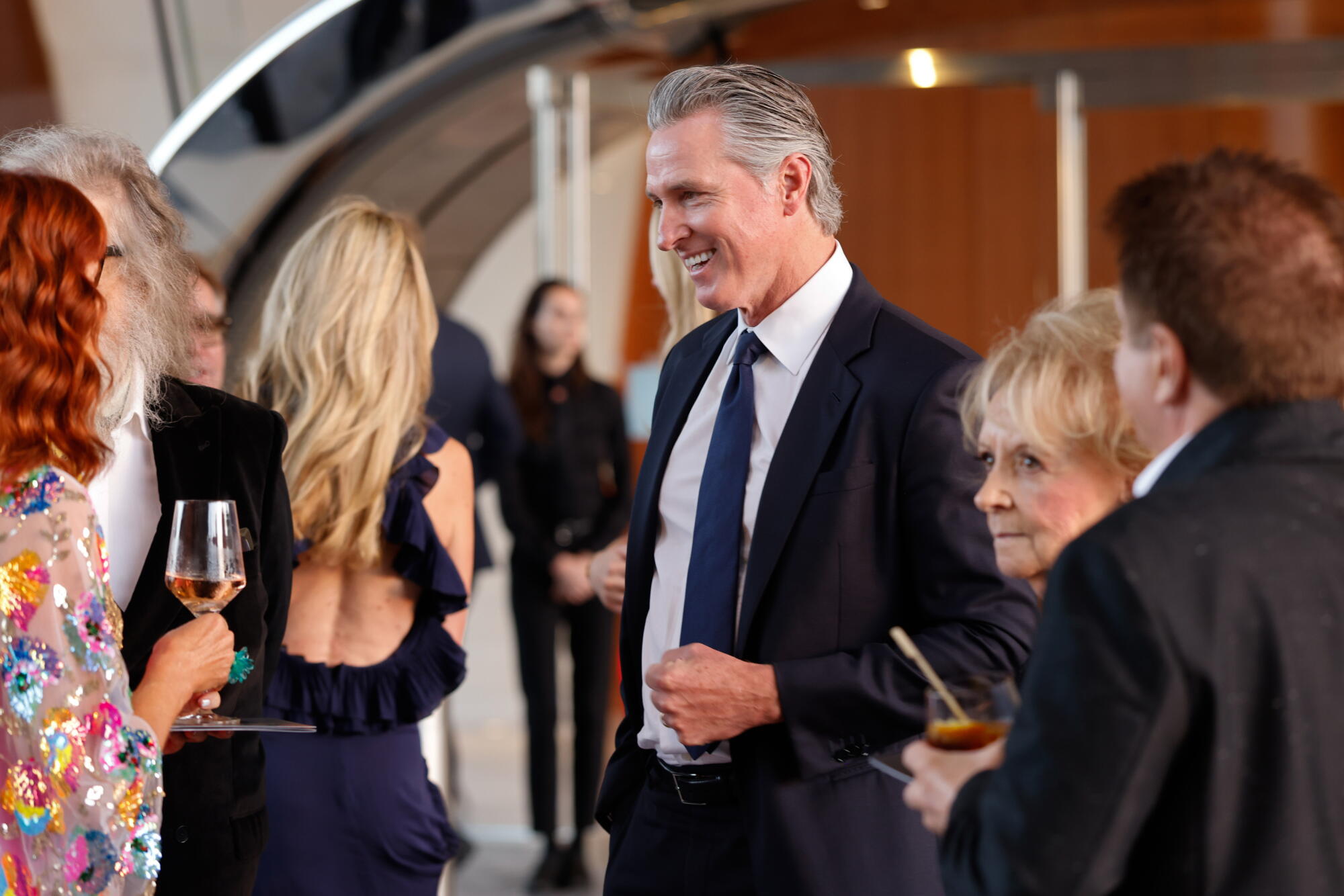
Gov. Gavin Newsom talks to guests at a party.

Gov. Gavin Newsom attended the opening-night party for the Lucas Museum of Narrative Art alongside a host of other notable guests and celebrities.

(Carlin Stiehl / For The Times)

After a rousing performance by a white-robe-clad vocal collective called Voices of Fire, co-founded by Pharrell Williams, Lucas’ wife Mellody Hobson noted that, “George kept saying, ‘Will this person come? Do you think this person will come?’”

“I said, ‘They will all come,’” Hobson said as the crowd laughed during opening remarks on a raised platform in the museum’s grand lobby.

And so they did. There was even a banner moment inside the posh fifth-floor Skywalker Grill where a group of directors gathered to be photographed in what could very well become a seminal photo of Hollywood influence in the 21st century. The shot included Lucas, Jon M. Chu, Chris Columbus, Francis Ford Coppola, Lee Daniels, Guillermo del Toro, Jon Favreau, Bryce Dallas Howard, Ron Howard, Peter Jackson, Chris Meledandri, Denis Villeneuve, Christopher Nolan, Spike Lee, Tyler Perry, Steven Spielberg, Frank Miller, Robert Rodriguez, Nathan Fielder and David Benioff.

Organizers were scrambling to find Gerwig, but she had dashed off somewhere else.

Mark Hamill and Marilou York at a museum party.

“Star Wars” legend Mark Hamill and his wife, Marilou York, were guests at the Lucas Museum of Narrative Art opening party.

(Carlin Stiehl / For The Times)

There were artists in attendance too, of course, but not as many. Jeff Koons, Refik Anadol, Judy Baca and Takashi Murakami strolled through the crowd, as did museum directors including the Broad’s Joanne Heyler and Los Angeles County Museum of Art’s Michael Govan, who was relieved to be attending someone else’s party after hosting so many of his own in April and May when the new Geffen Galleries opened.

Lucas and Hobson went to great lengths to explain why the Lucas Museum matters and why it is different from other museums. Their comments, in many ways, sought to address the criticism that has been lobbed at the museum since it held its press preview a few weeks back.

Though it has received a number of rave reviews, critics have called narrative art a false conceit and argued that the juxtaposition of masterworks with pop culture ephemera does not work. Much of the criticism has been focused on a perceived lack of context since there is almost no wall text clarifying why certain curatorial choices were made.

George Lucas and Mellody Hobson stand in front of grass wall.

George Lucas and his wife Mellody Hobson hosted an extravagant opening party at the Lucas Museum of Narrative Art.

(Carlin Stiehl / For The Times)

“When I started it, everybody said, ‘You’re crazy. You shouldn’t do it. It’s not going to work. People are going to come after you,’” Lucas said of his plans for the museum. “I said, ‘People have come after me all my life, especially in the movies.’”

Lucas also addressed why he curated the museum’s 100,000 square feet of gallery space on his own, noting that at a certain point plans were “getting off the rails.”

“I’m going to have to take this over because people don’t understand what I’m doing,” Lucas recalled thinking. “The idea that illustration is an art form and illustrators are artists was just too much for somebody who had been taught otherwise by the art schools that they went to and the universities that they went to.”

People with PhDs often can’t see the big picture, Lucas said, “You can’t say ‘This is art. This is not art.’ Art is in the eye of the beholder. If it is emotional to you, then it’s art. And, of course, I’ve been criticized up and down and sideways for that. But I believe it wholeheartedly — that you get to decide what art is.”

A choir in white robes enters a museum plaza.

Members of the Virginia Beach vocal collective Voices of Fire, co-founded by Bishop Ezekiel Williams and Pharrell Williams perform at the Lucas Museum.

(Carlin Stiehl / For The Times)

Lucas noted that throughout his career he has worked with many illustrators, “and I will tell you, they are as talented as any artist I’ve ever met. This is the way of giving back to them something that they’ve all wanted … inevitably, all of the illustrators say the same thing — everybody from R. Crumb to Rockwell — they all say, ‘I wish I could be in a museum,’ but they can’t. There isn’t a major museum in the world that’ll have this kind of art in it. I’m hoping this will change that.”

Lucas’ comments came after his friend and co-host Queen Latifah noted to the cheering crowd that, “Paris has the Louvre, New York has the Met and now L.A. has the artistic equal.”

Guests mingle at the Lucas Museum of Narrative Art opening party.

Guests mingle at the Lucas Museum of Narrative Art opening party.

(Carlin Stiehl/For The Times)

It took more than a decade for the Lucas Museum to land in L.A. after a search that included Chicago and San Francisco as well as lots of civic pushback and lawsuits over the use of public parkland.

“We did not realize how hard it would be to give a city a museum,” Hobson said during her remarks, later joking: “If your husband or spouse comes home and says they want to build a museum, I suggest your response is a hard no.”

Laura Dern and Greta Gerwig stand in front of a grass wall.

Laura Dern, left, and Greta Gerwig spent the early part of the night chatting and laughing.

(Carlin Stiehl / For The Times)

Hobson went on to extol Lucas’ vision and his ability to never waver from his dream for the museum.

“He was driven to create a space that would showcase the brilliant illustrators that he thought were too often overlooked and ignored,” Hobson said. “And if critics say that a museum of narrative art is too much like a popcorn movie and not enough like an art film, well, we love popcorn movies in our family.”

Like a popcorn movie, the evening ended happily with a drone show in the night sky narrated by Winfrey and Jackson, and featuring images from the museum’s collection including the Cave of Altamira, N.C. Wyeth’s “The Storybook,” Julie Bell’s “The Huntress,” Banksy’s “Girl With Balloon,” the “Star Wars” Millennium Falcon and Maxfield Parrish’s “Ecstasy.”

Afterward the party moved inside from the rooftop terrace for a performance by the Black Eyed Peas.

Source link

First look at new Guinness World Records family attraction opening in the UK this winter

EVER dreamt of getting a World Record? Well, you soon can have a chance at securing one in a huge new UK attraction dedicated entirely Guinness World Records.

Guinness World Records London, which is the first permanent entertainment venue from Guinness World Records, will open at The O2 in Greenwich, this winter.

Guinness World Records are opening a new attraction in London Credit: Image by Paul Michael Hughes T 07790819111 UK E pmh@paulmichaelhughes.com W http://www.paulmichae
Inside there will be 45 challenges to complete across five arenas Credit: Image by Paul Michael Hughes T 07790819111 UK E pmh@paulmichaelhughes.com W http://www.paulmichae

Spanning across 2,322sqm, Guinness World Records London will be home to 45 different official Record Challenges, in five arenas.

Challenges include Loudest Scream, Fastest Typist, Fastest Basketball and Fastest Buzzwire.

Visitors testing out the different challenges could even walk away a Guinness World Record holder themselves.

There will be a number of interactive exhibits as well.

Read more on travel inspo

CHEAP BREAKS

UK’s best 100 cheap stays – our pick of the top hotels, holiday parks and pubs


TRAVEL TIP

The £2.99 SIM hack that can save Brits HUNDREDS abroad

While no specific opening date has been revealed yet, on the attraction’s website it states “late 2026” as the expected opening.

The website adds that there will also be “themed food and drink”, as well as a shop with “record-breaking souvenirs”.

Ahead of the attraction opening to the public, Guinness World Record London are looking for the UK’s most competitive family.

The winning family will be the first to look at the new attraction and try out the different challenges.

You could even leave with a world record title Credit: Image by Paul Michael Hughes T 07790819111 UK E pmh@paulmichaelhughes.com W http://www.paulmichae
Collage of travel items including a plane, sunscreen, passport, suitcase, and plane tickets, advertising The Sun's travel Instagram account.

Will Munford, Adjudicator at Guinness World Records, said: “Guinness World Records London will give every guest the unique chance to take on our line-up of brilliantly fun and exciting record attempts, and potentially walk away a world record breaker themselves.

“We know how competitive families can get, so we want to find out who is the most competitive of them all and get them along to our new attraction to see if they have what it takes to become our first record breakers!”


Source link

Hilton reveals 10 new ‘economy’ hotels opening in UK

HILTON has revealed 10 new locations are set to come to the UK – and one is coming to a major capital city.

The new hotels will form part of the chain’s “value-focused” brand.

Exterior view of a Spark by Hilton hotel entrance.
The new hotels will operate under Hilton’s budget-friendly brand Credit: Spark by Hilton
A compact hotel room with a bed against a blue wall, a television, and a bedside table with an alarm clock and outlets.
The hotels provide clean and reliable rooms at an affordable rate Credit: Spark by Hilton

Ten new hotels, operating under the Spark by Hilton brand, are set to come to major railway stations, stadiums, motorways and visitor attractions across the UK.

The locations, confirmed to open in Cardiff, Coventry, Derby, Doncaster – among others will add a total of 672 rooms to Hilton’s portfolio.

Created with “value” in mind, the sites will provide reliable, comfortable and affordable accommodation.

Exact dates of completion and room rates are yet to be confirmed, however the company said the new locations could open as early as late 2026 through to 2028.

DRINK UP

Quirky bar to open inside abandoned UK landmark where Winston Churchill lived


ON THE LINE

Busy London tube line faces closures this month – but it’s good news for once

Paul Blackmore, vice-president of development for the UK and Ireland at Hilton, said: “With nearly 700 rooms in the pipeline, including the brand’s first hotel in Wales, Spark continues to gain momentum.”

Launched in 2023, Spark by Hilton operates more than 275 hotels worldwide, with more than 200 properties in development.

The budget conscious “premium economy” brand was designed to provide a reliable and value-driven stay at an accessible price point.

The 10 properties have been signed through an agreement between Hilton and UK hotel owner and operator AG Hotels Group.

An additional 53-room property in Dunfermline, Scotland is scheduled to launch in late 2026.

However this is set to operate separately from the 10 hotels included in the latest agreement.

All 10 new Spark by Hilton locations

  1. Spark by Hilton Cardiff North – 51 rooms
  2. Spark by Hilton Coventry Walsgrave – 48 rooms
  3. Spark by Hilton Derby Station – 100 rooms
  4. Spark by Hilton Doncaster East – 51 rooms
  5. Spark by Hilton Hull Central – 51 rooms
  6. Spark by Hilton Peterborough Norman Cross – 99 rooms
  7. Spark by Hilton Runcorn – 53 rooms
  8. Spark by Hilton Sunderland Northern Spire Bridge – 63 rooms
  9. Spark by Hilton Wakefield South – 77 rooms
  10. Spark by Hilton Washington Newcastle South – 79 rooms

Source link

Star-studded Rams humbled by Brock Purdy, 49ers in opening loss

The Rams arrived here as the star-studded favorite to win Super Bowl LXI at SoFi Stadium.

They left star-crossed, stunned and searching for answers on their long flight back to Los Angeles.

The Rams sleep-walked through much of the season opener against the rival San Francisco 49ers, who sent them to a 27-7 defeat before a sold-out crowd of 100,021 on Friday at Melbourne Cricket Ground, in the first NFL game in Australia.

Coach Sean McVay’s strategy of arriving the day before the game backfired and resulted in a dull performance by a team that features some of the biggest stars in the NFL.

Quarterback Matthew Stafford, the reigning NFL most valuable player, completed only 15 of 25 passes for 155 yards with an interception. With the game out of reach, McVay pulled Stafford late in the fourth quarter and had backup Stetson Bennett lead the Rams’ final possession.

All-Pro receiver Puka Nacua, the NFL leader in catches last season, caught five passes for 74 yards and never broke loose. Davante Adams, who led the NFL in touchdown catches last season, caught only three passes as Raheem Morris, the Rams’ former defensive coordinator, outschemed McVay and his staff.

The additions of All-Pro cornerback Trent McDuffie, record-setting edge rusher Myles Garrett and cornerback Jaylen Watson were supposed to supercharge the Rams’ defense.

Rams defensive end Myles Garrett sits on the bench late in the fourth quarter during a 27-7 loss to the 49ers.

Rams defensive end Myles Garrett sits on the bench late in the fourth quarter during a 27-7 loss to the 49ers on Friday.

(Doug Benc / Associated Press)

But 49ers quarterback Brock Purdy passed for three touchdowns, and the Rams recorded no sacks.

It made the decision by 49ers coach Kyle Shanahan to have his team spend a week in Melbourne to acclimate the correct one.

Shanahan, McVay’s friend/mentor/nemesis, had bristled at the fact that the 49ers were chosen as the Rams’ opponent because it took away the ability of 49ers fans to descend onto SoFi Stadium.

Shanahan also wasn’t happy that the Rams’ next game is Sept. 21 on “Monday Night Football,” while the 49ers are playing on Sept. 20. Add in the fact that the 49ers also must play in Mexico in November, and there was plenty of motivation beyond the game itself.

The Rams trailed, 10-7, at halftime after managing a five-yard touchdown run by Kyren Williams and not much else.

MELBOURNE, AUSTRALIA - SEPTEMBER 11: Davante Adams #17 of the Los Angeles Rams.

Rams wide receiver Davante Adams attempts to catch a pass in the fourth quarter against the 49ers.

(Robert Cianflone / Getty Images)

The 49ers wasted no time extending their advantage, taking the opening possession of the second half and moving down the field on Christian McCaffrey runs and a Purdy pass to Demarcus Robinson, whose 39-yard touchdown in the second quarter had given them the lead. Purdy capped the drive by lofting a two-yard touchdown pass to Mike Evans for a 17-7 edge.

And the Rams’ offense finally woke up.

Stafford connected with tight end Davis Allen, Nacua and Adams and tight end Colby Parkinson as the Rams moved to the 49ers’ two-yard line. However, after a one-yard catch by Nacua, the 49ers stuffed Stafford’s sneak attempt.

The 49ers capitalized, marching 99 yards in 11 plays, with Purdy capping the drive on a 15-yard touchdown pass to Deebo Samuel for a 24-7 lead.

The Rams could not mount a comeback.

Tight end Tyler Higbee fumbled after catching a pass with 11:08 left, and the 49ers added a field goal to extend the lead to 20 points.

Source link

Arab News | Asian Games begin with Qatar basketball win, nine days before opening ceremony

Tokyo: The Asian Games began in Japan on Thursday when Qatar beat Iran in the men’s basketball opening group game, the first action in the continental multi-sport showpiece that has more participants than the Olympics.

Over 17,000 athletes and officials are expected to take part in 43 sports at the Nagoya-Aichi Games — which do not officially start until the opening ceremony on September 19 and will run until October 4.

Several events such as basketball, football, cricket, hockey and modern pentathlon will get under way before the opening ceremony.

Qatar held off a comeback from Iran to win their Group B encounter 59-35 at the Aichi International Arena in Nagoya in the first match of a men’s basketball competition that will hold medal finals on September 20, the day after the opening ceremony.

Los Angeles 2028 Olympics qualifying spots are up for grabs in several sports at the Asian Games, which are returning to Japan for the first time since 1994.

Organisers hope the athletes will have a “unique experience” staying in eye-catching accommodation ranging from a cruise liner and wooden containers to standard hotel rooms.

Officials are confident that the plan will not be affected by Japan’s typhoon season, which is usually in full swing in September-October.

Weather has already caused disruptions, with record rainfall on Tuesday forcing hundreds of athletes briefly to evacuate their accommodation.

Rainwater also leaked into some competition venues, with more wet weather forecast for the coming days.

Among those in action at the Games will be Philippine tennis sensation Alexandra Eala and a pair of world-class teenage talents in 15-year-old Indian cricketer Vaibhav Sooryavanshi and 13-year-old Chinese swimmer Yu Zidi.


Source link

Siân Heder on following ‘CODA’ and opening Toronto’s festival

It’s pronounced “human.” Yet writer-director Siân Heder acknowledges that the unusual spelling of the title of her new movie, “Being Heumann,” is something people might give a puzzled second look, unsure of how to say it and possibly dismissing it altogether.

Which, the more she sat with it, made it perfect as the title for a portrait of real-life disability rights activist Judy Heumann, who, while being in a wheelchair, made herself undismissable.

More specifically, the film looks at the pivotal 1977 protest in which Heumann led a group in a 26-day sit-in at a federal office building in San Francisco until the government began enforcing Section 504 of the Rehabilitation Act of 1973 — the first federal law that recognized disability as a civil rights category.

“The fact that her last name was ‘human’ has so many beautiful layers of meaning,” says Heder, 49, during a recent interview in Los Angeles. “I think Judy was asking for the world to see disabled people as human beings who were worthy of rights and being looked at and being included.”

A world premiere and the opening-night selection of this year’s Toronto International Film Festival, which begins on Thursday, “Being Heumann” will hit theaters Nov. 6 and begin streaming on Apple TV Nov. 13. It is also, crucially, Heder’s first film since 2021’s “CODA,” the bittersweet drama about a young woman in a Deaf family (the title is an acronym for “child of Deaf adults”) that won three Academy Awards including adapted screenplay for Heder and best picture.

A woman using a wheelchair gets a note from a crouching director.

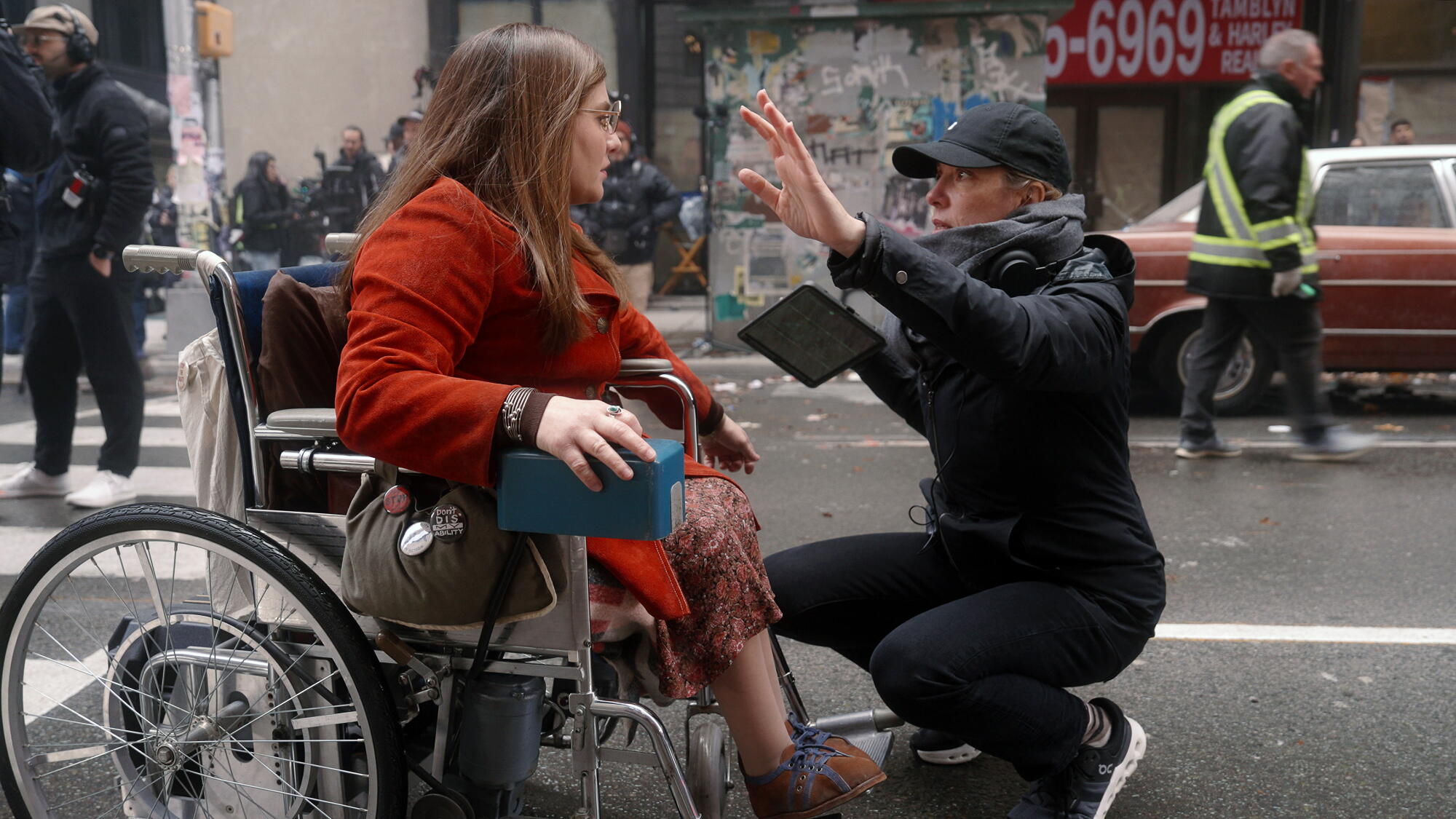
Actor Ruth Madeley and filmmaker Siân Heder during production on “Being Heumann.”

(Apple TV)

In Heumann, a wheelchair user after contracting polio as a child, Heder found a subject who was in the process of discovering herself as a leader: learning when to hold firm and when to cede ground and empower other people. And for someone who was grappling with the aftermath of unexpected success, that felt familiar.

“I think I was making a movie about myself, honestly,” Heder says. “When you’re moving forward on a massive project or a movement or anything, there’s a necessary drive and ambition and focus that is needed. And if you look at any major change that’s happened in human history, it takes a certain kind of person to push that through. I’m not identifying myself with great leaders of the civil rights movement, but directing a movie is a similar thing.”

Heder is tucked into a quiet corner of a busy coffee shop in L.A.’s Eagle Rock neighborhood, where she has long lived. She is in the process of moving from one historic house to an even older one a few blocks away. Heder didn’t want to disrupt the schooling of her two young children, ages 10 and 12, and has become too enmeshed in the area to want to leave it.

A woman sits behind a leafy tree.

“There’s definitely an element of: ‘She manipulated everyone with that movie. She made us all cry and that’s why she won,’” Heder says of “CODA,” her Oscar-winning best picture. “I was an indie filmmaker that was compelled to tell that story.”

(Jason Armond / Los Angeles Times)

Community is a word that comes up often over the course of a conversation with Heder, who has a warm manner and a quiet self-possession. Though “CODA” may have brought her wider attention, she was far from a novice by the time she made that film. She won a Peabody Award as a writer on the series “Men of a Certain Age” and was a writer, director and producer on the acclaimed “Orange Is the New Black.” She expanded her 2006 short film “Mother” into her first feature “Tallulah,” about a young woman who takes a baby from a reckless mother and tries to pass it off as her own. It premiered at Sundance in 2016.

Winning the Oscar created changes in her life both big and small. Heder at first kept it on her desk at home, but had to move it because she began to feel the statuette’s crossed arms quietly judging her as she worked. When she drove herself to the Spirit Awards the year after “CODA’s” triumph and spontaneously gave a ride to an afterparty to Maggie Gyllenhaal and Ebon Moss-Bachrach, Heder suddenly realized her 10-year-old Subaru wasn’t going to cut it anymore.

“I have a nicer car now,” she says, laughing at the memory. “It’s baby steps.”

The day after the Oscars, Heder recalls that she couldn’t stop crying, all the pressure built up from months of campaigning events and Q&As finally letting itself out.

She says two things changed almost immediately after winning the Oscar. One was a sense of expectation, wanting to make the most of whatever the moment might allow.

“This was not a part of my plans,” she says. “I didn’t ever intend to have so many eyeballs turn to me and go, ’What are you doing now?’”

The second was simply the volume of material and opportunities incoming. Heder says she met with Marvel “so many times” about different projects but none of them felt right. As an independent filmmaker “you’re always pushing against the no,” she puts it, moving projects forward against all odds. But now she felt she had to be the resistance, the one to ask whether something was worthwhile.

“Suddenly there are a lot of voices chiming in too because your reps have an idea of what you should do next and the industry has an idea of what you should do next,” Heder says. “And it was really important for me to center myself back in a feeling of: I’ve always been drawn to stories because they move me. And that hasn’t changed.”

Her Oscars triumph was also the night of the notorious Will Smith-Chris Rock on-stage slap, which overshadowed coverage. Heder is online enough that she knows that some film fans would want an asterisk next to the Oscar wins for “CODA,” as if to note some sort of COVID-era exception for the first film from a streaming service to win Hollywood’s top award.

“There’s definitely an element of: ‘She manipulated everyone with that movie. She made us all cry and that’s why she won,’” Heder says with a edge of defiance. “I was an indie filmmaker that was compelled to tell that story. And then audiences embraced that story and that story took off in a way that was unexpected and surprising even for me.”

A woman in a gold dress holds an Oscar and a red envelope.

Siân Heder holds her Oscar for best adapted screenplay for “CODA” backstage during the Oscars in 2022.

(Robert Gauthier / Los Angeles Times)

Heder had been developing “Being Heumann” before “CODA” was released. A friend encouraged Heder to see the 2020 documentary “Crip Camp,” which includes Heumann as a subject, and the filmmaker was so struck by that story, she followed up by reading Heumann’s 2020 memoir.

She sent Heumann a cold email expressing interest in the book. As it turned out, Heumann was deciding that very day who should direct a movie of her life. Heumann gave the filmmaker a last-minute chance to pitch herself. After saying she’d cast authentically disabled performers as she did on “CODA,” Heder got the job.

Heder would work for two years on researching and developing the project with Heumann, interviewing dozens of people involved in the actual Carter-era protest. When Heumann died unexpectedly in 2023, Heder did not think she could continue, but it was “Crip Camp” co-director James Lebrecht who convinced her otherwise.

“I think Judy’s death, which was sudden — it made me feel like she had left her legacy in my hands,” remembers Heder.

After developing other scripts post-Oscars that never quite became her next film, Heder eventually found herself in the enviable position of having two projects greenlit at once: “Being Heumann” at Apple and an adaptation of Gabrielle Zevin’s popular novel “Tomorrow and Tomorrow and Tomorrow” at Paramount.

As she was trying to make a decision, she went to a meeting with several other directors about the relaunching of the Village Theater in Westwood. She found herself having coffee with Guillermo del Toro and asked him how he decided between potential projects.

“And he said, ‘Make the movie that can’t get made without you,’” she recalls. “And that was very clarifying for me. When you are the element that gets that story told, it takes on an importance and urgency.”

As can often be the case, Del Toro’s advice confirmed what she already felt and she began to move forward with “Being Heumann.” (She is currently prepping “Tomorrow and Tomorrow and Tomorrow” so there will not be another five-year gap between releasing films.)

“I was having a rare moment of power in the industry to push something forward,” Heder says, “and it felt like there was a path to go make a big paycheck and have that kind of jump up, or I could use that moment of power and success to try to push through the hardest project I could think of. It was in that moment, after ‘CODA,’ where I really realized: I could make this incredibly difficult movie that no one might make.”

Several people using wheelchairs stage a protest at a municipal building.

Andrew Pilkington, from left, Siena Rafter, Charlie Rush-Reese, Dylan O’Brien, Roberta Colindrez, Ruth Madeley and Madeline Delp in the movie “Being Heumann.”

(Apple TV)

Following what Heder describes as “the casting Olympics,’ she arrived at BAFTA-nominated actor Ruth Madeley, a wheelchair user, to play the lead role. “Being Heumann” was shot in Toronto, largely on a soundstage built to stand in for the San Francisco federal office building where the sit-in took place.

“Hollywood might be the least accessible industry out there,” Heder notes while beginning to explain the accommodations that needed to be made for a cast that included performers with a wide range of disabilities. Custom-built trailers were created and the set had to be made accessible in ways that a filming location typically is not. An accessibility team oversaw everything, from large-scale logistics to the personal needs of individual background actors.

Rather than a more conventional biopic, Heder wanted to tell the more specific story of the 504 sit-in, building out an ensemble of characters around Heumann.

“I said, “It’s almost like ‘Bad News Bears’ and ‘Dog Day Afternoon’ together,” says Heder. “There’s an underdog-sports-team feeling and bank-heist-gone-wrong.”

But a filmmaker friend asked her: Is making movies about disability now her “thing”? It is a question Heder had already considered.

“Of course it was on my mind if it starts to feel like: Oh, is Siân Heder a social justice warrior who’s just out to try to make these movies that have some kind of message behind them,” she says preemptively. “But I think this is just a great story. Outside of disability, outside of anything else, it is a great story.”

Heder remains interested in stories about outsiders, about class and people generally ignored by or on the fringes of society. And it remains important that she herself feel a part of a larger community in her life and her work.

“My daughter said to me the other day, ‘Mom, I think you’re the right kind of famous because you are important to people who know who you are, but you can still just be in the world and be anonymous.” And I think there’s something true about that.”

Her daughter has obviously inherited Heder’s deep well of empathy, one that is more concerned with bringing new, unseen stories to the screen than with the pursuit of cool points or pure fame.

“‘Earnest’ has become a dirty word,” says Heder. “And what earnest actually means is direct and truthful.”

Source link