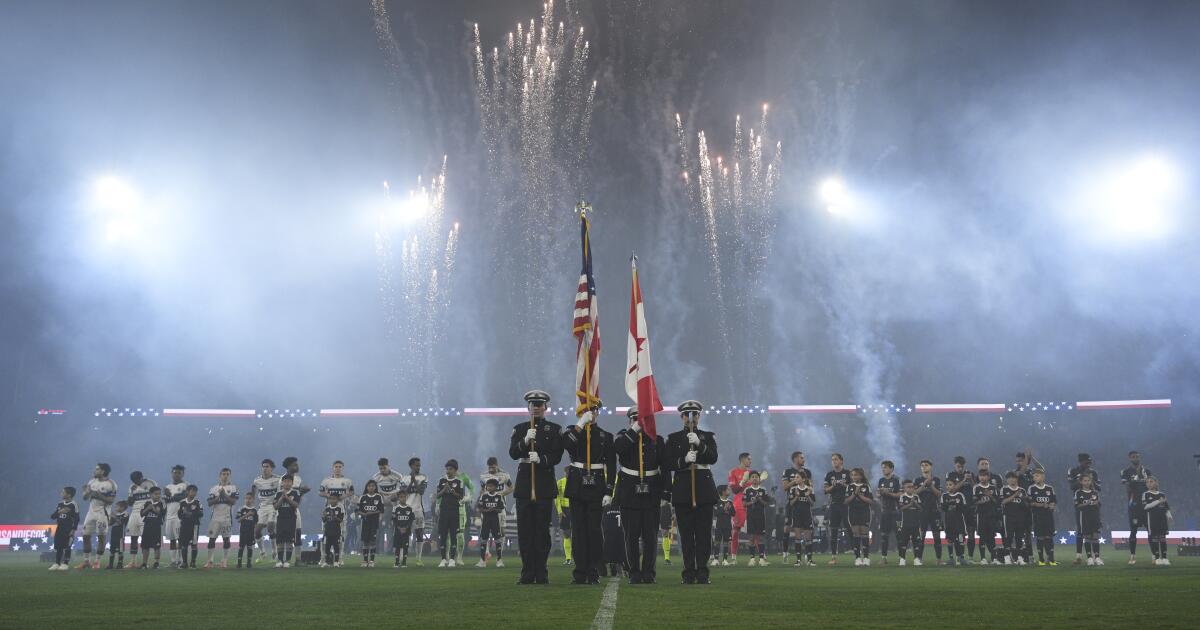
opening ceremony

Winter Olympics opening ceremony review: A sleek Italian spectacle

The Olympics are back, wearing their warm Winter Games gear. Although there were will be a couple of weeks of sports competitions to come, none are possible without an opening ceremony, a combination of solemn official protocol with a fantastic representation of the host country’s culture and character, evoking the Olympic spirit itself. There are few opportunities to mount an entertainment of this scale — not even a Super Bowl halftime show can compare.

This year we are in Italy, for the bi-metropolitan Milan-Cortina games, held in the city’s San Siro Stadium and in the north where the mountains are. The ceremonies, too, were split geographically, with Olympic cauldrons in both cities, with the athletes’ parade further shared with Livigno and Predazzo, national delegations divided according to where their events would be held.

1

Three dancers in black wearing giant heads of older men.

2

Dancers in white and black leotards surround a conductor in the middle of a stage.

1. Human bobbleheads of Italian composers Rossini, left, Puccini and Verdi. (Robert Gauthier/Los Angeles Times) 2. Dancers on stage in San Siro Stadium. (Robert Gauthier/Los Angeles Times)

The main business took place in the arena. Directed by Marco Balich, who specializes in big shows, it was elegant, in a sleek, clean-lined Italian way, and over the top, also in an Italian way. Color played a great part, the program beginning in white (a balletic interpretation of Antonio Canova’s sculpture “Psyche Revived by Cupid’s Kiss”), moving to to black and white (a nod to Fellini’s “La Dolce Vita” and its paparazzi), and then to a riot of color, as giant floating tubes of paint sent streams of colored fabric stageward.) There were dancing human bobbleheads of opera composers Verdi, Puccini and Rossini, as if they were mascots for Team Rigoletto, Team Tosca and Team William Tell. There were dancing gladiators and moka pots, a phalanx of runway models dressed (in Armani) in green, white and red, to represent the Italian flag.

In white and shiny silver, with an ostrich feather boa and a reported $15 million worth of diamond jewelry, there was a statuesque, statue-still Mariah Carey, who is not Italian, but sang in Italian, the standard “Nel blu, dipinto di blu,” known here as “Volare,” which merged into her own “Nothing Is Impossible.” (She must by now be accounted a citizen of the world.) Why did I find this so moving? I am not someone who ordinarily cares anything about Carey, but she was marvelous in this context.

A woman in a white gown singing on a stage.

Mariah Carey performed the Italian tune “Volare,” before leading into “Nothing Is Impossible.”

(Robert Gauthier/Los Angeles Times)

The parade of nations is also a fashion show; for whatever reason, the cold weather gear is generally better looking than the togs of summer. (As usual, Ralph Lauren designed the American outfits — white puffy jacket with knit caps of a Scandinavian pattern.) As ever, the countries arrived alphabetically (apart from Greece, who always gets to march first; Italy, coming in last as the host country; France, in penultimate position as the host of the next Winter Games; and the U.S., third to last as the host of the games, in 2034, after that). It makes neighbors of Lebanon, Lichtenstein and Lithuania, and so on, equal in standing if not in size. (I have a special fondness for the small delegations from the less imposing nations.) There was an especially big hand for the Ukrainian team, dressed in their national colors.

The second half opened with a cartoon in which an animated Sabrina Impacciatore (of “The White Lotus” and, “The Paper,” which NBC happily did not cross-promote), traveled backward through previous Winter Games before coming to life to lead an energetic production number that traveled back to now. (She should get some sort of athletic medal for this performance.) The Chinese pianist Lang Lang accompanied Cecilia Bartoli singing the Olympic anthem, and the great Andrea Bocelli, flanked by strings, offered a thrilling reading of Puccini’s “Nessun Dorma.” Surrounded by dancers, the Italian rapper Ghali read an antiwar poem by Gianni Rodari.

A woman in a silver and gold leotard surrounded by dancers on a stage.

Sabrina Impacciatore leading a group of dancers during the ceremony.

(Robert Gauthier/Los Angeles Times)

The theme of the evening, and of evenings going forward, it is hoped, was “Armonia,” or harmony, not just between the city and the country (expressed symbolically through dance), but, as a series of speeches made clear, among everybody, everywhere.

“At a time when so much of the world is divided by conflict, your very presence demonstrates that another world is possible. One of unity, respect and harmony,” said Giovanni Malagò, president of the organizing committee, addressing the athletes. Kirsty Coventry, the first female president of the IOC, noted that while Olympic athletes are fierce competitors, they “also respect, support and inspire one another. They remind us that we are all connected, that our strength comes from how we treat each other, and that the best of humanity is found in courage, compassion and kindness.”

And then there was Charlize Theron, of all people, quoting her countryman Nelson Mandela: “Peace is not just the absence of conflict; peace is the creation of an environment where all can flourish, regardless of race, color, creed, religion, gender, class, caste or any other social markers of difference,” This is, of course, exactly what some portion of this nation would call “woke,” and though such divisions are not the exclusive province of the United States, it was easy enough to read this as a message delivered to the White House.

A woman in a black gown stands on a stage with a microphone.

Charlize Theron quoted her fellow countryman Nelson Mandela in her speech.

(Robert Gauthier/Los Angeles Times)

Finally, two Olympic torches were lit two Olympic cauldrons, in Milan and Cortina, their flames at the center of shape-shifting spheres. Almost inevitably, the ceremonies flirted with, or embraced, corniness at times, but even (or especially) when it was corny, it was terrifically affecting. I ran through half a dozen handkerchiefs over the course of the proceedings. Admittedly, I might be unusually susceptible to these things, but I doubt I’m the only one.

Let the games begin.

Source link

Amid protests over ICE’s presence at the Olympics, will American athletes get booed?

Many of the officials supporting the nearly 250 U.S. athletes competing in this month’s Winter Olympics arrived in Italy last weekend to a greeting they may not have expected: Hundreds of demonstrators packed a square in central Milan to protest the reported plan to deploy U.S. Immigration and Customs Enforcement agents during the Games.

The first events in the 18-day competition, which will be shared by Milan and Cortina d’Ampezzo in the Italian Alps, begin Thursday and the opening ceremony is scheduled for Friday. Against that background, International Olympic Committee President Kirsty Coventry called the agents’ involvement “distracting” and “sad.”

“This is a militia that kills. They are not welcome in Milan,” Mayor Giuseppe Sala said on local radio ahead of the protests, which took place beneath the neoclassical Porta Garibaldi arch in the Piazza XXV Aprile, named for the date of Italy’s liberation from Nazi fascism in World War II.

Many demonstrators blew whistles and carried signs of the five Olympic rings rendered as handcuffs above the words “No ICE in Milan.” One woman held a handmade poster featuring photos of Renee Good and Alex Pretti, the two Minnesotans killed by federal agents last month, alongside Liam Conejo Ramos, the 5-year-old boy in the blue bunny hat who was taken from his home in Minneapolis to a detention facility in Texas.

Anti-ICE protests in Piazza XXV Aprile before the Olympics in Milan

Anti-ICE protests take place in Piazza XXV Aprile ahead of the Olympics in Milan.

(Lucia Buricelli / Associated Press)

“All the videos are public and everyone can see what’s happening,” Bruna Scanziani, an 18-year-old demonstrator told reporters. “The perception of America has changed.”

Tricia McLaughlin, an assistant secretary for the Department of Homeland Security, confirmed the presence of ICE agents in Italy to the Athletic, leaving her department, the U.S. Consulate and the U.S. Olympic and Paralympic Committee to try to cool the controversy.

DHS said the agents dispatched to Milan are not immigration agents but come from a unit known as Homeland Security Investigations, which specializes in cross-border crime. They commonly provide intelligence and security at large sporting events, both in the U.S. and overseas, but in Milan their role will be strictly advisory and intelligence-based, Ambassador Tilman J. Fertitta said.

Travelers pass through the lobby of Milan Linate Airport M4 Metroline train station

Travelers pass through the lobby of Milan Linate Airport M4 Metroline train station Tuesday.

(Robert Gauthier/Los Angeles Times)

The U.S. Olympic and Paralympic Committee, meanwhile, said it is working with the Diplomatic Security Service, which is under the umbrella of the State Department, unlike ICE, which is part of Homeland Security. The Diplomatic Security Service has been providing security for U.S. delegations at every Olympics since 1992.

“The USOPC does not work with U.S. domestic law enforcement or immigration agencies in the planning or execution of the Games, including agencies within the Department of Homeland Security often referred to as ICE,” the committee said in a statement. “Italian authorities are solely responsible for all security operations at the Games.”

Despite the tensions, in the days before the Games there were few signs of the kind of heavy security presence that marked the Paris Olympics 17 months ago. At Linate Airport, the closest of Milan’s three airports to the city center, two camouflage-clad Italian soldiers with long guns milled outside the arrival gates Monday evening. They were gone by Tuesday afternoon.

Five miles away at the Piazza del Duomo, the cultural and social heart of Milan, two pairs of soldiers stood on either side of the massive square, huddling under white awnings on either side of a pop-up Olympic souvenir tent and ignoring the hundreds of international tourists raising their phones to take photos of the ancient Gothic cathedral that gives the square its name.

A building located in the heart of Piazza del Doumo is lit up with animated Olympic competitors

A building located in the heart of Piazza del Doumo is lit up with animated Olympic competitors Tuesday.

(Robert Gauthier/Los Angeles Times)

Up the street, where the trolley tracks curve before the trendy shops and restaurants that line the busy Via Orefici, groups of city police and Carabinieri, the national police known by their black Giorgio Armani-designed uniforms, joked among themselves. They were far less menacing than the roving patrols of soldiers and police officers that were ubiquitous in France.

A local woman shrugged at the officers’ presence.

“Being the iconic and most touristy place of Milan,” she said “there are always lots of police and soldiers.”

It’s unclear how American athletes will be received during Friday’s opening ceremony, which Vice President JD Vance and Secretary of State Marco Rubio are expected to attend.

“When they have the flag and when they have the tracksuit and they’re announced as the U.S., that’s obviously an opportunity for the spectators to make known their feelings about the U.S.,” said Kristian Coates Ulrichsen, a fellow for Middle East studies at Rice University’s Baker Institute and an expert on sports and international relations.

Europeans have strong feelings about the U.S. right now, feelings spurred by more than the images of ICE agents that have led TV newscasts and have filled social media feeds for months in Italy and beyond. In the last few months, President Trump has sent forces into Venezuela to removes its president, threatened military action against Iran, fired on alleged drug boats in the Caribbean and Pacific, and disparaged Europe as “decaying” and its leaders as “weak.”

Demonstrators protesting ICE in Milan

Demonstrators in Milan hold signs protesting ICE in solidarity with the people of Minneapolis on Saturday.

(Alessandro Bremec / Associated Press)

“Without us,” he said in a combative speech before the World Economic Forum in Davos, Switzerland, “you’d all be speaking German.”

What has upset the continent most amid the chaos, however, is Trump’s insistence that the U.S. take control of Greenland from Denmark, a loyal North Atlantic Treaty Organization ally, warning the Danes and seven other countries that they would be hit with 25% tariffs if they didn’t relent. Many in Europe’s far-right parties, whose members are often supportive of Trump, now consider the U.S. president an “enemy of Europe,” according to a poll published by the Paris-based platform Le Grand Continent.

As a result of the blowback, Trump has backed away from the tariff threat and said he wouldn’t take control of Greenland by force, but the fallout from tensions remains.

“Greenland, especially, has really touched a nerve. That’s unfortunate coming right in the run-up to the Olympics,” said Coates Ulrichsen, who was born in Greece to English and Norwegian parents.

And that makes the U.S. team and its 232 athletes, the largest contingent at the Milan-Cortina Olympics, a convenient foil for European wrath.

“The national team is symbolic of the nation. That just makes it such a target for any potential political frustration,” Coates Ulrichsen said. “It wouldn’t be the first time.”

During the 2004 Summer Games in Athens, for example, which opened 17 months after the American-led invasion of Iraq, the U.S. team was roundly booed.

“The Olympics have been no stranger to politics,” Coates Ulrichsen said. “And obviously the key element [of athletes] walking out behind a flag is a very easy target in a way.”

Some Italians aren’t so sure.

“My personal view is that U.S. athletes will not be targeted by the protests,” said one woman who asked that her name not be used because she works with many international clients, including some in the United States. “It is more of a political subject.”

She also said the attitude of Italian Prime Minister Giorgia Meloni, among the European leaders most supportive of President Trump, has blunted public opposition to the U.S.

The Olympic Rings ahead of the Milano Cortina 2026 Winter Olympics on Tuesday.

The Olympic Rings ahead of the Milano Cortina 2026 Winter Olympics on Tuesday.

(Mattia Ozbot / Getty Images)

Because this month’s Games, the first Winter Olympics to officially have co-host cities, will be spread across four clusters covering about 8,500 square miles in northern Italy, there will be four opening ceremonies Friday, with the main one at San Siro Olympic Stadium in Milan beginning at 11 a.m. Pacific time. Smaller events will take place simultaneously in the mountain venues of Cortina d’Ampezzo, Valtellina and Val di Fiemme.

Bobsledder Azaria Hill, a first-time Olympian whose mother, father and aunt all competed in the Summer Games, said marching in the opening ceremony has long been a dream of hers. And she doesn’t think politics will spoil that Friday.

“Olympics brings all the nations together,” she said. “That’s one of the special things about the Olympics, and you really see that in the unity. I think everything will be fine.”

In an effort to separate athletes from politicians, the U.S. governing bodies for three winter sports — figure skating, speedskating and hockey — changed the name of their Milan hospitality space to the Winter House.

They had planned to call it the Ice House.

Source link

IOC president calls Casey Wasserman emails, ICE sad distractions

Two years before the Los Angeles Olympics, the United States is already dominating the narrative in the run-up to the opening ceremony of the Milan-Cortina Winter Games.

International Olympic Committee officials, including President Kirsty Coventry, couldn’t avoid questions relating to ICE and the Jeffrey Epstein files at a news conference in Milan, Italy, on Sunday.

Coventry tried to fend them off by saying it was not the IOC’s place to comment on the issues, but when pressed remarked it was “sad” that such stories were deflecting attention away from the upcoming Olympics.

“I think anything that is distracting from these Games is sad, right? But we’ve learned over the many years … there’s always been something that has taken the lead, leading up to the Games,” Coventry said. “Whether it has been Zika, COVID, there has always been something.

“But what is keeping my faith alive is that when that opening ceremony happens and those athletes start competing, suddenly the world remembers the magic and the spirit that the Games have and they get to suddenly remember what’s actually important and they get to be inspired, and so we’re really looking forward to that.”

Hundreds of demonstrators gathered Saturday in Milan to protest the deployment of U.S. Immigration and Customs Enforcement agents during the upcoming Winter Olympics, although agents would be stationed in a control room and not operating on the streets.

Meanwhile, the latest collection of government files released on Epstein includes emails from 2003 between Casey Wasserman, the head of the Los Angeles Olympics organizing committee, and Epstein’s one-time girlfriend, Ghislaine Maxwell.

“From all the information that we have and I believe that the U.S. authorities, as the other authorities, have made all the clarifications needed, so from our side that’s not for us to further comment on that part of the security. But we’re really looking forward to the Games,” Coventry said when asked about the presence of ICE agents in Milan.

She was even less responsive when asked about Wasserman.

“We didn’t discuss it yesterday and I believe Mr. Wasserman has put out his statement and we now have nothing further to add,” said Coventry, who was elected just over 10 months ago as the first female IOC president.

The upcoming Olympics run from Friday through Feb. 22. U.S. Vice President JD Vance will lead an American delegation to the Milan-Cortina Games and attend the opening ceremony.

Matar writes for the Associated Press.

Source link