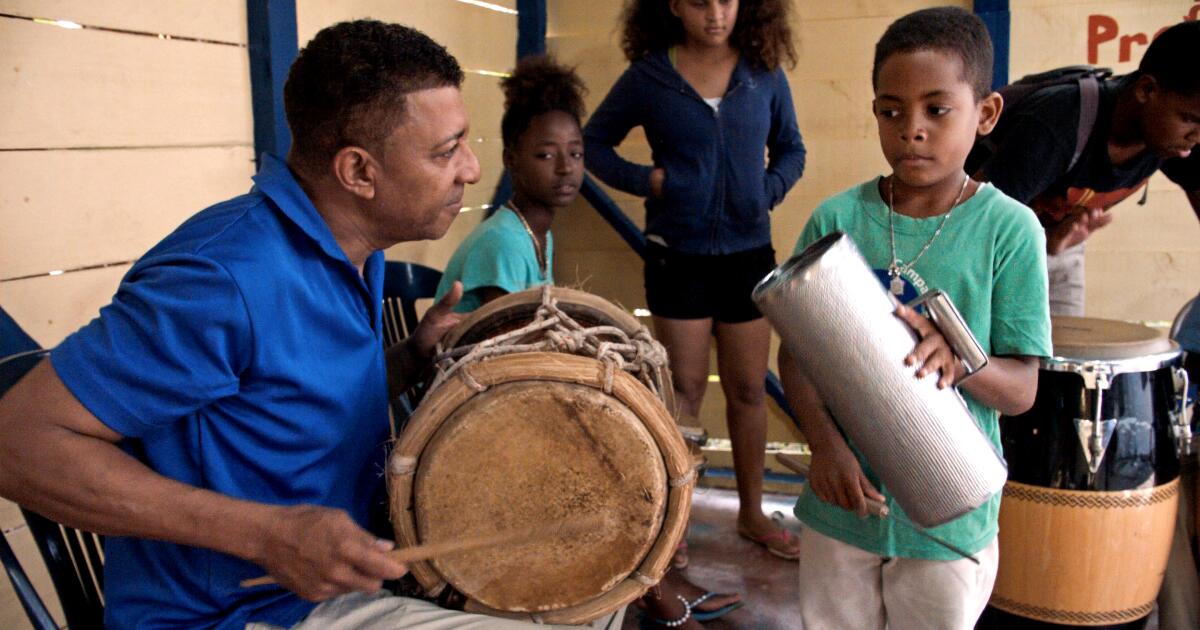
In the coming-of-age documentary ‘Agridulce,’ the kids are keeping bachata alive
Before becoming a global phenomenon in the 2000s thanks to artists like Aventura, Monchy y Alexandra and Prince Royce, and before being declared an “intangible cultural heritage of humanity” by UNESCO in 2019, bachata was — and continues to be — the soundtrack of the Dominican Republic.
The importance of the genre to the people of the Caribbean nation is at the heart of “Agridulce,” a music documentary that had its world premiere at this month’s South by Southwest Film Festival in Austin, Texas. Filmed over the course of five years, the feature follows four young students at Academia de Bachata, a music conservatory in the beachside resort town of Cabarete. It’s the only school of its kind in the world.
Academia de Bachata was founded in 2013 by music producer Benjamin De Menil. After traveling to the Dominican Republic to record for nearly three decades, De Menil says he wanted to create something that would ensure that the next generation continues the traditions of bachata.
“One of the things I loved about the bachata musicians I was working with early on is that they were such natural musicians. There was never any sheet music, so whenever we were going to record I would say, ‘Let’s do this song and it goes like this,’ and they would listen to it for a little bit before they figured it out and they were playing it,” he said. “I thought that we could somehow harness that energy in a more organized and educational format and make a school where we’re helping young children become professional musicians within this genre that has a lot of opportunity.”
De Menil partnered with DREAM Project, a nonprofit organization that did work in Cabarete, and launched Academia de Bachata in 2013. Since then, the school has provided hundreds of children with a free musical education.
“There were a lot of things we were trying to figure out along the way about what the best way to teach this music was because this wasn’t your typical conservatory. We were focusing on the traditions passed on rather than some style of music that there are already textbooks for.”
To make “Agridulce,” De Menil, who produced the film, reached out to Frank Pavich, director of the 2013 “Jodorowsky’s Dune,” the cult classic documentary about avant-garde filmmaker Alejandro Jodorowsky’s quixotic and failed attempt to adapt Frank Herbert’s 1965 sci-fi novel “Dune.” It didn’t take much to bring him on onboard.
“Ben contacted me and told me about the project. I responded with what’s Bachata?,” the Croatian American director said. “I had never even heard of the musical genre. And then he sent me some music. He sent me footage that he had shot of [Cabarete] and of the school. And it was unlike anything I’d ever seen. It was so colorful and so incredible that I just wanted to jump on right away. I was like, ‘Great, when can we go down there and start shooting? It was really that fast.”
Pavich says now he hears bachata everywhere.
“I live between Switzerland and Croatia and now that I know how to pick it up, I hear it in cars passing by a cafe in Geneva and in Croatia,” he said. “It’s everywhere, it’s infiltrated everything in the best way possible.”
“Agridulce” is an ethnomusicological documentary — it captures the music of a specific place and people and shows how the tradition is kept alive — that also doubles as a coming of age story. The film follows students of varying ages — Edickson, Frandy, Orianny and Yerian — out of the classroom, showing us moments of intimacy with their families and friends while also giving us a slice of quotidian life in Cabarete.
As such, “Agridulce” doesn’t shy away from the political tensions of the beachside resort. Much like in the U.S., immigration is a contentious topic in the Dominican Republic — the country shares the island of Hispaniola with Haiti, which has seen an exodus of its people over the decade.
De Menil and Pavich said that nearly a third of Academia de Bachata’s student body is of Haitian descent, and that they would have had to go out of their way to not include one of them in the film.
This tension plays out in the storyline of Frendy, a magnetic student of Haitian descent who uses bachata to fit in.
“Many young people are in that position of being made to feel they don’t belong at that time in life when a person most wants to find their place,” De Menil said. “We see that music can help kids, particularly immigrant kids, find belonging.”
“The film ultimately speaks to the way that culture and shared history contribute to the development of authentic, lived creativity,” said South by Southwest consulting programmer Jim Kolmar. “It’s something innate and inevitable, and ‘Agridulce’ really explores that beautifully. Obviously it’s full of incredible music, but the deeper cultural context is essential, and seeing it through the perspective of the students at Academia de Bachata helps us connect the dots.”