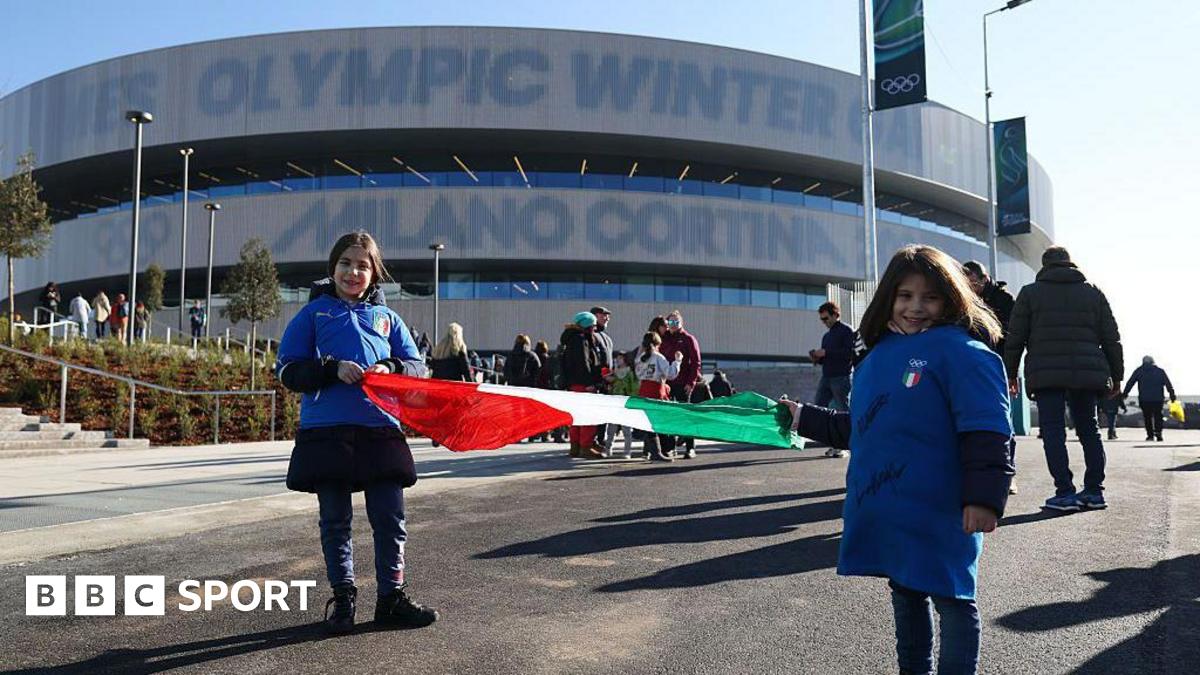
Beset by delays, concerns and last-minute building works, the Milano Santagiulia Ice Hockey Arena finally opened its doors to the Olympics on Thursday.
And while, as the International Olympic Committee admitted, it was not completely ready for its opening game, the arena was in a much better state than it had been when BBC Sport visited five days prior.
The 11,800-capacity stadium was nearly full for the Group B match between Italy and Olympic debutants France, won 4-1 by the host nation.
On the Saturday before the fixture, we found a frantic construction site, with building materials and dust inside and outside the stadium.
Rubbish littered the floor, lifts and toilets were covered in plastic wraps and many areas of the arena, including hospitality boxes as well as food and drink stalls, were unfinished.
Christophe Dubi, the International Olympic Committee’s executive director for the Olympic Games, admitted on Sunday: “Do we have every single space in that venue finished? No. And is everything in that venue needed [for the matches to take place]? No.”
Returning on the morning of the first game – about three hours before face-off – we found the piles of rubble and building materials gone from the concourses inside and out.
Not all the amenities were quite ready, with merchandise stalls being built and posters still to be put up. This is just over three hours before the opening match.
Inside the arena, one side of the stadium was simply a big black wall. This houses temporary stands on top of what will eventually be a stage for concerts, and was supposed to feature large boards with Olympic branding.
In the stands, it was very dusty and dirty. The arena had the feel of a new build, finished in a hurry without much spit and polish.
And around the stadium, it is an actual building site. The arena stands virtually alone in wasteland, 25 minutes’ walk from the nearest metro station and with no amenities, barring a car park, nearby. Bella Italia this is not.
Friday’s live TV and streaming broadcasts unless noted (subject to change). All events stream live on Peacock or NBCOlympics.com with a streaming or cable login. All times Pacific.
OPENING CEREMONY: 11 a.m.| NBC, Peacock (replay at 8 p.m. on NBC)
MULTIPLE SPORTS 7 p.m. — “Primetime in Milan” (delay): Figure skating, curling, hockey, skiing and more.| NBC
ALPINE SKIING 2:30 a.m. — Men’s downhill, training | Peacock 2:30 a.m. — Women’s downhill, training | Peacock
CURLING Mixed doubles (round robin) 1:05 a.m. — U.S. vs. Canada | Peacock 1:05 a.m. — Italy vs. Switzerland | Peacock 1:05 a.m. — Sweden vs. Britain | Peacock 5:35 a.m. — Czechia vs. U.S. | Peacock 5:35 a.m. — Estonia vs. Italy | Peacock 5:35 a.m. — South Korea vs. Britain | Peacock 5:35 a.m. — Sweden vs. Norway | Peacock 5:55 a.m. — Czechia vs. U.S. (in progress) | USA
FIGURE SKATING Team competition 1 a.m. — Rhythm dance | USA 2:35 a.m. — Pairs, short program | USA 4:35 a.m. — Women, short program | USA
HOCKEY Women (group play) 3:10 a.m. — France vs. Japan | Peacock 5:40 a.m. — Czechia vs. Switzerland | Peacock
From Kevin Baxter: Many of the officials supporting the nearly 250 U.S. athletes competing in this month’s Winter Olympics arrived in Italy last weekend to a greeting they may not have expected: Hundreds of demonstrators packed a square in central Milan to protest the reported plan to deploy U.S. Immigration and Customs Enforcement agents during the Games.
The first events in the 18-day competition, which will be shared by Milan and Cortina d’Ampezzo in the Italian Alps, begin Thursday and the opening ceremony is scheduled for Friday. Against that background, International Olympic Committee President Kirsty Coventry called the agents’ involvement “distracting” and “sad.”
“This is a militia that kills. They are not welcome in Milan,” Mayor Giuseppe Sala said on local radio ahead of the protests, which took place beneath the neoclassical Porta Garibaldi arch in the Piazza XXV Aprile, named for the date of Italy’s liberation from Nazi fascism in World War II.
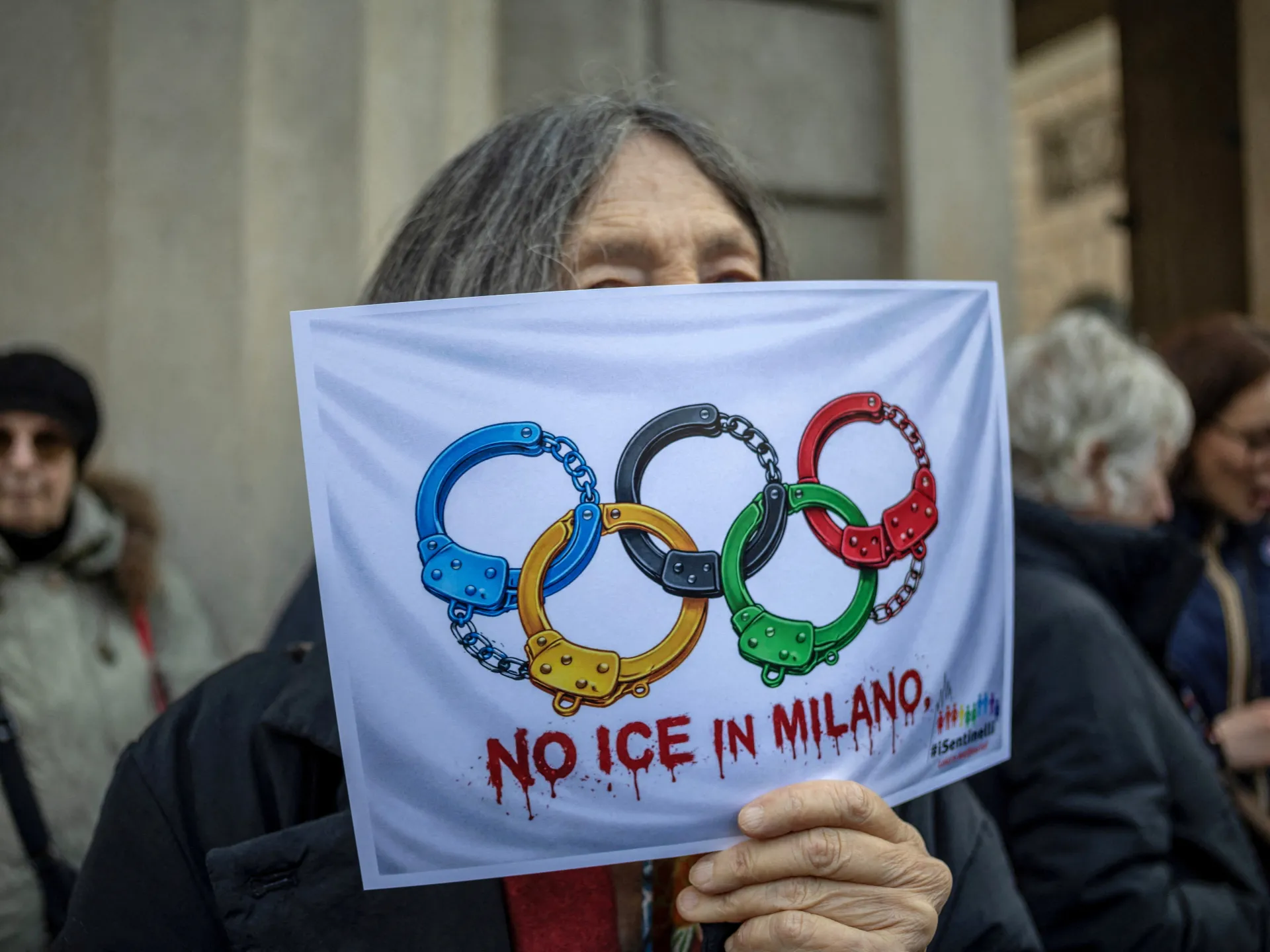
Many demonstrators blew whistles and carried signs of the five Olympic rings rendered as handcuffs above the words “No ICE in Milan.” One woman held a handmade poster featuring photos of Renee Good and Alex Pretti, the two Minnesotans killed by federal agents last month, alongside Liam Conejo Ramos, the 5-year-old boy in the blue bunny hat who was taken from his home in Minneapolis to a detention facility in Texas.
From Thuc Nhi Nguyen: Amber Glenn achieved a lifelong goal, sealing her Olympic bid by winning her third consecutive U.S. championship last month. Her first celebration came with her opponents.
“We all deserve it,” Glenn said with her arms wrapped around national silver medalist Alysa Liu and bronze medalist Isabeau Levito.
The spirit of collaboration has brought U.S. figure skating into a new golden age. The 16-athlete team the United States sent to Milan may be the country’s strongest Olympic team in decades. With three reigning world champions and three current Grand Prix final champions, the United States is poised for one of its best Olympic Games ever in figure skating.
Starting Saturday, you will receive a separate newsletter containing all the Olympics news from our reporters in Italy, including a medal count and TV listings. Sports Report subscribers will automatically get this newsletter, and it should arrive around 3 a.m. in your inbox.
Thursday’s Oly TV/streaming schedule
Thursday’s live TV and streaming broadcasts. All times Pacific.
The first day of full competition begins Saturday.
ALPINE SKIING 2:30 a.m. — Men’s downhill, training | Peacock
CURLING Mixed doubles (round robin) 1:05 a.m. — Norway vs. U.S. | Peacock 1:05 a.m. — Britain vs. Estonia | Peacock 1:05 a.m. — South Korea vs. Italy | Peacock 1:05 a.m. — Sweden vs. Czechia | Peacock 5:35 a.m. — U.S. vs. Switzerland | USA 5:35 a.m. — Norway vs. Canada | Peacock 10 a.m. — Canada vs. Italy | USA 10:05 a.m. — Czechia vs. Britain | Peacock 10:05 a.m. — Estonia vs. Sweden | Peacock 10 a.m. — Switzerland vs. South Korea | Peacock 2 p.m. — Norway vs. U.S. (delay) | CNBC
HOCKEY Women (group play) 3:10 a.m. — Sweden vs. Germany | Peacock 5:40 a.m. — Italy vs. France | Peacock 7:40 a.m. — U.S. vs. Czechia | USA 12:45 p.m. — Finland vs. Canada | USA
SNOWBOARDING 10:30 a.m. — Men’s big air, qualifying | USA
Checking in on Dodgers’ commitment
From Bill Shaikin: Not long after Pacific Palisades and Altadena had burned, Gov. Gavin Newsom summoned reporters and television cameras to Dodger Stadium. Newsom stepped behind a podium dropped within a stadium parking lot, with a commanding view of Los Angeles as the backdrop.
He was there to unveil LA Rises, a signature initiative under which the private sector and philanthropists could unite to help Southern California rebuild and recover.
The most valuable player that day: Mark Walter, the Dodgers’ chairman and controlling owner. The big announcement: Walter and two of his associated charities — his family foundation and the Dodgers’ foundation — would contribute up to $100 million as “an initial commitment” to LA Rises.
One year later, Newsom’s initiative has struggled to distinguish itself amid a panoply of wildfire relief efforts. LA Rises has delivered $20 million to date, including $7.8 million from Walter’s family foundation, according to Newsom’s office.
From Gary Klein: If he returns for an 18th NFL season, Rams quarterback Matthew Stafford will almost certainly demand a significant raise. And receiver Puka Nacua is positioned to potentially break the bank with an extension.
Those are just two issues Rams general manager Les Snead will deal with in the coming weeks and months as the franchise retools for the 2026 season.
Snead, who along with coach Sean McVay signed extensions this week, said Wednesday during a videoconference with reporters that the “opportunity to continue shouldering my responsibility” along with McVay and other executives for owner Stan Kroenke was “the opportunity of a lifetime.”
Former Baltimore slugger and cancer survivor Trey Mancini is taking another shot at a major league comeback after agreeing to a minor league contract with the Angels that includes an invitation to big league spring training.
The Angels on Wednesday listed the infielder among their 27 non-roster invitees to camp in Tempe, Ariz.
The 33-year-old Mancini has batted .263 with 129 homers and 400 RBIs over parts of seven seasons, but he hasn’t played in the major leagues since 2023. He began his career by playing parts of six seasons with the Orioles, hitting a career-high 29 homers in 2019.
Darius Garland could not have been more in transition than he was Wednesday night on his first day with his new team.
Officially traded earlier in the day from the Cleveland Cavaliers to the Clippers for 11-time All-Star James Harden, Garland talked about his upheaval during halftime of Wednesday’s game between his current and former teams, a game the Cavaliers won, 124-91.
“I knew about it. It wasn’t a shock, though,” the two-time All-Star said. “It’s the business of basketball. Cleveland was great to me and my family, and I have respect for all of those guys over there. … Seven years was a really long time, and it was great. I’m glad I’m here now. The next chapter in my book.”
Headlined by first and third quarter dominance, No. 2 UCLA women’s basketball picked up a 86-46 win over Rutgers (9-14, 1-11) at Pauley Pavilion on Wednesday night.
Kiki Rice led the Bruins (22-1, 12-0 Big Ten) with 17 points and seven rebounds, while Gabriela Jaquez got things started, scoring 10 of her 14 points in the first quarter.
Rutgers, playing without its two leading scorers in Nene Ndiaye and Imani Lester, committed 18 turnovers that the Bruins converted into 25 points.
The Kings acquired high-scoring left wing Artemi Panarin from the New York Rangers on Wednesday for a conditional third-round draft pick and prospect Liam Greentree.
The Kings then signed Panarin to a two-year, $22-million contract that will keep the Russian forward in Los Angeles through the 2027-28 season.
The trade ends weeks of uncertainty around the future of the 34-year-old Panarin, who hadn’t played since Jan. 26 while the Rangers held him out in anticipation of trading their top scorer in each of the past seven consecutive seasons. He currently leads New York with 57 points in 52 games.
Shane Wright scored twice to lead the Seattle Kraken to a 4-2 win over the Kings on Wednesday night.
Vince Dunn and Adam Larsson also scored and Chandler Stephenson and Frederick Gaudreau each had two assists for the Kraken, who have won five of their last six games. Joey Daccord made 25 saves.
Andrei Kuzmenko scored both of the Kings’ goals and Darcy Kuemper made 19 saves.
Sunday at Santa Clara Seattle vs. New England 3:30 p.m. PT, NBC, Peacock, Telemundo, KLAC AM 570 Halftime show: Bad Bunny National anthem: Charlie Puth Odds: Seahawks favored by 4.5 points Over/Under: 45.5 points
This day in sports history
1913 — The New York State Athletic Commission bans boxing matches between fighters of different races.
1919 — Charges against Cincinnati’s Hal Chase of throwing games and betting against his team are dismissed by National League president John Heydler. Two weeks later, Chase is traded to the New York Giants.
1948 — After landing the first double axel in Olympic competition, Dick Button becomes the first American to win the Olympic gold medal in figure skating. Gretchen Fraser becomes the first U.S. woman Olympic slalom champion.
1960 — Bill Russell grabs 51 rebounds in the Boston Celtics’ 124-100 victory over the Syracuse Nationals. Russell is the first player in NBA history to pull in 50 or more rebounds.
1972 — Bob Douglas is the first Black person elected to Basketball Hall of Fame. Known as “The Father of Black Professional Basketball,” Douglas owned and coached the New York Renaissance from 1922 until 1949.
1976 — Austrian Franz Klammer wins the Olympic gold medal in the downhill at Innsbruck, Austria. Bill Koch wins a silver in the 30-kilometer cross-country race to become the first American to win a medal in a Nordic event.
1980 — Gordie Howe plays his 23rd and final All-Star Game. Howe doesn’t score, but sets up the final goal of the game, by Real Cloutier, in the Wales Conference’s 6-3 win against the Campbell Conference at Joe Louis Arena in Detroit.
1990 — Notre Dame bucks the College Football Association and becomes the first college to sell its home games to a major network, agreeing to a five-year contract with NBC beginning in 1991.
1991 — Dave Taylor of the Kings has two assists in a 3-2 win over the Philadelphia Flyers to become the 29th player in NHL history with 1,000 points.
1999 — Patrick Roy, at 33, becomes the youngest goalie in NHL history to earn 400 wins when he makes 26 saves in the Colorado Avalanche’s 3-1 win against the Red Wings at Joe Louis Arena.
2003 — Bode Miller of the United States captures his first major title, winning the gold medal in the combined at the world championships in St. Moritz, Switzerland.
2006 — Pittsburgh wins a record-tying fifth Super Bowl, but its first since 1980 with a 21-10 win over the Seattle Seahawks.
2009 — Tennessee’s Pat Summitt becomes the first Division I basketball coach — man or woman — to win 1,000 games after her Lady Vols beat Georgia 73-43.
2011 — Dejen Gebremeskel of Ethiopia wins the men’s 3,000 at the Boston Indoor Grand Prix, after losing his right shoe at the start of the race. Gebremeskel stays close to the lead throughout the race and takes over on the final lap to finish in 7:35.37. Britain’s Mo Farah finishes second in 7:35.81.
2012 — Eli Manning and the Giants one-up Tom Brady and the Patriots again, coming back with a last-minute score to beat New England 21-17 for New York’s fourth Super Bowl title.
2017 — Tom Brady leads one of the greatest comebacks in sports, let alone Super Bowl history, lifting New England from a 25-point hole to the Patriots’ fifth NFL championship in the game’s first overtime finish. The Patriots score 19 points in the final quarter, including a pair of two-point conversions, then marches relentlessly to James White’s two-yard touchdown run in overtime beating the Atlanta Falcons 34-28.
2022 — Six days before his 50th birthday, 11-time world surfing champion Kelly Slater wins his eighth Pipeline title beating 22-year old Hawaiian Seth Moniz in the final.
Compiled by the Associated Press
Until next time…
That concludes today’s newsletter. If you have any feedback, ideas for improvement or things you’d like to see, email me at houston.mitchell@latimes.com. To get this newsletter in your inbox, click here.
Italy has foiled “Russian origin” cyber-attacks targeting the Winter Olympics, says Foreign Minister Antonio Tajani.
He said websites linked to the Games, hotels in host town Cortina d’Ampezzo and foreign ministry facilities, including an embassy in Washington, were targeted.
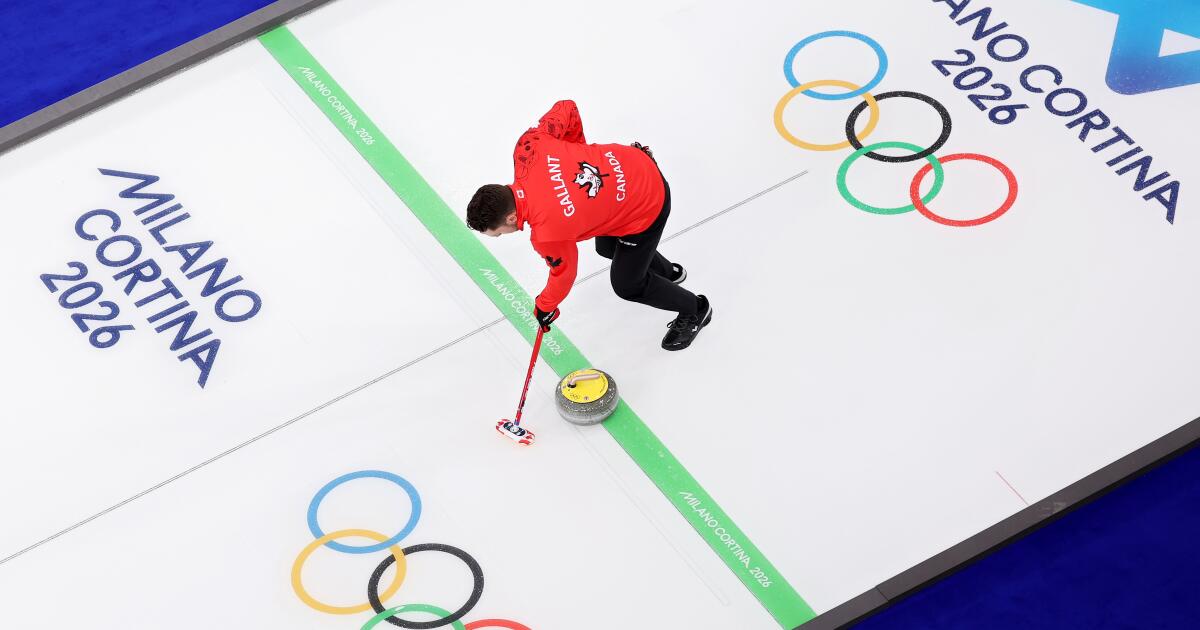
Cortina d’Ampezzo, one of five host clusters for the Olympics, will stage alpine skiing, biathlon, curling, and sliding events.
“We prevented a series of cyber-attacks against foreign ministry sites. These are actions of Russian origin,” said Tajani.
The Games officially begin on Friday, although the first action got under way on Wednesday.
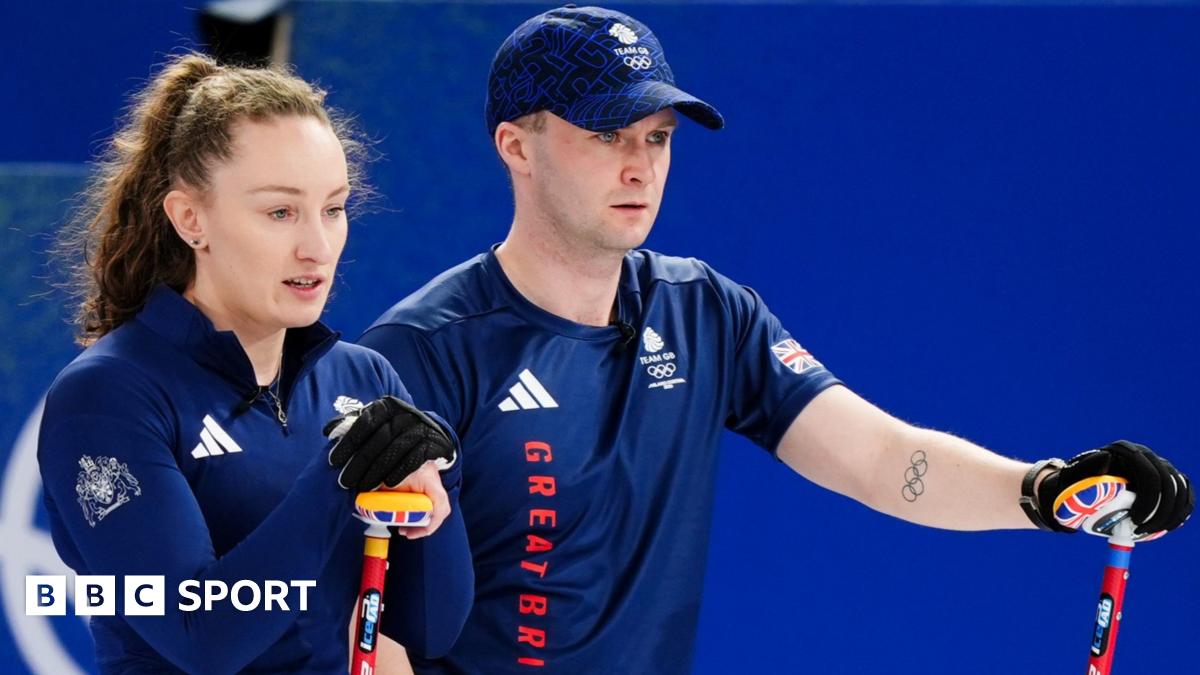
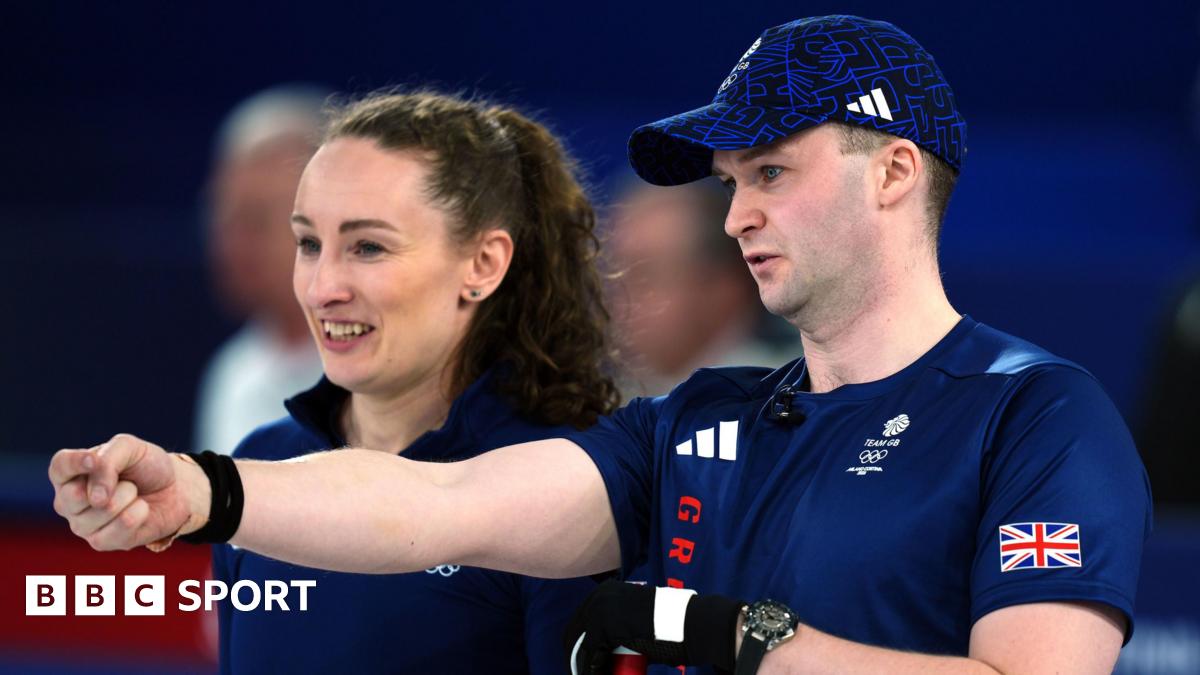
GB started with the hammer, took two in accomplished first end, and looked like they might enjoy a comfortable start to the day in Italy.
Estonia responded by doing the same, though, after a slight Dodds error with her last stone. “Sorry, Bruce,” said the 34-year-old, who was slightly errant again with her opening rock of the third end.
But Dodds, peerless against Norway, righted herself to deliver a magnificent final store and restore GB’s two-point advantage.
The Estonians should have pulled level again, but a Marie Kaldvee mistake ensured they still trailed at the break. “It’s been a bit of back and forth,” was how 2022 Olympic gold medallist Vicky Wright described it.
Kaldvee was slack again upon the resumption and Mouat – fuelled by an interval munch of mango – delivered with GB’s final stone to extend the advantage to 6-3 with three ends remaining.
Estonia – who overcame a four-point deficit in the final end against Switzerland in their opener – employed their powerplay in the sixth and moved back within one after capitalising on a rare Mouat error.
GB played their own powerplay in response and made full use of it, a furious double sweep by both Mouat and Dodds earning a decisive four points after some deliberation with the measuring stick.
That opened up a five-point chasm, which persuaded the Estonians to shake hands and concede defeat with an end to spare.
“That was better from me today. I had a few that slipped up, but I called myself a bad word, and moved on,” Mouat told BBC Sport.
“We’re very happy with how we’re performing and excited to get GB off on the right foot.”
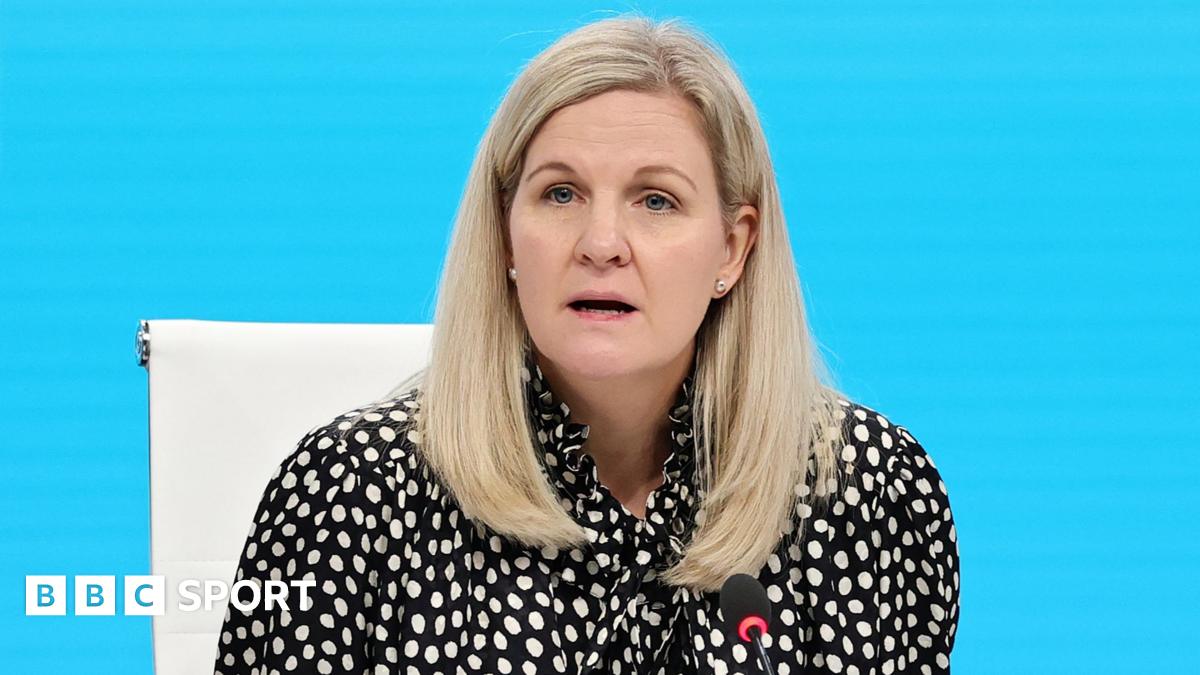
Christophe Dubi, the IOC executive director for the Olympic Games, added: “We make a point to receive those petitions, and we have to recognise climate is a challenge for all of us.
“What we have to do as an organisation is to be at the forefront of sustainability, and our principles are very clear.”
One area the IOC is aiming to make the Olympics more sustainable is having Games take place over a wider area with more pre-existing facilities, and Coventry said Milan-Cortina is an acid test for whether this is a viable future.
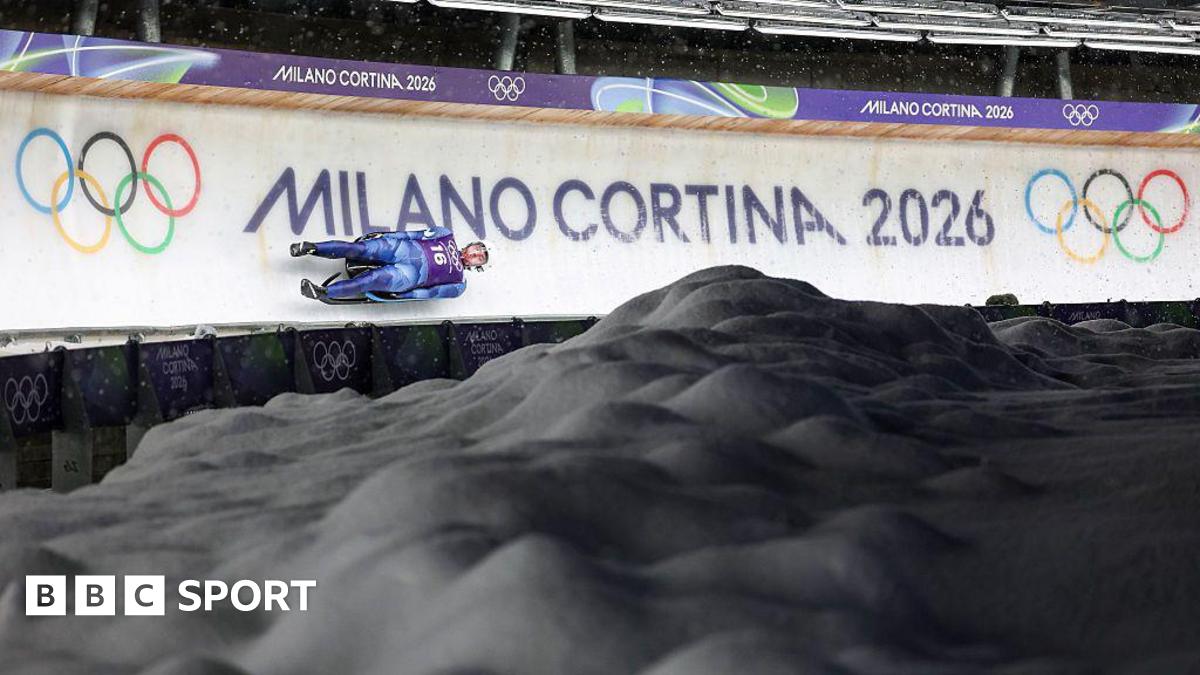
Milan-Cortina takes place in three hubs spread across northern Italy – in Milan, Cortina and Livigno – with only two newly built sporting facilities: the Santagiulia ice hockey arena and Cortina Sliding Centre.
The next two Winter Olympics – French Alps 2030 and Utah 2034 – will also have sports spread more widely, while the 2032 Summer Olympics in Brisbane is will have venues across Queensland.
“We are really experiencing a spread out Games here for the first time – we are going to learn a lot,” Coventry said.
“We have taken this decision for sustainability reasons, climate and not having to have new venues. We are seeing there is an impact on National Olympic Committees because of the spreadness [sic], also for broadcast and media, making it harder to get around.
“What is really cool is that you get to see iconic venues in beautiful places – but now we have to weigh this up, the balance between a spread games for sustainability reasons but not shifting complexity and sustainability to different areas.”
While the action got underway on Wednesday with the start of the curling events, the 2026 Winter Olympics will officially start with the opening ceremony on Friday.
Coventry said she hoped all nations would be treated with respect by spectators, including the USA team amid criticism from Italian authorities about the presence of ICE agents in Milan.
“I hope the opening ceremony is seen by everyone as a chance to be respectful,” she said.
“For me, when we went to the Olympic village that is the best reminder of how the Games should be. I hope the opening ceremony will do that.”
The pounding music and disco lights lent a sense of occasion to the first action of this year’s Games in the high-end Italian resort of Cortina d’Ampezzo.
The snow which had hammered down all day in the Dolomites had turned to sleet by the time the four matches started in front of a healthy crowd inside the 3,500-capacity arena.
But many of those spectators were cast into darkness for four or five minutes early on until someone put some change in the meter,the scoring screens flickered back into life and play resumed.
“I didn’t mind the lights going off,” said Mouat. “It was a bit of a boogie, a rave… it was like a nightclub.”
When the dancing stopped, Norway’s husband and wife team of Magnus Nedregotten and Kristin Skaslien initially took control before the sides fell into a cagey contest.
Mouat and Dodds seized the initiative in a splendid second end – the final accounting reached after some lengthy deliberation with the measuring stick – and led 4-3 at the break after edging a tight fourth against the 2002 silver medallists.
The interval did check the momentum of the childhood friends a little, as Norway – who also won bronze in 2018 – drew level again.
Nedregotten’s flawless play was keeping Norway in it – wife Skaslien’s struggles threatening a little domestic disharmony – but even his efforts could not prevent Team GB snatching three in the sixth end thanks to a stunning Dodds throw.
That opened a three-shot lead with two ends to play.
And, although the Norwegians invoked the powerplay to cut the deficit to one, Mouat and Dodds did likewise in the last end to close out a statement 8-6 win.
“It took us a bit of time to work out one end was curling more than the other, but once we did we took a step up in performance and took control from there,” Dodds said.
“It’s a good confidence builder to start the week.”
This race marks the return of legendary American skier Lindsey Vonn, six years after her retirement from the sport.
Downhill is the 41-year-old’s speciality and she’s won a record 45 World Cup races in this event, plus her only Olympic gold medal in 2010.
We will have to see how much of an affect crashing in the final World Cup downhill before the Winter Olympics hinders Vonn’s bid.
Keep an eye out for her superbly-named compatriot Breezy Johnson, who is the 2025 world champion.
The host nation will be hopeful of at least one podium place, although World Cup champion Federica Brignone only returned to action in January, nine months after breaking multiple bones in her left leg and tearing her ACL during a giant slalom crash at the Italian Championships.
Bergamo native Sofia Goggia took downhill silver four years ago despite suffering a knee injury just 23 days before the event.
Cross country skiing: Men’s skiathlon (11:30-12:50)
It’s a fifth Winter Olympics for Britain’s Andrew Musgrave, whose best Olympic result is seventh in the skiathlon in 2018.
In this event, competitors complete 10km using the classical technique before changing skis and doing 10km using the freestyle technique.
Johannes Hosflot Klaebo is the world champion and this could be the first of a bobble-hatful of golds for the Norwegian at these Games.
Snowboard: Women’s big air qualification (18:30-20:45)
Britain’s Mia Brookes has every chance of becoming Britain’s youngest Winter Olympic medallist for 78 years.
The rider from Cheshire has just turned 19 but has already won back-to-back big air World Cup titles and comes to Italy fresh from winning medals in the X Games.
But she will face a stacked field, including Japan’s Kokomo Murase, Reira Iwabuchi and Mari Fukada, who formed a clean sweep of the medals at last year’s World Championships.
Austria’s Anna Gasser is aiming to win the event for the third Games in a row at the age of 34.
Maisie Hill, whose career was almost ended by a horrific training accident three years ago, will be Britain’s other representative.
Figure skating: Team (20:55)
The team figure skating competition concludes with the men’s free skate.
The USA won gold after the Russian team was demoted in Beijing in a protracted saga that delayed the medal ceremony by over two years.
The USA are the reigning World Team Trophy champions and won three of the four individual events at last year’s World Championships but Japan and Georgia will be pushing them hard.
MILAN — Many of the officials supporting the nearly 250 U.S. athletes competing in this month’s Winter Olympics arrived in Italy last weekend to a greeting they may not have expected: Hundreds of demonstrators packed a square in central Milan to protest the reported plan to deploy U.S. Immigration and Customs Enforcement agents during the Games.
The first events in the 18-day competition, which will be shared by Milan and Cortina d’Ampezzo in the Italian Alps, begin Thursday and the opening ceremony is scheduled for Friday. Against that background, International Olympic Committee President Kirsty Coventry called the agents’ involvement “distracting” and “sad.”
“This is a militia that kills. They are not welcome in Milan,” Mayor Giuseppe Sala said on local radio ahead of the protests, which took place beneath the neoclassical Porta Garibaldi arch in the Piazza XXV Aprile, named for the date of Italy’s liberation from Nazi fascism in World War II.
Many demonstrators blew whistles and carried signs of the five Olympic rings rendered as handcuffs above the words “No ICE in Milan.” One woman held a handmade poster featuring photos of Renee Good and Alex Pretti, the two Minnesotans killed by federal agents last month, alongside Liam Conejo Ramos, the 5-year-old boy in the blue bunny hat who was taken from his home in Minneapolis to a detention facility in Texas.
Anti-ICE protests take place in Piazza XXV Aprile ahead of the Olympics in Milan.
(Lucia Buricelli / Associated Press)
“All the videos are public and everyone can see what’s happening,” Bruna Scanziani, an 18-year-old demonstrator told reporters. “The perception of America has changed.”
Tricia McLaughlin, an assistant secretary for the Department of Homeland Security, confirmed the presence of ICE agents in Italy to the Athletic, leaving her department, the U.S. Consulate and the U.S. Olympic and Paralympic Committee to try to cool the controversy.
DHS said the agents dispatched to Milan are not immigration agents but come from a unit known as Homeland Security Investigations, which specializes in cross-border crime. They commonly provide intelligence and security at large sporting events, both in the U.S. and overseas, but in Milan their role will be strictly advisory and intelligence-based, Ambassador Tilman J. Fertitta said.
Travelers pass through the lobby of Milan Linate Airport M4 Metroline train station Tuesday.
(Robert Gauthier/Los Angeles Times)
The U.S. Olympic and Paralympic Committee, meanwhile, said it is working with the Diplomatic Security Service, which is under the umbrella of the State Department, unlike ICE, which is part of Homeland Security. The Diplomatic Security Service has been providing security for U.S. delegations at every Olympics since 1992.
“The USOPC does not work with U.S. domestic law enforcement or immigration agencies in the planning or execution of the Games, including agencies within the Department of Homeland Security often referred to as ICE,” the committee said in a statement. “Italian authorities are solely responsible for all security operations at the Games.”
Despite the tensions, in the days before the Games there were few signs of the kind of heavy security presence that marked the Paris Olympics 17 months ago. At Linate Airport, the closest of Milan’s three airports to the city center, two camouflage-clad Italian soldiers with long guns milled outside the arrival gates Monday evening. They were gone by Tuesday afternoon.
Five miles away at the Piazza del Duomo, the cultural and social heart of Milan, two pairs of soldiers stood on either side of the massive square, huddling under white awnings on either side of a pop-up Olympic souvenir tent and ignoring the hundreds of international tourists raising their phones to take photos of the ancient Gothic cathedral that gives the square its name.
A building located in the heart of Piazza del Doumo is lit up with animated Olympic competitors Tuesday.
(Robert Gauthier/Los Angeles Times)
Up the street, where the trolley tracks curve before the trendy shops and restaurants that line the busy Via Orefici, groups of city police and Carabinieri, the national police known by their black Giorgio Armani-designed uniforms, joked among themselves. They were far less menacing than the roving patrols of soldiers and police officers that were ubiquitous in France.
A local woman shrugged at the officers’ presence.
“Being the iconic and most touristy place of Milan,” she said “there are always lots of police and soldiers.”
It’s unclear how American athletes will be received during Friday’s opening ceremony, which Vice President JD Vance and Secretary of State Marco Rubio are expected to attend.
“When they have the flag and when they have the tracksuit and they’re announced as the U.S., that’s obviously an opportunity for the spectators to make known their feelings about the U.S.,” said Kristian Coates Ulrichsen, a fellow for Middle East studies at Rice University’s Baker Institute and an expert on sports and international relations.
Europeans have strong feelings about the U.S. right now, feelings spurred by more than the images of ICE agents that have led TV newscasts and have filled social media feeds for months in Italy and beyond. In the last few months, President Trump has sent forces into Venezuela to removes its president, threatened military action against Iran, fired on alleged drug boats in the Caribbean and Pacific, and disparaged Europe as “decaying” and its leaders as “weak.”
Demonstrators in Milan hold signs protesting ICE in solidarity with the people of Minneapolis on Saturday.
(Alessandro Bremec / Associated Press)
“Without us,” he said in a combative speech before the World Economic Forum in Davos, Switzerland, “you’d all be speaking German.”
What has upset the continent most amid the chaos, however, is Trump’s insistence that the U.S. take control of Greenland from Denmark, a loyal North Atlantic Treaty Organization ally, warning the Danes and seven other countries that they would be hit with 25% tariffs if they didn’t relent. Many in Europe’s far-right parties, whose members are often supportive of Trump, now consider the U.S. president an “enemy of Europe,” according to a poll published by the Paris-based platform Le Grand Continent.
As a result of the blowback, Trump has backed away from the tariff threat and said he wouldn’t take control of Greenland by force, but the fallout from tensions remains.
“Greenland, especially, has really touched a nerve. That’s unfortunate coming right in the run-up to the Olympics,” said Coates Ulrichsen, who was born in Greece to English and Norwegian parents.
And that makes the U.S. team and its 232 athletes, the largest contingent at the Milan-Cortina Olympics, a convenient foil for European wrath.
“The national team is symbolic of the nation. That just makes it such a target for any potential political frustration,” Coates Ulrichsen said. “It wouldn’t be the first time.”
During the 2004 Summer Games in Athens, for example, which opened 17 months after the American-led invasion of Iraq, the U.S. team was roundly booed.
“The Olympics have been no stranger to politics,” Coates Ulrichsen said. “And obviously the key element [of athletes] walking out behind a flag is a very easy target in a way.”
Some Italians aren’t so sure.
“My personal view is that U.S. athletes will not be targeted by the protests,” said one woman who asked that her name not be used because she works with many international clients, including some in the United States. “It is more of a political subject.”
She also said the attitude of Italian Prime Minister Giorgia Meloni, among the European leaders most supportive of President Trump, has blunted public opposition to the U.S.
The Olympic Rings ahead of the Milano Cortina 2026 Winter Olympics on Tuesday.
(Mattia Ozbot / Getty Images)
Because this month’s Games, the first Winter Olympics to officially have co-host cities, will be spread across four clusters covering about 8,500 square miles in northern Italy, there will be four opening ceremonies Friday, with the main one at San Siro Olympic Stadium in Milan beginning at 11 a.m. Pacific time. Smaller events will take place simultaneously in the mountain venues of Cortina d’Ampezzo, Valtellina and Val di Fiemme.
Bobsledder Azaria Hill, a first-time Olympian whose mother, father and aunt all competed in the Summer Games, said marching in the opening ceremony has long been a dream of hers. And she doesn’t think politics will spoil that Friday.
“Olympics brings all the nations together,” she said. “That’s one of the special things about the Olympics, and you really see that in the unity. I think everything will be fine.”
In an effort to separate athletes from politicians, the U.S. governing bodies for three winter sports — figure skating, speedskating and hockey — changed the name of their Milan hospitality space to the Winter House.
‘We won’t see anything on national territory that resembles what’s been seen in the US,’ Italy’s interior minister says.
Published On 4 Feb 20264 Feb 2026
Share
Agents from the divisive United States Immigration and Customs Enforcement (ICE) agency will have no operational role in the Winter Olympics, Italy’s interior minister has said days before the Milan-Cortina Games open.
ICE’s Homeland Security Investigations (HSI), which is a separate investigative arm of the Department of Homeland Security (DHS) from the department carrying out the US immigration crackdown, will operate within US diplomatic missions only and “are not operational agents” and “have no executive function”, Matteo Piantedosi told the Italian Parliament on Wednesday.
Recommended Stories
list of 3 itemsend of list
He said the outrage over the HSI presence, including the Milan mayor’s warning that they were not welcome in the city during the February 6-22 Winter Games, was “completely unfounded”.
“ICE does not and will never be able to carry out operational police activities on our national territory,” Piantedosi said.
The minister aimed to clarify the news of the contentious deployment of ICE agents, which prompted protests in the Italian metropolis.
“Security and public order are ensured exclusively by our police forces,” he said.
“During the Milan-Cortina Games, the members of this agency will be engaged solely in analysis and information exchange with the Italian authorities,” he added.
“The presence of personnel linked to the ICE agency is certainly not a sudden and unilateral initiative to undermine our national sovereignty, as some have portrayed, but rather compliance with a legally binding international agreement entered into by Italy.”
Last week, the US agency said it will support the “Department of State’s Diplomatic Security Service and host nation to vet and mitigate risks from transnational criminal organisations”.
Following the announcement, Milan Mayor Giuseppe Sala said ICE would not be welcome in his city.
“This is a militia that kills … It’s clear that they are not welcome in Milan. There’s no doubt about it. Can’t we just say no to [US President Donald] Trump for once?” he said in an interview with RTL 102.5 radio.
ICE said its operations in Italy are separate from the immigration crackdown ordered by Trump in the US.
The Italian interior minister confirmed that the agency’s role would be limited.
“We will not see anything on national territory that resembles what has been seen in the media in the United States,” Piantedosi said.
“The concerns that have inspired the controversy of the last few days are therefore completely unfounded, and this information allows me to definitively dispel them.”
“Huge thank you to everyone who reposted, shared and supported,” Sabate said.
“Because of you, Universal Studios reconsidered and officially granted the rights for this one special occasion.
“There are still a couple of things to be tied up with the other two music of the program, but we are so close to accomplishing it! And it’s all thanks to you.
“I’m so happy to see that the Minions hitting Olympic ice is becoming real again!”
The routine in Sabate’s short program – the first of two routines in singles figure skating – has proved a hit in competitions, including in Sheffield at this year’s European Figure Skating Championships, where he finished 18th but became a fan favourite.
Sabate, a six-time Spanish champion set to make his Olympic debut in Milan, said he followed all required procedures and submitted the music through the International Skating Union’s (ISU) ClicknClear system in August.
If he is unable to perform to the Minions mix, he may use music by the Bee Gees for his short program, as this was the routine he performed to in 2024-25.
The men’s event starts in Milan on Tuesday.
“As soon as we have more details on this specific case, we will share them as appropriate,” read an ISU statement.
“Copyright clearances can represent a challenge for all artistic sports.”
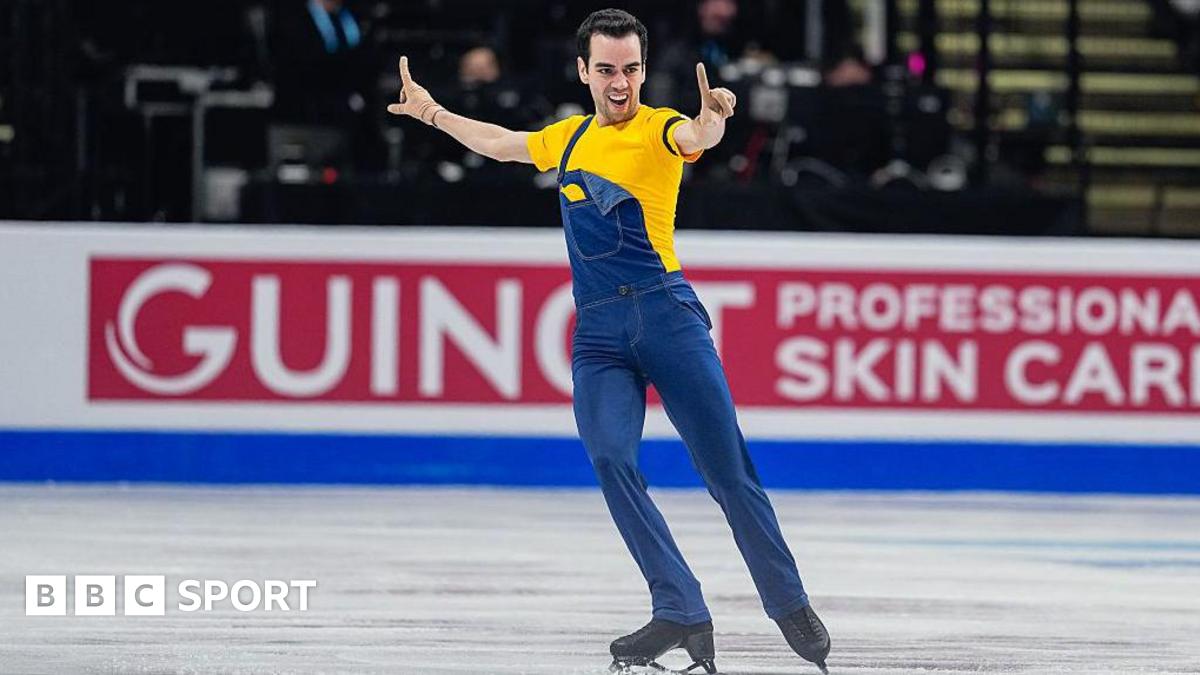
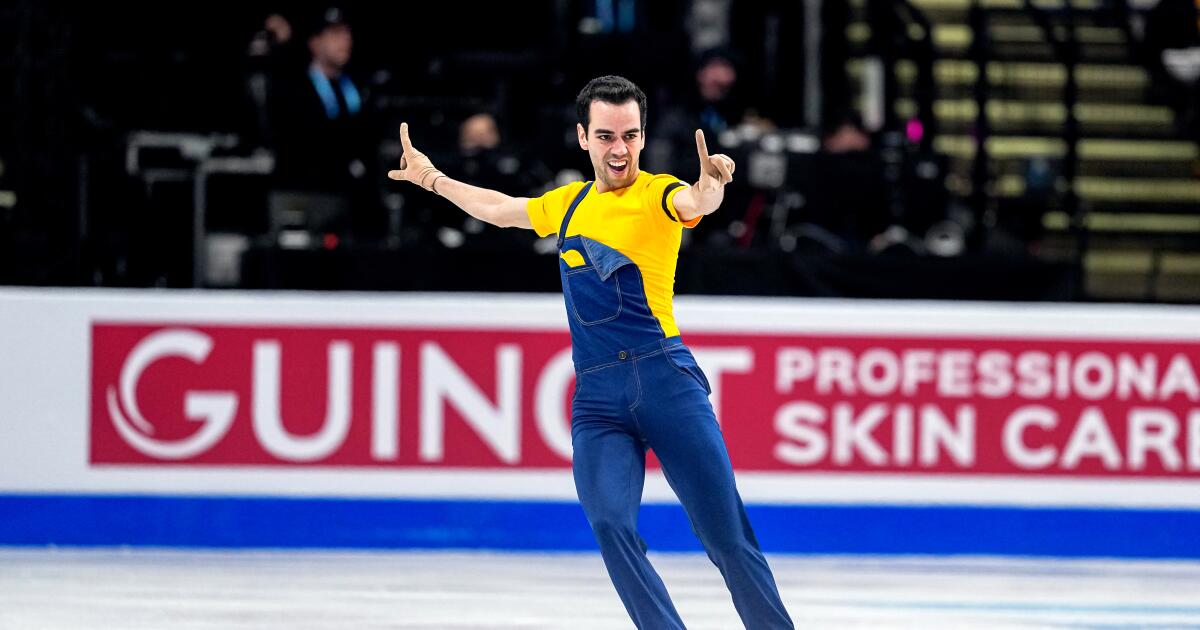
Spanish figure skater Tomàs-Llorenç Guarino Sabaté said Tuesday that he may be able to skate his Minions-themed program at the Olympics after all. He shared on Instagram that Universal is allowing him to use the music from its popular animated franchise for the “special occasion” and said he is working to clear the remaining hurdles.
“There are still a couple things to be tied up with the other 2 musics of the program but we are so close to accomplishing it!” Guarino Sabaté wrote in his update thanking his supporters. “I’m so happy to see that the minions hitting Olympic ice is becoming real again!! I’ll keep you posted!”
A six-time Spanish national champion, Guarino Sabaté said on Monday that he had been informed Friday — exactly a week before the opening ceremony of the Milan-Cortina Games — that the medley of “Minions” music he had skated to, while dressed in blue overalls and a yellow shirt, through the entirety of the season could not be used at the Olympics due to copyright issues. This meant that Guarino Sabaté, who had been set to make his Olympics debut with his Minions-themed short program on Feb. 10, would need to change his plans last minute. How bananas.
The cheery yellow creatures are a signature of Universal and Illumination’s “Despicable Me” film franchise. NBCUniversal owns the U.S. media rights to the Olympics.
“Finding out about this … so close to the most important competition of my life, was incredibly disappointing,” Guarino Sabaté wrote in his post sharing the initial news. “This season I competed with my Minions short program to bring joy and playful style to the ice while still meeting every required element to show that skating as a male Olympic figure skater can be fun. … Nevertheless, I will face this challenge head on and do my best to make the best of it.”
The Olympian said then that he had followed the proper procedures and submitted his music through the International Skating Union’s recommended rights clearance system in August. The situation has brought to attention to the complexities of music licensing and how it affects artistic sports like figure skating. Contemporary music is not in the public domain and skaters are responsible for clearing their own music.
For now, fans will just have to remain hopeful that Guarino Sabaté’s dream of bringing joyous Minion mayhem to the Olympic ice will come true in the end.
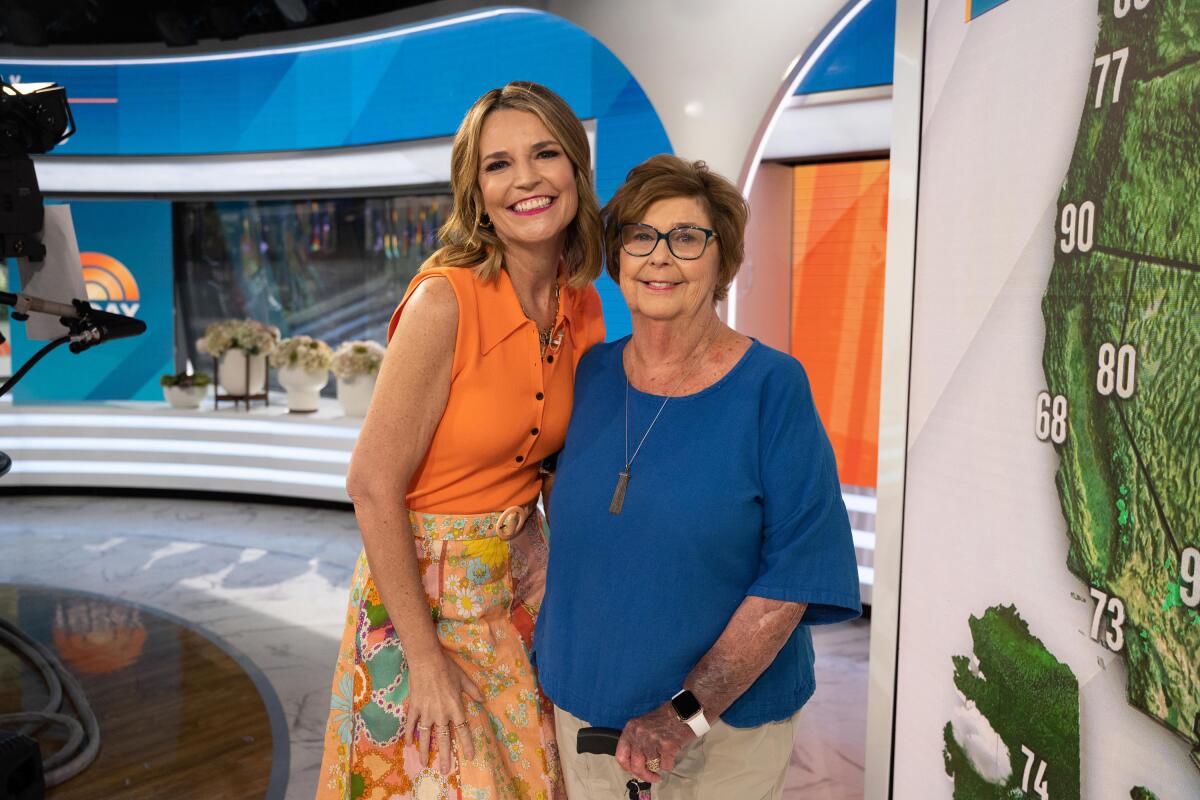
“Today” co-anchor Savannah Guthrie will not head to Milan for NBC’s 2026 Winter Olympics coverage as she deals with the ongoing police investigation into the suspected abduction of her mother.
“Savannah will not be joining us at the Olympics as she focuses on being with her family during this difficult time,” an NBC News representative said Tuesday in a statement. “Our hearts are with her and the entire Guthrie family as the search continues for their mother.”
Guthrie was scheduled to co-host NBC’s telecast of the Friday opening ceremonies for the Milan Cortina Games alongside Terry Gannon of NBC Sports. The network representative said alternative plans will be announced shortly.
June 2023 photo of Savannah Guthrie and mother Nancy Guthrie. (Photo by: Nathan Congleton/NBC via Getty Images)
(Nathan Congleton/NBC via Getty Images)
Law enforcement officials believe Nancy Guthrie, 84, was last seen at her home outside of Tuscon, Ariz. on Saturday night. Police were called after relatives were told she missed the Sunday church service she regularly attends and did not find her at home.
Police found Nancy Guthrie’s cell phone, wallet, car and medication were left behind, indicating she did not leave voluntarily. She has no cognitive issues, but has limited physical mobility and could not walk far on her own, family members have told police.
On Tuesday, Lima County Sheriff Chris Nanos said at press briefing that authorities believe Nancy Guthrie was taken against her will. He also said the department is aware of “reports circulating about possible ransom note(s)” in the case. TMZ reported on the existence of an alleged ransom note Tuesday, but Nanos did not verify the account,
According to law enforcement sources not authorized to speak about the case publicly, there was blood at the scene and someone appeared to have forced their way inside.
Guthrie, a “Today” co-host since 2012, has been off the program since Monday. She was scheduled to head to Milan early this week.
Guthrie’s mother, who lived on her own, has been an occasional on-air guest at “Today.” Her appearances made her a favorite of Guthrie’s co-workers and staff at the program.
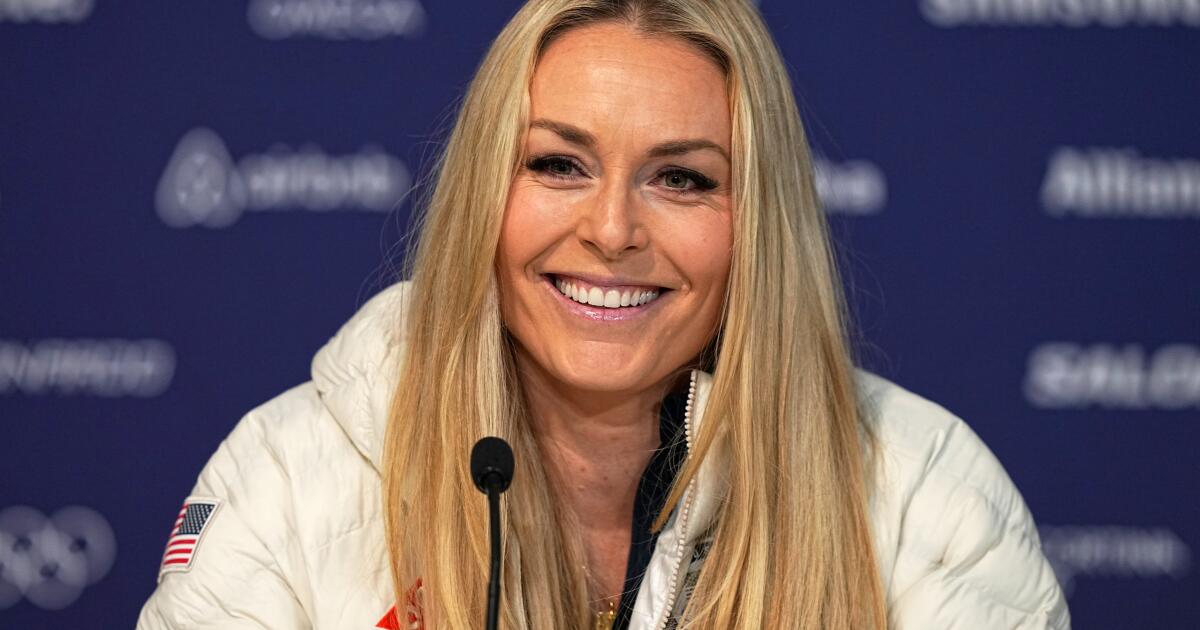
MILAN — A partial knee replacement in her right leg wasn’t enough to stop Lindsey Vonn from pursuing her Olympic comeback. Neither will a recent left torn anterior cruciate ligament.
Vonn revealed Tuesday she suffered a completely ruptured ACL in a crash last week but remains focused on racing in the Milan-Cortina Olympics.
“If my knee is not stable, I can’t compete and at the moment, it is stable and it is strong,” Vonn said during a virtual news conference from Cortina d’Ampezzo. “… So far so good but we have to take it day by day. But if it remains the way it is now, I think I’m pretty solid.”
The 41-year-old Vonn said she skied Tuesday to test her knee. She is not in any pain and the swelling has gone down, but with bone bruising and additional meniscus damage, she still has to tackle full-speed downhill training runs beginning on Thursday before the downhill competition starts Sunday.
Vonn, who also has hopes to race in the super-G and the team event, said her “intention is to race everything.”
“I am not letting this slip through my fingers,” she said. “I’m going to do it, end of story. I’m not letting myself go down that path. I’m not crying. My head is high, I’m standing tall and I’m going to do my best, whatever the result is.”
Vonn is no stranger to knee injuries. She retired from the sport in 2019 and underwent a partial knee replacement in April 2024. Since announcing her comeback in November 2024, Vonn has already defied expectations by becoming the oldest skier to win a World Cup race when she won at St. Moritz, Switzerland, in December and by making the Olympic team seven years after her retirement.
“I think if anyone can do it, it’s Lindsey,” U.S. teammate Bella Wright said of competing with a torn ACL. “I think we all know how strong of a skier she is, but I think that her mental game is what makes Lindsey Lindsey.”
Vonn was racing at a World Cup event Jan. 30 at Crans-Montana, Switzerland, when she lost control while attempting to land a jump. She slid into the safety netting and was later airlifted to a hospital. While a torn ACL typically sends athletes straight to the operating room, Vonn said surgery was not a discussion.
“The Olympics are the only thing that I’m thinking about,” Vonn said.
Despite the crash occurring so close to the Games, Vonn said her knee feels better now than when she has battled other injuries, including in 2019 when she competed at the world championships without a lateral collateral ligament and three tibial plateau fractures. She still won the bronze medal.
“I know what my chances [at the Olympics] were before the crash, and I know my chances aren’t the same as it stands today,” Vonn said, “but I know there’s still a chance and as long as there’s a chance, I will try.”
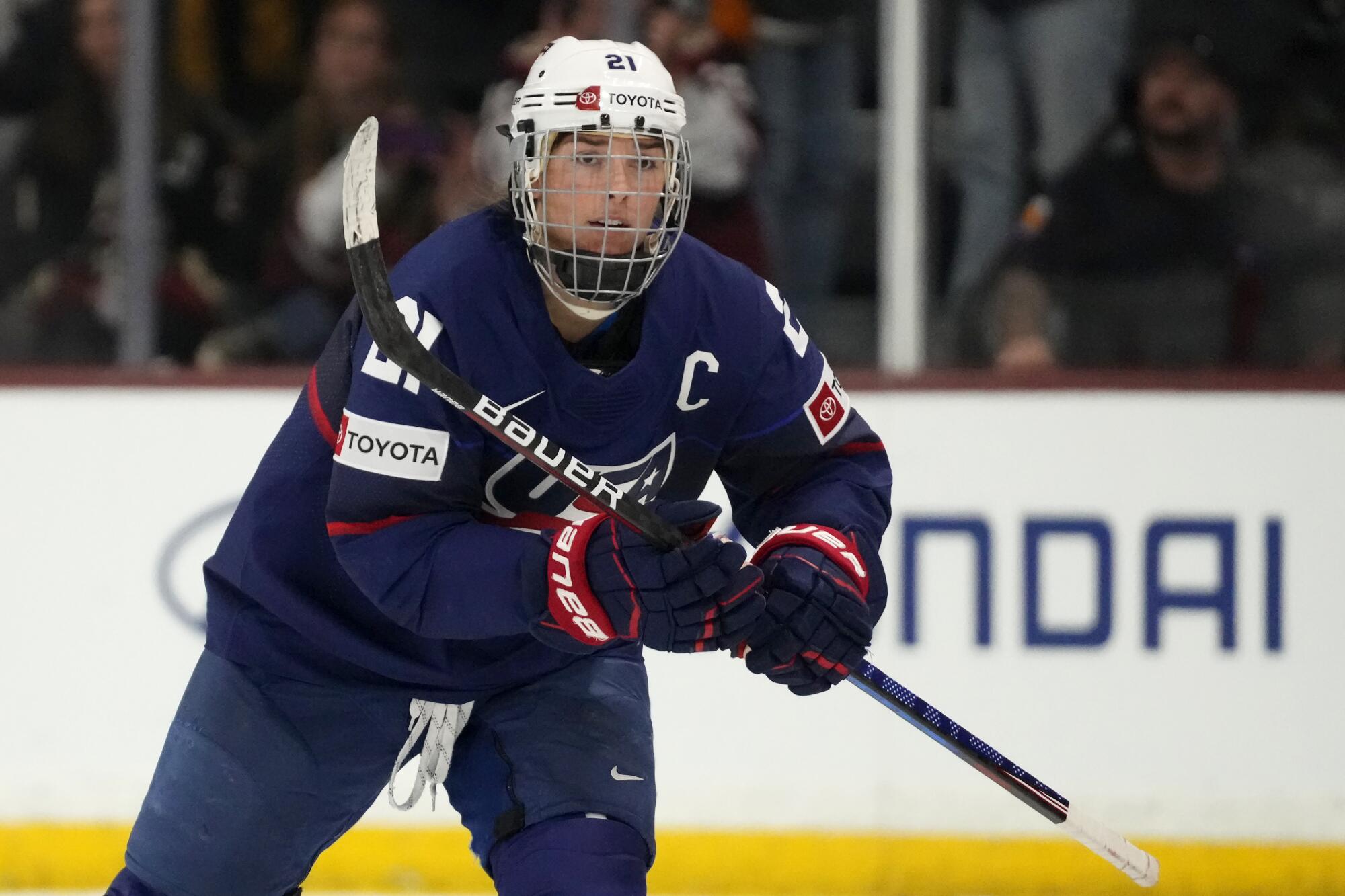
If Hilary Knight is the GOAT of women’s ice hockey, then Caroline Harvey is the kid.
That isn’t just a reference to her age, 23, which makes her the seventh-youngest player on the U.S. Olympic team. The term is also used for baby goats. And with Knight, the oldest player on the U.S. team, expected to retire from Olympic competition after the Milan Cortina Games, that makes Harvey the GOAT in waiting.
“Hilary is a great role model,” Harvey said. “She did blaze that trail. It’s been exciting to see what she did, the legacy she left.”
Like the 10 world championship gold medals, most by a hockey player of either gender; the soon-to-be five Olympic appearances, most by any American hockey player; the scoring titles and MVP awards. But the real legacy she’ll leave will have little to do with any of that.
In 2019, while at the height of her career, Knight risked everything when she joined more than 200 other players in boycotting the existing women’s hockey leagues to form the Professional Women’s Hockey Players Assn. Four years later that led to the creation of the well-funded Professional Women’s Hockey League, with eight teams playing in the U.S. and Canada.
Knight said she took inspiration for that campaign from the 1999 Women’s World Cup soccer team of Mia Hamm, Julie Foudy and Brandi Chastain, which not only won the title but soon after began the decades-long fight with the U.S. Soccer Federation that eventually ended with the women getting the same pay and benefits as the men’s team.
“We credit the ‘99ers to sort of helping us with our vision and creating more equitable space,” she said. “We’re far from there but we’re taking great steps in that direction.”
In fact, women’s hockey has never been better, a popularity both Knight and Harvey hope to build on in the Olympic tournament, which begins Thursday with the U.S. facing Czechia.
“Visibility is really important; continuing to get those eyes,” said Knight, a tireless promoter of the game. “We’re going to have some new and unique viewership. With the Olympics in itself [viewers] might accidentally watch hockey and be like ‘I love this sport.’
“Just having more programming elevates the game on the global stage. And that’s really exciting.”
U.S. forward Hilary Knight skates to the bench after scoring against Canada in November 2023.
(Ross D. Franklin / Associated Press)
The game Knight, 36, is championing is really one she built, especially in the U.S. A two-time NCAA champion at Wisconsin, she’ll be going for her fifth Olympic medal — and second gold — in Milan. Yet she insists the experience never gets old.
“Every Olympics feels like my first Olympics,” she said. “Each is so unique. You’re in a different country, a different culture, just so much fun to be able to explore. The Olympics are so special, whether it’s your first or your fifth.”
These Games are likely to feel a little different, though, since they’ll end with her passing the baton to Harvey, who followed Knight to Wisconsin. The two women have more in common than just their alma mater, though.
Both were the youngest players on the team when they made their Olympic debuts, Knight as a high-scoring forward in 2010 and Harvey as a physical, offensive-minded defenseman in 2022. Both have won multiple world championships and both began their careers playing on boys teams. As children, they both told relatives they would someday play in the Olympics — a prediction that was particularly bold for Knight since women’s hockey wasn’t even an Olympic sport then.
When Harvey joined the national team ahead of the 2021 world championships, Knight shared some advice.
“She said something to the effect of ‘it’s the same game, no matter what level you’re at. Trust your instincts, play natural, play free,’” Harvey said. “That just really stuck with me.
U.S. defenseman Caroline Harvey shoots during a Rivalry Series game against Canada in November.
(Jason Miller / Getty Images)
“Hopefully at some point [I] grow into that leadership role,” she continued. “I’ve had some years now and that past Olympics, it was more of a being a sponge. I’m always trying to learn something new every day from the veterans.”
One thing she’s learned recently is how to beat Canada, which could come in handy in Milan since the U.S. will face its northern neighbors in the final game of group play, and likely a second time in the knockout rounds.
Canada has won five of the last six women’s Olympic tournaments, beating the U.S. in four of the those finals, including the most recent one in 2022. But the U.S. swept Canada in the pre-Olympic Rivalry Series, winning the four games by a combined 24-7. Knight and Abbey Murphy led the tournament in scoring with five goals each.
“When the puck drops, your heart is beating out of your chest,” Knight said of playing Canada. “You’re like ‘am I human? This is insane. This is awesome.’”
Still, when Knight finally does hang up her skates for the final time, those won’t necessarily be the memories she holds closest from her Olympic career.
“I get to do cool things with cool people on a daily basis,” she said. “What I’ve been able to accomplish in my career is incredible. And I’ve obviously played with amazing women and I’m so grateful for every opportunity that I’ve had.
“I’m just at a place where I want to embrace these lasting memories and moments with teammates and friends and family, all those people that go into this journey. That’s what I’m looking forward to.”
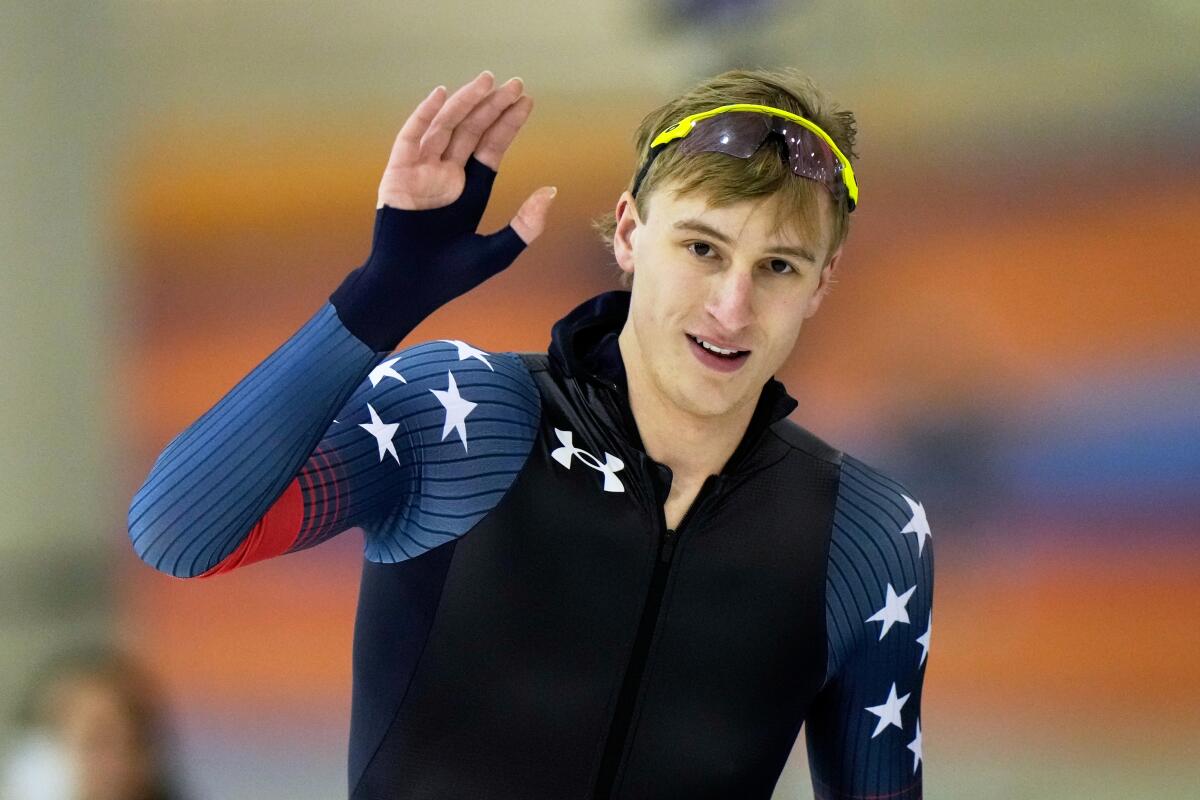
Jordan Stolz will be trying to win multiple gold medals in speedskating the Milan Cortina Olympic Games.
(Morry Gash / Associated Press)
Since making his Olympic debut at 17, Stolz has become a star in international speedskating. He was the first man to win three world championships in one year in 2023 and repeated in the 500, 1,000 and 1,500 meters in 2024. He also competes in the team pursuit. U.S. speedskating has several medal contenders, including two-time Olympic bronze medalist Brittany Bowe and gold medalist Erin Jackson, who became the first Black woman to win an individual gold medal at the Winter Olympics in 2022.
Not the sinister kind, who give away state secrets for money or revenge; Buckley is privy to much lower-level intelligence. But that doesn’t mean it’s not just as valuable to the people involved.
Buckley is the Kings’ goaltender coach and his chief pupil is Darcy Kuemper, who will be playing for Team Canada in the Milan Cortina Olympic hockey tournament. Buckley will be in Milan coaching for Team USA. And if the competition goes to form, Canada and the U.S. will meet in the final.
You can see where this is going.
So would Buckley give up the goods on his NHL goalie if it meant helping his national team win a gold medal?
“I probably have a little bit more insight being with him on a day-to-day basis. But at the end of the day, the players still have to execute,” said Buckley, like Kuemper, a first-time Olympian. “So if I tell someone to shoot somewhere at a certain time or a certain spot, they’re going to have to be able to execute that.”
The answer then is maybe.
Still, that’s a dilemma Buckley will probably never face since Jordan Binnington of the St. Louis Blues, who was spectacular in goal in last year’s Four Nations Face-off, will probably start for Canada in Milan. But with the Kings sending four other players (defenseman Drew Doughty, Canada; and forwards Adrian Kempe, Sweden; Kevin Fiala, Switzerland; and Joel Armia, Finland) plus Canadian equipment manager Darren Granger to the Olympics, there’s a good chance guys who have shared a dressing room since September will be competing against one another.
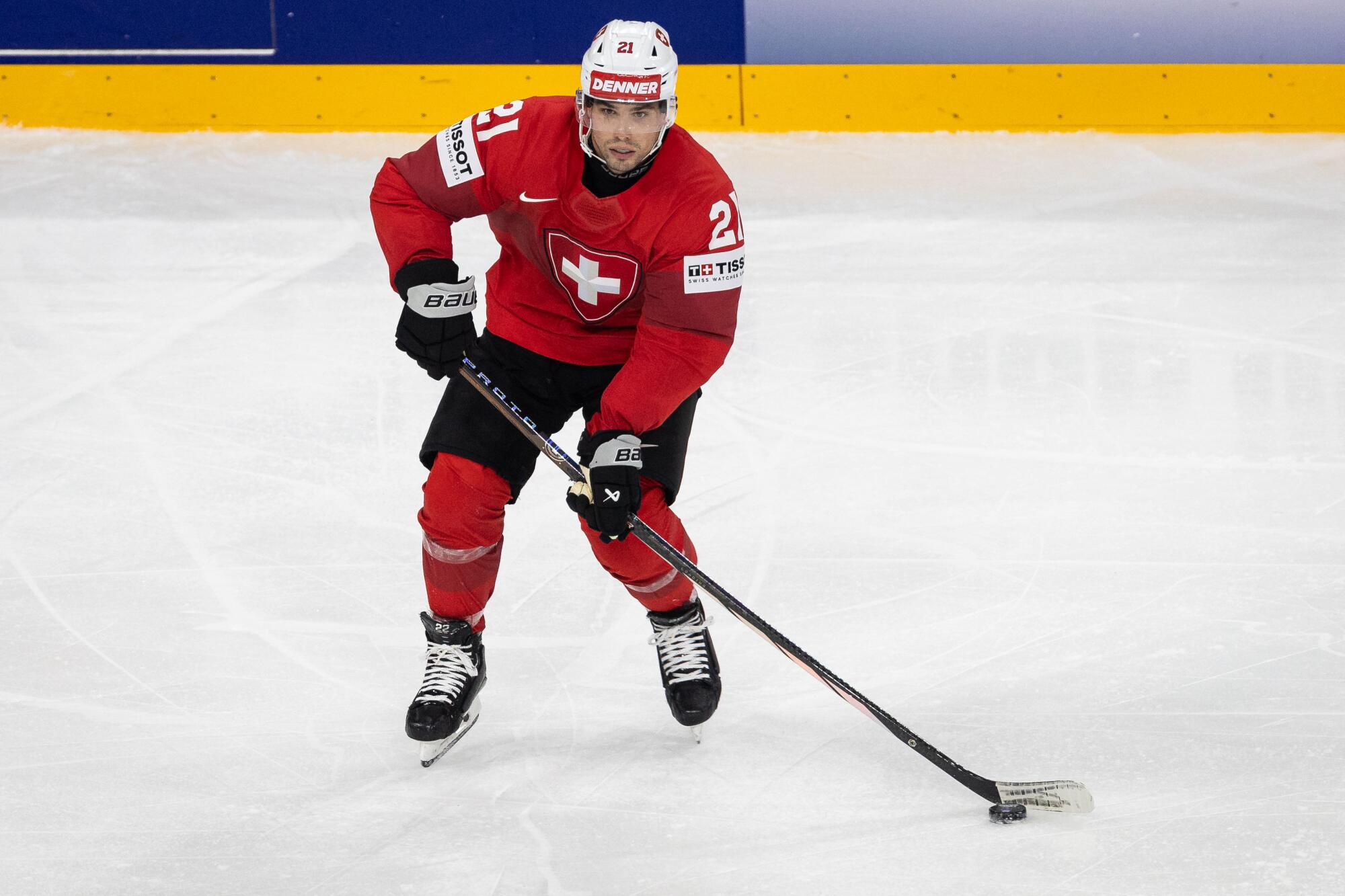
Kings forward Kevin Fiala controls the puck while playing for Team Switzerland at the 2025 world championships.
(Michael Campanella / Getty Images)
The same goes for the Ducks, who are sending four players — goalie Lukas Dostal and defenseman Radko Gudas, Czechia; forward Mikael Granlund, Finland; and defenseman Jackson LaCombe, U.S. — to Milan. Ducks star Leo Carlsson, who was expected to start for Sweden, will miss the Games after undergoing surgery to repair a rare injury in his left thigh last month.
So while the Olympics may bring countries together, it also has the potential to turn teammates against one another — at least temporarily.
In the group stage of the tournament, for example, Armia and Finland will play against Kempe’s Sweden. And Canada, with Kuemper and Doughty, will face Switzerland, which is led by Fiala.
“It’s obviously going to be a little strange,” Gudas said. “It’s only for a few games. For that amount of time, you can put things aside a little bit.”
Those kinds of match-ups were rare in the last two Olympic tournaments since NHL players didn’t take part, sidelined by a dispute over insurance, travel costs and scheduling issues. This year 147 NHL players are on the 12 Olympic rosters, with all 32 NHL clubs represented.
Not all the top NHL players will be in Milan, however. Russia has been banned from the tournament because of the country’s invasion of Ukraine, meaning Alexander Ovechkin, the NHL’s all-time leading goal scorer, won’t play.
Granlund, who won a bronze medal with Finland in 2014, the last time NHL players participated in the Olympics, is glad to be back.
“It was such a cool experience,” he said. “It’s one of the biggest honors I can have as a hockey player, playing for a country in the Olympics. There’s no player in the NHL who wouldn’t go.”
That’s due in large part to the rush that comes with wearing your country’s colors on your chest.
“It’s tough to explain how much it means,” he said. “You grow up in a country like Finland, watching the national team play. As a kid you’re dreaming to play for that team.
“Every single time you put that jersey on, it’s such a pride you feel.”
Doughty, who already has two gold medals, agreed, saying the only time he sings along with the Canadian anthem is at the Olympics.
Kings defenseman Drew Doughty controls the puck while playing for Canada in the Four Nations Face-Off last year.
(Maddie Meyer / Getty Images)
“When we hear it in the NHL, I’m not singing,” he said. “But when you’re wearing a Canadian jersey, that’s one of the biggest moments you can have.”
Not just for the guys on the ice. Granger, the equipment manager, will be making his third trip to the Olympics with Canada. And the journey never gets old.
“It’s not something that you apply for. It’s something that you’re asked to do,” he said. “So I don’t take that lightly. It’s an honor.”
The equipment managers may have the most difficult job in the Olympic hockey tournament since they must prepare and maintain the sticks, skates, gloves and uniforms for 25 players, some of whom they’ve never met. That means checking in with the equipment managers of rival NHL teams to get prepared.
“We have quite a few players that are particular about certain things,” he said. “After a while, you just kind of get used to what those things are. If it’s a player that likes to use three sticks a game, then making sure he has that. If it’s a guy that likes to change gloves every other game, making sure you have enough.”
Yet if Canada wins the tournament, Granger’s reward won’t be a gold medal. Olympic rules say medals only go to the players, leaving the equipment managers, trainers and coaches — even coaches with inside information like Buckley — out in the cold.
“That’s OK,” Buckley said. “I just want the players to get one.”
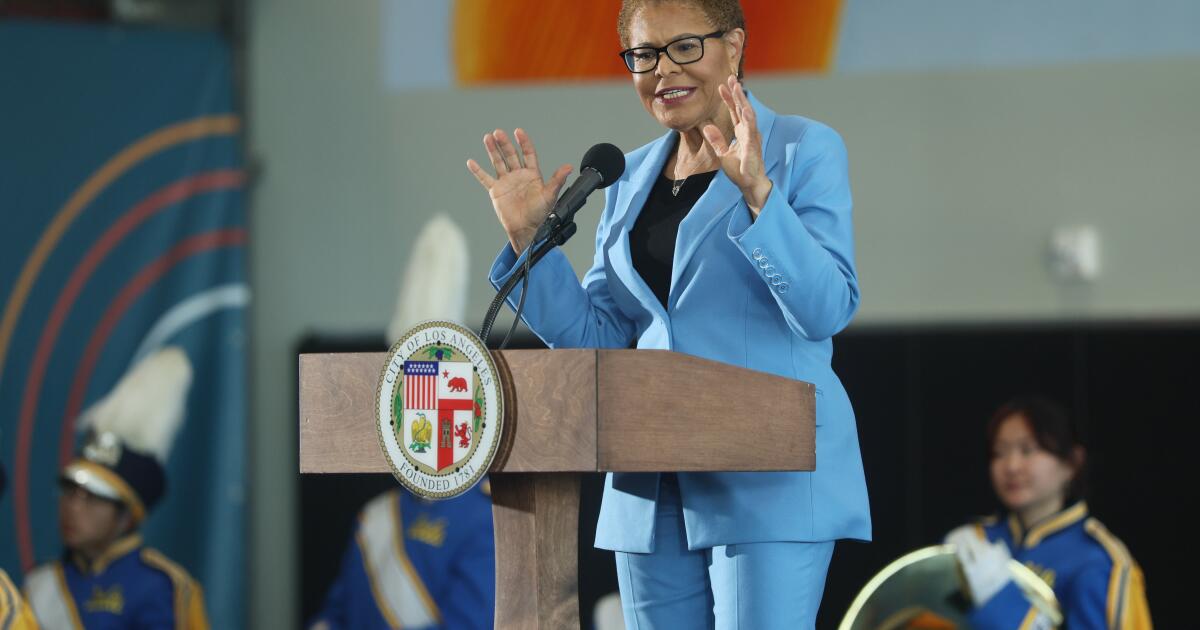
Mayor Karen Bass, delivering the first of two State of the City addresses planned this year, urged Angelenos on Monday to come together ahead of the 2028 Olympics while announcing a push to clean up Los Angeles’ busiest streets in the run-up to the Games.
The mayor spoke at the Expo Center in Exposition Park in front of hundreds of city workers and politicos. A second address is planned for April.
After both the UCLA and USC marching bands played to welcome the mayor, she fittingly homed in on a theme of unity as the region prepares to host the World Cup, the Olympic and Paralympic Games and the Super Bowl, among other events. But she also said that Angelenos needed to unite in the face of immigration raids, the homelessness crisis and the fires that burned in the city last year.
“Even in this difficult chapter, in our history, great events — moments of unity — are possible. And they are coming,” Bass said.
“As we prepare for … the greatest Olympic and Paralympic Games in history — we will continue to focus on the fundamentals, the things that shape how a city feels to the people who live here and the millions who will visit,” Bass said.
The preparation will include a continued focus on cleaning up encampments through Bass’ signature program, Inside Safe, she said.
Bass also announced a new clean streets initiative dubbed Clean Corridors, which she said would “accelerate beautification” of major thoroughfares throughout the city in advance of the Olympics.
“We will crack down on any illegal dumping, those who cut corners, avoid disposal fees, and leave a mess for workers and neighbors to deal with,” she said.
The mayor also focused on the Trump administration’s continued immigration raids that have led to protests in downtown Los Angeles and across the country. She spoke about the shooting in Los Angeles of Keith Porter by federal agents.
“Staying silent or minimizing what is happening is not an option. This administration does not care about safety. They don’t care about order. And they most certainly do not care about the law,” she said.
The mayor also spoke about the Palisades fire, saying she and Councilmember Traci Park would head to Sacramento next week to call for more investment in the rebuild of the Palisades. Already, 400 homes are under construction in the Palisades and hundreds more are approved and ready to be built, she said.
“We are not just rebuilding — we are rebuilding smarter, faster, and safer,” she said. “Families are returning home.”
The announcement came after a week in which President Trump criticized the city’s rebuild for going too slowly, and said he would preempt the city’s ability to issue permits for people rebuilding after the Palisades fire.
The president announced in an executive order that victims of the fire using federal aid money could self-certify to federal authorities that they have complied with local health and safety standards.
The mayor decided to deliver two States of the City this year. Traditionally, she and other mayors have made a single speech in April before releasing the proposed annual budget for the new fiscal year.
Her second State of the City is likely to focus more on the city’s budget issues.
Last year, the mayor and City Council had to close a $1-billion budget shortfall. During her State of the City in 2025, the mayor announced likely layoffs to city workers in order to produce a balanced budget.
The city ultimately avoided making any layoffs through other cuts and agreements with city unions. But the city is likely to face another tough budget year in the upcoming fiscal year.
The seventh in an occasional seriesof profiles on Southern California athletes who have flourished in their post-playing careers.
Tai Babilonia’s life changed forever when she was asked to hold a boy’s hand.
At first she resisted.
“I didn’t want to,” she remembered. “He’s a yucky boy.”
But Mabel Fairbanks, Babilonia’s skating coach, wouldn’t take no for an answer, bribing the 8-year-old with stickers and a Barbie doll if she would just reach out and grab the hand of 10-year-old Randy Gardner.
It would be another 40 years before she let go.
By then Tai Babilonia and Randy Gardner had become one of the most decorated pairs in U.S. figure skating history, their individual names eventually melding into one.
“My last name is ‘and Randy,’” Babilonia said. “And I embrace it.”
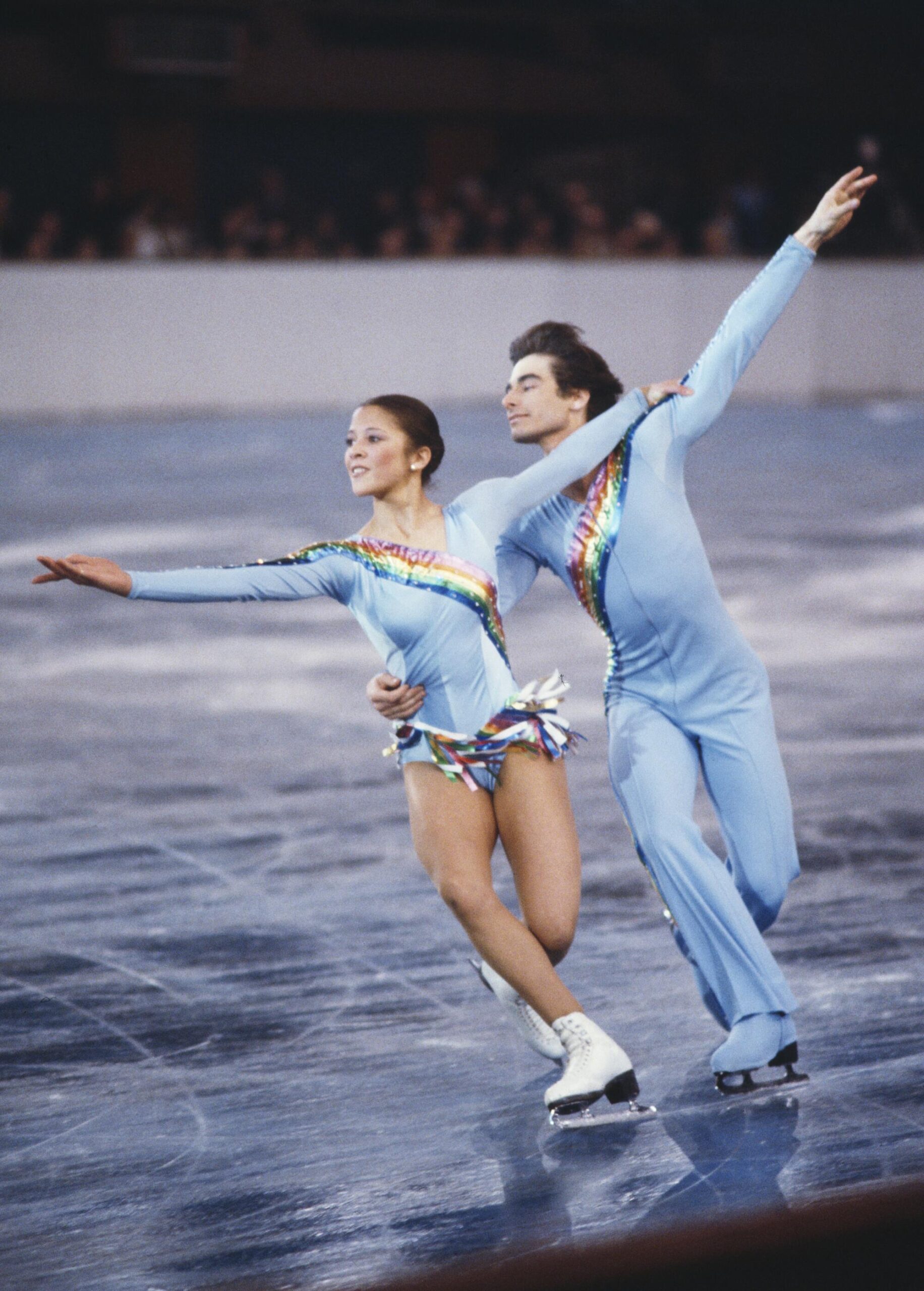
U.S. pairs figure skating duo of Tai Babilonia and Randy Gardner in 1979.
(Tony Duffy / Getty Images)
As a pair “Tai and Randy” won five U.S. championships, medaled in three world championships and qualified for the Olympics twice, all before Babilonia’s 21st birthday. Their success also pushed open doors that had long been closed since Babilonia, Black on her mother’s side and part Filipino and Native American on her dad’s side, was the first U.S. skater from any of those ethnic groups to compete in the Olympics or win a world title.
Among those to follow her were Debi Thomas, a two-time U.S. champion and a bronze medalist at the 1988 Winter Olympics, and Elizabeth Punsalan, a two-time Olympian and five-time national champion in ice dancing.
At about the same time Babilonia and Gardner were moving from competitive skating and the Olympics to the Ice Capades, another young girl was just starting to pursue her own Olympic dreams. Tiffany Chin would go on to win a national championship, two Skate America titles and just miss a medal in the 1984 Winter Games, retiring before she was old enough to legally drink.
In that brief but brilliant career, Chin changed U.S. figure skating forever. She was the country’s first Asian American national champion and first Chinese American Winter Olympian, paving the way for Olympic medalists Kristi Yamaguchi, Nathan Chen, Michelle Kwan and siblings Alex and Maia Shibutani.
After retiring from skating, Babilonia, now 66, dabbled in coaching and sportswear design, became a motivational speaker, an activist and, most importantly, a grandmother. But the legacy Babilonia and Chin created will be on display in Italy this month when the U.S. fields one of the most eclectic Olympic figure skating teams ever, with 12 of the 16 athletes having immigrant parents.
Five of the six singles skaters — Alysa Liu, Isabeau Levito, Ilia Malinin, Maxim Naumov and Andrew Torgashev — are first-generation Americans while the other, women’s national champion Amber Glenn, identifies as pansexual. Pairs skaters Emily Chan, Spencer Howe and Ellie Kam and ice dancers Anthony Ponomarenko, Christina Carreira, Vadym Kolesnik and Emilea Zingas are also immigrants or first-generation Americans while Madison Chock, the reigning Olympic champion in ice dancing, has Hawaiian, Chinese, German, English, Irish, French and Dutch ancestry.
At a time when diversity, equity and inclusion programs are being dismantled, immigrants are being attacked and diversity is labeled a weakness, America’s Olympic figure skaters have come to mirror the country at large.
“It’s wonderful and so important,” said Babilonia. “Especially now.”
Nearly 60 years after Babilonia and Gardner skated together for the first time, the decision to pair them seems inspired, even providential.
It was neither. Fairbanks, Babilonia learned later, simply needed a couple to skate in a club show at the Culver City Ice Arena.
“We just happened to be similar in height. And I guess we were cute,” Babilonia said last month during a lengthy interview at the Colonial Revival-style mansion in the West Adams District that houses the LA84 Foundation.
Gardner was already an excellent skater, as strong and athletic as he was outgoing and friendly; Babilonia was shy and far less steady on the ice. But that wasn’t the only thing that made their pairing unusual.
Gardner was white and Babilonia was Black. And in 1968, asking them to hold hands in public was scandalous, even in Culver City. However, Fairbanks, a legendary coach who had spent much of her life pushing back against convention, didn’t see color. She focused only on talent.
Randy Gardner and Tai Babilonia roller skating together in May 1979.
(Tony Duffy / Getty Images)
“Mabel was the coach who taught all races, Hispanic, Black, mixed, Jewish,” Babilonia said. “Mabel broke down that wall.”
Fairbanks, who was Black and Seminole, was born in the Deep South at a time when ice rinks were segregated. Even after moving to New York, where she bought a pair of skates for $1 at a pawn shop, then taught herself how to use them, she skated mostly in nightclub shows, where she was limited to jumps and moves that wouldn’t show up the white skaters.
She soon moved to Los Angeles, touring internationally with the Ice Capades and Ice Follies, before becoming a coach and mentoring hundreds of young skaters, including Olympic medalists Scott Hamilton, Yamaguchi and Thomas.
“If it weren’t for Mabel Fairbanks, you wouldn’t have any color in the predominantly white skating world,” said Babilonia, who is shopping a biopic of Fairbanks, who died in 2001.
“People don’t really know her. She’s like a hidden figure.”
Yet three years after Fairbanks made Tai and Randy a pair, they left her for John Nicks, who was coaching at the Paramount Iceland.
“He took our skating to a whole different level. And it happened really quick,” said Babilonia, who still calls her former coach Mr. Nicks. “That’s when we started winning and improving and just really became a great pair of skaters.”
Two years later Babilonia and Gardner won the U.S. junior nationals and three years after that they won the first of five national championships, qualifying for the 1976 Winter Olympics in Austria, where they finished fifth. Gardner wasn’t old enough to vote and Babilonia didn’t have a driver’s license. But together they were holding their own against the best pairs skaters in the world.
“Such an incredible year,” Babilonia said. “We won our first U.S. title, became Olympians, I got my learner’s permit and had a crush on Peter Frampton.”
But they were just getting started. Gardner and Babilonia wouldn’t lose in the U.S. championships for the rest of the decade. And 11 months before the next Olympics, they won their first world championship, then celebrated by skating for the queen of England at Wembley Stadium.
Tai Babilonia and Randy Gardner compete at the World Figure Skating Championships in Tokyo in March 1977.
(Tony Duffy / Getty Images)
With the Winter Games coming back to the U.S. at Lake Placid, the Americans were favored to keep the Soviet Union off the top step of the medal platform for the first time since 1960, the last time the Olympics were held in the U.S.
Only they never made it to the ice.
Nicks had moved his skaters from Paramount to the Ice Capades Chalet, a buff-colored concrete-block building in Santa Monica, five blocks from the Pacific Ocean. During a training session there, Gardner inflamed a groin injury that had plagued him for months.
It got worse when they got to Lake Placid and Gardner had a Xylocaine injection, but the anesthetic was too strong and it only made things worse; the pain was gone, but now Gardner couldn’t feel his leg at all. They pulled out of the competition moments before it was supposed to begin.
The next morning, with the skaters, their parents and their coach perched on the stage at a high school auditorium for a hastily arranged news conference, hundreds of reporters tried to get a shattered Babilonia to turn on her partner. She didn’t take the bait.
“She totally had my back,” Gardner said. “There was so much camaraderie and trust and love between the two of us. She understood that it was a major injury and it was devastating. It changed the path of our career.”
“I’m not going to say it ruined it,” he added. “It just changed the path.”
Two months after leaving Lake Placid in sorrow, Gardner and Babilonia, who had gone from “Tai and Randy” to the “Heartbreak Kids,” turned pro, signing a three-year contract with the Ice Capades that included endorsement deals.
They never skated in the Olympics again. And while the money was good, the pace was punishing, with eight shows a week on a 30-week tour.
“You’re performing every night, weekends two shows a day,” Babilonia said. “If you don’t pace yourself, which I didn’t, it will rock your world in a negative way.
“You can’t do all the tricks you did as a teenager every night.”
Tai Babilonia and Randy Gardner skating in 1979, the same year they won the pairs world championship.
(Tony Duffy / Getty Images)
Babilonia had never truly dealt with the emotional pain of the Olympic withdrawal. Now she was also dealing with the strain and fatigue of the ice show schedule as well as an identity crisis.
“Randy figured out how to put Tai and Randy in a box and leave them there and go on with his life,” Babilonia said. “I didn’t know how to separate them from me.”
So she sought answers in amphetamines, heavy drinking and a number of brief but high-profile romances before hitting rock bottom just before her 29th birthday, when she tried to kill herself with an overdose of sleeping pills. Her recovery started seven months later with an emotional first-person account of her fall in People magazine.
“I did it because I knew I had to,” Babilonia, still fit and youthful, said of a confession in which she blamed no one but herself. “I had to stop what I was doing and this was part of my recovery process. I couldn’t say yes quick enough.
“Something inside of me said, ‘This is your moment. Get it out. It may help some people,’” she continued. “And it did.”
The magazine cover story was followed 19 months later by the prime-time NBC movie “On Thin Ice,” which went over much of the same territory, with Babilonia and Gardner playing themselves in many of the skating scenes.
“It took me a while to watch the whole thing. Some scenes were hard,” said Babilonia, who speaks in a confident, careful cadence. “It was just part of my recovery process.”
She’s been sober 17 years and her relationship with Gardner, who came out as gay in 2006 — also in People magazine — has lasted longer than her marriage. Along the way, Babilonia matured from the shy withdrawn child who refused to hold a boy’s hand into a bold, strong and confident woman.
“She’s totally mature. She is worldly. And she’s an advocate for equality in sports, people of color and all that,” said Gardner, 68, whose home in Manhattan Beach is about 10 miles from the Culver City ice rink where he and Babilonia learned to skate once stood.
The former teammates still meet at least once a month and talk on the phone frequently, although they haven’t been on the ice together since Gardner underwent surgery on his back a year ago.
Flames from a olympic torch passes in front of Tai Babilonia at LA84 Foundation in January.
(Ronaldo Bolanos / Los Angeles Times)
When she stopped skating Babilonia tried coaching, but that didn’t work because she didn’t know how to teach the moves she had so easily mastered. Instead, she launched a clothing line, became a motivational speaker, volunteered with various groups promoting diversity on and off the ice, co-hosted a TV interview show taped in Santa Barbara and, for the last nine years, has co-hosted a holiday skate party for kids from the Union Rescue Mission. She also continues to skate in charity events.
All that in addition to her work with Atoy Wilson, a former U.S. novice champion, on the Mabel Fairbanks biopic, tentatively titled “Black Ice: The Mabel Fairbanks Story.”
“I want to try everything,” she said. “I want to experience everything.”
But her real job, she quickly adds, is being a grandmother to Ryett, her son’s 2-year-old boy in Arizona.
“I love being a grandmother,” she said. “Absolutely love it.”
She is also a prolific presence on social media, where most of her posts are either trenchant comments on the politics of today or black-and-white photos from back in the day, when she and Gardner — Tai and Randy — were winning medals and opening doors, helping to change U.S. figure skating forever.
“I appreciate what we did more as I get older,” Babilonia said. “We were pretty good and we made our mark. We worked hard. We became two-time Olympians. We met the queen of England.
Men: Bruce Mouat, Grant Hardie, Bobby Lammie, Hammy McMillan, Kyle Waddell (alternate)
Women: Rebecca Morrison, Sophie Jackson, Jennifer Dodds, Sophie Sinclair, Fay Henderson (alternate)
Mixed: Mouat and Dodds
In Beijing four years ago, curling was the only sport to return to Britain with medals. Eve Muirhead’s rink took women’s gold and Mouat’s men claimed silver.
Muirhead is no longer playing – instead, she will lead the overall GB team as chef du mission – but her Bejing team-mate Dodds is.
“Jen and the kids” is how the women’s rink this time label themselves and, while their inexperience means they are not among the favourites, they could find themselves in contention for a podium place if things go their way.
Edinburgh duo Dodds and Mouat will be fancied in the mixed, though, having lost the bronze-medal match last time.
And Mouat’s rink are the team to beat in the men’s event. For them, anything less than gold would be a disappointment.
Files published by the US Department of Justice included flirtatious emails between Casey Wasserman and Epstein associate Ghislaine Maxwell.
Published On 1 Feb 20261 Feb 2026
Share
Los Angeles 2028 Olympics chief Casey Wasserman has apologised for communicating with convicted sex trafficker Ghislaine Maxwell more than 20 years ago, after the publication of a series of personal emails between the two.
New files related to late financier and sex offender Jeffrey Epstein, Maxwell’s former boyfriend, published by the United States Department of Justice on Friday, included flirtatious email exchanges between Wasserman, who was married at the time, and Maxwell dating from 2003.
Recommended Stories
list of 4 itemsend of list
Maxwell is serving a 20-year prison sentence after being found guilty in 2021 by a jury in New York on charges including sex trafficking of a minor. Epstein died in jail in 2019 while awaiting trial.
“I never had a personal or business relationship with Jeffrey Epstein,” Wasserman said in a statement on Sunday.
“I am terribly sorry for having any association with either of them.”
Maxwell was arrested in 2020 after being accused by federal prosecutors of recruiting and grooming girls for sexual encounters with Epstein between 1994 and 2004.
“I deeply regret my correspondence with Ghislaine Maxwell,” said Wasserman, adding that it took place before her and Epstein’s crimes “came to light”.
The International Olympic Committee, which works very closely with Wasserman in preparation for the Summer Olympic Games, refused to comment on the matter.
“I believe Mr Wasserman has put out his statement and we have nothing further to add,” IOC President Kirsty Coventry said in a press conference before the start of next week’s Milano-Cortina Olympics.
Asked whether the Wasserman emails were a distraction shortly before the Milano Games, Coventry said there had been past Olympics that were dogged by stories prior to their start, such as the Zika virus before the Rio de Janeiro 2016 Olympics.
“Anything that is distracting from these Games is sad,” Coventry said.
“But we have learned over the many years … there has always been something that has taken the lead, leading up to the Games. What is keeping my faith alive is when the opening ceremony happens … suddenly the world remembers the magic and spirit the Games have,” she said.
Wasserman is a sports and entertainment executive who has been leading the LA28 Olympic project from the bidding phase and currently serves as chairman of the organising committee, which is due to deliver a progress report to the IOC session on Tuesday.
The 2028 Summer Olympics were awarded to the city in 2017.