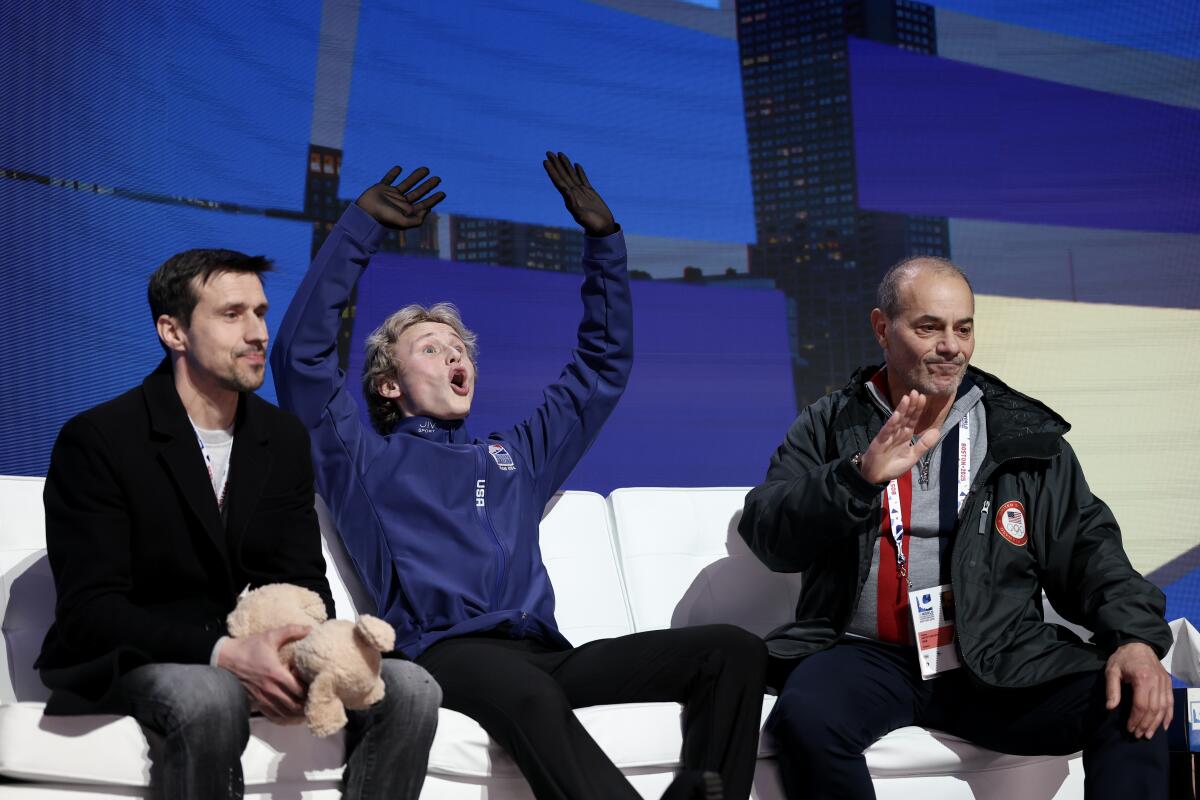
The Winter Olympics has seen its fair share of twists and turns this week, but none come close to Ilia Malinin’s shock downfall in the men’s single skating final, with Clare Balding left at a loss for words
22:28, 13 Feb 2026Updated 23:28, 13 Feb 2026
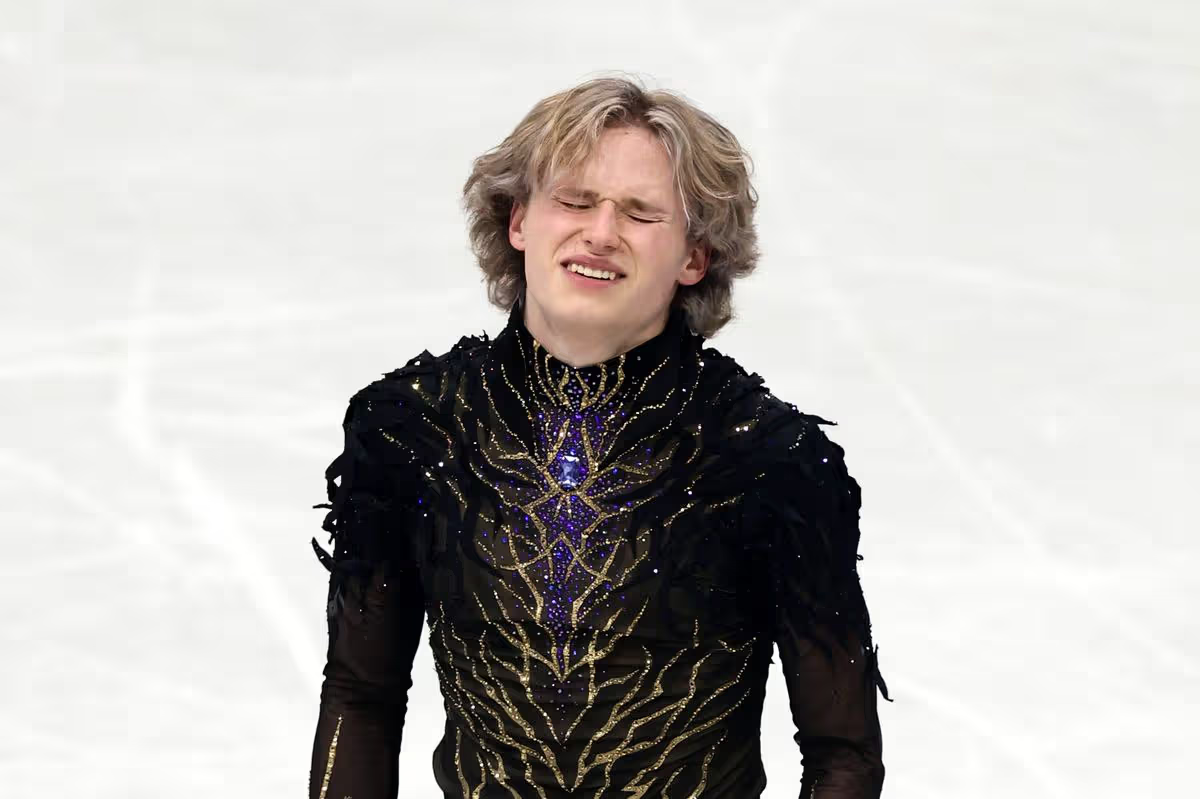
Ilia Malinin finished 8th in the men’s single skating final(Image: Getty Images)
Clare Balding was left flabbergasted at Ilia Malinin’s eighth-place finish in the final of the men’s single skating at the Winter Olympics. That’s given the Team USA star was slated as an overwhelming favourite for a gold medal.
Despite his most fierce challengers preceding his time on the ice, giving him what should have been a clear pathway to at least a podium place, the 21-year-old suffered a number of high profile mistakes under immense pressure. As a result of falling twice, Malinin tallied a total of 264.49 – his lowest free skate score in years.
As a result, Malinin sunk to eighth in the standings, while Kazakhstan’s Mikhail Shaidorov secured gold with a score of 291.58. Japan’s Yugi Kagiyama and Shun Sato secured silver and bronze respectively, with scores of 280.06 and 274.90.
Reacting to Malinin’s performance, Balding was left stunned. Speaking to BBC Sport, she said: “We didn’t expect that anything could happen to Ilia Malinin but it did – and he will leave these Games without a medal.”
BBC commentator, Kat Downes, meanwhile, was also astounded at Malinin’s fumble. She added: “This is taking some computing from everybody.
“The ‘quadgod’ has fallen. Beaten for the first time in two years, the gold that was supposed to be his. That was supposed to be the most predictable gold of this games but Ilia Malinin has fallen to eighth.”
Elsewhere, Olympic gold medallist, Robin Cousins, picked problems with a sloppy performance on the skater’s part on the whole, with a number of errors outside his falls. He said: “No one has ever seen this from him Ilia Malinin.
“When he executes, you can see how easy it is for him. There’s so many questions about those elements that are being reviewed.
“Underrotated which caused the fall. Even the landing of the backflip wasn’t the best.”
Despite being visibly upset with his own result, Malinin showed humility by quickly congratulating Shaidorov on his win, the two spotted embracing one another after the results were read. Speaking in the aftermath of the event, meanwhile, Malinin said it was a difficult night on the ice to process.
He explained: “I was not expecting that. I felt like going into this competition, I was so ready. I just felt ready getting on the ice, but I think maybe that have been the reason that maybe I was too confident that I was (going to) go well.
“It honestly just happened. I can’t process what just happened. It happens. I think it was definitely mental. Just now experiencing that Olympic atmosphere, it’s crazy. It’s not like any other competition. It’s really different.”
Ensure our latest sport headlines always appear at the top of your Google Search by making us a Preferred Source. Click here to activateor add us as Preferred Source in your Google search settings
Sky Sports discounted Premier League and EFL package
This article contains affiliate links, we will receive a commission on any sales we generate from it. Learn more
Sky has slashed the price of its Essential TV and Sky Sports bundle ahead of the 2025/26 season, saving members £192 and offering more than 1,400 live matches across the Premier League, EFL and more.
Sky will show at least 215 live Premier League games next season, an increase of up to 100 more.
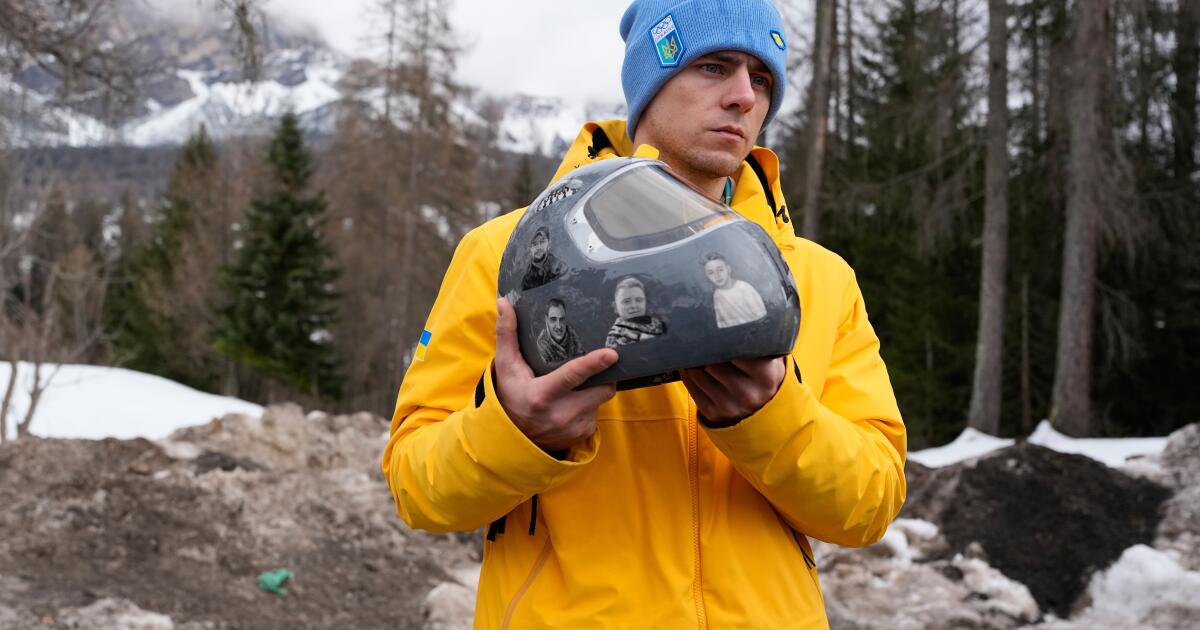
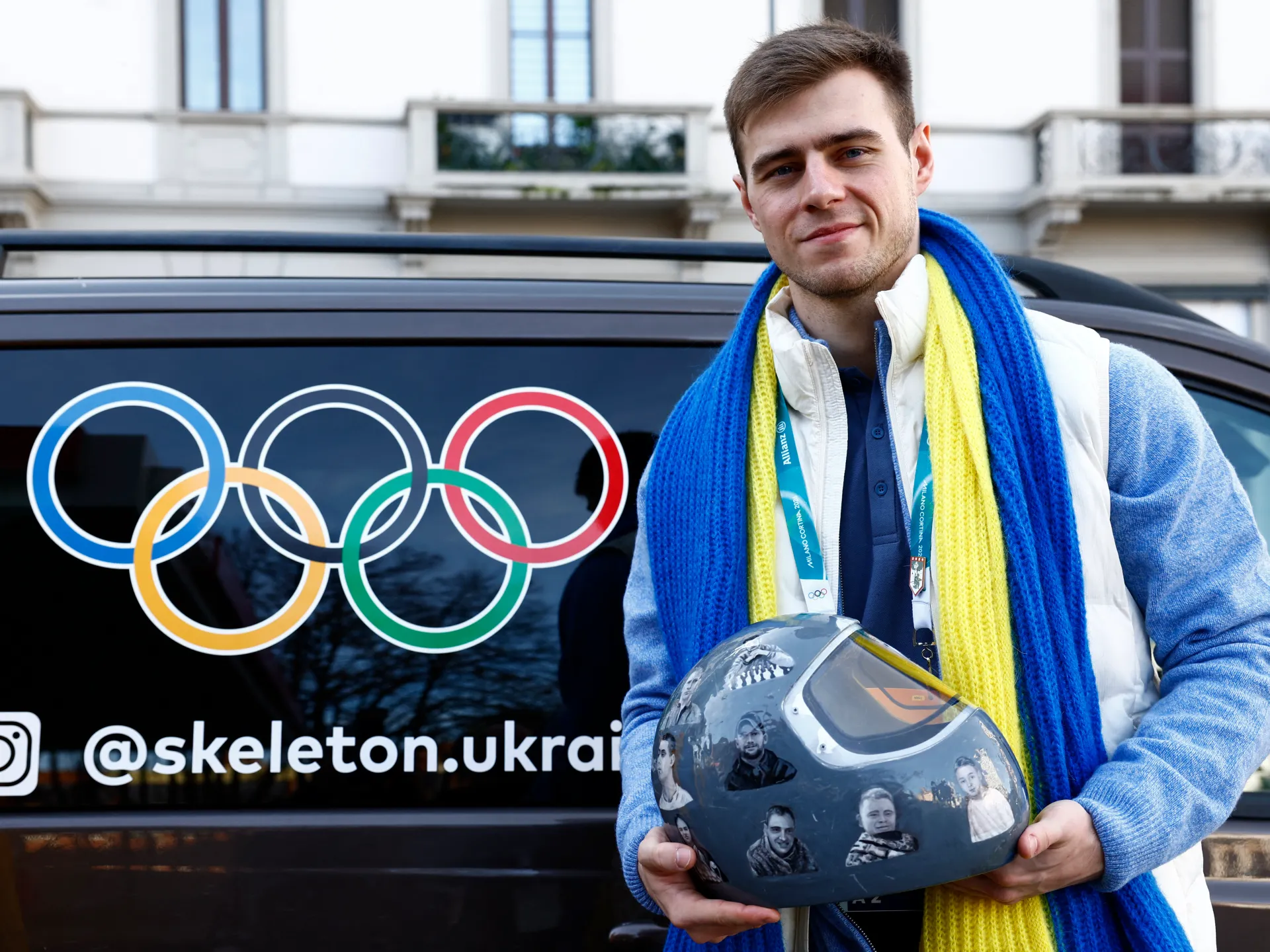
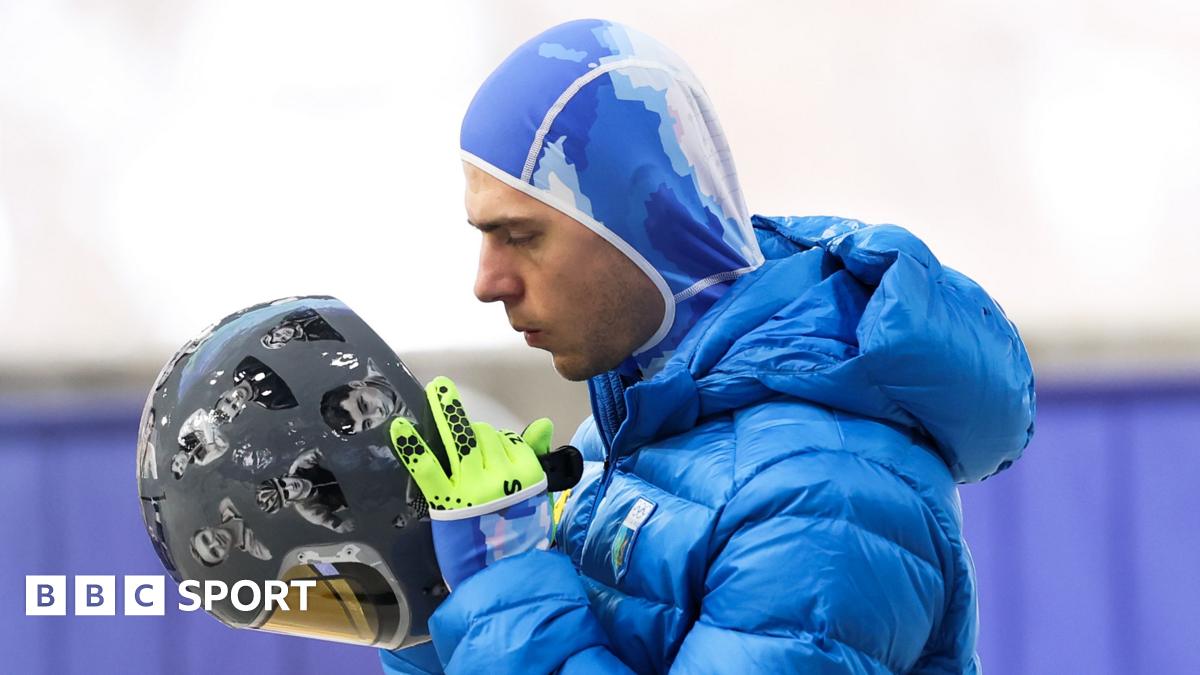
CORTINA D’AMPEZZO, Italy — Ukrainian skeleton athlete Vladyslav Heraskevych took his case to sport’s highest court Friday, detailing the reasons why he wanted to race at the Milan-Cortina Olympics in a helmet that paid tribute to his country’s war dead.
The arbitrator was moved by his story but ruled against him anyway, denying him his last chance for a win of any kind at this year’s Winter Olympics.
The Court of Arbitration for Sport denied Heraskevych’s appeal of his disqualification from the men’s skeleton race, agreeing with the International Olympic Committee and the sliding sport’s federation that his plan to wear a helmet showing the faces of more than 20 Ukrainian coaches and athletes killed since Russia invaded their country four years ago would violate Olympic rules.
“The court sided with the IOC and upheld the decision that an athlete could be disqualified from the Olympic Games without actual misconduct, without a technical or safety threat, and before the start,” wrote Yevhen Pronin, Heraskevych’s attorney.
The Court of Arbitration for Sport said the sole arbitrator who heard the case sided with IOC policy about what athletes at an Olympics can say on a field of play — and that the “memory helmet” Heraskevych brought to the Milan-Cortina Games would not align with the rules.
The arbitrator, the court said, “found these limitations reasonable and proportionate,” especially since Heraskevych could show his helmet away from the racing surface, such as in interview areas and on social media. Heraskevych also wore the helmet in training runs.
The court added that the arbitrator “is fully sympathetic to Mr. Heraskevych’s commemoration and to his attempt to raise awareness for the grief and devastation suffered by the Ukrainian people, and Ukrainian athletes because of the war.”
The appeal, which Heraskevych believed he would win, was largely moot anyway. He was disqualified from the competition 45 minutes before its start on Thursday, and whatever the Court of Arbitration for Sport said Friday wouldn’t have changed that.
“Looks like this train has left,” Heraskevych said after Friday’s hearing, knowing there was no way he could race. He left Cortina d’Ampezzo’s Olympic village on Thursday night with no plans to return.
He was blocked from racing by the IOC and the International Bobsled and Skeleton Federation on Thursday after the slider and his father emerged from a last-minute, last-ditch meeting with IOC President Kirsty Coventry — who was unable to get Heraskevych to change his mind.
Coventry reiterated Friday that she believed the disqualification was justified. The IOC made its decision based on the guidelines for athlete expression at the Olympics, he said.
They say, in part, “the focus on the field of play during competitions and official ceremonies must be on celebrating athletes’ performances.” Heraskevych never made it to the field of play — not in competition, anyway.
“I think that he in some ways understood that but was very committed to his beliefs, which I can respect,” Coventry said. “But sadly, it doesn’t change the rules.”
The IOC contends that the rule is in place for multiple reasons, including protecting the athletes from pressure from their own countries or others about using Olympic platforms to make statements.
“I never expected it to be such a big scandal,” Heraskevych said.
He also said he found it puzzling that his accreditation for the Games was taken away, then returned in short order Thursday in what seemed like a goodwill gesture.
“A mockery,” he said.
The Court of Arbitration for Sport did agree that Heraskevych should keep his accreditation.
Heraskevych said he felt his disqualification fed into Russian propaganda, noting that he and other Ukrainian athletes have seen Russian flags at events at these Games — even though they are not allowed by Olympic rule. He has previously spoken out against the IOC’s decision to allow Russians and Belarusians to compete at Milan-Cortina as “neutral” athletes and said the IOC empowered Russia by awarding it the 2014 Sochi Games.
He also wondered why other tributes from these Olympics, such as U.S. figure skater Maxim Naumov displaying a photo of his late parents — killed in a plane crash last year — have been permitted without penalty.
Italian snowboard competitor Roland Fischnaller had a small Russian flag image on the back of his helmet during these Games, and Israeli skeleton athlete Jared Firestone wore a kippah with the names of the 11 athletes and coaches who were killed representing that country during the 1972 Munich Olympics.
Pronin wrote that IOC representatives at Friday’s hearing said that “they were not punished because they did not declare this in advance, but did it after the fact, so there was no point in disqualifying them.”
The IOC said those cases were not in violation of any rules. Naumov showed his photo in the kiss-and-cry area and not while he was actually on the ice; Fischnaller’s helmet was a tribute to all the past Olympic sites he competed at, with Sochi included; and Firestone’s kippah “was covered by a beanie,” IOC spokesman Mark Adams said.
The IOC offered Heraskevych the chance to compete with a different helmet and bring the tribute helmet through the interview area after his runs. He also could have worn a black armband, which the IOC typically bans. It just didn’t want him making a statement by competing in the helmet.
“I think it’s the wrong side of history for the IOC,” Heraskevych said.
Reynolds writes for the Associated Press. AP journalists Annie Risemberg and Stefanie Dazio in Milan and Vasilisa Stepanenko in Warsaw contributed to this report.
Ukraine’s Vladyslav Heraskevych had his appeal dismissed as images on his helmet breached an Olympic ‘sacred principle’.
Published On 13 Feb 202613 Feb 2026
Share
The Court of Arbitration for Sport on Friday dismissed an appeal by Ukrainian skeleton racer Vladyslav Heraskevych to be reinstated in the Milano Cortina Olympics after he was disqualified over his “helmet of remembrance”.
The 27-year-old was removed from the Olympic programme on Thursday when the International Bobsleigh and Skeleton Federation jury ruled that imagery on the helmet — depicting athletes killed since Russia invaded Ukraine in February 2022 — breached rules on political neutrality.
Recommended Stories
list of 4 itemsend of list
“The CAS ad Hoc division dismissed the application and found that freedom of expression is guaranteed at the Olympic Games but not on the field of play which is a sacred principle,” CAS Secretary-General Matthieu Reeb said, reading from a statement following an eight-hour hearing.
Heraskevych, who was seeking reinstatement or at least a CAS-supervised run, pending a decision by sport’s highest court in advance of the final two runs set for Friday evening, said he would look at his legal options now.
“CAS has failed us. We will consider our next steps,” Heraskevych told Reuters.
The case has dominated headlines in the first week of the Olympics, with the International Olympic Committee President Kirsty Coventry meeting the athlete on Thursday morning at the sliding venue in Cortina d’Ampezzo in a last-minute attempt to broker a compromise and have him race without the specific helmet.
The IOC instead offered that he wear a black armband and display the helmet before and after the race, but said using the helmet in competition breached its rules on political protests and slogans in the field of play.
In a statement, CAS said the IOC guidelines for athletes’ expression in the Games were fair.
“The Sole Arbitrator found these limitations reasonable and proportionate, considering the other opportunities for athletes to raise awareness,” CAS said.
“The Sole Arbitrator considers these Guidelines provide a reasonable balance between athletes’ interests to express their views, and athletes’ interests to receive undivided attention for their sporting performance on the field of play.”
Ukraine’s Olympic Committee has backed their athlete, who is also the team’s flagbearer for the Games and also displayed a “No War in Ukraine” sign at the Beijing 2022 Olympics, days before Russia’s invasion. Heraskevych has also received support from Ukrainian President Volodymyr Zelenskiy.
CAS was established in 1984 by the International Olympic Committee as an independent judicial authority to settle sports disputes worldwide.
The case has dominated headlines in the first week of the Olympics.
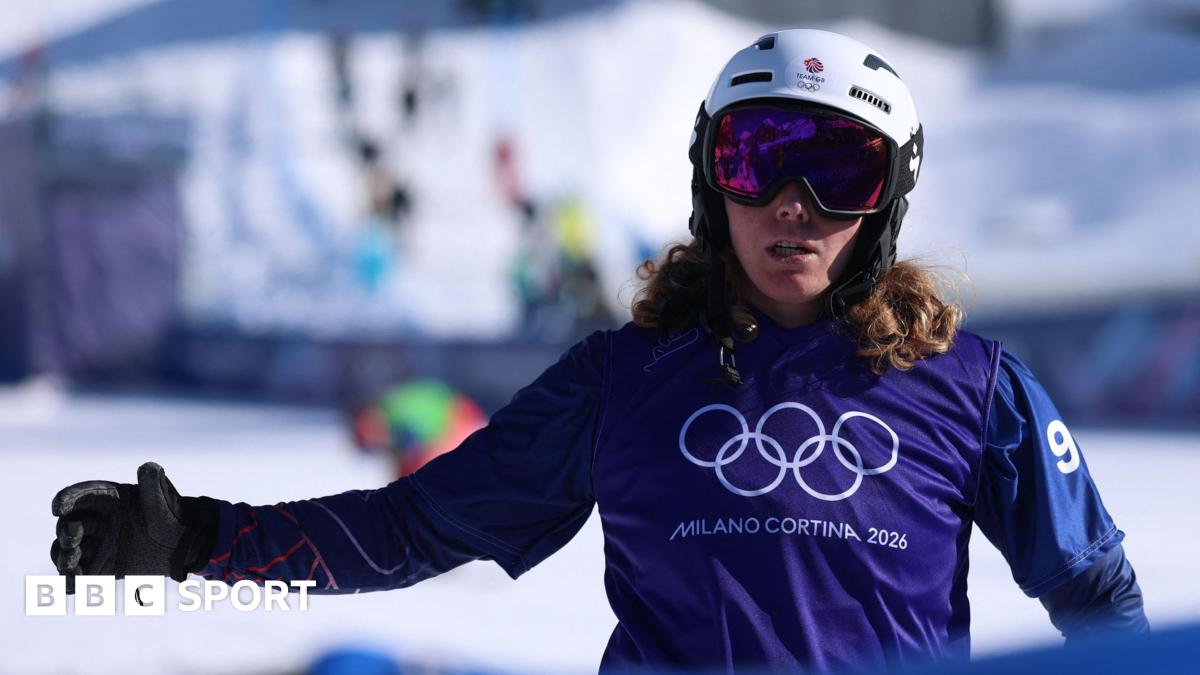
Charlotte Bankes hoped to “put on a better show” as her Olympic hoodoo continued with a quarter-final exit from the snowboard cross – in another missed medal chance for Team GB.
Bankes, appearing at her fourth Games, is a former world champion and has 26 World Cup golds to her name, but an Olympic medal is the one that continues to evade her grasp.
Although slower than anticipated in her seeding run, the 30-year-old had qualified fastest from her heat but looked off the pace from the start of her quarter-final, crossing the finish line last.
It was the same story four years ago in Beijing when Bankes exited at the same stage, a crash to blame on that occasion.
Asked by BBC Sport how she was feeling, Bankes replied: “Lost.
“I feel like I’ve done exactly the same as four years ago, which is very frustrating.
“We’ve worked incredibly hard to improve from that and I feel it hasn’t made any difference today.
“I’ve been struggling with the track all week, but we thought we’d found solutions.
“I really wanted this one.”
Bankes’ preparations for these Games had not been ideal.
In April last year she broke her collarbone, an injury she needed further surgery – including a bone graft from her hip – on in the summer after it was found not to be healing correctly.
But she came into the Games back to full fitness and had won a gold medal at a World Cup in China just last month.
“It’s a tough one to swallow. I was hoping to put on a better show, but it didn’t work out today,” she added.
“It can be a cruel sport. The team did all the work behind me and I didn’t pull it off.”
Australia’s Josie Baff won gold, with Czech Eva Adamczykova taking silver and Italian home favourite and former champion Michela Moioli the bronze.
Bankes has just 48 hours to brush off her disappointment before she returns to the start gate alongside team-mate Huw Nightingale in the mixed team event.
Bankes and Nightingale were crowned world champions in 2023.
The Livigno Snow Park has not been a happy hunting ground so far for Team GB at the Milan-Cortina Games, and the wait goes on for a first Olympic gold or silver medal on snow.
Two fourth-place finishes for freestyle skier Kirsty Muir and snowboarder Mia Brookes came earlier in the week, but both will return to action in the coming days, as will Zoe Atkin, the current halfpipe world champion.
Ukrainian skeleton racer Heraskevych says 2006 Winter Olympics ‘acts as propoganda for Russia’ after IOC decision.
Published On 13 Feb 202613 Feb 2026
Share
The Court of Arbitration for Sport (CAS) began hearing Ukrainian skeleton racer Vladyslav Heraskevych’s appeal on Friday, with a decision expected later in the day on whether he can return to competition at the Milano Cortina Olympics after his disqualification over his “helmet of remembrance”.
The 27-year-old was removed from the Olympic programme on Thursday when the International Bobsleigh and Skeleton Federation jury ruled that imagery on the helmet — depicting athletes killed since Russia invaded Ukraine in February 2022 — breached rules on political neutrality at the Games.
Recommended Stories
list of 4 itemsend of list
Heraskevych is seeking reinstatement or at least a CAS-supervised run, pending a decision by sport’s highest court in advance of the final two runs set for Friday evening.
“I’m pretty positive about how it went,” he told reporters outside the office of CAS in Milan following his appearance before the court. “I hope the truth will prevail, and I know that I was innocent.”
The racer said he was now getting threats from Russians and blamed the IOC’s decision for that.
“I believe that these Games now and this act of the IOC also serves as an instrument of propaganda for Russia,” Heraskevych said. “I still receive a lot of threats from the Russian side.”
The IOC, whose president, Kirsty Coventry, met Heraskevych on Thursday in a last-ditch effort to break the impasse, has allowed the athlete to keep his credentials despite his disqualification, so he can stay at the Milano Cortina Games.
“For me, sitting down with Vladyslav and his dad, the conversation was extremely respectful,” Coventry told a news conference on Friday. “After that, I asked the disciplinary commission to re-look at not pulling his accreditation, out of respect for him and his dad. I thought that was the right thing to do.”
The case has dominated headlines in the first week of the Olympics.
CAS Secretary-General Matthieu Reeb could not say exactly when they were likely to reach a decision, despite the tight schedule.
“We hope to have a final decision announced today, but it’s difficult for me to say when,” Reeb told reporters. “Obviously, we know the schedule of the competition, and it is an objective for CAS to be able to run the decision before the start of the race, but we don’t know how long the hearing will take.
“We have only one arbitrator from Germany, and she will be in charge of this case. We have participants attending in person, like the IOC, the athlete is here, the father of the athlete is here.
“We have a representative of IBSF attending remotely. The athlete is also assisted by legal counsel speaking from Kyiv.”
AS millions tune in to watch this year’s Winter Olympics in Milan, it is inspiring Brits to try out some of the sports for themselves.
Ski chalet specialist, Ski Beat, report a post-Games flurry with a spike in traffic during the global event.
Sign up for the Travel newsletter
Thank you!
Skiing holidays are seeing a boost thanks to the Winter OlympicsLaura Hazell shared some of her top tips
According to Ski Beat’s Laura Hazell: “100 years ago, the Chamonix Winter Olympics inspired Brits to try out skiing for the first time – in fact the origins of modern-day ski holidays can be traced back to those early days.
“The same effect is true today. Throughout the competition we see spikes in website traffic.
“There’s a real buzz, with many people who have never skied engaging in the sport, our phones are busier, and we this year we expect that what is already a good ski season will continue right into April.”
According to Inthesnow.com, the UK’s leading ski and snow sports website and magazine, spending in Europe’s winter sports destinations is up 14.3% year-on-year, with France, Italy and Austria among the strongest performers.
France remains the most popular destination for UK skiers, accounting for almost half of British ski trips.
Nearly seven in ten Brits say the Winter Olympics inspire them to try winter sports, and 45 per cent say their interest has increased over the past decade.
Around a third of UK adults booked a winter sports experience in the last year, with most choosing to travel abroad rather than stay in the UK.
The good news? There is no need to wait for next winter’s snow globe to settle as there’s still time to ski this season – and arguably the best weeks are just ahead.
Laura continued: “Spring skiing is the Alps’ best-kept secret. As the mercury softens, so do the prices, with late season deals on ski holidays making high-altitude getaways more attainable.
“The weather is kinder too: bluebird mornings, sunnier terraces, and longer daylight hours that stretch skiing well into the afternoon.
“With the half-term crowds gone, lifts hum more quietly and pistes feel wider, creating a relaxed rhythm that suits beginners finding their edges and families enjoying the snow together.
“Add in mountain restaurants serving lunch in shirtsleeves and you have a late season winter holiday that’s less about bracing for the cold and more about all about basking in the glow of it all.”
Skiing in February post the half term holidays means you can make the most of the tail end of the winter chill.
Wrap up well and go high altitude for the best snow where pistes and lifts are fully open.
April is still a great time for a last minute ski holiday
If you wan to go in March, days are lengthening, temperatures rising and layers and outerwear can be lighter.
Pistes will be busier over Easter, which is around March 28 , so don’t hang around if school holiday dates are important.
If not, plan in a week mid-month for optimum conditions and fewer crowds.
But skiing in April is just as fantastic. There is plenty of ski mileage to be had, aim high (above 2000m is ideal) and enjoy more daylight hours, long, lazy days, bluebird skiing, and lower ski holiday prices.
High factor sun cream and anti UV eye-protection are essential, pack a few t-shirts and lighter layers too, but be ready to layer up when the sun goes down.
Top tips for thrifty spring skiing:
For snow-sure spring skiing look for north facing slopes, and ski areas above 2000m
Beginners don’t need miles of skiing, well-groomed nursery slopes and blue runs will suffice, so save money and buy a local area lift pass.
Select accommodation that includes meals, dining out or shopping for self-catering can be expensive in the mountains.
Make sure the accommodation is close to the lifts, ski school, clomping around in ski boots, carrying skis, is an experience best limited.
Consider buying ski clothing from reseller sites like Vinted or Ebay.
There’s no need to buy skis or ski boots, hire in resort, most people do
Look out for late season offers, avoid the easter peak (28th March), and for the best prices all season consider a high altitude escape on 11th or 18th April.
Here are some of Ski Beat’s top last minute deals to sneak in one last ski holiday this year.
February 21: 7 nights La Plagne, £994pp (saving £304pp)
Includes a chalet host to prepare breakfast, afternoon tea and three course evening meals with wine, return Gatwick flights and transfers, based on two sharing a twin or double ensuite room at Ski Beat’s Chalet Sorbier.
February 28 : 7 nights skiing in French Alps, £1143pp (saving £136pp)
Includes return Gatwick flights, transfers and accommodation at high altitude Chalet Gentiane in Plan Peisey, with a chalet host to prepare breakfast, afternoon tea and three course evening meals with wine, based on two sharing a twin or double ensuite room.
March 21 : 7 nights in Three Valleys resort, £999pp (saving £98pp)
Incudes accommodation in Chalet Vallon Blanc in La Tania. Prices include a chalet host to prepare breakfast, afternoon tea and three course evening meals with wine, based on two sharing a twin or double ensuite room, return Gatwick flights and transfers.
Or fly on March 7 and March 14 for £1125pp, saving £100pp.
April 11: 7 nights in La Rosiere for £716pp (saving £307pp)
Ski Beat’s has 30 per cent off April 11 ski holiday departures.
Staying in Chalet Perdrix in high altitude La Rosiere on the French/Italian border, includes return Gatwick or Manchester flights, a chalet host to prepare breakfast, afternoon tea and three course evening meals with wine, based on two sharing a twin or double ensuite room.
However, be wary of booking any ski holidays that seem too good to be true for the price.
Laura warned: “With skiing it’s all about value, rather than price.
“Bargain ski holidays can result in an inferior lift infrastructure, a resort that’s in the valley and requires buses or lifts before the skiing even starts, or lower altitude skiing where the snow is less reliable, especially late season.”
Other top ski tips include:
Choose a high-altitude resort with reliable late-season cover
Look for resorts with north-facing pistes that retain the snow longer
Line up lessons in advance to build confidence from the first glide
Warm up before departure, with time in an indoor ski slope to acclimatise
Plan in a few visits to the gym, some power walks, or home exercise to get muscles in tone
Check out spring packages inclusive of flights, transfers, accommodation and meals.
Pack lighter layers and outerwear for sunnier slopes
Invest in UV-protective sunglasses and goggles to protect against sun and snow glare
Cover up with top-tier SPF defence to keep skin totally protected on bluebird days
Start early, linger late, make the most of firmer morning snow then ease into long lunches on sunny terraces once the slopes soften.
Book slopeside accommodation, a ski chalet close to ski schools, lifts and kindergartens is ideal, with a chalet host to point skiers in the right direction.
Weigh up the advantages of catered accommodation; save time, money and energy on shopping, and let someone else do the cooking, cleaning and catering.
Ski Beat’s Laura Hazell adds, “While the aspiration to fly like an Olympiad is still fresh in mind, make the medal-winning moments a cue, not just an inspiration.
“The mountains are still very much open for business right until the end of April, and there’s no better time to answer their call.”
Bargains can still be found – if you know where to look
MILAN — Chloe Kim came up short in her attempt to become the first person to win three consecutive Olympic snowboarding gold medals on Thursday, finishing second in the halfpipe to South Korea’s Gaon Choi at Livigno Snow Park.
Choi stormed back from a nasty crash on her first run in which she clipped the lip of the halfpipe and came tumbling almost head first onto the icy surface. She looked shaky on her second run then the 17-year-old who leads the World Cup standings threw down a near flawless 90.25-point run while fresh snow fell to jump ahead of Kim, who had 88 points on her first run.
Dropping in last as the top qualifier, Kim had a chance to grab the gold medal back. She flashed two thumbs up to her coaching team before dropping in. But she fell on a cab double cork 1080, which she had stomped in her first two runs.
At the bottom of the halfpipe, Choi threw her arms in the air. Her coach ran to hug her. Kim, after sliding to the bottom of the pipe, ran through the crowd to congratulate Choi. The new Olympic champion was celebrating with Kim’s family.
The snowboard stars have history. Kim helped Choi train at Mammoth Mountain Snowboarding Club. Choi counts Kim among one of her snowboarding idols after Kim launched herself to superstardom at the 2018 Olympics.
Kim, then 17, became the youngest woman to win an Olympic snowboarding gold medal in PyeongChang. She followed it up with a historic gold in Beijing, where she became the first woman to win two Olympic gold medals in halfpipe.
The 25-year-old Kim suffered a torn labrum in her right shoulder in early January while training in Switzerland. It was the second time she had injured her shoulder in less than four weeks after she was forced to withdraw from a World Cup competition in December.
The injury meant the Olympics were Kim’s first competition of the season.
PALM BEACH, Fla. — As Major League Baseball closes in on an agreement for its players to participate in the 2028 Olympics, Commissioner Rob Manfred said the controversy surrounding LA28 chief Casey Wasserman would not impact the league’s final decision.
“Our dealings are not with Casey,” Manfred said Thursday at the MLB owners’ meetings. “Our dealings are with the institution of the Olympics.”
In recently released emails, Wasserman was linked to Jeffrey Epstein and his associate, Ghislaine Maxwell. The board retained a law firm to investigate, the statement said, and the review did not uncover any behavior beyond what was already known: a “single interaction with Epstein” on a plane flight for a humanitarian mission and raunchy emails with Maxwell, both two decades ago, before the “deplorable crimes” of both became public.
“Based on these facts, as well as the strong leadership he has exhibited over the past ten years, Mr. Wasserman should continue to lead LA28 and deliver a safe and successful Games,” the committee statement said.
Epstein died by suicide after his indictment on sex trafficking charges in 2019. Maxwell was convicted of sex trafficking in 2021.
Manfred declined to say whether he was concerned that an association with Wasserman could be detrimental for baseball.
“I’m going to pass on that one,” Manfred said. “People much closer to that situation are better to opine on that.”
Mark Attanasio, the Los Angeles-based owner of the Milwaukee Brewers, is a member of the LA28 executive committee. Attanasio said he would let the statement speak for itself.
While baseball is not new to the Olympics, the participation of major leaguers would be. In past Olympics, MLB declined to interrupt its season so its players could travel halfway around the world, and Team USA featured minor leaguers and college players.
MLB players already travel to Los Angeles every summer, and Wasserman has pitched Manfred and MLB owners in a variety of meetings on the benefit of using major leaguers at a time the league is focused on broadening its international appeal.
“What an incredible opportunity to elevate the sport in a city where you have one of the great cathedrals of the sport,” Wasserman told The Times last year. “There is no better chance to tell the global story of baseball than from the Olympics in Los Angeles.
“They understand that. We could have another Dream Team, or two, depending on the countries. That is a vehicle to tell the story of baseball around the world, and that is really powerful.”
MLB and LA28 officials have worked out a tentative timeline under which the All-Star Game would be played in its usual mid-July spot in 2028, most likely in San Francisco, followed by a six-day, six-team Olympic baseball tournament at Dodger Stadium.
“I think people have come to appreciate that the Olympics on U.S. soil is a unique marketing opportunity for the game,” Manfred said Thursday. “We’ve got a lot of players interested in doing it, and I feel pretty good about the idea we’ll get there.”
Are the Dodgers good for baseball?
Outfielder Kyle Tucker adjusts his Dodgers cap during his introductory news conference at Dodger Stadium on Jan. 21.
“I think great teams are always good for baseball,” Manfred said. “I think, with respect to this particular great team, it added to what we have been hearing from fans in a lot of markets for a long time about the competitiveness of the game. But great teams are always good for baseball.”
MLB officials have cited that fan concern repeatedly over the last year, prelude to an expected push for a salary cap. Manfred declined to discuss the owners’ labor strategy but said he expected negotiations on a new collective bargaining agreement to begin after Opening Day and said he would not talk about MLB proposals until they are presented to the players’ union.
The current agreement expires Dec. 1, and a lockout is widely expected.
Where can you watch the Angels?
Angels star Mike Trout celebrates after hitting a solo home run against the Houston Astros on Sept. 28 in Anaheim.
(Wally Skalij / Associated Press)
The Angels already are in spring training, and yet their fans have no idea where to watch their games on television this season.
The Angels have agreed that MLB will provide a streaming option, and a team official confirmed they are still deciding whether to let MLB sell their telecasts to cable and satellite distributors or reinvent what remains of the FanDuel Sports channel already part-owned by the team, with the Kings joining the Angels.
The Angels’ situation is not unique. Three years ago, MLB did not provide broadcast services to any team. Today, amid the collapse of the cable and satellite universe, MLB provides broadcast services to 14 of its 30 teams — 15, if the Angels go that way.
In 2028, Manfred would like to sell national streaming packages, in the hope that more bidders would mean more revenue, a particularly acute need for the teams losing revenue as guaranteed rights fees are cut or eliminated altogether. The challenge: how to convince the Dodgers and other big-market teams to sacrifice their still-lucrative local rights so MLB can sell a 30-team package.
“Ideally, I’d love to get there,” Manfred said. “I don’t need to get all the way there to accomplish most of what I am thinking about.”
On Thursday, Manfred cited one way he could get close enough: have rival owners vote to expand the number of games — for the Dodgers or anyone else — that would be classified as national rather than local.
“We can take as many games as we want from any club in a national package,” Manfred said, “with a majority vote of the clubs.”
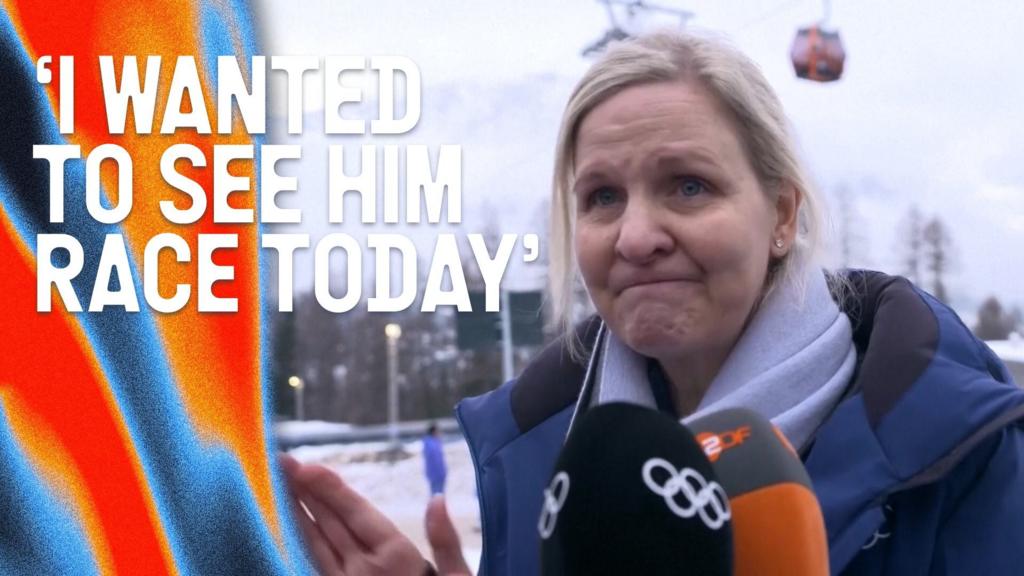
International Olympic Committee (IOC) President Kirsty Coventry gets tearful as she explains the conversation she had with Ukrainian skeleton pilot Vladyslav Heraskevych.
Heraskevych was banned from participating in the race for continuing to wear a helmet featuring images of athletes killed during Russia’s invasion of his home country, which the IOC says breaks its rules.
The decision to ban Heraskevych has drawn shock and condemnation from many former and current Olympic athletes.
Lizzy Yarnold, Team GB’s two-time Olympic skeleton gold medallist, told BBC Sport: “I think it is actually quite shocking. Within the sliding community there is shock and confusion.
“This [wearing the helmet] was a reaction to something which was an act of memorial and incredibly emotionally important to him.
“I think the IOC owe him an apology and this was the wrong decision.”
Two-time Olympic bobsledder John Jackson was equally unimpressed with the IOC.
Jackson, who also served as a Royal Marines commando, told the BBC: “His approach to that is about remembering those who have fallen.
“For me, being military and now a veteran, remembrance is really important to all veterans. We have all lost friends and colleagues in conflict, and we all know someone who isn’t here and paid the ultimate sacrifice.
“I support him in what he was trying to achieve. It is really important to remember those who have given their life for something that ultimately doesn’t need to happen.”
Heraskevych meanwhile told the BBC that being banned only left him feeling “emptiness.”
“Yesterday and before yesterday I was training good. I could be among the medallists for this event, but suddenly because of some interpretation of the rules that I do not agree with, I am not able to compete,” he said.
“Expression guidelines – what do you consider as expression? Many others here in this arena have helmets with different colours and I believe that is also a kind of expression.
“Some others had national symbols, that is also expression. For some reason, their helmets weren’t checked and they were allowed to compete but I am not.
“I believe they [those who have fallen] deserve to be here because of their sacrifice. I want to honour them and their families.”
Heraskevych’s international team mates showed their support throughout Thursday’s competition in Italy.
Alpine skier Dmytro Shepiuk displayed a note reading “Ukrainian heroes with us” after competing, while luger Olena Smaha also voiced support for Heraskevych wearing a glove reading: “Remembrance is not a violation.”
Ukraine president Volodymyr Zelensky accused the IOC of “playing into the hands of the Russian aggressor” after Heraskevych’s disqualification
“Sport shouldn’t mean amnesia, and the Olympic movement should help stop wars, not play into the hands of aggressors,” he wrote on X, external.
“Unfortunately, the decision of the International Olympic Committee to disqualify Ukrainian skeleton racer Vladyslav Heraskevych says otherwise.”
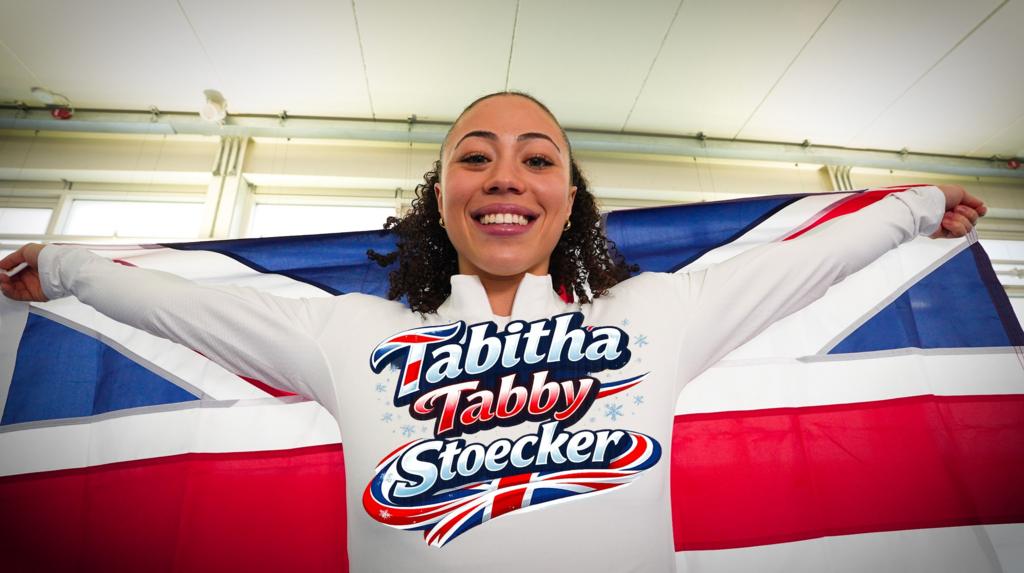
British skeleton racer Tabby Stoecker is aiming to follow in the sled path of Lizzy Yarnold and Amy Williams by winning an Olympic gold medal in one of the fastest sports in Milan-Cortina.
The 25-year old is already a double world silver medallist in the mixed team event, with Matt Weston. She credits her time at circus school, learning juggling and the flying trapeze, for giving her the confidence to take on the challenge of skeleton.
MILAN — After injuries and stumbles, Madison Chock and Evan Bates earned their first Olympic medal Friday, but it wasn’t expected to be this color.
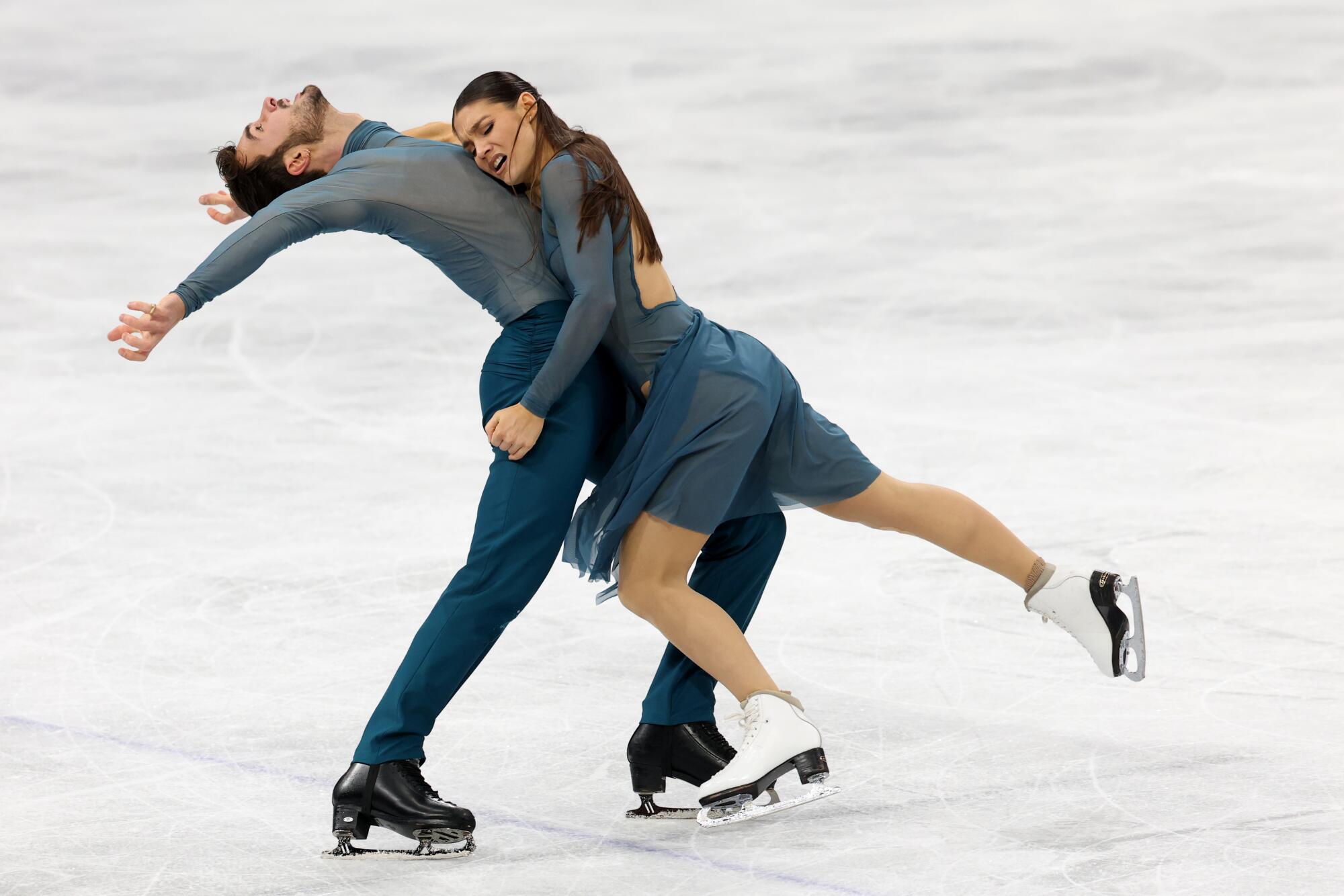
The three-time world champions settled for silver in their fourth Olympics together, falling 1.43 points behind France’s Laurence Fournier Beaudry and Guillaume Cizeron. Cizeron has won back-to-back Olympic titles with different partners after climbing the podium in Beijing with Gabriella Papadakis.
While Chock and Bates, who have skated together for 15 years and got married in 2024, Fournier Beaudry and Cizeron shot to the top of the sport after just 11 months together. When the winning score was announced, Cizeron hugged his coach and covered his face while crying. Chock and Bates, sitting next to the kiss-and-cry in white arm chairs reserved for the current leaders, clapped politely.
They wanted this gold medal as a perfect ending to their accomplished career.
France’s Laurence Fournier Beaudry and Guillaume Cizeron compete in the ice dance final at the Winter Olympics in Milan on Wednesday.
(Robert Gauthier / Los Angeles Times)
The three-time world champions and seven-time U.S. champions were in their fourth Olympics together. Bates was competing on this stage for the fifth time. On a team with only one other athlete with previous Olympic experience — 20-year-old Alysa Liu skated in Beijing as a teenager — Chock and Bates became the unofficial parents to their younger teammates, including Emilea Zingas and Vadym Kolesnik, who finished fifth, and 11th-place finishers Christina Carreira and Anthony Ponomarenko.
Chock and Bates were the steadiest contributors of this year’s team gold medal run, winning both dance programs to win the second consecutive team Olympic championship for the United States, but struggled in previous individual Olympic events. In 2018, Chock suffered an ankle injury during the warm-up before the short dance. In 2022, she slipped and had an uncharacteristic fall.
But they haven’t missed a podium since that stumble. They were undefeated this season, placing first for both the rhythm and free dance portions of every competition. Until the individual Olympic short dance.
Fournier Beaudry and Cizeron, who paired together last year only after Fournier Beaudry’s longtime skating partner was suspended for sexual assault allegations, inched ahead by 0.46 points after Monday’s rhythm dance. It was a reversal from the team event, where Chock and Bates swept both the rhythm and free dance portions and led the qualifying round 91.06-89.98 over the French pair.
After the rhythm dance score for Chock and Bates flashed across the screen, her eyebrows shot up in surprise. Their coach Patrice Lauzon’s mouth dropped open. He furrowed his brow and cocked his head in confusion. While Chock and Bates smiled and waved to the crowd, Lauzon, who is also on the coaching team for Fournier Beaudry and Cizeron, looked on with suspicion.
Chock and Bates did their best to leave no doubt Wednesday. Their enthralling matador and bull program set to “Paint it Black” eclipsed the season’s best they earned two days prior during the team event, but it wasn’t enough to earn elusive individual Olympic gold.
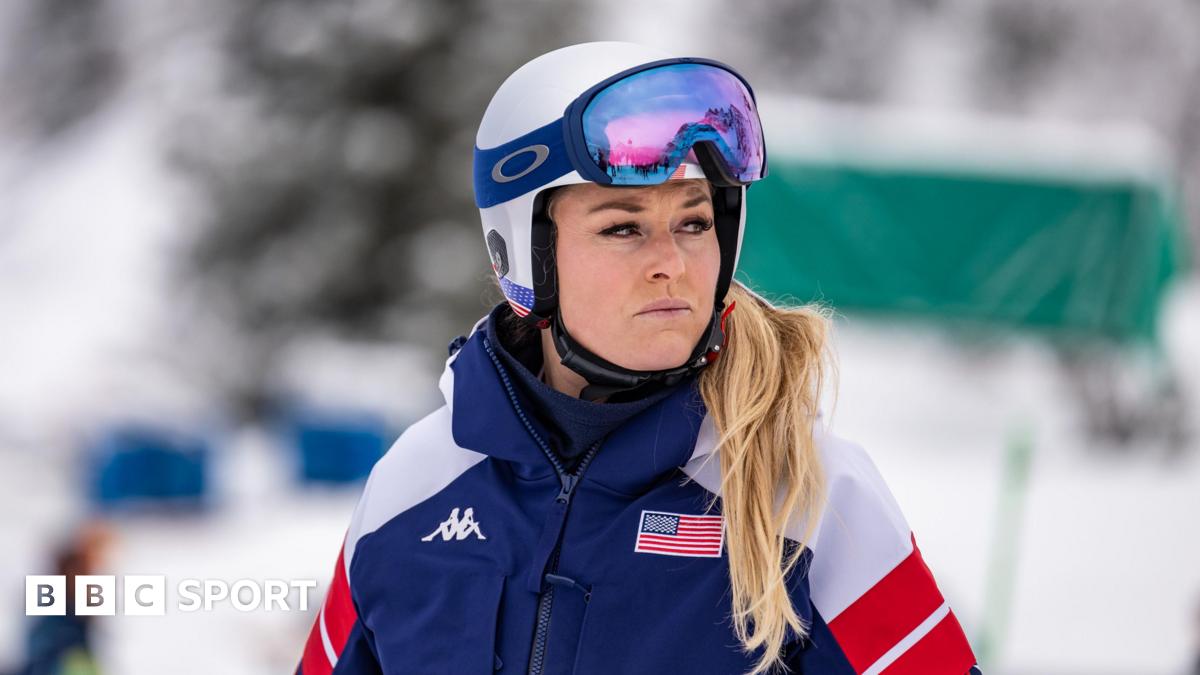
Before her fateful downhill run Sunday — one that ended with a violent crash after 13 seconds — Lindsey Vonn pulled on a pair of out-of-production gloves from her childhood skiing idol, Picabo Street.
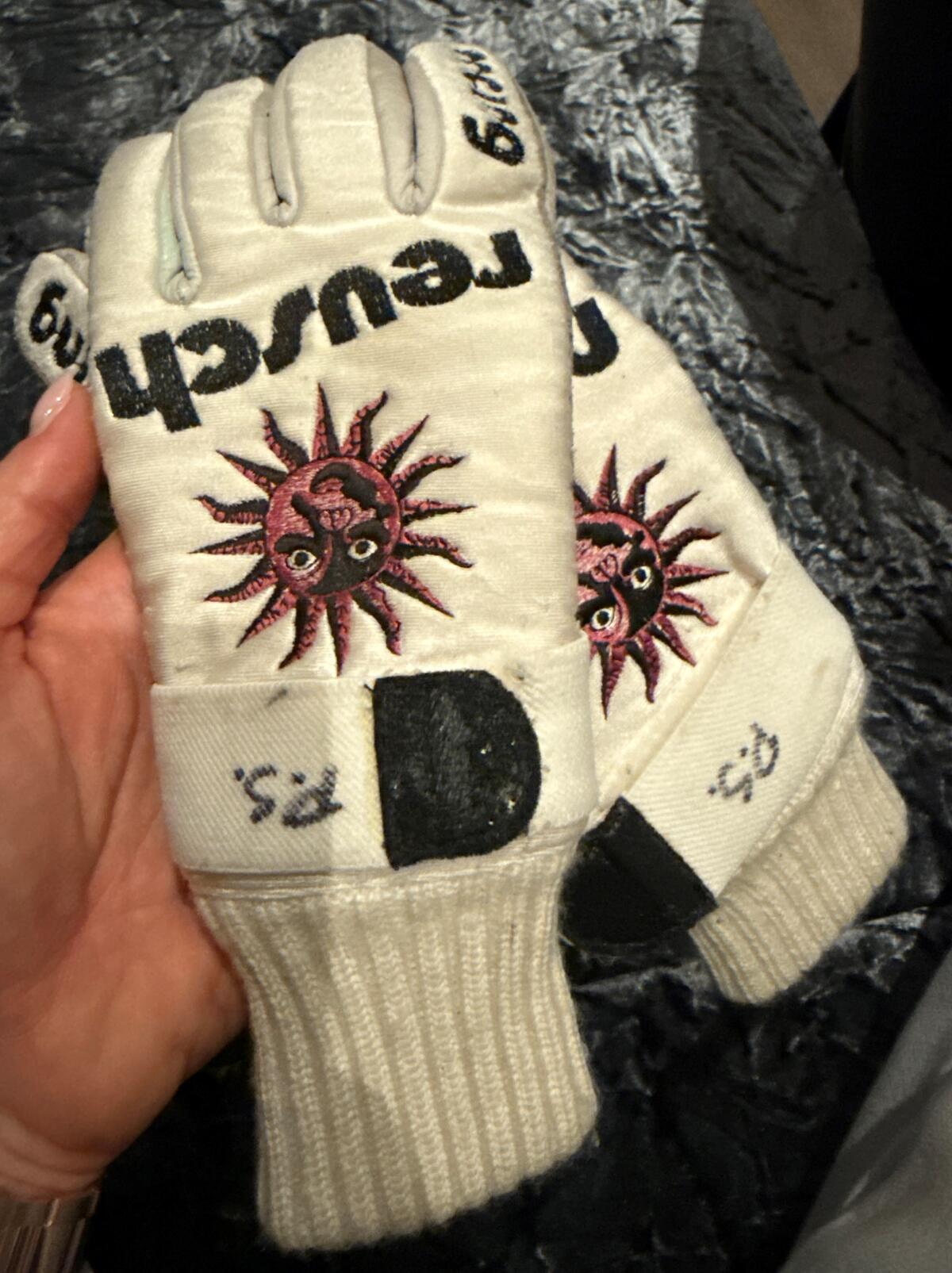
The gloves are weathered and white, their brightness dulled by the decades, with the brand name “reusch” across the knuckles and a big, plum-colored sun on top. On the wrist straps are Street’s initials, scrawled in marker.
Vonn didn’t announce the gesture, nor did NBC, which employs Street as a color commentator. Street was at the starting gate of the Olimpia delle Tofane course for Sunday’s coverage.
Street confirmed to the Los Angeles Times that the two longtime friends made the glove exchange before the Olympics.
“When she saw a picture of me in those gloves, she was like, ‘Oh, those would be cool,’” Street told the Times. “And I caught wind of it, and was like, ‘Well, I just happen to have them.’”
Those gloves are especially meaningful to Street because they are immortalized on the bronze statue of her in Sun Valley, Idaho. The sun across the top is visible in the sculpted detail.
“It was just my way of being able to show her that, you know, I love you and I believe in you,” Street said. “And wear these, they’ll be fun.”
The two were on the U.S. Ski Team together — Street at the end of her career, Vonn at the beginning — and have been close friends for years. Vonn co-produced the documentary “Picabo,” and in it tells Street, “You are my hero.”
The gloves Picabo Street gave to Lindsey Vonn before Vonn’s race in the Olympic downhill on Feb. 8.
(Courtesy of Picabo Street)
Street, whose skiing and who’s first name helped make her a pop-culture sensation during her Olympic career is a huge fan of Vonn. In speaking to the Times, she said on multiple occasions, “I’m not the story here, so this isn’t about me.”
Still, there are some uncanny coincidences. For instance, Vonn was the 13th skier in Sunday’s lineup and her run lasted 13 seconds before her fall, in which she broke her left leg. Late in her career, Street suffered a broken left leg in a race that took place on Friday the 13th in Crans Montana, Switzerland, where Vonn sustained a ruptured anterior cruciate ligament in a fall at the end of January.
Street had an emotional reaction when she learned what bib number Vonn would be wearing.
“I about puked when I saw number 13,” Street said. “I got very little sleep. I cried all night long, and I cried in the morning. I couldn’t shake it.”
She said her main concern now is her friend’s return to health, not for competitive skiing but for life.
“I want her leg to work for her,” Street said. “I want her nerves to work for her. I want her to have function of her whole body again, and in case she wants to have a family, she can play with her kids.”
The gloves weren’t the first piece of equipment Street loaned to Vonn.
Lindsey Vonn prepares to leave the downhill starting gate while wearing Picabo Street’s gloves on Feb. 8.
(Screenshot courtesy of NBC)
“I remember when I raced in Salt Lake, and I retired, and I was packed up and leaving the house we were staying in,” Street said, referring to the 2002 Winter Olympics. “She came into the house, and I remember giving her a huge hug and giving her a couple of items — one of which she wore in those Games — which was a sleeve around her braid, because we both have really long hair.
“I wore a red, white and blue American-flag neoprene sleeve around my hair, and she wore one as well. I handed her that there and was like, ‘Here you go. Go get ‘em.’”
After Vonn’s crash Sunday, Street told her own mother about loaning the gloves.
“I said, ‘Oh God, mom, she was wearing my gloves,’” she said, her voice catching with emotion.
“At first my mom said, ‘Oh, honey,’ and then she goes, ‘OK, let’s flip this. Maybe the gloves kept her from getting injured worse.’”
MILAN — Maxim Naumov typically trembles as he waits in his opening position before the music begins. But on Tuesday, the 24-year-old U.S. figure skater stood firm at center ice with the Olympic rings beneath his feet and his right fist raised. A white gold ring with a single diamond on his ring finger glittered in the light.
It was his father’s ring.
A year after his parents, Vadim Naumov and Evgenia Shishkova, were among 67 people killed in a Washingon, D.C. plane crash, Naumov carried their strength during his Olympic debut and delivered an emotional season’s best 85.65 in the men’s short program that qualified him for the free skate.
U.S. teammate Andrew Torgashev also scored a season’s best in his Olympic debut, qualifying for Thursday’s free skate with an 89.94. His coaching team, which includes Irvine-based Rafael Arutyunyan, fist-bumped after Torgashev hit the final combination jump of his program. Skating to “Maybe I Maybe You” by the Scorpions, Torgashev flashed the rock-and-roll symbol to the crowd as he saluted.
Instead of the raw emotion Naumov released after the U.S. championship that clinched his Olympic spot last month, he smiled purely and breathed deeply while the crowd at Milano Ice Skating Arena showered him with applause. He looked toward the rafters and spoke to his parents.
“Look what we just did,” Naumov said. “We did it.”
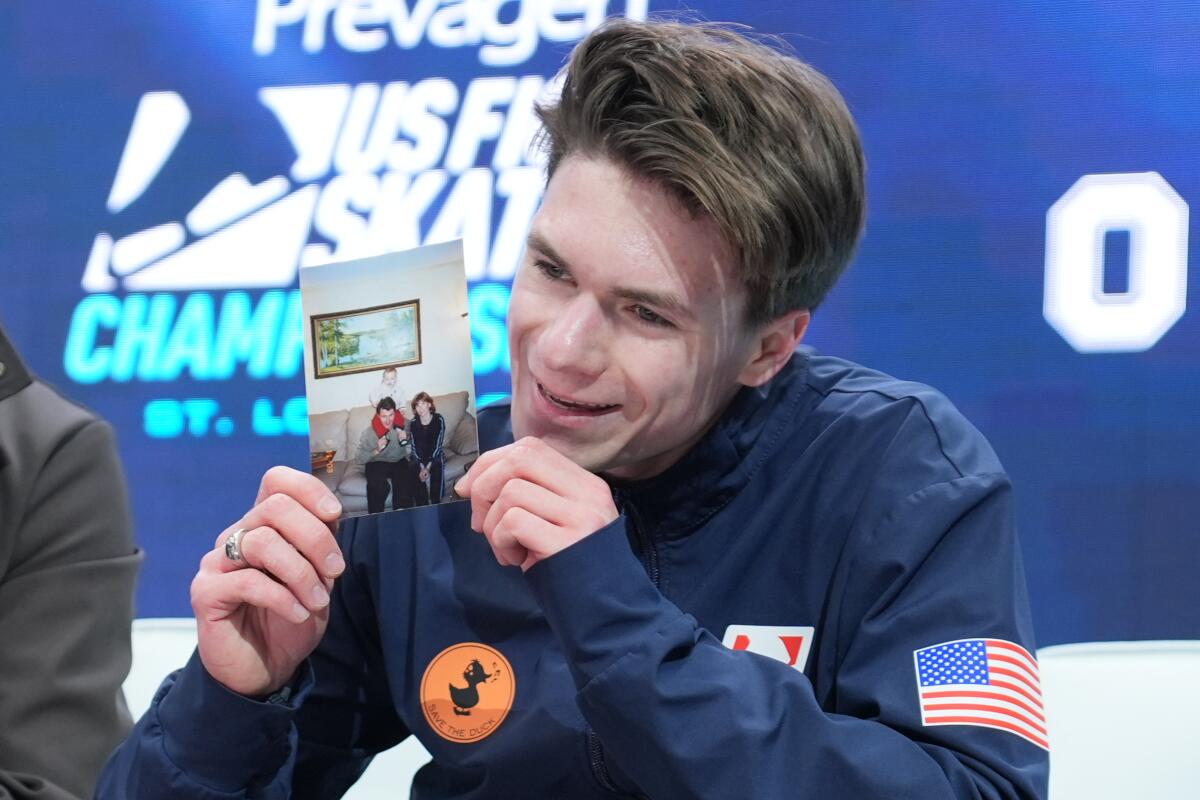
Maxim Naumov holds a photo of his parents after competing during the men’s free skate at the U.S. championships.
(Stephanie Scarbrough / Associated Press)
The elder Naumov and Shishkova were three-time world pairs skating medalists and two-time Olympians. The 1994 world champions coached at the Skating Club of Boston and remained at the 2025 U.S. championships in Wichita, Kan., after the competition to coach a development camp.
Maxim Naumov, who had finished fourth at the U.S. championships for the third time in a row, returned home immediately after the competition. In one of their last discussions as a family, Naumov’s father laid out the plan to ensure they could reach the Olympics in one year. The talk lasted about 45 minutes. After the first 30 minutes, Naumov said he was rolling his eyes the way children often do, but he understood the message: They were going to work together and revamp everything they do.
After the crash on Jan. 29, 2025, Naumov struggled to leave the house. He couldn’t bear to tie his skates. Going to the rink felt unimaginable.
At every moment, Naumov wanted to lay in bed and rot. He instead chose to find the thing that felt like the most difficult task and attack it. At first it was simply waking up. Then it was getting out of bed. Then it was going to work and coaching his parents’ former students. Now they’re his students.
“The only way out is through,” Naumov said. “Everyone has the ability to do that: to remain strong in your mind, have willpower and do things out of love instead of fear. I think if you’re able to do that, whatever it is that you’re going through, however big or small, you can have small wins every single day, and you can do things that you never thought that you could.”
Naumov earned his Olympic spot by finishing third at last month’s U.S. championships. The emotions of the national competition that would decide the family’s dream were so heavy that after he finished his free program, he found a secluded corner in the tunnel and sobbed.
Finally on the Olympic stage, Naumov felt nothing but stillness. Naumov said he felt his parents’ presence and the support of the entire figure skating community “like a hand on my back pushing me forward.”
Looking at old videos can still be painful for Naumov. But he mustered the strength to look through the family’s large photo album ahead of the U.S. championships and pick out several photos he brought to the competition. His parents had always been in the kiss-and-cry with him. With his spot on the Olympic team at stake, he wanted them there again.
Waiting for his score in Milan, Naumov flashed a photo he picked. He is flanked by his parents standing on the ice for the first time at about 3 years old.
Two decades later, he was stepping off Olympic ice.
“To be able to just have 2 minutes and 50 seconds to show what you’ve been working on for 19 years, and to be able to make it happen when it matters and when it counts, there’s no feeling like it at all ever,” Naumov said, still breathless from the emotional performance more than 30 minutes after he nailed the final note. “I just hope that I made everyone proud.”
U.S. flags waved on every side of the rink as he saluted the crowd. He knows his mother would have not been there watching in person because she was too nervous to attend. Refreshing the online score tracker to keep up with Naumov’s program, she would always find a way to send a message of support to her son.
Before his program, Naumov sent a message of his own.
“Mom and dad,” the videoboard in the arena read, “this is for you.”
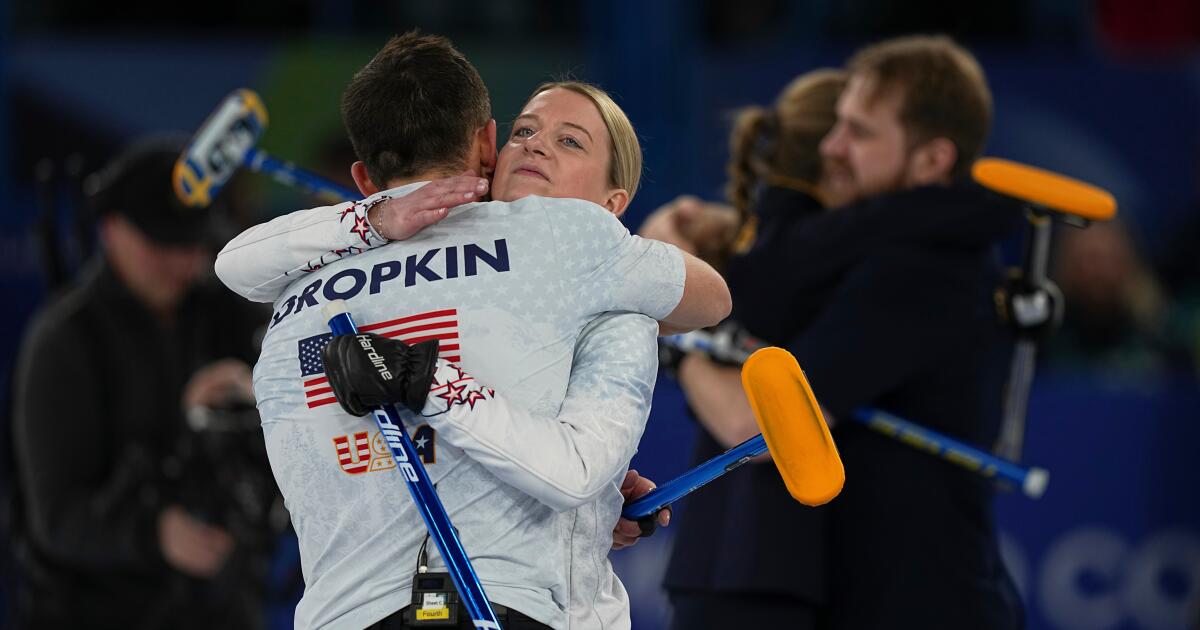
MILAN — Korey Dropkin and Cory Thiesse became the first U.S. curlers to medal in Olympic mixed doubles competition Tuesday, but the medal wasn’t the one they were trying to achieve.
The American pair lost in a dramatic final, 6-5, to the Swedish brother-sister combo of Isabella and Rasmus Wrana at the Cortina Curling Olympic Stadium in Cortina d’Ampezzo, Italy.
Dropkin and Thiesse led going into the final throw of the match.
A team skipped by John Shuster won gold in 2018, the last time the U.S. reached the medal podium in the sport. Shuster was also part of the only other U.S. medal-winning team, in 2006. That team was skipped by Peter Fenson.
Dropkin and Thiesse are the first Americans to win a medal in mixed doubles, which joined the Olympic calendar in 2018, while Thiesse is the first American woman to win a curling medal.
The U.S. reached the final when an incredible shot by Thiesse on the final delivery of Monday’s semifinal scored two points, turning a deficit into a 9-8 upset of Italy, a team that had beat the Americans in round-robin play. Sweden routed Britain 9-3 in its semifinal. Italy defeated Britain 5-3 for the bronze medal.
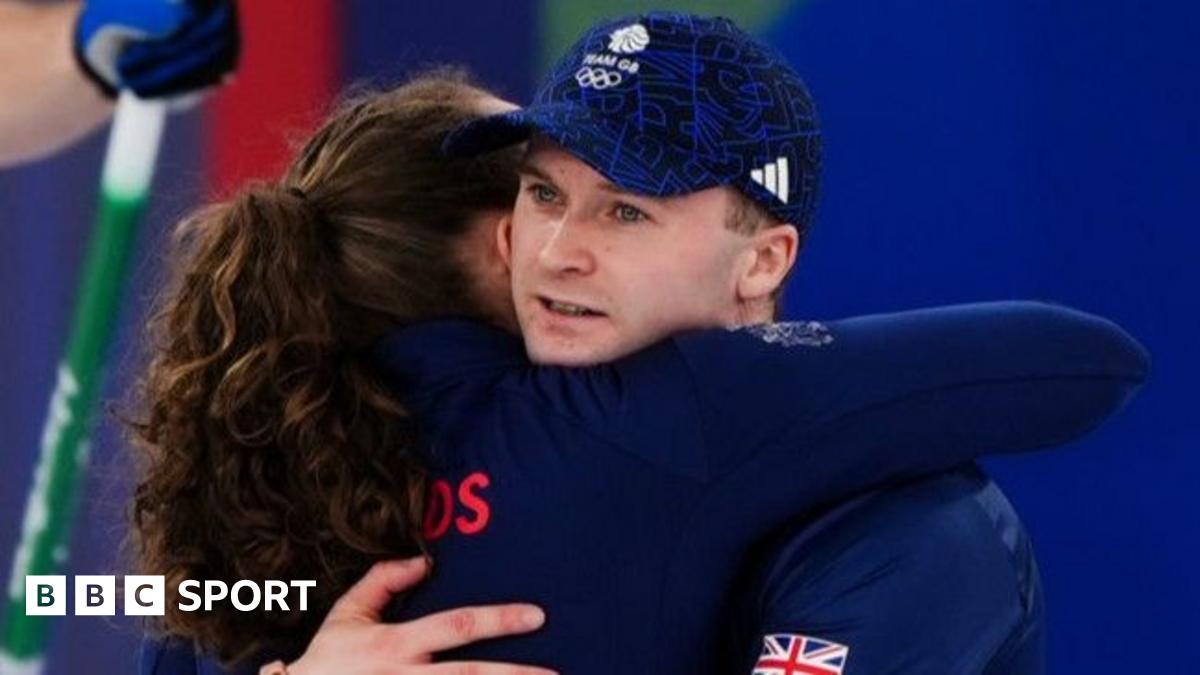
In a game of fine margins, Mouat and Dodds were repeatedly an inch or two away from where they needed to be.
They started with the hammer – theoretically advantageous in allowing a team to control a match – and had a shot in the first end to take three points.
However, Dodds’ effort was fractionally out and the Italians stole one. It would be a recurring theme as Constantini and Amos Mosaner dictated the contest.
The British pair levelled, before the hosts edged back ahead in a cagey third end and pinched another in the third. Again, it was a near-miss from Dodds.
That had Italy 3-1 ahead at the interval and GB chasing.
One in the fifth was less than they wanted but a big mistake by Mosaner in the sixth opened the door. Was this going to be the moment the momentum shifted?
It wasn’t. Constantini – a picture of tranquility throughout – played a perfect shot to ensure the Italians edged two clear again with two to play.
GB needed a big score, and deployed their powerplay, but again could only take one and were left needing a steal to even force an extra end.
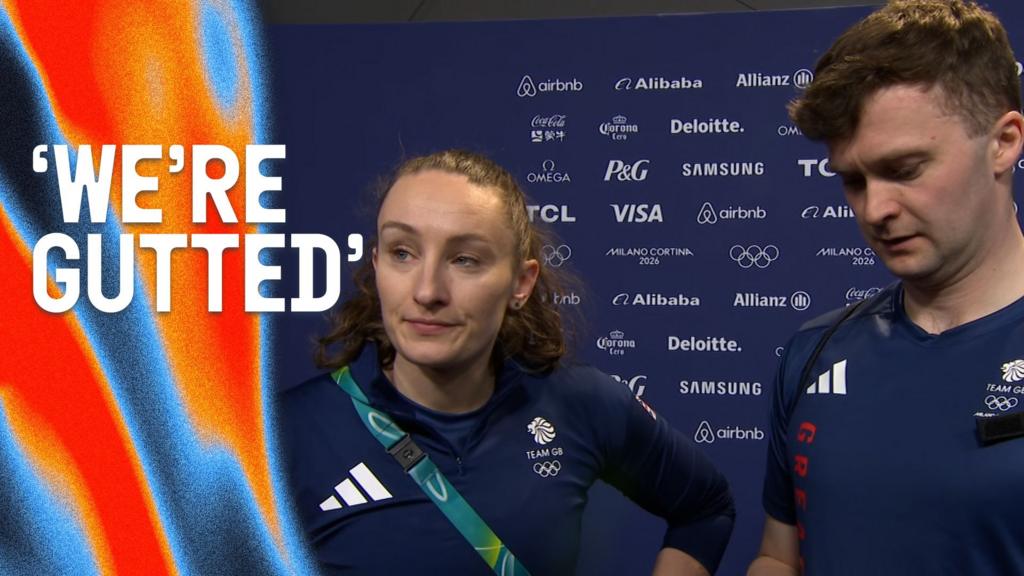
They couldn’t. And they were left to face the nightmare scenario of another Games in which they have finished in fourth place and without a mixed doubles medal.
“We spoke last night about how lucky we are to be playing at the Olympics as best mates,” Mouat added. “We are two people that grew up together and never really knew where we could go with curling. It has been pretty special with Jen.
“I’m obviously pretty gutted but I’m so proud of us for sticking at it.”
In Beijing, they responded the right way, with women’s gold and men’s silver. What will they do this time?
Despite undergoing surgery for a fractured left leg, ski icon Lindsey Vonn defended her decision to compete at Games.
Published On 10 Feb 202610 Feb 2026
Share
American ski athlete Lindsey Vonn said on Monday she had suffered a “complex tibia fracture” when she crashed in the Winter Olympics downhill and would need “multiple surgeries”.
“While yesterday did not end the way I had hoped, and despite the intense physical pain it caused, I have no regrets,” Vonn said on her social media, from the hospital in Italy where she is being treated.
Recommended Stories
list of 3 itemsend of list
Vonn, 41, insisted that the ruptured anterior cruciate ligament she suffered in a crash in a World Cup race before the Milan-Cortina Games “had nothing to do with my crash whatsoever”.
“I was simply 5 inches too tight on my line when my right arm hooked inside of the gate, twisting me and resulted in my crash,” she added.
“I sustained a complex tibia fracture that is currently stable but will require multiple surgeries to fix properly.”
In her first statement since the crash, Vonn said: “My Olympic dream did not finish the way I dreamt it would. It wasn’t a story book ending or a fairy tale, it was just life. I dared to dream and had worked so hard to achieve it.
“Because in Downhill ski racing the difference between a strategic line and a catastrophic injury can be as small as 5 inches.”
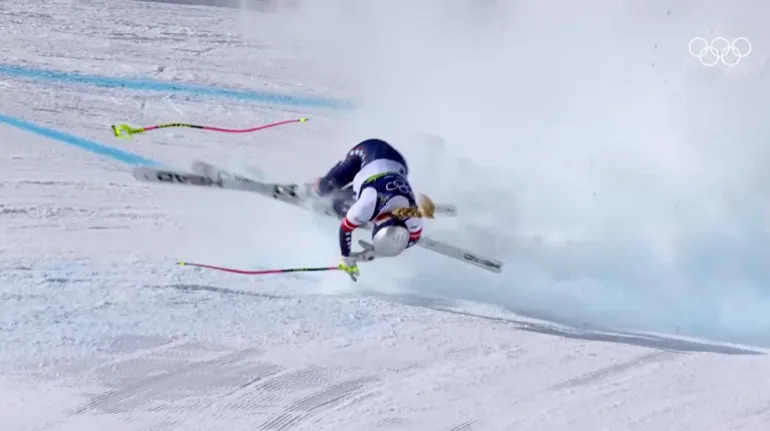
Vonn crashed heavily just 13 seconds after starting her run. She was winched off the piste by a rescue helicopter and is being treated in a hospital in Treviso.
She had resumed her career in late 2024 after nearly six years in retirement and was considered a strong favourite for the downhill at these Olympics after recording seven World Cup podium finishes, including two wins, before her pre-Olympics crash in Crans-Montana, Switzerland.
Vonn’s crash during the Olympic Women’s Downhill on Sunday is likely to be career-ending for the American Alpine ski athlete [Screengrab by IOC via Getty Images]
American skier Lindsey Vonn says she has “no regrets” after a crash in the women’s downhill competition at the Winter Olympics resulted in a “complex tibia fracture” which will require multiple surgeries.
The 41-year-old’s arm got stuck in a gate just 13 seconds into her run on Sunday at Olimpia delle Tofane in Cortina, throwing her off balance.
She was treated on the slope for a lengthy period before being airlifted off the piste to Ca Foncello hospital in Treviso, where she had surgery on a fractured left leg.
The 2010 Olympic downhill champion was already racing with ruptured ligaments in her left knee but was determined to compete in her fifth and final Games.
“Yesterday my Olympic dream did not finish the way I dreamt it would,” she said in a post on Instagram on Monday.
“It wasn’t a story book ending or a fairytale, it was just life. I dared to dream and had worked so hard to achieve it.
“While yesterday did not end the way I had hoped, and despite the intense physical pain it caused, I have no regrets.
“Standing in the starting gate yesterday was an incredible feeling that I will never forget. Knowing I stood there having a chance to win was a victory in and of itself.”
Vonn crashed in Switzerland in the final race before the Olympics nine days before competing in the downhill event in Italy.
In a media conference on Wednesday, she confirmed she had torn her anterior cruciate ligament (ACL) but expressed determination to compete.
The two-time world champion says the torn ACL and her previous injuries, including a partial right knee replacement, “had nothing to do with my crash whatsoever”.
Vonn’s decision to race has led to widespread praise for her bravery but also criticism about the dangers and potential risk of permanent damage.
“It always was and always will be an incredibly dangerous sport. And similar to ski racing, we take risks in life,” she said.
“We dream. We love. We jump. And sometimes we fall. Sometimes our hearts are broken. Sometimes we don’t achieve the dreams we know we could have. But that is also the beauty of life; we can try.
“I hope if you take away anything from my journey it’s that you all have the courage to dare greatly. Life is too short not to take chances on yourself. Because the only failure in life is not trying.
Jen Dodds and Bruce Mouat react after failing to guarantee Team GB’s first medal of the 2026 Winter Olympics in their curling mixed doubles semi-final against Sweden.
For the second straight Winter Olympics, Mathilde Gremaud bests Eileen Gu in the women’s blue ribband freeski event.
Published On 9 Feb 20269 Feb 2026
Share
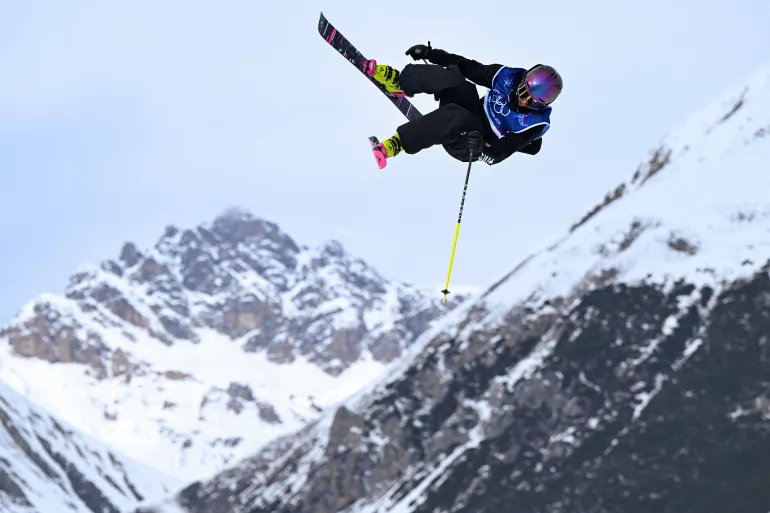
Switzerland’s Mathilde Gremaud has retained her Olympic title in the slopestyle freestyle skiing competition at the Milano Cortina 2026 Winter Games in a gripping race in the Italian Alpine town of Livigno.
China’s Eileen Gu, who had been hoping to convert her Beijing 2022 silver medal into gold this time, came in second on Monday after tumbling at the start of her last run.
Recommended Stories
list of 4 itemsend of list
Canada’s Megan Oldham, 24, took the bottom step of the podium despite a big crash on her second run.
Earning herself a day-late birthday present, Gremaud skied well above the already very high bar set by Gu on her first run with three spectacular runs of her own, wearing the Swiss flag like a cape as she came down the last time, having already ensured herself the gold medal.
Gremaud competes in the women’s slopestyle final [Kirill Kudryavtsev/AFP]
Gremaud rolls out new trick
On a crisp and sunny day in the high-altitude ski resort close to the Swiss border, Gremaud kicked off the final by performing – for the first time by a woman – an elite-level trick known as the nose butter double cork 1260.
In this trick, the skier presses the tips of the skis on the takeoff to start the spin and then performs a double cork 1260, two distinct off-axis, inverted flips combined with three-and-a-half full, horizontal rotations.
Known for her variety of tricks on the slope, the Swiss champion veered towards the very technical ones, followed by breathtaking acrobatic jumps during her second run, earning her the eventual highest score overall of 86.96, just pipping Gu’s first-run score of 86.58.
Despite the big crash on her second run, Oldham picked up in the third run, soaring through the rails and performing conservative yet still very acrobatic jumps at the end, winning her a score of 76.46.
At the end of the race and during the prize-giving ceremony, the crowd was painted in different hues of red as the flags of the three winning countries – Switzerland, China and Canada – all waved in the air to the beat of loud music and cheering. The medals were handed out by Britain’s Princess Anne, a former Olympic equestrian.
Gu won her second straight Olympic silver medal in the freestyle slopestyle event [Kirill Kudryavtsev/AFP]
High competition
Double Olympic champion Gu, 22, set the bar high on the first run with big tricks on the rails and stunning jumps, adding flair to all of her tricks and putting herself in first place early on.
After a poor second run when she stumbled on the rails at the beginning of the beautifully sculpted piste, Gu knew she would need something special on her final run to grab the title away from Gremaud. But she tumbled into the snow almost immediately, ending her hopes of reclaiming top spot in the competition.
American-born Gu, who represents her mother’s country of China at the Olympics, said last week that she had nothing left to prove after her two gold and one silver medal from Beijing.
She will be defending her big air and halfpipe titles later in the Games.
MILAN — He raised up the Quad King. He refined the jump that defined the Quad God.
From a sprawling ice facility in Irvine, Rafael Arutyunyan could just be the “Quad Maker.”
The 68-year-old figure skating coach is renowned as one of the best technicians in the world. He trained Olympic champion Nathan Chen starting when the “Quad King” was 10 years old. Four years after Chen became the first U.S. man to win singles Olympic gold since 2010, Arutyunyan could have a second consecutive pupil on top of the Olympic podium.
Ilia Malinin, who has worked with Arutyunyan part time since 2021, is the only person in the world to land a quad axel and is the overwhelming favorite for men’s gold at the Milan-Cortina Olympic Games.
American Ilia Malinin celebrates with his coaches, including Rafael Arutyunyan to the right, during the world skating championship in March 2025.
(Maddie Meyer / Getty Images)
The walls in Arutyunyan’s office at Irvine’s Great Park Ice, where he is the head coach of the high performance team, are plastered with photos of stars including Chen, Michelle Kwan, Adam Rippon and Ashley Wagner. They each came to his door with dreams of perfecting their performances, making it to the Olympics or, in some cases, revolutionizing the sport. They scribbled messages over their pictures saying: “I couldn’t have done it without you.”
“Rafael is more like the dream maker,” said Rippon, the 2016 U.S. champion and 2018 Olympic team bronze medalist. “… Rafael is able to take each of his students’ individual goals on a case-by-case basis, and he’s able to help the athletes go after whatever that goal is they’re trying to achieve.”
Malinin came with a lofty goal. Even his father Roman Skornikov — an Olympian for Uzbekistan who coaches his son with his wife, Tatiana Malinina — thought the idea of doing four-and-a-half revolutions in one jump was crazy.
Arytyunyan assured him Malinin could do the quad axel.
The coach of nearly 50 years just looked at the 5-foot-9 Malinin and could tell. It was his slender body type, natural athleticism and strong technique that made Arutyunyan know the jump many thought was impossible could be done. They discussed small technical tweaks to Malinin’s entry. A short two to three months later, Malinin, who trains primarily with his parents in his native Virginia, sent a video of him landing the quad axel in practice.
“The way he explains is really good. And he explains in like, metaphors and analogies that you’re surprised to hear,” said Malinin, who debuted the quad axel in 2022 when he was 17. “They work really well because it helps you get a different perspective on a technique or how he explains.”
Arutyunyan instructed Malinin to think of himself as a slingshot while approaching his jumps. Skaters know to gain power from deep edges that carve circles into the ice, but Artutyunyan describes it like a person riding a motorcycle: The rider tilts side to side just like a skater’s blade glides over the ice. Over time as he gets more familiar with a skater, Arutyunyan communicates through hand signals to show how their blades are interacting with the ice. Learning to manipulate the blade with Arutyunyan made Rippon feel as if he truly learned how to skate.
“He is a genius,” said Mariah Bell, a 2022 Olympian and U.S. champion.
Nathen Chen celebrates with coach Rafael Arutyunyan after competingin the 2020 U.S. Figure Skating Championships Greensboro, N.C.
(Matthew Stockman / Getty Images)
With the exception of Chen, many of Arutyunyan’s students came to him later in their careers. It takes a special eye and tenacity for a coach to rewire decades of bad habits, Bell said.
Arutyunyan loves it.
“I am emergency room for skaters,” he said. “Many people comes to me as emergency and I start to fix it.”
Arutyunyan is equipped to solve the most dire skating situations because after nearly 50 years as a coach, he’s seen it all already. Arutyunyan, who began coaching in his native Armenia, was first trained in the Soviet style that relied on biomechanics and physiology to unlock efficient jumping techniques. European and American teachings focused more on compulsory figures, the basic patterns skaters would trace across the ice that give the sport its name.
Arutyunyan, who came to the United States in 2000 from Russia, blended both into a signature style that has top skaters traveling from all corners of the globe seeking his help.
“Why I think he’s one of the best coaches in the world,” Rippon said, “is that he’s never not learning.”
After a promising juniors career in which he was named junior national champion in 2015 and competed at the 2020 world junior championships, Andrew Torgashev knew he had competitive ability and presentation. But wanting to step up his senior career, Torgashev, 24, knew he needed to tame his wild technique. Performing his programs felt like “going to the casino,” Torgashev said.
“Red or black,” Torgashev said with a smile, “who knows what’s going to happen?”
Since relocating to California from Colorado in 2019, Torgashev, a Florida native whose parents were both elite international figure skaters, reworked every aspect of his skating with Arutyunyan. He was always skating on his toes when he should have been on his heels. They changed his three-turn — one of the first things skaters learn when skating on one foot — to find more power. They tinkered with his crossovers and his camel spin.
It took years. Much of it was disheartening.
“I felt like, ‘what’s the point of this? I’m losing jumps, he’s ruining me,’” Torgashev said. “But he always has a method to his madness.”
The method finally yielded results after two years. Injuries kept Torgashev out of competition for two seasons. But he finished second at the 2023 Eastern Sectional Championships and ahead of the 2023 U.S. championships, he was performing his programs more consistently than ever in practice.
After finishing on the podium at U.S. championships in three of the last four years, including two consecutive silver medals, Torgashev will make his Olympic debut in Milan.
“He’s forced me to be very resilient and independent and trust myself, trust what I’ve learned from him, and try to take that with me to competition,” Torgashev said. “I think it’s the best move I made in my life.”
Arutyunyan’s ability to take established, struggling skaters and put them into the podium conversation is how he believes he first started getting respect in the United States. When he emigrated from Russia, he was searching simply for freedom, he said.
He never thought it would turn into a hall of fame career.
Arutyunyan was inducted into the U.S. Figure Skating Hall of Fame in January at the U.S. Championships. At the induction ceremony in St. Louis, Arutyunyan waved toward a packed crowd and bowed his head. He looked forward to the ceremony because it was a chance to see his students again. What thrilled him most was getting to rub elbows with other Hall of Famers such as Brian Boitano, Dorothy Hamill and Scott Hamilton. The Olympic and world champions were Arutyunyan’s idols, he said giddily.
After 50 years of helping skaters achieve their dreams, the man who was always behind the scenes got to live his.