Olympic

L.A. officials raise alarms over crippling Olympic costs

Los Angeles officials are expressing growing fears that taxpayers and the city treasury could be hit with a round of crippling costs to support the 2028 Olympic Games if the city doesn’t ink a rigorous deal to assure a “zero–cost” Games.

Some city officials have long been concerned that taxpayers could be left with massive bills if the Olympics don’t generate the income organizers have promised. Delays in finalizing a deal between City Hall and the Olympics committee have heightened those tensions.

The exact costs to L.A. and other local governments remain unknown, as officials wait to hear from LA28 and federal security agencies about exactly what services they will need. Recent controversy over the ties between Casey Wasserman, the head of the L.A. Olympics, and Jeffrey Epstein have added to the uncertainty over the finances in the minds of some city leaders.

City Atty. Hydee Feldstein Soto and Councilmember Monica Rodriguez both issued letters demanding a contract pledging that LA28 cover any of the city’s future costs that arise as the city plays host to hundreds of thousands of athletes and fans.

The contract, more than six months overdue, is needed “to foreclose any scenario in which funds might go back to the wealthy backers and investors of the LA 28 organization without reimbursing taxpayer funded extraordinary costs,” the city attorney wrote to council members.

Rodriguez agreed in a separate letter this week that the city needs a contract that assures that the Olympics organization will pay any excess costs for policing, transportation, trash pickup and more, so that taxpayers are not burdened or “core city services” slashed.

That should take priority over the private nonprofit LA28 building a “Legacy Fund” to bankroll future youth sports programs, public sports facilities and the like, argued the city officials, who are both up for reelection this year.

“Bankruptcy cannot be the legacy of these Games,” Rodriguez wrote, without elaborating on what she meant, though L.A.’s top budget official recently projected a deficit, unconnected to the Olympics, of “several hundred million” dollars.

LA28 officials responded with a statement they issued previously, saying, in part, that “LA28 remains committed to delivering the safest, most secure, and fiscally responsible Games that will benefit Angelenos for decades to come,” adding, “We remain engaged in good faith negotiations and look forward to our continued partnership with the City of Los Angeles.”

LA28 Chief Executive Reynold Hoover said at a press event Wednesday that ticket sales were one vehicle for the host committee to assure that taxpayers didn’t get stuck with a big bill down the road.

The stakes remain high for both sides. The private LA28 group needs the city’s police, fire, sanitation, streets and transportation services to deliver a successful event. The city wants the sports extravaganza to succeed, not only to burnish its image on an international stage, but also to assure there is enough money to pay for all the extra tasks city workers will perform.

The LA28 leaders project the Games will cost more than $7.1 billion. They say that money will come from a variety of sources: nearly $1 billion from the International Olympic Committee, $437 million from international marketing rights, $2.5 billion from corporate sponsors in the U.S., $2.5 billion from ticket sales and hospitality packages, $344 million from licensing and merchandise and $405 million in other revenue.

LA28 reports being ahead of schedule on the revenue front. But city officials worry that unforeseen events — including an economic downturn or natural disaster — could blow up the income model, with one of many wild cards being the willingness of President Trump and the Republican-controlled Congress to follow through with a funding pledge to the Democratic-controlled city.

L.A. officials have long expressed concern that Trump and Congress might belatedly yank away $1 billion already set aside to reimburse state and local governments for security, planning and other Olympics-related costs.

While the two elected officials and some others, including an attorney representing city employees, raised alarms, an individual with knowledge of the talks between the city and LA28 said that a tentative agreement would likely be before the City Council “within two or three weeks.”

The knowledgeable individual, who asked not to be named because of the sensitive nature of the discussion, said negotiators on both sides must bear in mind how a third party, the federal government under Trump, is integral to the financing model.

The source tracking the negotiations said that both sides needed to make sure the pact creates a path to “maximize federal resources, which were dedicated by Congress for the Games,” adding: “The contract needs to avoid saying that LA28 is going to pay, for example, for all of the LAPD’s extra costs in such a way that the federal government says, ‘Fine, then you don’t get any of the federal money.’ We can’t afford to leave a billion dollars on the table.“

City Administrative Officer Matt Szabo, one of those bargaining for the city, struck a positive note.

“We are invested in a successful Olympics. The organizing committee knows that it needs the city and city services to have a successful Games,” said Szabo. “It’s in both the city’s and the organizing committee’s best interest to have a successful Games. We’re joined at the hip and we’ll succeed together, or not.”

The 2028 Games have been designated a National Special Security Event, placing it in the same category as major party political conventions and Super Bowls. The U.S. Secret Service sets the security plan for those events.

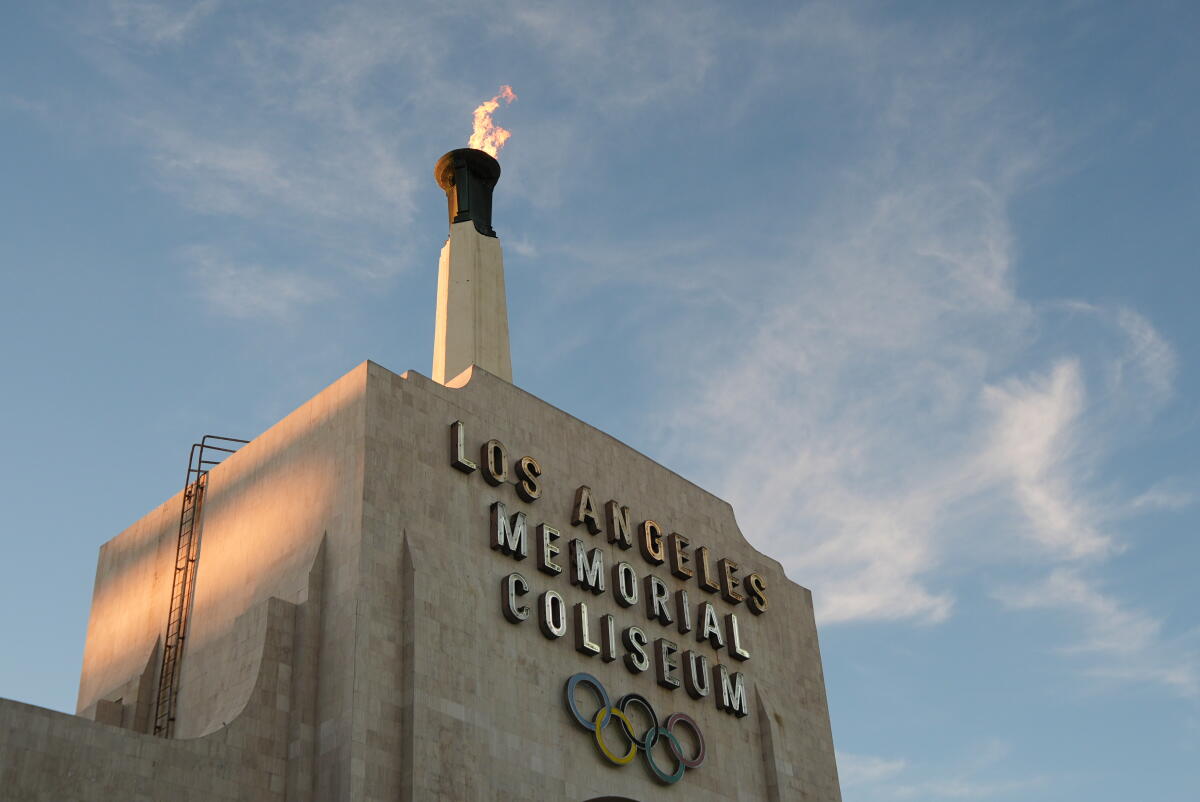
Officials in L.A. have said they are still waiting to learn from the Secret Service how broad the security “blast area” should be around each athletic venue. The federal agency will then dictate how many police and federal agents will flood those zones, which include the Los Angeles Memorial Coliseum, Exposition Park and Crypto.com Arena.

Attorney Connie Rice, who represents L.A. city employees concerned about how the city will pay for the Games, said that her clients still had questions. Rice, whose past litigation helped force LAPD reforms, said that employees helping to plan for security said they had estimated that the Los Angeles Police Department and the Los Angeles County Sheriff’s Department, alone, would need at least $1 billion to pay for extra security during the Games.

The current federal allocation would not get the city and county of Los Angeles $1 billion since many other jurisdictions, including Long Beach, Oklahoma City and the state of California also will be competing for U.S. funding. And the federal government has not yet released its “notice of funding opportunity” — laying out the parameters for claiming a part of the $1 billion.

Rice argued that the city gave up its best leverage when it signed an earlier agreement to host the Games. “Who is going to pay the bill, or who are they even going to send the invoices to, when the Games are over and LA28 is dissolved?” Rice asked. “LA28 has no obligation to raise money once the event is over.”

Los Angeles city officials expect to have requests by October from LA28 for the services the Games organization needs at each venue. The Games organizing group has agreed to pay any costs that exceed the city’s typical expenditures. But there is not a clear understanding of what constitutes a customary level of service. The massive event is expected to require an array of services, including trash pickup, bus service, street closures, park maintenance, drinking water stations and building inspections of temporary Olympic structures.

In her letter late last month to City Council members, the city attorney raised a slew of questions about the fiscal contract with LA28. Feldstein Soto contended the Games had a “heightened risk exposure … given the recent claims against LA 28 Chairman Casey Wasserman.”

Wasserman’s name appeared in the files about convicted sexual predator Epstein, with records showing the then-28-year-old sports marketer had gone on a two-week tour of Africa sponsored by Epstein and later exchanged risque emails with Epstein accomplice Ghislaine Maxwell. Though some activists demanded Wasserman leave his post as LA28 chair and called for a Games boycott, there has been no apparent reduction in sponsorships or ticket sales because of the furor.

As city attorney, Feldstein Soto is advising the city officials negotiating the Olympic contract. Her letter says she will insist that “transparent audit rights and procedures” be put into place to assure the city treasury does not take a hit in supporting the Games.

The letter raises the possibility that natural disasters or other emergencies could cut into LA28’s bottom line. It also asks: “What happens if the federal government does not pay the assume $1 billion [or] … [w]hat happens if the city’s actual expenses exceed $1 billion?” Feldstein Soto’s answer: “In either situation, this office believes that all surplus funds must reimburse the city and its taxpayers first, as promised, before any surplus funds are available for a [LA28] legacy or tribute fund.”

Source link

LA28’s first Olympic ticket drop is a major flop for locals

Duped. Scammed. Gouged. Sidelined.

LA28 organizers probably didn’t count on such words accompanying their first big ticket rollout ahead of the 2028 Olympic and Paralympic Games in Los Angeles. After all, the committee and city leaders spent the last six months talking up the event.

The LA28 committee described the arrival of the Games as a boon for the city’s inhabitants, with unifying statements: “Creating the Games together!” Mayor Karen Bass promoted a “Games for All” vision. And we’ve been told over and over that tickets to events would start as low as $28, the 24% ticketing fee included!

The presale ticket lottery for those residing in ZIP Codes around LA28 venues also meant we would have a fair shake at getting into the Games, right? Finally, an affordable way into a major L.A. sporting event for those of us who are not Casey Wasserman, the multimillionaire chairman of the Los Angeles Organizing Committee for the 2028 Olympic and Paralympic Games.

But that’s not what SoCal locals found in their first real brush with ticket access over the past week.

The presale launched Thursday, and by 10 a.m. Friday, aspiring ticket buyers reported that all artistic gymnastics events were marked “unavailable,” as was the opening ceremony. The few available tickets to swimming and athletic events such as track and field started at $1,116.27 per seat. Friends described the prices as “Criminal,” “Greedy AF” and “horrific.” My sibling said she felt crestfallen and likened it to discovering there was no Santa Claus. Jeffrey Epstein-level deception is where my mind went (please refer back to Wasserman).

Sunday was my window to sign in for the privilege of seeing what wasn’t available, or what was so far out of my price range it might as well have been cordoned off behind a gold rope and glass. There were no tennis, artistic gymnastics or men’s basketball tickets available. And by Monday, there were only a handful of events accessible for less than $150 a ticket (handball, women’s cricket, Judo). The women’s basketball bronze-medal game started at $407.17 a ticket.

Wait, was that a FBL08 Football (Soccer) Women’s Preliminary ticket at only $104.30? Forget it. It’s in St.Louis, among the handful of football (soccer) games that will take place outside California. The canoe slalom and kayak cross are scheduled for venues in Oklahoma City. Tickets are probably still available for those events, which even with air travel figured in may be the closest you’ll get an affordable LA28 event.

By Tuesday’s draw, we were graciously given the option to purchase closing ceremony tickets at the Los Angeles Memorial Coliseum, at $4,961.20 apiece.

Remember L.A., we’re all in this together.

With that in mind, LA28 has offered locals another way in that won’t cost a dime: Volunteer to work the events throughout L.A., be it at the SoFi Arena, the Rose Bowl, the Coliseum or in Santa Anita. We should probably clarify that the dime saved is theirs, not yours. You’ll be working for free.

Those of us who registered and were selected for the ticket draw had a 48-hour time slot once the LA28 ticket portal opened to purchase up to 12 tickets per session or event. As that was hardly enough time to sell my home, jewelry and pets for ticket funds, my family and I will be watching swimming, table tennis and the 4×400-meter relay competitions from somewhere outside of L.A. That way we’ll avoid the LA28 traffic, limited parking and inflated prices.

More tickets will become available, according to LA28. Tickets for the general public for the LA28 Olympic Games are on sale from April 9 to 19. This “Drop 1” is available to fans worldwide who registered for the ticket draw and were selected for a time slot. Maybe they saved the lion’s share of tickets for the rest of the world … because they need locals to volunteer?

When the organizers claimed they would be “celebrating the communities closest to the action with the LA & OKC Locals Presale … giving local residents the chance to experience the Games up close and secure seats starting at $28,” they didn’t say that the “experience” would likely be outside their venues, on your TV screen, with $28 worth of streaming fees and snacks.

Nothing like being locked out of a party that’s taking place in your own backyard. Way to go, LA28.

Source link

Daniel Wiffen: Olympic gold medallist open to changing training base after Irish Open

Wiffen said he is expecting “to swim the best ever so I don’t have to make a decision” across the 200m, 400m, 800m and 1500m events he will be competing in, despite his recent lack of competitive action.

He outlined his goals as swimming the 400m around 4.33 seconds, the 800m below 7.42 seconds and the 1500m under 14.40 to assess whether his time spent in California has been successful.

The County Armagh man also cited Dublin as a potential future base if he does decide to move, but emphasised that doing so would be heavily dependant on his performances in Bangor.

“If I’m around those times, under or around PB, then that’s great. That obviously means the training is working, and if it doesn’t work then I [have to figure out] what I’m going do after,” he added.

“I’m thinking of coming back to Dublin if it doesn’t go well, but, we have to see. If I swim lights out in Bangor, then my decisions obviously can’t have been made.”

Wiffen also explained the main differences he has encounter between training in England and in the US, where they use yardage instead of metres.

“The training is just quite different and, even though I don’t swim a lot of yards, I just think being in America is fun. There’s quite a lot of distractions, and it’s a good lifestyle but, it’s not the same as what Loughborough was like,” he said.

“[It was] all about grind, very similar weather to Ireland and I love swimming in the rain and when the weather is dull. When you’re in the sun everything becomes a lot harder and the motivation becomes a lot harder.

“When I’m swimming in California, my motivation is I’m with a really good training group and everybody’s pushing each other, where as in Loughborough, I feel like it was more self-motivation, I was getting there because I wanted to win.

“I wanted to do all these things where I feel like another group is kind of pushing me to swim fast, which I like, but I think I want a bit of the self-motivation back, so we’ll have to see how the next week goes.”

Source link

Caster Semenya pledges to fight against Olympic gender-testing policy | Athletics News

‘We’re going to be vocal about it, we’re going to make noise until we’re heard,’ South Africa’s gold medallist says.

Double Olympic champion Caster Semenya ⁠says she intends to fight ⁠against the introduction of gender testing for the female category at the Olympics, a policy the South African insists “undermines women’s rights”.

The International Olympic Committee (IOC) unveiled the policy last week and it is expected to become a universal ⁠rule for competitors in female elite sports after years of fragmented regulation that led to controversy.

Recommended Stories

list of 4 itemsend of list

Semenya has been at the centre of one of those controversies due to her long-running legal case against World Athletics over her right to compete on the track despite having a ⁠Difference of Sexual Development (DSD).

“We’re going to be vocal about it, we’re going to make noise until we’re heard,” the 35-year-old athlete told the Reuters news agency on Monday.

“Now it’s a matter of women standing for themselves to say, ‘Enough is enough.’ We are not going to be told how to do things.

“If really we are accepted as women to take part, why does my appearance or my voice, why do my inner parts ‌need to be a problem to take part in the sport?”

DSDs are a group of rare conditions involving genes, hormones and reproductive organs. Some people with DSDs are raised as female but have XY sex chromosomes and blood testosterone levels in the male range.

The IOC policy document said including “androgen-sensitive XY-DSD athletes” in the female category in events that rely on strength, power or endurance “runs fundamentally counter to ensuring fairness, safety and integrity in elite competition”.

Semenya, who won two Olympic and three world titles in the 800 metres before being limited to shorter events, believes the IOC got the science wrong.

Semenya said “there’s no science” that XY-DSD gave an athlete ⁠an advantage. “I’ve been there, I’ve done that. There’s no such thing as that,” she said.

“There are people ⁠who are delusional. There are people who are convinced because a woman is masculine, a woman is born with intersex conditions, the DSD, they’ve mentioned all those things [that they have an advantage].

“But what I say is that if you’re going to be a great athlete, it’s through hard work.”

The test that will be applied to ⁠all athletes who want to compete in the female class will be conducted by a cheek swab or saliva analysis.

There will be further investigation for any athletes who test positive for the SRY gene, ⁠which is on the Y chromosome and triggers the development of male characteristics in ⁠mammals.

“What this decision does, it undermines women. It undermines women’s dignity. It violates women’s rights because we know historically, these [tests] have failed before,” Semenya said.

“Women need to be celebrated. Women are not supposed to be questioned about their gender. Why that is their physique? Why it is how they look like? It doesn’t matter. Neither also the ‌hormone level. Those are the things that are obviously genetics that cannot be controlled.”

Semenya said IOC President Kirsty Coventry, the first woman and first African to hold the office, had failed to properly consult her or other athletes living with DSDs about the policy.

“They sent us ‌a ‌letter the day they were going to publish [the new policy],” she said.

“If you’re going to consult, consult with a genuine heart. Don’t consult because you’re ticking the box. Unfortunately, they have ticked a wrong box.”

Source link

Here’s how to purchase tickets for 2028 Los Angeles Olympic Games

p]:text-cms-story-body-color-text clearfix”>

There’s a 12-ticket maximum for each fan across all sports and sessions, plus 12 tickets for soccer sessions that don’t count toward the general maximum. A four-ticket maximum per ceremony for the opening and closing ceremonies is included in the general limit. Each attendee, including children of any age, will need a ticket to attend.

Tickets included in hospitality packages sold by On Location, the official hospitality provider of the LA28 Games, will not count toward the general limit.

Source link

Olympic gender test ‘a disrespect for women’, South Africa’s Semenya says | Olympics News

South African sprinter Caster Semenya, a two-time Olympic 800-metres champion, says the International Olympic Committee’s (IOC’s) reinstatement of gender verification tests for the 2028 Los Angeles Games is “a disrespect for women”.

The hyperandrogenic athlete on Sunday also expressed her disappointment that the measure was taken under new IOC President Kirsty Coventry of Zimbabwe.

Recommended Stories

list of 3 itemsend of list

“For me personally, for her being a woman coming from Africa, knowing how African women or women in the Global South are affected by that, of course it causes harm,” Semenya said in Cape Town on the sidelines of a sporting competition.

The IOC said on Thursday that only “biological females” will be allowed to compete in women’s events, preventing transgender women from competing.

The IOC had previously used chromosomal sex testing from 1968 to the 1996 Atlanta Olympics before abandoning it in 1999 under pressure from the scientific community, which questioned its effectiveness, and from its own athletes commission.

“It came as a failure, and that’s why it was dropped,” Semenya said.

“It’s like now we need to prove that we are worthy as women to take part in sports. That’s a disrespect for women.”

Semenya has become the symbol of the struggle of hyperandrogenic athletes, a battle on the athletics tracks and then in courtrooms, to assert her rights, which she has waged since her first world title in the 800m in 2009.

In 2025, she won a partial victory at the European Court of Human Rights in her seven-year legal fight against track and field’s sex eligibility rules.

The court’s highest chamber said in a 15-2 ruling that Semenya had some of her rights to a fair hearing violated before Switzerland’s Supreme Court, where she had appealed against a decision by the Court of Arbitration for Sport. It had ruled in favour of track’s international governing body, World Athletics.

The original case between Semenya and Monaco-based World Athletics was about whether female athletes who have specific medical conditions, a typically male chromosome pattern and naturally high testosterone levels, should be allowed to compete freely in women’s sports.

The European court’s ruling did not overturn the World Athletics rules that in effect ended Semenya’s career running the 800m after she had won two Olympic gold medals and three world titles since emerging on the global stage as a teenager in 2009.

IOC’s policy shift removes conflict with Trump

In a major shift of policy, the IOC is abandoning rules it brought in in 2021 that allowed individual federations to decide their own policy and is instead implementing a policy across all Olympic sports.

“Eligibility for any female category event at the Olympic Games or any other IOC event, including individual and team sports, is now limited to biological females, determined on the basis of a one-time SRY gene screening,” the IOC said in a statement.

They will be carried out through a saliva sample, cheek swab or blood sample. It will be done once in an athlete’s lifetime.

“The policy we have announced is based on science and has been led by medical experts,” Coventry said.

“At the Olympic Games, even the smallest margins can be the difference between victory and defeat, so it is absolutely clear that it would not be fair for biological males to compete in the female category. In addition, in some sports it would simply not be safe.”

The new policy removes a potential source of conflict between the IOC and United States President Donald Trump as the 2028 Los Angeles Olympics comes onto the horizon.

Trump issued an executive order banning transgender athletes from women’s sport soon after he returned to office in January 2025.

The US leader took credit for the IOC’s new policy in a post on his Truth Social network on Thursday.

“Congratulations to the International Olympic Committee on their decision to ban Men from Women’s Sports,” Trump wrote. “This is only happening because of my powerful Executive Order, standing up for Women and Girls!”

2024 Olympic gender row

While sports such as swimming, athletics, cycling and rowing have brought in bans, many others have permitted transgender women to compete in the female category if they lowered their testosterone levels, normally through taking a course of drugs.

The IOC is bringing in the new policy after the women’s boxing competition at the 2024 Paris Olympics was rocked by a gender row involving Algerian fighter Imane Khelif and Lin Yu-ting of Taiwan.

Khelif and Lin were excluded from the International Boxing Association’s 2023 world championships after the IBA said they had failed eligibility tests.

However, the IOC allowed them both to compete at the Paris Games, saying they had been victims of “a sudden and arbitrary decision by the IBA”.

Both boxers went on to win gold medals.

Lin has since been cleared to compete in the female category at events run by World Boxing, the body that will oversee the sport at the Los Angeles Summer Games.

Source link

Mary Rand: 1964 Olympic gold winner dies at age of 86

Mary Rand, the first British woman to win an Olympic gold medal in athletics, has died at the age of 86.

Rand secured the long jump title at the Tokyo Games in 1964, also winning silver in the inaugural women’s pentathlon and bronze in the 4x100m relay.

That meant she also became the first British woman to win gold, silver and bronze at a single Olympic Games.

In the long jump, Rand broke the British and Olympic records with her first leap of 6.59m and then smashed the world record on her fifth attempt with an effort of 6.76m.

“Mary was the most gifted athlete I ever saw,” said Ann Packer, who won 800m gold at the 1964 Olympics days after Rand’s triumph and was her room-mate in Tokyo.

“She was as good as athletes get. There has never been anything like her since – and I don’t believe there ever will.”

Rand, whose first husband was British rower Sydney Rand, also won long jump gold at the 1966 Commonwealth Games in Jamaica.

However, injury denied her the chance to defend her Olympic title in 1968 and she retired at the age of 28 the same year.

Born in Wells, Somerset, she was only 17 when she set her first British record in the pentathlon, and she won 12 national titles across long jump, high jump, sprint hurdles and pentathlon during her illustrious career.

Rand was voted the BBC Sports Personality of the Year in 1964 and was awarded an MBE in the 1965 New Year Honours List.

Source link

Women’s Olympic sports be limited to biological females from 2028

The women’s category of Olympic sports will be limited to biological females from 2028, says the International Olympic Committee.

Eligibility will be determined by a “once in a lifetime” sex test, which would prevent transgender women and those with differences in sexual development (DSD) from competing.

It will take effect from the Los Angeles Olympics.

IOC president Kirsty Coventry said the policy was “led by medical experts”.

“At the Olympic Games even the smallest margins can be the difference between victory and defeat,” she said.

“So it is absolutely clear that it would not be fair for biological males to compete in the female category. In addition, in some sports it would simply not be safe.”

Source link

Owner of $1 million hockey puck that won U.S. Olympic gold in dispute

U.S. hockey star Jack Hughes might have lost more than a couple of teeth during the gold-medal-winning victory against Canada at the Milan-Cortina Olympics last month.

The puck that Hughes smacked into the net in overtime to give the United States its first men’s Olympic hockey gold since the 1980 “Miracle on Ice” was seemingly forgotten amid the raucous celebration.

But this week, the Hockey Hall of Fame began displaying that puck along with the one Megan Keller knocked into the net in overtime to give the U.S. women’s team gold in Milan. The International Ice Hockey Federation apparently secured the frozen vulcanized rubber disks immediately after the games and handed them to the Hall of Fame located in Toronto.

Hughes is happy “his” puck surfaced but believes he is the rightful owner of a piece of memorabilia that David Kohler, president of SCP Auctions, estimated might be worth $1 million.

“I don’t see why Megan Keller or I shouldn’t have those pucks,” Hughes told ESPN. “I’m trying to get it. Like, that’s [B.S.] that the Hockey Hall of Fame has it, in my opinion. Why would they have that puck?”

Hughes might not like the answer. The provenance of the puck is similar to that of a basketball or football used in a notable moment. It is dissimilar to a historic home run because a baseball leaves the field of play, and the owner becomes the fortunate fan.

“Because of the increasing value of memorabilia, ownership of items has become standardized over the last decade or so,” said an expert who agreed to speak anonymously because they work in the acquisition of such items. “Whoever purchased the puck owns it. Jerseys belong to the team, shoes and gloves to the player, the puck to whoever supplied it to the Olympics.”

That would be the International Ice Hockey Federation, the governing body of the Olympics hockey tournament. The IIHF employees who immediately secured those precious pucks amid gold-medal bedlam apparently did their job well.

“The puck was designated for archival preservation with the Hockey Hall of Fame to ensure its long-term safekeeping and historical recognition,” an IIHF spokesperson said.

The pucks are featured in an “Olympics ‘26” display that also contains a hockey stick used by Brady Tkachuk of the U.S. team and a U.S. jersey worn by four-time Olympian Hilary Knight.

It might strike some as odd that the display is in Canada, where fans are mourning the loss to the United States, but that’s been the location of the Hall of Fame since it was established in 1943. HOF president Jamie Dinsmore said in a statement that the display contains “donated items,” although it is unclear whether the IIHF has donated or merely loaned the pucks to the HOF.

“The Olympics ’26 display will help ensure that these unforgettable Olympic moments are preserved for our guests from around the world to experience,” Dinsmore said.

Meanwhile, Hughes told ESPN he wants the puck to become the property of one particular fan — his father, who collects memorabilia for him and his brothers Quinn and Luke. All three play in the NHL.

“I wouldn’t even want it for myself. I’d want it for my dad. I know he’d just love, love having it,” Hughes said. “When I look back in my career, I don’t collect too many things for myself, but my dad’s a monster collector for the three of us. I know he would have a special place for it.”

Or it could be sold at auction, where certainly it would pay for any dental work Hughes needs after getting teeth knocked out during the gold-medal game. Various auction houses have estimated the value of the puck to be from $40,000 to $1 million.

Should he acquire the puck, though, Hughes might not even consider selling it. The first pick of the 2019 NHL draft, he signed an eight-year, $64 million contract extension with the New Jersey Devils four years ago.

Source link

LA28 releases men’s and women’s soccer schedule for 2028 Olympic Games

LA28 revealed the schedule Monday for an extended Olympic soccer tournament that will begin four days before the opening ceremony.

The soccer competition begins July 10 with four men’s group stage games across New York, Columbus, Nashville and St. Louis. The women’s tournament begins July 11 with games in all six of the preliminary round sites, including San José and San Diego.

The soccer competition, which will feature 12 women’s teams and eight men’s teams for the first time, has the longest competition window of any sport in Olympic history because the International Olympic Committee Executive Board wanted to give each team two extra rest days throughout the tournament.

Each team will have two days of rest between group stage games and three days between the final group game and the quaterfinal rounds. The men will begin their knockout round games on July 20 while the women start quarterfinal play on July 21, including one women’s quarterfinal match at the Rose Bowl.

The iconic stadium in Pasadena will host only five matches for the Olympics, including a men’s and women’s semifinal July 24 and the men’s gold medal match on July 28 and the women’s on July 29.

San Diego’s SnapDragon Stadium will have the most matches of any site with 11. In addition to three days of women’s group stage games, the home of San Diego State football, San Diego FC and San Diego Wave FC will host a women’s quarterfinal July 21, men’s and women’s semifinals July 24 and both bronze medal matches.

With the coast-to-coast soccer tournament shaping up, LA28 announced additional ticket opportunities for the competition, allowing fans interested in attending soccer matches to buy up to 12 soccer tickets in addition to the current 12-ticket maximum for all other Olympic events. The 12-ticket maximum for Olympic events includes the opening and closing ceremonies on July 14 and 30, respectively, which each have a four-ticket limit.

Ticket registration for the first ticket drop ends Wednesday at 11:59 p.m. PDT with the first tickets going on sale to locals in Southern California and Oklahoma beginning April 2. The first general ticket drop begins April 9. Fans who are randomly selected to participate in the first ticket drop will be notified via email between March 31 and April 7 with information and their assigned timeslot to purchase tickets.

More than 5 million fans have already registered for Olympic tickets, LA28 said, with Paralympic tickets going on sale in 2027. The organizing committee expects 14 million tickets to be available for the Games, which could eclipse the total ticket sales record set by Paris in 2024.

Source link

Armand Duplantis: Two-time Olympic pole vault champion breaks world record at Mondo Classic in Sweden

Duplantis, widely known by his nickname ‘Mondo’, has already won every major gold available to him, and became the first man in 68 years to retain the Olympic pole vault title at Paris 2024.

The US-born Swede, who chose to represent his mother’s homeland, has not lost a major final since the World Athletics Championship in Doha in 2019, where as a teenager he missed out to American Sam Kendricks on countback.

World record talk has largely replaced any discussion of the destination of men’s pole vault gold medals since he took the record off Lavillenie in February 2020.

How has he done it? A potent combination of lightning runway speed, technical precision in the take-off, explosive power and the bravery to embrace it as he travels far beyond the average height of a giraffe (5.5m).

It is his sprinting prowess in particular that his rivals pinpoint as a defining factor, with the higher approach speed generating greater kinetic energy and creating the foundation for greater heights.

That is something he has enhanced through specially-developed sprinting spikes which he wears for his world record attempts, which feature an unusual hooked spike in the forefoot.

His incremental centimetre-by-centimetre approach to improving the world record is by no means revolutionary; since Sergey Bubka became the first person to clear six metres 40 years ago, the record has been nudged no more than two centimetres higher at a time.

It helped that Duplantis grew up with a pole vault pit in the back garden of his childhood home in Louisiana, with his father a former elite competitor in the discipline.

The record-breaking dominance he has gone on to achieve has transcended the sport and established Duplantis – coached by his parents Greg and Helena – as the sport’s biggest star.

Source link