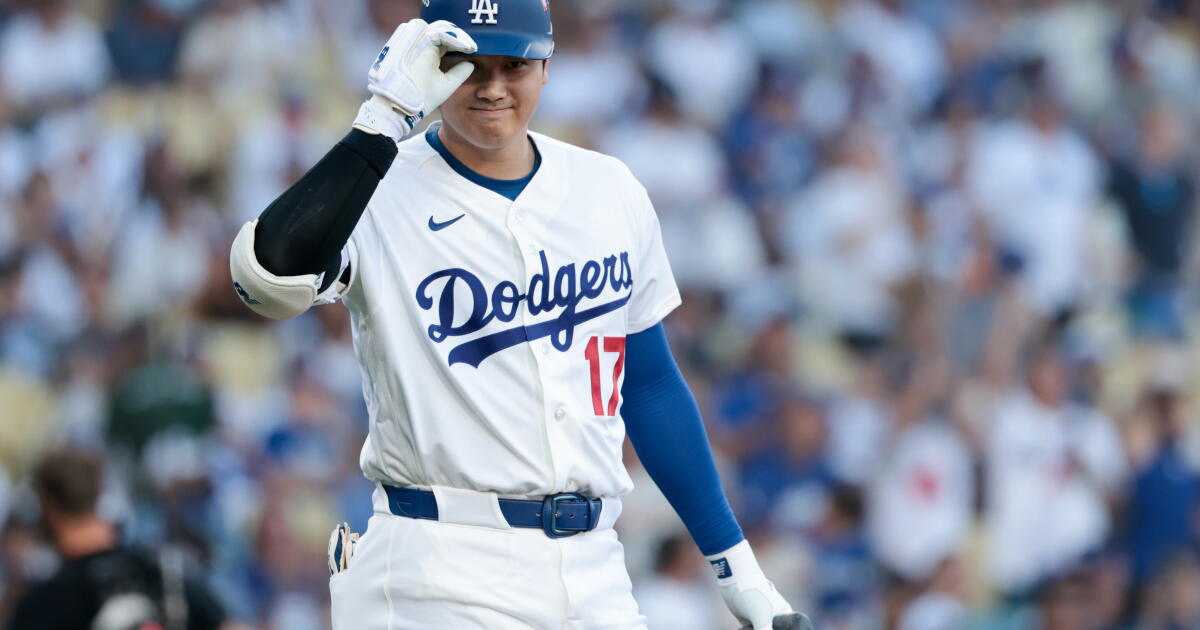
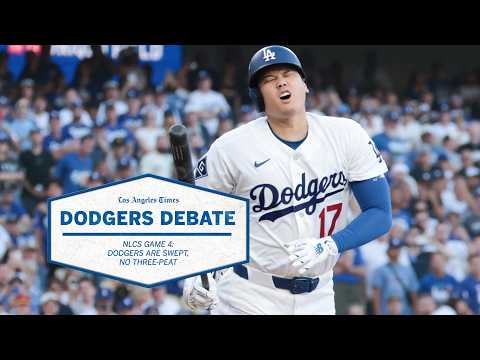
Given the problem the Dodgers have with their pitchers staying in the rotation for the whole season, and the way Shohei Ohtani was lunging for sweepers, I would say, “Don’t allow him to hit anymore.” Bill Plaschke says Ohtani led them to two championships. In 2024, the 55/55 year, he indeed did, although I would argue that Freddie Freeman did even more. But last year, many others were responsible for their ultimate victory, not Ohtani. Use him as a pitcher and a part-time hitter.
Mike Schaller Temple City
So Bill Plaschke has momentarily stopped playing psychic and has morphed into general manager, saying the Dodgers should either force Shohei Ohtani to stop pitching or trade him. Is Plaschke part of the medical staff of the Dodgers so he knows the root causes of Ohtani’s injuries this year, or what it might take this offseason to fix them?
He has written a lot of inane columns making bold statements that he usually has to eat crow on, and trading Ohtani while he is still one of the best players on the planet would fall into that category. Ohtani will eventually get to the point where his body can’t do both, but I’m sure no one is using Bill Plaschke’s medical expertise to determine when that might be.
Danny Balber Jr. Pasadena
OK, so now Plaschke is ready to give the boot to Shohei Ohtani, the baseball GOAT, as he much as he was gleefully behind basketball GOAT LeBron James’ departure based upon his controlling of the team’s condition, from trades to draft picks. This takes more chutzpah than Ohtani’s insistence to continue as a two-way player.
When will the L.A. Times decide they’ve had enough of him?
What we don’t know: What the future holds, in what could be a turbulent winter for the Dodgers and for all of Major League Baseball.
Here are four things we don’t know about the Dodgers, but well worth keeping an eye on:
Shohei Ohtani
Just three short months ago, we wondered whether Ohtani would win his fifth most valuable player award and his first Cy Young Award. Has the time come for the Dodgers to consider curtailing his pitching?
As the Dodgers trudged through the playoffs, we endured daily drama over where in the lineup Ohtani would bat (first, second, fourth, fifth or sixth) and what he could produce despite playing through multiple injuries.
We’ll soon get a better understanding of those injuries, and whether rest, rehabilitation and/or surgery might be recommended for each one. We’ll also get a better sense of what the future might hold for Ohtani as a two-way player, and for his potential to perform at an elite level on both sides of the ball.
Ohtani said he plans to resume pitching next year. He is 32. He just completed his 14th professional season.
Ohtani has pitched more than 132 innings once since 2016, when he was 22 and playing for the Nippon Ham Fighters.
In his three seasons with the Dodgers, this was the first that did not involve rehabilitation from elbow surgery. He started 14 games before a knee injury prevented him from pitching any more this season.
Payroll
Dodgers pitcher Tarik Skubal walks off the field during Game 1 of the NLDS.
(Eric Thayer / Los Angeles Times)
Major league owners are poised to shut down the sport this winter, in pursuit of a salary cap designed to restrain the Dodgers, since they won’t restrain themselves.
The owners’ initial proposal set a salary cap of $245 million next year. The Dodgers already have $347 million committed to 14 players next year, according to Cot’s Baseball Contracts.
Under a cap, the owners have promised a transition period to account for existing commitments, and an actual negotiated cap could be higher.
Even if the players do not agree to a cap — and they insist they won’t — whatever economic system that would emerge from collective bargaining would be almost certain to make it painful for the Dodgers to spend so freely.
Whatever the case, the Dodgers could face the kind of difficult roster choices they often have papered over with money this decade. Two closers for $141 million? Good luck with that.
And would they be able to fit soon-to-be free agent Tarik Skubal into their payroll? Skubal might well sign before the lockout is expected to start in December, but there is nothing agent Scott Boras loves more than pitching a marquee free agent to a new owner. The two other Southern California teams — the Angels and San Diego Padres — both have one.
Age
Dodgers president of baseball operations Andrew Friedman, left, and general manager Brandon Gomes have decisions to make about their aging roster.
(Luke Hales / Getty Images)
When Andrew Friedman made his name as the general manager of the Tampa Bay Rays, he did it in large part by taking advantage of one market inefficiency within the American League East: He beat up on the Boston Red Sox and New York Yankees because they were stuck with rosters crowded with aging stars on big contracts. The Rays couldn’t have done that even if Friedman had wanted to.
He didn’t want to do it too much in Los Angeles, because it compromises roster flexibility. But, after seven National League West titles and no World Series championships, ownership went all in: Mookie Betts (12 years, $365 million), Freddie Freeman (six years, $162 million), Ohtani (10 years, $700 million), Yoshinobu Yamamoto (12 years, $325 million), Tyler Glasnow (five years, $137 million), Blake Snell (five years, $182 million), Will Smith (10 years, $140 million) and Kyle Tucker (four years, $240 million).
It worked: three rings in six years. Now the bill comes due.
The Dodgers fielded the oldest group of position players in the major leagues this season. Ohtani and Betts are under contract through their age-39 seasons; Smith will be 38 when his deal’s up, Yamamoto and Max Muncy 37, Snell 36, Glasnow 35.
Something to watch this winter: Freeman is 37, signed through next year. He would like to play until 40 and finish his career here. That would take a two-year extension. Would the Dodgers say no?
Ownership
Mark Walter’s insurance empire is under investigation by federal authorities — and the subject of discussions with state regulators — over allegations the businesses he controls failed to properly follow laws designed to protect investors.
Walter’s company has denied wrongdoing, and neither Walter nor his businesses have been charged with a crime. He is, however, a defendant in multiple civil lawsuits in which insurance policyholders claim he and several of his companies committed fraud and breach of contract.
Walter may need more than $20 billion to satisfy regulators by recapitalizing insurance companies. He abruptly sold the Lakers in August, in a deal that valued the team — not just Walter’s controlling interest — at $12.5 billion. He and fellow Dodgers co-owner Todd Boehly also sold a small stake in English soccer club Chelsea FC last month for about $1.27 billion, the Financial Times reported. It is uncertain how Walter would provide the rest of the money for recapitalization.
“Regarding the Los Angeles Dodgers, to be clear, the team is not being sold,” Walter’s holdings company said in a statement last month.
It is uncertain whether a resolution with insurance regulators would satisfy the Department of Justice, which reports to President Trump. In July, when the Dodgers visited the White House, Walter presented Trump with an official World Series championship ring with his name engraved on it. He also sold the Lakers to former Disney chief Bob Iger and venture capitalist Joshua Kushner, the brother of Trump’s son-in-law.
Major League Baseball is monitoring the situation and could conduct its own review after the state and federal matters are concluded.
Major League Baseball wrapped a postseason advertisement around the front page of The Times this week. “OCTOBER STARTS TODAY,” the headline screamed.
Beneath those enormous letters, Shohei Ohtani smiled. Who else?
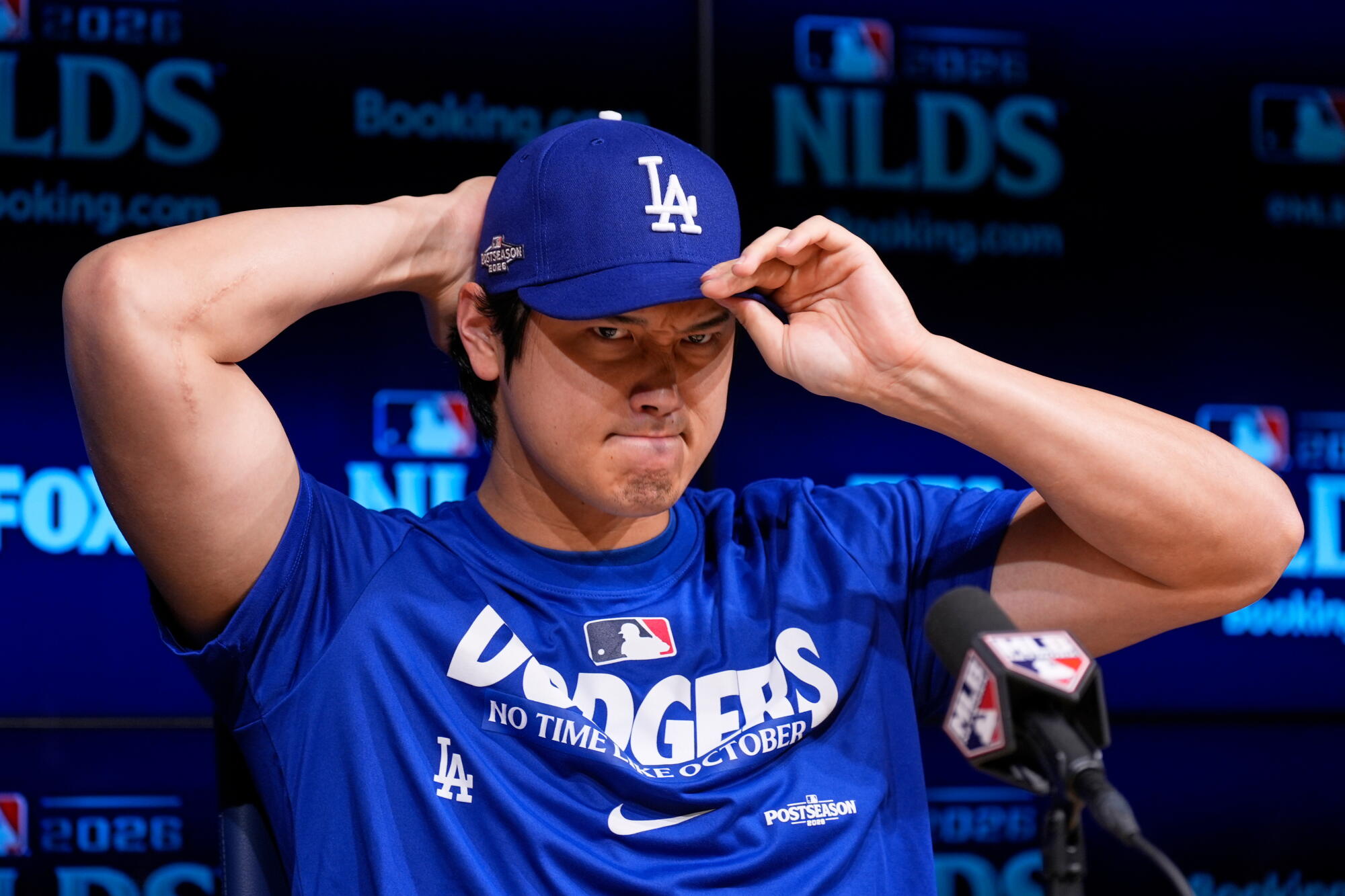
And so dozens of reporters crammed into a cramped room within Dodger Stadium on Friday afternoon, on the eve of the National League Division Series between the Dodgers and the Atlanta Braves, waiting for Ohtani to answer a few versions of “How are you?”
It’s not just about attracting casual fans to watch the icon whose face adorns everything from airplanes to skin care products. For the Dodgers and their fans, it’s about whether their most famous player can be a game-changer in October.
The Dodgers could have shut him down as a pitcher rather than let him continue to try to pitch through knee and biceps injuries. They didn’t, and that backfired.
The Dodgers could have shut him down as a hitter, not for the season but for a stint on the injured list. They didn’t. They gave him just a few days off, and that backfired.
Then the Dodgers did put him on the injured list, but activated him for the final five games of the regular season rather than give him extended rest for the playoffs, limiting his activity to controlled workouts.
That might backfire, or it might not, and the repercussions of the former could represent a significant hurdle in their quest for a third consecutive World Series championship. Giving Ohtani time off during the regular season would have carried no penalty; the Dodgers would have won the NL West with or without him.
If the Dodgers decide Ohtani needs a few days off now, they would face this unpleasant dilemma: play one man short, or put him on the injured list. Under MLB rules, a player put on the injured list during a postseason series must sit out the next series. So, if Ohtani starts wincing at the end of his swings during the NLDS, a stint on the injured list would mean he could not play again until the World Series — if the Dodgers get there.
Shohei Ohtani speaks during a news conference at Dodger Stadium on Friday.
(Mark J. Terrill / Associated Press)
Ohtani has not hit a home run since Aug. 18. Since then, he is batting .157, and he has struck out in 41% of his at-bats. In those final five games, he hit the ball hard in the first two, then hit ground balls in the final three. In the on-deck circle, he did not always take a swing.
In batting practice Friday, he hit lots of home runs.
The general sense of how Ohtani is feeling now: good enough.
Ohtani said he feels “really good” as compared to before he went on the injured list, but acknowledged he isn’t sure what he might need to do to address the injuries over the winter.
“As of now, it’s something I’m just going to have to manage,” he said through interpreter Will Ireton.
Dodgers manager Dave Roberts offered this medical update: “Shohei’s not 100%, but he’s going to be in the lineup.”
Same for Freddie Freeman, who has not homered in a month. The difference, Roberts said, is how encouraged the manager was by Freeman’s workouts this week.
“With Shohei, I’m not so sure,” Roberts said. “I know that once the lights turn on, the postseason starts, the focus will be heightened. I expect good things. I really do. We just haven’t seen it enough to really — for me to forecast it.”
Ohtani plays when he says he can. After he tore up his left shoulder in Game 2 of the 2024 World Series, he had trainers tape the shoulder in place and took 11 at-bats over the final three games of the series. He had one hit, a single.
“I do pride myself on playing every day,” Ohtani said. “I do see it as an obligation as a professional to be on the field every single day.”
Andrew Friedman, the Dodgers’ president of baseball operations, acknowledged recently that communication with Ohtani has been “awesome” but “fully sharing exactly how he’s feeling, maybe not as awesome.”
Said Friedman: “He’s not always the best reporter of how he feels. Freddie’s the same way. Clayton Kershaw. I’ve been around a lot of these guys that feel like their job is to be out there to help the team however they can, and sometimes will downplay some things that are bothering them. But again, it’s because he wants to help the team win.”
The Dodgers are talented enough that Ohtani not hitting well would not damage their chances as much as, say, Sale not pitching well for the Braves. In the NLDS and the first three games of the NLCS last October, Ohtani hit .103 with no home runs and struck out in 48% of his at-bats.
In the NLCS clincher, he hit three home runs (and struck out 10 batters). The Dodgers could trade a few bad days from Ohtani for that one really good day.
In that MLB advertisement, the one that featured Ohtani, the league acknowledged that its screaming headline was not exactly accurate. The explanation also fits the Dodgers’ hopes of Ohtani starring in October.
The ad, after all, appeared on Sept. 29.
October starts today?
“Logic and reason would tell you otherwise,” the ad read. “But October isn’t about being reasonable.