odysseus

Yes, Emily Wilson, Odysseus has been changed for the movie. Deal with it

In the spirit of Zeus’ law to be generous toward guests, I’m honored to welcome classics professor Emily Wilson to the land of film criticism. As she’s recently learned, it’s an adventure that sails smack into islands of musky internet trolls and clashes with cinematic and literary titans like Christopher Nolan and Joyce Carol Oates.

Nolan credits the opening line of Wilson’s 2017 translation of Homer’s “The Odyssey” — “Tell me about a complicated man” — as partly inspiring his adaptation of the ancient epic, which, nearly a month into its release, is soldiering toward a billion-dollar box office gross. Symbiotically, Wilson’s edition is now the No. 2 bestselling book in the country. That Wilson’s incendiary essay in the London Review of Books revealed she doesn’t think much of Nolan’s blockbuster struck some as hubris, including Oates, who took to social media to decry the scholar’s “tone of dismissal” and “haughty superiority.”

If you haven’t been following the controversy, Wilson felt that Nolan had flattened the saga by mostly erasing the Greek gods and Odysseus’ wit, lust and thorny contradictions. Oates likened the tone of Wilson’s critique to the “crude language of MAGA folks.” In short: Wilson snuck a 2,700-year-old poem through the gates of mainstream taste — and after that victory, her arrogance left her marooned.

Sounds familiar if you’ve read Homer. Less so if you’ve only seen the film. Wilson is right that Nolan’s movie lacks Odysseus’ egomaniacal brilliance.

I’m here to play peacemaker. Wilson adores Odysseus so much that she has his bow tattooed on her right leg. Frankly, Nolan doesn’t seem to like the wily, libidinous and violent trickster-veteran of the poem — half Rhett Butler, half Rambo in “First Blood” — as much as Wilson or I do. Because if he did, that Odysseus would be onscreen.

spot illustration of Odysseus cut out from the background and tinted blue

But having seen his movie twice, it’s obvious that Nolan is less interested in Wilson’s first line than her fifth: “Tell the old story for our modern times.” That, he’s done. His take on Homer is, as I wrote in my original review, “a moralistic ‘Oppenheimer’ prequel.” For the record, I like it anyway.

Film critics and translators start work in the same place. Step one: What is the artist’s intent? Wilson considered the entirety of Homer’s tale and decided the right word for polytropos was “complicated.” I weighed what Nolan chose to protect, tweak and abandon in his own version and concluded that he wanted to make an action-tragedy about societal decline.

Movies must be measured against their own ambitions. A stoner comedy can’t be graded like a Shakespearean drama (and vice versa). Here’s where Wilson runs aground. She wants to allow Nolan creative freedom, knowing that the Greek playwrights rebooted figures like Odysseus and Medea just like Marvel treats Spider-Man. There’s even a spinoff of the original poem in which Odysseus has kids with Circe.

Yet, storytellers have to protect the core of their characters. Medea must be angry, Spider-Man must be helpful and Odysseus, dang it, must have swagger. Damon doesn’t.

This is why Wilson deserves empathy even if she can’t bring herself to grant Nolan the same grace. As a professor of classics at the University of Pennsylvania, she’ll be on the front line of academics condemned to unteach Nolan’s heavily altered screenplay to students who will arrive quoting it chapter and verse. For decades to come, high school kids — probably even a few high school teachers — are just going to pop in his Blu-ray and call it a day.

Nolan does hit his target, eventually. Yet his script wobbles. He’s made a movie about Odysseus’ remorse for inventing the Trojan horse without a crucial scene: the moment he invents it. We see Odysseus silently stroll the beach outside Troy, but not the pride he must have felt running back to base to pitch an idea that will finish the war and let his allies go home. The emotional arc Nolan wants to trace should start there. The beat’s absence is confounding since Odysseus also needs to appear clever (and never does).

This is what it means to measure a film against its ambitions. Only after we accept that Nolan is solely interested in human mistakes can we gauge his disregard for the Greek gods. I dig that choice — it’s bold — yet still think he flubs it by not replacing the magical powers of Charlize Theron’s Calypso and Zendaya’s Athena with, say, a personality. What a waste of two terrific actors. It’s no wonder Oates stuck up for him. Her novel “Blonde” also stripped the agency from love goddess Marilyn Monroe and its own 2022 movie adaptation launched a thousand hot takes.

There will never be a faithful modern film version of “The Odyssey.” No, not even whatever AI slop Elon Musk claims he’s green-lighted, a project I’m sure will come to fruition as fast as his any-year-now claim that he’s landing on Mars.

The issue isn’t just the poem’s length. It’s that today’s audiences have zero stomach for happy endings about horrible wrongs. We can barely rationalize the slaughter of the suitors. No one wants to watch Homer’s gory scene after that, when Telemachus cruelly orders a dozen enslaved girls to clean up the mess and then executes them too.

Only a seven-and-a-half hour Italian miniseries produced by Dino de Laurentiis in 1968 dares mention that second bloodbath and even in that, the women are hung offscreen after we’ve been assured (fictitiously) that the maids tried to kill them first. (Side note: Dino’s Penelope, played by the mighty Irene Papas, is my favorite.)

Previous movie adaptations of “The Odyssey” soft-pedal or ignore the hero’s postwar PTSD. You catch a glimpse of it in the two-part NBC special from 1997 in which Armand Assante’s Odysseus rescues a Trojan toddler. But mainly, he spends more time hot-tubbing with Vanessa Williams’ Calypso.

That’s not a knock. The ’90s “Odyssey” is as tacky as Caesars Palace but Assante’s smooth-talking horndog is closer to my ideal Odysseus than Damon’s neutered mope. He sleeps with both Calypso and Circe and still earns his tender reunion with Penelope by choosing her beloved wrinkles over those gods’ immortal perfection. (For what it’s worth, Oates is a fan of it too. Wilson has yet to comment.)

Only the two most recent versions — Nolan’s and Uberto Pasolini’s 2024 “The Return,” starring a sinewy Ralph Fiennes — center on Odysseus’ culpability for the carnage of the Trojan War. Damon’s Odysseus is numbed by the massacre of Troy’s civilians; Fiennes’ hates himself for leading the best men of Ithaca to their death, gutting his own community in the heedless destruction of another. I’m tempted to diagnose the current gloom as the result of our own post-9/11 forever wars.

The 21st century has seen enough genocide for Homer to compose a hundred sequels. Only those stubbornly ignorant to the human cost of actual combat would be psyched to bring on more of it. (Just ask the veterans in my family how they feel things are going in Iran.) At the end of “The Return,” when Fiennes stands entrail-smeared before his beloved Penelope, she recoils from the horror of the battlefield brought right into their home.

That interpretation has its flaws too. The middle stretch has a concocted outdoor chase sequence that feels like a clumsy campground slasher. Wilson applauded its “stylish sparseness.” Fair enough. I’d still love to invite her and Nolan and even Oates to a banquet of wine and roasted fowl and have a blast agreeing to disagree. No weapons allowed.
Source link

‘Odyssey’ translator Emily Wilson rips apart Nolan’s film adaptation

Emily Wilson, whose translation of Homer’s “The Odyssey” published in 2017 served as inspiration to Christopher Nolan when crafting his blockbuster adaptation of the nearly 2,800-year-old poem, has some thoughts on the film.

In a biting missive for the London Review of Books, the British American classicist dissected Nolan’s work with a scalpel so sharp that he may need to borrow some of Matt Damon’s armor to read it all the way through. Last fall, the acclaimed director quoted Wilson’s translation when telling Empire magazine why he was drawn to the story. “I think it’s the Emily Wilson translation that begins, ‘Tell me about a complicated man,’” he said. “The genius of the character, the cleverness, the inventiveness of him, that was a huge part of what interested me. He’s not just a soldier. He’s an amazing strategist, a very wily person.”

Wilson, although admittedly “humbled” by the nod from the filmmaker, wrote: “But I would be ashamed to have written any part of this script.”

A professor of classical studies at the University of Pennsylvania, Wilson has also translated Seneca and Euripides, as well as Homer’s “Iliad.” In her takedown of the film, she likens Nolan’s nearly three-hour epic to Peter Jackson’s “Lord of the Rings” trilogy and “Game of Thrones” and says that, by the end, she “almost expected everyone to break into Elvish.”

Earlier this month, The Times’ film critic, Amy Nicholson, wrote that “Nolan has sacrificed Odysseus himself to serve his own needs, scrapping the character’s prickly personality to Trojan-horse a message about how empires collapse. … Aghast at the ways of men, he’s dug his own Circe-like fingers into Homer to manipulate the tale into a moralistic ‘Oppenheimer’ prequel.”

Wilson appears to share the sentiment.

“Unlike some of Nolan’s other films,” she wrote, “‘The Odyssey’ is not boring, thanks to the source material, which is impossible to mess up entirely. It’s a family-friendly audiovisual spectacle, like an elaborate Fourth of July fireworks display — and with about the same level of narrative and emotional depth.”

When casting was announced for the film, it was no surprise that culture wars broke out over the choice of Oscar-winning actor Lupita Nyong’o to play Helen of Troy, with Elon Musk leading the charge.

Nolan responded, telling the Telegraph earlier this month before the film hit theaters, “These conversations that happen before people see the film — they’re always irrelevant, because no one having them knows what the film actually is yet.”

According to Wilson, Nolan’s race-neutral casting had “nothing progressive about it.”

“Most of the non-white actors — Zendaya, Lupita Nyong’o, Himesh Patel, Corey Antonio Hawkins, Travis Scott — play versions of the Black best friend, whose only role in the drama is to provide aid to the white protagonist,” she wrote.

Wilson zeroes in on the portrayal of Homer’s female characters in another major critique: “There are more female characters than in most Nolan movies, thanks to the source material. But none of them has much to say, in contrast to the [characterizations] in the poem.”

Where Charlize Theron’s Calypso ought to have been angry, funny, skilled in rhetoric and libidinous, according to Wilson, she’s “an unpaid therapist.” On Anne Hathaway’s Penelope, Wilson writes that the script “gives her nothing to do except yearn for Matt Damon, for reasons unknown.” And Zendaya’s Athena “turns out to be a vulnerable victim of war, or perhaps a projection of Odysseus’ conscience — not a scheming and bloodthirsty war goddess.”

And then there’s the human cost of war — the central theme of the film, and one that Wilson says contradicts Homer’s poem.

“The representation of Odysseus as a reluctant warlord makes a nonsense of the movie’s imagined world,” she writes. “We are not shown that war or killing are bad, only that good men sometimes feel bad about it — a very different point. Any serious depiction of violence, ancient or modern, must show the perspectives of the victims as well as the perpetrators, and the Homeric poems easily clear the bar — but Nolan doesn’t.

“The film asks us both to be horrified at war and to celebrate the action-movie sequences in which the reluctant warrior finally gets his hands on his bow and the blood starts flowing.”

Since Nolan announced “The Odyssey” back in December 2024, various versions of the poem have been in high demand at bookshops and libraries — especially the only English version written by a woman: Wilson’s 2017 translation. Louise Brockett, spokeswoman and head of communications at W.W. Norton, told USA Today that domestic sales of Wilson’s translation surpassed a million copies this year.

Concluding her critique of Nolan’s “Odyssey,” Wilson says the release of the movie is “still an event to celebrate.”

“In what we are told is the streaming era, this epic is bringing audiences back to cinemas. In what we are told is a time of declining literacy and the ‘death of the humanities,’ translations of The Odyssey, including mine, are flying off the shelves.”

Nolan spent $250 million making “The Odyssey,” and on opening weekend the film brought in a total of $264.1 million worldwide, according to studio estimates.

Source link

Samantha Morton on how she cast a spell over ‘The Odyssey’

Samantha Morton didn’t mean to start humming during that scene in “The Odyssey,” the scene everyone is talking about, when, as the sorceress Circe, she turns Odysseus’ men into pigs, literally molding them into their true savage selves.

It wasn’t in the script. It just happened. And when Morton was done, she looked over to director Christopher Nolan, waiting for him to say something like, “Maybe try it without the humming, Samantha.”

But Nolan didn’t say anything, so Morton did it again and the music that was swirling inside her head, which she remembers now as a symphony of glass harmoniums and theremin, kept coming out as Circe went about her witchy business, altering her gluttonous guests, who are busy slurping and gulping down her stew.

“These are sounds that can make you go mad, apparently,” Morton, 49, tells me, reclining on her bed at the Hotel Chelsea in New York. “So to transform the men, the magic came not just from my hands but from my sounds.”

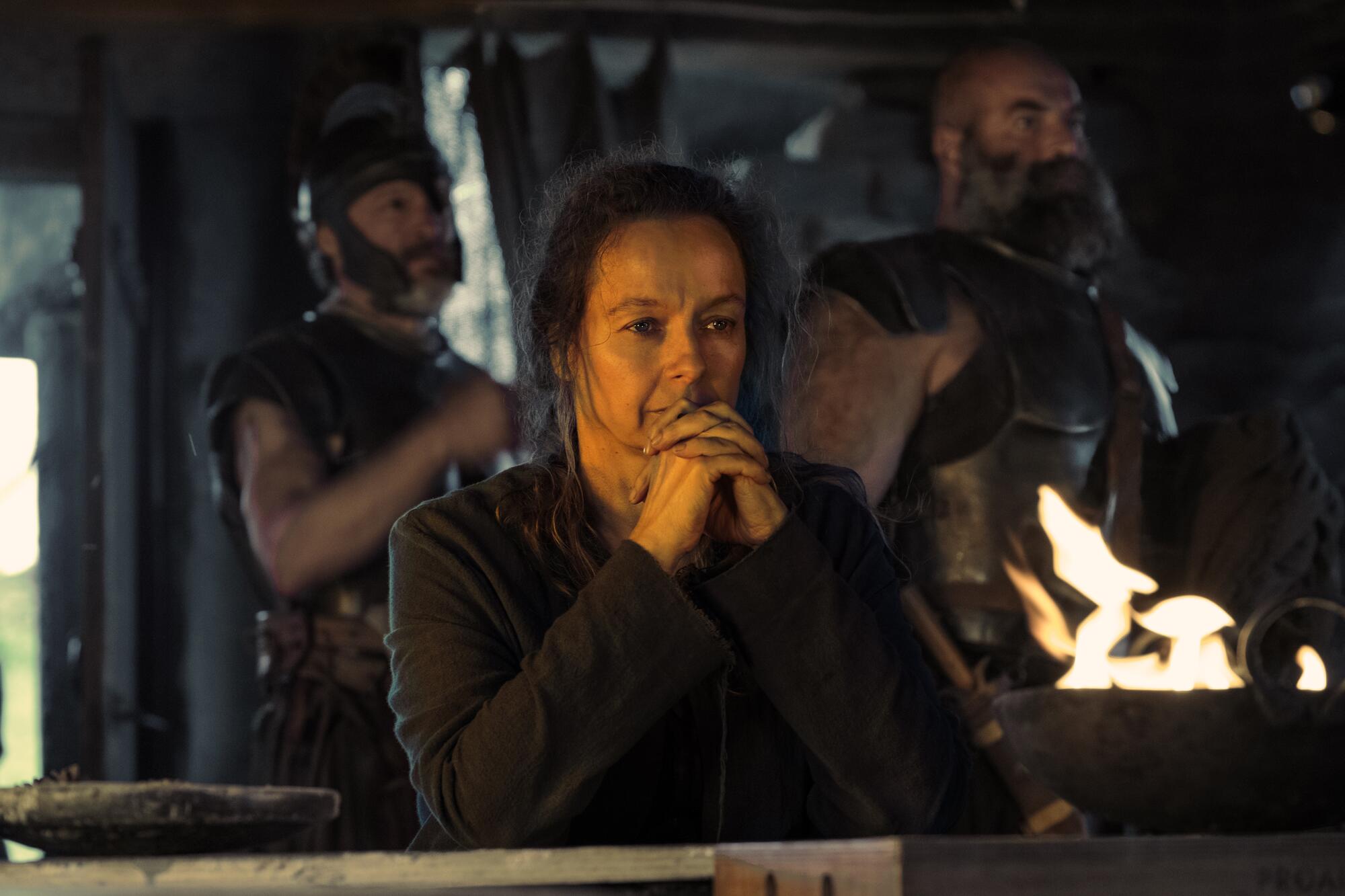
A woman sits in concentration by a fire.

Samantha Morton as Circe in “The Odyssey,” directed by Christopher Nolan.

(Melinda Sue Gordon / Universal Pictures)

Morton unabashedly believes in magic. How else, she asks, can you explain how a girl who was shuttled between children’s homes and a dozen foster families, only to be living on the streets of Nottingham, England, at the age of 14 with a criminal record, be here talking with me now, sipping green tea at the Chelsea?

“That’s got to be guardian angels and love — and not that I suddenly became good at acting and got a job,” says Morton, a veteran who’s been at it for 35 years, dazzling audiences and stealing scenes for the likes of Steven Spielberg, Jim Sheridan and, now, Nolan. “I’ve always believed that anything is possible and there’s no doubt in here,” and she pats her heart, “because I’ve always felt this immense love for me from another entity.”

When Morton heard that Nolan wanted to meet her for “The Odyssey,” she says she wept. If that sounds dramatic, she makes no apologies. She likens it to being an athlete who qualifies to represent their country at the Olympics. She’d spent decades honing her craft for that phone call. When it came, she flew to Los Angeles in January 2025 during the wildfires, embarking on what would become the best job interview of her life.

I ask her what she remembers about that meeting.

“I think it went really well,” Morton answers, laughing.

Morton told Nolan she hadn’t read “The Odyssey,” which, when you quit school at the age of 12, makes sense. Flying back home to England — she and her husband live in East Sussex with their children, 18-year-old daughter Edie and 12-year-old son Teddy — she recalled that, yes, she knew a bit of “The Odyssey” from having seen it parodied on an episode of “The Simpsons.” (“We’re ‘Simpsons’ mad in our house,” she says. “Like, mad.”)

But Morton doesn’t believe in bogging herself down in research, not since starring in a British TV production of “Jane Eyre” when she was 19 and carried around a heavily highlighted copy of the Charlotte Brontë book, despairing whenever the adaptation deviated from the novel. From that point on, she stuck to the script and her own imagination.

A woman looks out a city window on a gloomy day.

“That’s got to be guardian angels and love — and not that I suddenly became good at acting and got a job,” says Morton of her career. “I’ve always believed that anything is possible.”

(Ebru Yildiz / For The Times)

Thinking about Circe, Morton recalled going to the library with her dad (“We had nothing and were beyond poor, but he always had a library card,” she says) and finding the Howard Pyle fairy-tale book “King Stork.” She remembers being mesmerized by the story’s wicked witch. She recalls other witches from folk tales like Baba Yaga, frightening characters but also, she says, “women possessing an innocence that had been eroded over the years by the harshness of life.”

Morton does a playful verbal evasion when discussing the nuts-and-bolts aspects of shooting the scene where Circe transforms Odysseus’ men, saying that back in the day when behind-the-scenes features were prevalent on DVDs, she routinely declined to participate.

“I didn’t mean to be tricky, but it was like: This is my private moment. This is for me,” she says. “I do like the idea of a little mystery.”

But then a beat later, she laughs it off and dives in, remembering that her husband showed her an Instagram post from Nolan’s set revealing how the movie’s Cyclops was, in fact, a puppet.

“Oh my gosh — I love puppets!” Morton raves, and off she goes, telling me how much she adores Jim Henson and how “The Dark Crystal” is one of her all-time favorite films.

What she will say about her “Odyssey” scene is that there were no digital effects. Everything was real and “in camera” and that she was so in the zone that she barely remembers any of it, only flashes.

“That’s not CGI,” Morton says. “That’s human brilliance and a connectivity of me as a performer, almost dancing and feeling one. And not to say that it was sexual, but I wanted it to be very sensual when she’s with the men and the animals, just like, you know, that she’s almost one with them.”

“What was lovely about that,” Morton begins and then stops, wondering if she should draw back the curtain on the creative process. She goes ahead. “There was a day on set when Chris was like, ‘OK,’ and he put his hand in because I was a little scared. It’s like that scene in ‘Raiders of the Lost Ark’ where he puts his hand in the thing, and you’re like, ‘Oh no!’ I was a little nervous, but Chris did it first. I think he actually cut his finger.” She giggles. “You know, he’s going to go in first, like getting into the cold water in the sea. I felt protected and supported in that whole process.”

When Odysseus’ men arrive at Circe’s home, hungry, asking to be fed, Circe seems frightened — understandably so. She’s alone, and these soldiers have a history of pillaging and taking what they want. And yet, she’s a powerful sorceress. Is Circe really scared or tricking them to lure them in?

“I played that like she was genuinely frightened because she was caught off-guard,” Morton says. “I also wanted to play somebody that was all ages, so I played her like a 16-year-old girl in that scene. And then in other scenes, I’m playing her as a 90-year-old woman or a 49-year-old woman or a sister or a mother, a grandmother. I just wanted her to be ageless.”

Morton, looking out for Circe, stresses that transforming Odysseus’ men was not purely vengeful.

“It’s not just hate,” she says. “It’s not just harm. It’s not just anger. It’s almost like a Zen master within the goddess role of the teaching as well. ‘Be careful what you wish for,’ gluttony, greed, all of these things.”

There’s a righteous feminist rage underneath the scene as well, a modernization that brings “The Odyssey” fiercely and disturbingly up to date. It’s another reason why people leave are leaving the theater talking about Morton.

A woman in a blazer stands by a mirror in a hotel room.

“In some weird way, the film lived or died over that character,” says director Nolan of Morton’s Circe, a creation of pure acting and no digital sorcery. “She was the fulcrum.”

(Ebru Yildiz / For The Times)

Nolan thinks “The Odyssey,” in some weird way, “lived or died over that character — she was the fulcrum.” He told The Times that “after one of her takes, the crew gave her a great round of applause.” Emma Thomas, Nolan’s producing partner and wife, later recalled that the last time that had happened was with Heath Ledger on “The Dark Knight.”

Morton makes a point of telling me how much Ledger meant to her, having been cast opposite him (and Odysseus himself, Matt Damon) more than 20 years ago in Terry Gilliam‘s 2005 fantasy adventure “The Brothers Grimm.” Miramax chief Harvey Weinstein overruled Gilliam, dropping Morton from the film because, in his eyes, she wasn’t attractive enough.

“And Heath fought for me with such kindness and compassion,” Morton says. “He’s up there with Philip Seymour Hoffman for me. There’s something otherworldly personal about what they gave, such sincerity and vulnerability and an absolute dedication to craft. They leave a mark on your heart.”

It’s not the first time Morton has invoked the heart in our conversation. She brought her son, Teddy, to New York for the premiere of “The Odyssey” because she wanted to show him the place where her creative spirit was born. Morton first came to New York as a teen to do press for “Emma,” returned a year later to promote “Jane Eyre” and then couldn’t bring herself to leave, “sofa-surfing” at friends’ apartments so she could immerse herself in the city.

“New York stole my heart,” Morton says. It’s where she first got into literature, devouring Charles Bukowski, roaming the aisles at the St. Mark’s Bookshop, checking out movies from Kim’s Video and gobbling hash browns and eggs over easy at the Waverly Diner.

Not long after, Morton scored the role that would land her the first of two Oscar nominations (for now, at least), playing the mute laundress in Woody Allen’s “Sweet and Lowdown.” The production put her up in a Greenwich Village apartment and when it ended, she moved to the East Village.

Only the diner remains but Morton still plans on touring the Village with Teddy, showing off all of mom’s old haunts and, yes, having a cup of soup at the Waverly.

“Life is good right now,” Morton says, smiling. “Who knows? Maybe I’ll indulge in some hash browns.”

Source link

‘The Odyssey’ review: ‘Oppenheimer’ through an ancient lens

Tell me, Christopher Nolan, when did it first rosy-fingered dawn on you that your favorite type of protagonist — a tormented sinner-hero — was a specialty of the ancient Greeks? Millennia before Matthew McConaughey’s astronaut sobbed over abandoning his family and Cillian Murphy’s Robert Oppenheimer gasped that he had become the destroyer of worlds, the Greeks spun cautionary legends about Odysseus, the Trojan War tactician who outsmarted his own plan to sail smoothly home.

Nolan refuses to tremble before the canon. Grabbing mighty scissors, he cuts and rejiggers Homer and a bit of Virgil to transform these classical texts into his type of tale: one fixated on memory, self-identity, destructive genius and the slippage of time. As ever, it’s light on sex, heavy on wine-dark angst.

Once you endure its opening stretch — an expositional barrage with the pace of an obnoxious cop show — “The Odyssey” ascends as a monument to movie craft with shuddering ships, rough-hewn landscapes and practical monsters who snatch and grab men at random from above like giant skill cranes. Unlike in most mythological tales, the white Corinthian columns have been swapped out for brutal stone architecture. The Parthenon won’t be built for another 800 years; likewise, Athenian democracy is centuries away.

Nolan has anchored his “Odyssey” at the fall of the Bronze Age, a once-great era toppled by wealth-hoarding, diminished trade and climate catastrophes. Fearful of invading marauders, humankind has turned distrustful and stingy, ignoring Zeus’ command to show generosity toward the poor and foreign-born, a cornerstone of faith that would later be repurposed in the New Testament.

  • Share via

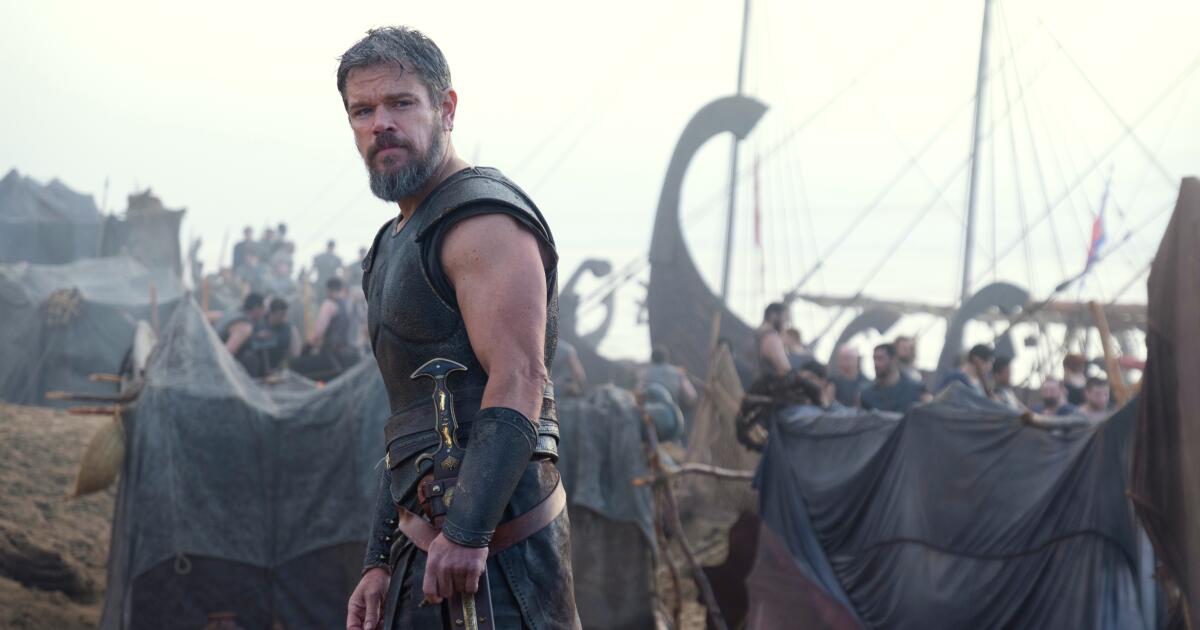
This Odysseus (Matt Damon) is both witness to and wrecking ball of the collapse. Not only does he steal, slaughter and pillage while expecting to be treated with kindness, but he’s also brainstormed the atomic bomb of his day: the Trojan horse, a deceitful invention planted into the sandy beaches of Troy that marks the decline of civilization like the Statue of Liberty in “Planet of the Apes.” Inside this claustrophobic wooden beast, Odysseus and his wild and bloodthirsty Greeks are crammed cheek-to-sandal so tightly that you can’t imagine how they’ll spring into action without first getting a massage. Outside and looking up at it, the pony seems to sneer.

“The Odyssey” is a saga with half a dozen detours and one destination, Ithaca, Odysseus’ kingdom. While he’s been fighting in Troy, his palace has been overrun by men who want to marry his faithful wife, Penelope (Anne Hathaway), and murder his helpless son, Telemachus (Tom Holland). Robert Pattinson’s oily suitor woos Penelope like a “Bachelorette” contestant: “It’s time to live again,” he urges her, certain that Penelope’s vengeful husband won’t come back. Forget that rose, dude, and run away.

A woman in blue and a young man speak on a patio in ancient Greece.

Anne Hathaway and Tom Holland in the movie “The Odyssey.”

(Melinda Sue Gordon / Universal Pictures)

After 20 years away — 10 at war, 10 adrift — Odysseus is anxious to reclaim his kingdom. Or is he? Nolan floats a convincing psychological reason why this Odysseus subconsciously believes his duplicitous actions during the war deserve permanent exile from civilization. Although, as is the case with too much of Nolan’s storytelling, he wrongly thinks it’s more interesting to withhold Odysseus’ traumatic hang-up until the ending. The Greeks never tried to confuse the audience in the pursuit of suspense. They delivered their plots arrow-straight to make the dread sting.

Saddled with a silly black beard that eventually goes gray, Damon’s Odysseus is stubborn, overconfident and sacrilegious, but doesn’t bear that much resemblance to the conniving, hypocritical egotist of lore who fretted over his wife’s fidelity while seducing not one, but two, enchantresses, Calypso and Circe. Today’s viewers might demonize Odysseus’ erotic exploits; instead, they’ve been Damon-ized into something innately goodhearted.

The chasteness of Nolan’s version bugs me as it’s insulting he doesn’t trust audiences to grapple with this hero’s moral complexity — and I’m gut-sick that he’s probably right. Plus, it leaves Charlize Theron’s Calypso nothing to do but limply listen to (and medicate) Odysseus like a bored therapist reaching for the lithium. I was hoping for more zest from a blond wearing actual fishnets that could catch sardines.

At least Samantha Morton’s body-horror spin on the witch Circe is terrific. To punish his men for barging into her hut, she digs her fingers inside their skin like clay, remolding them into the swine she claims they are. Her outrage is one of the best ideas in the movie. Likewise, Lupita Nyong’o’s Helen is regal and formidable, but it’s a mistake to double-cast her as Helen’s twin sister, Clytemnestra. The whole reason thousands of men fought a war over the most beautiful woman alive is that there’s only one of them — unless undermining that excuse is the point. (In an aside, we’re told that Benny Safdie’s aloof Agamemnon, hiding under a try-hard scary helmet decorated with a golden spine, really waged it to break up Troy’s trade routes.)

Unlike in Homer or even “Clash of the Titans,” which showed the gods as toga-clad twits toying with mortal lives like action figures, they have little, if anything, to do in this plot. In Homer’s original verse, Athena is as fussy as a stage mother, showing up every few pages disguised as someone mortal to bless both Odysseus and Telemachus with live-action Photoshop filters that make them extra handsome. Here, Holland’s Telemachus gambles Athena is hiding inside half the people he meets until his father chides, “Don’t look for gods in men, you’ll just be disappointed.”

Instead, Nolan balances religion on the spear tip of doubt. The angry sea god Poseidon is reduced to rumors; mighty Zeus withheld to a few well-timed thunderclaps. Even Athena, if that genuinely is whom Zendaya is playing, isn’t that helpful, mostly staring at Odysseus in mute dismay. It’s possible to get to the end of “The Odyssey” and conclude that Nolan doesn’t believe in gods at all. To him, men must be proactive in their own demise. (I’m half-convinced, the way I don’t really swear by the zodiac but nevertheless stopped dating Libras.)

Composer Ludwig Göransson scores the breath-holding assault on Troy to drums that pound faster and faster on our nerves, as does our alarm that Odysseus’ troops aren’t the good guys. Occasionally, Göransson adds a lovely monotone layer of woodwinds or a keening chorus that sounds like the oldest song on Earth.

Conversely, during the talky Ithaca sequences, when the movie is rightly paranoid of losing our attention, the more modern heist-thriller music is flat-out obnoxious, especially in a scene where Odysseus lays out his ruse to infiltrate his house to John Leguizamo’s trusty goatherd, the most lovable man ever introduced throwing a puppy off a cliff. (No, really — it’s the movie’s only outright joke.)

Hoyte van Hoytema’s Imax-framed cinematography is assertive and present, rocking with the stormy waves and peering into the torch-lit darkness where the color palate is as starkly orange and black as an ancient Greek urn. Working with the special effects team, Van Hoytema cloaks the non-digital wizardry of the Cyclops and six-headed Scylla behind naturalistic camera movements and shadows so that, rather than drawing too much attention to themselves, the creatures just feel real. As gray and wrinkled as the bottom of a mummy’s foot, the Cyclops’ face is wonderfully askew, like he was stepped on by someone even bigger than him.

Nolan’s “Odyssey” engraves marvelous images onto the ancient oral poem. One of the most haunting shots is Odysseus sprinting out of Hades chased by an army of the dead who regret following him into battle. In turn, Nolan has sacrificed Odysseus himself to serve his own needs, scrapping the character’s prickly personality to Trojan-horse a message about how empires collapse.

Aghast at the ways of men, he’s dug his own Circe-like fingers into Homer to manipulate the tale into a moralistic “Oppenheimer” prequel. Even Odysseus seems to suspect as much. “Our mistakes will again be forgotten,” Odysseus predicts as the land he loves sails into the Dark Ages while he steers the helm. He’s done unforgivable wrongs. But in that moment, he’s right.

‘The Odyssey’

Rated: R, for violence and some language

Running time: 2 hours, 52 minutes

Playing: Opens Friday, July 17 in wide release

Source link