nuclear weapon

Column: Obama’s strong terms curbed Iran. Trump struggles to secure even a weak deal

President Trump, it’s well known, is into gold. Every day brings new evidence that he’s thoroughly enjoying the “golden age” he pronounced in his inaugural address — as few other Americans are — with stock trades, crypto profiteering and much more, even a new taxpayer-financed slush fund to reward his allies.

As for me, I’ve gone into silver. That is, I constantly look for the silver linings in Trump’s heinous acts.

One silver lining, of course, is his cratering job-approval numbers in the polls, especially among the young and Latino voters who made his reelection possible. But here’s another: By his humiliating failure to bring Iran to heel, nearly three months after starting a war that he said would last weeks at most, Trump has brought new, more positive attention to what he again this week derided as “Barack Hussein Obama’s Iran nuclear deal.” (The emphasis on “Hussein” is Trump’s, always.)

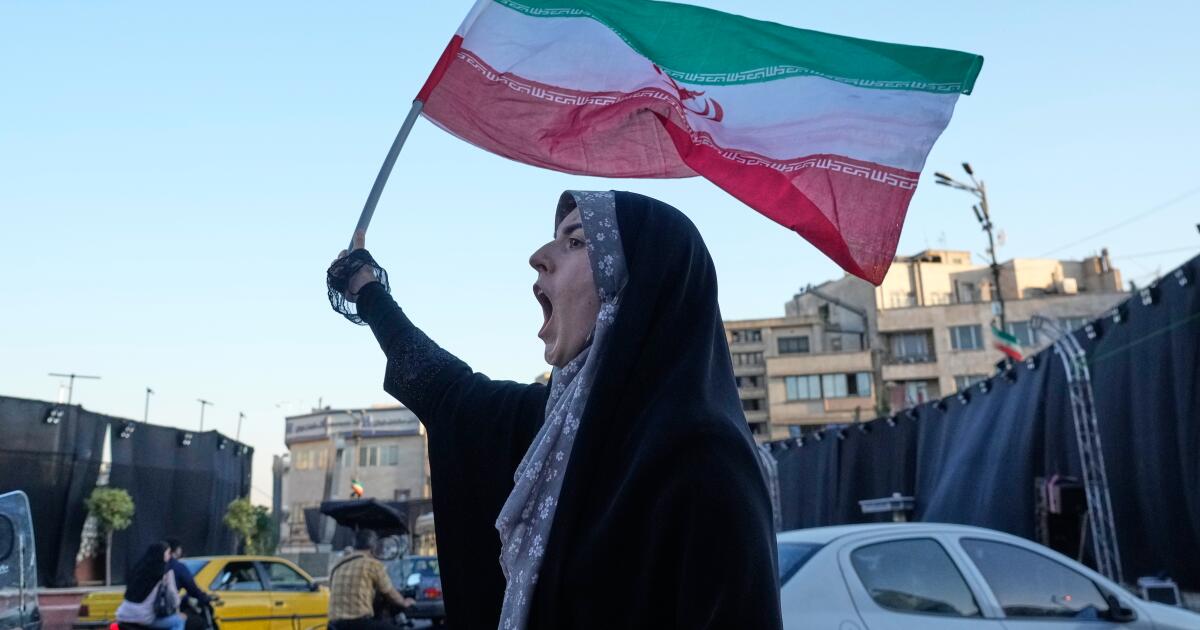
The president, along with his Republican cheerleaders, counts his first-term abrogation of the 2015 Iran nuclear agreement, the Joint Comprehensive Plan of Action, as a signature achievement. This week, yet again, he falsely claimed that had he not done so, Iran would have a nuclear weapon. In fact, his action in 2018 taking the United States out of the multinational deal subsequently led to Iran’s rebuilding of its nuclear program, the emboldening of the Iranian hard-liners now in power and the Middle East morass in which the United States is now mired.

That quagmire has left Trump seeming desperate for a deal — almost certainly a worse deal than the one Obama struck. Call it JCPOA Lite.

If he were able to get Iran’s sign-off on the sort of detailed, restrictive agreement that Obama and other world leaders won 11 years ago, he’d be trumpeting himself as the world’s greatest dealmaker. (He does that anyway, but his record proves otherwise.) Instead, by his own failure to date, Trump has invited reconsideration of the very agreement he decried as the “worst deal ever” on his march to election and reelection.

No sooner was the 2015 deal signed than Trump and Republicans succeeded in defining it as a giveaway to Iran that assured, not hindered, its development of a nuclear weapon to threaten Israel and the world. Opponents condemned the agreement for not addressing Iran’s other threats, notably its support for militant proxies throughout the Mideast. Some Democrats, notably Senate Minority Leader Chuck Schumer of New York, were among the foes. Other Democrats, cowed by opposition to the agreement by Benjamin Netanyahu’s Israeli government and pro-Israel lobbyists, were all but mute in the pact’s defense.

Now some Democrats are belatedly finding their voice (and, post-Gaza, some willingness to defy Israel). Along with nonpartisan experts, those Democrats are drawing comparisons between the 2015 agreement, flawed yet successful, and Trump’s promised yet ever-elusive alternative. What’s ironic for Israel and Netanyahu, still implacably against negotiating with Tehran, is that they could end up, under Trump, with a nuclear deal that gives Iran more leeway than the hated JCPOA did.

As Americans are being reminded, the 2015 deal wasn’t just between Iran and Obama, as Trump has long suggested; other signatories were China, Russia, Britain, France, Germany and the 27-nation European Union. Reconstituting that group would be all but impossible today.

The pact’s 159 highly technical pages and five appendices — a far cry from the short-lived one-pager that Trump officials teased earlier this month — required Iran for 15 years to limit its nuclear program to civilian purposes, forfeit more than 97% of its enriched uranium and submit to intrusive monitoring by the International Atomic Energy Agency to ensure compliance. In return, Iran gradually got relief from some, but not all, international economic sanctions and access to Iranian funds that were frozen after the 1979 Islamic revolution. Presumably, after 15 years, the agreement would have been extended somehow.

By all accounts, including those of Trump’s first-term intelligence and national security officials, Iran was complying when he abandoned the deal. Its “breakout time” for building a nuclear weapon was about a year — time enough for the world to intervene — instead of two to three months. Now, though the president boasts he barred Iran from having that weapon by breaking the Iran nuclear deal, he incessantly tells Americans that he went to war against Iran on Feb. 28 because it was on the brink of a bomb — never mind that he also said he had “obliterated” Iran’s nuclear program last summer, a program that was in a well-monitored box until he first took office.

If you’re confused, you’re paying attention.

A month ago, Trump posted online that he was close to a deal “FAR BETTER” than the 2015 accord. “I am under no pressure whatsoever, ⁠although, it will all happen, relatively quickly!” To several reporters, he suggested he in fact had a deal and that Iran had agreed both to suspend its nuclear activities and to forfeit all of its enriched, near-weapons-grade uranium.

Preposterous claims, given Iran’s current government, and Tehran promptly denied them. It was a sign of Trump’s squandered credibility that few, if anyone, believed him in the first place. Nor have folks believed his more recent talk of imminent success; oil markets, too, have learned not to trust the president, as prices at the pumps attest.

On Tuesday at the White House, amid a noisy tour of the billion-dollar-ballroom construction site, Trump told reporters he’d been “an hour away” from striking Iran again that very day but Mideast leaders asked for more time for negotiations.

Don’t hold your breath.

But for the tragic consequences, Obama might be enjoying some justifiable schadenfreude about Trump’s travails.

“We pulled it off without firing a missile. We got 97% of the enriched uranium out,” he told Stephen Colbert in an interview last week. Both U.S. and Israeli intelligence agreed that Iran was abiding by the nuclear limits, Obama added, “and we didn’t have to kill a whole bunch of people or shut down the Strait of Hormuz.”

That sure doesn’t sound like the “worst deal ever.” It wasn’t.

Bluesky: @jackiecalmes
Threads: @jkcalmes
X: @jackiekcalmes

Source link

Vatican and State Department stress solid ties after Rubio’s fence-mending visit over Trump attacks

The Vatican raised the “need to work tirelessly in favor of peace” in talks Thursday with U.S. Secretary of State Marco Rubio, who came to Rome on a fence-mending visit after President Trump’s criticisms of Pope Leo XIV over the Iran war.

Both the Vatican and the U.S. State Department stressed that Rubio’s meetings with Leo and the Vatican’s top diplomat underscored strong bilateral ties. Those relations, though, have been strained over Trump’s repeated broadsides about Leo’s calls for peace and dialogue to end the U.S.-Israeli war.

Rubio, a practicing Catholic, has often been called on to tone down or explain Trump’s harsh rhetoric. He had an audience first with Leo, which was complicated at the last minute by Trump’s latest criticism of the Chicago-born pope. During a 2½-hour visit, Rubio then met with the Vatican secretary of state, Cardinal Pietro Parolin, who on the eve of his visit had strongly defended Leo and criticized Trump’s attacks.

“Attacking him like that or criticizing what he does seems a bit strange to me, to say the least,” Parolin said Wednesday.

After the meetings, the U.S. State Department said that Rubio and Parolin discussed “ongoing humanitarian efforts in the Western Hemisphere and efforts to achieve a durable peace in the Middle East. The discussion reflected the enduring partnership between the United States and the Holy See in advancing religious freedom.”

In a separate statement about the audience with Leo, U.S. State Department spokesperson Tommy Pigott said that the two discussed the situation in the Middle East and the Western Hemisphere. “The meeting underscored the strong relationship between the United States and the Holy See and their shared commitment to promoting peace and human dignity,” he said.

The Vatican, for its part, said that during Rubio’s meetings with both Leo and Parolin, “the shared commitment to fostering good bilateral relations between the Holy See and the United States of America was reaffirmed.”

It said the two sides exchanged views on the current events “with particular attention to countries marked by war, political tensions, and difficult humanitarian situations, as well as on the need to work tirelessly in favor of peace.”

Rubio also has meetings Friday with Italian Premier Giorgia Meloni and Foreign Minister Antonio Tajani. Those meetings might not be much easier for Washington’s top diplomat, given both have strongly defended Leo against Trump’s attacks and have criticized the Iran war as illegal — drawing the president’s ire.

A mission to smooth ties

The tensions began when Trump lashed out at Leo on social media last month, saying the pope was soft on crime and terrorism for comments about the administration’s immigration policies and deportations as well as the Iran war. Leo then said that God doesn’t listen to the prayers of those who wage war.

Later, Trump posted a social media image appearing to liken himself to Jesus Christ, which was deleted after a backlash. He has refused to apologize to Leo and has sought to explain away the post by saying that he thought the image was a representation of him as a doctor.

Rubio said that Trump’s recent criticisms of Leo were rooted in his opposition to Iran potentially obtaining a nuclear weapon, which he said could be used against millions of Catholics and other Christians.

Leo has never said Iran should obtain nuclear weapons and that the Catholic Church “for years has spoken out against all nuclear weapons, so there is no doubt there.”

“The mission of the church is to preach the Gospel, to preach peace. If someone wants to criticize me for announcing the Gospel, let him do it with the truth,” Leo said late Tuesday, after Trump again accused him of being “OK” with Iran having a nuclear weapon.

By Thursday, tensions seemed to have eased.

Rubio gave Leo a small crystal football paperweight. He acknowledged Leo’s known allegiance to the Chicago White Sox, saying “you’re a baseball guy,” but noted that the football had the seal of the State Department on it.

“What to get someone who has everything?” Rubio joked as he gave Leo the paperweight.

Leo, for his part, gave Rubio a pen apparently made of olive wood — “olive being of course the plant of peace,” Leo said — with his coat of arms on it and a picture book of Vatican artworks.

Trump also has criticized Meloni and other NATO allies for a lack of support for the Iran war, recently announcing plans to withdraw thousands of American troops from Germany in the coming months.

Vatican seen as willing to have dialogue

Giampiero Gramaglia, former head of the ANSA news agency and its onetime Washington correspondent, said that he didn’t expect much to come out of Rubio’s visit for Italian or Vatican relations. He, and other Italian commentators, believe Rubio instead was looking to smooth over relations with the pope for his own political ambitions, as well as the upcoming midterm U.S. congressional elections and 2028 presidential race.

“I doubt Rubio has the role of conciliator for Trump,” he told Italy’s Foreign Press Association. “I have the perception that Rubio’s mission is more about himself” and his political ambitions as a prominent Catholic Republican.

The Rev. Antonio Spadaro, undersecretary in the Vatican’s culture office, said that Rubio’s mission wasn’t to “convert” the pope to Trump’s side. Rather, Washington “has come to acknowledge — implicitly but legibly — that (Leo’s) voice carries weight in the world that cannot simply be dismissed.”

“The situation created by President Trump’s remarks required a high-level, direct intervention, conducted in the proper language of diplomacy: a semantic corrective to a narrative of frontal conflict with the church,” he wrote in an essay this week.

Cuba is also on the agenda

Rubio said that topics other than the Iran war were on the agenda for the Vatican visit, including Cuba. The Holy See is particularly concerned about the Trump administration’s threats of potential military action there following its January ouster of Venezuelan President Nicolás Maduro.

Trump has said frequently that Cuba could be “next,” and even suggested that once the Iran war is over, naval assets deployed in the Middle East could return to the United States by way of Cuba.

Rubio is the son of Cuban immigrants and a longtime Cuba hawk.

“We gave Cuba $6 million of humanitarian aid, but obviously they won’t let us distribute it,” Rubio said. “We distributed it through the church. We’d like to do more.”

Winfield and Lee write for the Associated Press. Lee reported from Washington.

Source link