Trump is searching for an endgame to the Iran war
WASHINGTON — After two weeks of war with Iran, the Trump administration is being forced to temper its expectations of a swift end to the conflict, with U.S. intelligence and defense officials expressing doubt it can achieve the overthrow of Iran’s government and the destruction of its nuclear program through military means.
It was an outcome forewarned by analysts at the State Department, the CIA and the Pentagon, who together alerted the administration to the pitfalls full-scale war with Iran would bring before President Trump decided to proceed, two U.S. officials told The Times, granted anonymity to speak candidly.
Certain military goals of Operation Epic Fury laid out at the start of the war are still seen as achievable at the Pentagon, with U.S. and Israeli strikes making steady progress degrading Iran’s ballistic missile infrastructure, its drone program and its navy.
But a prewar U.S. intelligence assessment, that an air assault was unlikely to topple the Islamic Republic, still holds, with the intelligence community now casting doubt the assault had any more political effect than to radicalize a government already devoted to the destruction of Israel and harming the United States.

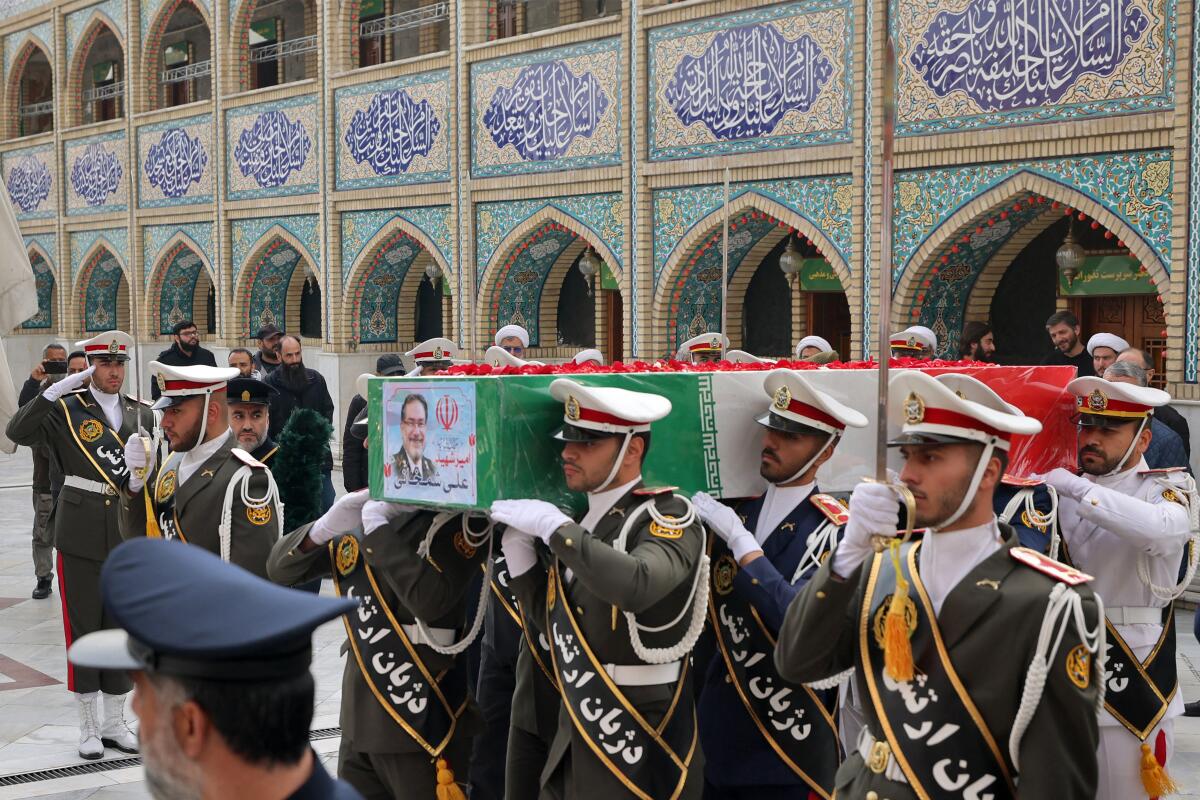
A military procession in Tehran carries the casket of Ali Shamkhani, political advisor to Iran’s last Supreme Leader Ayatollah Ali Khamenei, who was also killed in U.S.-Israeli attacks.
(Atta Kenare / AFP/Getty Images)
Concern has only grown that Iran’s new government will make the fateful strategic decision to build a bomb after the war, unless Trump decides to escalate the conflict with a perilous ground invasion. And the White House now contends with a new mission imperative, created by its decision to launch the war itself, of reopening the Strait of Hormuz to vital shipping traffic that carries 20% of the world’s daily oil and liquid natural gas supply.
The foreign policy strategy Trump publicly laid out as his playbook for the conflict — to come down hard on the government, decapitating its leadership, and hope the remnants would seek mercy — has not worked, with Tehran looking for new ways to expand the war and maximize pain for the U.S. administration.
Trump has minimized the conflict as an “excursion” that would end “very soon,” while also calling it a war, vowing to take the time he needs to “finish the job.” He says it will conclude whenever he decides to end it.
It remains possible that a declaration from Trump that the fighting is over results in a ceasefire, as it did in June of last year, when Trump demanded an end to 12 days of war between Iran and Israel. But the Iranians have a vote, too — and senior leadership in the Islamic Republic have made plain they plan to continue fighting this time whether Trump likes it or not.
On Friday, the Pentagon announced that an additional expeditionary unit of 2,500 Marines was being deployed to the region to support the effort.
“Starting wars is an easy matter,” Ali Larijani, secretary of Iran’s Supreme National Security Council, wrote on social media. “Ending them does not happen with a few tweets.
“We will not leave you until you admit your mistake and pay its price,” he added.
It is a sore lesson for a president whose decade in public life has been distinguished by an exceptional ability to warp reality to his liking.
“The White House has created a dilemma for America: If it declares victory and ends the war, it leaves in place a weakened Iranian government with the means and renewed motivation to pursue nuclear weapons,” said Reid Pauly, a professor of nuclear security and policy at Brown University.
“If it presses on with the war,” Pauly added, “it risks the kind of mission creep that may eventually find American boots on the ground.”
In a news release last week, the White House said that, “from the opening hours of this historic campaign, the objectives were clear: obliterate Iran’s ballistic missile arsenal and production capacity, annihilate its navy, sever its support for terrorist proxies, and ensure the world’s leading state sponsor of terrorism will never acquire a nuclear weapon.”
Yet, at the start of the operation, Trump issued a promise to the people of Iran that, at the end of the U.S.-Israeli campaign, Iran’s military and paramilitary infrastructure would be so badly hobbled that a rare, generational opportunity would emerge for them to take their government back.
“To the great proud people of Iran, I say tonight that the hour of your freedom is at hand,” Trump said. “Stay sheltered. Don’t leave your home. It’s very dangerous outside. Bombs will be dropping everywhere. When we are finished, take over your government. It will be yours to take. This will be probably your only chance for generations.”
Trump said in the days that followed he would need to have a say over the next ruler, after assassinating the country’s longtime supreme leader, Ayatollah Ali Khamenei. But the Iranian system of clerics and militants defied the president, selecting in Khamenei’s son a man viewed as even more hostile to the West than his father was.
Israeli leadership, too, set out regime change as a goal of the war. Yet even their officials now say that a substantial leadership change in Tehran is an unlikely result.
Trump would go on to insist on the “unconditional surrender” from the Iranian government, a demand that he later said would be satisfied by the incapacitation of Iran’s military.
Repeating his conviction that the war will end soon, Trump told Fox News’ Brian Kilmeade in an interview Friday that he would order an end to the fighting “when I feel it. When I feel it in my bones.”
“The problem with the administration’s approach is that it has constantly shifted its goals. Some are achievable, such as degrading Iran’s conventional force. Others are not, such as picking the next leader of Iran,” said Ray Takeyh, a scholar on Iran at the Council on Foreign Relations.
“The mixed messages have led to confusion at home,” Takeyh added, “and lack of planning for oil shortages and getting the Americans out of the region shows that process and personnel can actually matter.”
Mark Dubowitz, CEO of the Foundation for Defense of Democracies, said the joint U.S.-Israeli campaign was always designed to unfold in three phases: degrading Iran’s ability to wage war, reducing Iran’s ability to repress democratic forces inside the country, and finally, encouraging the Iranian people to rise up.
“The president controls the strategy, but no president fully controls the endgame because the regime gets a vote,” Dubowitz said. “The endgame is not a scripted political transition directed from Washington. It is a regime under simultaneous military, economic, and internal pressure — to strip of its war-making and repression capabilities — and whether that produces succession, fracture, or collapse will ultimately be decided in Tehran.”
Whether the conflict will achieve the destruction of Iran’s nuclear program is an equally grave question in Washington, where officials are debating over a list of stark options on how to physically destroy, bury or retrieve the fissile material that Tehran could use to build a nuclear weapon — a threat seen as only more grave under the stewardship of an angry and vengeful government.
“The war was publicly justified, to the extent it was justified at all, in terms of destroying Iran’s nuclear program. Very few strikes have been directed against nuclear-related targets, however — almost certainly because those that survived last June’s attacks are invulnerable to air attack,” said James Acton, co‑director of the nuclear policy program at the Carnegie Endowment for International Peace.
“Unless the U.S. and Israel attempt high-risk special forces operations or a ground incursion,” he added, “Iran will end the war with its surviving nuclear infrastructure largely intact and greater incentives to build the bomb.”
Pauly agreed it is unrealistic to expect the United States and Israel can destroy Iran’s nuclear program through air power alone. The U.N. International Atomic Energy Agency believes Iran has roughly 440 kilograms — about 970 pounds — of 60% highly enriched uranium, possibly spread across multiple facilities.
“Securing this material will require either U.S. ground troops or, after some coercive bargain is reached, international inspectors,” Pauly said.
In an exchange with reporters last week at the Pentagon, Defense Secretary Pete Hegseth had few details to offer on what U.S. options were to remove or eliminate an accessible uranium stockpile, enriched to near weapons grade, that had been buried in a U.S. operation last year intended on obliterating the nuclear threat.
Diplomacy, he suggested, might be required to secure the material.
“I will say we have a range of options, up to and including Iran deciding that they will give those up,” he told reporters, “which of course we would welcome.”