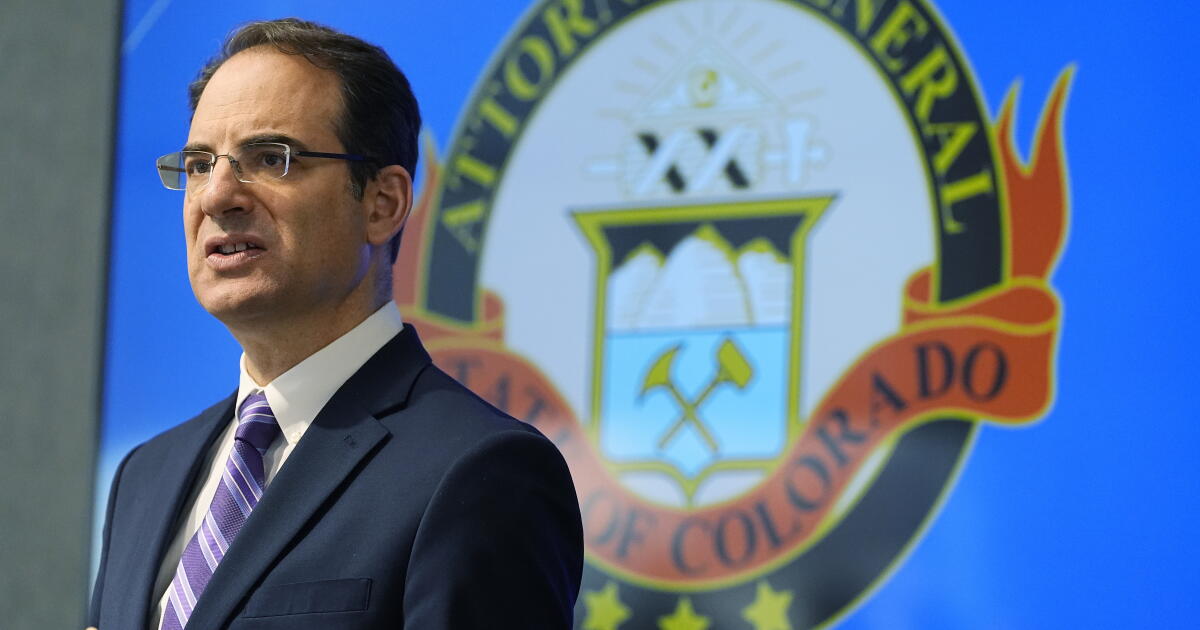
DENVER — The office of Colorado’s attorney general is a perch 10 stories above downtown Denver. From his aerie, Phil Weiser has a sweeping view of the city skyline, the gold-domed Capitol and, occasionally, a red hawk on the wing.
But looking toward November, Weiser sees something darker.
“With this administration what we have seen is it’s important that we not limit our imagination to what … type of harm could happen,” Weiser said during a sunny noon hour in the Mile High City.
For that reason, Colorado’s attorney general and his Democratic peers around the country have spent more than a year strategizing — by phone, via Zoom, sometimes in person — on ways to Trump-proof the midterm election.
They’ve researched history and the law, war-gamed what-ifs, divvied up responsibilities and drafted emergency lawsuits and temporary restraining orders so they can be hurried into court at a moment’s notice.
“We have prepared for a range of contingencies … so that we’re ready to act,” Weiser said.
“We’re not going to be reacting in real time” or pulling all-nighters, he added. “We are going to be following through on plans we’ve made, having looked at what’s possible.”
The efforts of Weiser, California’s Rob Bonta and more than 20 other Democratic attorneys general are part of a mass mobilization aimed at thwarting Trump’s unprecedented efforts to pervert and subvert November’s midterm balloting.
It’s remarkable that kind of man-the-barricades action is needed to preserve and protect the voting franchise in this, the land of the free and home of the brave. But having weighed the threats, Weiser said his greatest fear of election interference comes not from a bad overseas actor or some terrorist group, but rather our own federal government “and what this administration might do.”
So here we are.
To fend off that threat from within, state Democratic parties across the nation are aiming to recruit 10,000 volunteers to guard polling places in the event armed federal agents show up.
Various sponsors have launched education campaigns to explain election rules and offer hotlines for voters who have trouble casting their ballot.
Civil rights groups and democracy-defending organizations have staged their own tabletop exercises brainstorming and rehearsing various scenarios. A group of Democratic U.S. senators has done the same.
“What we’re doing is preparing for the fact that Donald Trump, in 2020, lied about the election in advance, lied about it in the aftermath, went to court … and then he instigated a violent insurrection in this very building,” Marc Elias, a Democratic elections attorney, told MS NOW in a July interview at the Capitol. “So I think we need to take these threats in the 2026 midterm run-up … both seriously and literally.”
In a more courageous, less heedlessly partisan world, Republicans would be working with Democrats to keep the power-drunk Trump in check. (The House and Senate supposedly comprise a separate and equal branch of government, with its own power, prerogatives and such.)
But, as Weiser noted, this Republican-led Congress “has been lacking in backbone, lacking in the role of checks and balances. That has left it to state attorneys general to fill that vacuum, going to court and essentially playing the role of a check on a lawless and often bullying president.”
The nation’s 24 Democratic attorneys general have filed more than 125 lawsuits in Trump’s second term alone, fighting his moves on trade and tariffs, energy and immigration policies and efforts to gut or eliminate programs and whole government agencies. They’ve prevailed in the overwhelming majority of cases that have been adjudicated or settled.
Even before Trump was elected again, some attorneys general began conferring on ways to fight the excesses they anticipated in a second administration. Anyone who didn’t see them coming wasn’t paying attention, said Weiser, who, most likely, will be elected Colorado’s next governor on Nov. 3.
(His victory in Colorado’s Democratic primary stemmed in good part from Weiser’s record battling Trump in court.)
Trump is constitutionally (small “c”) incapable of acknowledging the result of any election he didn’t win. He’s openly urged supporters to “cheat like hell.” Thus, one can only assume malign intent when the president tries to wantonly purge voter rolls, hijack the U.S. Postal service to gum up mail balloting and override the Constitution (capital “c”) by federalizing November’s election.
Some might call such fears melodramatic, or overblown.
Trump’s refusal to accept the outcome of elections “is historic,” the attorney general said. “It is unique. It’s a threat. And it’s why we have to stand our guard.”
Vote, to bring this rogue president to heel. Stay vigilant, to make sure that vote counts.
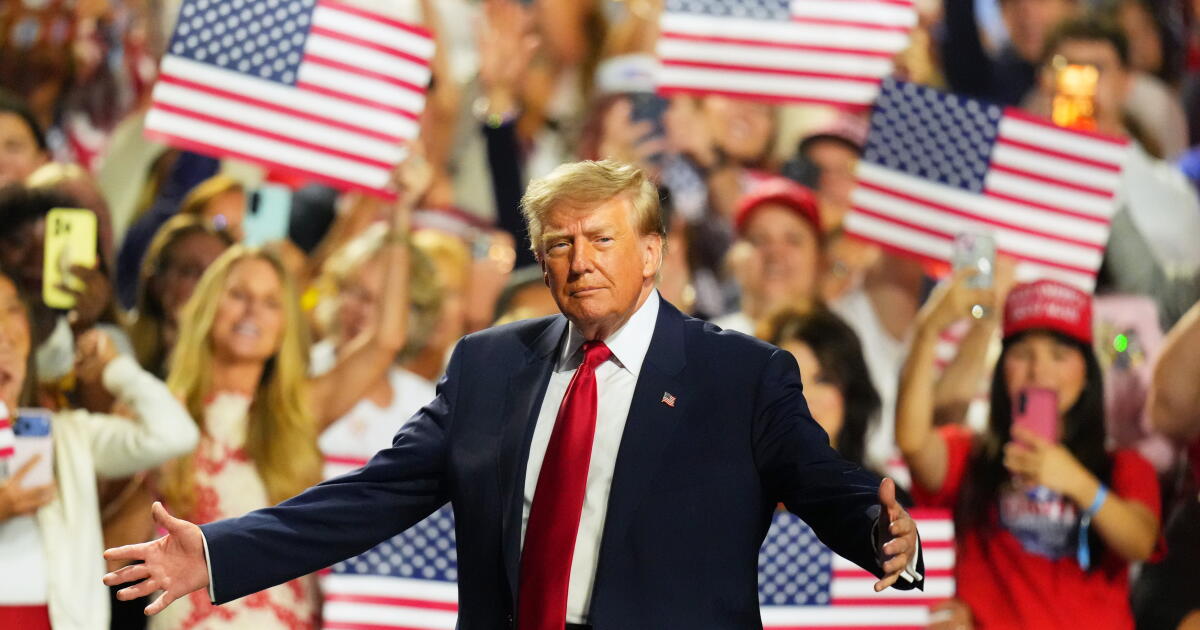
MONTGOMERY, Alabama — President Trump vowed to campaign in 35 of the most competitive battleground districts in the final sprint to November’s midterm elections.
Instead, he will begin October by stumping in Alabama and Oklahoma, two of the most Republican states in the nation. His events are sure to draw enthusiastic crowds of fans, but his choice of destinations is a reminder of his deep unpopularity in much of the country during a campaign season he’s sought to make all about himself.
Trump will hold rallies Thursday in Durant, Okla., and Friday in Mobile, Ala., where he is sure to draw crowds, but also has raised eyebrows.
While organizers insist the rallies are in locations with media markets that span state lines and they will help bolster broader turnout, Trump’s itinerary is yet another sign of the uphill fight that his party faces. Republicans already have been pouring money into red states once considered safe as they try to shore up candidates facing an unhappy electorate that has soured on Trump and his polices.
Some Republicans also have been distancing themselves from the president in recent weeks as they try to appeal to voters beyond Trump’s “Make America Great Again” base. They’ve removed or downplayed references to the president on their websites and increasingly voiced opposition to his unpopular war with Iran.
But Trump’s events next week are likely to deliver something he craves: adoring crowds. He is almost guaranteed to fill the venues with the kind of die-hard supporters who fueled his political rise, projecting excitement as he tries to bolster enthusiasm and rally Republicans.
“The President’s ability to engage with and activate low-propensity voters is unmatched. That’s why he’ll be barnstorming the country to activate the voters we need to win in November,” Republican National Committee spokesperson Natalie Baldassarre said, promising more October rallies.
Democrats, meanwhile, celebrated the announcement. “The political floor is falling out from underneath Trump and Congressional Republicans, forcing them to scramble to spend and campaign in deep red territory in the final weeks,” said Viet Shelton, spokesperson for the Democratic Congressional Campaign Committee.
The RNC noted that Durant is on the Texas border and next to the Dallas-Fort Worth media market and will draw Republicans in Texas, which has emerged as one of the most critical states on the map. Scandal-plagued Atty. Gen. Ken Paxton, whom Trump backed over incumbent Sen. John Cornyn, is locked in a tight race against Democrat James Talarico. Gov. Greg Abbott also is facing a stronger-than-expected challenger in Democrat Gina Hinojosa.
Mobile is next to Florida’s panhandle, a Republican stronghold where high turnout can help bolster Trump-backed candidates running for Senate and governor. However, Florida Republican Sen. Ashley Moody is not expected to attend.
In Oklahoma, Trump will be stumping for Mike Mazzei, whom he backed as the Republican nominee for governor during a competitive primary. Mazzei is running against Oklahoma’s Democratic House Minority Leader Cyndi Munson.
“This race continues to get more competitive — and national Republicans are right to be worried about Mazzei,” Democratic Governors Assn. spokesperson Kevin Donohoe said in a statement.
Alabama, meanwhile, holds deep nostalgia for Trump and his early supporters. He held his first mega-rally in Mobile more a decade ago, drawing some 30,000 people to a college football stadium. The crowd made clear to skeptics of his campaign that he was more than a celebrity novelty.
“It’s very natural that he would host a rally here as he is gearing up for the midterm elections,” said John Wahl, the Republican candidate for lieutenant governor and former chair of the Alabama Republican Party.
Although Republicans remain the heavy favorites in Alabama’s statewide campaigns, they face a more challenging political landscape.
Former Democratic Sen. Doug Jones is mounting a vigorous campaign for Alabama governor against one of Trump’s most vocal allies, Republican Sen. Tommy Tuberville, who welcomed the president’s visit.
Republican Rep. Barry Moore, running to replace Tuberville in the Senate with Trump’s backing, said the president’s rally “will be the jet fuel we need to win big in Alabama.”
Mobile is also near Alabama’s 2nd Congressional District, which leans red after its lines were redrawn but is not a slam dunk for Republicans as they try to dislodge Democratic Rep. Shomari Figures.
Figures has been criticizing the president’s plan to lower import tariffs on foreign beef in an appeal to cattle ranchers as he tries to fend off a challenge from his Trump-backed opponent, State Rep. Rhett Marques.
Trump has promised to ramp up his campaigning in the election’s final stretch and had said he would visit all of the most competitive districts .
“It’s all about 35 races,” he said at a recent Rose Garden dinner attended by Republican lawmakers. “I’m going to go to every one of those 35 places and we’re going to see if we can get everyone elected.”
Colvin and Chandler write for the Associated Press. Colvin reported from New York. AP reporter Bill Barrow in Atlanta contributed to this report.
SACRAMENTO — As Californians prepare to elect a new governor in November, the concern they want to be his top priority is reducing the state’s entrenched high cost of living, according to a poll by the UC Berkeley Institute of Governmental Studies and co-sponsored by the Los Angeles Times.
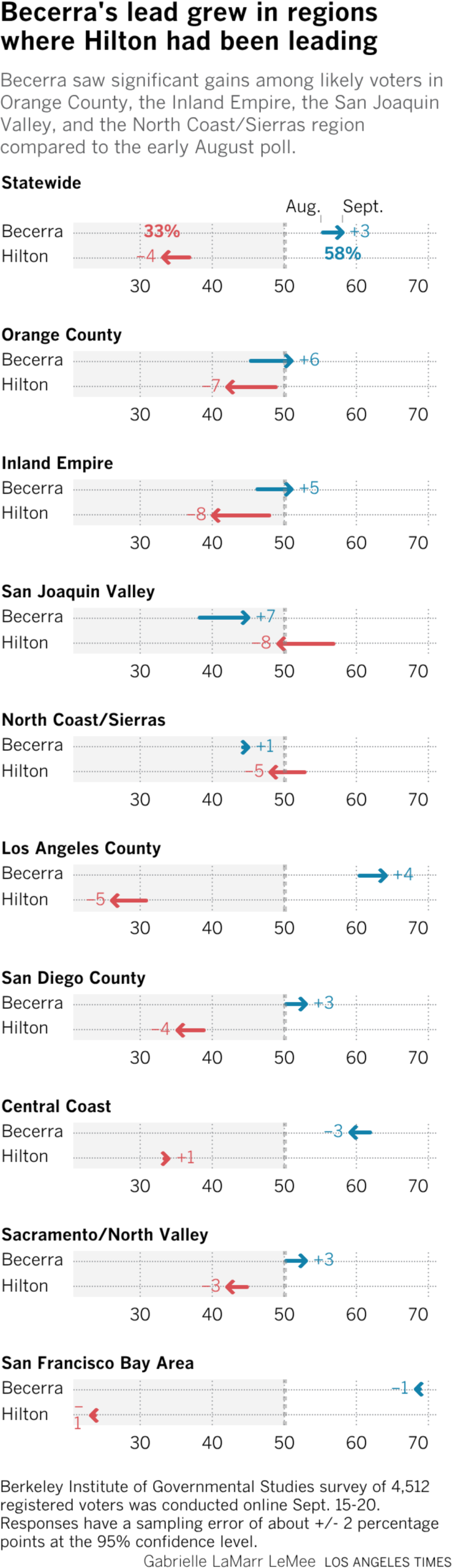
Not too far behind that is strong voter support for fighting the policies of the Trump administration. That may be among the many reasons 58% of likely voters surveyed support Democrat Xavier Becerra in the governor’s race compared to the 33% who back Republican Steve Hilton, whom the president endorsed.
“These results suggest that Becerra is in a commanding position heading to November,” said IGS co-director Eric Schickler. “With 2026 shaping up to be a strong Democratic year nationally, the headwinds facing Hilton in Democratic-leaning California are even stronger than usual.”
The poll found that Becerra’s lead over Hilton had increased slightly since an August IGS poll, and the Democrat now holds a 25-percentage-point advantage.
Despite an effort to reach out to Democrats and independent voters and making California’s high housing costs, top-in-the-nation gasoline prices and other increasing daily living expenses a central focus of his campaign, Hilton is struggling to gain ground in the race to replace Gov. Gavin Newsom, the poll found.
“The difficult thing is that Steve Hilton’s a Republican in California,” said Tim Rosales, a Republican strategist who previously advised GOP gubernatorial candidate John Cox in the 2018 race against Newsom. “On the scale of what’s more important to voters, the cost of living certainly is there, but those Democrats really aren’t willing to cast a vote or cross party lines to vote for a Republican.”
Asked to name one or two of their top concerns heading into the Nov. 3 election, 44% of likely voters cited the cost of living, 37% said it was important to push back against policies from the Trump administration and 30% said they wanted to help their political party win or maintain control of Congress.
“The November elections are being held at a time when the economic backdrop is worsening not only in California but across the nation, as prices are rising on most major household purchases, including groceries, gasoline, electricity and healthcare,” said IGS poll director Mark DiCamillo. “Pocketbook issues have traditionally played a big role in election politics and this year is no exception.”
“Independent voters are a little bit different. They aren’t partisan but they are ideological and there is some opportunity there.” But Hilton would “need a whole lot of them in California in order to have a chance on a statewide level,” he said.
More than half of likely voters not registered with either the Democratic or Republican parties — most of whom declare themselves as “no party preference” — said they supported Becerra in the governor’s race, while 30% favored Hilton. The remaining 14% were undecided.
Hilton has made a slew of campaign promises to lower the cost of living, including $3 gasoline, no taxes on income below $150,000 and lowering energy bills by slashing climate-friendly regulations imposed by Democrats.
Both Rosales and DiCamillo agreed that while voters list affordability as a top issue, Democrats in particular are more motivated by the opportunity to push back on President Trump in the midterm elections.
“When you look at the Becerra voters on the issues or concerns that are important to them, it’s really framed by fighting Trump administration policies. I think that’s an indication of what’s happening in this election cycle,” DiCamillo said. “You’re seeing it across the country as well.”
The poll showed that 59% of Becerra supporters said fighting the Trump administration was a top priority, while 62% of Hilton supporters said reducing taxes was their main concern. More than 60% of undecided voters listed the cost of living as a top item.
Trump, who remains extremely unpopular among most Californians, endorsed Hilton for governor in April. Though the president’s backing helped the former Fox News host consolidate enough Republican support to finish second in the June primary, allowing him to advance to the November election, it may hurt his chance in the general election. A recent Public Policy Institute of California poll showed Trump with a 27% approval rating in the state, a record low across both of his terms.
Hilton has tried to court voters, especially Latinos and independents, who dislike Trump but are also dissatisfied with California’s Democratic leadership and its failure to alleviate some of California’s most incessant problems. The British-born Republican has also declined to criticize the president on issues including immigration enforcement or the Iran war.
Becerra’s wide lead is also boosted by his favorability rating — 48% of likely voters have a favorable opinion of him while 40% view him unfavorably and 11% have no opinion. Hilton’s rating is underwater; 51% of likely voters have an unfavorable opinion compared to 35% favorable and 13% with no opinion.
The Republican has criticized his opponent for doing few public events since the primary election and challenged Becerra to accept debate invitations from roughly a half-dozen news outlets around the state.
The poll was conducted online in English and Spanish from Sept. 15 to 20. Responses for the governor’s race poll came from a weighted sample of 4,512 respondents considered likely to vote in the November election, from a larger group of 6,989 registered voters throughout California. It has a margin of error of 2 percentage points in either direction.
With SWIFT’s ISO 20022 compliance deadline looming in November, several banks are behind schedule.
This article appears in the September 2026 issue of Global Finance Magazine.
Cross-border payments are approaching a hard deadline in November, when SWIFT stops accepting unstructured address data under ISO 20022. The global messaging standard that replaced the old SWIFT MT format, ISO 20022 was designed to give every country’s banks a common baseline, and November’s structured-address requirement is the next phase of that migration.
SWIFT data from April showed that 61.2% of payments still carried unstructured debtor addresses, and 62.9% unstructured creditor data. This matters; once fully unstructured addresses are removed, noncompliant payments risk rejection or delay, with no fallback transition layer for missing address data.
A March survey of senior payments professionals across Europe and North America by RedCompass Labs found that 44% of banks were behind schedule on readiness for SWIFT’s removal of unstructured addresses. Pratiksha Pathak, RedCompass senior vice president and head of payments, attributed that figure to years of treating the wider ISO 20022 migration as a message-format exercise rather than the data quality overhaul it was always meant to be.
Scale and Legacy Hurdles
Anxiety about readiness was clear but uneven, with 20% of the very largest banks deeming the deadline “unrealistic,” compared with 5% of smaller banks, indicating that scale and legacy systems are part of the problem. This was not for lack of trying; most banks are spending around $20 million on the requirements, with larger institutions spending over $30 million.
Bank readiness has shifted since March, Pathak noted. Some trailblazers have rolled out “brilliant” programs, she said, while laggards still hope SWIFT will push back the clock. That won’t happen, Pathak said: “They’re not moving the deadline.”
Lloyds is among the banks that recognized the central issue early, building its solutions around structured data from the outset. API-based channels natively support the required fields, backed by validation controls and proactive client outreach, including a ramp-up in dedicated resources as November approaches.
“The biggest challenge isn’t usually the payment message itself,” said Surath Sengupta, head of transaction banking products at Lloyds. “It’s the readiness of the underlying data. Many organizations already hold most of the required information, but it’s often stored inconsistently across ERP and treasury systems.”
Early movers aren’t aiming just to meet the deadline, he said. They are positioning themselves to capture the broader gains from automation that follow, “from increasing automation and reducing friction to laying the foundations for the next generation of cross-border payments.”
Industry estimates suggest that 5% to 10% of payments currently generate sanctions screening alerts requiring manual review, a friction that richer structured data should directly ease.
‘Beyond’ ISO 20022 Compliance
Not every treasurer is equally confident in the guidance they receive, however. Some have faced practical challenges with the availability of detailed technical specifications and implementation guidance from banking partners, said Marianna Polykrati, group treasurer at aquaculture producer Avramar: “Many corporates are still waiting for this information.”
Ownership of payment process and master data varies across organizations. At Avramar, treasury and accounts payable share the responsibility, making close collaboration essential.
“Our preparation goes well beyond generating ISO 20022 XML files,” said Polykrati. “We see this as a data quality and process transformation project. As we prepare for an ERP migration by the end of the year, we are using this opportunity to clean up master data, standardize payment workflows, and strengthen governance. Rather than treating ISO 20022 and the ERP implementation as separate initiatives, we see them as complementary projects.”
While compliance may be the starting point, “operational improvement is where the real value is created,” she said, echoing Pathak and Sengupta’s views. With just two months to go, the real test may not be whether the deadline holds, but how many organizations have treated it as an opportunity for long-term gains rather than a burdensome medium-term obligation.
Deborah Ritchie is a contributing writer based in the U.K.
They “are feeling very pessimistic,” said Mark Baldassare, PPIC’s statewide survey director. “You know that comes out not just in the questions we ask about the economy, but generally about the direction of the state and the nation. This just indicates the level of negativity that people have going into this final stage before people cast their ballots this November.”
More than half of the state’s likely voters believe that California is headed in the wrong direction, and 73% predict sour economic times in the state next year. Less than a quarter of likely voters believe the nation is headed in the right direction.
President Trump has an approval rating of 27% of likely voters, but that’s better than Congress, which has a 16% approval rating. Majorities do not have confidence in either major political party’s ability to solve problems.
Ballots will begin arriving in 23.2 million voters’ mailboxes in a little over two weeks. Nearly 80% of likely voters are frustrated by the length of the ballot, which includes 14 propositions as well as statewide, congressional and local elections. This a rare consensus among Democratic, Republican and independent voters.
“This year, there are more propositions on the ballot than we’ve seen for a decade,” Baldassare said. “Overwhelming majorities of Californians say that there are too many propositions on the ballot, too many things for them to decide. And many Californians feel that the wording of ballot initiatives makes it very hard for them to understand what happens if one passes.”
The proposal to tax the assets of billionaires to make up for federal government healthcare cuts, Proposition 40, has a slim lead in the poll, with 52% of likely voters saying they support the one-time 5% levy.
However, there are two ballot measures, Propositions 41 and 42, that would nullify the wealth tax if one is approved and gets more votes than Proposition 40. Narrow majorities support both of these proposals, creating a quandary for wealth tax supporters: ensuring their proposal receives the support of a majority of voters while also tamping down support for the competing efforts.
Findings about the proposal to require showing government-issued identification to vote and the governor’s race show less competitive contests that break along predictable partisan lines in a state where registered Democratic voters outnumber Republicans nearly 2 to 1.
The voter ID measure is opposed by 55% of likely voters. In the race to succeed termed-out Gov. Gavin Newsom, 60% of likely voters support Democrat Xavier Becerra, and 38% support Republican Steve Hilton. The other 2% were undecided or do not plan to vote on the race.
The poll of 1,745 adult Californians was conducted Sept. 4-10, and has a margin of error of about 3 percentage points in either direction, and 3.8 percentage points among the 1,103 likely voters.
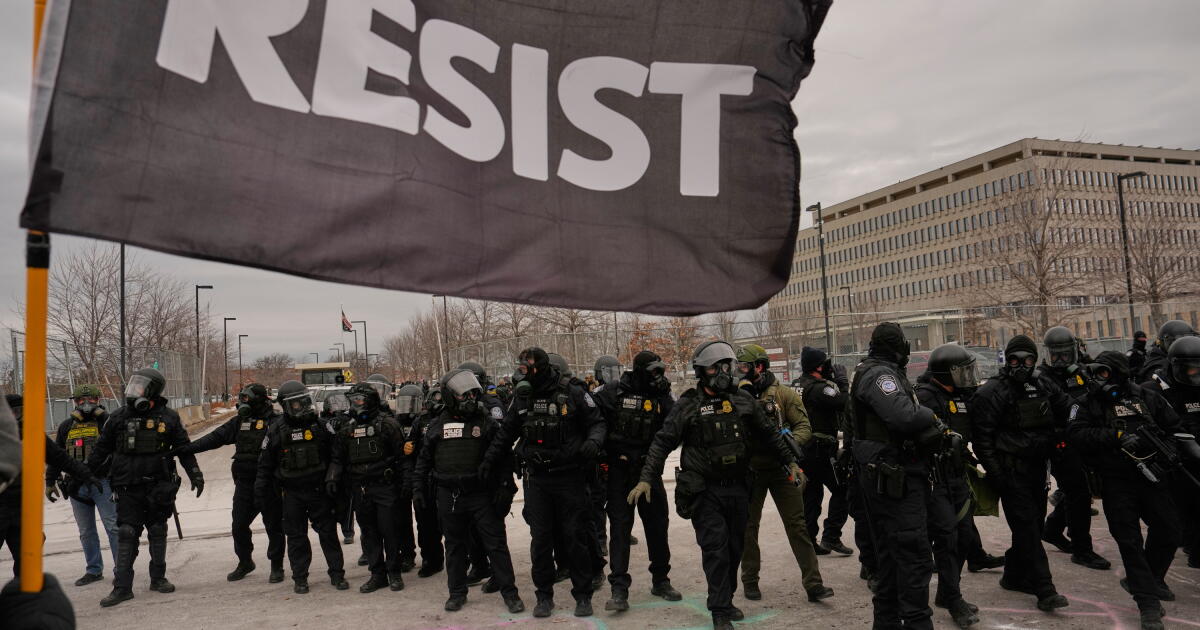
Democratic state parties announced Monday that they are launching an operation for the midterm elections they’re calling the “New Battlefield Project,” intended to recruit 10,000 volunteers to guard polling places in case armed federal officers show up.
Activists are planning mass protests if the Trump administration tries to interfere with voting or ballot counting. And legal scholars are distributing white papers advising judges what they should do if the government tries to seize ballots.
The unprecedented efforts are in response to President Trump’s equally unprecedented moves to interfere in this year’s midterm elections, which include attempts to impose proof-of-citizenship requirements to register to vote and directing the Postal Service to play a central role in deciding which voters should get a mail ballot.
The anxious contingency planning as voting gets underway has become a marker for how fraught democracy has become in the country that once stood as an example to the world.
“We have never prepared for an election sabotage event like we have now,” said Ezra Levin of the left-leaning group Indivisible.
Trump has given Democrats plenty of reasons to organize a resistance
Democrats say they have reason to plan for doomsday scenarios. During his first term, Trump refused to accept his 2020 loss to Democrat Joe Biden and attempted to overturn the vote, only to be defied by career officials and more establishment Republicans. Upon returning to power, Trump has stocked his administration with those who helped his 2020 efforts, has used the federal government to target his political enemies and pardoned more than 1,000 people prosecuted for the Jan. 6, 2021, attack on the U.S. Capitol that was intended to halt the certification of Biden’s win.
Incumbent presidents’ parties usually lose ground in the midterms, but Trump has pulled out the stops to try to keep that from happening this time. He’s demanded Republicans redraw maps to create more safe seats for themselves in the House of Representatives, held last week’s unusual midterm convention and tried to change election rules even as states begin to send out ballots.
The advice for judges asked to approve search warrants for ballots, for example, was inspired by the Trump administration’s seizure of 2020 ballots and other election records in Fulton County, Georgia, which includes Atlanta, based on old, disproven conspiracy theories.
Rick Hasen, a UCLA Law professor and director of the school’s Safeguarding Democracy Project, noted that Trump has expressed regret that he didn’t take more aggressive action to overturn the 2020 results, such as ordering voting machines to be seized.
“All these things take what was off the wall and put it on the wall,” Hasen said. He said that while it is important not to unduly scare voters about what might happen, it’s “hard to walk the line between alarmism and complacency.”
Trump’s actions worry Democrats. Administration calls them common sense
Last year, Democrats worried that Trump might intervene in off-year elections in California, Virginia and elsewhere, only to have voting go smoothly with no clashes with the federal government.
“The only ‘fears’ Americans have about our elections are being fueled by extreme liberal Democrats who refuse to support commonsense legislation that ensures Americans, and Americans only, decide our elections and other basic election security measures like Voter ID,” White House spokeswoman Lauren Blis said in a statement.
Still, the stakes are far higher in the midterms, which will determine whether Republicans continue to control both houses of Congress. So far Trump has been unable to change voting procedures before the midterms.
Courts halted Trump’s first attempt to reshape election rules via executive order last year. The president backed a bill in Congress to make even more sweeping changes but it’s stalled in the Senate because of opposition from Democrats and some Republicans.
Then Trump tried to limit mail voting by executive order, but the courts again blocked it, saying the changes couldn’t happen before the midterms. That case is before the Supreme Court. Election officials warn that it would be impossible to implement Trump’s requirements in time for this election.
Litigation about election rules has reached such a pitch that the National Bar Association last week announced an initiative to help voters of both parties understand last-minute election rule changes and to create a hotline for those who encounter trouble casting ballots.
Concerns that polling places will become targets for immigration agents
Every election, the two major parties mobilize massive operations of attorneys, staffers and volunteers to monitor polling places and ballot counting. The Republican National Committee said it’s already recruited a record number of poll watchers.
“The RNC has spent this entire cycle preparing not just to defy history in November, but to protect it,” spokeswoman Ally Triolo said. “We’ve built the largest election integrity operation in Republican Party history because our mission is simple: secure every legal vote and ensure Americans can trust the outcome of our elections.”
Democrats also have expanded their operations, and the Association of State Democratic Parties is adding to that effort with its “battlefield” recruitment project. That also will include a network to share information about online threats and manipulation, said Jane Kleeb, the chair of the group and of the Nebraska Democratic Party.
“If they’re saying they’re going to put armed people outside polling places, we should put friendly people outside polling locations to film them,” Kleeb said in an interview. “There’s a whole new battlefield we have now.”
Kleeb was referring to widespread fears among Democrats that U.S. Immigration and Customs Enforcement officers will be deployed to the polls, something that multiple administration officials for months have denied will happen. There have been scattered instances of ICE officers at polling places over the past year, usually saying they’re in pursuit of or investigating a specific person. Homeland Security Secretary Markwayne Mullin said this month it’s possible that could happen again in November.
In an indication of the distrust of the administration’s reassurances, civil rights groups and the city of Denver last week filed a lawsuit asking a federal judge to formally bar ICE from polling places. They cited a law dating to the Civil War era prohibiting armed federal agents at election sites.
“This administration is basically using the rhetoric that undocumented citizens are voting and that they’re going to have DHS and ICE at the polls to try and intimidate and suppress the Latino vote,” said Juan Proaño, CEO of the League of United Latin American Citizens, one of the plaintiffs.
Activists see Minneapolis immigration protests as a midterms model
A staple of the election buildup is a series of tabletop exercises in which each side runs hypothetical scenarios to practice its response. As part of that, Democrats and civil rights groups are rehearsing for the possible deployment of ICE agents or the National Guard to polling sites, although the Pentagon has said it has no plans to deploy troops to the polls.
Levin, of Indivisible, said his group has run 17 different scenarios preparing for what could happen in November. But the first priority, he said, is to boost turnout.
The No Kings network, which has spearheaded large anti-Trump protests over the president’s second term and includes Indivisible, is launching a campaign encouraging early voting that will peak with rallies Oct. 17.
Others are organizing among both left-wing and more traditional groups to push back if the administration is aggressive in November. Some look to the anti-ICE protests in Minneapolis as a possible model.
Two activists were shot and killed by ICE agents during those January demonstrations, and the administration eventually backed off the aggressive crackdown the president had launched against the city.
“We recognize there might be a similar moment in November, where Trump attempts to do that again, where everyday working people and students need to band together and say, ‘Actually, no, this is our country, you don’t get to decide who gets elected or who gets to take office,’” said Kidus Girma of the left-wing Sunrise Movement.
Riccardi and Brown write for the Associated Press.
Within a few short months, he will be termed out of office and return to being a regular citizen, if not an average one. Newsom’s presidential ambitions are stronger than ever, and there’s virtually no list of Democratic hopefuls that doesn’t include his name near the top.
But 2028 is a long way away, about a millennium in political time. Newsom has a tough road ahead to not just stay relevant, but also to forge a difficult path between keeping a national profile as a Trump-attacking defender of democracy and not getting pummeled (or worse, ignored) when he loses the safety and power of his elected office.
Our columnists Anita Chabria and Mark Z. Barabak take a look at what the next few months, and the next year, may have in store after the governor becomes simply Mr. Newsom.
Chabria: Newsom is making the most of his last leg in office. Recently, he went on an election jaunt through the South, visiting the Carolinas and Alabama to help campaign and raise money in those states.
It is not his first out-of-state trip to lend a hand in campaigns, but likely one of his last as governor. He wouldn’t be the first elected official to have a gap year (or years) before being elected to the Oval Office — Ronald Reagan had more than five years off between being governor of California and winning the presidency — but it’s definitely a disadvantage.
How much do you think being out of office hurts Newsom?
Barabak: Loyal readers of this column — thanks, we appreciate both of you! — know I’ve long looked askance at our gallivanting governor and his extracurricular, eyes-on-2028 activities. I understand that preening and politicking is way more fun and ego-enhancing than the minutiae of government in Sacramento. At the same time, I’m old-fashioned enough to think a person should do the job taxpayers are paying them to do.
But, as you note, that will be a moot point soon enough.
I’m not certain being out of office will be all that great a hindrance. In fact, I think it offers advantages, the main one being Newsom’s freedom to devote his full time and energies to running for president.
You mention Reagan; I don’t think it’s an accident he made two failed tries for the White House while serving in Sacramento. Pete Wilson also attempted the leap from the state Capitol to Washington, and failed badly.
It’s tough to do both.
As Dan Schnur, a former Wilson strategist, once put it, “There aren’t any direct flights from Sacramento to Manchester” — New Hampshire traditionally being home to the first primary — “and you can’t run the state from a cellphone at O’Hare” airport.
In a recent PBS interview, though, Newsom didn’t disavow some democratic socialist ideas, such as Medicare for all, pointing out that California has long had a powerful progressive faction and many of the ideas considered radical for the right are run of the mill here — and potentially popular across the country.
Newsom seems to be embracing some of those lefty stances, especially ones about affordability and opportunity. While affordability is going to be everyone’s platform, pairing it with big-swing policy like universal health insurance might appeal to voters tired of words without action.
We agree that no fellow Democrat is going to cede the $7-a-pound affordability argument to Newsom. But to offer some differentiation, many will doubtless portray him as being a bit too out there, especially when they start making the electability argument.
And that’s not to mention what awaits him if Newsom were to emerge as the Democratic nominee. (Fun fact: In 1988, it was a Democratic primary opponent, Al Gore, who first criticized Michael Dukakis over Massachusetts’ prison-furlough program. Republicans then seized upon the issue and used it as a bludgeon, to Dukakis’ great detriment, in the fall campaign.)
In a way, it’s interesting we’re even having this discussion about whether Newsom is too far left. There are parts of his record — his chummy ties to Silicon Valley, his light regulatory stance toward data centers, his making nice with the likes of Charlie Kirk and Steve Bannon, that make some Democrats question whether he’s too far right.
Chabria: It’s true that Newsom is more centrist than progressive, and equally true that most of America misses that point.
I think there is a version of the next election, though, where the Democratic Party has its own Tea Party moment, when a populist faction wanting social change carries power.
Everything we know about elections and electability really is up for grabs in this new age of technology and billionaire influence, and the vein of frustration within the rank-and-file of the Democratic Party is only growing stronger because of it. If Republicans do lose out in the midterms — and I am not convinced they will — it changes the calculation on everything, including how far left the average independent voter may swing in the face of an economically crushing oligarchy.
We need to safeguard elections, otherwise candidates don’t matter.
Barabak: We 100% agree on that. Candidates, and the campaigns they wage, matter only if elections are free and fairly conducted and all sides —looking at you, President Trump — acknowledge and abide by the outcome.
But midterm results are notoriously unreliable barometers of the presidential election that follows. To give just a few examples, Republicans walloped Democrats in the 1994 and 2010 midterm elections and yet Presidents Bill Clinton and Barack Obama each won reelection just two years later. In 2022, Democrats fared surprisingly well in the midterm election, and in 2024, well … you know what happened.
Chabria: I don’t think America has a past political moment that can be compared to this one. By nearly every independent measure, the United States is closer to an autocracy than we’ve ever been. We’ve lost the respect and trust of our allies, and a political party that has the support of only about 30% of citizens is reshaping our social and civic life under white nationalist principles.
We are in a high-stakes moment, and the next election won’t be a decision between Democrats and Republicans, but between democracy and something else. The sad truth is that in 2024, more Americans did not vote at all than voted for Trump. About 64% of eligible voters cast a ballot, and Trump received only 49.8% of those votes.
The next Democratic nominee can come with whatever message they want, but if Democrats don’t vote, their candidates don’t win. So for Newsom, or whoever the nominee is, the first victory may be the nomination — but the real test will be turning out the vote.
Barabak: It’s a long way — about a millennium, as you said — from here to November 2028. I agree, though, on the importance of not sitting out this or any election, for that matter. I recollect a button I once saw in a shop on Elm Street, the main drag through, yes, downtown Manchester! It read: “Didn’t vote? Don’t bitch.”
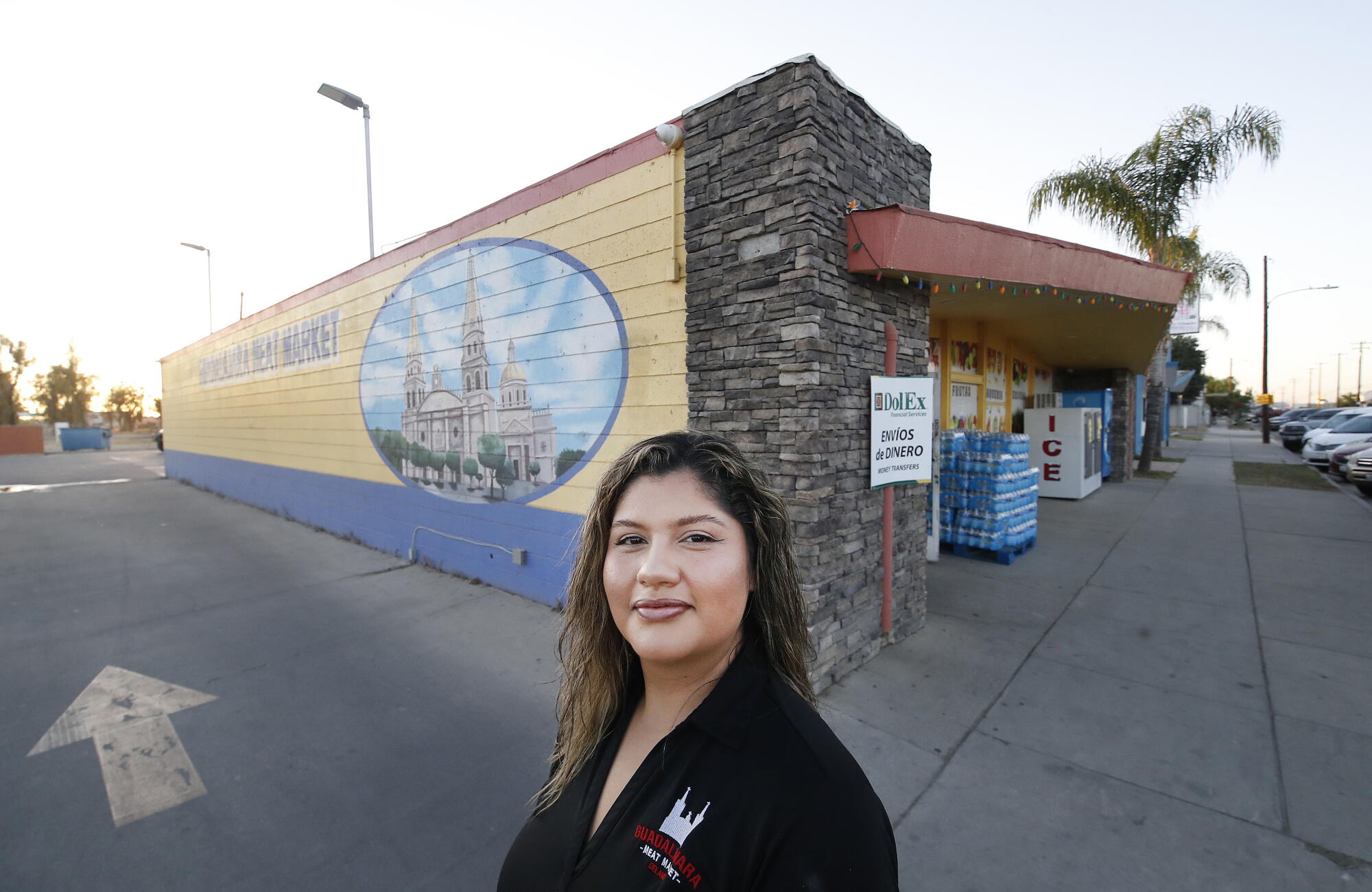
DELANO, Calif. — The rows of candies and nuts at the Guadalajara Meat Market — tamarindo con chile, seasoned pistachios, spicy paletas — sat mostly untouched as customers filtered through this carniceria in the late afternoon heat.
“You see a lot of people consuming the minimum, what they need to get by through the week,” said owner Carina Murillo, 31, as she checked out customers on a recent weekday. “Instead of buying six items, they’re buying three items.”
While customers bypass extras, like the snacks at the front counter, Murillo’s costs have gone up. Imported goods from Mexico and Canada have become more difficult to source and sometimes carry tariffs, she said. Transportation fees have risen as diesel prices respond to the war in Iran. The market’s insurance costs have risen by about a third. All of it has forced Murillo to increase prices.
“You see a lot of people consuming the minimum,” says Carina Murillo, owner of Guadalajara Meat Market. “Instead of buying six items, they’re buying three items.”
As the area struggles, Murillo, a college graduate who years ago felt motivated enough to door-knock for political causes, is among those who have become disillusioned. Those in Washington, she said, don’t understand the lives of the working people who keep the country running.
There have been “years where I feel completely overpowered to the point where I’m not motivated to take part,” said Murillo, who didn’t vote in 2024 but plans to do so in November. “That’s what happens when you feel discouraged or like nothing’s going to change.”
The economic strife plaguing Americans is clear in this rural, majority-Latino Central Valley congressional district, home to the state’smost competitive House race, the closely watched contest between Republican Rep. David Valadao and Democrat Randy Villegas.
Democrats hope the national economic angst will translate into big turnout in the midterm elections, but some in this region worry that years of financial struggle may depress voters’ desire to participate rather than motivate them.
Rep. David Valadao (R-Hanford) presides over a congressional hearing in March. The Republican is in a race against Democrat Randy Villegas that is considered a toss-up.
(Allison Robbert / Associated Press)
And Republicans, who rely on their party turnout beating that of Democrats in rural areas, also face the risk that frustration with the current political climate could dampen enthusiasm.
“Before they can think about Valadao, before Trump or Gavin Newsom or who’s going to run, families are concerned with the immediate: paying the rent, having the food on the table,” said Eliseo Gamiño, who heads the Central Valley Leadership Round Table, a coalition of Latino community leaders and elected officials. “You can’t be thinking about voting when your kids are hungry.”
Few voters who spoke to The Times in this swing district were decided on which party to support in November — or whether to vote at all. Such undecided voters will likely decide the election outcome, and persuading them is the key challenge for both parties as November nears.
Alexa Lopez sweeps up at closing time on a slower than usual Friday that saw one dress sold at Christina’s Fashion in Delano.
In a district that is the third-youngest in population in the country, the simmering uncertainty among Gen Z and millennial voters in particular could affect turnout or results.
Thirty-one percent of its voting-age population is 29 or younger, according to the Tufts University research center CIRCLE, which tracks youth civic engagement, making it among the top swath of House races in which young people could swing the outcome.
California’s swingiest district
The 22nd District, carved from the state’s agricultural epicenter, is one of fewer than two dozen toss-up races nationwide that will likely determine which party controls the U.S. House in the second half of President Trump’s current term. It is also among several high-stakes races nationwide that will test progressive candidates.
Valadao’s seat has long been considered a vulnerable one; Democrats added about 100,000 Fresno residents to the district under Proposition 50’s new map in a bid to help their chances. The boundaries include swaths of Kern, Kings and Tulare counties, along with a very small piece of Madera County.
“It’s going to be crucial in an area that is more purple, more bipartisan, where it’s very clear it can go either way … that these candidates make an effort to get those voters on their team,” said Brittany Martinez, a California-based Republican strategist.
Valadao, 49, who comes from a dairy farming family, is well known in the district and has repeatedly secured victory in close races, retaking the seat in 2020 after losing it in 2018’s blue wave. He saw a close race in 2022, then won by nearly seven percentage points in 2024, outperforming Trump.
His biggest vulnerability this time around may be his vote for the One Big Beautiful Bill Act, which included steep cuts to Medicaid. Local hospitals are bracing for funding cuts, though a carve-out may keep many valley residents from losing coverage. The district has the highest proportion of Medi-Cal recipients of any in the state, with 67% of residents enrolled as of 2025, according to the California Health Care Foundation.
Valadao spent part of the August recess touring the Central Valley for private meetings with local entities including a hospital, a housing program, a sawmill and a school district, and held a telephone town hall last week. Democrats have criticized him for not holding face-to-face voter events, including public town halls.
Democratic candidate Randy Villegas chats with residents during an August town hall in Hanford.
Villegas, 31, a professor and school board member who was endorsed by Sen. Bernie Sanders (I-Vt.) and is aligned with the Working Families Party, bested a Democrat backed by the party’s House campaign arm to win the nomination.
Villegas has banked on a more public-facing approach to win over swing voters — recently handing out popsicles from a pushcart he wheeled around a Labor Day event in Bakersfield, for instance — a strategy his campaign calls “going everywhere.” Republicans have criticized his record as too far left for the moderate district.
Both candidates have attempted to lean away from partisan narratives. Valadao rarely mentions Trump on social media and did not attend the president’s Republican convention in Dallas last week; Villegas has worked to frame the progressive issues he champions as an effort to help Central Valley voters rather than an ideology.
Trump carried the district as drawn now by less than 2 percentage points in 2024. Since then, residents say they have felt squeezed by housing, gas and grocery prices. The war in Iranhas pinched Central Valley farmers — already struggling withwater supply and other issues — by driving up fertilizer prices.
Ailyn Flores, center, picks up balloons for a party at Big Delano Discount store.
Tyler Stidham, 28, and her husband recently moved back to Lemoore from San José with their 1-year-old in order to live with family because they could no longer afford their own place.
“Rent got too high and having a family is expensive,” she said as the couple waited for their order from a food truck at the Hanford farmers market on a recent Thursday evening. They have cut out family trips and started meal-planning and budgeting to save money.
Stidham said she is planning to vote and hoping government leaders can make life more affordable. Her husband recalled a favorable impression of Valadao after once meeting him. Stidham isn’t sure who she’ll be casting her vote for.
“I haven’t done my research [yet],” she said.
Young voters said they felt frustrated waiting for a better economy that has yet to materialize.
“I feel like the government is playing in our face. I feel like everything is a show,” said Emma Woodward, 23, of Hanford.
The Sierra movie theater has closed down in Delano, Calif.
(Gary Kazanjian / For The Times)
A store manager at a coffee chain, Woodward bought a house last year to avoid throwing money at increasingly high rent payments, but it has been “hard to survive.” She got a roommate to help with costs, but the two of them sometimes find themselves using food drives for groceries. She has cut out “fun spending,” including concerts and travel.
Woodward said she wanted to vote in order to send the message to Congress that the economy needs improvement. She, too, wanted to research the candidates further; she leaned toward Villegas but was not yet convinced.
‘Whatever happens happens’
Valadao and Villegas must also battle to reach apathetic voters — those who may sit the election out or who are fed up with both parties. In one indication of voter fatigue, local organizers have found it a challenge to register new voters this year.
Dresses on display at Christina’s Fashion store after closing time on a quiet Friday night in Delano, Calif.
People who are unregistered often express mistrust in the government and the feeling that “nothing’s going to change,” said Biviana Camacho, 23, civic engagement program manager for Loud for Tomorrow, a youth organizing group based in Delano that runs voter registration events.
“A lot of folks have been in survival mode for such a long time,” she added, as the group worked on planning a fall event series on a recent afternoon. Their goal: 20 to 25 new registrations per event.
The group’s head of membership, Rosanai Paniagua, 28, agreed. “Here, there’s not a lot of hope because people haven’t seen what good policy could do for them,” she said. “A lot of apathy, for sure, because change hasn’t really happened here.”
Marco Estrada, 20, taking a break outside the Main Street barbershop where he works in Delano, said he wasn’t sure he could imagine anything Congress could do for him. He’s never voted and doesn’t plan to in November. His two co-workers said the same.
“Whatever happens happens,” Estrada said.
Valeria Valdez, a College of the Sequoias freshman, said she was planning to vote in her first election and said the government should help lower gas prices. The 18-year-old wasn’t sure, though, whether she would make a decision in the House race.
“It feels pretty far away from me, to be honest,” she said. “I just want to do what I can for our community and not focus on how corrupt the government is.”
That sentiment is part of what Villegas is aiming to target as he meets voters.
“It’s easy to feel cynical and apathetic in a moment where so many things seem stacked against us,” Villegas said in an interview. “But I tell people that … their vote and their voices do matter, otherwise we wouldn’t have billionaires and corporations spending millions of dollars trying to influence these election outcomes.”
A spokesperson for Valadao did not respond to a request for comment. Valadao said on a Washington Sun podcast in January that he “absolutely” worries about Republican voter enthusiasm, but noted it was a problem on both sides of the aisle. Earlier this month, he conveyed confidence about his race.
“I’ve won in these types of races. I can win again,” he told the Associated Press. “I think we should be fine.”
Inside Murillo’s market, business picked up as 5 o’clock neared. Murillo rang up tortillas, cuts of meat, and three-liter Mexican soda bottles. She advised a customer about treating a bug bite, helped a man wire money and cajoled a city worker about getting a sidewalk repair.
Congress should “definitely” be helping communities like hers, she said. She plans to research her voting options so she can participate in November. But trusting political candidates, she mused, can feel like a risk for voters.
“Whether they execute what they promise or not,” she said, “that’s shown with time.”
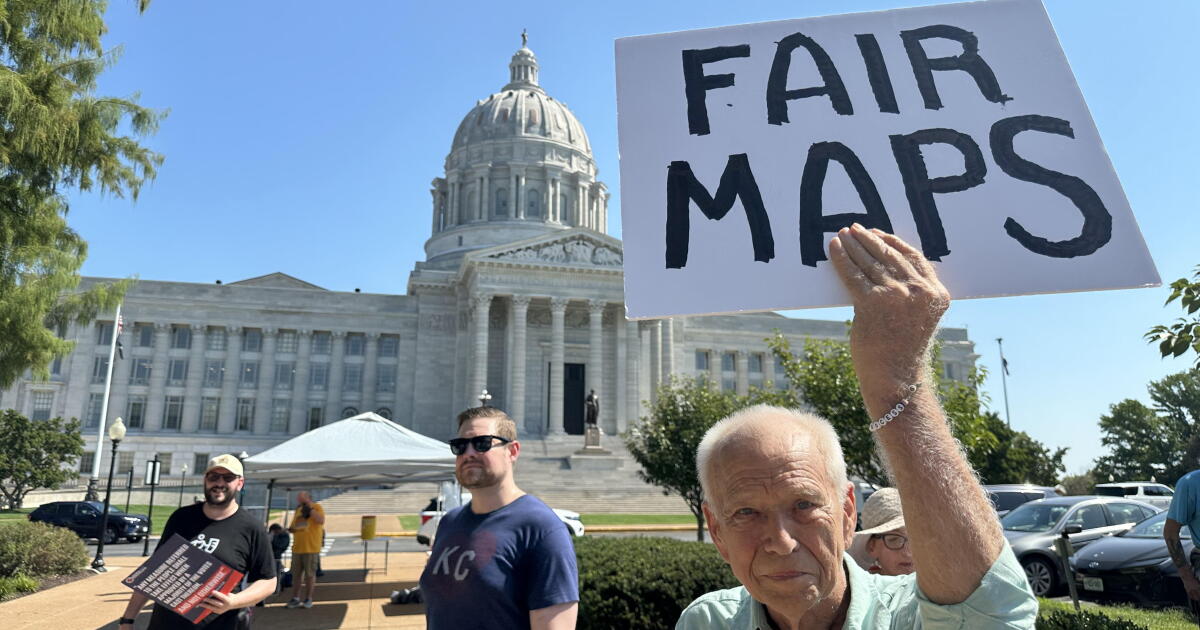
WASHINGTON — The Supreme Court on Tuesday rebuffed an appeal from Missouri officials who wanted to use new congressional districts backed by President Trump in the November election, a defeat for Republicans who had hoped the new map could help them hold onto their slim House majority.
The justices let stand a decision by Missouri’s top court, which said the new districts were automatically suspended by a citizen petition demanding a statewide vote.
The ruling marks a rare setback for Republicans in a nationwide redistricting battle that Trump urged Republicans to launch last year.
Missouri’s new districts were used in the August primaries. But the Missouri Supreme Court ruled in September that the state must revert to districts adopted after the last census.
Republican state Atty. Gen. Catherine Hanaway, who appealed, had argued it would violate federal rights to switch districts for voters between the primary and general elections. She also said it would cause confusion.
Missouri currently is represented in the U.S. House by six Republicans and two Democrats who were elected under districts that Republican state officials approved in 2022.
But at Trump’s urging, Missouri Gov. Mike Kehoe called the Legislature into a special session last year to redraw congressional boundaries to their advantage ahead of the midterms.
The revised map targeted the 5th Congressional District, held by longtime Democratic Rep. Emanuel Cleaver of Kansas City. It reassigned portions of Kansas City to two neighboring districts represented by Republicans and stretched the remainder of Cleaver’s district far eastward into rural Republican areas.
Cleaver was unopposed in the Democratic primary. State Sen. Rick Brattin won the Republican primary in the reshaped district.
On the same day as the primary, Republican Secretary of State Denny Hoskins rejected a petition with thousands of signatures seeking to force a November referendum on the map. Hoskins asserted that Missouri’s Constitution doesn’t allow a referendum on congressional redistricting. A lower court agreed, but the state Supreme Court reversed Hoskins’ decision.
The state’s top court said the new districts were retroactively frozen in December, when the petition signatures were submitted, and thus never became law. Hoskins on Tuesday assigned the redistricting referendum as Proposition A on the November ballot, in compliance with the state court order.
The Missouri Constitution does not specifically say that a referendum can be used for congressional redistricting. But the state Supreme Court said a constitutional provision allowing a referendum on “any act” of the Legislature encompasses congressional redistricting legislation.
Missouri was the second Republican-led state, after Texas, to respond to Trump’s call last year to redraw congressional districts. Several other states followed. All told, Republicans had hoped to win as many as 16 additional seats from new House maps enacted in eight states — Texas, Missouri, North Carolina, Ohio, Florida, Tennessee, Louisiana and Alabama. Democrats, whose counterattack faced several setbacks, think they could win up to six additional seats from new districts in California and Utah.
It remains to be seen whether the redistricting works as intended for Republicans. The president’s party historically has lost congressional seats in the midterms, and Trump’s poor approval ratings could provide an extra hurdle for Republican candidates.
Whitehurst and Lieb write for the Associated Press.
Free and fair elections are foundational to our representative democracy. A government intended to reflect and honor the will of the people works only if the people can express their will. That’s why we have elections.
John Lewis, the late Georgia congressman and hero of the civil rights movement, said voting is precious and “the most powerful non-violent tool we have in a democratic society.” Former President Reagan called the right to vote “the crown jewel of American liberties.”
Alas, we have a president who believes his most precious right, apart from lining his silken pockets, is nursing his over-ripened ego. Donald Trump can’t stand the fact he lost the 2020 election — which he most emphatically did — and so he’s built a carapace of lies: about illegal ballots, rigged election machinery, rampant voting by noncitizens, and so on.
Reagan, no less than Lewis, probably is turning cartwheels in his grave.
But there’s a chance to push back. In November, voters in 26 states will elect a secretary of state, choosing the officials who will oversee the 2028 presidential race throughout most of the country. What could possibly go wrong?
What really politicized the office of secretary of state, though, was Trump’s obsessive compulsion with his 2020 defeat.
Spurred by his incessant lies about supposed fraud, allies and opportunists set out to hijack the country’s election machinery and do Trump’s dirty work from the inside. In 2022, a group calling itself the America First SOS Coalition endorsed a slate of cranks and quacks who ran for secretary of state in 14 states, including the presidential battlegrounds of Arizona, Georgia, Michigan, Nevada and Wisconsin.
FILE – Tina Peters, former Mesa County, Colo., clerk, listens during her trial, March 3, 2023, in Grand Junction, Colo. (Scott Crabtree/The Grand Junction Daily Sentinel via AP, Pool, File)
(Scott Crabtree / Associated Press)
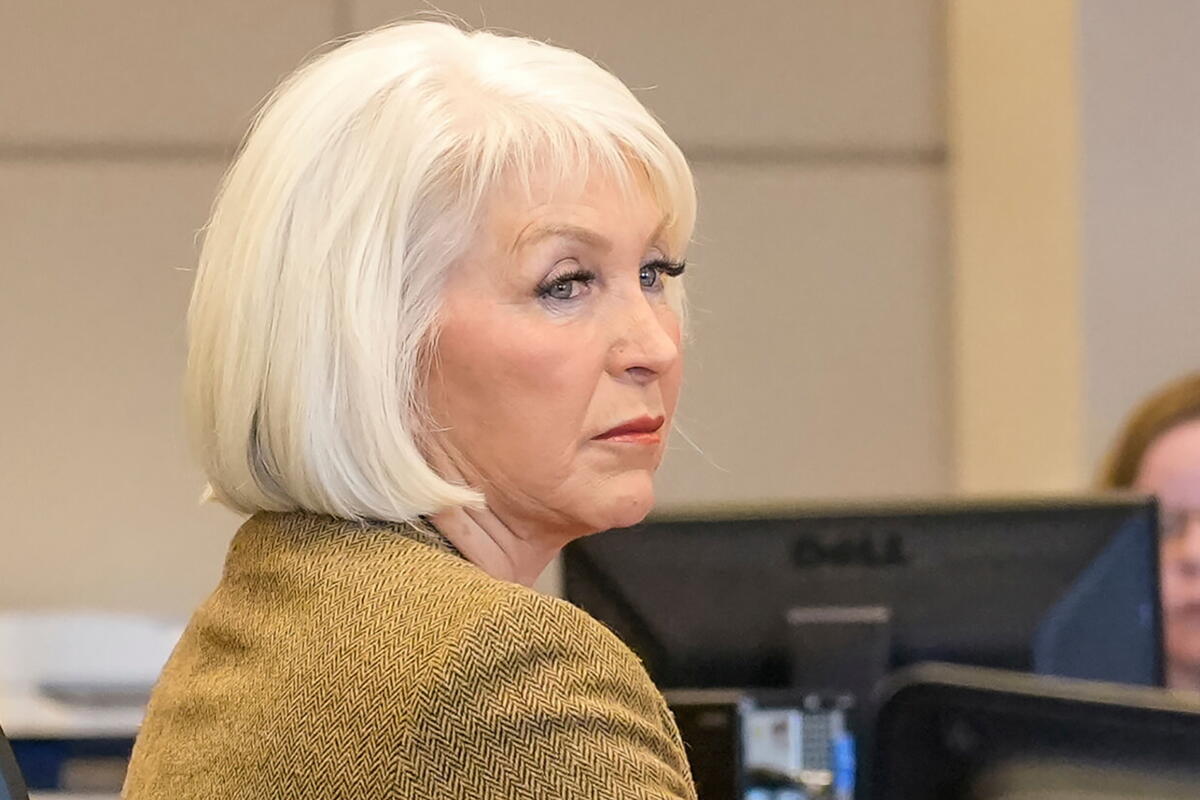
Thankfully, all of them lost, save for one candidate in Indiana. Among those defeated was Tina Peters, the former county elections chief in Mesa County, Colo., who went on to infamy, and prison, for orchestrating a security breach aimed at “proving” 2020 votes were stolen from Trump. (Never mind that he won the county by nearly 30 percentage points.)
The SOS Coalition apparently is defunct; its website address now leads to an online gambling portal.
But more than two dozen election deniers ran for secretary of state this year, according to States United Democracy Center, a nonpartisan group that works to promote fair and secure elections nationwide. Six of those candidates won their primaries and made it to November’s ballot, including in three states — Arizona, Nevada and Wisconsin — that promise to be key once more to picking the next president.
The stakes in those races are considerable, said Peverill Squire, a University of Missouri expert on state elections. “Who’s going to be administering [election] rules? How they’re going to interpret those rules?” he said, offering examples of the office’s import. “Whether they’re going to try to make it more difficult to vote, or easier to vote. Whether they’re going to try to engage in activities that will further raise doubts in some people’s minds about how fairly the election has been conducted.”
Nevada Republican Jim Marchant is among the election deniers running for secretary of state in November. He lost four years ago after promoting Donald Trump’s false claims he beat Joe Biden.
(Ricardo Torres-Cortez / Associated Press)
The contest in Nevada is a rerun of 2022, when Democrat Cisco Aguilar narrowly defeated Republican Jim Marchant. Undeterred, Marchant continues to spout gibberish about sabotaged voting machines and other far-fetched claims of election chicanery. Among the remedies he’s floated, according to the Nevada Independent, is using technology to measure voters’ heartbeat as a way to verify their identity.
Um…
Meanwhile, in Arizona, incumbent Democrat Adrian Fontes faces Republican state Rep. Alexander Kolodin, an attorney who was sanctioned by the State Bar for pursuing baseless claims of 2020 election fraud. One of his Trump-inspired lawsuits was swiftly rejected by a federal judge who noted its conspicuous lack of “relevant or reliable evidence” — thus raising doubts not just about Kolodin’s discernment but also his capacity to cover even the basics.
In Wisconsin, where elections are overseen by a six-member, bipartisan commission, Republican Jay Schroeder is running on a pledge to dismantle that fair-minded system, calling it a “failed experiment.” Had he been secretary of state in 2020, Schroeder told NBC News, he would not have certified Joe Biden’s victory in the state.
That’s all you need to know, Wisconsin.
Great amounts of time, energy and resources are being devoted this election to races for Congress and for statehouses across the country, which makes sense.
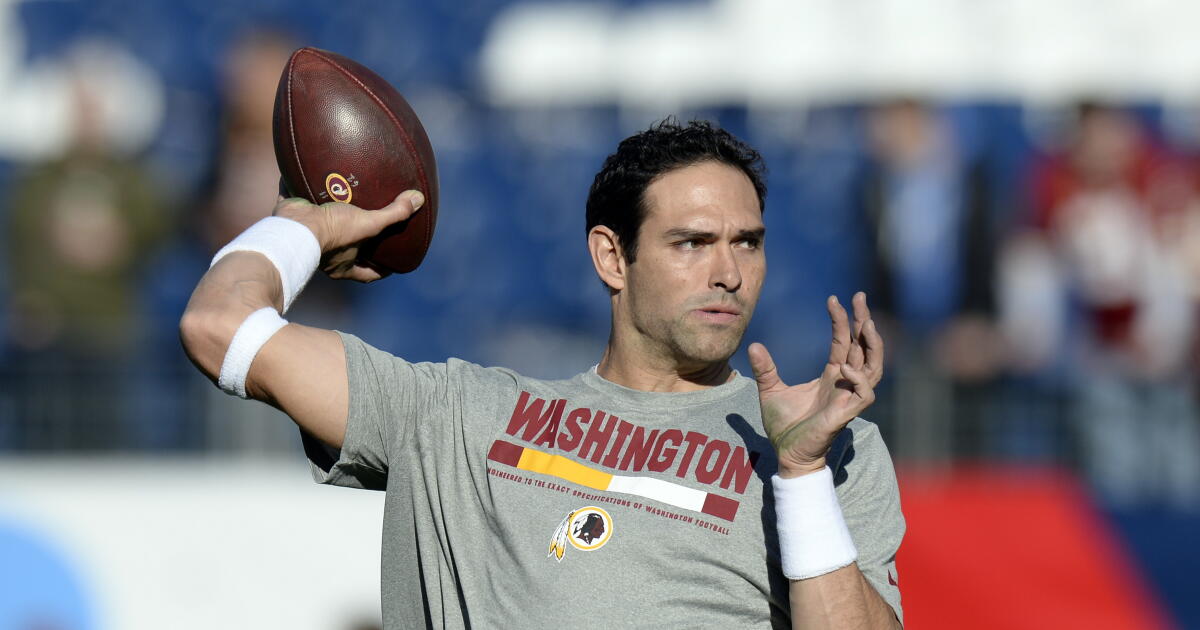
Former USC and NFL quarterback Mark Sanchez plans to enter a guilty plea in connection with his physical altercation with a 69-year-old truck driver in Indianapolis last October, according to online court records.
Attorneys for both sides entered a joint motion Thursday requesting that the judge “set this matter for a guilty plea and sentencing hearing,” according to WTHR-TV in Indianapolis, which has viewed the filing.
A jury trial had been scheduled to start Tuesday. The filing asks instead for a sentencing trial to be scheduled for November.
“The parties have reached a resolution that will obviate the need for the jury trial,” the document reads.
Sanchez was in town during the first weekend of October to cover a Colts game for Fox Sports. According to a police affidavit, Sanchez accosted Perry Tole after the Indiana resident had backed his truck into the loading docks of a downtown Indianapolis hotel.
Sanchez was charged with a level five felony of battery involving serious bodily injury, as well as the misdemeanors of battery resulting in injury, unauthorized entry of a motor vehicle and public intoxication. It is not clear the charges to which Sanchez will be pleading guilty.
In a civil suit against Sanchez, Tole alleged that he suffered “severe permanent disfigurement, loss of function, other physical injuries, emotional distress, and other damages.” Sanchez was hospitalized with stab wounds to his upper right torso following the incident.
“This is a positive development. We are finalizing an agreement with the prosecutor’s office that provides a path toward resolving the state’s case,” Nick Sanchez Jr., the former quarterback’s brother and legal advisor, said Thursday in a statement obtained by multiple media outlets. “We’re also encouraged by the constructive conversations taking place regarding the related civil matter. There is real momentum toward bringing this entire chapter to a close.”
Tole’s attorney, Matt Golitko, said Thursday in a statement: “We are pleased with the constructive and professional conversations we’ve had with Mr. Sanchez’s team. Our discussions have been productive and we’re on a positive path toward an agreement that will allow the parties to move forward. Mr. Tole appreciates the progress we have achieved and looks forward to an amicable resolution.”
Sanchez played for the New York Jets, Philadelphia, Dallas and Washington during his eight-year NFL career. Fox Sports confirmed in November that Sanchez is no longer employed by the network.
“You don’t take anything for granted,” said James Aldrete, a Democratic strategist in Austin, who’s watched for years as his party wandered fruitlessly in the campaign desert. “But there is beautiful native wildlife that grows in the desert, and it’s blooming right now.”
The question — for the moment, at least — is why California hasn’t budged while Texas has become a surprise battleground.
The answer involves individual personalities, demographics and political headwinds.
You’re reading the L.A. Times Politics newsletter
George Skelton and other analysts cover the insights, legislation, players and politics you need to know. In your inbox Monday and Thursday mornings.
By continuing, you agree to our Terms of Service, which include arbitration and a class action waiver. You agree that we and our third-party vendors may collect and use your information, including through cookies, pixels and similar technologies, for the purposes set forth in our Privacy Policy such as personalizing your experience and ads.
Of the two contests, the fight for Texas’ open Senate seat appears to be much closer. Election handicappers rate it a toss-up.
The Democrat, state Rep. James Talarico, is a highly gifted campaigner and prodigious fundraiser. But arguably the best thing he has going for his candidacy is his Republican opponent, Atty. Gen. Ken Paxton, whose history of scandal, shady dealings and moral lapses trail him like dirty footprints on a white carpet.
In the race for governor, Republican Greg Abbott is facing Democratic state Rep. Gina Hinojosa as he seeks an unprecedented fourth term — “a big ask of voters,” in the words of J. Miles Coleman, who analyzes elections at the University of Virginia’s Center for Politics. Sabato’s Crystal Ball, the center’s forecasting project, recently moved the gubernatorial race to “likely Republican,” a shift away from “Safe Republican.”
“One of the external factors that’s making Texas competitive is the degree of wind in Democratic sails,” said Jim Henson, director of the Texas Politics Project at the University of Texas in Austin.
Whether it’s anti-establishment anger, directed at the party in power, or frustration with Trump, his war-making and failure to deliver the sterling economy he promised, “when you think of the problems Republicans are having at the national level … that’s helping Democrats here as well,” Henson said.
Henson, who conducts polling statewide, said another reason Texas is more competitive than California is simple mathematics: “Democrats [haven’t] fallen quite as far in Texas as Republicans have in California.”
Texas doesn’t register voters by party. But weighting political surveys by demographics and following election results, Henson expects about a 10% Republican turnout advantage in November. By contrast, registered Democrats outnumber registered Republicans in California by nearly 2 to 1.
Yet another reason Texas appears to have grown more competitive is the apparent discontent of Latino voters, an increasingly important part of the state’s burgeoning electorate.
In recent years, as the country cleaved, California emerged as the unofficial capital of blue America, offering a political, social and cultural counterweight to Texas, the unofficial capital of red America. The two states anchor the Democratic and Republican parties, respectively, and are key to their financial well-being and the success of their candidates nationwide.
A Democratic toehold in Texas would instantly scramble long-standing political calculations, starting with the 2028 presidential race.
“It changes the narrative. It changes the demographic strategy,” Madrid said. “It changes the 270 [electoral college] map. It changes the whole strategy.”
In short, a November win would be more than symbolic, or gratification after years of Democratic futility. It would be a political earthquake.
WASHINGTON — The highest-ranking officer in the U.S. military says there are no plans to send troops to polling places during November’s midterm congressional elections, addressing concerns among Democrats that the Trump administration could use the military to interfere with the vote.
Gen. Dan Caine, chairman of the Joint Chiefs of Staff, made the statement in a letter to Michigan Democratic Sen. Elissa Slotkin, who recently asked Caine and Defense Secretary Pete Hegseth to confirm they won’t send troops to the polls.
“The Joint Force has no plans to send Federal military personnel or Federalized members of the National Guard to polling places during the 2026 elections,” Caine said in the letter to Slotkin, which was obtained Monday by the Associated Press. “Likewise, the Joint Force has no plans to use such personnel to seize ballots, voting machines, or other election-related material.”
Caine, who advises Hegseth and President Trump on military matters, also wrote: “I have neither received nor anticipate receiving any unlawful order concerning the role of the Joint Force in the upcoming November 2026 midterm elections.”
Anxiety among Democrats that the Trump administration could try to meddle in the midterm elections has grown, particularly after the president deployed federal agents in Democrat-led states over the objections of local leaders.
Slotkin told the AP earlier in August that Trump has been laying the groundwork to claim the elections were stolen. She noted that Trump contemplated using the military to seize voting machines after his loss in 2020 and has deployed the National Guard to cities against the wishes of Democratic leaders. He also deployed active-duty Marines to Los Angeles during his immigration crackdown in 2025.
Federal law prohibits the deployment of armed federal forces to election locations unless “necessary to repel armed enemies of the United States.” If any element of the military were to get involved, it would probably be the National Guard under state control.
White House Chief of Staff Susie Wiles denied in a Vanity Fair interview last year that Trump would use the military to suppress voting in the midterms.
Sonja Thrasher, Slotkin’s press secretary, said Hegseth has not replied to the letter asking him to confirm troops won’t be deployed to the polls in November. Slotkin had asked for a response by last Thursday.
The Pentagon did not immediately respond to an email from the AP asking for the status of Hegseth’s response to Slotkin. The Pentagon previously said it would respond directly to the senator.
Slotkin asked Hegseth during an April congressional hearing if he would follow orders to seize ballots. Hegseth called the question a “gotcha hypothetical,” but said, “I’ve never been ordered to do anything illegal, and I won’t.”
In 2020, Gen. Mark Milley, then-chairman of the Joint Chiefs of Staff, responded to a similar letter from Slotkin, then a congresswoman.
“I believe deeply in the principle of an apolitical U.S. military,” Milley wrote. “In the event of a dispute over some aspect of the elections, by law U.S. courts and the U.S. Congress are required to resolve any disputes, not the U.S. military.”
They need only flip three seats and, going back well over half a century, the average midterm gain for a party out of the White House is more than two dozen. Even with the advantage the GOP engineered through aggressive gerrymandering, the deadweight of a deeply unpopular president threatens to drag down a number of Republicans in competitive and some otherwise-not-so-competitive races.
There are 35 contests on the ballot in November. Of those, nearly two dozen are effectively over before they’ve even started, given the advantage one party holds over the other. Of the remainder, most are being held in states Trump won in 2024, which makes them, broadly speaking, much friendlier terrain for Republicans.
Democrats need to flip four Senate seats and until fairly recently that inhospitable political map made it seem like an all-but insurmountable challenge.
“Republicans still retain a structural advantage given the partisan challenges of the map, and Democrats still need almost every key race to break their way,” Jessica Taylor, who tracks Senate races for the Cook Report, wrote in a recent analysis. But, she went on, “in a wave election akin to 2006” — when Democrats gained six Senate seats — “even states that President Donald Trump won by double digits could move within Democrats’ reach.”
Not so fast. A toss-up means it’s just as likely Republicans will retain their Senate majority.
Understood. So break it down.
Let’s start with those things Democrats have going for them, with the usual caveats …
… There are no certainties but death and taxes. Got it. Go on.
At one time, Georgia looked to be a toss-up as Democrat Jon Ossoff sought reelection in one of those battleground states Trump carried. But Ossoff has raised a boatload of money and drawn a less-than-world-beating opponent in Republican Rep. Mike Collins. Lately, the buzz around Ossoff has been focused more on a potential 2028 run for president than his November reelection.
Meantime, in North Carolina, where former Democratic Gov. Roy Cooper is running against former national GOP Chairman Michael Whatley, a Cooper victory seems much more likely than not. A win there would give Democrats one of the four seats they need to flip.
Then there’s a handful of red-state seats that Republicans are fighting to hang on to, in Alaska, Iowa, Ohio and Texas.
Do tell.
In Alaska, former Rep. Mary Portola managed to win nearly 50% of the vote in the Aug. 18 primary, which is noteworthy given she ran on the same ballot as the GOP incumbent, Dan Sullivan, who finished second. (Another Dan Sullivan also appeared on the ballot; under Alaska’s top-four system both Sullivans will advance to a November runoff, along with Portola. The fourth slot is pending.
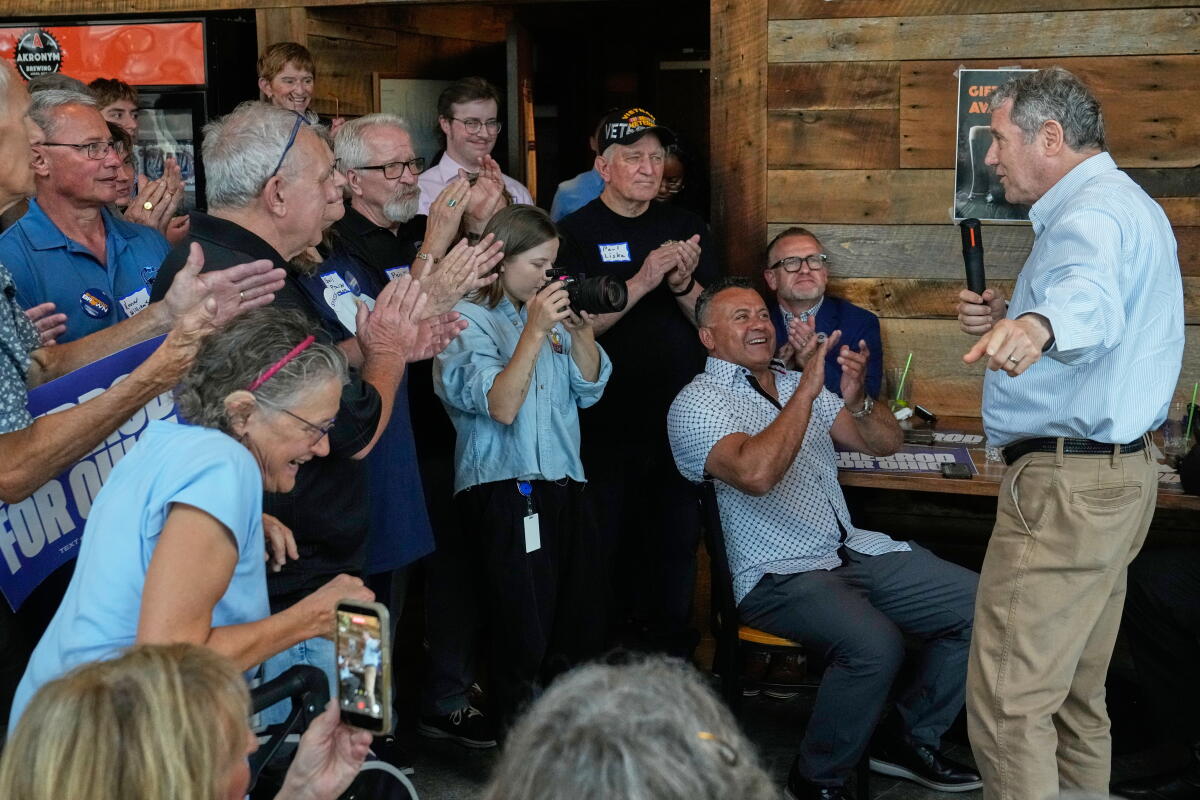
In Ohio, former Sen. Sherrod Brown, who was elected three times before losing his 2024 reelection bid amid a Trump landslide, faces Republican Jon Husted, who was appointed to fill the seat vacated when JD Vance became vice president. Husted has proved a less-than sure-footed candidate while Brown is waging a strong comeback campaign.
Supporters applaud as Democratic Ohio Senate candidate Sherrod Brown speaks at a campaign event in Akron
(Sue Ogrocki / Associated Press)
In Iowa, Rep. Ashley Hinson (a USC grad and former KABC-TV intern!) is running against state Rep. Josh Turek in a state that’s been hammered by Trump’s tariffs and the surging price of gas — especially the diesel fuel that sustains Iowa’s all-important agricultural economy. Turek could also benefit from the strong campaign being waged by gubernatorial front-runner Rob Sand, who tops the Democratic ticket.
Democrats haven’t won a statewide contest in Texas since 1994, despite no end of hype and hope. This time, they’re pinning their dreams on state Rep. James Talarico, a seminarian and viral sensation. But what’s made the race highly competitive is the singularly defective GOP nominee, Ken Paxton, whose splotchy resume includes indictment, impeachment and alleged adultery. On top of all that, he’s been a pretty lousy fundraiser and has yet to bind the wounds left by a savage GOP primary.
So everything is coming up Democratic roses?
Not necessarily.
Two states they’re counting on to flip the Senate, Maine and Michigan, have grown problematic.
Maine once looked to be Democrats’ best pickup opportunity. Incumbent Susan Collins is the lone Republican running in a state Kamala Harris carried in 2024. Then came Graham Platner, along with his inflammatory social media postings, Nazi tattoo and allegations of sexual assault. He stepped aside in July and was replaced by Troy Jackson, a former logger and state Senate president, who has considerable ground to make up after his late start.
Collins, who’s been reelected four times, has a history of winning tough races. The Platner debacle certainly hasn’t helped Jackson or Democrats.
Meanwhile, in Michigan, the progressive Abdul El-Sayed inched past a more centrist alternative to win the Democratic nomination. The question is whether he’s too far left (and, frankly, whether there’s too much anti-Muslim sentiment) for El-Sayed to prevail in that purple state. The Republican nominee, former Rep. Mike Rogers, ran two years ago and lost by less than half a percentage point.
Good to know. A lot can happen in the next 65 days.
Exactly.
Which is why we stick to columnizing. If you want predictions, ask a mystic or consult your Magic 8 Ball.
While many tourists flock to Cairo and Giza to see the Pyramids, there’s one perfect spot for history buffs that goes unnoticed
07:04, 29 Aug 2026Updated 07:05, 29 Aug 2026
This article contains affiliate links, we will receive a commission on any sales we generate from it. Learn more
The Mirror’s Jess Phillips visits Luxor in Egypt
Drifting 2,000 feet above the ground in cloudless skies, I can hardly fathom that the only thing keeping me from plummeting to the ground is a balloon full of hot air and an engine spurting fire.
But here I am, in a hot air balloon rising high above the Valley of the Queens in Luxor, Egypt. It’s one of the most breathtaking things I’ve ever seen – 20 or so other balloons bobbing around us as we take in the ancient temples and ruins dotting the land below us.
Our pilot reaches around his flight contraption to point out the Temple of Hatshepsut. There’s lush green vegetation, too, and people as small as ants working on uncovering more historical sites less than a mile beneath our basket.
I honestly thought I’d be more scared than this, but aside from a slightly bumpy landing – thankfully away from any farmers’ fields in the vicinity – the balloon ride is smooth and offers an incredible view of the landscape.
I arrived in Luxor after three nights spent in the tourist haven of Marsa Alam, on the coast of the nearby Red Sea. Switching the ocean for the River Nile – with our hotel, the Sonesta St. George, located right on the riverbank and accessible by boat – isn’t a hardship at all, and the buildings surrounding me are simply stunning.
A few hours’ drive from Marsa, holidaymakers who travel with TUI can access Luxor for a day excursion or longer. It’s 100% worth the early start and winding coach journey through the nearby desert to reach the historic city, founded in 3000 BC.
Stepping into the hustle and bustle of Luxor, I can imagine exactly what people like Agatha Christie and Howard Carter must have felt doing the same all those years ago.
Along with our incredible hot air balloon trip, I’m whisked away to the Valley of the Kings for a closer look at the ancient tombs, including the one which holds Tutankhamun’s mummy, still meticulously preserved after all those centuries.
Uncovered in 1922, the tomb had been covered in a mountain of rubble from excavations happening higher up on the hill, leaving archaeologists baffled until they finally found its location.
Honestly, I’m not sure why so many more tourists opt for Cairo and Giza over this. Of course, Luxor doesn’t have any pyramids of its own, but there are plenty of sphinxes, statues and incredible temples which offer access to the public.
Seeing the bright colours of the tombs – reds and blues and yellows – and the ancient hieroglyphs still etched into walls and columns is truly surreal. Along with the famous Valley of the Kings, we visit Karnak Temple – which Agatha Christie famously named her Nile steamer after – and Luxor Temple, along with Hatshepsut Temple.
Our guide points out the “first ever spreadsheet”, made so many centuries before the release of Microsoft Excel, and used to count up the food offerings made to the gods when the temples were still in use.
We’re shown the endless line of sphinx statues in various states of disrepair, lining a huge corridor which bridges the temples of Karnak and Luxor together. ‘Sphinx Alley’, as it is so aptly named, was used for the annual Opet Festival, which would see the Ancient Egyptians carry statues of their gods in a parade between the two temples.
All the while, though, I’m certainly not missing out on the metropolitan feel Luxor has to offer. A trip to the local bazaar plunges me right into the heart of the city’s merchant district, and I’m at once surrounded by a gaggle of stall owners attempting to sell me jewellery, T-shirts and Egyptian perfumes.
There’s time to stop for a delicious meal at the historic Winter Palace hotel’s 1886 restaurant, where jackets and ties for men aren’t optional and “smart” clothing is recommended for ladies. It’s the same hotel frequented by big names such as Howard Carter, Tony Blair and Lord Carnarvon.
It’s worth it solely for the hotel’s opulence, however. Artwork lines the corridors, while huge windows look out onto the sweeping gardens, where live music tinkles gently by an impressive fountain.
My hotel itself, the Sonesta St. George, blends traditional Egyptian architecture with modern luxury. Some of the rooms have their own saunas tucked away in the bathrooms, and the property boasts a heated swimming pool overlooking the Nile.
TUI offers all-inclusive packages and bounteous excursions in Luxor, so it’s not somewhere I’d describe as a hidden gem when so many UK tourists choose Cairo as an entry point. But a little deeper into the country you’ll find so much incredible history – though don’t bank on seeing any pyramids.
Book the holiday
TUI offers seven-night holidays to Marsa Alam, Egypt staying at the 5T Jaz Elite Amara on an all-inclusive basis from £990 per person. Book at tui.co.uk or on the TUI app.