november election

Becerra heads toward the November election with a major edge over Hilton in governor’s race, poll shows

Democrat Xavier Becerra holds a major advantage over Republican Steve Hilton as the race for California governor heads toward the November election, a new poll shows.

The two candidates topped a crowded field of gubernatorial hopefuls in the June 2 primary, earning them the opportunity to face-off in the general election.

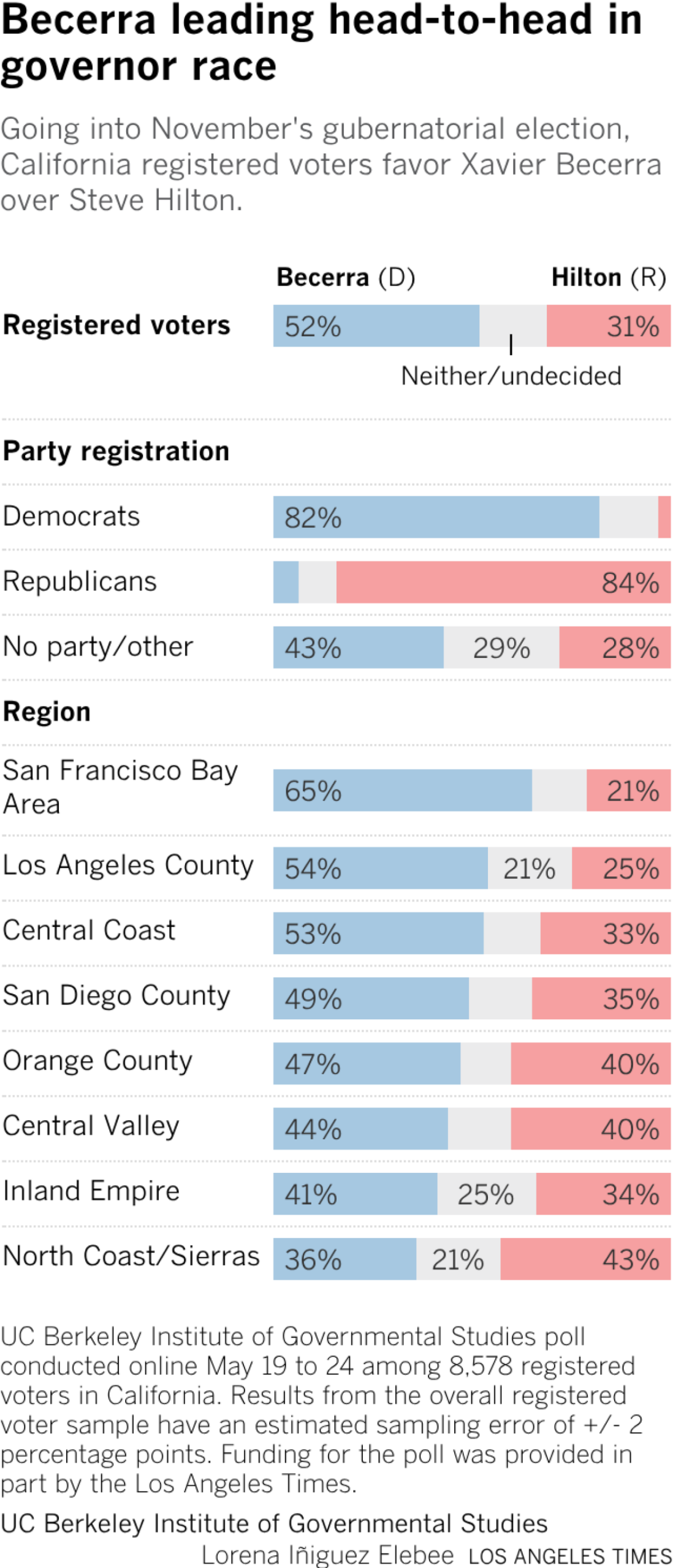
Among registered voters in the state, 52% supported Becerra in a head-to-head matchup against Hilton, who was backed by 31%, according to a UC Berkeley Institute of Governmental Studies poll which was co-sponsored by The Los Angeles Times. The remainder were undecided.

“It looks very much like a traditional, partisan-based general election, with most of the Democrats, over 80%, behind Becerra as the campaign starts,” said IGS Poll Director Mark DiCamillo. “Even though Hilton has over 80% of the Republicans, the Democrats outnumber Republicans by 20 points in the state, and that gives the Democratic candidates a huge advantage, which Becerra is clearly taking advantage of in this election.”

The survey of California voters was conducted before the primary, from May 19-24.

The poll found that Democratic and Republican voters were extremely loyal to their party’s candidate. Among Democrats, 82% said they would support Becerra in the general election, while 84% of Republicans said the same about Hilton.

Becerra also had an edge among voters registered as no party preference or registered with other parties — who make up almost a third of the state electorate. Among those voters, 43% backed Becerra, 28% supported Hilton and 29% were undecided, the poll showed.

Along age, gender, racial and geographic lines, voters preferred Becerra to Hilton nearly across the board. The only geographic region where voters preferred Hilton to Becerra are those in the North Coast/Sierra region, which makes up about 2% of the electorate, DiCamillo said.

Hilton, who served as an advisor to former British Prime Minister David Cameron before immigrating to the United States, in April secured the endorsement of President Trump, which helped him gain enough support among Republican voters to outpace his GOP rival, Riverside County Sheriff Chad Bianco.

More than a third of Republicans, 37%, said Trump’s endorsement made them more likely to support Hilton. But while it helped Hilton consolidate the Republican vote in the primary, helping him finish in second place, it will likely hurt him in the general election, DiCamillo said. Trump remains deeply unpopular in California; the poll released Thursday showed 69% of voters disapprove of the president’s performance while 29% approve.

“A majority of Californians have a very strong negative view of the president, so Hilton’s backing by the president will not be nearly as beneficial to him in the general as it was in the primary,” he said.

A former Biden Cabinet secretary, state attorney general and longtime congressman from Los Angeles, Becerra had been wallowing in the low single-digits in public opinion polls less than three months ago. His fortunes changed when former Rep. Eric Swalwell, one of the Democratic front-runners, dropped out of the governor’s race after he was accused of sexual assault and misconduct, which he denies.

Democratic voters and interest groups quickly coalesced behind Becerra, who was seen as a steady candidate with a long resume in California politics and a record of fighting the Trump administration. In two months, he went from polling at 5% in a March IGS poll to 25% in a late May poll and finishing first in the unofficial primary vote count.

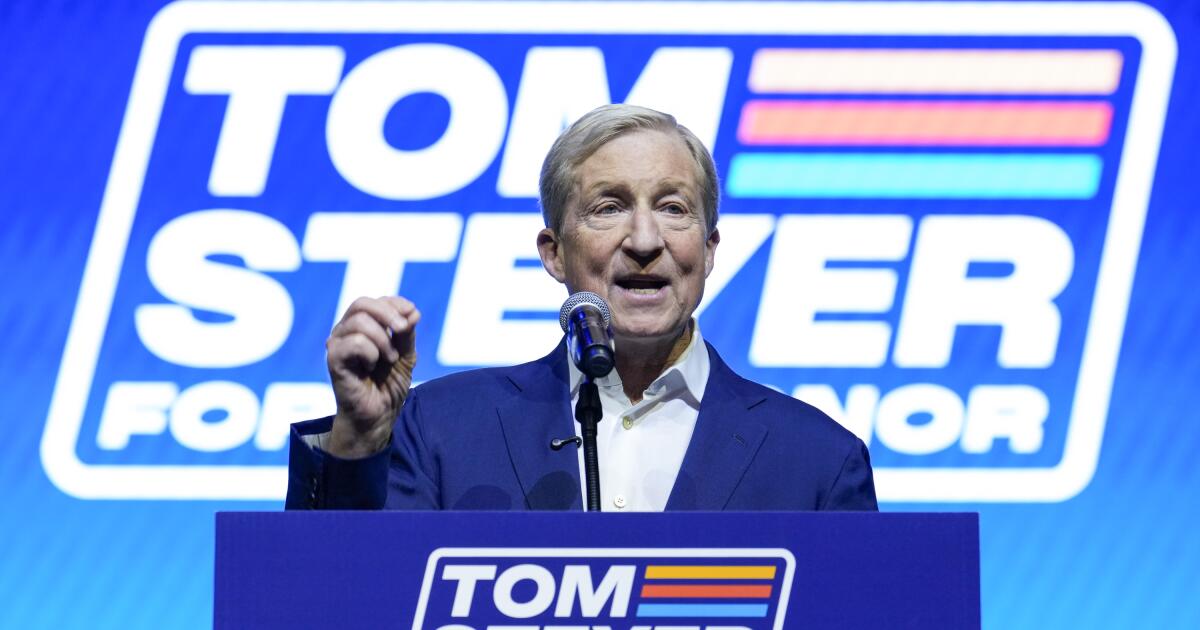
With 91% of ballots tallied as of Wednesday afternoon, Becerra led with 27.9% of the vote compared to 25% for Hilton, according to the Associated Press, which declared Becerra and Hilton the two winners. Billionaire hedge fund founder turned environmentalist Tom Steyer was in third place with 22.5% — knocking the Democrat out of contention for the November election.

DiCamillo said Swalwell’s dropping out of the race “really gave Becerra an opening and he capitalized on it.”

The poll also showed that in the end, “Becerra was the only one of the major candidates who ended the primary race with a favorable image among the overall electorate, even in the face of all the negative ads that Steyer was running” against him, DiCamillo said.

Just before the primary election, 44% of likely primary voters surveyed had a favorable view of Becerra compared to 38% who viewed him unfavorably.

Hilton and Steyer were upside down — 31% had a favorable opinion of Hilton compared to 38% unfavorable, and 39% had a favorable view of Steyer while 43% saw him unfavorably.

Though Steyer had aggressively courted progressive voters and secured the backing of left-wing individuals and groups like Rep. Ro Khanna (D-San Jose) and Our Revolution, a group founded by Sen. Bernie Sanders (I-Vt.), the final IGS poll before the election showed more progressive voters ended up backing Becerra.

Among those who self-identified as progressive, 39% said they would support Becerra while 29% preferred Steyer, according to the late May survey.

“It’s really one of the factors that was responsible for Steyer’s campaign not being successful,” DiCamillo said. Progressive voters were “a target audience for Steyer, but Becerra was able to have an advantage there.”

The poll was conducted online in English and Spanish among 8,578 registered California voters. The survey has a margin of error of 2% in either direction.

Source link

Why Tom Steyer’s $216-million California gubernatorial bid failed

Californians couldn’t escape billionaire Tom Steyer’s political ads — during newscasts, sitcoms, or sporting events; on streaming services, YouTube, influencers’ social media feeds, or their mailboxes. Even the Puppy Bowl.

Yet despite spending a record-shattering $216 million of his wealth on his run for governor, the Democrat failed to win enough votes in last week’s primary to advance to the November general election to replace termed-out Gov. Gavin Newsom.

“Money isn’t everything, even though it obviously helps,” said Andrea Godfrey Flynn, a marketing professor at the University of San Diego. “It boosted Steyer way up. … But there are so many other factors at play that it may not have been enough.”

Steyer, a hedge fund co-founder turned environmental warrior, polled at 1% shortly before he entered the governor’s race in November, according to a survey by UC Berkeley’s Institute of Governmental Studies that was co-sponsored by the Los Angeles Times.

He climbed in subsequent polls, hitting 19% in the same poll shortly before the June 2 primary, putting Steyer in contention for winning one of the top two spots in the contest that would allow him to advance to the November election. But then he hit a ceiling, and on Tuesday, it became official that he failed to advance.

Steyer emailed supporters Tuesday expressing gratitude for their efforts backing his campaign, endorsements and votes.

“Together, we fought for a California that belongs to the people who keep it running every day, and we insisted that they do not have to settle for a system that protects corporate profits at the expense of working people,” he wrote. “I’m proud of how we never compromised our values or lowered our sights for what California can and should be.”

He pointed with pride at major corporations such as Chevron and Meta spending heavily to oppose his bid, and said their tens of millions of dollars spent attacking him shows the flaws in the electoral system. And he acknowledged that may be part of the reason some voters were skeptical of voting for a billionaire.

“I’m proud of the enemies we made,” Steyer said. “This campaign proved that business-as-usual depends on politics-as-usual, and there is no going back. We must continue to fight for a system where democracy serves Californians, not corporations — and where you do not have to be a billionaire to run on single-payer, or on breaking up monopolies, or on calling out a corrupt system when you see it. Because people are fed up with a system rigged to benefit billionaires and leave them behind.”

As of Tuesday evening, Steyer had received more than 1.9 million votes of the more than 9 million cast, lagging behind the two candidates who will appear on the November ballot: Republican Steve Hilton, a former Fox News commentator, and Democrat Xavier Becerra, a longtime elected official who most recently served in President Biden’s cabinet. Steyer was trailing Hilton, the second-place finisher, by just over 200,000 votes.

Steyer immediately endorsed Becerra, whom he had relentlessly attacked in the closing weeks of the campaign as beholden to corporations with business in front of the governor.

California has a history of unsuccessful self-funders. Former Northwest Airlines co-chairman Al Checchi spent more than $40 million of his money on an unsuccessful gubernatorial primary campaign in 1998, which broke records at the time.

More than a decade later, former EBay chief Meg Whitman spent $144 million of her wealth on her bid to become California’s governor, setting a new national record for spending on a state election. She won the GOP nomination but lost in the general election.

This year’s gubernatorial contest is not the first time Steyer has spent an inordinate sum seeking office. In 2020, he spent $342 million on a brief, unsuccessful presidential campaign.

Sheri Sadler, a veteran Los Angeles-based Democratic media buyer, said Steyer’s 2026 gubernatorial deluge was notable.

“I literally saw his spots ad nauseam,” she said. “They left almost no stone unturned.”

Sadler worked for Steyer in the final weeks of his presidential bid and scheduled $50 million of billionaire Rick Caruso’s money on ads during his unsuccessful 2022 Los Angeles mayoral campaign.

She believes that Steyer hit a ceiling because voters who are bombarded by ads eventually feel that the candidate is trying to purchase their affection.

“It’s one thing to give me a message I can resonate with. If they’re just trying to buy my vote, that feels different to me,” she said, adding that Steyer’s wealth undermined his platform, which included support for raising taxes on billionaires. “That’s my gut. And I feel like that’s what happened to us on Caruso and possibly why he didn’t run” for governor this year.

Steyer, 68, made his fortune founding a hedge fund that included investments in fossil fuels, private prisons and other businesses that are controversial among Democrats. He told voters that he walked away from the firm 14 years ago, leaving an enormous amount of money on the table, because it did not align with his morals. Steyer adds that he and his wife have pledged to give away most of their wealth before they die.

And unlike many wealthy self-funders, Steyer did not leap into a campaign as a political neophyte who assumed their business skills would translate into being an effective elected official.

Steyer and his wife, Kat Taylor, are longtime donors to Democratic candidates, but for well over a decade, they have spent hundreds of millions of dollars on liberal causes such as fighting climate change, mobilizing young voters, urging the impeachment of President Trump, opposing an effort by oil companies to suspend California environmental standards, increasing the state cigarette tax and supporting last year’s redrawing of the state’s congressional districts to counter Trump.

Darry Sragow, a veteran Democratic strategist who advised Checchi, said that Steyer’s focus on such causes had the potential to be meaningful to voters who are often skeptical about the sincerity and motives of rich candidates.

“Tom Steyer has done a good job in that respect, because if you’re going to overcome that skepticism, it’s very helpful for the candidate to show that he or she has actually been involved in the world of public policy and politics for an extended period,” and Steyer has, Sragow said.

Assemblyman Isaac G. Bryan (D-Los Angeles), who endorsed Steyer, argued that he promoted proposals that were against his personal interests, such as the proposed billionaire’s tax that is expected to appear on the November ballot.

“Interestingly enough, Tom Steyer is also the only candidate who’s talked about campaign finance reform and wanting to get money out of politics, including his money, to return power to the people and have publicly financed elections,” Bryan said after a Steyer rally near downtown L.A. on May 31.

Former Orange County Rep. Katie Porter and state Supt. of Public Instruction Tony Thurmond also campaigned on limiting the influence of corporate PAC money in elections, or implementing publicly financed elections in California. Porter often criticized Steyer for running as a “change agent” while spending millions he earned from investments in oil and gas.

“You paid the lowest tax rate on this stage and yet you made the billions that you’re using to fund your campaign off fossil fuels,” she said to Steyer during an April 28 debate in Claremont.

Political experts argue that messages that seem contradictory to a candidate’s background, as well as drowning voters with incessant ads, can be jarring and off-putting to the electorate.

“It can be an overload to voters where they hit that tipping point where they’re no longer interested,” Flynn said.

Despite Steyer’s foundational argument that his wealth meant he was not beholden to anyone, she said voters may be unable to reconcile a billionaire’s ability to understand or empathize about an average Californian’s needs.

“The messaging still is a giant factor,” Flynn said. “I’m curious [about] how believable it came across to voters — can you trust a billionaire to really care about affordability, someone who made money working with business or in business not to care about special interests?”

While Steyer campaigned as a hard-left liberal, he failed to be the top pick for progressives. Steyer had the support of 35% of likely voters who identified as strongly liberal while Becerra was backed by 37%, according to Berkeley’s May poll.

After talking to college Democrats at UCLA on the eve of the primary, Steyer said regardless of what happens in the primary, he will remain politically involved, though he would not run for president in 2028.

“I’m going to keep working on these issues, because I’ve been working full-time on these issues for 14 years,” Steyer said. “There’s no question what I’m going to do. How I do it is a little bit up in the air.”

Times staff writer Dakota Smith contributed to this report.

Source link