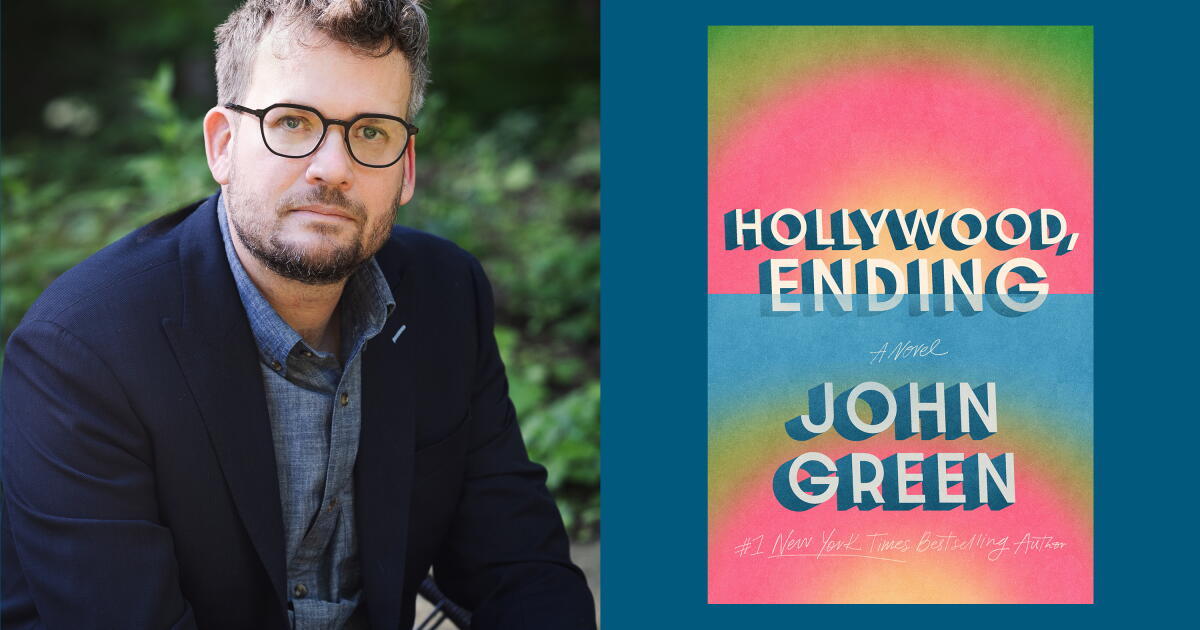
John Green’s nine-year hiatus from fiction has ended, and his adult debut, “Hollywood, Ending,” comes right on time to explore the dark side of fame.
The novel centers on former child actor Juniper Castillo and Hollywood newbie Kai Laramie, who are cast in the artsy biopic “Andy Warhol Never Gets Old,” with hotshot movie star Matthew Malone in the title role. It’s Juniper’s chance to establish herself as an adult actor and Kai’s first foray into the spotlight, a position he quickly realizes doesn’t come without a personal cost.
“There’s no way I could have written this book without spending a lot of time on film sets,” Green told The Times in a recent call.
On the Shelf
Hollywood Ending
By John Green
Dutton: 304 pages, $32
If you buy books linked on our site, The Times may earn a commission from Bookshop.org, whose fees support independent bookstores.
Over the last two decades, several of the author’s bestselling young-adult novels have been adapted for the screen. His debut, “Looking for Alaska” (2005), was adapted as a Hulu limited series in 2019, the same year Netflix released the feature film adaptation of his co-authored holiday anthology, “Let It Snow” (2008). On the big screen, “Paper Towns” (2008) made its film debut in 2015, while his bestseller “The Fault in Our Stars” (2012) became a box-office hit in 2014. Most recently, his 2017 novel, “Turtles All the Way Down,” received a feature film adaptation in 2024.
“I hope the book is a love letter to movies. But I also wanted to be honest about how difficult it is to make a work of art that, in order to be commercially successful, has to be loved by millions of people,” Green said. That’s where the Hollywood machine comes in. “It’s really hard to figure out how to get millions of people to pay to watch something, and that challenge leads to all kinds of compromises and sacrifices.”
While Green’s young-adult novels have often explored the teenage experience, he never felt confined by the YA genre. “I think teenagers have infinite intellectual capacity,” he said, adding that he doesn’t really think about which shelf will hold his novels inside a bookstore. In “Hollywood, Ending,” his main characters are navigating their early 20s, a period which Green finds especially interesting.
“The questions in this novel explore how it feels in those early years of adulthood when there are still so many possibilities, so many directions you might go,” he said.
The following conversation has been edited for length and clarity.
How did you land on Andy Warhol as a celebrity figure and metaphor to use in telling this story about Kai and Juniper?
I think Andy Warhol saw so much of our world coming. He saw that three-dimensional experience was going to be rendered in two dimensions. He’s most famous for taking cylindrical soup cans and making them flat, but he also saw celebrity culture coming.
There’s the famous quote about everybody being world-famous for 15 minutes. I think he understood that normal people were going to experience celebrity, and he also saw the way that the repetition of images, as I write about in the novel, would lead to a certain desensitization. So I think everything from screen-based experience to the ways that technology was going to reshape our lives, he was the patron saint of all of that.
One of the images that really struck me is when you talk about him dying wigless and being too uncomfortable with that to have friends come and visit him in the hospital.
I think Juniper says at one point that fame is a kind of armor. I don’t know how Warhol thought of his wigs, but I wanted it to be a sort of emblem of protection for him.
Your wife, Sarah, is an Andy Warhol scholar. Was that a major strength while you were writing this?
There’s a huge advantage to being able to fact-check something by shouting down the hall. I also wanted to include Warhol partly as a love note to Sarah … She co-wrote a book about Andy Warhol’s relationship with money and business called “Andy Warhol Enterprises.” After 25 years, our way of looking at art and the art that we’ve shared together is so deeply intertwined that anything I write is unimaginable without her. She’s my first reader and most important reader … It’s only thanks to her that Warhol’s in the book.
You really humanize the young actors in “Hollywood, Ending,” which, unfortunately, is a unique thing. This is an intimate, vulnerable portrayal of behind-the-scenes Hollywood — why was that important for you to examine?
I wanted to write about the machine that takes private experience and commodifies it, and I think that machine is especially challenging to navigate when you’re young, when you’re in early adulthood, because you don’t yet have those relationships that are going to carry you through. You don’t have the love that you need to survive all that you’ve got to survive. When my work became very successful, I was in my 30s. I was married. I had two kids. I lived in Indianapolis. I had best friends. I was pretty grounded, and it was still very disorienting.
How so?
It’s a completely different life to have everybody have opinions about your work than it is to take your kids to school every day. So I was thinking partly about that, but I was also thinking about the influencers I’ve known, and the actors I’ve known who’ve had to go through that [while] much younger, and what that’s been like for them as well.
You do a really good job of examining the dark side of the attention economy. Why was this especially of interest?
Well, it used to be that the attention economy was mostly a problem for actors and other celebrities, but now the attention economy is something we all participate in. We’re all taking our private experiences and packaging them up for public consumption on Facebook and Instagram and Twitter and Reddit, and I think we gain something from that, or we wouldn’t do it. But we also lose a lot.
I wanted to try to be honest about what we gain, and also be honest about what we lose. My last novel, nine long years ago, was about a young woman with OCD. I also have OCD, and I had to make a decision when I was promoting that book, about whether I would talk about having OCD, and I decided that I would, and that became a huge part of talking about the novel — talking about my own experiences with mental illness, and it was a gift in many ways because so many people have said to me that it helped them to see that it’s possible to have a good and fulfilling life while living with a serious mental illness, and it was helpful for me because it helped me feel less alone in it.
But it was also complicated because there are real costs when you share something. It’s not yours anymore in ways that are a relief, but also in ways that are difficult.
You’re offering it up for scrutiny in a way that can be really scary.
It is really scary to have your private life scrutinized in that way, right? And there’s an element of judgment that comes with creative expression that’s a natural and healthy part of conversations about what art is and what art should be, but being in the middle of those conversations isn’t always fun.
I think you capture that in Kai’s experience. He is really pressured to come out and talk about his traumatic experience, and he doesn’t want to. The “machine” wants to sell tickets and exploit his trauma in the process.
It’s one thing to try to make good art. It’s another thing to try to make good art that lots of people interact with, and a portion of that second issue is inevitably finding ways to interest an audience, and nothing interests an audience quite like a personal story, especially a personal story of overcoming difficulty.
Was the movie star Matthew Malone based on anyone specifically?
I have aphantasia, this brain condition that causes me not to be able to imagine anything visually. I have no visual imagination, and so I can’t see actors when I’m writing. I can’t see characters when I’m writing. I can’t see anything. Everything’s made out of language, and so there’s no way I could have cast the movie in my mind or had somebody in mind for the character. It’s been great to hear all the folks who people were thinking of. I’m curious who you were thinking of.
I thought of Tom Cruise a couple of times. Have other people said that?
A couple people have said that as well. Yeah.
That’s so interesting about your work with language solely. Do you think that’s been a strength with you as a writer? Because you create such vibrant visuals for your readers.
It’s the only way I’ve ever been. I never knew that other people had this vibrant visual imagination until I was in my 40s, and my wife said I think maybe the reason you don’t have a sense of direction and you have to open up all the cabinets when you put away the dishes and you don’t know whether there’s a rug in the living room is because you don’t have a visual imagination, and I was like, of course I don’t. Nobody does, and she was like, you can’t picture an apple in your head? And I was like, no, nobody can picture an apple in their head. They say they can, but they mean it metaphorically … And Sarah explained to me that, in fact, the vast majority of people can see an apple, which still seems fictional to me, like science fiction stuff.
Some people don’t have that inner voice in their head (anendophasia).
I do have an inner voice. I think. But this all gets to something really interesting about being a person, though, which is that you’re stuck the whole time you’re here inside of one consciousness and looking at the world through one set of eyes. And I have no idea what it’s like to be you. The great thing about writing fiction for me is that act of imagination, that attempt to empathize, that attempt to escape the self and imagine what it would be like to be somebody else with some clarity, but of course, there’s always a limit to my ability to do that, and that problem has fascinated me my whole career.
Your books have meant so much to so many people, and in recent years, I’ve reported quite a bit on your book, “Looking for Alaska,” being one of the most commonly banned books. How do you feel about that?
I’m really concerned about attempts to limit intellectual freedom in the U.S., especially when it comes to libraries and schools. We have professionals we’ve trained to make collection decisions and to make curricular decisions in schools, and those professionals are teachers and librarians, and I’m very disturbed when other people come into that conversation and try to usurp the work that teachers and librarians are doing. I think a lot of times authors get most of the credit for the fight against book bans, and the truth is, all the credit should go to the teachers and librarians who are often putting their jobs on the line, making really difficult decisions to try to do the best by the kids that they’re representing and working with.
John Green will be in conversation with Julia Whelan to discuss “Hollywood, Ending” at 7 p.m. Tuesday, Oct. 13, at a ticketed ALOUD event hosted at Saban Theatre. 8440 Wilshire Blvd., Beverly Hills.