North Wales

Forget Italy and visit ‘stunning’ UK coastal village that ‘looks like film set’

The UK village has gone viral online for its stunning beauty. Visitors say it looks just like an Italian seaside town and “feels like wandering through a film set”

Many people will be jetting off to popular European destinations such as Spain, Italy or France this summer. However, a growing number of Brits are opting for staycations this year to avoid lengthy airport queues and make the most of the glorious weather the UK has been enjoying.

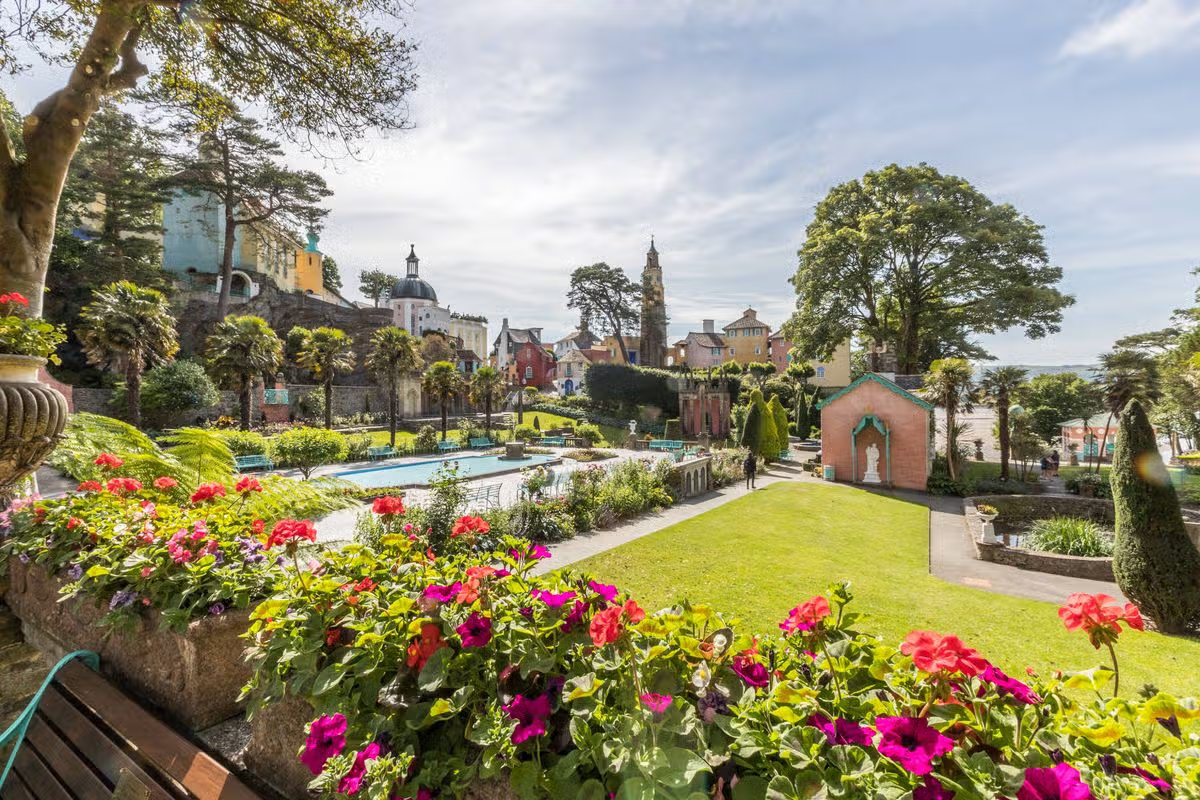
If that sounds like you, but you’ve yet to decide on a destination, then you’ll want to pay attention. One ‘enchanting’ UK village that will have you convinced you’re in Italy has taken the internet by storm. Portmeirion is a breathtaking, Italianate tourist village nestled in Gwynedd, North Wales. Perched on the cliffs of the Afon Dwyryd estuary, it was designed and constructed by Welsh architect Sir Clough Williams-Ellis between 1925 and 1976.

His vision was to demonstrate that developing a naturally beautiful location need not come at the cost of its charm.

The village is owned by a charitable trust and is renowned for its vibrant, pastel-coloured Mediterranean architecture, picturesque woodlands, and its unique place in pop culture.

Key highlights of the village

The Architecture: Williams-Ellis built the village as a “post-modern bricolage”, incorporating salvaged fragments from demolished historic buildings across the UK. It features a central piazza, a giant human chessboard, a Riviera-inspired layout, and a lighthouse.

The Gwyllt (Wildwood): A 70-acre subtropical forest surrounding the village. It includes 19 miles of pathways, hidden gardens, a ghost garden, a dog cemetery, and exotic trees like giant redwoods and monkey puzzles.

The Prisoner TV Show: Portmeirion is recognised worldwide as the filming location for the cult 1960s psychological spy thriller, The Prisoner. Devoted fans regularly flock to the dedicated Prisoner Shop on-site.

Portmeirion Pottery: The world-renowned pottery brand was established in 1960 by the architect’s daughter, Susan Williams-Ellis, who drew on botanical motifs inspired by the village. Discounted earthenware is available to purchase at the local shops.

Where to stay and eat

While thousands descend on the village for day trips, it operates primarily as a hotel resort where guests can stay beyond opening hours.

Hotel Portmeirion: A Grade II listed, converted Victorian villa situated directly on the waterfront.

Castell Deudraeth: A grand, 19th-century castellated folly transformed into a contemporary hotel.

Cottages & Dining: There are 13 self-catering cottages dotted throughout the village alongside several cafes, an authentic Italian gelateria (Angel Ices), and formal dining rooms.

Visiting information

Admission: Day visitors are required to purchase an admission ticket to enter the grounds.

Accessibility: Owing to its cliffside, coastal setting, many paths within the village and leading back up from the estuary are steep, hilly, and may prove challenging for those with limited mobility. Getting there: The village is extremely well-connected by public transport.

It sits just a 1-mile walk or taxi ride from Minffordd Railway Station, which serves both local lines and heritage steam trains like the Ffestiniog & Welsh Highland Railways.

What people online are saying

Content cannot be displayed without consent

One visitor known as Bec recently took to her Instagram page to share her experience of visiting Portmeirion.

Despite having just 3,000 followers, Bec’s post went viral – amassing more than 38,000 likes from fellow travel enthusiasts.

Although Bec called it “the weirdest UK village”, she went on to say that Portmeirion ‘looks like an Italian seaside town’, despite being nestled in North Wales.

She also claimed that once the tourists are gone for the day, you ‘have the whole village to yourself’.

Bec wrote: “Walking around after dark felt like wandering through a film set.”

She also showcased the village’s breathtaking views, exclaiming: “I’ve never been happier to wake up early.

“I think I said, ‘this is so pretty’, every thirty seconds.”

Bec also labelled Portmeirion a “must-visit for anyone who supports architectural whimsy”.

Adding further detail in the caption, she wrote: “It’s a little bit Disneyland for adults who enjoy cruises… (affectionately). I’ve wanted to visit Portmeirion for years and it lived up to every expectation.

“It’s unlike anywhere else in the UK, with colourful Mediterranean inspired buildings and baroque architecture and beautiful views across the estuary. During the day it’s very busy (understandably), and I found it a bit overwhelming… but then everyone went home.

“Walking around after dark and again before breakfast the next morning completely changed the experience. You could actually stop, look around and appreciate how strange and beautiful the place is.”

She rounded off by saying: “One I’ve wanted to tick off for years, and I’m so glad I finally did.”

One viewer responded: “Fantastic find,” while another added: “I’m so jealous, I love it there but never stayed!”.

A third chimed in: “Its very pretty and photogenic.”

However, one less impressed commenter wrote: “Don’t fall for the hype. Major tourist trap at £20 each to get in and only really cafes inside.”

Source link

Abandoned UK village ‘entirely drowned’ but ruins reappear during hot weather

The village was once a thriving community, but it was completely submerged to create a reservoir – and visitors can see its haunting memorial today and even spot the buildings if they’re lucky

Once a thriving, proud Welsh-speaking community, this cherished village was entirely abandoned and left to disappear beneath the water without a trace.

The submersion of this much-loved settlement remains a deeply painful topic for those in the surrounding area, who fought with every ounce of strength to preserve their homes. Sadly, their determined efforts proved futile, as the UK government flooded the village entirely to provide water to a considerably larger English city.

In 1965, the village of Capel Celyn, tucked away in the Tryweryn Valley in North Wales, was lost forever when it was left to sink beneath the surface of a vast reservoir. It was a deeply contentious decision, to say the least, driven by the Liverpool Corporation to provide water to Liverpool and the Wirral.

For some, it may have appeared to be little more than a straightforward infrastructure project, but for the vast majority, the implications ran far deeper. The devastation it brought to the local area and the broader Welsh community had a profound political impact, fuelling a significant surge in support for Welsh nationalist party Plaid Cymru.

The fight for the village

It was in 1955 that the residents of Capel Celyn first discovered their homes had been earmarked for sacrifice to make way for a new reservoir, marking the start of a grueling decade-long struggle. Before long, the villagers banded together, forming what became known as the Capel Celyn Defense Committee, which debated, protested and condemned the scheme across the country and as far as Liverpool.

On several occasions, this led them to march directly to Liverpool to make their opposition unmistakably clear.

Despite their determined efforts, Liverpool councillors voted overwhelmingly in favour of pressing ahead with the plans, and in 1957, a private bill backed by Liverpool City Council was brought before Parliament.

All 35 Welsh Members of Parliament who cast their votes opposed the bill, yet it was passed regardless in 1962. Three years on, the village and all its buildings, including people’s homes, were submerged beneath the water.

In total, approximately 800 acres of land were consumed by the reservoir, taking with it the school, the post office, the chapel and the cemetery.

Some 48 people lost their homes out of the 67 who had lived in the valley, with many forced to relocate to entirely unfamiliar areas and rebuild their lives from scratch.

What made this so deeply controversial was the wholesale destruction of a traditional Welsh community, as the village had stood as a living symbol of authentic Welsh culture and its endangered language.

The site today

Visitors continue to flock to the site to this day. During particularly dry periods if the water levels drop enough, you can occasionally spot some of the ruins of the houses, school and post office. One TripAdvisor reviewer described the place as “beautiful but sad”.

They wrote: “This wasn’t my first visit to this beautiful area, but after researching the flooding of the village and being Welsh, we spent more time around where the village once stood.

“There is no doubt the scenery is outstanding, but I also found it to be quite sad; people’s lives were completely upturned, and their entire village was drowned. Well worth a visit, especially if you read the history of the village.”

The reservoir offers a breathtaking backdrop, framed by the gently rolling hills of the valley, and many visitors opt to take a stroll around the area. A memorial chapel stands as a tribute to the village that once existed, offering a place for people to reflect on its history.

One visitor remarked: “Poignant and stunning. The heartbreaking history of this reservoir should never be forgotten.”

There is every chance the village could resurface this year, as it only emerges above the waterline during spells of extreme heat. The ongoing heatwave may cause water levels to drop sufficiently, much as they did in 2018.

Source link

‘I hiked in UK national park like a tropical paradise – not Lake District or South Downs’

The national park’s a hotspot for tourism, but this particular walk felt like, at points, I could have been hiking in a tropical destination, with its bright green rugged cliffs

The more I travel around the UK, the more I am in awe of its natural beauty which seems to be overlooked by a lot of keen travellers, and this particular spot feels like a real slice of paradise.

You don’t need to hop on a plane to experience a sense of the tropics; it turns out you can immerse yourself in the brightest hues of green and walk along waterfalls in the north of Wales. While, of course, Snowdonia National Park is no secret, especially to avid hikers, cyclists and explorers, it was my first time visiting, and this specific route is one that blew me away.

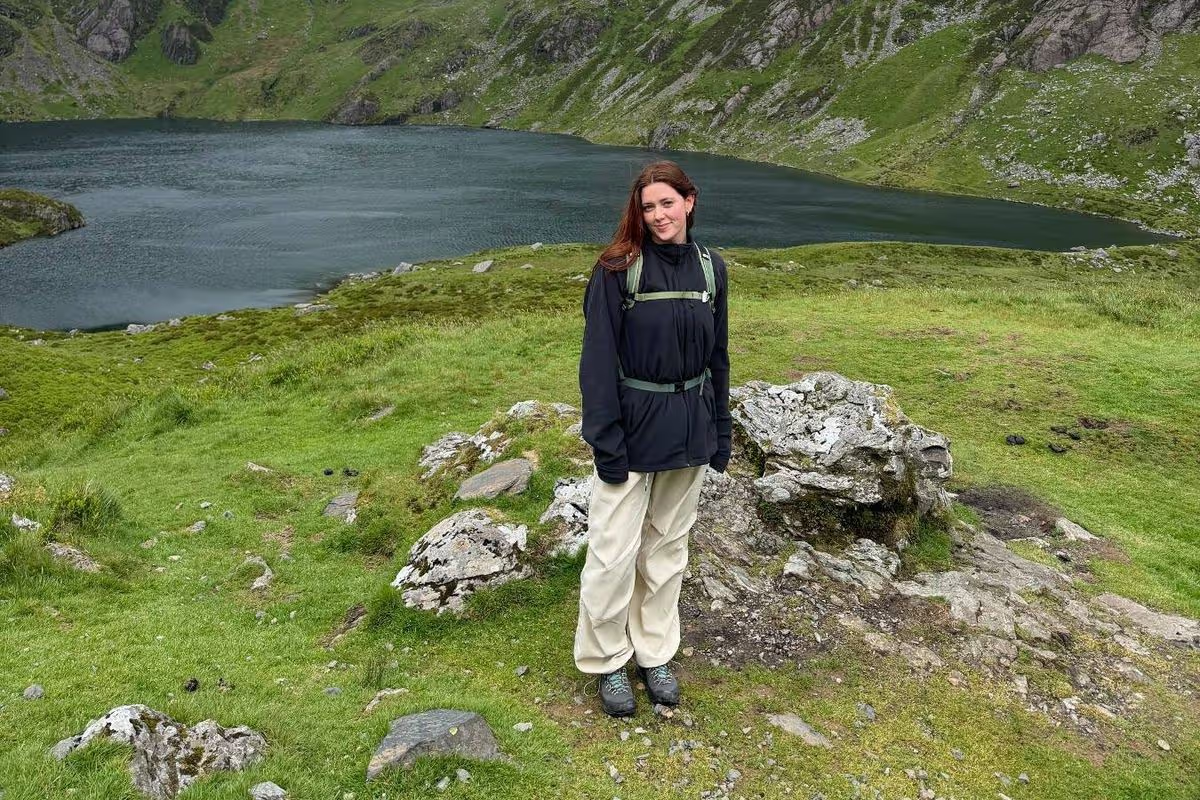
It’s often cited as one of the best hikes in Snowdonia (Eryri). Cadair Idris is an 893-metre mountain in the southern part of the park and is renowned for its wild and rugged scenery. To me, it looked like its surroundings could belong in the likes of Peru or Southeast Asia, with its tropical plants, waterfalls and vibrancy of its green grass.

But of course, like any beautiful place in Wales, it reminded me exactly where I was when I spotted sheep dotted around its cliffs, even on the steepest parts. It looked as though the sheep could fall off the edge of the world, taking me with them, as I fought for hours against the growing pain in my shins, with each step up and up to the peak.

The route

I was taken up the Minffordd Path route, which is described as the shortest yet steepest route to the mountain’s summit, tackling a demanding 10 km walk. Overall it’s set to take up to four to five hours to complete, and in turn you are rewarded with dramatic and captivating views of the national park’s landscape.

The route begins at Dôl Idris car park and takes you past the Cadair Idris visitor centre, which quickly fills up. We were recommended to get there early in the morning to beat the pile-up and were thankful that we did; setting off on our walk at around 8am meant we got to experience the quietness of the route in all of its natural wonder. Albeit, the lie-in would have also been appreciated.

Running parallel along the stream which runs parallel to the stream which leads to Llyn Cau, the lake at the heart of the base of the mountain. It was immediately, when taking on these steep steps along the river, that I felt like I could be abroad.

Not only was the sun shining down on us, but the water was trickling down, with tropical plants growing around us, and it felt as wild and wonderful as the experiences I had in Thailand or the pictures I’ve seen of hikes in Vietnam or Peru.

This continued as we made our way out of the forest area and into the open air, with nothing but pure greenery around us, and the mountain stood proudly ahead. The second phase levels lightly as you enter a rocky amphitheatre, with up-close and personal views of the lake.

Pushing past slate and rocks, many of which are loose and therefore can be difficult to navigate, this section and throughout the walk, requires concentration and care with each step. A quick trip or fall could have you stumbling, and that’s why lots of hikers opt to go armed with sticks to help gain their balance and push them through.

By the time I made it to the top of the mountain, the weather dramatically changed, from sunny to high winds which were extremely cold. It’s this that can catch a lot of amateur hikers out, and I think it’s always best to go armed with windproof and waterproof layers, as they say ‘don’t dress for the car park’.

The real treat after that consistently steep hike upwards is this – the flat walk along the edge of the entire mountain before reaching its penultimate peak. Seeing it all from a circular angle gave you a real treat at each point whenever I decided to stop and take a breath.

Wales is the gift that keeps on giving when it comes to my explorations, and Cadair Idris was no exception to that. If you’re willing to take on the circular route and the real challenge of its steep and unsteady ground, then you will be rewarded with a touch of paradise and views you’ll continue to daydream about.

Source link

Second coach added as world’s first 250-mile Wetherspoons pub crawl sells out

Beer lovers prayers have been answered as this Coach firm has just launched a 250-mile-long pub crawl starting early at 9:15am from Dolgellau and taking in many famous Spoons along the way

Nobody loves an organised pub crawl more than the Brits – but this one may have just topped them all.

While some make pilgrimages to a significant place or worship or set out on a journey to deepen their spirituality, this particular tour will have travellers doing less thinking and more drinking.

Lloyd’s Coaches has launched the ultimate ‘Spoons Pilgrimage’, a 250-mile round journey visiting a whole load of JD Wetherspoon pubs throughout North Wales, and venturing slightly beyond the border as well. The route begins and ends in Dolgellau.

It’s such a brilliant idea that other travel companies are likely kicking themselves, wondering why they didn’t come up with the scheme first. Yet the concept is pretty simple.

READ MORE: Airport sandwich rule could mean you are breaking the lawREAD MORE: Europe’s cheapest summer getaway is ‘one of the safest’— just 3 hours from the UK

For the very reasonable price of just £20, not including any drinks bought along the way, passengers can embark on a day trip like no other.

Departing nice and early from Dolgellau, Wales at 9.15am, the coach will head towards the inaugural Spoons in Oswestry, known as the Wilfred Owen. It’s expected that the coach arrives at noon, with attendees given a 45-minute stop to knock back a pint or two.

Then it’s time to get back on board and head on towards The Castle Hotel in Ruthin, under an hour’s drive away. Here they’ll have another 45-minute stop, before carrying on to The Picture House in Colwyn Bay, a further 45-minute drive.

It’s shaping up to be a long day on the road already, but fortunately, it’s a shorter drive this time around to the Palladium in Llandudno: the most impressive of all the establishments on the route. At this point, six county boundaries have been crossed, but there’s still plenty more to go.

Perhaps feeling a little bit giddy from all of the drinking thus far, punters will head to Tafarn y Porth in Caernarfon, then Pen Cob in Pwllheli for 7.30pm, for the final drinking stop.

Lloyds Coaches announced in a statement: “Ready for a legendary day out without the ‘who’s driving?’ debate. Grab your mates and hop aboard for the Lloyds Coaches Wetherspoons Tour. We’re hitting some of the most iconic pubs across North Wales and the border. Whether you’re in it for the affordable ales, the legendary breakfasts, or just to check the carpet patterns, this is the trip for you!”

The never-before-seen Wetherspoons Tour is set to be held on Saturday, June 27, and with the initial Facebook post gaining so much traction, who knows, it could go on to be a regular event.

Full of excitement, the travel firm later added: “We’re filling up faster than a pint of Ruddles on a Tuesday. At this rate, we’re seriously asking ourselves: ‘Do we need to add another coach’.”

On Wednesday afternoon, Lloyds Coaches added a second coach on the same day, after the first sold out.

Source link