nomination

Trump pulls nomination of Casey Means for surgeon general

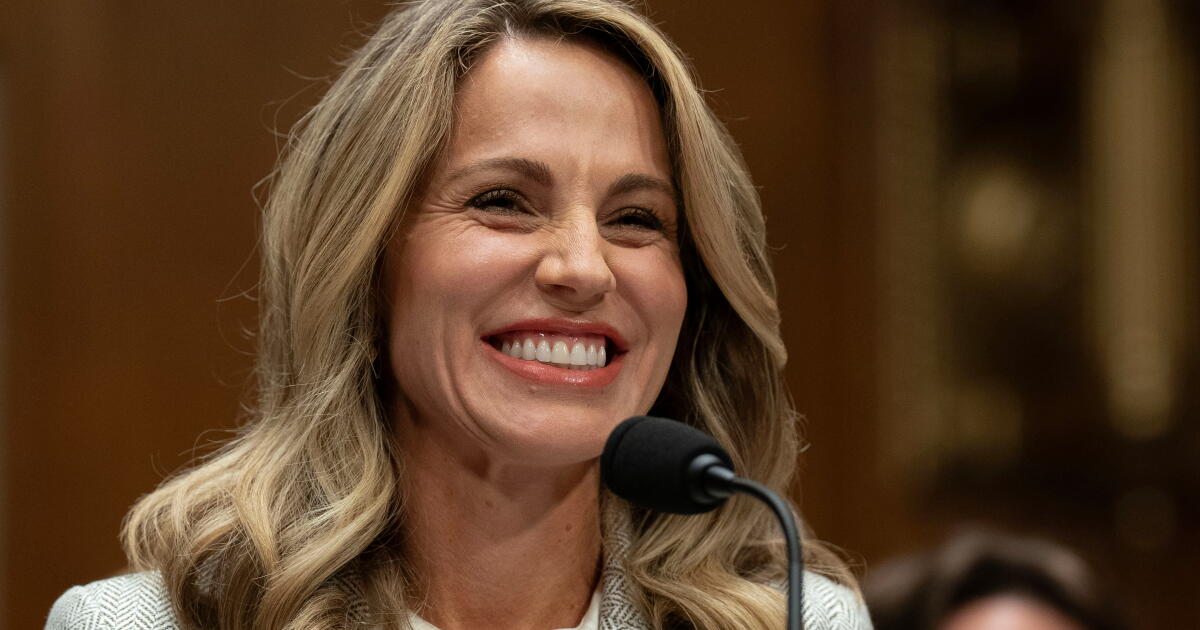
Casey Means speaks during a Senate Committee on Health, Education, Labor, and Pensions hearing on her nomination to be surgeon general on February 25. On Thursday, President Donald Trump pulled her nomination. File Photo by Bonnie Cash/UPI | License Photo

April 30 (UPI) — President Donald Trump on Thursday pulled the nomination of Casey Means for surgeon general and replaced her with Dr. Nicole Saphier.

Means, a medical doctor, is a Make America Healthy Again activist who doesn’t have an active medical license.

Saphier is a working radiologist at Memorial Sloan Kettering Cancer Center in New York and a former Fox News contributor.

Trump announced the appointment on Truth Social.

“Nicole is a STAR physician who has spent her career guiding women facing breast cancer through their diagnosis and treatment while tirelessly advocating to increase early cancer detection and prevention, while at the same time working with men and women on all other forms of cancer diagnoses and treatments. She is also an INCREDIBLE COMMUNICATOR, who makes complicated health issues more easily understood by all Americans. Dr. Nicole Saphier will do great things for our Country, and help, ‘MAKE AMERICA HEALTHY AGAIN,'” the president posted.

Means’ nomination had stalled in the Senate. In February, she answered senators’ questions about vaccines, psychedelics and abortion pills.

Trump blamed Sen. Bill Cassidy, R-La., a physician, because he had refused to say if he would support Means.

He said, in a separate post: “Hopefully all of the Great Republican People of Louisiana, which I won, BIG, three times, will be voting Bill Cassidy OUT OF OFFICE in the upcoming Republican Primary!”

In January, Trump endorsed Rep. Julia Letlow, R-La., for the Louisiana Republican primary against Cassidy.

When reporters asked Cassidy about Trump blaming Means’ failed nomination on him, Cassidy said, “I can promise you, there are multiple people on the committee who decided to vote no,” Politico reported.

Artemis II pilot Victor Glover (L) and mission specialist Christina Koch meet with President Trump in the Oval Office of the White House on Wednesday. Photo by Graeme Sloan/UPI | License Photo

Source link

Trump pulls nomination for stalled surgeon general nominee Means and says he’ll put forth Saphier

President Trump says he’s nominating Fox News Channel contributor Nicole Saphier for surgeon general after Casey Means’ path forward stalled in the Senate over questions about her experience and her stance on vaccines.

In a social media post Thursday, the Republican president said Saphier is “a STAR physician who has spent her career guiding women facing breast cancer through their diagnosis and treatment.”

Senators of both major political parties grilled Means on her vaccine stance and other health topics during a tense confirmation hearing, deepening doubts about her ability to secure the votes she needs for the role.

Earlier Thursday, Trump on social media commended Means as “a strong MAHA Warrior,” also criticizing the “intransigence and political games” from GOP Sen. Bill Cassidy of Louisiana, who interrogated Means about vaccines during the hearing.

The withdrawal of Means’ nomination to be the next U.S. surgeon general is a blow to Health Secretary Robert F. Kennedy Jr. and his movement, which championed Means for the role as the country’s top doctor despite her nontraditional path in medicine and some controversial past remarks on vaccines and other health topics.

The withdrawal comes after tense exchanges between Means and lawmakers of both parties threw into question whether she could secure enough votes to advance out of the Senate health committee. Her nomination had languished since her confirmation hearing in late February, even as activists from Kennedy’s Make America Healthy Again movement orchestrated a push to support her bid by surging phone calls to Republican senators Lisa Murkowski of Alaska and Susan Collins of Maine, who had both indicated reservations with the pick.

In nominating Means last May, Trump sought to hire a close ally of Kennedy as the nation’s doctor. Means, a Stanford-education physician whose disillusionment with the healthcare system led to her career as an author and entrepreneur, promotes ideas popular with the MAHA movement, including that Americans are overmedicalized and that diet and lifestyle changes should be at the center of efforts to end widespread chronic disease.

Source link

Warsh says he got no pressure from Trump to cut rates even as president publicly pushes for them

President Trump’s nominee to chair the Federal Reserve said Tuesday that he never promised the White House that he would cut interest rates, even as the president renewed his calls for the central bank to do so.

“The president never once asked me to commit to any particular interest rate decision, period,” Kevin Warsh, a former top Fed official, said under questioning by the Senate Banking Committee. “Nor would I ever agree to do so if he had. … I will be an independent actor if confirmed as chair of the Federal Reserve.”

Warsh’s comments came just hours after Trump, in an interview on CNBC, was asked if he would be disappointed if Warsh didn’t immediately cut rates and responded, “I would.”

The comments underscore the challenge faced by Warsh, 56, a financier and former member of the Fed’s board of governors whom Trump named in January to replace the current Fed chair, Jerome H. Powell. Democrats on the committee accused Warsh of flip-flopping on interest rates over the years, supporting higher interest rates under Democratic presidents and advocating rate cuts during Trump’s time in office. Investors are watching the hearing closely to see how Warsh balances Trump’s demands with worsening inflation, as the war in Iran pushes up the price of gasoline.

Higher inflation typically leads the Fed to raise rates, or at least keep them unchanged, rather than cut them. When the Fed changes its key rate, it can affect mortgages, auto loans and business borrowing.

Yet Warsh’s account was challenged by Sen. Ruben Gallego, an Arizona Democrat, who said that Wall Street Journal reporting last year found that Trump had urged Warsh to reduce borrowing costs.

“Who’s lying here? Is it you or the president?” Gallego asked.

“I think those reporters need better sources,” Warsh responded.

For all the back and forth, the hearing didn’t appear to advance Warsh’s nomination, which has been delayed by a Justice Department investigation into the Fed and Powell, over brief testimony Powell gave last June before the same panel about a building renovation.

Sen. Thom Tillis, a North Carolina Republican on the committee, reiterated Tuesday he wouldn’t vote for Warsh until the investigation is dropped. With the committee closely divided and all Democrats opposed to his nomination, Tillis’ opposition is enough to bottle it up in committee.

“We have got to get rid of this investigation,” Tillis said, “so I can support your nomination.”

Tillis has previously said that all seven Republicans on the committee have signed a letter stating that Powell did not commit a crime when he testified before the panel last June. Federal prosecutors, led by U.S. Atty. Jeanine Pirro, are investigating his testimony for potential perjury, though a judge said last month they offered no evidence to support the charge when he threw out subpoenas Pirro had issued.

Prosecutors from her office as recently as last week sought access to the Fed’s building project but were turned away, revealing that the Trump administration has not reversed course despite opposition from members of his own party that are essential to Warsh’s confirmation.

In his opening remarks, Warsh told the Senate Banking Committee that one of his top goals would be to fight inflation, which remains elevated at 3.3% annually.

“Congress tasked the Fed with the mission to ensure price stability, without excuse or equivocation, argument or anguish,” Warsh said. “Inflation is a choice, and the Fed must take responsibility for it.”

Warsh would be in a tough spot if confirmed. Inflation is worsening, making it much harder for the Fed to implement the interest rate cuts Trump so desperately seeks. The conflict could also slow the economy, as well as hiring. And if Warsh ultimately becomes chair, he may very well find his predecessor, Powell, still sitting on the Fed’s governing board, an uncomfortable arrangement that hasn’t occurred since the late 1940s.

Warsh said the Fed’s political independence is “essential,” and that the central bank wasn’t threatened when “elected officials — presidents, senators, or members of the House — state their views on interest rates.” Trump has repeatedly urged Powell to cut the Fed’s key rate from its current level of about 3.6% to as low as 1%, a view almost no economist shares.

Sen. Elizabeth Warren, a Massachusetts Democrat, said that Trump has not just stated his opinions on rates, but has sought to fire a Fed governor and is investigating Powell.

“The Senate should not be aiding and abetting Donald Trump’s illegal takeover of the Fed by installing his chosen sock puppet as chair,” she said Tuesday.

Warren also noted that Warsh has not disclosed all of his financial holdings, which include investments in startups and private companies, or the size of those financial stakes. For example, Warsh has said he has holdings in SpaceX and Polymarket, but has not said how large those investments are.

Warren charged that Warsh is not in compliance with ethics requirements. Warsh argued that the Office of Government Ethics has signed off on his plan to sell all his assets within 90 days of his confirmation.

The turmoil could make a potential transition from Powell to Warsh an unusually turbulent one for the world’s most pivotal central bank, which has historically experienced smooth transfers of power. Should the change in leadership prove particularly bumpy, it could unnerve markets and lift longer-term interest rates.

Powell’s term as chair ends May 15. He said last month that he would remain as chair until a successor is named. Powell also is serving a separate term as a member of the Fed’s governing board that lasts until January 2028. Fed chairs typically leave the board when their terms as chair end, but Powell said last month he would remain on the board, even if a new chair is approved, until the investigation is dropped.

Trump said he would fire Powell if he attempted to remain at the Fed. Yet Trump’s previous attempt to remove a Fed governor, Lisa Cook, has been tied up in court. During oral arguments in January, a majority of justices on the Supreme Court appeared to lean toward leaving Cook at the Fed.

Rugaber writes for the Associated Press.

Source link

Trump nominates Erica Schwartz, former deputy surgeon general, to serve as CDC director

President Trump on Thursday nominated Erica Schwartz, a former deputy surgeon general, to be the next director of the Centers for Disease Control and Prevention.

In a social media post, Trump described Schwartz as “incredibly talented” and said, “She is a STAR!”

The Atlanta-based CDC, which is charged with protecting Americans from preventable health threats, has been in turmoil since Trump returned to office more than a year ago, with a succession of mostly temporary leaders.

The agency is overseen by Health Secretary Robert F. Kennedy Jr., who had promised not to change the nation’s vaccination schedule. But shortly after taking office, Kennedy said he was going to investigate the childhood vaccine schedule and went on to attempt a substantial rewrite of vaccine recommendations for kids. Some of those efforts were put on hold recently by a federal judge.

The administration’s first pick to run the CDC was former Florida congressman Dr. David Weldon, but his March 2025 Senate confirmation hearing was canceled an hour before it was to begin. Weldon said at the time that he’d been told not enough senators were willing to vote for him.

The White House then moved on to Susan Monarez, who had been serving as the CDC’s acting director. Monarez was confirmed by the Senate, but she was ousted in less than a month. Trump administration officials said she wasn’t aligned with their agenda so they terminated her.

Several key CDC scientific leaders resigned in protest, saying Monarez’s dismissal dashed their hopes that a CDC director would be able to guard against political meddling in the agency’s scientific research and health recommendations.

Since then, there’s been a revolving door in agency leadership, with the short-term role of acting director being passed from one Washington-based Health and Human Services official to another. National Institutes of Health Director Jay Bhattacharya has been overseeing the CDC the past several weeks.

During a House Appropriations Committee hearing Thursday, Kennedy said the new CDC team was “extraordinary.”

“I think this new team is really going to be able to revolutionize CDC and get it back on track,” he said.

Schwartz holds multiple academic credentials, including both medical and law degrees. Her career has largely been spent in military uniform, including in a leadership position at the U.S. Coast Guard where she oversaw the organization’s system of 41 clinics and 150 sick bays.

She later served as deputy surgeon general, where she helped lead uniformed medical and health professionals posted at the CDC and government health agencies that serve the general public.

Schwartz could not be reached for comment.

Trump also announced the appointment of Sean Slovenski, a former Walmart executive, as CDC deputy director and chief operating officer. Dr. Jennifer Shuford, Texas health commissioner, was named the CDC’s deputy director and chief medical officer. And Dr. Sara Brenner, a former Food and Drug Administration administrator, was designated as a senior counselor for public health to Kennedy.

In a social media post Thursday, Kennedy congratulated Schwartz and the other appointees and said he looks “forward to working together to restore trust, accountability, and scientific integrity” at the CDC.

But Aaron Siri, a lawyer and ally of Kennedy in attacking vaccines and pharmaceutical companies, criticized Schwartz’s selection. In a social media post, Siri lambasted Schwartz’s past promotion of vaccinations and said “she lacks the basic ethics and morals to lead the CDC.”

Schwartz’s nomination comes as Dr. Casey Means, Trump’s pick for another key health-related role, U.S. surgeon general, has had difficulty getting confirmed.

Means’ languishing nomination after appearing for a confirmation hearing in February reflects the skepticism that lawmakers of both parties have expressed toward the direction in which Kennedy has taken his department.

Stobbe writes for the Associated Press. AP writer Ali Swenson contributed to this report.

Source link

Mark Sanford makes a last-minute bid to return to Congress — again — in South Carolina

Mark Sanford, the former South Carolina congressman and governor whose political ascendancy was stalled by a 2009 affair, wants to return to Congress — again.

Just hours ahead of the deadline to do so, Sanford filed candidacy paperwork with state officials to run in the June 9 GOP primary for South Carolina’s 1st District seat, which he has held twice before.

Sanford’s first political office was in the 1st District. An outsider with almost no name recognition, he navigated a primary for the open seat, finishing second before winning the runoff. He served for six years before his outside run at governor, again pushing his way through a crowded primary, then knocking off the last Democrat to hold the office.

But his eight years were overshadowed by the Appalachian Trail, which became shorthand for Sanford’s disappearance to go to Argentina to see his lover. Sanford’s wife, family and his staff didn’t know where he was.

Beating back both an ethics inquiry and calls to resign, Sanford held fast, leaving office on his own terms.

In 2013, Sanford won back his old seat, beating 15 other candidates in a primary and runoff. He won two more full terms before falling to a GOP challenger in 2018 who had President Trump’s backing.

The seat would go on to flip to Democratic hands that fall for the first time in decades, won back by GOP Rep. Nancy Mace in 2020. Mace is running for governor this year.

Sanford, 65, also briefly ran for president in 2020, challenging Trump for the nomination in what he characterized as a “long shot” effort around warnings about the national debt. Some, including Sanford’s former gubernatorial staffers, initially questioned whether the effort was a serious one, positing that it might be an effort to stay relevant after the 2018 defeat.

Sanford dropped out of the contest just ahead of the New Hampshire primary. Sanford’s home state would ultimately opt not to hold a 2020 GOP presidential primary, clearing the way for Trump’s nomination in South Carolina.

Sanford did not immediately return a message seeking comment on Monday. True to the themes that have dominated his political thinking, an email release on Sanford’s candidacy focused on the national debt, with the candidate saying he felt 1st District voters wanted a representative “who is an advocate for financial sanity that has been lost in Washington for all too long.“

Since leaving the U.S. House, Sanford has hung onto more than $1.3 million in a federal campaign account, funds that he can now use in a primary already crowded with multiple Republican and Democratic candidates.

Kinnard and Collins write for the Associated Press.

Source link

Means’ surgeon general nomination is stalled as senators question her experience and vaccine stance

Wellness influencer Dr. Casey Means’ nomination to be U.S. surgeon general is stalled a month after senators of both major political parties grilled her on vaccines and other health topics during a tense confirmation hearing, deepening doubts about her ability to secure the votes she needs for the role.

The nomination has languished despite ongoing efforts from the White House and Make America Healthy Again activists, revealing how intractable rifts over health policy can be even when Congress has shown deference to President Trump. It’s become the latest snag in Health Secretary Robert F. Kennedy Jr.’s agenda after two legal setbacks last week.

Means, a 38-year-old Stanford-educated physician who became disillusioned with traditional medicine and did not finish her surgical residency program, has faced scrutiny for her lack of experience and potential conflicts. Another sticking point has been her close alignment with Kennedy, whose efforts to dramatically pull back vaccine recommendations have been slammed by lawmakers and medical groups.

To advance to a full Senate vote, Means likely needs every Republican on the Senate Health, Education, Labor and Pensions Committee to support her nomination. But after last month’s hearing, two of them — Sens. Lisa Murkowski of Alaska and Susan Collins of Maine — told reporters they still had questions for her.

Murkowski told reporters Tuesday that “I’m just in the same spot” when it comes to those hesitations. Collins and Republican committee chairman Sen. Bill Cassidy, a physician from Louisiana who interrogated Means about vaccines during the hearing, didn’t respond to multiple inquiries about the delay.

White House spokesman Kush Desai said in a statement that the Trump administration has been having “productive conversations with the Senate” to advance Means. He added that her “elite academic credentials, research background and advocacy on America’s chronic disease epidemic will make her a critical asset for President Trump’s push to Make America Healthy Again.”

Kennedy spokesman Andrew Nixon reinforced the Republican administration’s support for Means and praised her message calling for healthier lifestyle choices rather than “sick care.”

Contentious hearing set the stage for a tough path to confirmation

Means promotes ideas popular with the MAHA movement, including that Americans are overmedicalized and that diet and lifestyle changes should be at the center of efforts to end widespread chronic disease.

But she’s been criticized for having an inactive medical license, for sometimes failing to disclose financial relationships with brands she promotes and for some of her past health-related comments.

Senators asked her during her hearing about how she would speak to the public about vaccines.

Murkowski and Cassidy pressed Means about her past doubts about the birth dose of the hepatitis B vaccine, which the U.S. Centers for Disease Control and Prevention stopped recommending for all children late last year in a move later temporarily blocked by a federal judge. Means called the hepatitis B vaccine important and lifesaving but said parents should make their own decisions with their doctors.

Cassidy also asked Means whether she would advise Americans to vaccinate against the flu and measles amid outbreaks across the country. She didn’t make that commitment, instead emphasizing the importance of informed consent.

Collins asked Means about her past advocacy for the therapeutic use of psychedelic mushrooms. Means, who has spoken positively of her own experience with the drugs, said she wouldn’t recommend psychedelics for the American public.

Kennedy’s supporters put pressure on hesitant senators

Once it appeared Murkowski and Collins were undecided, MAHA activists orchestrated a push to support Means’ bid by surging phone calls to the two senators.

“Please call both of them. Call them time after time. Get your friends to call them,” Tony Lyons, head of the Kennedy-aligned group MAHA Action, told supporters earlier this month.

Others have loudly opposed Means’ nomination. Dr. Jerome Adams, Trump’s first-term surgeon general, has repeatedly called her unqualified for her lack of an active medical license. He said in an interview that Republicans in Congress and in the Trump administration have told him they disapprove of the pick but see it as Kennedy’s choice.

“What I keep hearing from folks is, ‘This is what Bobby wants,’” he said.

While surgeons general aren’t mandated by law to have an active medical license, they are required to be part of the U.S. Public Health Service Commissioned Corps, a group of health professionals that says members should have up-to-date licenses.

Means said during her confirmation hearing that she had voluntarily made her Oregon medical license inactive, and that Adm. Brian Christine, who runs the Commissioned Corps, had testified that she was eligible to serve.

Even if Means advances out of committee, she might have difficulty securing confirmation by the full 100-member Senate. Republican Sen. Thom Tillis of North Carolina, who isn’t seeking another term, told the Associated Press that he’s leaning against voting for Means.

“Her resume already puts me on alert — and then I don’t think she did herself any favors in the hearing,” Tillis said.

Means’ confirmation delay is unusually long

At nearly 300 days since her nomination in May, Means’ confirmation process has taken almost twice as long as the average presidential pick in Trump’s second term, according to data from the nonprofit Partnership for Public Service. The group found that in the first 400 days, the average time between nomination and confirmation for Trump’s nominees was 157 days.

Sometimes the process has gone far more quickly. Markwayne Mullin, the new Department of Homeland Security secretary sworn in Tuesday, had his confirmation hearing, floor vote and swearing-in all within a weeklong period.

One reason for Means’ drawn-out nomination is the birth of her son, which happened last October on the day of her initially scheduled confirmation hearing.

But Chris Piper, manager of public policy and stakeholder engagement at the Partnership for Public Service, said the length of time that has passed since Means’ rescheduled confirmation hearing also is unusual. He said candidates are often voted out of committee within a week of their hearing.

“A monthlong delay following a hearing is atypical for most nominations, particularly at this level of position,” he said.

Swenson writes for the Associated Press. AP writers Joey Cappelletti and Stephen Groves in Washington contributed to this report.

Source link

Senate Republicans advance Markwayne Mullin’s nomination to lead DHS

March 23 (UPI) — Senate Republicans have advanced the nomination of Sen. Markwayne Mullin for secretary of the Department of Homeland Security, paving the way for his confirmation as early as Monday evening.

The Senate voted 54-37 Sunday afternoon to invoke cloture, clearing a procedural hurdle permitting a final vote on his confirmation.

The vote was mostly along party lines, with Democratic Sens. John Fetterman of Pennsylvania and Martin Heinrich of New Mexico joining their Republican colleagues in approving the motion.

Nine lawmakers, including eight Democrats, did not vote, including GOP Sen. Rand Paul of Kentucky, chair of the Homeland Security and Governmental Affairs Committee, who has been vocally opposed to Mullin’s confirmation.

Paul was the only Republican to vote against the Oklahoma senator when his committee voted last week to advance his nomination to the full Senate.

The Senate is expected to vote on his confirmation Monday night.

President Donald Trump nominated Mullin after firing Kristi Noem following months of controversy over her leadership of the department, especially after the fatal shootings of two U.S. citizens by federal immigration officers in Minneapolis and a $220 million advertising contract.

Fetterman was among those who called for Noem’s firing, and said he was supportive of Mullin to lead the DHS.

He has said he approached Mullin’s confirmation “with an open mind.”

“My AYE is rooted in a strong committed, constructive working relationship with Senator Mullin for our nation’s security,” he said.

Following Sunday’s vote, Heinrich issued a statement, similarly addressing the Oklahoma senator as “a friend” with whom he shares “a very honest and constructive working relationship.”

“We often disagree and when we do, we work to find whatever common ground we share,” he said.

“I have also seen first-hand that Markwayne is not someone who can simply be bullied into changing his views, and I look forward to having a secretary who doesn’t take their orders from Stephen Miller.”

Miller is Trump’s far-right Homeland Security adviser.

Mullin is likely to be confirmed by the GOP-controlled Senate, despite opposition from Paul, who voted against him during last week’s committee hearing and did not vote on Sunday.

Paul confronted Mullin during the committee hearing over reportedly calling him “a freaking snake.” He also accused Mullin of lying when he told a reporter he had told Paul that he “completely” understood why a man had attacked him in late 2017, breaking five of his ribs.

“You got a chance today. You can either continue to lie or you can correct the record,” Paul said in his opening statement.

“You have never had the courage to look me in the eye and tell me that the assault was justified, so today, you’ll have your chance.”

When it was Mullin’s turn to give his opening statement he began by addressing Paul’s comments, stating that he had made the remarks while Paul was in the same room and that it was due to his behavior of seemingly going against hardline Republican policies.

“As far as my terms of a snake in the grass, I worked to try to fix problems. I’ve worked with many people in this room. It seems like you fight Republicans more than you work with us.”

President Donald Trump presents the Commander in Chief’s Trophy to the Navy Midshipmen football team during a ceremony in the East Room of the White House on Friday. The award is presented annually to the winner of the football competition between the Navy, Air Force and Army. Navy has won the trophy back to back years and 13 times over the last 23 years. Photo by Bonnie Cash/UPI | License Photo

Source link

‘Sinners’ wins four Oscars from a historic 16 nominations

p]:text-cms-story-body-color-text clearfix”>

“Sinners” entered the night with the record for the most Oscar nominations for a single film, with 16.

It leaves with four awards, won by Ryan Coogler for original screenplay, Michael B. Jordan for lead actor, Autumn Durald Arkapaw for cinematography and Ludwig Göransson for score. Arkapaw became the first woman to ever win in her category.

It seemed every time the film’s title came up during the broadcast there would be cheers and a swell of emotion from the audience. The live performance of the nominated song “I Lied to You” re-created the fantastical moment from the film in which generations of musicians collide, weaving together past, present and future.

Since its release in April of last year, the film has been a cultural touchstone and point of extended conversation on its way to some $370 million in worldwide box office. Among this year’s best picture nominees, only “F1” earned more, with $631 million. When Oscars host Conan O’Brien mentioned the name of the film in his opening monologue, it generated a huge ovation from the room.

Directed and written by Coogler, the film tells the story of twin brothers, Smoke and Stack, both played by Jordan. On the opening night of their juke joint in 1930s Mississippi, they are beset by a small band of vampires, intent on turning everyone inside into bloodsuckers.

In accepting his lead actor award, Jordan thanked Warner Bros. executives Mike De Luca and Pam Abdy “for believing in this dream, this vision of Ryan Coogler and betting on the culture and betting on original ideas and original artistry.” (Including its Oscars for “One Battle After Another” and “Weapons,” Warners Bros. ended the night with an 11-Oscar tally, tying the record for most wins by a single studio.)

Across what seemed an extremely long awards season — a run that was even longer for “Sinners” due to its spring release date — the film had many ups and downs. But its momentum seemed to be peaking at just the right time, as seen with the crucial wins for Jordan and the cast at the Actor Awards on March 1.

Regardless of how one feels about its final tally at the Academy Awards, the movie has already firmly established its continued relevance. As The Times’ Greg Braxton recently wrote, “‘Sinners’ is now being increasingly hailed in Hollywood as a groundbreaking symbol of Black artistic excellence, as well as a timely pushback to the divisive political climate that has reached fever-pitch proportions.”

Source link

PPP candidates urge Seoul mayor to end nomination standoff

Seoul Mayor Oh Se-hoon speaks during a New Year’s greeting event at the headquarters of the Korea Chamber of Commerce and Industry in Seoul, South Korea, 07 January 2026. Photo by YONHAP / EPA

March 13 (Asia Today) — Several candidates from South Korea’s conservative People Power Party publicly urged Seoul Mayor Oh Se-hoon on Friday to apply for the party’s nomination for the upcoming local elections, as his refusal to do so has prolonged internal tensions.

Oh has delayed submitting his candidacy application while calling for broader party reforms, prompting criticism from party members who say the standoff is deepening divisions ahead of the June 3 local elections.

Incheon Mayor Yoo Jeong-bok, who has secured the party’s nomination for his reelection bid, visited the party’s headquarters in Seoul and called on Oh to move forward with the nomination process.

“The party is in confusion,” Yoo said. “I hope Mayor Oh will quickly apply for the nomination and confidently join the party’s path forward.”

Yoo also urged former nomination committee chairman Lee Jung-hyun – who abruptly resigned earlier in the day – to reconsider his decision and return to the role.

“I ask Chairman Lee to withdraw his resignation and fulfill his responsibility to ensure a successful nomination process,” Yoo said, while also calling on party leader Jang Dong-hyuk to strengthen unity within the party.

South Chungcheong Province Gov. Kim Tae-heum also called on Oh to demonstrate leadership as a senior party figure.

“I understand Mayor Oh’s position,” Kim said. “But as a senior member of the party, I hope he will show dedication to keeping the party united.”

Kim had previously delayed submitting his own nomination application alongside Oh but completed the process Thursday after discussions with party leadership.

Some party figures have issued sharper criticism.

Lee Sang-kyu, a People Power Party candidate for Seoul mayor, accused Oh of creating unnecessary pressure within the party while insisting on the creation of an “innovation campaign committee.”

Another mayoral hopeful, Yoon Hee-sook, wrote on social media that it is not the time for internal disputes over candidate registration.

“Primary candidates must unite and focus on confronting the Lee Jae-myung administration while working toward party reform,” she said.

Criticism has also emerged within the party leadership over Oh’s proposal to launch a reform-oriented campaign committee.

Park Jun-tae, chief of staff to the party leader, questioned whether the proposal effectively amounted to a demand for Jang to step down.

“If the proposal implies that the party leader should resign, it would be difficult for the party to accept,” Park said.

Senior lawmaker Na Kyung-won also criticized Oh’s position in a social media post Thursday, urging him to stop escalating tensions within the party.

— Reported by Asia Today; translated by UPI

© Asia Today. Unauthorized reproduction or redistribution prohibited.

Original Korean report: https://www.asiatoday.co.kr/kn/view.php?key=20260313010004055

Source link