noise

‘Death of a Salesman’ at Noise Within disappoints, ‘The Price’ thrives

When the world is topsy-turvy, the theatergoing public seeks explanations. Arthur Miller provides something better: moral intelligence. He doesn’t tell his audience what to think but challenges them to think harder.

There’s clearly a hunger right now for Miller’s work. His plays are back in high demand in Los Angeles, New York and London.

A new revival of “Death of a Salesman,” starring Nathan Lane and Laurie Metcalf, is in previews on Broadway. And a less starry production of Miller’s masterpiece opened last weekend at Pasadena’s A Noise Within.

“All My Sons,” Miller’s breakthrough play about capitalism’s warped ethics in the guise of a domestic drama, just finished a successful run at Antaeus Theatre Company in Glendale. And National Theatre Live will screen the recent London production, starring Bryan Cranston and Marianne Jean-Baptiste, in April and May courtesy of Boston Court Pasadena and L.A. Theatre Works. (Late last year, I caught a screening at the Wallis of another London revival, the 2019 production starring Bill Pullman and Sally Field.)

Dana Dewes and Scott G. Jackson stand in a living room in "The Price."

Dana Dewes and Scott G. Jackson in “The Price” at Pacific Resident Theatre in Venice.

(Ian Cardamone)

“A View From the Bridge,” a play whose revenge plot hinges on a tip to immigration authorities, could hardly be more timely. The same could just as unnervingly be said about “The Crucible,” Miller’s parable about the McCarthy witch hunts. The play, always front of mind when power is being abused, has given rise to a modern feminist riposte, Kimberly Belflower’s thrilling “John Proctor Is the Villain,” which is coming to the Mark Taper Forum next year.

Not to be missed right now is a small, exquisitely acted production of “The Price” at Pacific Resident Theatre. Miller’s 1968 play, written during the agonizing days of the Vietnam War, concerns the disposition of the remains of a once-illustrious estate. As two estranged brothers working with an 89-year-old appraiser try to put a price on the antiques and personal effects their father — a casualty of the Great Depression — left behind, the family history they both tried to bury explodes.

Miller’s plays compel theatergoers to connect the dots not only between the past and the present but also between the political and the personal. His dramas set domestic conflicts against the backdrop of societal systems that insidiously warp the playing field for their characters.

Miller is often contrasted with Tennessee Williams. And while it’s true that Miller is more of a social realist and Williams is more of a dramatic poet, Miller’s carefully carpentered plays are emotionally supple and Williams’ lyrical dramas are acutely mindful of the power dynamics of our collective life.

Jason Huber, Dana Dewes and Scott G. Jackson stand in a living room in "The Price."

The realism of “The Price” is as heavy as the old wooden furniture that the Franz brothers, Victor (Scott G. Jackson) and Walter (Jason Huber), are trying to profitably offload.

(Ian Cardamone)

Director Elia Kazan was drawn to both playwrights because he understood that they were as interested in the stories of individual Americans as they were in the larger tale of America itself. Kazan found in both writers more than enough poetry and grit to satisfy the new breed of realistic actor he was showcasing on stage and screen.

“Death of a Salesman” and “The Price” are vastly different plays. The former, which Miller once considered calling “The Inside of His Head,” is fluidly constructed, playing fast and loose with time as it tracks the disintegrating mental life of down-and-out salesman Willy Loman. “The Price,” by contrast, is set inside what looks at first glance to be a crowded antique shop but turns out to be the apartment once inhabited by the Franz family after the market crash changed everything.

The realism of “The Price” is as heavy as the old wooden furniture (stacked and sorted on Rich Rose’s eye-catching set) that the Franz brothers, Victor (Scott G. Jackson) and Walter (Jason Huber), are trying to profitably offload on a shrewd antique dealer named Gregory Solomon (Richard Fancy). “Salesman” is more limber in its dramaturgy, shifting locations and blurring chronologies. But it too depends on the ability of actors to embody the biographical weight of its finely detailed characters.

Richard Fancy and Scott G. Jackson in "The Price."

Arthur Miller’s 1968 play “The Price,” written during the Vietnam War, concerns the disposition of the remains of a once-illustrious estate.

(Ian Cardamone)

“The Price,” directed by Elina de Santos, thrives in the intimacy of Pacific Resident Theatre’s main stage. There’s not a moment in the play that isn’t deeply inhabited by a cast that understands the value of listening.

The drama builds toward a confrontation between Victor, a cop who dropped out of college to support his dad, and Walter, a wealthy doctor who made no such sacrifices and resents the guilt that he’s spent a lifetime trying to elude. Miller gives both characters some claim on the truth, making the twisting argument that breaks out between the brothers enthralling to follow.

But just as insightfully handled are the complicated emotional dynamics between Victor and his wife, Esther (Dana Dewes), who is frustrated by her husband’s resignation and blunted ambition but loyal to him and prepared to fight for his due. As for Solomon, the scene-stealing appraiser who dispenses old world wisdom while toting up an estimate for the furniture haul in between bites of a hard-boiled egg, is deliciously brought to life by Fancy, who has starred in both “All My Sons” and “Death of a Salesman” at PRT and enlivens this production with his veteran experience.

I saw “The Price” on Sunday after having been dismally disappointed at the Saturday night opening of “Death of a Salesman” at A Noise Within. That production, directed by Julia Rodriguez-Elliott, seems completely deracinated on a set by Frederica Nascimento that registers no Brooklyn ZIP Code or locatable address anywhere.

Deborah Strang, Ian Littleworth, David Nevell and Geoff Elliott in "Death of a Salesman."

Deborah Strang, Ian Littleworth, David Nevell and Geoff Elliott in “Death of a Salesman” at A Noise Within.

(Craig Schwartz)

But the bigger problem is that the performances are ungrounded. Geoff Elliott, who shares the title of producing artistic director at A Noise Within with wife Rodriguez-Elliott, doesn’t so much play Willy Loman as try on various accents, none of them remotely convincing to this native Brooklynite. Are the Lomans meant to be Irish immigrants or is that a Boston dialect that is being affected when the cartoonish New Yorkese takes a breather?

The house needn’t be fleshed out to be made to seem real, but since it plays such an important role in the play, its presence onstage ought to at least be palpable to the characters. At one point near the play’s tragic climax, Willy is feverishly planting seeds in the backyard, but Elliott gives no credibility to any of his character’s actions. Willy might as well be delivering newspapers or mopping the kitchen floor, so disconnected are his gestures.

It’s true he’s not in his right mind, but it’s just another instance of the casual disregard of the character’s moment-to-moment reality. Willy’s world never comes into being onstage, and the rest of the cast seems to wander in the limbo that’s left behind.

Geoff Elliott and Deborah Strang in "Death of a Salesman."

“Death of a Salesman” is more limber in its dramaturgy, shifting locations and blurring chronologies.

(Craig Schwartz)

As Linda Loman, Deborah Strang, normally so reliable, tries to follow the lead of husband Willy, but that turns out to be a dead end. Ian Littleworth’s Happy, the dissolute son always looking for an easy way out, seems unsettled not only in his bearings but in his command of the script.

David Kepner’s Biff, the prodigal son who rediscovers the reasons he ran off in the first place, delivers the most centered performance. It’s at least possible to believe what his character is supposed to be feeling, but the placelessness of the production doesn’t give him enough to dig into. The emotional combustion of his climactic scenes with Willy fail to reach cathartic levels.

Still, I found myself listening attentively to the warning Miller was issuing about buying into the salesman ethos. Willy’s belief that good connections matter more than skill and that blarney and bluff can substitute for hard work explains a good deal about our current national disorder.

David Kepner and Ian Littleworth in "Death of a Salesman."

David Kepner, who delivers the most centered performance, and Ian Littleworth in “Death of a Salesman.”

(Craig Schwartz)

But Miller’s dramatic vision requires actors to relive the experiences of their characters, the way they do in De Santos’ production. “The Price” might not be an indisputable masterpiece like “Death of a Salesman,” but its solid construction reveals tremendous complexity when the human story is scrupulously observed and the societal forces shaping our lives are suddenly thrust into view.

‘The Price’

Where: Pacific Resident Theatre, 703 Venice Blvd., Venice

When: 8 p.m. Thursdays to Saturdays, 3 p.m. Sundays. (Check for exceptions). Ends May 11

Tickets: $45

Contact: (310) 822-8392 or https://app.arts-people.com/index.php?show=302016

Running time: 2 hours, 30 minutes (including intermission)

‘Death of a Salesman’

Where: A Noise Within, 3352 E Foothill Blvd., Pasadena

When: 7:30 p.m. Thursdays to Fridays, 2 and 7:30 p.m. Saturdays, 2 p.m. Sundays. Ends April 19

Tickets: Start at $41.75

Contact: anoisewithin.org or (626) 356-3100

Running time: 2 hours, 45 minutes (including intermission)

Source link

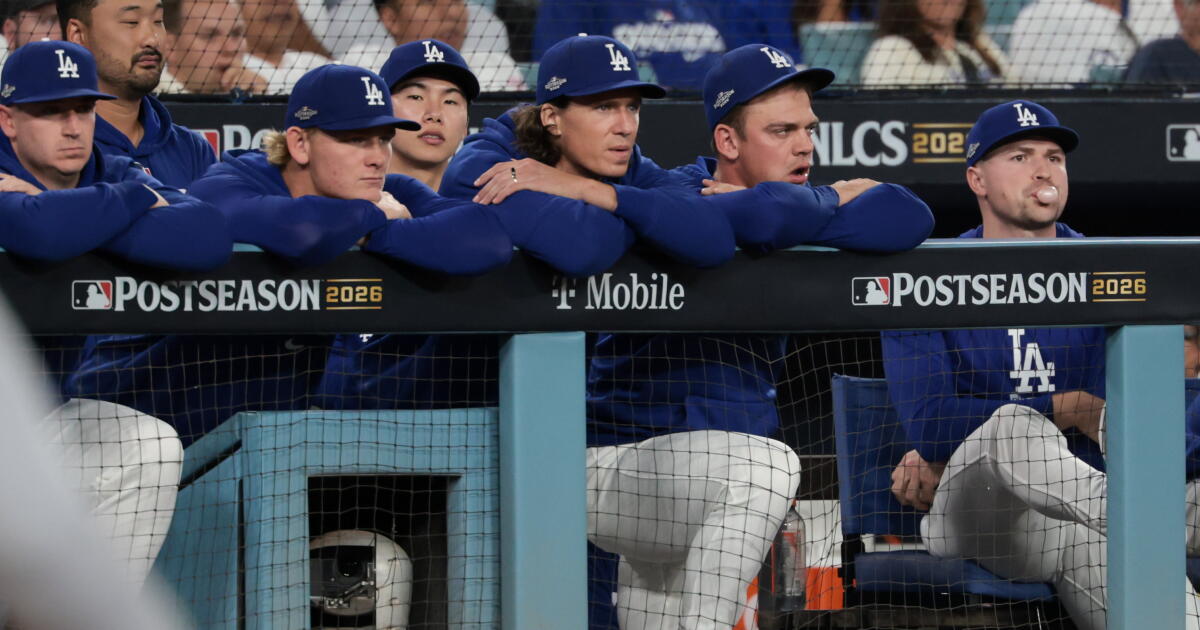
Andrew Friedman on looming labor battle and ‘noise’ around the Dodgers

Dodgers president of baseball operations Andrew Friedman went into the offseason expecting outfielder Kyle Tucker to sign elsewhere.

Sure, Friedman was confident in what the Dodgers could provide on and off the field to the 29-year-old four-time All-Star. And Tucker was a rare hitter who could actually elevate an already star-powered Dodgers lineup. But with the team unwilling to offer a super long-term deal, their chances at landing the best free-agent hitter available this past offseason felt “incredibly low.”

“I can’t remember a time where a player has taken a shorter-term, higher-AAV deal when they’ve had an actual long-term contract on the table,” Friedman said Wednesday.

The Dodgers, however, had already pulled off a bigger surprise when closer Edwin Díaz chose them over returning to the Mets this past December.

The team’s pitch, which included a conversation with the Dodgers’ director of family programs Patricia Romero, discussions about preparation and player resources, and a championship track record, helped land both top-tier free agents.

Of course it didn’t hurt that though Tucker’s contract was only four years, it was worth $240 million. Taking deferrals into account, the net-present day value set an MLB record at about $57 million per year.

The Dodgers’ aggressive offseason, coming off consecutive World Series titles, once again makes them the favorite entering the 2026 season.

They wrap up their Cactus League schedule this week, as World Baseball Classic participants trickle back into camp, and baseball operations leadership make final opening day roster decisions.

Before Friedman headed back to Los Angeles, he spoke with The Times on a range of topics. Here’s part of that conversion, edited for length and clarity.

Q: When it comes to the WBC, there’s variance on how supportive teams are. You have Shohei Ohtani participating as a position player, Yoshinobu Yamamoto pitching after an extra-short offseason, Kiké Hernández supporting Puerto Rico in person while rehabbing. How have you landed in being highly flexible?

Friedman: Obviously everything is case by case. But in a vacuum, we are incredibly supportive of the World Baseball Classic and what it does for our game worldwide. We saw it in ‘23, we saw it this past year, with just how important this is to the players, the staff, the fans — and just how exciting it is for baseball.

So that part’s easy. Now you layer on our situation, us trying to win a World Series. For position players, it’s easier to justify. For pitchers, it’s way harder. Throwing at that intensity in March is really, really challenging. And so we feel like our role is to work with each of our players and have conversations and share our thoughts, listen to their thoughts, and then answers kind of fall out of that.

Q: It’s such a cliche to say you can never have too much pitching, but with this group, are you close?

Friedman: I’ve learned my lesson to never say that we have enough pitching. But I do feel like we are breaking camp with the most talented one through 20 arms — which gets at, obviously, who we’ll break with, and then depth behind it — that we’ve ever had.

Q: Between Díaz, who’s part of that equation, and Tucker, you signed two players this offseason who you didn’t necessarily expect to land. What does that say about this organization and what you’ve done the last few years?

Friedman: Our biggest, most overarching goal is to be a destination spot, where our own players don’t want to leave, where players on other teams are looking longingly, because we feel like championships fall out of that. By having the right environment, having the right culture, that helps your star players want to stay, it helps in the recruitment of others. So we’re way better at it today than we were five years ago. But it’s like a living organism that we have to continue to foster and nurture and develop. And we hope we’re way better at it five years from now.

Q: On that note, the Dodgers are very much caught in the middle of CBA posturing with the current agreement expiring this year. You hear a lot of players saying the Dodgers are doing it the right way and other teams could be doing something similar. On the other hand, the league appears to be floating a salary cap, and plenty of fans are accusing the Dodgers of “ruining baseball.” What’s it been like to see those conflicting narratives?

Friedman: Obviously see it, come across it, hear it quite a bit. But we’re just not that focused on it. We’re a really healthy organization, and the partnership we have with our fans is our guiding light. And we’re doing everything we can to put a team out there that our fans really connect with, and that they feel that partnership with all that they pour into us, and don’t really think about it in any other terms.

And so obviously, there’s a lot of narratives that get extrapolated from that. But our sole focus is on ourselves and the partnership we have with our fans and the rest of it to us, it’s kind of just noise.

Q: You guys raised the bar years ago to, “We’re going to be in the postseason every year.” But there were clear frustrations from the fan base when that wasn’t consistently leading to championships. Is it fair to say that this continued push is almost a response to that frustration?

Friedman: Each year we’ve poured everything we have into winning. And in October, you need a really talented roster, and you need some good fortune. And there’s years where we haven’t been as talented as we wanted to be, whether it’s injuries or lack of performance. There’s years we’ve had really bad fortune, there’s years we’ve had good fortune. And a lot of that is the game, and it’s what I both love and hate about it.

I wouldn’t say our mindset is all that different. But obviously, when you’re in a moment in time with an incredibly talented roster, I think the mindset is, ‘Don’t sit back on your heels, be aggressive, and don’t be nonchalant about the opportunity that we have in front of us.’ And so it’s more the idea of pressing an advantage and being aggressive on that front.

Q: I’m sure when you were pursuing Ohtani, you looked into the revenue ramifications of signing him. Has this been about what you expected? Has it exceeded your expectations?

Friedman: Oh, it’s far exceeded. I don’t think the human brain could have comprehended it correctly. It’s been a perfect storm on a lot of levels, and something that has definitely far exceeded our expectations.”

Q: A three-peat seems to be the goal. Is there such a thing as a successful season without winning a championship, or has this team gotten to a point where you really have to win a World Series in order to claim success?

Friedman: Everything for us, all of our energy and focus, is on doing everything we can to win a championship this year. And our first goal is to win the division and be in position to have a bye. Last year, we added to the degree of difficulty [by winning the division but having to play in the wild-card round] in a way that I’d like to avoid this year.

So that’s the first goal. And then obviously that puts you in the best position to accomplish our ultimate goal, which is winning a World Series. So that’s what all of our energy and focus is on.

And, obviously, if we win the World Series this year, it will be a three-peat. But it’s not how my brain processes it. We’ve won back-to-back, and those are in the bank. And now it’s, do everything we can to win this year, and it’s its own unique, disparate year.

Source link

Ryanair passengers told to reserve two rows for greater leg room with less noise

Former Ryanair flight attendant Eleanor has shared her top seating recommendations for passengers, including the best rows for extra space and which seats to avoid on your next flight

When reserving a flight with Ryanair, many of us will steer clear of selecting our own seat, primarily due to the extra charge. However, a former cabin crew member with the budget carrier has identified the best row to reserve if you’re seeking optimal space and comfort for a specific journey.

Eleanor was based in Marseille, France, and logged countless hours traversing the globe alongside her cabin crew colleagues. She has now highlighted the seats that could enhance your trip considerably.

Speaking to us about her top travel tips, she explained: “I would say usually it’s better to sit at the emergency exits in the middle of the aircraft, usually around row 17 for safety reasons.

“You have more space and also because children under 16 can’t sit at the emergency exits and infants under two can’t even be in the two rows before and ahead of the emergency exits. So these and row 1 are basically the only seats where you can be sure you won’t be spending your flight with crying babies next to you.”

Nevertheless, while row 17 might be the most tranquil, according to Eleanor, there are particular seats passengers may also want to steer clear of.

The content creator, 25, revealed to us: “I can only say to avoid 11A. That’s supposed to be a window seat – but it doesn’t have a window! You won’t be able to see outside.”

This seat has previously been labelled “Europe’s most hated” because it’s notorious for being the sole ‘A’ seat on a Boeing 747 that lacks a window to peer through. And having urged travellers to reserve row 17, she also pointed out the row that might be worth avoiding.

She elaborated: “Also avoid row 32 on the 737 MAX, an aircraft that Ryanair has only in some bases. That has emergency exits at the wings, and a crew seat near them that faces the passengers.

“So, if you sit in that row, you’ll have the flight attendant stare at you during take off and landing, and you’ll have to move every time they have to pass. It was very uncomfortable as a flight attendant, I imagine it is as a passenger also.”

She emphasised that securing your seat on Ryanair wasn’t absolutely critical, especially since flights are generally brief and there’s no complimentary meal service, which means your location won’t determine whether you’re served first or last, as it might on other carriers.

The Italian ex-Ryanair employee said it ultimately boiled down to individual preference but she did provide one final recommendation.

She stated: “Another thing I can say is to avoid sitting at the rear of the aircraft, mostly because sometimes, although not often with Ryanair, only in some airports, you will have a bridge from the front and you’ll be the last one to disembark if you’re sitting at the back.

“And also because in case of ditching (controlled emergency landing onto water), that’s the first part that goes in the water, and you won’t be able to open the doors at the back, so you’re less likely to make it in case of a landing in water.”

Source link