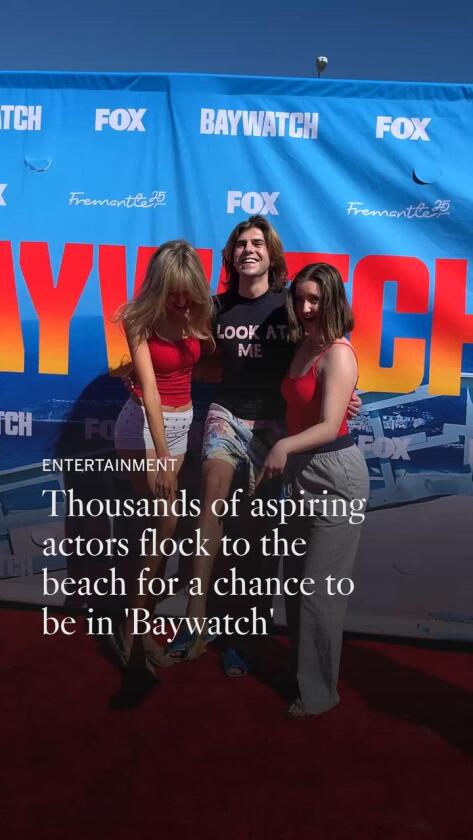
‘Baywatch’ casting call brings back ’90s with in-person auditions
Despite the string of storms that have hit the Los Angeles region in recent days, the skies cleared up long enough on Wednesday for thousands of aspiring actors to swarm a beachfront in Marina del Rey and take their shot at landing a role in the upcoming “Baywatch” reboot.
The open casting call brought old Hollywood magic to Los Angeles, as the show intensified its search for raw and local talent, reminiscent of how original “Baywatch” stars were discovered, said Brittainy Roberts, the vice president of casting at Fox.
The soapy drama series, which premiered in 1989 and ran for 11 seasons, followed the lives and relationships of lifeguards who patrolled L.A. County beaches (and later Hawaii). It was not only a hit stateside — internationally it was a success, becoming the most-watched show in the world at the time. A film adaptation starring Dwayne Johnson and Zac Efron was released in 2017, and despite negative reviews, it was considered a commercial success, signaling an appetite for more.

-
Share via
The casting team has “big bathing suits to fill,” Roberts said. The show famously created a slew of stars, including Pamela Anderson and Carmen Electra, who got their start on the show, and catapulted David Hasselhoff to new heights of fame.
Uncommon in a post-pandemic era of self-tape auditions, the open and in-person auditions attracted actors hungry for their big break and locals hoping to leave with a fun story to tell. Many donned “Baywatch” visors and sweaters while others sported bright red bathing suits, popularized by the original show. It was “an opportunity to really get people in the room in a large-scale way,” and allow “people an opportunity that maybe they aren’t getting in this new landscape of auditioning,” Roberts said.
The casting team saw live auditions from about 2,000 “Baywatch” hopefuls, and about 14,000 applications were submitted, said Joseph McGinty Nichol, known as McG, the reboot’s executive producer who will direct the first episode. His past projects include the “Charlie’s Angels” movie and “The O.C.”

Pat “The Jaguar” Uland, 31, of San Francisco, on the red carpet at the “Baywatch” open casting call.
(Allen J. Schaben / Los Angeles Times)
Beach-ready candidates filed in and out of a Marriott hotel in Marina del Rey for the in-person auditions. The casting call, which ran late into the night, embodied the joy of Hollywood, McG said.
Bri Ana Wagner, a 29-year-old living in Los Angeles, has been pursuing acting for around a decade. The open casting call was a reminder that the Hollywood “dream is alive,” she said.
“It’s like the way it used to be and the way it should be,” McG said. “You can come to a Marriott in Marina del Rey and change your life and blow it wide open.”
Hopefuls try to catch a break
David Chokachi hadn’t acted much before auditioning for “Baywatch” in the 1990s. Douglas Schwartz, one of the show’s original creators, and his wife, Deborah, had seen just about a thousand auditions for the role of Cody Madison. None of the actors matched the couple’s vision for the character, until Chokachi strolled in.
“It’s one of the most surreal things that’s ever happened in my life,” said Chokachi, the only actor from the original series confirmed for the reboot.

David Chokachi, who was on the original “Baywatch,” is reprising his role as Cody Madison.
(Allen J. Schaben / Los Angeles Times)
The aspiring actors who auditioned Wednesday hoped to get their chance at a big break similar to the one Chokachi got decades ago. Casting for the reboot began late last year, Roberts said, and people “have come out of the woodwork” since, with some messaging her directly on social media.
“The fact that we’re shooting in L.A., it’s certainly ignited a flame for a lot of agents and managers in town hoping to get their clients working here,” Roberts said.
The casting executive was hopeful that Wednesday’s auditions would bring together a talented pool of actors that the show can continue to pull from.

Massiel Taveras was among the many in attendance at the casting call: “I belong to this group. I belong to the show. I just feel it.”
(Allen J. Schaben / Los Angeles Times)
Massiel Taveras was crowned Miss Dominican Republic in 2007 and has pursued acting since, finding success in the Latino market. She arrived to the Marriott hotel sporting a bright red sports bra and leggings, paired with a large fur coat to shield her from the beach chill.
“I just love the show so much … It’s iconic. It’s something that everybody loves,” Taveras said. “I belong to this group. I belong to the show. I just feel it.”
Meanwhile, Dominique Lopez, a broadcast student from Monrovia, had never been to an audition before her boyfriend Colin Bolick, an actor, convinced her to attend the casting call together. The experience was “super easygoing” and intimate, she said as she walked out of the audition room.
“It’s making the industry exciting again. It’s putting people in the mind space of … ‘Let me put myself out there,’” said Lopez, 25. “Just for that, I feel like a better person, that I went and did something new.”
Could ‘Baywatch’ could help revive Hollywood?
Marko Dobrasinovic, 24, who made the trek from Chicago to audition, bumped into an old high school classmate, Alyssa Frey, while in line to check in. The pair attended the same high school as Hasselhoff, who played Mitch Buchannon on “Baywatch,” one of the actor’s best-known roles.
The impromptu reunion felt like a full-circle moment, said Frey, who moved to Los Angeles to pursue acting about two years ago. She landed in the city just as the actors’ and writers’ strikes froze Hollywood. Wednesday’s casting call was “one of the few opportunities to get in front of someone,” she said.
It was one that almost slipped away from the city. Showrunners were eyeing Australia as an alternative to filming in L.A., until Gov. Gavin Newsom and state legislators granted the production, along with 16 others, California’s film and TV tax incentive in November. Hollywood has struggled to return to its former status as a production mecca after the COVID-19 pandemic and 2023’s dual strikes. The wildfires early last year, coupled with studio spending cuts, added another blow to L.A.‘s waning film and TV industry.

The open casting call was a rare event in Los Angeles, as the TV and film industry struggles to recover.
(Allen J. Schaben / Los Angeles Times)
Chantal Groves left a stable job in international relations around two years ago, setting her sights set on Los Angeles. The 25-year-old, originally from the Dominican Republic, said acting was always her true passion. The career change has been fulfilling, but navigating such a fraught industry is difficult, she said.
“It’s basic laws of supply and demand,” Groves said. “There’s not a lot out there. There’s not a lot casting, and so just in general, it’s a really hard time to start in the industry.”
The “Baywatch” reboot received a $21-million credit, aimed at revamping the state’s entertainment industry.
“This was about keeping an iconic, world-famous brand right here in L.A.,” said Traci Park, a councilmember for District 11 who helped lead efforts to secure the tax incentive and attended the event. “We have the talent, we have the resources, we have the sets … it is exactly why we are fighting so hard to keep these productions in Los Angeles.”
A love letter to Los Angeles
“Baywatch” showrunner Matt Nix was in the middle of fighting off the wildfire that ravaged his Altadena neighborhood and got dangerously close to his home when he first got the call to lead the reboot. His house survived the fires, and he says a show like “Baywatch” felt like exactly what the city needed after such tragedy.
“This is a show about paradise and the people who keep it that way,” Nix said. “There’s something fundamentally earnest and positive about ‘Baywatch,’ the idea of heroes on the beach taking care of each other and the people that they protect.”
Others can relate to that sentiment. “Baywatch” was “right up my alley,” said Ava Cherlyn, a 19-year-old from Newport Beach. The aspiring actor, who moved to Hollywood six months ago, was a lifeguard growing up and played water polo competitively.
“I’m surprised that I haven’t been nervous,” Cherlyn said as she posed for photos in a red bathing suit.

Aspiring actor Ava Cherlyn, 19, in a red swimsuit made iconic in “Baywatch.”
(Allen J. Schaben / Los Angeles Times)
The original show attracted a worldwide audience because of its focus on “heroic people with complicated and interesting lives” while still feeling like an easygoing “hour-long vacation,” Nix said.
That nostalgic magic won’t be lost in the upcoming season, which Nix said is more of a continuation rather than a reboot. It will follow Hobie Buchannon, Mitch’s son, a character featured in the original series, played by “Arrow” protagonist Stephen Amell.
Hobie’s life will be derailed when he meets Charlie, a 21-year-old daughter he never knew he had who’s eager to continue the family’s legacy by becoming a Baywatch lifeguard. Hobie, now a Baywatch captain, will navigate the familial troubles throughout the season, Nix said.
“I don’t want to imply that ‘Baywatch’ is going to save the world or save America,” Nix said. “But, at the same time, I think it’s a good time for an unapologetically heroic show about people who care about each other and the people that they’re trying to save.”