From across the table or across the aisle, Rob Reiner was passionate about his pet causes
Whether you sat across the table from him or across the aisle, Rob Reiner left no doubt about what he cared about and was willing to fight for.
I had lunch with him once at Pete’s Cafe in downtown L.A., where he was far less interested in what was on his plate than what was on his mind. He was advocating for local investments in early childhood development programs, using funds from the tobacco tax created by Proposition 10 in 1998, which he had helped spearhead.
I remember thinking that, although political activism among celebrities was nothing new, Reiner was well beyond the easier tasks of making endorsements and hosting fundraisers. He had an understanding of public policy failures and entrenched inequities, and he wanted to talk about the moral duty to address them and the financial benefits of doing so.
“He was deeply passionate,” said Ben Austin, who was at that lunch and worked as an aide to Reiner at the time. “He was not just a Hollywood star … but a highly sophisticated political actor.”
Reiner, who was found dead in his Brentwood home over the weekend along with his wife, Michele, was also co-founder of the American Foundation for Equal Rights, which was instrumental in the fight to legalize same-sex marriage in California in 2008.
Michele Singer Reiner was her husband’s “intellectual partner” as an activist, Austin said, even though he was usually the one whose face we saw. But Michele made her voice heard, too, as she did when emailing me about the inexcusable crisis of veterans living on the street, including on the West L.A. veterans administration campus at a time when it was loaded with empty buildings.
I’d check on the progress and get back to her, and she’d check back again when little had changed. At one point, I told her I’d been informed that beds in a new shelter would be filled by the end of the year.
“And if you believe that,” she wrote back, “I’ve got a bridge for you.”
In choosing his causes, Austin said of Rob Reiner, the actor-director-producer “was not jumping on a train that was already moving.” Universal preschool education was barely a fringe issue at the time, Austin said, but Reiner was more interested in social change than making political points.
Reiner’s aggressive instincts, though, sometimes drew pushback. And not just from President Trump, who established a new low for himself Monday with his social media claim that Reiner’s death was a result of his disdain for Trump.
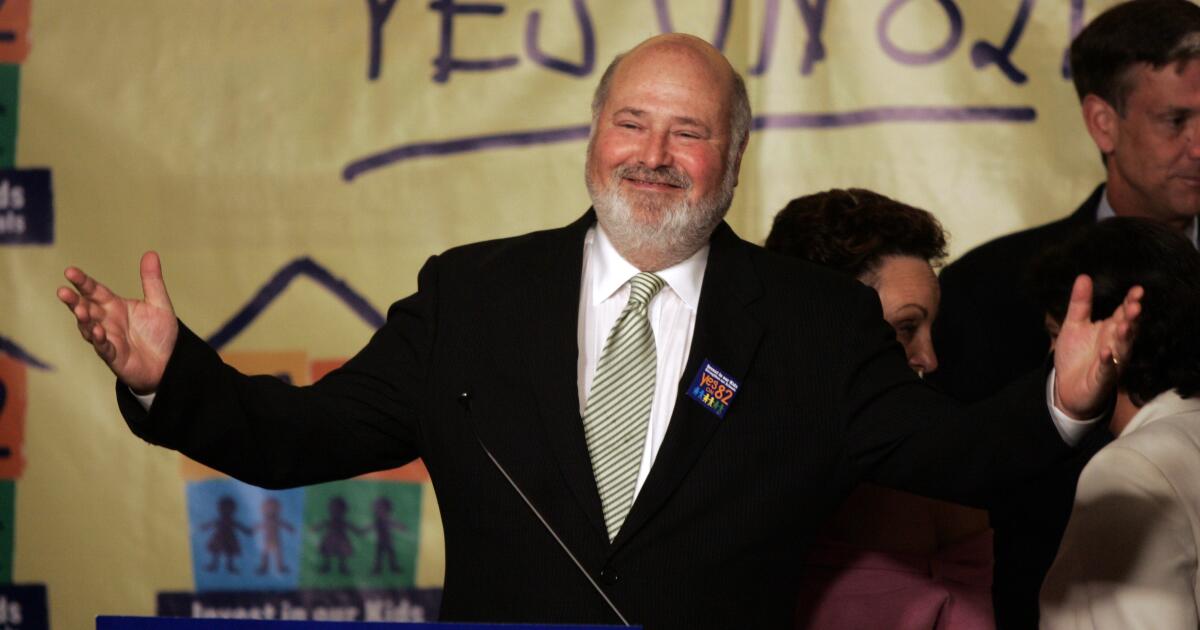
Reiner resigned in 2006 as chairman of California’s First 5 commission, an outgrowth of Prop. 10, after Times reporting raised questions about the use of tax dollars to promote Proposition 82. That Reiner-backed ballot measure would have taxed the rich to plow money into preschool for 4-year-olds.
In 2014, Reiner was at the center of a bid to limit commercial development and chain stores in Malibu, and I co-moderated a debate that seemed more like a boxing match between him and developer Steve Soboroff.
As the Malibu Times described it:
“Rob Reiner and Steve Soboroff came out with guns blazing Sunday night during a Measure R debate that’s sure to be one of the most memorable — and entertaining — Malibu showdowns in recent town history.”
Reiner threw an early jab, accusing Soboroff of a backroom deal to add an exemption to the measure. That’s a lie, Soboroff shot back, claiming he was insulted by the low blow. Reiner, who owned houses in both Brentwood and Malibu, didn’t care much for my question about whether his slow-growth viewpoint smacked of NIMBY-ism.
“I would say there’s a lot of NIMBY-ism,” Reiner snapped. “You bet. It’s 100% NIMBY-ism. Everybody who lives here is concerned about their way of life.”
But that’s the way Reiner was. He let you know, without apology, where he stood, kind of like his “Meathead” character in Norman Lear’s hit TV show “All in the Family,” in which he butted heads with the bigoted Archie Bunker.
Getting back to President Trump, he, too, unapologetically lets you know where he stands.
But most people, in my experience, work with filters — they can self-sensor when that’s what the moment calls for. It’s not a skill, it’s an innate sense of decency and human consideration that exists in the hearts and souls of normal people.
I did not know much about the history of Nick Reiner’s addiction issues and his temporary homelessness. But it became clear shortly after the bodies were found that the Reiners’ 32-year-old son might have been involved, and he was indeed booked a short time later on suspicion of murder.
What I do know is that with such an unspeakable horror, and with the family’s survivors left to sort through the madness of it all, a better response from the president would have been silence.
Anything but a grave dance.
The Reiners died, Trump said, “reportedly due to the anger he caused others through his massive, unyielding, and incurable affliction with a mind crippling disease known as TRUMP DERANGEMENT SYNDROME … .” The deaths occurred, Trump continued, “as the Trump Administration surpassed all goals and expectations of greatness …”
It was a reaction, Austin said, “that makes the case, better than Rob ever could have, about why Trump has no business being president of the United States.”
steve.lopez@latimes.com