Inside the bitter war over cows and wilderness at Point Reyes
POINT REYES NATIONAL SEASHORE — For nearly 60 years, warring camps have battled one another for the soul of a wind-swept peninsula with breathtaking hills, rugged cliffs, granite outcroppings, oak forests and wide expanses of pasture land and beach.
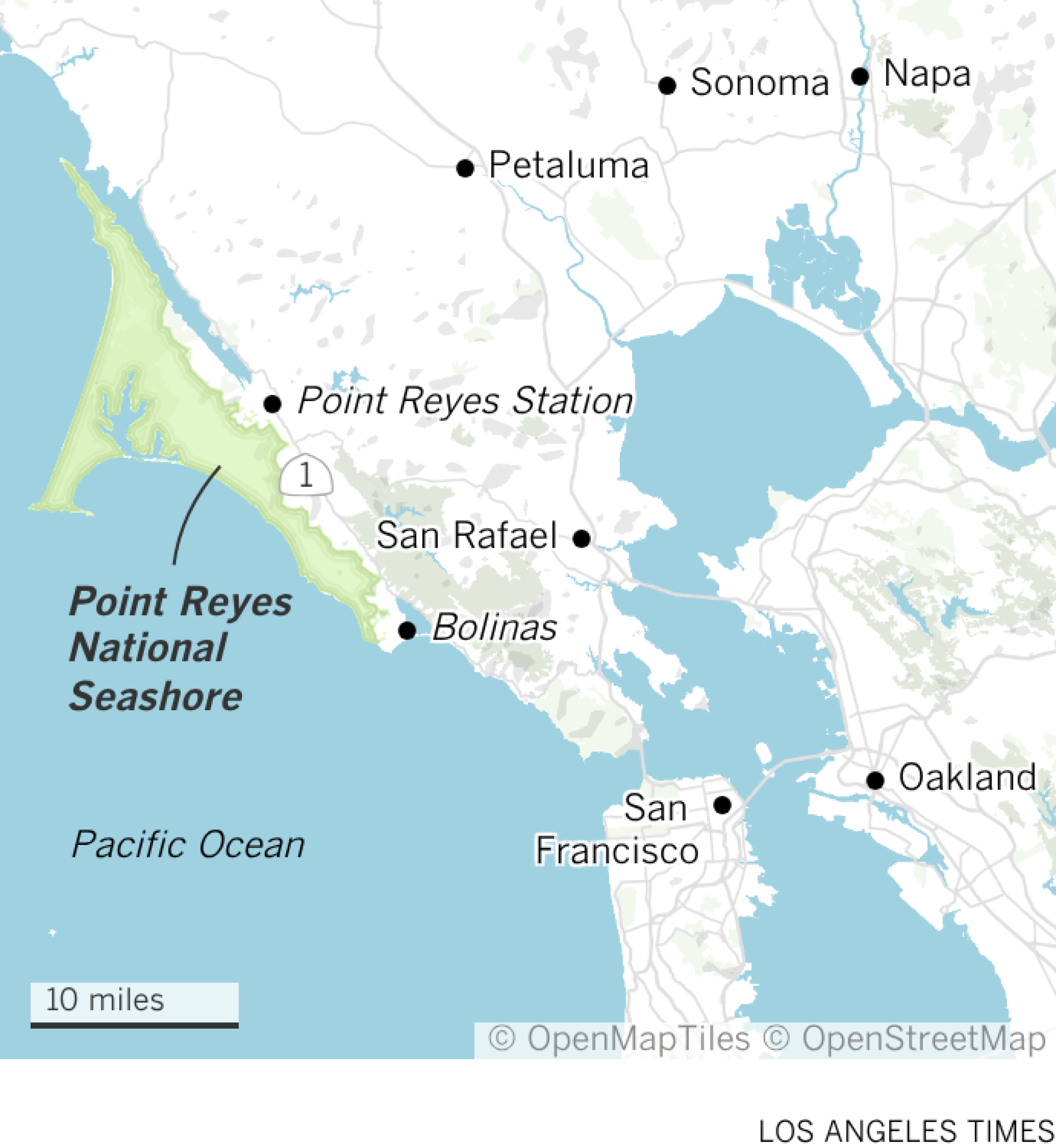
Jutting off the coastline like an upside-down ice skate, the Point Reyes National Seashore is separated from the mainland by the San Andreas fault, which runs like a skate’s blade edge separating the Pacific and North American plates. The peninsula covers about 110 square miles — roughly five times the size of Manhattan.
Elephant seals and sea lions bark and breed on its sandy coves. Whales and sharks breach and hunt in the waters beyond the thick kelp forests that tickle its edges. And in its forests and on its grasslands, tule elk and mule deer graze, while bobcats and coyotes hunt for rabbits and mountain beavers.
But the peninsula 20 miles north of San Francisco also has been home to agriculture since the 1800s and is the site of one of the state’s fiercest land disputes — one that, contrary to the usual red-versus-blue scenario, pits Northern California liberals against other Northern California liberals.

On one side: beef ranchers and dairy operators who advocate sustainable and organic food and land practices; they note the seashore was established, in part, to preserve their way of life.
On the other: environmentalists who say the taxpayer-funded park is no place for commercial farming, and that the seashore should protect its rare and diverse wildlife and welcome the visitors who bicycle, hike and camp on its beaches, oak forests and grasslands.
For seven weeks last year, it seemed the interminable battle over the seashore had finally come to an end.

The family dog guards poultry at Niman family farm at the Point Reyes National Seashore.
(Josh Edelson / For The Times)
In January 2025, a settlement was announced with the National Park Service laying out how the park would function going forward. Natural landscapes and wildlife would take priority over agriculture. Eleven of 13 historic ranching families would leave and be made whole for their losses.
While no one involved really loved the deal or got everything they wanted, many were satisfied, said Jeff Miller, senior conservation advocate for the Center for Biological Diversity, one of the environmental groups involved in the settlement. “The ranchers walked away with a few million dollars and the tule elk get to stay.”
Then this year, the two remaining ranch and dairy families sued. The goal: to upend the deal announced in the waning days of the Biden administration.
The Trump administration, with its pro-meat, pro-cattle agenda, is taking notice.
Since 1962, when the seashore was established, there have been grumblings. The ranchers said the park service saddled them with excessive rules and regulations. The environmentalists said the ranchers brought in invasive plants with their feed, and that cattle fouled the soil and waterways.
But nearly everyone agrees that it was in 2012 when things really began to boil over. That year, the park service moved to shut down a local oyster farm, whose lease was expiring. In his decision to shut it down, Ken Salazar, then secretary of the Interior, promised the ranchers they could remain.
“These working ranches are a vibrant and compatible part of Point Reyes National Seashore,” he wrote in a memorandum, “and both now and in the future represent an important contribution to the Point Reyes’ superlative natural and cultural resources.”
But four years later, environmentalists sued the park service. They argued the cows had degraded the seashore with manure pollution and soil erosion, harming the native wildlife. The iconic tule elk, some of which were fenced in on the northern part of the peninsula to keep them from competing for grassland with cows, were dying off.
The environmentalists demanded the park service establish a new management plan.
They won. But the new plan, issued in 2021, favored the ranchers, extending them 20-year leases, and allowed for the killing of elk if they interfered with cattle.

A tule elk calf is seen with its herd along the Tomales Point Trail, part of the Point Reyes National Seashore.
(Josh Edelson / For The Times)
Once again, the environmentalists — the Resource Renewal Institute, the Center for Biological Diversity and the Western Watersheds Project — sued.
That’s what led to the settlement and the departure of the 11 ranch families and their workers. Each family is believed to have received between $2.5 million and $3 million, but exact amounts have not been divulged because of a nondisclosure agreement.
The 17,000 acres they vacated would be dedicated to conservation and ecological restoration — with a few cattle remaining to feast on invasive species.
But the two litigious families that did not join the settlement — the Evanses and the Nimans — have a different vision.
David Evans, who declined to be formally interviewed, told The Times while moving cattle in the seashore on his ATV that he hadn’t known anything about the settlement. The Evans clan has been running cattle on the peninsula for 150 years.
The other family, headed by Bill Niman and Nicolette Hahn Niman, came to their land comparatively recently.
Born in Minnesota, Bill Niman found himself in Bolinas in 1969, where he befriended lefty intellectuals who were critical of factory farming. In 1978, he and Orville Schell — who later became the dean of UC Berkeley’s School of Journalism — bought land and co-founded the Niman-Schell Ranch. They dedicated their business to raising pigs, and then cattle, in a humane and environmentally sound way.
Niman said he and Schell also wanted to preserve the land from developers and “wealthy people from the Central Valley,” who were moving to the area to build second homes, golf courses and four-lane highways.
In 1984, Niman and Schell sold their 206 acres to the National Park Service for $1.3 million and the promise that they could stay on the property until Niman, Schell or Niman’s older sister all died. They’re now at ages 81, 86 and 90.
Schell did not respond to a request for comment.
“Orville and I concluded that mortals should not own land like this,” Niman said. “It belongs in the hands of the people, because it’s too valuable to cut up and develop.”
The business, which Schell left in 1997, flourished: Alice Waters, at Chez Panisse, bought pork exclusively from Niman, as did Zuni Cafe in San Francisco. In 2009, he merged his company into Natural Food Holdings, which was later bought by Perdue Farms.

Bill Niman and Nicolette Hahn Niman sued the federal government to upend a settlement that paid other ranchers and dairy owners to leave Point Reyes National Seashore.
(Josh Edelson / For The Times)
In 2007, Niman and Hahn Niman started BN Ranch, specializing in organic, grass-fed beef and heritage turkeys. The company, which was bought by Blue Apron in 2017, has operations across the world. Niman later founded Bill Niman Farm LP, which raises grass-fed cows and chickens.
On a recent afternoon, sitting on the back porch of the Bolinas ranch house that Niman built, with a view of the Pacific in the distance, Niman and Hahn Niman — who is 22 years his junior — spoke about their decision to file the lawsuit, which argues the park service was negligent in its rule making.
The Nimans say the seashore’s founders explicitly included agriculture in their vision of the park. They noted that, according to the original charter, Congress could not take the land without the consent of landowners “so long as it remains in its natural state, or is used exclusively for ranching and dairying purposes.”
Hahn Niman also noted, at least five times over two interviews, that Point Reyes is a “seashore” and not a “park,” and therefore doesn’t have as many rules governing preservation. For instance, you can drive an off-road vehicle at Cape Hatteras National Seashore, but off-roading in Yosemite could land you in jail.
The Nimans hope that, should they win or settle, farmers and ranchers would again be allowed in the seashore. Their vision: a test kitchen of sorts that models how farming can, and should, be done.
“We’re really talking about a kind of agrarian model and a use of land that basically keeps this land in its natural state, where agriculture is practiced in harmony with wildlife and nature’s cycles,” said Hahn Niman, who wrote three books, including “Righteous Porkchop” about her work in the early 2000s as an environmental attorney for Robert F. Kennedy Jr.’s Waterkeeper Alliance.

The view from Chimney Rock at Point Reyes National Seashore, which covers about 110 square miles and includes a variety of habitats.
(Christie Hemm Klok / For The Times)

Elephant seals gather below Chimney Rock in Point Reyes.
(Christie Hemm Klok / For The Times)
Hahn Niman said she has spoken with Kennedy about the park, and he supports agriculture in the seashore. She added that Albert Straus, a private equity-backed organic dairy processor in Petaluma, also reached out to Kennedy.
“Straus made efforts to involve [Kennedy], because he was really trying to get help anywhere … and he knew Bobby and I had this connection,” Hahn Niman said. It was Straus who believed legal action might keep agriculture on the peninsula and suggested the Nimans consult an attorney.
According to media reports, Kennedy directly reached out to Interior Secretary Doug Burgum. The Department of Health and Human Services, which Kennedy heads, did not respond to requests for comment on Kennedy’s involvement.
The more important contacts, Bill Niman said, have been political appointees in the Interior Department, including Karen Budd-Falen, the agency’s No. 3, who built her legal career advocating for western ranchers, and Brenda Younkin, a senior advisor to the Bureau of Land Management who worked closely with western ranchers on federal livestock grazing issues.
“We were able to have deep and meaningful conversations because the two people that are on the point of this effort, Karen and Brenda, they understand ranching, pastoral relationships, and how to manage government lands in the best of ways,” he said.
Early this spring, a town hall was held at an elementary school at Point Reyes Station. Hundreds of people crammed into the school gym that April evening, and the debate over Point Reyes agitated into a low boil.
There was no agenda or presentation. Instead, the park service, Nature Conservancy, the Nimans’ and Evanses’ lawyers, a representative from the Coast Miwok tribe — the people who lived on the land before the ranchers — and about a dozen other interest groups handed out pamphlets, answered questions and displayed maps at folding tables ringing the hall.
It was hard to hear above the din. Apple Watches around the room warned of “dangerous” noise conditions.
Foodies and farmers railed against the settlement, saying the park’s new plan would destroy the food scene in west Marin County and kneecap the already struggling agrarian community.
“These aren’t factory farms. This is real amazing quality local food,” said Bronte Edwards, a Sonoma County-based sheep farmer. And she made this observation, Edwards said, “as a liberal-facing queer person that believes in climate science.”
Settlement critics noted that the pact meant that ranch employees, many of them Latinos with moderate incomes, lost their homes along with the ranch owners.
They also complained that the settlement was negotiated in secret among the park service, environmental groups and ranch families.

A male tule elk is seen along the Tomales Point Trail, part of the Point Reyes National Seashore.
(Josh Edelson / For The Times)
“It was all hush-hush,” said Stephanie Moreda-Arend, an ag-aligned podcaster.
Others at the town hall, however, expressed fury that the two remaining ranching families were now trying to upend the deal.
“I understand people have been here a long time. People fear change. I understand that feeling,” said Center for Biological Diversity’s Miller. But the settlement, he added, is done. The seashore is “not their property.”
As residents, activists, farmers and journalists squeezed and jostled through the crowd, holding court in one corner was Budd-Falen, the high-ranking official with the Interior Department.
Budd-Falen, a rancher from Wyoming, has stated publicly that grazing regulations are her passion and that she aims to increase the number of grazing allotments handed out to western ranchers on BLM land, and to no longer declare areas as critical habitat for endangered species.
Though she described the settlement as a done deal, she obliquely suggested changes might still be afoot. “How is it managed from this point forward?” she said of the pact. “You can’t create a good management idea unless you talk to the citizens and see what people want.”
She did not answer questions about the Nimans’ and Evanses’ suit, but when asked why she came to the gathering, she said, “I started hearing about the controversy. Then I started making calls to lands [the Bureau of Land Management] and then to the park service and saying, ‘You know, there’s lots of grumbling, what is going on?’
“And they told me, and I was like, ‘Oh, this sounds like an interesting project, something that we ought to be involved in, and really listen to these locals. And how can I help?’”
Backing the remaining ranchers in Point Reyes and their organic beef, cheese and butter is consistent with an administration that places the commercial cattle industry at the center of its public lands agenda and meat at the center of nutrition policy.
But local politicians and parties to the settlement say scrapping the Biden-era pact would require years of federal review and public engagement. Even if the ranchers have some political pull right now, incarnating their vision within the seashore “would be really difficult,” said Rep. Jared Huffman (D-San Rafael).
“They would have to change the law” that established the park and the park system, Huffman said, or “find many millions in funding to subsidize” a new process or management plan that would take on the Nimans’ and Evanses’ vision of model farm.
Given the administration’s zeal to push legal boundaries, especially when confronting perceived enemies — such as California environmentalists — he said, “You don’t want to put anything past them.”
Theresa Harlan, a Coast Miwok descendant who runs the Alliance for Felix Cove — an area in the park where her family had a home until ranchers kicked them out in the 1950s — said the effort to upend the settlement “is just opening up the wound” that had finally started to heal.

Rancher Bill Niman walks along his property at his ranch in Bolinas, Calif.
(Josh Edelson / For The Times)
Now that the cattle are gone, she’s seeing all kinds of native plants, such as coastal strawberries, Yerba Buena Blue-eyed grass and the Douglas iris with their stunning lavender petals. Some of them she hadn’t seen since she was a child.
Ken Boulay, the CEO of the Turtle Island Restoration Network, said it’s time to move forward and imagine what the park could be like without cattle and private ranches.
He noted the peninsula had once been home to animals such as pronghorn, sea otter, North American porcupine, Humboldt marten, gray wolf, American black bear, grizzlies, northern fur seal and Steller sea lion.
And it could be again — well maybe not the grizzlies or wolves. His organization is already restoring native plants and rebuilding natural waterways in parts of the peninsula.
“It’s time to stop thinking about cheese and yogurt,” he said.
Niman, driving his Rivian across the golden, wind-swept fields, said he has some concerns with the way Trump is dealing with foreign policy, immigrants and some broader environmental issues. But the administration “gets it” when it comes to Point Reyes and public lands.
And he’s heard they’re going to do something about it soon.