With trade between the two countries at a record high, Charles is using the two-day visit to highlight the pair’s deep cultural and commercial links.
Published On 18 Mar 202618 Mar 2026
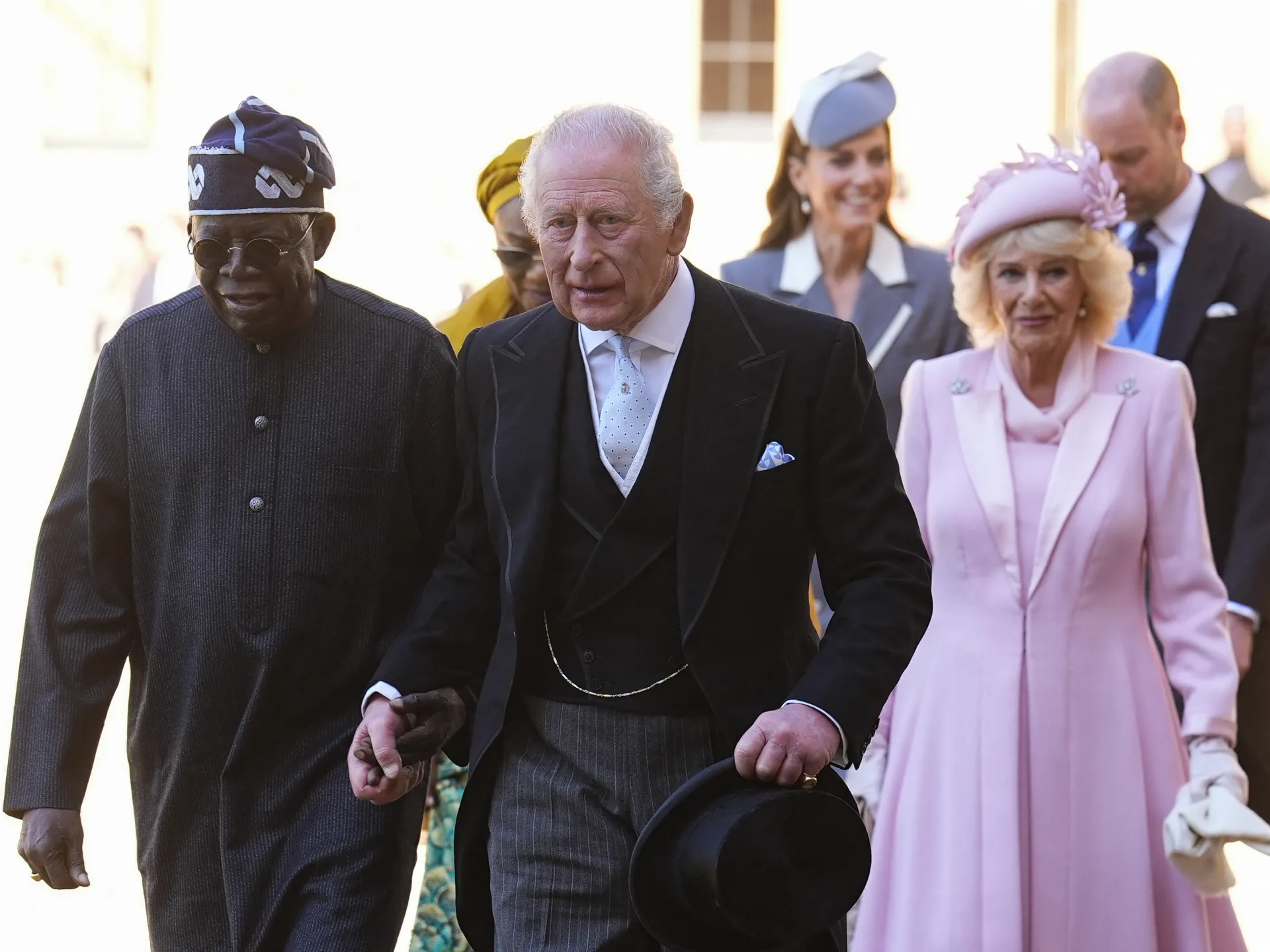
The UK’s King Charles III has welcomed Nigerian President Bola Tinubu at Windsor Castle in the first state visit by the leader of Africa’s most populous nation in nearly four decades.
More than 1,000 soldiers were out in force on Wednesday for the diplomatic show of soft power by the royal family.
Recommended Stories
list of 3 itemsend of list
With trade between the two countries at a record high, Charles is using the two-day visit to highlight the pair’s deep cultural and commercial links.
Tinubu has made less formal visits to the United Kingdom several times during his tenure, and the two countries remain major partners in trade, aid and defence. London is also home to a large Nigerian diaspora of about 300,000 people.
Nigeria’s presidency said the visit signalled a “renewed chapter” and reflected a shared commitment to “advancing trade and strengthening diplomatic ties”.
Calling the visit “historic”, London announced Nigerian companies, including banks, are expanding operations and creating hundreds of jobs in the UK, strengthening it as a global hub for African business.
Nigerian flags and Union Jacks
King Charles and Queen Camilla greeted the president and his wife in Windsor, west of London, as artillery fired salutes.
Both Nigerian flags and Union Jacks fluttered amid the procession.
The Nigerian president and his wife earlier chatted with heir-to-the-throne Prince William and his wife Catherine, at a hotel in the town.
The party then rode in carriages to the historic Windsor Castle.
Later, the king and queen showed the president and first lady items from the UK’s colonial rule of Nigeria, which existed until 1960.
Later on Wednesday evening, a lavish state banquet took place.
On Thursday, Tinubu is expected to meet British Prime Minister Keir Starmer, as well as members of the Nigerian community abroad, according to the official schedule.
Missing from the official schedule is the traditional meeting between the visiting head of state and the British opposition.
Conservative Party leader Kemi Badenoch, who is of Nigerian descent, has repeatedly publicly criticised the country she was raised in over corruption and violence.
The last Nigerian state visit to the UK took place in 1989, although Tinubu was received by Charles in September 2024.
Before the death of his mother, Queen Elizabeth II, in 2022, Charles also visited Nigeria four times as prince of Wales.
Tinubu’s visit went ahead, despite a deadly bombing in northeastern Nigeria’s Borno State on Monday, which killed 23 people and injured more than 100, with the president condemning the attacks and insisting “Nigeria will not succumb to fear.”
Bala Abubakar rises before dawn, fetching water and checking his irrigation canals. He grew up in Gurin, a community in Adamawa State, northeastern Nigeria, where rice cultivation has fed generations. To operate a thriving rice farm, Bala says he needs good seedlings, fertilisers, and perhaps a loan to tide him over.
In 2024, members of the Rice Farmers Association of Nigeria (RIFAN) in the state got subsidy inputs through the Nigeria Incentive-based Risk Sharing System for Agricultural Lending (NIRSAL), a programme designed to de-risk agricultural lending for low-income farmers. Bala went to the nearest cybercafé to register, hoping to benefit from the initiative.
The registration required him to enter his National Identity Number (NIN) before he could access the loan. At the café, he entered his name and the NIN, but the system failed to verify him. The café attendant told him that his record was not found and advised him to try his bank’s verification number (BVN). He tried, but the system still failed him. Disappointed after visiting the cybercafé, Bala trudged back home.
Like Bala, other farmers faced a similar problem. One farmer, Sani Bukar, tried to access the Growth Enhancement Support under the Government Enterprise and Empowerment Programme (GEEP), an initiative designed to improve smallholder farmers’ access to agricultural inputs through an electronic, voucher-based system. He only received a “verification failed” message, despite having a phone number linked to his NIN.
“They have our pictures and fingerprints now,” Bala says, referring to the recent biometric enrollment drive. “But those pictures are in Abuja. Here in my village, what do I have?”
His story reflects a deeper tension in Nigeria’s emerging Digital Public Infrastructure (DPI) ecosystem. Although Nigeria has made progress in several areas of DPI, alignment across them is uneven. The NIN, for instance, is managed by the National Identity Management Commission (NIMC), while the Central Bank of Nigeria (CBN) manages the BVN system to expand financial inclusion. In addition, SIM registration—conducted by mobile network operators—links phone numbers to individuals’ identities.
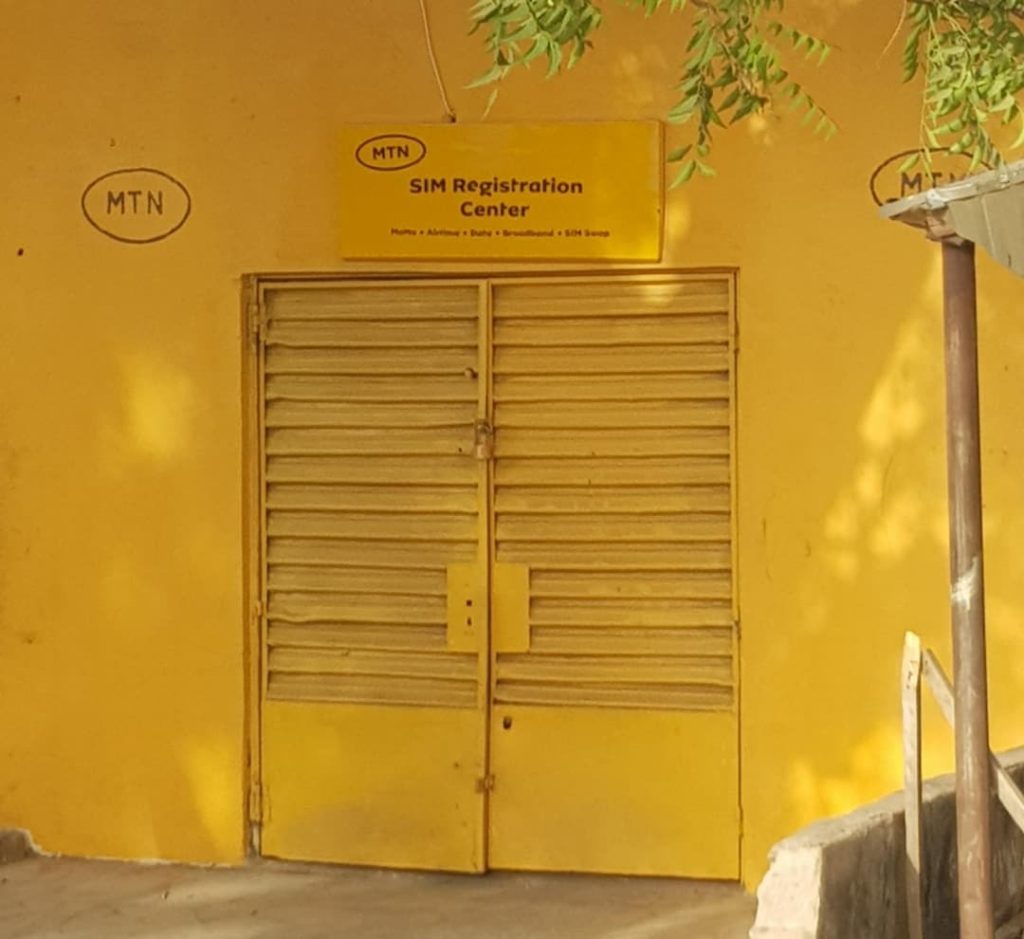
An MTN SIM registration centre in rural Adamawa. Photo: Obidah Habila Albert/HumAngle
On paper, these systems should make agricultural targeting seamless, but in practice, they often operate in silos.
Bala’s dilemma is built on concrete technical barriers. To access most federal or sub-national agricultural interventions today, a farmer must have a valid NIN, a phone number linked to that NIN, a bank account linked to a BVN, and a registration in a state or federal farmer database. If any link in that chain fails, the entire process most often collapses.
A 2025 overview of Nigeria’s connectivity landscape notes that only about 38 per cent of Nigerians were online in 2024, with rural communities significantly lagging behind.
“Without stable internet, many agricultural tools are rendered ineffective,” said Tajudeen Yahaya, an agricultural extension expert. “Even simple SMS or app-based registration frequently fails in rural communities.”
Beyond connectivity, issues with identity and data persist. The NIN registry has enrolled over 120 million people, but reports indicate that many more Nigerians have yet to enrol, particularly those in rural areas. Bala’s village falls within that gap.
The problem spans across multiple government programmes. Different states in Nigeria maintain their own farmer databases that conflict with federal government records. For instance, Agricultural Development Programme (ADP) offices may possess one list, while federal systems could have a different one.
“We tell farmers to get on the portal, but many are not in our state ADP database,” says Victor Anthony, who spoke on behalf of the Chairperson of the ADP programme in Adamawa State. “And even if they are, the federal system says we’re not synced.”
In 2025, the Federal Ministry of Agriculture officially launched a National Digital Farmers Registry. The minister, Abubakar Kyari, announced that it would be anchored and accessed through the NIN. According to Abubakar, the registry would eliminate ghost beneficiaries and ensure targeted delivery of inputs, extension services, credit, and insurance. The goal is a single unified platform that links NINs to farmlands, so that when a farmer applies, the system already “knows” him and his fields.
However, a recent statement from the agriculture ministry noted duplications and inconsistencies in farmers’ records, making it difficult to support them.
Interventions
Many government parastatals and private institutions are working to improve digitalisation for farmers and rural communities. NIMC has expanded the number of enrolment centres under the World Bank–supported programme, aiming to register up to 150 million Nigerians. Mobile NIN vans now travel to rural markets and religious gatherings, reducing distance barriers.
In October 2025, the World Bank approved a $500 million Building Resilient Digital Infrastructure for Growth (BRIDGE) project to lay fibre optics across Nigeria. Over the next five years, 90,000 km of fibre will be added, expanding the national backbone from 35,000 km to 125,000 km. When completed, this network will connect every local government, thousands of schools and clinics, and even remote agricultural research stations.
In local communities, farming cooperatives and technology companies are also contributing. The Extension Africa network has provided training to many local extension agents in digital tools, enabling them to act as “digital ambassadors” in rural areas. Some platforms are testing offline kiosks that permit farmers to download guidance and transaction records whenever they visit town.
The federal government’s renewed Agric Infrastructure Fund and various projects with agencies aim to equip these hubs with basic internet as part of a broader “Digital Village” initiative. However, these fixes are works in progress.
An African challenge?
Nigeria’s struggles are shared across the Global South, and other countries’ experiences offer cautionary lessons. In India, billions of dollars in farmer subsidies are paid directly to bank accounts via Aadhaar ID. The country is now rolling out Agri Stack, a digital initiative that gives each farmer a unique digital ID linked to land records.
Get our in-depth, creative coverage of conflict and development delivered to you every weekend.
Subscribe now to our newsletter!
When the government mandated e-KYC for OTPs in 2023, nearly 5 per cent of beneficiaries were flagged as “ineligible” when verification failed. Many older farmers lacked a working linked phone, had worn fingerprints, or ran into a buggy face-scan app.
With 70 per cent of the population in rural areas, agriculture accounts for 33 per cent of GDP in Kenya, but the country has struggled with piecemeal data. A recent study notes that millions of Kenyan smallholders remain “invisible to formal agricultural programmes”. In 2023, Kenya launched a national digital registry for farmers, but poor connectivity and low smartphone ownership are barriers, as in Nigeria.
On the positive side, Kenya has explored linking its digital ID (Huduma card) to farm cooperatives and training agents in the field. Rwanda goes even further by running the Smart Nkunganire e-voucher system, in which registered farmers receive digital coupons for seeds and fertilisers based on precise plots. These programmes suggest that pairing farmer IDs with geotagged land data can dramatically improve targeting, but only if the data are entered correctly, experts said.
Ethiopia has introduced a National ID requirement for various services. The newly established National Agricultural Finance Implementation Roadmap (NAFIR) incorporates a Fayda ID, which is a 12-digit unique identification number provided by the National ID Programme (NIDP) to residents who meet the necessary criteria set by NIDP. This system is designed for farmers associated with a land registry containing 18 million plots. The World Bank highlights that digital identity could unlock rural finance at scale in Ethiopia, but warns that without addressing its infrastructure gaps, digital solutions risk remaining pilots.
What needs to change
Experts argue that Nigeria must double down on making its digital agriculture ecosystem inclusive and resilient. Frank Akabueze, a Nigerian-based digital identity expert, noted that IDs should be flexible to ensure seamless registration. He said the NIN may be central, but alternative pathways should exist. For instance, cooperative leaders should be allowed to register farmers offline (paper intake by trusted agents) and synchronise later, rather than requiring each individual’s smartphone.”
“Voter card numbers should be made acceptable as interim IDs,” Frank said, noting the importance of equipping extension workers with portable biometric devices so they can register farmers on the spot, as some countries do. In India, the option of offline Aadhaar verification was eventually introduced to help offline farmers.
The digital expert noted that all of Nigeria’s data siloes – NIMC, BVN, SIM records and databases should be harmonised. He stressed that legal frameworks like the new digital ID policy can mandate data sharing between agencies (with privacy safeguards).
“Spelling mismatches and duplicates should be proactively cleaned: one approach is to use biometric deduplication, as India did at scale for Aadhaar,” he added.
He also said the proposed National Digital Farmers Registry should connect to the NIN and verify existing records, such as the national farmers’ census, to minimise errors, such as listing the same farmer in multiple states or with different ages.
This report is produced under the DPI Africa Journalism Fellowship Programme of the Media Foundation for West Africa and Co-Develop.
When he became Nigeria’s Inspector-General of Police (IGP) in 2023, Kayode Egbetokun vowed to fight criminality and insecurity with vim and vigour. He seemed determined to reform the police; he promised to improve officers’ welfare and make Nigeria a safer, better country for its people. As Usman Alkali stepped out of the IGP office and Kayode stepped in, Nigerians hoped he could deliver on his promise.
“I really can’t describe how I feel currently, but if I have to tell you anything, I will tell you that right now, I feel like a tiger inside of me, ready to chase away all the criminals in Nigeria. And some other times, I feel like a lion in me, ready to devour all the internal enemies of Nigeria. That’s my feeling right now,” he said during his decoration as acting IGP at the Presidential Villa in Abuja.
On Feb. 24, the reign of the 61-year-old police chief came to an end. He was forced to resign, according to local media reports. His regime appeared to have dampened the high hopes for police reform in Nigeria, leaving the new IGP, Tunji Disu, a highly decorated police chief, with a legacy of a failed policing system.
Disu is a familiar name within the police force, having held various important roles and risen through the ranks. In 2021, for instance, he succeeded Abba Kyari, a Nigerian once-upon-a-time supercop, as head of the Police Intelligence Response Team (IRT). He was an Assistant Inspector-General of Police before emerging as Nigeria’s new IGP.
Born on April 13, 1966, Tunji joined the police force in May 1992. Appointed as acting IGP at 59, he is due to retire in April this year, upon reaching the mandatory age of 60. However, in 2024, the National Assembly amended the Police Act, 2020, enabling him to serve out his full four-year term as IGP, unless the president removes him.
He had led the Rapid Response Squad (RRS) of Lagos State Police Command successfully and presented himself as a diligent supercop throughout his career. While his antecedent might have been thrilling, he’s inheriting the disturbing legacies of his predecessor, leaving him a deep forest to clear.
To understand what lies ahead, HumAngle engaged police officers, journalists, civic leaders, and human rights advocates, who not only reflected on the legacies of the former IGP but also outlined urgent priorities for the new administration. Their insights reveal both the depth of Nigeria’s policing crisis and the expectations riding on Disu to restore trust, improve welfare, and confront systemic failures within the force.
The legacy of human rights abuses
The NPF was infamous for several unlawful activities under the former IGP’s command, including high-handedness towards journalists demanding social justice and accountability. Journalists, whistleblowers, and media practitioners across Nigeria were targeted for simply doing their jobs, creating a climate of fear that undermined press freedom. On many occasions, journalists reported being beaten or threatened during arrests and manhandled at rallies, while editors said they received threatening calls warning them against publishing sensitive stories.
Over 80 incidents of attacks against journalists and media organisations were recorded in 2025, according to a report by the Media Rights Agenda (MRA), a non-profit organisation that promotes and protects freedom of expression, media freedom, and access to information in Nigeria. The report stated that arrests and detentions were the primary tools for suppressing media freedom and freedom of expression, constituting the most common form of attack, with 38 documented cases accounting for over 44 per cent of all incidents.
“In terms of perpetrators of attacks against journalists and violations of other freedom of expression rights, the Nigeria Police Force was identified in the report as the worst offender,” the report stated.
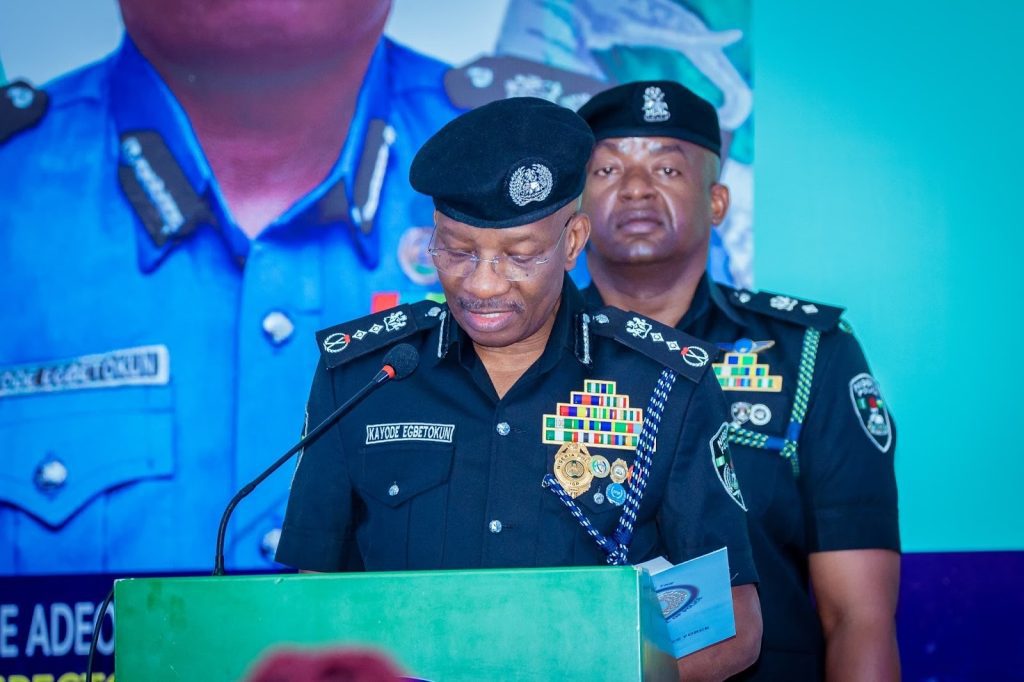
Immediate-past Inspector General of Police, Kayode Egbetokun. Photo: @PoliceNGR/Twitter
The police, under the former IGP, were also accused of weaponising the cyber law to incarcerate journalists seeking public accountability. Sometimes instigated by influential people within and outside government, the police have used this legislation to clamp down on journalists and activists despite the recent amendment. Digital journalists were even more targeted using Nigeria’s Cybercrime Act. In 2024, the National Assembly amended sections of the law following the ECOWAS Court’s declaration that they were inconsistent with Nigeria’s obligations under Article 1 of the African Charter on Human and Peoples’ Rights and with best practices.
The amended Cybercrimes Act 2024 has revised Section 24 of the 2015 law, which was previously used to prosecute individuals for “insulting” or “stalking” public officials. The updated amendment provides clearer definitions of the offences, focusing on computer-based messages that are either pornographic or intentionally misleading. However, despite these changes, the police have still been using this provision to intimidate journalists.
One interesting case, among several others, involved Nurudeen Akewusola, a senior journalist with the International Centre for Investigative Reporting (ICIR). In 2024, Nurudeen’s investigation exposed how two former IGPs, among others, were implicated in a shady multimillion-naira land deal involving property originally designated for police barracks in Abuja. The police detained Nurudeen and his employer, Dayo Aiyetan, over this story, asking the reporter to reveal his sources. He refused to name his sources, upholding journalistic ethics.
The reporter and his employer were detained by the Nigeria Police Force National Cybercrime Centre (NPF-NCCC), which was purportedly probing a “case of cyberstalking and defamation of character” against the reporter and the executive director of the ICIR.
Two years later, Nurudeen told HumAngle that his experience with the police still haunts him. The incident has since made him worried about the safety of journalists and truth-seekers in Nigeria. He remembers how he was detained and mistreated when chasing any similar public interest story.
“The incident also took a toll on those close to me. My family and loved ones were anxious and confused; calls kept coming in as people tried to understand what was happening and what might happen next. Watching them carry that fear because of my work was a heavy emotional burden,” he said.
Scores of journalists in Nigeria faced even worse attacks from police under the former IGP’s leadership. Busola Ajibola, the deputy director of journalism at the Centre for Journalism Innovations and Development (CJID), told HumAngle that at least 40 cases of press freedom attacks were recorded under former IGP Kayode. The media civic leader said there seemed to be a culture of impunity against journalists that predated the former police chief and was more pronounced during his administration.
“We’re building an environment that lacks accountability,” she warned, noting that media oppression by the police could have grave consequences. “We’re denying the public of demanding accountability using the media. Media oppression also has impacts on the right to freedom of expression generally.”
Failed to rein in terrorist attacks
Despite his flowery promises to curb insecurity, the former IGP seemed to have failed to secure lives and property in Nigeria’s most volatile communities. Communal crises lingered for so long that they attracted global attention, and terrorism resurged with terrorists operating brazenly, especially in the northwestern region. Between 2023 and 2024, for instance, Nigeria grappled with widespread insecurity, particularly in the northwestern and north-central regions. Kidnappings for ransom surged, with rural communities and travellers along highways being frequent targets. Armed groups intensified their operations, often overwhelming security forces. The HumAngle Tracker recorded hundreds of deaths during this period, revealing the persistent inability of police institutions to contain violence.
Insurgency intensified within the northeastern region, spreading rapidly to the north-central states, including Nigeria’s capital city. Boko Haram and ISWAP factions raided villages, military bases, and convoys, leading to significant civilian casualties. This period also saw an increase in targeted killings and ambushes.
Get our in-depth, creative coverage of conflict and development delivered to you every weekend.
Subscribe now to our newsletter!
Terrorist attacks expanded beyond the northern regions in 2025, with the South East Nigeria experiencing heightened violence linked to separatist movements and criminal gangs. Attacks on security personnel, government facilities, and civilians became more frequent. The HumAngle Tracker documented a rise in politically motivated violence, especially around election-related activities. Meanwhile, oil-producing areas in the South-South continued to experience militancy and pipeline vandalism, disrupting economic stability. By early 2026, the tracker data showed that insecurity remained entrenched, with no significant nationwide improvement.
Source: HumAngle Tracker (January 2026)
In November 2025, however, the former IGP described how the police were fighting terrorism and armed violence in Nigeria, saying insecurity was not something that could be fought in silos. While addressing reporters at the Lagos Police Command in Ikeja, the police chief said there must be synergy with other agencies and all communities for Nigeria to contain insecurity. He also advised Nigerians to stop spreading misinformation and falsehood about the police and other security agencies.
“When people spread falsehood against security institutions that are providing security, they are weakening the resolve of the nation,” he said. “So, let us all be committed to saying the truth about security agencies who are taking risks and providing security for the country.”
Decentralised the Police Complaints Response Unit
At first, the former police chief introduced a policing model that appeared to prioritise public complaints. Barely four months into his role as acting IGP, he decentralised the Police Complaints Response Units (CRU) to cater to the disturbing trust deficits in the policing system. In August 2023, he ordered police commissioners to establish the state-based police complaint units. The CRU made contact information for police spokespersons available online and set up social media pages to engage with citizens nationwide. He said the purpose of decentralising the CRU was to create a conducive platform for interaction between the police and the public, particularly regarding officers’ unprofessional conduct.
“It is going to enhance police-community collaboration and build confidence with members of the public,” he said, appealing to the public to supply the police with information for transparency. “Officers who are going to man the CRU are going to be carefully selected; they are going to be officers with impeccable integrity.”
Some police officers enforcing order during the #EndBadGovernance protest in 2024 in Jos, Plateau State. Photo: Johnstone Kpilaakaa/HumAngle
The CRU emboldened citizens to hold police officers accountable for their actions. The initiative brought several erring police officers to justice when citizens lodged complaints. However, the CRU decentralisation became defective when the police became reluctant to prosecute some officers caught in shady dealings. Journalists and civic actors who closely monitored the CRU said the initiative was promising at first, but it later flopped.
Daniel Ojukwu, a senior journalist with the Foundation for Investigative Journalism and Social Justice, said that while the former IGP must be commended for decentralising the CRU, he must also be blamed for ignoring significant citizen complaints against the police. Daniel covers police activities, seeking justice for citizens whose rights were violated by high-handed officers. The journalist also had his share of press attacks by police officers. He was arrested and detained – albeit illegally – by the force headquarters for an investigation he had conducted.
“Egbetokun did well with the CRU decentralisation, but of course, there were holes. We hope that the new IG will prioritise making the CRU work better,” he said.
HumAngle spoke with several police officers to inquire about the IGP’s general performance. Many of them believe he lost his way the moment he attained the highest position in the police force. Most of his promises, they said, were unfulfilled. Some of the officers we spoke with said he was a poor administrator who had the chance to reform the police but failed woefully. The officers begged not to be identified by name for fear of retribution.
“His administration made no sense,” one officer said bluntly. “We all thought he would be different, but our leaders are all the same.”
Setting the agenda for the new IG
On Feb. 25, President Bola Tinubu decorated Tunji Disu as the acting IGP, officially signalling a change in authority at the NPF. Interestingly, the newly decorated IGP vowed to enforce a zero-tolerance regime against corruption and human rights abuses. He told journalists after his inauguration that his leadership would ensure that police officers are well-trained to protect Nigerian citizens and engage them with utmost civility.
“I will let them (fellow policemen and women) know that the era of impunity is over,” he declared. “Most importantly, I’m going to drum it into them that we can never succeed without the cooperation of members of the public.”
A police armoured vehicle during the #EndBadGovernance protest in 2024 in Jos, Plateau State. Photo: Johnstone Kpilaakaa/HumAngle.
His declaration seems to be a shift in tone for the police force. Beyond his heavy promises and rhetoric, Nigerians are eager to see how these promises translate into action. Civil society organisations, human rights advocates, and community leaders have long pressed for reforms that prioritise accountability, transparency, and respect for citizens.
As Tunji steps into this role, civic actors are articulating their expectations of the new IG, underscoring the urgency of building trust between the police and the people they are sworn to protect. While some security experts believe the police seem to have neglected their counterterrorism role, other civic actors demand a safe space for journalists and activists to demand transparency in governance without being persecuted by the force.
Busola Ajibola of CJID reiterated that, beyond flowery speeches about fighting impunity, the new IGP must take a clear stand, backed by action, against press freedom violations and investigate officers who unlawfully violate journalists’ rights.
“He should invest in re-training middle-level and low-ranking officers on human rights and press freedom,” Busola noted. “Most times when we engage with senior police officers, we realise that they appear to know the right thing, but the problem is usually the middle-level or low-ranking officers who have little knowledge of press freedom and human rights.”
Speaking about his years of experience covering the police, Daniel said it has become clear to him that the police force is highly underfunded. He asked the current IG to prioritise funding for the police. An officer who asked not to be named confirmed this, saying that a system that fails to properly finance the police automatically sets operatives against the people.
“These officers don’t even have fuel in their vehicles to run operations many times. How do you expect them to be effective?” Daniel asked. “People go to lodge complaints in police stations, they’re asked to pay.” He added that to make the CRU more effective, the police must have a speed dial number that’s responsive and easy to memorise, so citizens can contact the police quickly when they face any challenge.