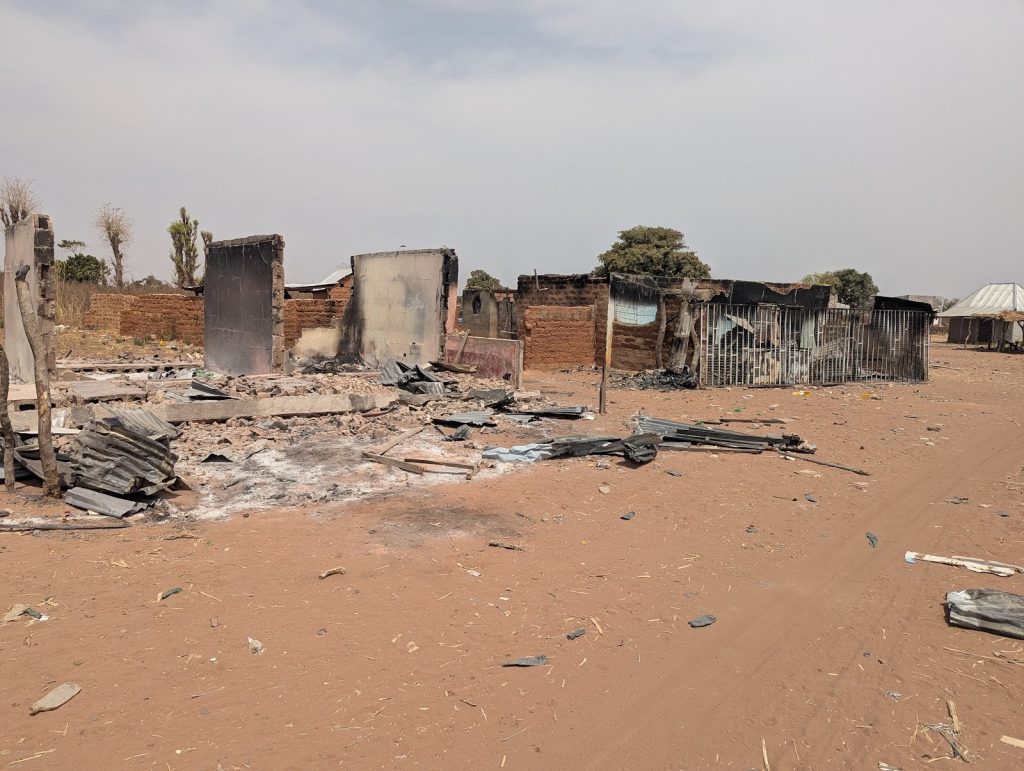
Niger

Why are some African countries banning US citizens from entry? | Donald Trump News

Mali and Burkina Faso have announced they are imposing full visa bans on United States citizens in retaliation for US President Donald Trump’s ban on US visas for their citizens this month.

The two West African countries, which are both governed by the military, on Tuesday became the latest African nations to issue “tit-for-tat” visa bans on the US. These follow Trump’s new visa restrictions, which now apply to 39 countries in Africa, Asia, the Middle East and Latin America. The White House said they were imposed on “national security” grounds.

Recommended Stories

list of 4 itemsend of list

“In accordance with the principle of reciprocity, the Ministry of Foreign Affairs and International Cooperation informs the national and international community that, with immediate effect, the Government of the Republic of Mali will apply the same conditions and requirements to US nationals as those imposed on Malian citizens,” the Malian ministry said in a statement.

Burkina Faso’s foreign minister, Karamoko Jean-Marie Traore, in a separate statement similarly cited a reciprocity rule for his country’s visa ban.

Which countries have issued bans on visas for US citizens?

The US directive issued on December 16 expanded full US visa bans to citizens of five nations other than Mali and Burkina Faso: Laos, Niger, Sierra Leone, South Sudan and Syria.

Travellers holding travel documents issued by the Palestinian Authority were also banned from entering the US under the order.

The US cited the countries’ poor screening and vetting capabilities, information-sharing policies, visa overstay rates and refusal to take back their deported nationals for the ban.

Trump’s order also noted countries were additionally assessed based on whether they had a “significant terrorist presence”.

The US ban takes effect on Thursday.

Mali, Burkina Faso and neighbouring Niger have been plagued by violence from armed groups linked to al-Qaeda and ISIL (ISIS) for years. The violence in those countries has displaced millions of civilians.

On Friday, Niger banned entry for US citizens, also citing the US ban on its citizens. The country is also military-led like its neighbours Mali and Burkina Faso. All three formed the Alliance of Sahel States in July 2024 to tackle security problems and improve trade relations.

In its own reciprocal move, Chad stopped issuing visas to US citizens on June 6 with an exception for US officials. Only US citizens who were issued visas before June 9 are now allowed entry into Chad.

The country was on an initial list of 12 nations whose citizens the Trump administration issued a full visa ban on from June 9.

Traore
Burkina Faso President Ibrahim Traoré, second from left, walks alongside Malian President Assimi Goïta during an Alliance of Sahel States summit on security and development in Bamako, Mali, on December 23, 2025 [Handout/Mali government information centre via AP]

Which countries are affected by the US visa bans?

Citizens of 39 countries are now under full or partial entry restrictions to the US, according to the US-based Council on Foreign Relations think tank.

Those fully banned are:

  • Afghanistan
  • Burkina Faso
  • Chad
  • Equatorial Guinea
  • Eritrea
  • Haiti
  • Iran
  • Laos
  • Libya
  • Mali
  • Myanmar
  • Niger
  • Republic of Congo
  • Sierra Leone
  • Somalia
  • South Sudan
  • Sudan
  • Syria
  • Yemen
  • Holders of travel documents issued by the Palestinian Authority are also fully banned.

Those partially restricted are:

  • Angola
  • Antigua and Barbuda
  • Benin
  • Burundi
  • Cuba
  • Dominica
  • Gabon
  • The Gambia
  • Ivory Coast
  • Malawi
  • Mauritania
  • Nigeria
  • Senegal
  • Tanzania
  • Togo
  • Tonga
  • Turkmenistan
  • Venezuela
  • Zambia
  • Zimbabwe

Is Trump specifically targeting African countries with visa bans?

Trump’s approach to Africa regarding visa entries in his second term as US president is similar to that of his first administration when he issued a “Muslim ban”, which included citizens of three African nations – Somalia, Sudan and Libya – as well as Yemen, Syria, Iraq and Iran.

In later updates to the ban, Sudan was removed while Chad was added.

Most countries under US entry restrictions since Trump took office on January 20 are in Africa. Of the 39 affected countries, 26 are African nations.

How have US-Africa trade relations fared under Trump?

Tradewise, the US has shifted away from its preferential African Growth and Opportunity Act (AGOA) trade programme to a tariff-based regime that has also been applied to most other countries around the world under Trump’s tariffs policy.

From 2000, AGOA provided African nations with duty-free access to US markets, bolstering African exports to the US of a wide range of goods, from wine to cars.

AGOA created an estimated 300,000 jobs in African countries and indirectly sustained another 1.2 million jobs, according to the US-based Center for Strategic International Studies.

However, AGOA expired in September after the US Congress failed to renew it. Although the Trump administration said it supported a one-year extension, no steps have been announced to revive the programme.

Instead, African countries now face often steep tariffs as the US sometimes justifies them on political grounds.

South Africa, Africa’s richest country, for example, was slapped with a 30 percent tariff after Trump made debunked allegations of a “genocide” on the country’s white Afrikaner minority. The US government has since prioritised resettling Afrikaners as refugees in the US.

South African President Cyril Ramaphosa met with Trump at the White House in May and explained that crime in the country targets the population at large – not just its white citizens – but was unable to persuade Trump.

Trump’s administration is also prioritising its access to critical rare earth minerals, used to develop high-tech devices, in a bid to remain competitive with China, which mines about 60 percent of the world’s rare earth metals and processes 90 percent of them.

Trump took up a mediator role in the conflict between the Democratic Republic of the Congo (DRC) and neighbouring Rwanda this year after the DRC government proposed a minerals deal with the US. The US and United Nations accuse Rwanda of backing a rebellion by the M23 armed group in the eastern DRC.

Trump did not commit to US military intervention in the DRC but successfully secured a peace pact between the two countries on December 4 after applying diplomatic pressure on Rwanda.

Attacks on civilians by M23 have nonetheless continued despite the peace deal.

A clause in the pact granted US firms priority access to both the DRC’s and Rwanda’s mineral reserves, which include cobalt, copper, lithium and gold.

US-South Africa leaders
US President Donald Trump, right, meets South African President Cyril Ramaphosa in the Oval Office of the White House on May 21, 2025 [Evan Vucci/AP]

How about aid and security cooperation?

In early 2025, the Trump administration shut down the US Agency for International Development and cut billions of dollars of US foreign aid, affecting many African countries that greatly depended on the world’s largest funder of health and humanitarian aid.

Aid groups have since reported rising hunger in northern Nigeria, Somalia and northeastern Kenya.

Health observers and analysts have also raised the alarm about the risk of undoing work to prevent and contain the spread of HIV in Lesotho and South Africa.

In northern Cameroon, officials have reported a spike in malaria deaths as drug supplies fall. This month, the US unilaterally pledged $400m in health funding to the country over the next five years on the condition that Cameroon raises its own annual health spending from $22m to $450m.

African nations were also most affected when Trump recalled 30 career diplomats appointed by former President Joe Biden from 29 countries last week.

Fifteen of them had been stationed in African nations: Algeria, Burundi, Cameroon, Cape Verde, Gabon, Ivory Coast, Egypt, Madagascar, Mauritius, Niger, Nigeria, Rwanda, Senegal, Somalia and Uganda.

Meanwhile, the US has continued to intensify strikes against armed groups linked to ISIL and al-Qaeda, similar to those during Trump’s first term as president from 2017 to 2021.

In Somalia, the US launched strikes in September targeting al-Shabab and the ISIL affiliate in Somalia Province, according to the US-based New America Foundation think tank.

The US also targeted ISIL- and al-Qaeda-linked groups in northwestern Nigeria for the first time on Thursday.

While those strikes were carried out in collaboration with the Nigerian government, a war of narratives prevailed between the two countries.

The US claims to be “saving” Nigerian Christians, who it alleges are experiencing a genocide.

Nigerian authorities, on the other hand, deny claims of genocide and say people of all religions have been badly affected by armed groups operating in the country.

Source link

A marriage of three: Will Mali, Niger, Burkina Faso bloc reshape the Sahel? | Politics News

“Bienvenue a Bamako!” The fixer, the minder and the men linked to the Malian government were waiting for us at the airport in Bamako. Polite, smiling – and watchful.

It was late December, and we had just taken an Air Burkina flight from Dakar, Senegal across the Sahel, where a storm of political upheaval and armed violence has unsettled the region in recent years.

Recommended Stories

list of 3 itemsend of list

Mali sits at the centre of a reckoning. After two military coups in 2020 and 2021, the country severed ties with its former colonial ruler, France, expelled French forces, pushed out the United Nations peacekeeping mission, and redrew its alliances

Alongside Burkina Faso and Niger, now also ruled by military governments backed by Russian mercenaries, it formed the Alliance of Sahel States (AES) in September 2023. Together, the regional grouping withdrew from the wider Economic Community of West African States (ECOWAS) bloc, accusing it of serving foreign interests rather than African ones.

This month, leaders from the three countries converged in Bamako for the Confederal Summit of Heads of State of the AES, the second such meeting since the alliance was formed. And we were there to cover it.

The summit was a ribbon-cutting moment. Leaders of the three countries inaugurated a new Sahel Investment and Development Bank meant to finance infrastructure projects without reliance on Western lenders; a new television channel built around a shared narrative and presented as giving voice to the people of the Sahel; and a joint military force intended to operate across borders against armed groups. It was a moment to celebrate achievements more than to sign new agreements.

But the reason behind the urgency of those announcements lay beyond the summit hall.

In this layered terrain of fracture and identity, armed groups have found room not only to manoeuvre, but to grow. Jama’at Nusrat al-Islam wal-Muslimin (JNIM), an al-Qaeda affiliate, has expanded from rural Mali, launching attacks across the region and reaching the coast of Benin, exploiting weak state presence and long-unresolved grievances.

As our plane descended toward Bamako, I looked out at an endless stretch of earth, wondering how much of it was now under the control of al-Qaeda affiliates.

From the airport, our minders drove us fast through the city. Motorbikes swerved around us, street hawkers peddled their wares, and Malian pop blared from speakers. At first, this did not feel like a capital under siege. Yet since September, armed groups have been operating a blockade around Bamako, choking off fuel and goods, the military government said.

We drove past petrol stations where long queues stretched into the night. Life continued even as fuel grew scarce. People sat patiently, waiting their turn. Anger seemed to have given way to indifference, while rumours swirled that the authorities had struck quiet deals with the very fighters they claimed to be fighting, simply to keep the city moving.

Mali
Motorcycles line up near a closed petrol station, amid ongoing fuel shortages caused by a blockade imposed by al Qaeda-linked fighters in early September, in Bamako, Mali [Stringer/Reuters]

‘To become one country, to hold each other’s hand’

Our minders drove us on to the Sahel Alliance Square, a newly created public space built to celebrate the union of the three countries and its people.

On the way, Malian forces sped past, perhaps toward a front line that feels ever closer, as gunmen linked to JNIM have set up checkpoints disrupting trade routes to the capital in recent months. In September 2024, they also carried out coordinated attacks inside Bamako, hitting a military police school housing elite units, nearby neighbourhoods, and the military airport on the city’s outskirts. And yet, Bamako carries on, as if the war were taking place in a faraway land.

At Sahel Alliance Square, a few hundred young people gathered and cheered as the Malian forces went by, drawn by loud music, trivia questions on stage and the MC’s promise of small prizes.

The questions were simple: Name the AES countries? Name the leaders?

A microphone was handed to the children. The alliance leaders’ names were drilled in: Abdourahamane Tchiani of Niger. Ibrahim Traore of Burkina Faso. Assimi Goita of Mali. Repeated again and again until they stuck.

Correct answers won a prize: a T-shirt stamped with the faces of the alliance leaders.

Moussa Niare, 12 years old and a resident of Bamako, clutched a shirt bearing the faces of the three military leaders.

“They’ve gathered together to become one country, to hold each other’s hand, and to fight a common enemy,” he told us with buoyant confidence, as the government’s attempt to sell the new alliance to the public appeared to be cultivating loyalty among the young.

France out, Russia in

While Mali, Burkina Faso and Niger went through separate political transitions, the paths that brought them into a shared alliance followed a similar pattern.

Between 2020 and 2023, each country saw its democratically elected leadership removed by the military, the takeovers framed as necessary corrections.

In Mali, Colonel Goita seized power after months of protest and amid claims that President Ibrahim Boubacar Keita had failed to curb corruption or halt the advance of armed groups.

In Burkina Faso, the army ousted President Roch Marc Christian Kabore in early 2022 as insecurity worsened; later that year, Captain Traore emerged from a counter-coup, promising a more decisive response to the rebellion.

In Niger, soldiers led by General Tchiani detained President Mohamed Bazoum in July 2023, accusing his government of failing to safeguard national security and of leaning too heavily on foreign partners.

What began as separate seizures of power have since become a shared political project, now expressed through a formal alliance. The gathering in Bamako was to give shape to their union.

One of the key conclusions of the AES summit was the announced launch of a joint military battalion aimed at fighting armed groups across the Sahel.

This follows months of escalating violence, as regional armies assisted by Russian mercenaries push back against armed groups who have been launching attacks for over a decade.

Under the previous civilian governments, former colonial ruler France had a strong diplomatic and military presence. French troops, whose presence in the region dates back to independence, are now being pushed out, as military rulers recast sovereignty as both a political and security imperative. The last troops left Mali in 2022, but at its peak, France had more than 5,000 soldiers deployed there. When they withdrew, the country became a symbol of strategic failure for France’s Emmanuel Macron.

But even before that, French diplomacy appeared tone deaf, and patronising at best, failing to grasp the aspirations of its former colonies. The common regional currency, the CFA franc, still anchored to the French treasury, has become a powerful symbol of that resentment.

Now, French state television and radio have been banned in Mali. In what was once the heart of Francophone West Africa, French media has become shorthand for interference. What was lost was not only influence, but credibility. France was no longer seen as guaranteeing stability, but as producing instability.

Across the Sahel and beyond, anti-French sentiment is surging, often expressed in French itself – the language of the coloniser is now also the language of resistance.

Traore
Captain Ibrahim Traore of Burkina Faso attends the Alliance of Sahel States (AES) second summit in Bamako, Mali [Mali Government Information Center via AP]

‘Like a marriage of reason’

At the end of the summit, Mali’s Goita was preparing to hand over the AES’s rotating leadership to Traore of Burkina Faso.

Young, charismatic, and the new rock star of Pan-Africanism, Traore, in particular, has captured young audiences with help from a loose ecosystem of pro-Russian messaging and Africanist influencers. Across social media platforms, short videos circulate relentlessly: speeches clipped for virality, images of defiance, and slogans reduced to shareable fragments.

Meanwhile, in Burkina Faso, journalists and civil society actors who have criticised the military rules have been sent to the front line under a conscription policy introduced by Traore. Human rights groups outspoken about alleged extrajudicial killings say they have been silenced or sidelined. But much of it is dismissed as collateral, the price, supporters argue, of sovereignty finally reclaimed.

Before the ceremony, we met Mali’s finance minister. At first, he was confident, rehearsed, assured. But when pressed about financing for the ambitious infrastructure projects the three governments have laid out for the Sahel, his composure faltered and his words stuttered. This was a government official unaccustomed to being questioned. The microphone was removed. Later, away from the camera, he told me, “The IMF won’t release loans until Mali has ironed out its relations with France.”

The spokesperson, irritated by my questions, took me aside. As he adjusted the collar of my suit, slowly and patronisingly, he said he sometimes thought about putting journalists in jail “just for fun”.

He did not question the organisation I worked for. He questioned my French passport; my allegiance. I told him my allegiance was to the truth. He smiled, as if that answer confirmed his suspicions.

In the worldview of Mali’s military government – men shaped by years on the front line, living with a permanent sense of threat – journalists and critics are part of the problem. Creating safety was the challenge. The alliance, the spokesperson explained, was the solution to what they could not find within regional body, ECOWAS.

The half-century-old West African institution is a bloc that the three countries had once helped shape. Now, the AES leaders say its ageing, democratically elected presidents have grown detached, more invested in maintaining one another in office than in confronting the region’s crises. In response, they are promoting the AES as an alternative.

As the Sahel alliance grows, it’s also building new infrastructure.

At its new television channel in Bamako, preparations were under way. The ON AIR sign glowed. State-of-the-art cameras sat on tripods like polished weapons.

The channel’s director, Salif Sanogo, told me it would be “a tool to fight disinformation,” a way to counter Western, and more specifically French, narratives and “give voice to the people of the Sahel, by the people of the Sahel”.

The cameras had been bought abroad. The installation was overseen by a French production company. The irony went unremarked.

To defend the alliance, he offered a metaphor. “It’s like a marriage of reason,” he said. “It’s easier to make decisions when you’re married to three. When you’re married to 15, it’s a mess.” He was referring to the 15 member states of ECOWAS.

‘We will survive this, too’

Two years into the AES alliance, they have moved faster than the legacy regional bloc they left behind. A joint military force now binds their borders together, presented as a matter of survival rather than ambition. A mutual defence pact recasts coups and external pressure as shared threats, not national failures. A common Sahel investment and development bank, meant to finance roads, energy, and mineral extraction without recourse to Western lenders, offers sovereignty, they say, without conditions. A common currency is under discussion.

A shared news channel is intended to project a single narrative outward, even as space for independent media contracts at home. And after withdrawing from the International Criminal Court, they have proposed a Sahel penal court, one that would try serious crimes and human rights violations on their own terms. Justice brought home, or justice brought under control, depending on who you ask.

What is taking shape is not just an alliance, but an alternative architecture, built quickly, deliberately, and in full view of its critics.

Where ECOWAS built norms slowly, through elections, mediation, and consensus, AES is building structure. Where ECOWAS insists on patience, AES insists on speed.

To supporters, this is overdue self-determination, dignity restored after decades of dependency. To critics, it is power concentrated in uniforms, accountability postponed, repression dressed up as emancipation.

From the summit stage as he took over the alliance’s leadership, Traore redrew the enemy: Not al-Qaeda. Not ISIL. Not even France. But their African neighbours, cast as the enemy within. He warned of what he called a “black winter”, a speech that held the room and travelled far beyond it, drawing millions of viewers online.

“Why are we, Black people, trying to cultivate hatred among ourselves,” he asked, “and through hypocrisy calling ourselves brothers? We have only two choices: either we put an end to imperialism once and for all, or we remain slaves until we disappear.”

Away from the summit’s “black winter”, under a sunlit sky in Bamako, life moved on with a quieter rhythm. Music drifted through public squares and streets, carrying a familiarity that cut across the tension of speeches and slogans. It was Amadou and Mariam, Mali’s most internationally known musical duo, whose songs once carried the country’s everyday joys far beyond its borders. Amadou died suddenly this year. But the melody lingers.

Its lyrics hold the secret of the largest alliance of all. Not one forged by treaties or uniforms, but by people, across Mali and the Sahel, in all their diversity.

“Sabali”, Mariam sings.

“Forbearance.

“We have survived worse. We will survive this, too.”

Source link

Niger’s military rulers order ‘general mobilisation’ against armed groups | Armed Groups News

The military rulers expand emergency powers, warning that people, property, and services may be requisitioned.

Niger’s military rulers have approved a general mobilisation and authorised the requisition of people and goods as they intensify the fight against armed groups across the country, according to a government statement.

The decision followed a cabinet meeting on Friday and marks a major escalation by the military government, which seized power in a July 2023 coup that toppled the country’s democratically elected president, Mohamed Bazoum.

Recommended Stories

list of 4 itemsend of list

“People, property, and services may be requisitioned during general mobilisation to contribute to the defence of the homeland, in compliance with the legislation and regulations in force,” the government said in a statement issued late on Saturday.

“Every citizen is required to respond immediately to any call-up or recall order, to comply without delay with the implementation of measures for the defence of the homeland, and to submit to requisition,” it added.

The authorities said the measures aim to “preserve the integrity of the national territory” and “protect the population” as Niger continues to face attacks by armed groups operating across several regions.

Niger has been embroiled in deadly armed conflict for more than a decade, with violence linked to fighters affiliated with al-Qaeda and the ISIL (ISIS) group. Nearly 2,000 people have been killed, according to the Armed Conflict Location and Event Data Project (ACLED), which tracks political violence.

The southeast of the country has also suffered repeated attacks by Boko Haram and its splinter group, the ISIL affiliate in West Africa Province (ISWAP), further stretching Niger’s security forces.

The mobilisation order comes five years after Niger expanded its armed forces to around 50,000 troops and raised the retirement age for senior officers from 47 to 52. Since taking power, the military government has also urged citizens to make “voluntary” financial contributions to a fund launched in 2023 to support military spending and agricultural projects.

Soon after the coup, Niger’s rulers ordered French and United States troops, who had supported operations to combat rebel fighters, to withdraw from the country.

Niger has since deepened security cooperation with neighbouring Mali and Burkina Faso, also ruled by a military government. The three Sahel states have formed a joint force of 5,000 troops, presenting it as a regional response to armed groups while further distancing themselves from Western partners.

Source link

Has Benin’s foiled coup made ECOWAS a West African heavyweight once more? | Politics News

When armed soldiers in the small West African nation of Benin appeared on national television on December 7 to announce they had seized power in a coup, it felt to many across the region like another episode of the ongoing coup crisis that has seen several governments toppled since 2020.

But the scenes played out differently this time.

Recommended Stories

list of 4 itemsend of list

Amid reports of gunfire and civilians scampering to safety in the economic capital, Cotonou, Beninese and others across the region waited with bated breath as conflicting intelligence emerged. The small group of putschists, on the one hand, declared victory, but Benin’s forces and government officials said the plot had failed.

By evening, the situation was clear – Benin’s government was still standing. President Patrice Talon and loyalist forces in the army had managed to hold control, thanks to help from the country’s bigger neighbours, particularly its eastern ally and regional power, Nigeria.

While Talon now enjoys victory as the president who could not be unseated, the spotlight is also on the Economic Community of West African States (ECOWAS). The regional bloc rallied to save the day in Benin after their seeming resignation in the face of the crises rocking the region, including just last month, when the military took power in Guinea-Bissau.

This time, though, after much criticism and embarrassment, ECOWAS was ready to push back against the narrative of it being an ineffective bloc by baring its teeth and biting, political analyst Ryan Cummings told Al Jazeera.

“It wanted to remind the region that it does have the power to intervene when the context allows,” Cummings said. “At some point, there needed to be a line drawn in the sand [and] what was at stake was West Africa’s most stable sovereign country falling.”

Benin coup
People gather at the market of Dantokpa, two days after Benin’s forces thwarted the attempted coup against the government, in Cotonou, December 9, 2025 [Charles Placide Tossou/Reuters]

Is a new ECOWAS on the horizon?

Benin’s military victory was an astonishing turnaround for an ECOWAS that has been cast as a dead weight in the region since 2020, when a coup in Mali spurred an astonishing series of military takeovers across the region in quick succession.

Between 2020 and 2025, nine coup attempts toppled five democratic governments and two military ones. The latest successful coup, in Guinea-Bissau, happened on November 28. Bissau-Guineans had voted in the presidential election some days before and were waiting for the results to be announced when the military seized the national television station, detained incumbent President Umaro Sissoco Embalo, and announced a new military leader.

ECOWAS, whose high-level delegation was in Bissau to monitor the electoral process when the coup happened, appeared on the back foot, unable to do much more than issue condemnatory statements. Those statements sounded similar to those it issued after the coups in Mali, Burkina Faso, Niger, and Guinea. The bloc appeared a far cry from the institution that, between 1990 and 2003, successfully intervened to stop the civil wars in Liberia and Sierra Leone, and later in the Ivory Coast. The last ECOWAS military intervention, in 2017, halted Gambian dictator Yahya Jammeh’s attempt to overturn the election results.

Indeed, ECOWAS’s success in its heyday hinged on the health of its members. Nigeria, arguably ECOWAS’s backbone, whose troops led the interventions in Liberia and Sierra Leone, has been mired in insecurity and economic crises of its own lately. In July 2023, when Nigeria’s President Bola Ahmed Tinubu was the ECOWAS chair, he threatened to invade Niger after the coup there.

It was disastrous timing. Faced with livelihood-eroding inflation and incessant attacks by armed groups at home, Nigerians were some of the loudest voices resisting an invasion. Many believed Tinubu, sworn in just months earlier, had misplaced his priorities. By the time ECOWAS had finished debating what to do weeks later, the military government in Niger had consolidated support throughout the armed forces and Nigeriens themselves had decided they wanted to back the military. ECOWAS and Tinubu backed off, defeated.

Niger left the alliance altogether in January this year, forming the Alliance of Sahel States (AES) with fellow military governments in Mali and Burkina Faso. All three share cultural and geographic affinities, but are also linked by their collective dislike for France, the former colonial power, which they blame for interfering in their countries. Even as they battle rampaging armed groups like Jama’at Nusrat al-Islam wal-Muslimin (JNIM), the three governments have cut ties with French forces formerly stationed there and welcomed Russian fighters whose effectiveness, security experts say, fluctuates.

ecowas
Sierra Leone’s President Julius Maada Bio, who chairs ECOWAS, walks with Guinea-Bissau’s transitional president, Major-General Horta Inta-A, during a meeting in Bissau, Guinea-Bissau, on December 1, 2025 [Delcyo Sanca/Reuters]

But Benin was different, and ECOWAS appeared wide awake. Aside from the fact that it was one coup too far, Cummings said, the country’s proximity to Nigeria, and two grave mistakes the putschists made, gave ECOWAS a fighting chance.

The first mistake was that the rebels had failed to take Talon hostage, as is the modus operandi with putschists in the region. That allowed the president to directly send an SOS to his counterparts following the first failed attacks on the presidential palace at dawn.

The second mistake was perhaps even graver.

“Not all the armed forces were on board,” Cummings said, noting that the small group of about 100 rebel soldiers had likely assumed other units would fall in line but had underestimated how loyal other factions were to the president. That was a miscalculation in a country where military rule ended in 1990 and where 73 percent of Beninese believe that democracy is better than any other form of government, according to poll site Afrobarometer. Many take particular pride in their country being hailed as the region’s most stable democracy.

“There was division within the army, and that was the window of opportunity that allowed ECOWAS to deploy because there wasn’t going to be a case of ‘If we deploy, we will be targeted by the army’. I dare say that if there were no countercoup, there was no way ECOWAS would have gotten involved because it would have been a conventional war,” Cummings added.

Quickly reading the room, Benin’s neighbours reacted swiftly. For the first time in nearly a decade, the bloc deployed its standby ground forces from Nigeria, Ghana, the Ivory Coast, and Sierra Leone. Abuja authorised air attacks on rebel soldiers who were effectively cornered in a military base in Cotonou and at the national TV building, but who were putting up a last-ditch attempt at resistance. France also supported the mission by providing intelligence. By nightfall, the rebels had been completely dislodged by Nigerian jets. The battle for Cotonou was over.

At least 14 people have since been arrested. Several casualties were reported on both sides, with one civilian, the wife of a high-ranking officer marked for assassination, among the dead. On Wednesday, Beninese authorities revealed that the coup leader, Colonel Pascal Tigri, was hiding in neighbouring Togo.

At stake for ECOWAS was the risk of losing yet another member, possibly to the landlocked AES, said Kabiru Adamu, founder of Abuja-based Beacon Security intelligence firm. “I am 90 percent sure Benin would have joined the AES because they desperately need a littoral state,” he said, referring to Benin’s Cotonou port, which would have expanded AES export capabilities.

Nigeria could also not afford a military government mismanaging the deteriorating security situation in northern Benin, as has been witnessed in the AES countries, Cummings said. Armed group JNIM launched its first attack on Nigerian soil in October, adding to Abuja’s pressures as it continues to face Boko Haram in the northeast and armed bandit groups in the northwest. Abuja has also come under diplomatic fire from the US, which falsely alleges a “Christian genocide” in the country.

“We know that this insecurity is the stick with which Tinubu is being beaten, and we already know his nose is bloodied,” Cummings said.

Revelling in the glory of the Benin mission last Sunday, Tinubu praised Nigeria’s forces in a statement, saying the “Nigerian armed forces stood gallantly as a defender and protector of constitutional order”. A group of Nigerian governors also hailed the president’s action, and said it reinforced Nigeria’s regional power status and would deter further coup plotters.

ECOMOG
Nigerian ECOWAS Ceasefire Monitoring Group (ECOMOG) soldiers guard a corner in downtown Monrovia during fighting between militias loyal to Charles Taylor and Roosevelt Johnson in Liberia in 1996. Between 1990-2003, ECOWAS successfully intervened to help stop the Liberian civil war [File: Reuters]

Not yet out of the woods

If there is a perception that ECOWAS has reawakened and future putschists will be discouraged, the reality may not be so positive, analysts say. The bloc still has much to do before it can be taken seriously again, particularly in upholding democracy and calling out sham elections before governments become vulnerable to mass uprisings or coups, Beacon Security’s Adamu said.

In Benin, for example, ECOWAS did not react as President Talon, in power since 2016, grew increasingly autocratic, barring opposition groups in two previous presidential elections. His government has again barred the main opposition challenger, Renaud Agbodjo, from elections scheduled for next April, while Talon’s pick, former finance minister Romuald Wadagni, is the obvious favourite.

“It’s clear that the elections have been engineered already,” Adamu said. “In the entire subregion, it’s difficult to point to any single country where the rule of law has not been jettisoned and where the voice of the people is heard without fear.”

ECOWAS, Adamu added, needs to proactively re-educate member states on democratic principles, hold them accountable when there are lapses, as in the Benin case, and then intervene when threats emerge.

The bloc appears to be taking heed. On December 9, two days after the failed Benin coup, ECOWAS declared a state of emergency.

“Events of the last few weeks have shown the imperative of serious introspection on the future of our democracy and the urgent need to invest in the security of our community,” Omar Touray, ECOWAS Commission president, said at a meeting in the Abuja headquarters. Touray cited situations that constitute coup risks, such as the erosion of electoral integrity and mounting geopolitical tensions, as the bloc splits along foreign influences. Currently, ECOWAS member states have stayed close to Western allies like France, while the AES is firmly pro-Russia.

Another challenge the bloc faces is managing potential fallout with the AES states amid France’s increasing closeness with Abuja. As Paris faces hostility in Francophone West Africa, it has drawn closer to Nigeria, where it does not have the same negative colonial reputation, and which it perceives as useful for protecting French business interests in the region, Cummings said. At the same time, ECOWAS is still hoping to woo the three rogue ex-members back into its fold, and countries like Ghana have already established bilateral ties with the military governments.

“The challenge with that is that the AES would see the intervention [in Benin] as an act not from ECOWAS itself but something engineered by France,” Adamu said. Seeing France instigating an intervention which could have benefitted AES reinforces their earlier complaints that Paris pokes its nose into the region’s affairs, and could push them further away, he said.

“So now we have a situation where they feel like France did it, and the sad thing is that we haven’t seen ECOWAS dispel that notion, so the ECOWAS standby force has [re]started on a contentious step,” Adamu added.

Source link