Can the Super Bowl set a ratings record again without the Chiefs (or Taylor Swift)?
The adage that records are made to be broken definitely applies to the TV ratings for the Super Bowl.
For three straight years, the game deciding the champion for the NFL season has set new viewing records, including last year’s Philadelphia Eagles crushing victory over the Kansas City Chiefs 40-22 that scored an average audience of 127.7 million viewers on Fox.
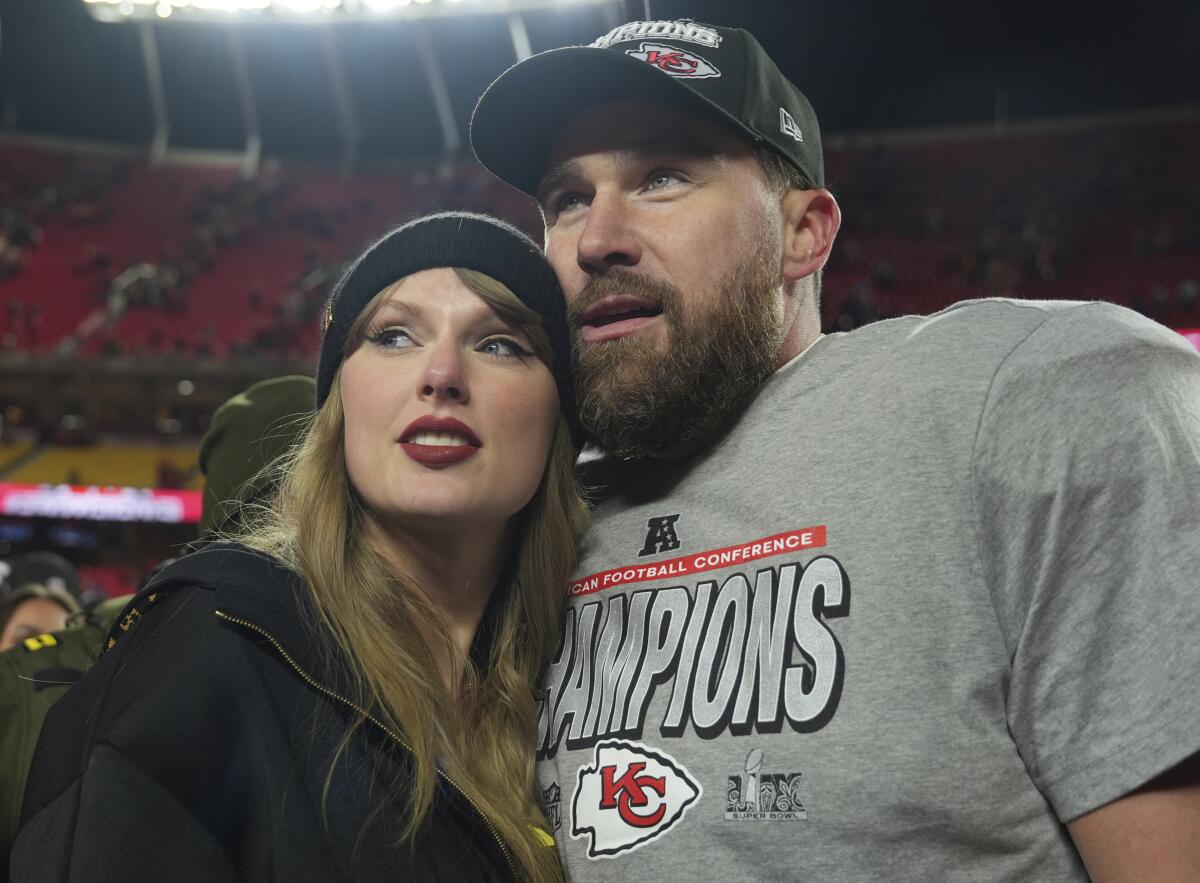
Both the 2024 and 2025 games had the benefit of the pop culture sizzle generated by Chiefs tight end Travis Kelce’s romance with pop superstar Taylor Swift, bringing in more casual fans.
This season, the Chiefs won’t be in the game for the first time in three years as NBC will have the Seattle Seahawks facing off Sunday against the New England Patriots in Super Bowl LX, not the match-up experts predicted for this year.
But that doesn’t mean it can’t set another ratings record.

Kansas City tight end Travis Kelce and Taylor Swift celebrate the Chiefs’ victory over the Buffalo Bills in the AFC Championship on Jan. 26, 2025, in Kansas City, Mo.
(Charlie Riedel / Associated Press)
“I believe it can,” said Lee Berke, president of LHB Sports, Entertainment & Media, noting the lift the NFL ratings have seen this season as viewing information from set-top devices and internet connected televisions in 45 million households are now included in Nielsen’s audience measurement.
“It’s definitely showing up and bumping up ratings throughout the year for the NFL,” Berke said.
A recent report from the Video Advertising Bureau found that the new measurement from Nielsen has boosted ratings for prime time NFL games in the mid-to-high single digit percentages.
Other changes to Nielsen’s measurement in recent years have given the Super Bowl a boost. While surpassing 100 million was once a reasonable goal, the numbers started climbing above that threshold since out-of-home viewing was added in 2021.
History is on the side of a robust audience number this year. The last time the Patriots faced the Seahawks in 2015, the NBC telecast set a viewership record at the time of 114.4 million. Fans watching Sunday can expect to see clips of Malcolm Butler’s interception at the goal line that helped give Tom Brady’s Patriots the win that year.
But NBC doesn’t need a record audience number for the Super Bowl to be a financial success. A robust TV advertising marketplace helped the network sell out the game at a record average of $8 million per 30-second spot, with some going for $10 million.
NBC has also sold spots that will air only on its Peacock streaming platform. The network pulled in the range of $3 million a spot, significantly above the $2 million Fox took in for ads last year when the game was streamed on its Tubi service.
This year NBC was able to use Super Bowl LX to drive ad sales for its coverage of the Winter Olympic Games in Milan that begin Friday and run through Feb. 22, (which is also sold out). The network also has the NBA All-Star Game at the Intuit Dome in Inglewood on Feb. 14, which is why Mike Cavanaugh, co-chief executive of NBCU parent Comcast, recently described February as “the most consequential month in live sports history.”
In 2022, NBC’s combination of both the Winter Olympics and the Super Bowl, accounted for $1.5 billion in revenue according to Comcast’s earnings report, a number the company will likely surpass this year. The company isn’t commenting on revenue but has said it expects to set a record for Super Bowl ad revenue.
Mark Marshall, chairman of global advertising sales and partnerships for NBCUniversal, said 70% of the companies in the Super Bowl are also running commercials in the Olympics.
In previous decades, a Super Bowl commercial was an event in itself with the reveal happening on the telecast. But Marshall noted that, as part of a larger marketing effort, advertising campaigns are now introduced with teasers ahead of the telecast and many get a full preview online.
This year, NBCU was able to offer the Olympics to help marketers connect with more consumers.
“We told advertisers ‘you’re going to spend eight figures (on producing a commercial) — extend the reach of that,” Marshall said.
Technology companies make up the largest share of advertisers. Several AI companies, including Anthropic and Genspark, will be first-time Super Bowl ad buyers. Viewers will also see returning entries from Google, Meta, Wix and Amazon, which will air a spot for its Alexa device.
While there are the usual array of snack food and soft drink companies that will appearin the commercial breaks, viewers will also see a spurt in pharmaceutical ads. Marshall said the category has increased its presence on NFL games. The Super Bowl spots will focus on a message of “wellness,” rather than straight ahead product spots with disclaimers listing unpleasant drug side effects.
Marshall said NBCU does not expect the announced alternative halftime show presented by Turning Point USA to have an impact on the ratings. A concert featuring Kid Rock and lesser known country artists Brantley Gilbert, Lee Brice and Gabby Barrett, will stream on YouTube, X, Rumble and several right-wing TV channels.
The concert promoted by the right-wing group founded by the late Charlie Kirk and now run by his widow Erika is in response to conservatives outraged over the NFL’s selection of Grammy-winning music superstar Bad Bunny, who sings primarily in Spanish, as the halftime act. (President Trump called the decision “terrible” and is skipping the game.)
But the league has not wavered for a moment amid the blowback, as it seeks to expand its global reach by having the most streamed artist in the world on the stage of its marquee event.
The only effective counter-programming gimmick against the Super Bowl halftime show came in 1992. Fox, still an upstart network, ran a live edition of its sketch comedy show “In Living Color” against the halftime of the CBS telecast of Super Bowl XXVI, which featured ice skaters Dorothy Hamill and Brian Boitano.
The pronounced dip in viewership prompted the NFL to sign Michael Jackson as the halftime act in 1993. The game saw a significant ratings boost and the league has booked contemporary music acts for the game ever since.