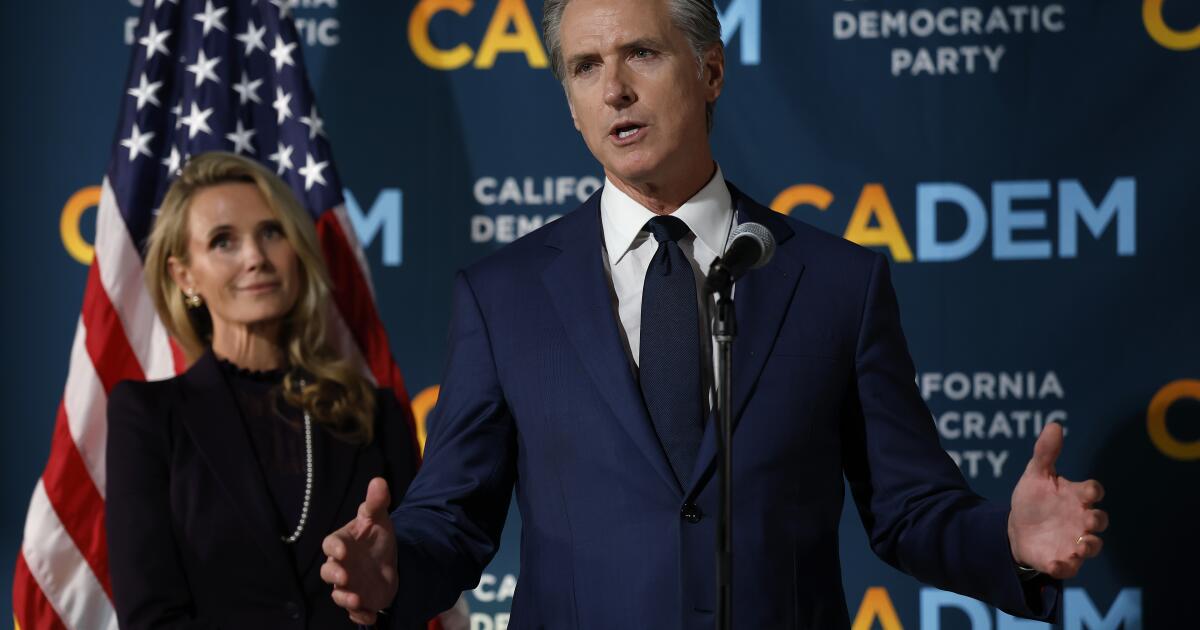
Newsoms’ tax returns show $11 million in earnings since he became governor
SACRAMENTO — California Gov. Gavin Newsom and his wife, documentary filmmaker Jennifer Siebel Newsom, have earned at least $11 million since he took office, with most of their income coming from wineries, restaurants and other investments, according to tax returns from 2019 through their most recent filings for 2024.
The tax records show the couple has earned between $1.4 million and $3.5 million per year, putting them in the upper echelon of Americans when it comes to annual income.
Newsom allowed reporters on Thursday to view four years of the couple’s jointly filed tax returns after receiving criticism for not disclosing his filings since he last released the information for the tax year 2020.
The release of the tax records comes just weeks after Newsom accused the Department of Justice of launching — at President Trump’s request — a baseless and politically motivated investigation into him and his wife, including her business interests and charity work. The governor said the probes, which federal officials have not confirmed, were a personal vendetta launched because he’s considering a run for president in 2028.
Siebel Newsom leads the Representation Project, a nonprofit that advocates for gender equity through film and education programs, and Girls Club Entertainment, a for-profit production company she owns that holds the copyrights to her documentaries. The nonprofit has faced criticism for accepting donations from companies that lobby the governor, including Pacific Gas & Electric Co. and AT&T.
The tax records released Thursday showed that her salary from the Representation Project was $145,000 to $150,000 annually from 2021 though 2024, similar to prior years. While Girls Club paid her $100,000 in 2021, and $11,700 in 2022, she did not report any income from the production company in the two years that followed.
The governor’s office, in a summary of the tax returns provided to reporters, stated that financial documents contradict “the FALSE right-wing claims that the Newsoms ‘enriched themselves’ through new ventures and nonprofit organizations.”
The memo stated that their income has declined since Newsom became governor. The tax records also show that Girls Club Entertainment has been losing money in recent years.
The governor signed a law during his first year in office to require presidential and gubernatorial candidates to release five years of tax returns to appear on the primary ballot. Democrats passed the law in response to Trump’s refusal to make the information public.
Less than six months later, the California Supreme Court struck down the portion that required presidential candidates to comply with the law. Gubernatorial candidates are still required to disclose their tax filings during election season.
Though tax returns became a flash point in the California vs. Trump political saga, Democrats have for decades demanded that candidates for governor and president release their income tax filings.
Presidential candidates dating back to the Nixon administration routinely shared their filings, with only President Ford and Trump refusing to do so. Former Democratic Gov. Jerry Brown and his Republican opponents also declined to share their tax returns before the 2010 and 2014 California gubernatorial elections.
Newsom released his tax returns during his campaigns for governor in 2018 and 2022, again in 2020 and before he beat a recall election in 2021. California candidates, elected officials, judges and some public employees also file annual economic interest statements.
“In the interest of transparency, he’s now voluntarily making all remaining filed tax returns available — going beyond what the law requires — as part of his longstanding commitment to transparency,” said Izzy Gardon, a spokesperson for the governor, in a statement.
The governor and his wife put their investments in a blind trust when he took office. Their earnings, which have totaled more than $1 million per year since at least 2011, stem from investments in wineries, restaurants, bars, hotels and hospitality management companies based in San Francisco, Napa Valley, and Lake Tahoe, according to economic interest disclosures filed with the state.
The latest batch of tax returns covers 2021 through 2024. Reporters were allowed to view, but not copy, more than 700 pages of tax records at the governor’s office in Sacramento on Thursday. Their 2025 tax returns were not available because, as he has done most years, the governor filed for an extension with the Internal Revenue Service and he doesn’t expect to file until October.
The couple’s reported income was the highest in 2021, when they sold their home in Kentfield, a wealthy enclave in Marin County, for $5.9 million. The Newsoms reported receiving more than $55,000 in rent for leasing out the home that same year, but declared an overall loss for tax purposes of $70,000 due to their mortgage payments, taxes, legal fees and depreciation.
The family previously moved to a mansion in Fair Oaks that they purchased for $3.7 million in 2019 following a brief residence at the Governor’s Mansion in downtown Sacramento.
The family kept the Fair Oaks home and purchased another $9.1-million estate in Marin County in 2024, where they primarily live and their four children attend school. Newsom and his wife also spend time in Fair Oaks while working at the state Capitol.
During those four years, Newsom and Siebel Newsom paid a high of $1,253,187 in federal income taxes in 2021, and a low of $488,821 in 2023. Their state tax income bill ranged from $34,307 to $213,331 during that time. The annual property tax bills hovered between $48,000 and $64,300 over that span.
The governor’s income included his government salary, which ranged from $167,647 in 2021 to $192,087 in 2024.
Newsom also was paid more than $150,000 during that period as an author. In recent years, Newsom has published a book for children with dyslexia and a memoir, “Young Man in a Hurry.”
The tax returns showed the family paid from $154,000 to almost $200,000 each year for household employees from 2021 through 2024. The returns showed that they paid for Social Security coverage, Medicare and the state’s unemployment benefits fund as part of those expenses.
The governor and his family donated more than $200,000 to charity from 2021 to 2024. While most of those donations were in cash, they also gave $4,900 in “Armani Business Wear” to the Oakland nonprofit organization Restorative Justice, and toys, furniture, appliances, books and other goods to Goodwill in Sacramento.
Among their listed expenses in 2021 was $3,542 in storage costs for silver and platinum holdings. Previously, the couple made nearly a half-million dollars trading silver bars in 2011 alone.