Newsom

The two, separate lives of Gavin Newsom detailed in new memoir

Gavin Newsom writes in his upcoming memoir about San Francisco’s highborn Getty family fitting him in Brioni suits “appropriate to meet a king” when he was 20 years old. Then he flew aboard their private “Jetty” to Spain for a royal princess’s debutante-style party.

Back home, real life wasn’t as grand.

In an annual performance for their single mom, Newsom and his sister would pretend to find problems with the fancy clothes his dad’s friends, the heirs of ruthless oil baron J. Paul Getty, sent for Christmas. Poor fit. Wrong color. Not my style. The ritual gave her an excuse to return the gifts and use the store credit on presents for her children she placed under the tree.

California’s 41st governor, a possible suitor for the White House, opens up about the duality of his upbringing in his new book. Newsom details the everyday struggle living with his mom after his parents divorced and occasional interludes into his father’s life charmed by the Gettys’ affluence, including that day when the Gettys outfitted him in designer clothes at a luxury department store.

“I walked out understanding that this was the split personality of my life,” Newsom writes in “Young Man in a Hurry.”

For years, Newsom asserted that his “one-dimensional” public image as a slick, privileged politician on a path to power paved with Getty oil money fails to tell the whole story.

“I’m not trying to be something I’m not,” Newsom said in a recent interview. “I’m not trying to talk about, you know, ‘I was born in a town called Hope with no running water.’ That’s not what this book is about. But it’s a very different portrayal than the one I think 9 out of 10 people believe.”

As he explores a 2028 presidential run and basks in the limelight as one of President Trump’s most vociferous critics, the book offers the Democratic politician a chance to write his own narrative and address the skeletons in his closet before opponents begin to exploit his past.

A book tour, which is set to begin Feb. 21 in Nashville, also gives Newsom a reason to travel the country, meet voters and promote his life story without officially entering the race. He’s expected to make additional stops in Georgia, South Carolina, New York, San Francisco and Los Angeles.

The governor describes the book as a “memoir of discovery” that sent him interviewing family members and friends and digging through troves of old documents about his lineage that his mother never spoke about and his father smoothed over. Learning about his family history, the good and the bad, Newsom said, helped him understand and accept himself. Mark Arax, an author and former Los Angeles Times journalist, was his ghostwriter.

“I’ve changed the opinion of myself,” Newsom said when asked if he believed the book would revise his glossy public image. “It kind of rocked so many parts of my life, and kind of cracked things open. And I started to understand where my anxieties come from and why I’m overcompensating in certain areas.”

Newsom writes that his interest in politics brought him and his father, William, closer. His mother, Tessa, on the other hand, didn’t share his father’s enthusiasm.

She warned him to get out while he still could, worried her only son would eschew his true self.

“My mother did not want that world for me: the shrewd marriage of tall husbands and tall wives that kept each year’s Cotillion Debutante Ball stocked with children of the same; the gritted teeth behind the social smiles; the spectator sport of who was in and who was out based on so-and-so’s dinner party guest list,” Newsom wrote.

At the heart of her concern was her belief that Newsom’s “obsessive drive” into business and politics was in response to his upbringing and an effort to solve “the riddle” of his identity from his learning disorder, dyslexia, and the two different worlds he inhabited.

“As I grew up trying to grasp which of these worlds, if either, suited me best, she had worried about the persona I was constructing to cover up what she considered a crack at my core,” Newsom writes. “If my remaking was skim plaster, she feared, it would crumble. It would not hold me into adulthood.”

Newsom’s mother was 19 years old when she married his father, then 32. He learned through writing the book that his mother hailed from a “family of brilliant and daring misfits who had carved new paths in botany and medicine and left-wing politics,” he writes.

There was also secret pain and struggles with mental health. His maternal grandfather, a World War II POW, turned to the bottle after returning home. One night he told his three young daughters to line up in front of the fireplace so he could shoot them, but stopped when his wife walked in the door and took the gun from his hand. He committed suicide years later.

Newsom’s father’s family was full of more traditional Democrats and Irish Catholic storytellers who worked in banking, homebuilding, law enforcement and law. Newsom describes his paternal grandfather as one of the “thinkers behind the throne” for former California Gov. Edmund “Pat” Brown, but his family never held public office despite his dad’s bids for the San Francisco Board of Supervisors and the California Legislature.

The failed campaigns left his father in financial and emotional turmoil that crippled his marriage when Newsom was a small boy. A divorce set the stage for an unusual contrasting existence for the would-be governor, offering him brief exposures to the wealth and power of the Gettys through his dad.

Newsom said he moved casually between the rich and poor neighborhoods of San Francisco as a boy.

“It was a wonder how effortlessly I glided because the two realms of my life, the characters of my mother’s world and the characters of my father’s world, did not fit together in the least,” Newsom writes.

Mayor Gavin Newsom and his dad, Judge William Newsom, have lunch at a cafe

Mayor Gavin Newsom and his dad, Judge William Newsom, have lunch at the Balboa Cafe in San Francisco.

(Christina Koci Hernandez / San Francisco Chronicle via Getty Images)

Though William Alfred Newsom III went on to become an appellate court justice, Newsom’s father was best known for his role delivering ransom money to the kidnappers of J. Paul Getty’s grandson. He served as an adviser to the family without pay and a paid administrator of the $4 billion family trust.

The governor wrote in the book that the ties between the two families go back three generations. His father was close friends with Getty’s sons John Paul Jr. and Gordon since childhood when they became like his sixth and seventh siblings at Newsom’s grandparents’ house.

Gordon Getty in particular considered Newsom’s father his “best-best friend.” Newsom’s dad helped connect the eccentric music composer “to the outside world,” the governor wrote.

“My father had this way of creating a safe space for Gordon to open up,” Newsom writes. “He became Gordon’s whisperer, his interpreter and translator, a bridge to their friends, a bridge to Gordon’s own children.”

San Francisco Mayor Gavin Newsom sits on the arm of a chair that his sister, Hilary Newsom, sits in

San Francisco Mayor Gavin Newsom and his sister, Hilary Newsom, in a promotional portrait for the Search for the Cause campaign, which raises funds for cancer research, on Nov. 21, 2025.

(Caroline Schiff/Getty Images)

His father’s friendship with Gordon Getty exposed Newsom and his younger sister, Hillary, to a world far beyond their family’s own means. Gordon’s wife, Ann, and Newsom’s father organized elaborate adventures for the Gettys’ four sons and the Newsom children.

Newsom describes fishing on the Rogue River and riding in a helicopter while studying polar bears on the shores of the Hudson Bay in Canada. He recalled donning tuxedos and carrying toy guns pretending to be James Bond on a European yacht vacation and soaring over the Serengeti in a hot air balloon during an East African safari.

Throughout his travels, Newsom often blended in with the Gettys’ brown-haired sons. He wrote that the actor Jack Nicholson once mistakenly called him one of the “Getty boys” at a party in a 16th-century palazzo in Venice where guests arrived via gondola. Newsom didn’t correct him.

“Had I shared this encounter with my mother, she likely would have asked me if deception was something I practiced whenever I hobnobbed with the Gettys,” Newsom said in the book. “Fact is, I was always aware of the line that separated us from the Gettys. Not because they went out of their way to make us aware of it but because we, as good Newsoms, paid constant mind to the distinction.”

Newsom wrote that his mother seemed to begrudge the excursions when her children returned home. She raised them in a much more ordinary existence. Newsom describes his father’s presence as “episodic.”

“For a day or two, she’d give us the silent treatment, and then we’d all fall back into the form of a life trying to make ends meet,” he wrote. “After enough vacations came and went, a cone of silence took hold.”

Newsom’s mother worked as an assistant retail buyer, a bookkeeper, a waitress at a Mexican restaurant, a development director for a nonprofit and a real estate agent — holding as many as three jobs at once — to provide for her children. His mother’s sister and brother-in-law helped care for them when they could, but he likened himself to a latchkey kid because of the amount of time he and his sister spent alone.

They moved five times in 10 years in search of a “better house in a better neighborhood” with good schools, taking the family from San Francisco to the Marin County suburbs. Though his mother owned a home, she often rented out rooms to bring in extra money.

Tired of his mother complaining about finances and his father not coming through, Newsom wrote that he took on a paper route.

In the book, Newsom describes his struggles with dyslexia and how the learning disorder undercut his self-esteem when he was an emotionally vulnerable child.

Eager to make himself something more than an awkward kid with sweaty palms and a bowl haircut who couldn’t read, Newsom mimicked Remington Steele, the suave character on the popular 1980s detective show. He chugged down glassfuls of raw eggs like Sylvester Stallone in “Rocky” and ran across town and back like a prizefighter in training.

He found confidence in high school sports, but his struggle to find himself continued into young adulthood. Newsom wrote that he watched tapes of motivational guru Tony Robbins and heeded his advice to remake yourself in the image of someone you admire. For Newsom, that became Robbins himself.

“Find a person who embodies all of the outward traits of personality, bearing, charisma, language, and power lacking in yourself,” Newsom described the philosophy in the book. “Study that person. Copy that person. The borrowed traits may fit awkwardly at first, but don’t fret. You’ll be surprised by how fast the pose becomes you, and you the pose.”

His father scoffed at the self-help gurus and nurtured his interest in business.

More than a half-dozen friends and family members, including Gordon Getty, invested equal shares to help him launch a wine shop in San Francisco. Newsom named the business, which expanded to include restaurants, hotels and wineries, “PlumpJack,” the nickname of Shakespeare’s fictional character Sir John Falstaff and the title of Gordon Getty’s opera.

“Gordon’s really inspired me to be bolder and more audacious. He’s inspired me to be more authentic,” Newsom said. “The risks I take in business … just trying to march to the beat of a different drummer and to be a little bolder. That’s my politics. But I also think he played a huge role in that, in terms of shaping me in that respect as well.”

Newsom described Gordon and Ann Getty as like family. The Gettys also became the biggest investors in his wineries and among his largest political donors.

In an interview, Newsom said there are many days when he feels his mother “absolutely” was right to worry about the facade of politics and the mold her son stuffed himself into.

Gavin Newsom in a white dress shirt and tie walks down a sidewalk

Gavin Newsom heads for his home neighborhood on Nov. 3, 2003, to cast hisvote for San Francisco mayor.

(Mike Kepka / San Francisco Chronicle via Getty Images)

He described the day the recall against him qualified for the ballot amid the COVID-19 pandemic as humbling and humiliating, though it later failed by a wide margin. Still today, he said, there’s a voice in his head constantly questioning why he’s in politics, what he’s exposing his wife and children to and doing with his life.

By choosing a career as an elected official despite his mother’s warnings, Newsom ultimately picked his father’s world and accomplished his father’s dream of taking office. But he said the book taught him that so much of his own more gutsy positions, such as his early support for gay marriage, and his hustle were from his mother.

Newsom said he’s accepted that he can’t control which version of himself people choose to see. Writing the book felt cathartic, he said, and left him more comfortable taking off his mask.

“It allowed me to understand better my motivations, my purpose, my meaning, my mission… who my mom and dad were and who I am as a consequence of them and what truly motivates me,” Newsom said. “There’s a freedom. There’s a real freedom. And it’s nice. It’s just so much nicer than the plaster of the past.”

Source link

Who pays for Newsom’s travel? Hint: It’s not always taxpayers

Gov. Gavin Newsom sat onstage at the Munich Security Conference in Germany on Friday and described one of the primary ways he is responding as the Trump administration shifts federal climate priorities.

“I’m showing up,” he said.

In recent months, that has meant trips to Brazil, Switzerland and now Germany, where he has repeatedly positioned California as a global climate partner. The travel has also revived a recurring question from critics and watchdog groups: Who pays for those trips?

In many cases, the costs are not borne by taxpayers. The governor’s office said his international travel is paid for by the California State Protocol Foundation, a nonprofit that is funded primarily by corporate donations and run by a board Newsom appoints.

For decades, California governors have relied on nonprofits to pick up the tab for official travel, diplomatic events and other costs that would otherwise be paid with taxpayer funds.

“The Foundation’s mission is to lessen the burden on California taxpayers by reimbursing appropriate expenses associated with advancing the state’s economic and diplomatic interests,” said Jason Elliott, a former high-ranking advisor to Newsom, who the governor added to the foundation’s board.

While the arrangement helps the state’s pocketbook, critics say it is another avenue for corporate interests to gain influence.

“The problem with the protocol foundation and others like it is that donors to these foundations receive access to the politicians whose travel they fund,” said Carmen Balber, executive director of the advocacy group Consumer Watchdog.

When did nonprofits start paying for gubernatorial travel?

The protocol foundation was created as a tax-exempt charity during Republican Gov. Arnold Schwarzenegger’s administration in 2004.

Similar nonprofits have existed since Gov. George Deukmejian created one in the 1980s. In the early 2000s, Gov. Gray Davis dramatically increased the use of nonprofits to cover travel, housing and political events.

When Schwarzenegger left office, his supporters turned the protocol foundation over to Democratic Gov. Jerry Brown’s backers, who in turn handed it over to Newsom’s camp. The foundation describes its mission in federal tax filings as “relieving the State of California of its obligations to fund certain expenditures of the Governor’s Office.”

Newsom appoints members to the foundation board, which then is responsible for determining what expenses to cover in the governor’s office. In its most recent tax filing covering 2024, the foundation lists its board chair as Steve Kawa, who served as Newsom’s chief of staff when he was mayor of San Francisco. The foundation’s secretary in those filings is Jim DeBoo, who was Newsom’s chief of staff in the governor’s office until 2022.

The foundation reported total revenue of $1.3 million in 2024 and, after expenses, had a balance of less than $8,000.

What is the foundation paying for?

Publicly available records are vague, but annual financial disclosure forms show the foundation paid more than $13,000 for the governor’s 2024 trip to Italy, where he delivered a speech on climate change at the Vatican.

That same year, the foundation paid nearly $4,000 for his trip to Mexico City to attend the inauguration of Mexico’s first female president, Claudia Sheinbaum. The cost of both trips included flights, hotel and meals for his “official travel,” according to the disclosure records, which are filed with the Fair Political Practices Commission and known as Form 700s.

Newsom has reported receiving $72,000 in travel, staff picnics and holiday events from the protocol foundation since he took office in 2019, according to the disclosures.

The foundation paid $15,200 for the governor’s 2023 trip to China, where he visited five cities in seven days during an agenda packed with meetings, sightseeing and celebrations, including a private tour of the Forbidden City.

In 2020, the foundation paid $8,800 for Newsom to travel to Miami for Super Bowl LIV — where he said he was representing the state as the San Francisco 49ers faced the Kansas City Chiefs.

The governor’s office said it did not yet have the amount picked up by the foundation for Newsom’s travel to Brazil to attend the United Nations climate summit known as COP30 or to Switzerland for the World Economic Summit.

Who are the donors behind the foundation?

In some cases, the well-heeled funders behind the foundation’s cash flow are easy to identify on state websites.

Donations to the foundation that are solicited directly or indirectly by Newsom are recorded with the Fair Political Practices Commission as behested payments. A behested payment occurs when an elected official solicits or suggests that a person or organization give to another person or organization for a legislative, governmental or charitable purpose.

The William and Flora Hewlett Foundation donated $300,000 in a 2023 behested payment earmarked for the California delegation traveling to China for the meetings on climate change. UC Berkeley gave $220,000 for the governor’s office’s trip to the Vatican in 2024.

Most donations simply indicate that they are directed for “general operating support” of the foundation. That includes two donations from the Amazon-owned autonomous vehicle company Zoox Inc. cumulatively worth $80,000.

Two charities set up to pay for Newsom’s inaugurations in 2019 and 2023 moved more than $5 million to the protocol foundation since 2019. The financial backers behind those inaugural charities include powerful unions, corporations, tribal casino interests, trade associations and healthcare giants — organizations with significant financial stakes in state policy decisions.

Past spending by the foundation has been criticized

During Schwarzenegger’s administration, his office avoided fully disclosing $1.7 million in travel costs paid for by the foundation, instead relying on vague internal memos and, in some cases, oral accounting, according to a 2007 Los Angeles Times investigation.

Schwarzenegger’s expenses picked up by the foundation included leased Gulfstream jets costing up to $10,000 per hour and suites going for thousands of dollars a night. The Times’ investigation found among the costs was $353,000 for a single round trip to China on a private jet in 2005.

The foundation also paid for Schwarzenegger’s travels to Japan, Europe, Canada and Mexico.

At the time, Schwarzenegger’s representatives told The Times the governor did not have to report the travel costs on his annual disclosure forms because the payments for the jets and suites were gifts to his office, not to him.

Newsom’s office said the governor travels commercially, not on private jets.

Source link

Newsom tells world leaders Trump’s retreat on the environment will mean economic harm

Gov. Gavin Newsom told world leaders Friday that President Trump’s retreat from efforts to combat climate change would decimate the U.S. automobile industry and surrender the future economic viability to China and other nations embracing the transition to renewable energy.

Newsom, appearing at the Munich Security Conference in Germany, urged diplomats, business leaders and policy advocates to forcefully stand up to Trump’s global bullying and loyalty to the oil and coal industry. The California governor said the Trump administration’s massive rollbacks on environmental protection will be short-lived.

“Donald Trump is temporary. He’ll be gone in three years,” Newsom said during a Friday morning panel discussion on climate action. “California is a stable and reliable partner in this space.”

Newsom’s comments came in the wake of the Trump administration’s repeal of the endangerment finding and all federal vehicle emissions regulations. The endangerment finding is the U.S. government’s 2009 affirmation that planet-heating pollution poses a threat to human health and the environment.

Environmental Protection Agency administrator Lee Zeldin said the finding has been regulatory overreach, placing heavy burdens on auto manufacturers, restricting consumer choice and resulting in higher costs for Americans. Its repeal marked the “single largest act of deregulation in the history of the United States of America,” he said.

Scientists and experts were quick to condemn the action, saying it contradicts established science and will put more people in harm’s way. Independent researchers around the world have long concluded that greenhouse gases released by the burning of gasoline, diesel and other fossil fuels are warming the planet and worsening weather disasters.

The move will also threaten the U.S.’s position as a leader in the global clean energy transition, with nations such as China pulling ahead on electric vehicle production and investments in renewables such as solar, batteries and wind, experts said.

Newsom’s trip to Germany is just his latest international jaunt in recent months as he positions himself to lead the Democratic Party’s opposition to Trump and the Republican-led Congress, and to seed a possible run for the White House in 2028. Last month Newsom traveled to the World Economic Forum in Davos, Switzerland, and in November to the U.N. climate summit in Belém, Brazil — mocking and condemning Trump’s policies on Greenland, international trade and the environment.

When asked how he would restore the world’s confidence in the United States if he were to become president, Newsom sidestepped. Instead he offered a campaign-like soliloquy on California’s success on fostering Tesla and the nation’s other top electric vehicle manufactures as well as being a magnet for industries spending billions of dollars on research and development for the global transition away from carbon-based economies.

The purpose of the Munich conference was to open a dialogue among world leaders on global security, military, economic and environmental. Along with Friday’s discussion on climate action, Newsom is scheduled to appear at a livestreamed forum on transatlantic cooperation Saturday.

Andrew Forrest, executive chairman of the Australia-based mining company giant Fortescue, said during a panel Friday his company is proof that even the largest energy-consuming companies in the world can thrive without relying on the carbon-based fuels that have driven industries for more than a century. Fortescue, which buys diesel fuel from countries across the world, will transition to a “green grid” this decade, saving the company a billion dollars a year, he said.

“The science is absolutely clear, but so is the economics. I am, and my company Fortescue is, the industrial-grade proof that going renewable is great economics, great business, and if you desert it, then in the end, you’ll be sorted out by your shareholders or by your voters at the ballot box,” Forrest said.

Newsom said California has also shown the world what can be done with innovative government policies that embrace electric vehicles and the transition to a non-carbon-based economy, and continues to do so despite the attacks and regressive mandates being imposed by the Trump administration.

“This is about economic prosperity and competitiveness, and that’s why I’m so infuriated with what Donald Trump has done,” Newsom said. “Remember, Tesla exists for one reason — California’s regulatory market, which created the incentives and the structure and the certainty that allowed Elon Musk and others to invest and build that capacity. We are not walking away from that.”

California has led the nation in the push toward EVs. For more than 50 years, the state enjoyed unique authority from the EPA to set stricter tailpipe emission standards than the federal government, considered critical to the state’s efforts to address its notorious smog and air-quality issues. The authority, which the Trump administration has moved to rescind, was also the basis for California’s plan to ban the sale of new gasoline-powered cars by 2035.

The administration again targeted electric vehicles in its announcement on Thursday.

“The forced transition to electric vehicles is eliminated,” Zeldin said. “No longer will automakers be pressured to shift their fleets toward electric vehicles, vehicles that are still sitting unsold on dealer lots all across America.”

But the efforts to shut down the energy transition may be too little, too late, said Hannah Safford, former director of transportation and resilience at the White House Climate Policy Office under the Biden administration.

“Electric cars make more economic sense for people, more models are becoming available, and the administration can’t necessarily stop that from happening,” said Safford, who is now associate director for climate and environment at the Federation of American Scientists.

Still, some automakers and trade groups supported the EPA’s decision, as did fossil fuel industry groups and those geared toward free markets and regulatory reform. Among them were the Independent Petroleum Assn. of America, which praised the administration for its “efforts to reform and streamline regulations governing greenhouse gas emissions.”

Ford, which has invested in electric vehicles and recently completed a prototype of a $30,000 electric truck, said in a statement to The Times that it appreciated EPA’s move “to address the imbalance between current emissions standards and consumer choice.”

Toyota, meanwhile, deferred to a statement from Alliance for Automotive Innovation president John Bozzella, who said similarly that “automotive emissions regulations finalized in the previous administration are extremely challenging for automakers to achieve given the current marketplace demand for EVs.”

Source link

Gov. Gavin Newsom approves $90 million for Planned Parenthood

Gov. Gavin Newsom signed a bill on Wednesday to provide $90 million to Planned Parenthood, a move intended to help offset the losses from recent federal cuts targeting abortion providers.

“These cuts were designed to attack and assault Planned Parenthood,” said Newsom, speaking at a news conference near the Capitol. “They were not abortion cuts; they were attacks on wellness and screenings and they were attacks on women’s healthcare.”

The Republican-backed “One Big Beautiful Bill Act,” signed last year by President Trump, blocked federal Medicaid funding from going to Planned Parenthood. More than 80% of the nearly 1.3 million annual patient visits to Planned Parenthood in California were previously reimbursed by Medi-Cal, the state’s version of Medicaid.

Sen. John Laird, who authored the legislation for the funding, Senate Bill 106, said the measure showed that California won’t back down. “This is us standing up to the immediate cut that was in that bill,” said Laird, (D-Santa Cruz). “This is how we are fighting back.”

Jodi Hicks, chief executive officer of Planned Parenthood Affiliates of California, thanked legislators for their support and said the organization could not survive without support from the state. She said Planned Parenthood would always fight against federal attacks but “needed an army” this time to stand beside them.

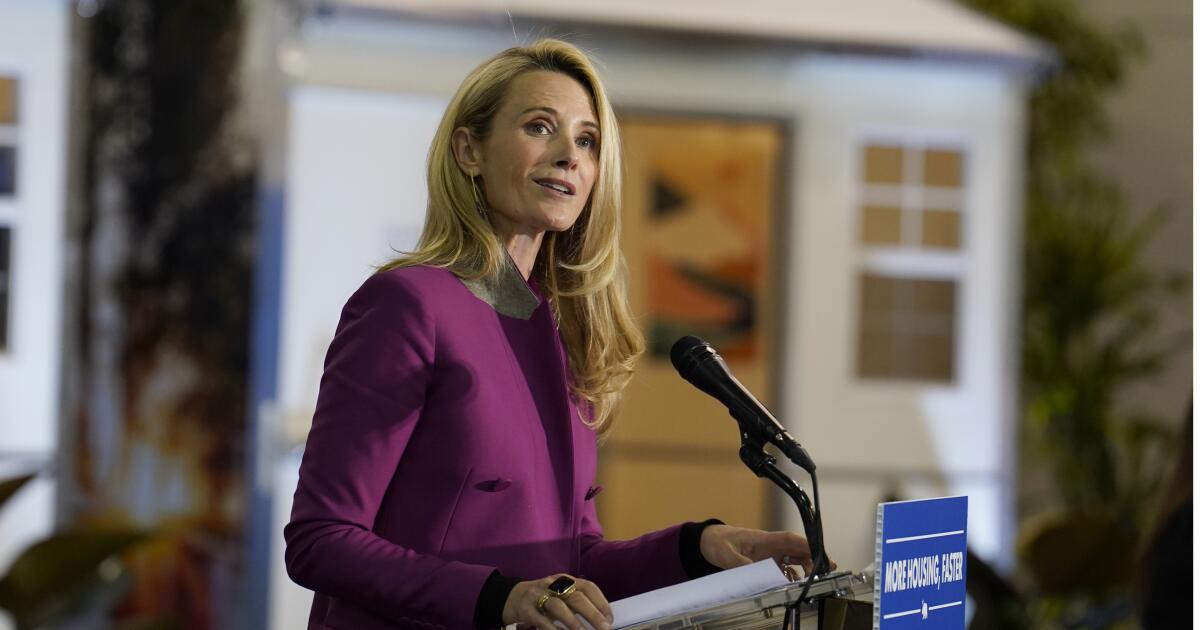
During the news conference, First Partner Jennifer Siebel Newsom expressed frustration with reporters for asking off-topic questions and said the media should be more concerned about women’s issues.

“All of these questions have really been about other issues,” she said. “This happens over and over and over again — (and we) wonder why we have such a horrific war on women in this country.”

Planned Parenthood offers a range of services, including abortions, birth control, cancer screenings and testings for sexually transmitted diseases. A coalition of states, including California, filed a lawsuit last year against the Trump administration over the cuts to the nonprofit. The states argue in the ongoing lawsuit that the measure violates the spending powers of Congress by singling out Planned Parenthood for negative treatment.

Senate Bill 106 has drawn ire from Republicans, who question why funding is going to Planned Parenthood when many hospitals in the state need more financial support.

“For rural Californians, this conversation is about access to care,” Sen. Megan Dahle (R-Bieber) said in a statement from the Senate Republican Caucus. “Hospitals are cutting services or facing closure, forcing families to drive hours for life-saving treatment. State lawmakers should prioritize stability for these communities.”

Source link

Newsom heads to Munich conference to challenge Trump’s vision for U.S.

Gov. Gavin Newsom is heading to a conference of world leaders in Germany later this week as part of his ongoing effort to use the global stage to urge investment in California’s climate-related initiatives and challenge President Trump’s isolationist policies.

Newsom will appear at the Munich Security Conference to talk about trade and jobs and tell foreign leaders that “California is a stable and reliable partner,” he said Tuesday during an unrelated event.

U.S. Secretary of State Marco Rubio is leading the official U.S. delegation to the conference, while Democratic leaders Michigan Gov. Gretchen Whitmer and Rep. Alexandria Ocasio-Cortez of New York are also expected, according to news reports.

The three-day event focuses on the intersections of trade, economics, security and foreign policy, and is expected to draw business leaders and heads of state.

Vice President JD Vance’s appearance at last year’s gathering caused a stir after he argued that European’s immigration policies are too relaxed and European nations are too reliant on the United States.

Ahead of the gathering, conference organizers released a report Monday that found that the “world has entered a period of wrecking-ball politics. Sweeping destruction — rather than careful reforms and policy corrections — is the order of the day.”

Newsom told reporters that he will appear on several panels, and suggested he will focus in part on staying competitive with China when it comes to new technologies and job growth.

“China is cleaning our clock as it relates to low-carbon green growth. They are cleaning our clock in terms of not just electric vehicles, because it’s not about electric power, it’s about economic power,” he said.

“It’s about exports, manufacturing, jobs — and this country is walking away,” he continued. “We are walking away from science and we are walking away from common sense.”

“Gavin Newscum is traveling to another international conference to whine about climate policies instead of doing his job as the governor of California?” said White House spokesperson Taylor Rogers, using President Trump’s derogatory nickname for the governor. “Nothing new to see here.”

Newsom is in his last year as California governor and is considering running for president in 2028. He last month traveled to the World Economic Forum in Davos, Switzerland, where he criticized world leaders for not challenging Trump’s aggressive posture when it comes to his threats to acquire Greenland, as well as his tariffs.

Newsom also attended the U.N. climate policy summit in Belém, Brazil, in November.

Source link

Trump shares racist image of the Obamas. White House says backlash is ‘fake outrage’

President Trump shared a short video clip on social media late Thursday depicting former President Obama and former First Lady Michelle Obama as apes, drawing immediate public backlash that the White House characterized as “fake outrage.”

The image, which Trump posted on his official Truth Social account around midnight, was included toward the end of a one-minute video clip that promoted a conspiracy theory about voting irregularities in the 2020 presidential election. In it, the Obamas are portrayed as apes as “The Lion Sleeps Tonight” plays in the background.

The White House said the clip was taken from “an internet meme video,” in which Trump is depicted as a lion and several high-profile Democrats — including former President Biden, former Vice President Kamala Harris, U.S. Sen. Adam Schiff and California Gov. Gavin Newsom — are rendered as giraffes, turtles, antelopes and other animals. The clip, which was shared by a social media account in October, is captioned: “President Trump: King of the Jungle.”

Only the image of the Obamas is included in the clip shared by Trump.

“Please stop the fake outrage and report on something today that actually matters to the American public,” Karoline Leavitt, the White House press secretary, said in a statement Friday.

The post, however, quickly drew fierce criticism from Democrats, some Republicans and civil rights organizations. The imagery was condemned for echoing long-standing racist tropes that have historically been used to demean Black Americans.

“Trump posting this video — especially during Black History Month — is a stark reminder of how Trump and his followers truly view people,” the NAACP wrote on X. “And we’ll remember that in November.”

Newsom, a Democrat, said it was “disgusting behavior by the president” to amplify such an image.

“Every single Republican must denounce this. Now,” Newsom wrote on X.

Sen. Tim Scott, a Black South Carolina Republican who is the chairman of the National Republican Senatorial Committee, said the image was “the most racist thing I’ve seen out of this White House.”

“The President should remove it,” Scott wrote on X.

Source link

Newsom walks thin line on immigrant health as he eyes presidential bid

California Gov. Gavin Newsom, who has acknowledged he is eyeing a presidential bid, has incensed both Democrats and Republicans over immigrant healthcare, underscoring the delicate political path ahead.

For a second straight year, the Democrat has asked state lawmakers to roll back coverage for some immigrants in the face of federal Medicaid spending cuts and a roughly $3-billion budget deficit that analysts warn could worsen if the AI bubble bursts. Newsom has proposed that the state not step in when, starting in October, the federal government stops providing health coverage to an estimated 200,000 legal residents — comprising asylees, refugees and others.

Progressive legislators and activists said the cost-saving measures are a departure from Newsom’s “health for all” pledge, and Republicans continue to skewer Newsom for using public funds to cover any noncitizens.

Newsom’s latest move would save an estimated $786 million this fiscal year and $1.1 billion annually in future years in a proposed budget of $349 billion, according to the Department of Finance.

State Sen. Caroline Menjivar, one of two Senate Democrats who voted against Newsom’s immigrant health cuts last year, said she worried the governor’s political ambition could be getting in the way of doing what’s best for Californians.

“You’re clouded by what Arkansas is going to think, or Tennessee is going to think, when what California thinks is something completely different,” said Menjivar, who said previous criticism got her temporarily removed from a key budget subcommittee. “That’s my perspective on what’s happening here.”

Meanwhile, Republican state Sen. Tony Strickland criticized Newsom for glossing over the state’s structural deficit, which state officials say could balloon to $27 billion the following year. And he slammed Newsom for continuing to cover California residents in the U.S. without authorization. “He just wants to reinvent himself,” Strickland said.

It’s a political tightrope that will continue to grow thinner as federal support shrinks amid ever-rising healthcare expenses, said Guian McKee, a co-chair of the Health Care Policy Project at the University of Virginia’s Miller Center of Public Affairs.

“It’s not just threading one needle but threading three or four of them right in a row,” McKee said. Should Newsom run for president, McKee added, the priorities of Democratic primary voters — who largely mirror blue states like California — look very different from those in a far more divided general electorate.

Americans are deeply divided on whether the government should provide health coverage to immigrants without legal status. In a KFF poll last year, a slim majority — 54% — were against a provision that would have penalized states that use their own funds to pay for immigrant healthcare, with wide variation by party. The provision was left out of the final version of the bill passed by Congress and signed by President Trump.

Even in California, support for the idea has waned amid ongoing budget problems. In a May survey by the Public Policy Institute of California, 41% of adults in the state said they supported providing health coverage to immigrants without authorization, a sharp drop from the 55% who supported it in 2023.

Trump, Vice President JD Vance, other administration officials, and congressional Republicans have repeatedly accused California and other Democrat-led states of using taxpayer funds on immigrant healthcare, a red-meat issue for their GOP base. Centers for Medicare & Medicaid Services Administrator Mehmet Oz has accused California of “gaming the system” to receive more federal funds, freeing up state coffers for its Medicaid program, known as Medi-Cal, which has enrolled roughly 1.6 million immigrants without legal status.

“If you are a taxpayer in Texas or Florida, your tax dollars could’ve been used to fund the care of illegal immigrants in California,” he said in October.

California state officials have denied the charges, noting that only state funds are used to pay for general health services to those without legal status because the law prohibits using federal funds. Instead, Newsom has made it a “point of pride” that California has opened up coverage to immigrants, which his administration has noted keeps people healthier and helps them avoid costly emergency room care often covered at taxpayer expense.

“No administration has done more to expand full coverage under Medicaid than this administration for our diverse communities, documented and undocumented,” Newsom told reporters in January. “People have built careers out of criticizing my advocacy.”

Newsom warns the federal government’s “carnival of chaos” passed Trump’s One Big Beautiful Bill Act, which he said puts 1.8 million Californians at risk of losing their health coverage with the implementation of work requirements, other eligibility rules, and limits to federal funding to states.

Nationally, 10 million people could lose coverage by 2034, according to the Congressional Budget Office. Health economists have said higher numbers of uninsured patients — particularly those who are relatively healthy — could concentrate coverage among sicker patients, potentially increasing premium costs and hospital prices overall.

Immigrant advocates say it’s especially callous to leave residents who may have fled violence or survived trafficking or abuse without access to healthcare. Federal rules currently require state Medicaid programs to cover “qualified noncitizens” including asylees and refugees, according to Tanya Broder with the National Immigration Law Center. But the Republican tax-and-spending law ends the coverage, affecting an estimated 1.4 million legal immigrants nationwide.

With many state governors yet to release budget proposals, it’s unclear how they might handle the funding gaps, Broder said.

For instance, Colorado state officials estimate roughly 7,000 legal immigrants could lose coverage due to the law’s changes. And Washington state officials estimate 3,000 refugees, asylees, and other lawfully present immigrants will lose Medicaid.

Both states, like California, expanded full coverage to all income-eligible residents regardless of immigration status. Their elected officials are now in the awkward position of explaining why some legal immigrants may lose their healthcare coverage while those without legal status could keep theirs.

Last year, spiraling healthcare costs and state budget constraints prompted the Democratic governors of Illinois and Minnesota, potential presidential contenders JB Pritzker and Tim Walz, to pause or end coverage of immigrants without legal status.

California lawmakers last year voted to eliminate dental coverage and freeze new enrollment for immigrants without legal status and, starting next year, will charge monthly premiums to those who remain. Even so, the state is slated to spend $13.8 billion from its general fund on immigrants not covered by the federal government, according to Department of Finance spokesperson H.D. Palmer.

At a news conference in San Francisco in January, Newsom defended those moves, saying they were necessary for “fiscal prudence.” He sidestepped questions about coverage for asylees and refugees and downplayed the significance of his proposal, saying he could revise it when he gets a chance to update his budget in May.

Kiran Savage-Sangwan, executive director of the California Pan-Ethnic Health Network, pointed out that California passed a law in the 1990s requiring the state to cover Medi-Cal for legal immigrants when federal Medicaid dollars won’t. This includes green-card holders who haven’t yet met the five-year waiting period for enrolling in Medicaid.

Calling the governor’s proposal “arbitrary and cruel,” Savage-Sangwan criticized his choice to prioritize rainy-day fund deposits over maintaining coverage and said blaming the federal government was misleading.

It’s also a major departure from what she had hoped California could achieve on Newsom’s first day in office seven years ago, when he declared his support for single-payer healthcare and proposed extending health insurance subsidies to middle-class Californians.

“I absolutely did have hope, and we celebrated advances that the governor led,” Savage-Sangwan said. “Which makes me all the more disappointed.”

KFF Health News is a national newsroom that produces in-depth journalism about health issues and is one of the core operating programs at KFF — the independent source for health policy research, polling and journalism.

Source link

Unions urge Newsom and California lawmakers to rein in AI

National union leaders, including the head of one of California’s largest labor organizations, on Wednesday urged Gov. Gavin Newsom to protect workers as artificial intelligence threatens to replace or surveil employees — and warned that a failure to do so could hurt his presidential ambitions.

“This is a priority for the entire nation,” Lorena Gonzalez, president of the California Federation of Labor Unions, said at a news conference near the state Capitol. “He cannot spend his time waiting to be done in California and think he’s not going to get questions about the true issues surrounding AI, Big Tech and the Big Tech billionaires that are trying to buy our government.”

Gonzalez, a former state lawmaker from San Diego, said the federation is sponsoring a package of new bills aimed at reining in the use of AI and protecting the rights of workers, including safeguards against spying in the workplace and restrictions on layoffs.

The package of bills supported by labor organizations includes:

  • Senate Bill 947 by Sen. Jerry McNerney (D-Stockton), which would require human oversight if an algorithm is used to justify the discipline or termination of an employee.
  • Senate Bill 951, introduced by Sen. Eloise Gomez Reyes (D-Colton), which would require employers to provide a 90-day advance notice to workers and local and state governments before AI-related layoffs. It would apply to cases affecting 25 or more workers or 25% of the workforce, whichever is less. Recent layoffs, including at Amazon, Expedia and Pinterest, have been tied to AI, although some economists argue it’s challenging to determine whether that was the primary factor.
  • Assembly Bill 1331, dubbed “No bosses in the bathroom,” would grant workers the right to remove workplace surveillance tools when entering public bathrooms or certain employee-only areas. The bill, authored by Assemblymember Sade Elhawary (D-Los Angeles), would subject employers to a $500 civil penalty for violations.

Gonzalez said labor organizations are often told to “work it out” with businesses but argued this was a dead end.

“We are not going to be able to achieve guardrails by working with bosses who want no guardrails,” she said. “It is time that the governor engages with workers in the workplace. Every AI convening he does, everybody he’s pulled together is [representing] AI and Big Tech lobbyists.”

Gonzalez was joined Wednesday by Liz Shuler, president of the AFL-CIO, and other labor leaders from Iowa, Georgia, North Carolina and Nevada.

“This is the most urgent issue that we [as workers] are facing,” Shuler said. “This is a crisis and no one is prepared.”

In a joint letter addressed to Newsom, they implored the governor to act quickly to establish meaningful safeguards around the technology.

“This fight extends beyond devastating job losses and new forms of union busting,” a copy of the letter states. “There is dignity in human work that is the foundation of a healthy, productive democracy. The future of our economy and our society cannot be left to the unchecked whims of profit driven technology corporations and billionaires.”

In an email to The Times, Newsom spokesperson Tara Gallegos said the governor had a strong record of fighting for workers’ rights, including raising the minimum wage and expanding sick leave and other worker protections.

“No Governor has done more than Governor Gavin Newsom to regulate AI in a way that protects workers without killing jobs or innovation,” she wrote. “Under his leadership, California has taken the most comprehensive, worker-centered approach to AI in the country.”

Adults in the United States are growing increasingly concerned about the ramifications of AI, according to a survey from the Pew Research Center. Fifty percent of those surveyed last year said they are “more concerned than excited” about the increased use of AI in daily life, up from 37% in 2021.

Source link

Dodgers pledged $100 million to wildfire relief fund. So far? $7.8 million

Not long after Pacific Palisades and Altadena had burned, Gov. Gavin Newsom summoned reporters and television cameras to Dodger Stadium. Newsom stepped behind a podium dropped within a stadium parking lot, with a commanding view of Los Angeles as the backdrop.

He was there to unveil LA Rises, a signature initiative under which the private sector and philanthropists could unite to help Southern California rebuild and recover.

The most valuable player that day: Mark Walter, the Dodgers’ chairman and controlling owner. The big announcement: Walter and two of his associated charities — his family foundation and the Dodgers’ foundation — would contribute up to $100 million as “an initial commitment” to LA Rises.

“We should clap for that,” Dodgers co-owner Magic Johnson told the assembled media. “A hundred million dollars, that’s an outstanding thing.”

One year later, Newsom’s initiative has struggled to distinguish itself amid a panoply of wildfire relief efforts. LA Rises has delivered $20 million to date, including $7.8 million from Walter’s family foundation, according to Newsom’s office.

“If it’s a number of 20 million after one year, after such a severe occurrence, and with Los Angeles having the giving capacity to meet that goal, I would have expected to hear that there had been more commitments, at a minimum,” said Casey Rogers, founder of Santa Barbara-based Telea Insights, which advises philanthropists and leaders of nonprofit organizations.

“Maybe not all of those commitments would have been paid. Maybe they would have been commitments over a number of years. But it would have been closer to the goal.”

Walter stands by his pledge, Dodgers president Stan Kasten said. A representative of Newsom’s office said Walter’s pledge did not come with a timeline.

“I know we haven’t spent the full 100 yet,” Kasten said, “but this is a long-term commitment.”

Rather than solicit large donations up front and determine how to use the money later, LA Rises prefers to identify “impactful opportunities for investment” as they arise and then “coordinate financial support from a variety of private, public and philanthropic donors, including the Walter Family Foundation,” said Dee Dee Myers, director of Newsom’s office of business and economic development.

Of the Walter foundation contributions, $5 million went toward grants for impacted small business, workers and nonprofits, with $2.8 million to Pasadena City College for modernizing and expanding technical education programs to train workers that can help rebuild their own communities.

LA Rises also funded programs that include day camps and mental health intervention to children affected by the fires; streamlined architectural planning and permits for survivors wishing to rebuild; and support for Habitat for Humanity in building new homes and rebuilding damaged ones.

“The administration is incredibly grateful for any philanthropic dollars that have gone towards the rebuilding efforts in Los Angeles,” Myers said.

The competition for those dollars is fierce. The Milken Institute reported that private giving toward wildfire relief — from individuals, corporations and other entities — hit nearly $1 billion last year.

“I know there has been a lot of money that has been paid to various programs,” Kasten said, “and there has also been some rethinking about how LA Rises is deployed and what foundational money from the Dodgers is used for. We continue to work hard with a lot of groups on that tragedy.

“There are talks ongoing about a variety of programs and a variety of ways of funding things. We are still very involved with this, both with LA Rises and other entities.”

Kasten did not rule out Walter shifting some or all of his remaining funding commitment to an organization outside LA Rises.

“I don’t know exactly what entity we will be formally engaged with — or doing it separately — but we’re absolutely committed to helping out those programs that need that kind of help,” he said. “We’ve done a lot of it already, and we can do a lot more.”

Source link

Tax billionaires, cut rents and other takeaways from California’s first gubernatorial debate

Gov. Gavin Newsom, barred from running for reelection, still took heat Tuesday during the first debate in California’s 2026 race for governor.

Six Democrats and one Republican on the stage in Newsom’s hometown of San Francisco took direct aim at the governor’s record on homelessness, efforts to ban the sale of new gas-powered cars and opposition to an anti-crime ballot measure that Californians overwhelmingly passed two years ago.

Former Los Angeles Mayor Antonio Villaraigosa, who unsuccessfully ran against Newsom for governor in 2018, pointed to state spending on homelessness as an example of ineptitude.

“We spent $24 billion at the state, along with billions more from the counties and the cities throughout the state, and homelessness went on,” he said. “We cannot be afraid to look in the mirror.”

The televised debate revealed the schism between the moderate and progressive Democrats hoping to replace Newsom, as well as efforts by Steve Hilton, the sole Republican who took part, to coalesce the conservative vote.

Hilton, a former Fox New commentator and British political strategist, called on his top GOP rival, Riverside County Sheriff Chad Bianco, to drop out of the race.

“My Republican colleague Chad Bianco is not here tonight to face these Democrats or his record in 2020, during the Black Lives Matter riots,” Hilton said at the event, which was co-sponsored by the nonprofit Black Action Alliance, which was founded to give Black voters a greater voice in the Bay Area.

Bianco “took a knee when told to by BLM, now he says he was praying,” Hilton said. “Chad Bianco has got more baggage than LAX.”

Bianco was invited to the debate but said he was unable to attend because of a scheduling conflict. His campaign did not respond to requests for comment about Hilton’s attacks.

The, at times, feisty debate came amid a gubernatorial race that thus far has lacked sizzle or a candidate on either side of the aisle who has excited Californians. Public opinion polls show that most voters remain undecided.

Seven of the dozen prominent candidates running to replace Newsom participated in the gathering at the Ruth Williams Opera House in front of a live audience of about 200 people. Rep. Eric Swalwell (D-Dublin) was scheduled to participate but canceled, citing the need to go back to Washington, D.C., for congressional votes. Former Rep. Katie Porter (D-Irvine) also did not attend the debate.

The two-hour clash, at times plagued by audio issues, was hosted by two local Fox News affiliates and moderated by KTVU political reporter Greg Lee and anchor André Senior, as well as KTTV’s Marla Tellez.

Five takeaways from the debate:

Making California affordable again

When grilled about how they planned to tackle the high cost of living in the state — gas prices, rent, utility bills and other day-to-day financial challenges — most of the candidates prefaced their answers by talking about growing up in struggling households, often with immigrant parents who worked blue-collar jobs.

Former U.S. Health and Human Services Secretary Xavier Becerra said he would stabilize rents and freeze utility and home insurance costs “until we find out why they’re increasing.” California Supt. of Public Instruction Tony Thurmond said he would raise taxes on billionaires and create tax credits to help families afford the high cost of living.

Villaraigosa and Hilton said they would lower gas prices by cutting regulations on California’s oil refineries.

Hilton blamed the state’s high cost of living squarely on Democratic policies. “They’ve been in power for 16 years,” he said. “Who else is there to blame?”

Billionaire hedge fund founder turned climate activist Tom Steyer said he favors rent control. Steyer and former state Controller Betty Yee said they would prioritize zoning and permitting reform to build more housing, particularly near public transit. Both Steyer, a progressive, and San Jose Mayor Matt Mahan, a moderate, spoke about using new technology such as pre-fabricated homes to build more affordable housing.

Protecting immigrants

In the wake of the Trump administration’s chaotic immigration raids that started in Los Angeles in June and have spread across the nation — recently resulting in the shooting deaths of two people by federal agents in Minneapolis — the Democrats on stage unanimously voiced support for immigrants who live in California. Some pledged that, if elected, they would use the governor’s office to aggressively push back on President Trump’s immigration policies.

“We’ve got to say no to ICE, and we’ve got to take on Trump wherever he raises his ugly head,” Villaraigosa said.

Steyer, whose hedge fund invested in a company that runs migrant detention centers on the U.S.-Mexico border, and Thurmond both said they support abolishing Immigration and Customs Enforcement, and Thurmond and Mahan said they support a pathway to citizenship for undocumented immigrants.

Politicians politicking

Antonio Villaraigosa, left, talks to Betty Yee

Antonio Villaraigosa, left, talks to Betty Yee during the California gubernatorial candidate debate Tuesday in San Francisco.

(Laure Andrillon / Associated Press)

Amid the debate’s dodging, weaving, yammering and spicy back-and-forth, there were a few moments when the candidates rose above the din.

Villaraigosa, the former two-term mayor of Los Angeles and a former speaker of the California Assembly, insisted that the moderators call him “Antonio” instead of Mayor Villaraigosa.

“It’s my name, everybody. I’m just a regular guy,” he said, prompting a laugh.

Mahan, on the other hand, tried mightily to portray himself as being above the dirty business of politics.

“The truth is that our politics has been oversimplified,” he said. “It’s become this blood sport between populists on both sides, and you deserve real answers, not the easy answers.”

Yee, who has been running on her background as controller and a member of the California Board of Equalization, cast herself as the financial savior the state needs in trying economic times of budget deficits and federal cuts.

“We have not been accountable or transparent with our dollars for a long time,” she said. “Why are we right now and [in successive] years spending more than we’re bringing in? This is where we are. So accountability has to be a tone set from the top.”

The rich guy and the new guy

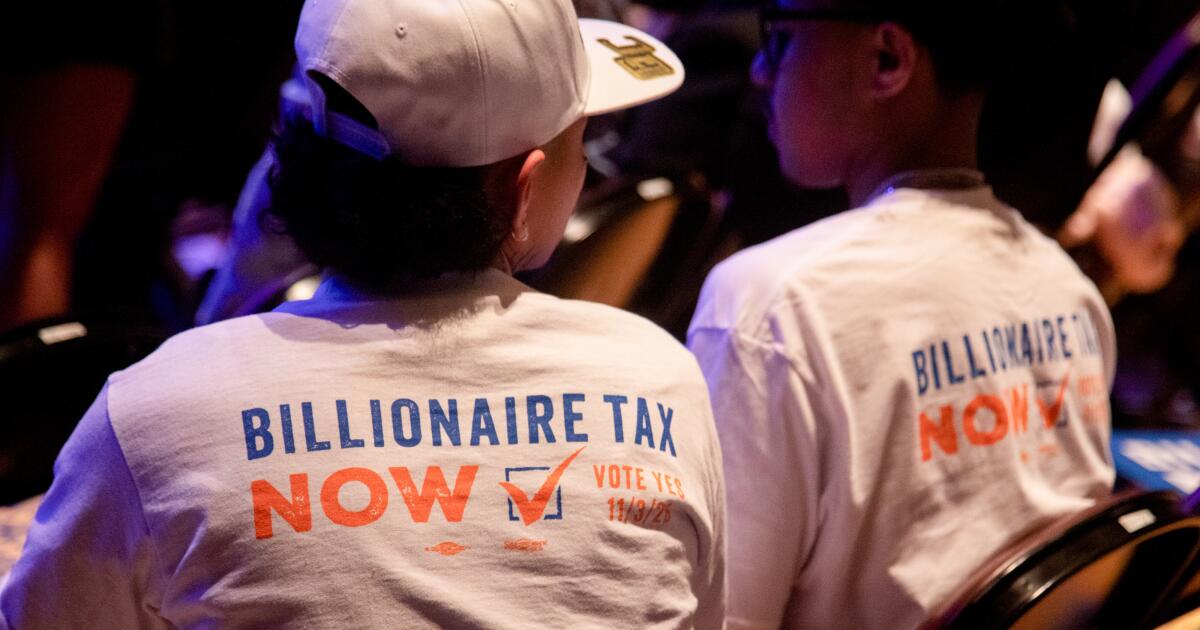
Steyer, who paints himself as a repentant billionaire devoted to giving away his riches to make California a better place for all, did not directly answer a question about his position on a controversial proposed ballot measure for a new tax on billionaires to fund healthcare. But he said he supported increasing taxes on the wealthy and boasted of having the political backing of bus drivers, nurses and cafeteria workers because he was the rich guy willing to “take on the billionaires for working families.”

Mahan, the latest major candidate to enter the race, wasn’t impressed.

“Tom, I’ve got about 3 billion reasons not to trust your answer on that,” he said, an apparent reference to Steyer’s net worth.

Although he supports closing tax loopholes for the wealthy, Mahan said he opposes the billionaire tax because “it will send good, high-paying jobs out of our state, and hard-working families, in the long run, will all pay more taxes for it.”

Money also spoke Tuesday

Although the battle over campaign fundraising didn’t overtly arise during Tuesday’s debate aside from Mahan’s comment about Steyer, it still was getting a lot of attention. Campaign fundraising disclosures became public Monday and Tuesday.

Unsurprisingly, Steyer led the pack with $28.9 million in contributions in 2025, nearly all of it donations that the billionaire spent on his campaign. Other top fundraisers were Porter, who raised $6.1 million; Hilton, who collected $5.7 million; Becerra, who banked $5.2 million; Bianco, who received $3.7 million in contributions; Swalwell’s $3.1 million since entering the race late last year; and Villaraigosa’s $3.2 million, according to documents filed with the California secretary of state’s office.

Mahan, who recently entered the race, wasn’t required to file a campaign fundraising disclosure, though he is expected to have notable support from wealthy Silicon Valley tech honchos. Former state Controller Betty Yee and state schools chief Tony Thurmond were among the candidates who raised the least, which spurs questions about their viability in a state of more than 23 million registered voters with some of the most expensive media markets in the nation.

Yee defended her candidacy by pointing to her experience.

“All the polls show that this race is wide open. You know, I think voters have had enough. I’ve been around the state. I’ve spoken to thousands of them,” she said. “Enough of the lies, the broken campaign promises, billionaires trying to run the world. You know, look, I’m the adult in the room. No gimmicks, no nonsense, straight shooter, the woman who gets things done. And we certainly can’t afford a leader who thinks grandstanding is actually governing.”

Mehta reported from Los Angeles and Nixon reported from San Francisco. Data and graphics journalists Gabrielle LaMarr LeMee and Hailey Wang contributed to this report.
Source link

Sorting fact from fiction in fraud allegations surrounding Newsom, California

The year opened with President Trump declaring that “the fraud investigation of California has begun,” a move that quickly set off a barrage of allegations from his administration and Republican allies questioning the integrity of state programs and the leadership of Gov. Gavin Newsom.

The accusations, amplified across social media and conservative outlets, have pushed California and its Democratic leadership to the center of a broader national political fight over waste, fraud and abuse.

Newsom has dismissed the claims as politically driven, arguing that the administration is singling out Democratic-led states while ignoring similar problems elsewhere. The governor also responded by highlighting fraud cases in Republican-led states and by criticizing Trump’s own record and business dealings.

Against that backdrop, it has become increasingly difficult to separate substantiated fraud from fabricated or recycled claims, to distinguish old findings from newly raised allegations and to determine who can credibly claim credit for uncovering wrongdoing — all amid a toxic and deeply polarized political climate.

Dan Schnur, who teaches political communications at USC and UC Berkeley, said allegations of malfeasance in California is a particularly ripe target for Republicans because Democrats have controlled the state Legislature and governor’s office for years.

Democrats hold a supermajority in both the Assembly and the Senate, meaning they hold at least two-thirds of seats in both houses, and not a single Republican has been elected to statewide office in California since 2006, when Gov. Arnold Schwarzenegger and Insurance Commissioner Steve Poizner were reelected.

“There is no shared responsibility here for Republicans,” Schnur said. “If you had a state in which Republicans were actually competitive, they would bear some responsibility for these problems.”

Audits and prosecutions show that California has experienced its share of fraud, particularly in complex programs involving emergency aid, healthcare and unemployment insurance. The state paid out billions of dollars in fraudulent unemployment claims during the COVID-19 pandemic, and the California State Auditor has issued repeated warnings about state agencies that are “at high risk for waste, fraud, abuse, or mismanagement.”

Along with recycling a barrage of years-old allegations of financial malfeasance in California and other Democratic states, the Trump administration elevated claims of child-care fraud in Minnesota last month, prompting Gov. Tim Walz to drop his reelection plans to focus on the growing political crisis in his state.

Fraud allegations are increasingly being deployed as a political weapon against Newsom, a leading Trump critic and a potential 2028 Democratic presidential contender. Politicians have always railed against government waste, fraud and abuse, but now those issues are being “weaponized into a partisan issue,” Schnur said.

For the public, it can be hard to discern the truth. Here is a look at three of the central fraud allegations — and what the evidence shows.

Child-care funding

President Trump used his social media platform, Truth Social, to accuse California of widespread fraud last month, drawing a link between his administration’s investigation into child-care spending in Minnesota and programs in the Golden State, and announcing a major federal “fraud investigation” into the state’s actions.

“California, under Governor Gavin Newscum, is more corrupt than Minnesota, if that’s possible???” wrote Trump, using a disparaging nickname for the governor.

The Trump administration then moved to freeze $10 billion in federal funding for child care in five Democrat-led states — California, New York, Colorado, Illinois and Minnesota — over “serious concerns about widespread fraud and misuse of taxpayer dollars.”

In a trio of Jan. 6 letters addressed to Newsom, the U.S. Department of Health and Human Services said it was concerned there had been “potential for extensive and systemic fraud” in child care and other social services programs that rely on federal funding, and had “reason to believe” that the state was “illicitly providing illegal aliens” with benefits.

The letters did not detail evidence to support the claims. The governor’s office dismissed the accusation as “deranged.”

A federal judge subsequently blocked the Trump administration temporarily from freezing those funds. In that ruling, U.S. District Judge Vernon Broderick said he didn’t understand why the government was making it harder for states to access child-care money before any wrongdoing had been discovered.

“It just seems like the cart before the horse,” he said.

Hospice funding

Days after Trump’s social media post about alleged corruption under Newsom’s watch, Dr. Mehmet Oz, administrator for the Centers for Medicare & Medicaid Services, and Bill Essayli, the top federal prosecutor in Los Angeles, held a joint news conference on public benefits fraud, but offered few details about the scope of their investigation.

The officials accused “foreign actors” of draining billions from public healthcare programs in California, referencing bogus hospice providers first exposed by The Times in 2020 and later investigated by California Atty. Gen. Rob Bonta.

Essayli placed the blame for bad actors squarely on Newsom, calling him “the fraud king.”

Weeks later, Oz released a video of himself walking in the Los Angeles neighborhood of Van Nuys as he questioned why dozens of alleged hospices were operating along four blocks. He blamed the “Russian Armenian Mafia” and made his remarks while pointing to an Armenian bakery, prompting accusations of racism from the Armenian community.

Newsom’s office last week hit back by highlighting state efforts to fight fraud, while pointing to a 2025 Axios story on the Trump administration’s decision to pause a federal program to crack down on bad hospice operators.

Bonta’s office said it has filed criminal charges against 109 individuals over hospice fraud-related offenses and launched dozens of civil investigations.

Newsom, speaking at a Bloomberg event Thursday in San Francisco, said the allegations have been recycled and misrepresented. Later that day, he filed a civil rights complaint against “baseless and racist allegations against Armenian Americans in California” made by Oz.

“Hospice, we’ve been after that for years and years before Oz was even on the scene,” Newsom said. “In 2021, we did a moratorium on new hospice programs, 280 we shuttered.”

The Center for Medicare & Medicaid Services said earlier this year that — in addition to California — Arizona, Nevada, Texas, Ohio and Georgia are being monitored following allegations of fraud and waste.

EDD fraud

The state’s Employment Development Department, known as EDD, reported in 2021 that approximately $20 billion was lost due to fraud, largely in the federal Pandemic Unemployment Assistance (PUA) program.

While unemployment fraud was rampant across country during the pandemic as governments rushed to provide support, California’s problems stood out.

The state itself admitted in 2021 that it failed to take precautions that had been implemented in other states, including using software to identify suspicious applications and cross-checking benefit claims against personal data on state prison inmates.

Rep. Kevin Kiley (R-Rocklin) said department mismanagement and fraud often overlap and cited EDD as a prime example.

“When there is a lack of internal controls, a lack of diligence of how funds are used, that makes it easier for those who want to take advantage of the system to profit,” Kiley said.

EDD’s own tracker said the state has recovered more than $6 billion in stolen funds and opened more than 2,300 unemployment fraud investigations since the pandemic began, leading to nearly 1,000 arrests and more than 670 convictions.

The department said it has expanded fraud enforcement through partnerships with law enforcement, new identity-verification technology and a dedicated fraud task force.

But, reports of mismanagement at EDD have continued. A recent audit also found EDD wasted $4.6 million by paying monthly service fees for more than 6,200 cellphones that went unused for at least four consecutive months between November 2020 and April 2025 — including some devices that were inactive for more than four years.

At the same time, “EDD continues to have high rates of improper [unemployed insured] payments, including fraudulent payments, and it needs to improve the customer service it provides to UI claimants,” another report found.

What’s next?

Newsom said there is a reason the Trump administration is not pointing to fraud in Republican-led states.

“This is about polarization, politicalization, weaponization,” Newsom said Thursday.

Asked what the Trump administration will discover in probing California for fraud, Newsom said investigators will find a state “taking that issue very, very seriously.”

“We absolutely are here to be a partner, to go after waste, fraud and abuse,” Newsom said.

State audits show vulnerabilities persist. The California State Auditor has repeatedly flagged Medi-Cal eligibility discrepancies that have exposed the state to billions of dollars in questionable payments, while also warning that weaknesses in information security across state agencies remain a high-risk issue.

Curtailing waste could be particularly important during the upcoming year as California and its state-funded programs head into a period of volatile fiscal uncertainty, driven largely by events in Washington and on Wall Street. Newsom’s own optimistic budget proposal projects a $3-billion state deficit for the next fiscal year despite no major new spending initiatives.

The nonpartisan Legislative Analyst’s Office warned in November that California faces a nearly $18-billion budget shortfall.

It will also be a key issue in upcoming elections. A group of Republicans running for statewide offices, including California gubernatorial candidate Steve Hilton, pegged that the state’s annual estimate of fraud, waste and abuse across state programs at $250 billion, an estimate that includes unverified public tips submitted to a campaign-run website.

The group cited the estimate as justification for creating their own “California Department of Government Efficiency,” or CAL DOGE, a nod to a similarly named federal initiative promoted by Elon Musk that generated headlines but has not produced documented savings or formal audit findings. CAL DOGE is not currently a state department, despite its name.

Who deserves credit when fraud is prosecuted has also become a point of contention. After a man was arrested last month for fleecing L.A.’s homeless services program for $23 million, critics of Newsom were quick to blame the governor. Newsom responded by saying the case was uncovered by local investigators working with law enforcement, which he added is “exactly the kind of accountability and oversight the state has pushed for.” (The Los Angeles district attorney’s office ran a parallel, independent investigation.)

Essayli responded on social media by saying no one made an arrest until Trump and Atty. Gen. Pam Bondi “appointed me to investigate and charge fraud offenses in California.”

Kiley, the California Republican congressman, said despite the partisan fighting over fraud, the issue should rally both parties.

The “easiest” way to solve the state’s budget problems and improve government services for taxpayers is to “minimize and eventually eliminate fraud,” said Kiley.

Source link

What these Democrats seeking to succeed Newsom would do differently

Matt Mahan, the mayor of San José and latest entrant into the jam-packed race for California governor, has in recent years raised his profile outside his Silicon Valley-area city by doing something most other elected Democrats would never: publicly criticize Gov. Gavin Newsom.

With the primary election almost four months away, candidates have already been busy trying to convince Californians that they can lead the state through its biggest challenges, including what they might do differently than Newsom on homelessness, crime and the high cost of living.

Democratic hopefuls have so far done so subtly, without taking direct shots at Newsom.

Until Mahan entered the race.

The 43-year-old-mayor began carving a moderate path in 2024, when he broke with Newsom and other Democrats to back Proposition 36, which increased penalties for theft and crimes involving fentanyl. Despite opposition from Newsom and legislative leaders, voters overwhelmingly approved it.

Mahan has also given mixed reviews to the Newsom administration’s approach to homelessness; he has praised efforts to make it easier for cities to clear homeless encampments but criticized inconsistent funding from the state to help local governments build interim housing.

Although most Democrats running to replace Newsom have praised his fiery opposition to President Trump and the Republican-led Congress, including the governor’s outlandish online trolling of Trump and his allies, Mahan was not impressed.

“Instead of spending so much energy attacking his opponents, the governor and his team should be addressing the high cost of energy, helping hard-pressed families make ends meet and keeping them and their employers from fleeing our state,” Mahan wrote last summer in a piece for the San Francisco Standard.

Mahan told reporters last week that his disagreements with Newsom are “rooted in substance” and praised the governor for muscling through major reforms to the California Environmental Quality Act and behavioral health treatment.

“I see the job of the next governor” as “building on many of the initiatives [Newsom] has championed,” he said, adding he would use those new reforms to build more housing and treatment facilities for people struggling with addiction and mental illness.

Newsom has routinely won approval from the state’s Democratic base, as well as respect and deference from its elected leaders, and his notoriety as a top foe of Trump continues to rise. Because the perch of California governor provides Democrats with an effective cudgel against the Republican administration, attacking Newsom could easily backfire in this left-leaning state.

“It’s a very delicate balancing act” to campaign to replace a leader of one’s own party, said Democratic strategist Garry South, who has worked on four California gubernatorial campaigns.

“The traditional way to do it is to try to project that you will build on things that the incumbent has done: programs they started, successes they’ve had,” he said.

South, who ran Newsom’s first, short-lived, campaign for governor in 2009, took issue with Mahan’s criticisms of the governor.

“To stick it to the incumbent of your own party might be OK if that person is viewed as a failure. … The fact is, Newsom is not unpopular. This guy’s had four massive victories in California,” he said, listing Newsom’s two elections in 2018 and 2022, defeating a recall in 2021 and overwhelmingly passing Proposition 50 last year.

Like Mahan, billionaire venture-capitalist-turned-environmentalist Tom Steyer has cast himself as an outsider of California’s Democratic establishment. Though he has so far avoided disparaging anyone directly, Steyer dinged “Sacramento politicians [who] are afraid to change this system” when he launched his campaign in November.

Early on in his campaign, former Los Angeles Mayor Antonio Villaraigosa indicated he would backtrack on Newsom’s strict oil drilling limits and what he calls heavy-handed regulations, which the industry has blamed for the state’s high gas prices.

A Phillips 66 refinery shut down last fall and a Valero refinery in Northern California plans to idle by the end of April, raising concerns that prices in the state’s isolated fuels market could climb even higher.

Villaraigosa previously told The Times he is “not fighting for refineries” but “for the people who pay for gas in this state.”

The former mayor took a more aggressive approach in the California’s governor’s race in 2018, when Villaraigosa accused Newsom of selling “snake oil” with his support for single-payer healthcare in order to win over the nurses union and progressives. Villaraigosa, who ran on a moderate platform, finished in a distant third place in the primary, and Newsom went on to win two terms as governor.

Former Rep. Katie Porter has gone in a more progressive direction on oil. When asked in October to name a policy arena in which she would act differently than Newsom, Porter said she would not have signed recent legislation to allow 2,000 new oil wells in Kern County.

“Drilling new wells is locking us into 100-plus years of energy of the past,” she said. “I absolutely know that we need our refineries to stay open. … But I’m concerned about the environmental consequences, the environmental justice consequences, the shortened lifespan and pollution that we see in some of our fossil fuel-producing places.”

While Newsom and most other candidates for governor have raised concerns about a proposed statewide ballot measure to tax the assets of billionaires, primarily to raise billions of dollars in revenue to blunt the impact of federal healthcare cuts, Tony Thurmond, the state superintendent of public instruction, has embraced the idea.

Even before the potential ballot measure drove some billionaires into leaving the state, Thurmond said that if elected, he would introduce a tax “solely on megamillionaires and billionaires to hire more teachers, healthcare workers, firefighters, construction workers and social workers,” who would earn “decent middle-class wages” to bolster the state’s economy.

Thurmond has also repeatedly said he would pursue single-payer healthcare in California, a promise Newsom also campaigned on before his first term but did not fully deliver.

Betty Yee, a former state controller and budget director, has pitched herself as the most qualified candidate to fix California’s ongoing budget deficits, and took swipes at accounting tricks Newsom and other governors have used in the past.

Newsom and state lawmakers have faced criticism for using short-term tactics like deferred spending and internal borrowing to fill budget shortfalls while ignoring the larger issue: The state regularly spends more money than it brings in.

“No more gimmicks. We can’t kick the can down the road anymore,” Yee said during a recent interview with KTLA. She said she would implement “spending cuts — not like DOGE” and explore “corporations and upper-income earners” potentially paying more tax revenue.

Newsom, aware that he’s entering lame-duck status, has jokingly called himself “a milk carton with a sell-by date” and admitted “these questions about who’s next and all that are uncomfortable.”

Asked specifically about Mahan’s criticisms, Newsom on Thursday declined to fuel any supposed rivalry with the San José mayor.

“I don’t know enough about him,” the governor said. “I wish him good luck.”

Times staff writer Taryn Luna contributed to this report.
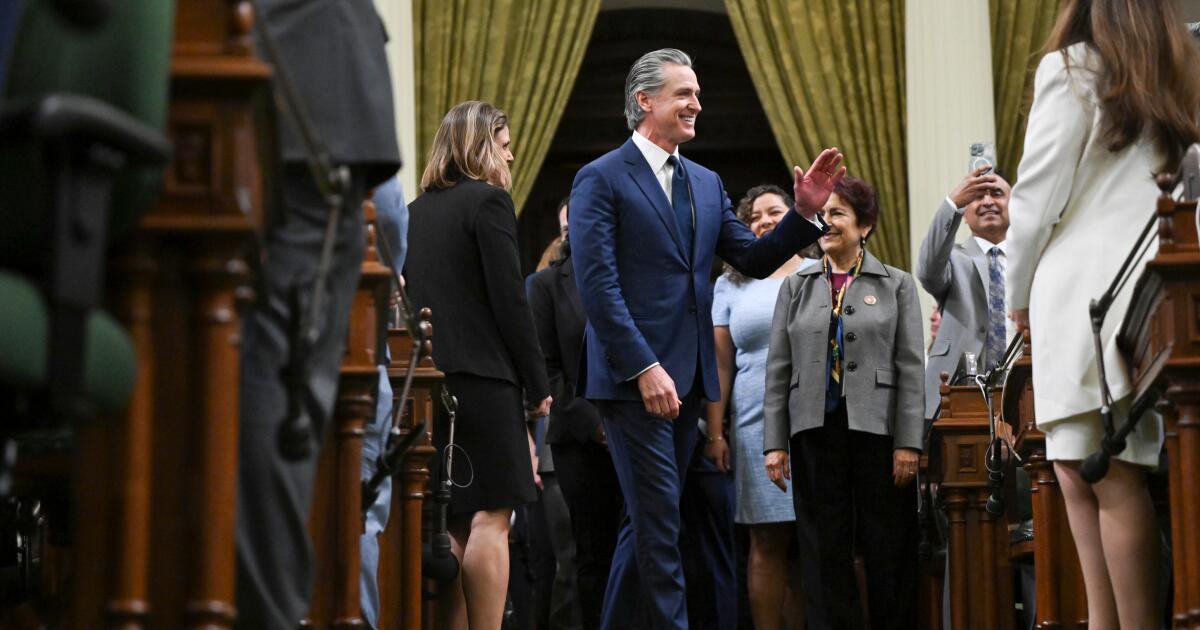
Source link

Comparing Andy Beshear, Gavin Newsom as they eye White House

Gavin Newsom was in his element, moving and shaking amid the rich and powerful in Davos.

He scolded European leaders for supposedly cowering before President Trump.

He drew disparaging notice during a presidential rant and captured headlines after being blocked from delivering a high-profile speech, allegedly at the behest of the White House.

All the while, another governor and Democratic presidential prospect was mixing and mingling in the rarefied Swiss air — though you probably wouldn’t know it.

Flying far below the heat-seeking radar, Kentucky Gov. Andy Beshear leaned into the role of economic ambassador, focusing on job creation and other nutsy, boltsy stuff that doesn’t grab much notice in today’s performative political environment.

Like Newsom, Beshear is running-but-not-exactly-running for president. He didn’t set out to offer a stark contrast to California’s governor, the putative 2028 Democratic front-runner. But he’s doing so just the same.

Want someone who’ll match Trump insult for insult, over-the-top meme for over-the-top meme and howl whenever the president commits some new outrage? Look to Sacramento, not Frankfort.

“I think by the time we reach 2028, our Democratic voters are gonna be worn out,” Beshear said during a conversation in his state’s snowy capital. “They’re gonna be worn out by Trump, and they’re gonna be worn out by Democrats who respond to Trump like Trump. And they’re gonna want some stability in their lives.”

Every candidate enters a contest with a backstory and a record, which is condensed to a summary that serves as calling card, strategic foundation and a rationale for their run.

Here’s Andy Beshear’s: He’s the popular two-term governor of a red state that three times voted overwhelmingly for Trump.

He is fluent in the language of faith, well-liked by the kind of rural voters who have abandoned Democrats in droves and, at age 48, offers a fresh face and relative youth in a party that many voters have come to see as old and ossified.

The fact he’s from the South, where Arkansas Gov. Bill Clinton emerged the last time Democrats experienced this kind of existential freak-out, also doesn’t hurt.

Beshear’s not-yet-candidacy, still in the fledgling phase, offers a mix of aspiration and admonition.

Democrats, he said, need to talk more like regular people. Addiction, not substance use disorder. Hunger, not food assistance.

And, he suggested, they need to focus more on things regular people care about: jobs, healthcare, public safety, public education. Things that aren’t theoretical or abstract but materially affect their daily lives, like the costs of electricity, car insurance and groceries.

“I think the most important thing we should have learned from 2024 is [Democratic voters are] gonna be looking for somebody that can help them pay that next bill,” Beshear said.

He was seated in the Old Governor’s Mansion, now a historic site and Beshear’s temporary office while the nearby Capitol undergoes a years-long renovation.

The red-brick residence, built in the Federal style and completed in 1798, was Beshear’s home from age 6 to 10 when his father, Steve, lived there while serving as lieutenant governor. (Steve Beshear went on to serve two terms as the state’s chief executive, building a brand and a brand name that helped Andy win his first public office, attorney general, in 2015.)

It was 9 degrees outside. Icicles hung from the eaves and snowplows navigated Frankfort’s narrow, winding streets after an unusually cold winter blast.

Inside, Beshear was seated before an unlit fireplace, legs crossed, shirt collar unbuttoned, looking like the pleasantly unassuming Dad in a store-bought picture frame.

He bragged a bit, touting Kentucky’s economic success under his watch. He spoke of his religiosity — his grandfather and great-grandfather were Baptist preachers — and talked at length about the optimism, a political rarity these days, that undergirds his vision for the country.

“I think the American people feel like the pendulum swung too far in the Biden administration. Now they feel it’s swung way too far during the Trump administration,” Beshear said. “What they want is for it to stop swinging.”

He went on. “Most people when they wake up aren’t thinking about politics. They’re thinking about their job, their next doctor’s appointment, the roads and bridges they drive, the school they drop their kids off at, and whether they feel safe in their community.

“And I think they desperately want someone that can move the country, not right or left ideologically, but actually forward in those areas. And that’s how I think we heal.”

Beshear doesn’t shy from his Democratic pedigree, or stray from much of the party’s orthodoxy.

Seeking reelection in 2023, he seized on the abortion issue and the Supreme Court’s overturning of Roe vs. Wade to batter and best his Republican opponent.

He’s walked the picket line with striking auto workers, signed an executive order making Juneteenth a state holiday and routinely vetoed anti-gay legislation, becoming the first Kentucky governor to attend an LGBTQ+ celebration in the Capitol Rotunda.

“Discrimination against our LGBTQ+ community is unacceptable,” he told an audience. “It holds us back and, in my Kentucky accent, it ain’t right.”

For all of that, Beshear doesn’t shrink from taking on Trump, which, essentially, has become a job requirement for any Democratic officeholder wishing to remain a Democratic officeholder.

After the president’s rambling Davos address, Beshear called Trump’s remarks “dangerous, disrespectful and unhinged.”

“From insulting our allies to telling struggling Americans that he’s fixed inflation and the economy is amazing, the President is hurting both our families’ financial security and our national security,” Beshear posted on social media. “Oh, and Greenland is so important he’s calling it Iceland.”

But Beshear hasn’t turned Trump-bashing into a 24/7 vocation, or a weight-lifting contest where the winner is the critic wielding the heaviest bludgeon.

“I stand up to him in the way that I think a Democratic governor of Kentucky should. When he’s doing things that hurt my state, I speak out,” Beshear said. “I filed 20 lawsuits, I think, and we’ve won almost all of them, bringing dollars they were trying to stop from flowing into Kentucky.

“But,” he added, “when he does something positive for Kentucky, I also say that too, because that’s what our people expect.”

Asked about the towel-snapping Newsom and his dedicated staff of Trump trollers, Beshear defended California’s governor — or, at least, passed on the chance to get in a dig.

“Gavin’s in a very different situation than I’m in. I mean, he has the president attacking him and his state just about every day,” Beshear said. “So I don’t want to be critical of an approach from somebody that’s in a very different spot.

“But the approach also has to be unique to you. For me, I bring people together. We’ve been able to do that in this state. That’s my approach. And in the end, I’ve gotta stay true to who I am.”

And when — or make that if — both Newsom and Beshear launch a formal bid for president, they’ll present Democratic voters a clear choice.

Not just between two differing personalities. Also two considerably different approaches to politics and winning back the White House.

Source link

A measured stance on ICE pits Newsom against the party base

It took Democrats nearly a year to respond with a unified message to President Trump’s signature policy initiative, harnessing national outrage over the administration’s immigration enforcement tactics in Minnesota this week to leverage government funding and demand change.

Yet divisions persist as the party barrels toward midterm elections and, a year from now, the start of primary season. And Gavin Newsom stands right in the middle of them.

You’re reading the L.A. Times Politics newsletter

George Skelton and Michael Wilner cover the insights, legislation, players and politics you need to know in 2024. In your inbox Monday and Thursday mornings.

By continuing, you agree to our Terms of Service and our Privacy Policy.

Staking the middle ground

A calibrated position by the California governor has placed him to the right of the party’s progressive base that has opposed the very existence of U.S. Immigration and Customs Enforcement for years — well before Republican lawmakers passed legislation doubling the agency’s budget, increasing its presence and visibility in American life.

Newsom has rejected calls for ICE to be abolished since the 2024 campaign, when Democrats saw clear alarms in public polling that showed President Biden and his vice president, Kamala Harris, on the back foot against Trump on immigration. To the contrary, Newsom has highlighted California’s cooperation with the agency, and his efforts to protect that relationship from progressive local lawmakers.

While Trump’s federalization of the California National Guard last summer was prompted, in part, by protests in Los Angeles against ICE raids across the city, the governor’s reaction focused more on the president’s alleged abuses of power than on the ICE raids themselves. To the extent he did comment on them, Newsom characterized their deployment as unnecessary and gratuitous, a political tool used to intimidate the population.

After the killing of U.S. citizen Renee Good, 37, by ICE officers earlier this month, and days before the fatal shooting of Alex Pretti, also 37 and a U.S. citizen, by Border Patrol agents last weekend, Newsom told conservative podcaster Ben Shapiro that his position against abolishing the agency had not changed. And he disassociated himself from a social media post by his office that characterized ICE’s conduct in Minneapolis as “state-sponsored terrorism.”

“California has cooperated with more ICE transfers probably than any other state in the country, and I have vetoed multiple pieces of legislation that have come from my Legislature to stop the ability for the state of California to do that,” Newsom told Shapiro.

The immigration enforcement agency received a massive influx of cash for detention facilities and recruitment last year with the passage of Trump’s One Big Beautiful Bill Act. Republicans now hope to build on that law with even greater appropriations this year, providing ICE with more funding than most foreign militaries, including the armies of Iran, Turkey, Canada and Mexico.

“I disagreed when I think a candidate for president by the name of Harris said that in the last campaign,” Newsom added, of calls to abolish the agency. “I remember being on [MS NOW’s Chris Hayes’ show] hours later saying, ‘I think that’s a mistake.’ So, absolutely.”

A progressive rallying cry

It’s a position in stark contrast with potential 2028 Democratic hopefuls that could pose a challenge to Newsom’s presidential ambitions.

Rep. Alexandria Ocasio-Cortez, a Democratic lawmaker from New York said to be considering a bid, has referred to ICE as “a rogue agency that should not exist.” The agency “doesn’t deserve a dime” of federal dollars, she has said, “until they can prove they are honoring human rights.”

Rep. Ro Khanna (D-Fremont), also rumored to be considering a run for the nomination, has advocated explicitly for ICE to be replaced with a new entity, built from scratch, without the baggage of the Sept. 11–era agency.

“Frankly, we need to tear down the ICE agency and have a new federal agency to enforce immigration law under the Justice Department,” Khanna said this week.

After Pretti’s death, Newsom also called for a pause to any “new funding” for ICE. He did not call for a review of its existing, historic levels of funding.

“Suspend the LAWLESS mass deportation raids nationwide NOW — ICE is no longer just deporting dangerous criminals,” the governor wrote on X. “Send the border patrol back to the border. End the militarization of ICE.”

Showdown on Capitol Hill

Pretti’s death is already complicating efforts to avert another government shutdown in Washington, as Democrats — joined by some Republicans — view the episode as a tipping point in the debate over the Trump administration’s immigration enforcement policies.

Senate Democrats pledged this week to block funding for the Department of Homeland Security unless changes are made to ICE operations in Minnesota. And Democrats in the House are calling for Homeland Security Secretary Kristi Noem’s departure as a condition in shutdown negotiations with the White House. House Minority Leader Hakeem Jeffries (D-N.Y.) threatened to pursue her impeachment if Trump doesn’t fire her first.

Both demands track with Newsom’s latest position. The California governor was harshly critical of Senate Democrats when, during the shutdown late last year, a core bloc voted with Republicans to reopen the government without achieving any meaningful concessions in their weeks-long fight over healthcare tax breaks.

The latest Democratic uproar over ICE tactics threatens a similarly broad spending package that also includes funding for the rest of the government, including the departments of Defense, Education, Health, Labor and Transportation.

“Senate Democrats have made clear we are ready to quickly advance the five appropriations bills separately from the DHS funding bill before the Jan. 30 deadline,” Senate Democratic Leader Chuck Schumer of New York said this week.

“The responsibility to prevent a partial government shutdown,” he added, “is on [Majority Leader John Thune (R-S.D.)] and Senate Republicans.”

Times staff writer Ana Ceballos, in Washington, D.C., contributed to this report.
What else you should be reading

The must-read: Spencer Pratt knows you love to hate him. Now he wants to lead Los Angeles
The deep dive: Housing costs are crippling many Americans. Here’s how the two parties propose to fix that
The L.A. Times Special: How once-exiled filmmaker Brett Ratner staged a Hollywood comeback with ‘Melania’

A note to readers: I will be out on parental leave until April, but fear not, California Politics will be in capable hands. You’ll keep getting the latest each week from my distinguished colleagues.

I’ll see you all soon,
Michael Wilner


Was this newsletter forwarded to you? Sign up here to get it in your inbox.

Source link

Trump signs executive order to ‘preempt’ permitting process for fire-destroyed homes in L.A.

President Donald Trump has announced an executive order to allow victims of the Los Angeles wildfires to rebuild without dealing with “unnecessary, dupicative, or obstructive” permitting requirements.

The order, which is likely to be challenged by the city and state, claimed that local governments have failed to adequately process permits and were slowing down residents who are desperate to rebuild in the Palisades and Altadena.

“American families and small businesses affected by the wildfires have been forced to continue living in a nightmare of delay, uncertainty, and bureaucratic malaise as they remain displaced from their homes, often without a source of income, while state and local governments delay or prevent reconstruction by approving only a fraction of the permits needed to rebuild,” Trump wrote in the executive order, which he signed Friday.

The order called on the Secretary of Homeland Security and the Federal Emergency Management Agency to “preempt” state and local permitting authorities.

Instead of going through the usual approval process, residents using federal emergency funds to rebuild would need to self-certify to federal authorities that they have complied with local health and safety standards.

The order comes as the city and county approach 3,000 permits issued for rebuilding. A December review by The Times found that the permitting process in Altadena and Pacific Palisades was moving at a moderate rate compared to other major fires in California. As of Dec. 14, the county had issued rebuilding permits for about 16% of the homes destroyed in the Eaton fire and the city had issued just under 14% for those destroyed in the Palisades fire.

While Mayor Karen Bass did not immediately provide comment, the executive order drew intense pushback from Gov. Gavin Newsom.

A spokesperson for Newsom, Tara Gallegos, called Trump a “clueless idiot” for believing the federal government could issue local rebuilding permits.

“With 1625+ home permits issued, hundreds of homes under construction, and permitting timelines at least 2x faster than before the fires, an executive order to rebuild Mars would do just as useful,” Gov. Gavin Newsom wrote in a post on X, citing the number of permits issued solely by the city of Los Angeles.

Newsom said that the federal government needed to release funding, not take over control of the permitting process. The governor said that what communities really lack is money, not permits.

“Please actually help us. We are begging you,” Newsom wrote.

Instead of descending into the permitting process, Newsom called on the president to send a recovery package to congress to help families rebuild, citing a letter from a bipartisan delegation of California legislators that called for federal funding.

“As the recovery process continues, additional federal support is needed, and our entire delegation looks forward to working cooperatively with your administration to ensure the communities of Southern California receive their fair share of federal disaster assistance,” wrote the California legislators on Jan 7.

Some in the Palisades agreed that money was a bigger issue than permitting.

“When I talk to people it seems to have more to do with their insurance payout or whether they have enough money to complete construction,” said Maryam Zar, a Palisades resident who runs the Palisades Recovery Coalition.

Zar called the executive order “interesting” and said that it was fair of the president to call the recovery pace slow and unacceptable.

Source link

Column: Newsom tried to punch over his weight class in the Alps

You’re reading the L.A. Times Politics newsletter

George Skelton and Michael Wilner cover the insights, legislation, players and politics you need to know in 2024. In your inbox Monday and Thursday mornings.

By continuing, you agree to our Terms of Service and our Privacy Policy.

When a California governor goes to Europe and lectures world leaders that they must “grow a spine” and “stand tall” against the American president, I wince.

Not that they shouldn’t, nor that President Trump doesn’t deserve almost any nasty thing said about him. It just seems a tad arrogant.

A world stage in the Swiss Alps is not the proper place for a state governor to be scolding leaders of foreign nations about how they should deal with the U.S. president, no matter how despicably Trump behaves.

Gov. Gavin Newsom is merely the top elected official of one state, even if he can boast that it’s the fourth- or fifth-largest economy in the world. It still doesn’t have a seat at the United Nations or an awesome military that is the heart of NATO and the Western alliance.

Contrary to hackneyed bragging points, California is not a “nation state.” We’re a state — highly populated, but one of 50.

At the World Economic Forum in Davos, Switzerland, last week, Newsom was like the lightweight boxer trying to punch far above his class.

He was attempting to score points in the early rounds of his fight for the 2028 Democratic presidential nomination, repeating what has been working well for him: swinging from the heels at Trump and attracting the attention of party activists across the country.

And that’s fine for here in the U.S. This is the arena where it belongs.

One can argue that Newsom overdoes it, reaching for all the national exposure he can grab and not focusing enough on the job Californians hired him for at the state Capitol. But there’s no disputing his political success nationally. He’s leading the early polls of potential contenders for the presidential nomination.

But that was probably of little concern for the foreign leaders and other global elites attending the prestigious annual World Economic Forum.

Newsom was given two speaking slots, presumably to inform international movers and shakers about California’s golden investment opportunities. But after arriving, he began blathering about the evil American president, Trump’s threats to hike tariffs and seize Greenland and how European leaders are allegedly cowering before him.

The governor soon after was disinvited to speak at one event, a series of interviews hosted by Fortune magazine at USA House, the Trump administration headquarters.

Newsom blamed Trump for blocking his participation, accusing White House staffers of pressuring the event sponsors.

Well, duh! You can’t shoot spit wads like a little kid at a big meanie and not expect some to be shot back.

“No one in Davos knows who third-rate governor Newscum is or why he is frolicking around Switzerland instead of fixing the problems he created in California,” asserted White House spokeswoman Anna Kelly, using the classless president’s oft-repeated derogatory name for the governor.

Whatever. Snatching Newsom’s mic was probably the right decision. Davos delegates didn’t need to hear a political stump speech attacking the American president or be berated by a governor for also not beating up on him.

This was some of the fiery, expletive-laced stuff the governor had been telling reporters, referring to European leaders:

“Wake up! Where the hell has everybody been? Stop this bullshit diplomacy of sort of niceties. … Have some spine, some goddamn balls ….

“The Europeans should decide for themselves what to do, but one thing they can’t do is what they’ve been doing. … And it’s embarrassing. Just, I can’t take this complicity, people rolling over. I should have brought a bunch of knee pads for all the world leaders. … I mean, it’s just pathetic.

“And I hope people understand how pathetic they look on the world stage.”

The leaders of Canada and France demonstrated how to make the same point — but with dignity — about standing firm against bullying.

“There is a strong tendency for countries to go along to get along. To accommodate. To avoid trouble. To hope that compliance will buy safety. It won’t,” Canadian Prime Minister Mark Carney told the forum attendees.

French President Emanuel Macron said, “We do prefer respect to bullies. And we do prefer rule of law to brutality.”

Newsom was allowed to keep one speaking slot: an interview on the forum’s main stage with Ben Smith, editor in chief of the news outfit Semafor.

“Is it surprising the Trump administration didn’t like my commentary and wanted to make sure that I was not allowed to speak? No,” Newsom said. “It’s consistent with … their authoritarian tendencies.”

There’s something distasteful — perhaps even unpatriotic — about an elected American official, regardless of party, vilifying a U.S. president when among allied leaders abroad. Even if it is the dreadful Trump.

But American politics has changed greatly for the worse in recent years, as evidenced by the Newsom-Trump spitball flinging.

California Gov. George Deukmejian spoke at the 1989 Davos forum and was a model of civil diplomacy, promoting the state’s trade and investment opportunities and laying off demagoguery.

Of course, Deukmejian and President Bush were both Republicans. So the Duke didn’t assail the president, not that he would have anyway. He had too much respect for the presidential institution when traveling abroad.

But unlike today’s top elected Republicans, Deukmejian didn’t shy away from giving the president advice. At Davos, the governor urged Bush not to renege on his “read my lips, no new taxes” pledge that got him elected. To reduce the federal deficit, cut spending, the governor cautioned.

Bush ignored such advice and raised taxes — and lost his 1992 reelection bid to Democrat Bill Clinton.

Clinton’s campaign motto is still a classic: “It’s the economy, stupid!”

Newsom needs to pick up on that. Or at least work it into his anti-Trump rant.

What else you should be reading

The must-read: GOP rails against Newsom’s late date for special election to fill Rep. Doug LaMalfa’s seat
The TK: Trump lawyers urge Supreme Court to block California’s new election map while upholding Texas’
The L.A. Times Special: California is suffering truth decay. Sacramento should do something about it

Until next week,
George Skelton


Was this newsletter forwarded to you? Sign up here to get it in your inbox.

Source link