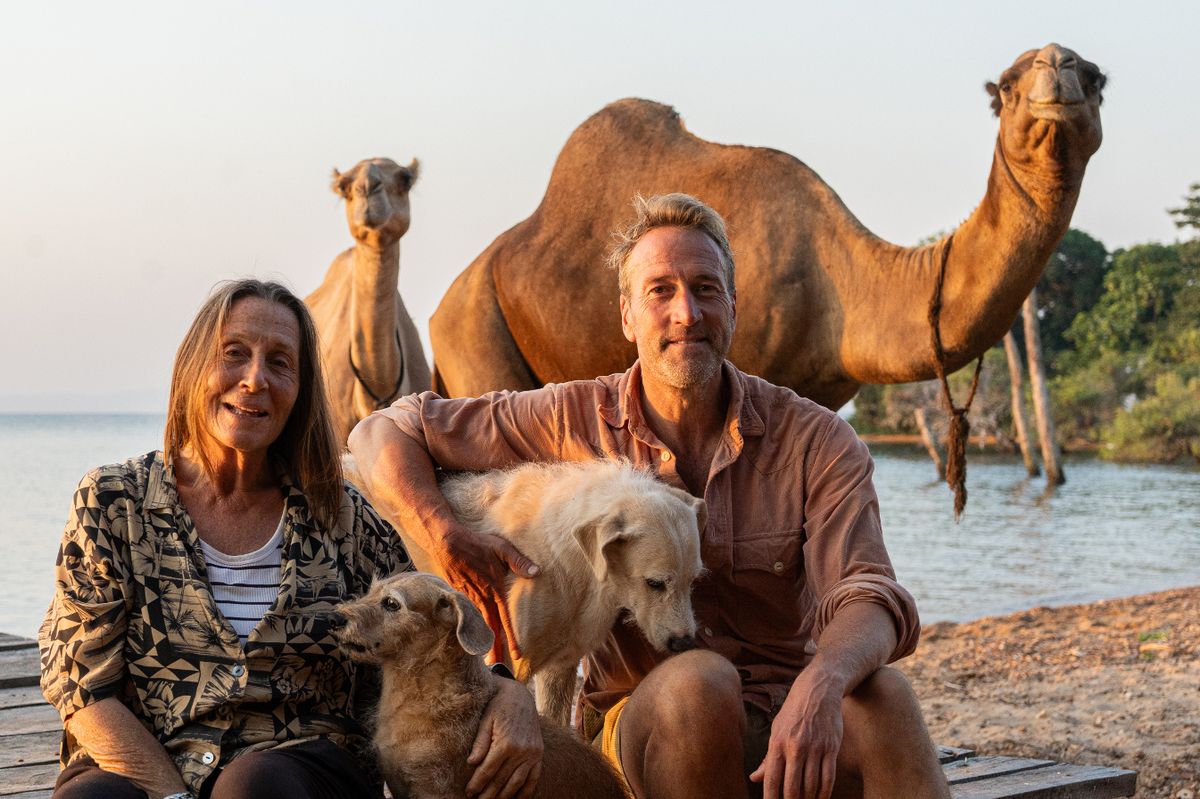
The Mirror meets Ali Porteous, star of the new series of Ben Fogle: New Lives in the Wild, who lives one mile south of the equator on the remote island of Bulago in Uganda

Ali stars in the new series of Ben Fogle: New Lives in the Wild(Image: DAILY MIRROR)
Living on a remote island in Uganda’s section of Lake Victoria, just one mile south of the equator and up to three hours from the mainland on a public canoe, might not be everyone’s cup of tea but for 66-year-old British-born Ali Porteous, it’s paradise on earth. A former television camerawoman from Chichester in West Sussex, Ali swapped a career filming the wars of the 1980s in Afghanistan, Peru and Sri Lanka for a life on Bulago island, where she has now lived for 27 years, after discovering the island on a boat trip.
Life’s priorities change living on an island, Ali explains, “Watching the full moon rise as the sun sets takes precedence over everything. I’m happy to live quite frugally, growing my own fruit and veg where I can. I’m mostly vegetarian but eat like a queen thanks to ‘the pearl of Africa’s’ lush abundance. We grow the juiciest pineapples I’ve ever tasted and the best and biggest avocados,” says Ali, who stars in episode one of the new series of Ben Fogle: New Lives in the Wild, which begins this Thursday on Channel 5.
READ MORE: Ben Fogle bombshell surprises fans as the TV presenter considers a future in politics
“I live off very little money. We run everything on solar and don’t have heating bills. When I go to the mainland, I still drive a 1996 Rav4 car too old to have airbags! Most of my clothes come from a wonderful second-hand shop on the mainland where I can buy beautiful silk and designer clothes that the owner brings all the way from Hollywood.”
Ali shares her life with an eclectic bunch of animals. Her horse Tufani, which means storm in Swahili, came to the island at four months old and is now best friends with Donkey, who was dumped on the beach. Wanting to introduce hardy animals, she brought two camels from North Kenya called Rumi and No 9, who climatised happily to island life and produced a son called Minimus.
Ali’s love for dogs knows no bounds so she has always nurtured a multi-generational pack of little dogs, mixing Dachshund with Jack Russell and Pomeranian to make feisty companions. There’s Mama Huche, Maximus and puppy Spoticus. But sadly living out on the island, tragedy does strike.
“I’ve lost dogs to crocodiles and snakes. Just a few months ago, three of Max’s grown-up pups attacked a big forest cobra and were dead within the hour. It was horrific, I tried to save them by picking up and throwing the snake into the lake but it was too late. Dogs are instinctive hunters so every day when we are out walking, I have to be ready for the dogs to catch the scent of something, most often a monitor lizard. If they catch one, I try to save the lizard by picking it up by its shoulders and hips and throwing it into the lake or a nearby tree. My main motivation for doing this, besides saving the animal, is to save the dogs as these lizards have salmonella in their saliva, which can be fatal.”
And it’s not just Ali’s animals that are in danger. “If I get sick or injured there are no medical facilities on the island so help seems far away. A boat ride away but the crossing can be difficult in bad weather. And this is getting worse each year with global warming’s unpredictable and frightening storms. I always used to ride my horse bareback, but now with ageing bones, I have to be cautious and ride with a saddle because I don’t want to fall off and break my back and be paralysed.”
Born in 1959, Ali was a rebellious child who never settled in school but buckled down to earn a degree in media studies, where she picked up a camera for the first time. A life-changing commission came from BBC 2 Newsnight to film an Afghan Mujahideen/Russian prisoner exchange, which took her to the frontlines of Afghanistan and launched her career as a war camerawoman.
“I ended up filming deep in the mountains in Bin Laden’s secret hideaway. A Russian bomb landed quite near me but didn’t explode so once the explosive had been removed, I decided to take the shell home with me on a British Airways flight, who were more than happy to transport the souvenir.” The shell now forms the base of a table in her island garden.
In 1985, disguised as a travel agent and smuggled through Kampala roadblocks, Ali embedded with the National Resistance guerilla Army to report a silent genocide than would kill a million Ugandans. It was then that Ali’s love affair with this country began, which made her return the following year for Uganda’s liberation. Although three months pregnant with her son, Oliver, she felt compelled to get back, to witness and film this new beginning.
Ali and her partner Robin raised two children – Oliver and Phoebe – in the English countryside, in between her trips to war zones. But by the early-90s, disillusioned with making documentaries in the UK, she returned to Uganda to work for President Yoweri Museveni as a media/PR adviser.
“These were exciting times to be working in Uganda with the constitution being written and the first democratic elections taking place so I tried to split my time between the UK and Uganda, working for the President and trying to look after my children but such a schism took its toll and my relationship with Robin couldn’t survive,” remembers Ali.
When Ali’s contract ended with the President, she had to decide her future, to return to the UK or to stay. “I borrowed a little sailing boat to take a last trip out on Lake Victoria with my longtime reporter friend and we came across Bulago island. Maybe we should buy it, I whimsically suggested and we did. We bought a 49-year lease on this 500 acre island for $16,000, with a plan to develop Uganda’s first marine eco resort.”
So, Ali as a newly single parent, moved to the island, taking her children with her, Oliver was nine and Phoebe was five years old. To begin with, the children went to school in Kampala but later they boarded at Pembroke Prep school in Gilgil, Kenya, which required a regular nine hour school run to visit and bring them back for holidays.
“There was nothing here when we came – just bush, bush, bush.… We lived in British army tents for about three years and had to learn how to build and run a lodge on an island. We made the bricks from termite hills and built the resort with no machinery and of course, without mains electricity so everything runs on solar power.”
Ali saved Bulago from destruction. “When I first arrived in 1997, the island’s forests were being destroyed for charcoal and timber, the flora for commercial farming and the fauna and fish were fighting extinction. There were only a handful of people living on the island but they were being terrorised by the illegal fishermen so we started working on how to protect the local communities and conserve their fishery.”
But in 2009 everything was put on hold as Ali nearly lost everything she had built when her friend and business partner made decisions without her and ultimately the lodge was sold without her consent.
“There was a court order against me going to the lodge. So, I rented a one-bedroom unit in Kampala and worked at an international school to pay the rent. I lived off dates and coffee. The lodge was mostly knocked down and the island returned to bush. It took Ali 10 years of legal battles to win back her island home. “I was so broken by it all. I lost my faith and trust in mankind. But I think I’m on the road to recovery which is why I love to live out here. Every day I wake with a smile, feeling so happy.”
And since then, she’s been more determined than ever to make Bulago thrive. To make enough money to develop the island into a protected eco resort, she sold plots of land to like-minded people for them to build houses and it has worked because the island is conserved while the neighbouring islands are deforested and destroyed. Bulago now has a thriving community of about 150 residents, who mainly live in the fishing village and are employed by the island lodge and private houses.
“I’ve fought long and hard to protect the lake around the island, by campaigning for a Lacustrine Protected Area, which for the last 10 years has been successfully secured by the Government and I’m proud to have made that happen. I’ve been able to help the local communities too, many of whom are living well below the poverty line. At least now they can make some money from responsible fishing and farming.”
Next on her list is to encourage marine tourism to support this community conservation. “We’ve built essential infrastructure – a harbour, lakewall, jetties and a beautiful boat to provide essential access so tourists and local people can travel to the Koome archipelago and enjoy this amazing wilderness. Future plans include establishing Uganda’s first National Marine Park and partnering with an eco-hospitality investor to commence the sustainable development of the remaining southeastern section of Bulago into a conserved and beautiful eco wilderness resort.
Ali’s son Oliver, a “tech genius” now 39 and living in Estonia and her daughter Phoebe, an artist passionately trying to fight climate change, 35, and living in Chang Mai, Thailand, are both planning to their mum this year to celebrate Oli’s 40th birthday in style.
Despite living alone, many miles from friends and family, Ali says she doesn’t get lonely. Far from it. “I don’t know if you’ve heard Jane Fonda’s description of life in three acts? I’ve entered my “Third Act” (60s to death) and loving every minute. There is a delicious sense of liberation, no longer burdened with the trappings of being a woman, hormones disappearing fast, along with the need to take care of everyone. She calls it self-actualising, becoming a more complete and honest version of myself, which has given me the chance to pursue and realize my dreams for the island and the lake. I feel happier now here in the wild than I’ve ever been in my life.”
*Ben Fogle: New Lives in The Wild launches Thursday 15 January 2026 on 5 and is then on catch-up. For an island getaway or a magical stay at Ali’s guest house, one mile south of the Equator, visit oneminutesouth.com
READ MORE: Pride of Britain hero double amputee plants Mirror flag in Antarctica as he makes history