A viral World Cup campaign tapped into a familiar conversation among Egyptian football fans, prompting debate over hope, expectation and decades of World Cup disappointment. Al Jazeera’s Yasmeen ElTahan explains.
The advertisements all start the same way. It could be a barber, an aunt or a family member in discussion with others about the FIFA World Cup, but in each case, they assume Egypt will be heading home after the group stage.
Then an Egyptian footballer pushes back: “To all the doubters, this time we’re staying longer.”
It’s a line that’s resonating like never before in the nation of 120 million people, as Egyptian football fans wait with bated breath for the final round of group stage matches that could send The Pharaohs, as the national team are known, into uncharted territory: the knockout stages.
Here’s why these commercials have captured the zeitgeist in Egypt:
Egypt’s poor World Cup track record
Egypt was the first African and Arab nation ever to play in a World Cup, back in 1934. It has won the Africa Cup of Nations a record seven times. Football in Egypt isn’t just a sport, it’s a national identity, and The Pharaohs have long been a source of genuine pride and belief.
But the World Cup has always told a different story. Before this tournament, Egypt had qualified just three times — in 1934, 1990 and 2018.
It had never won a single match. Fans still carry the painful memories of a penalty shootout loss to Senegal that kept Egypt out of the Qatar World Cup 2022 entirely.
Egyptian children play football in front of the Giza Pyramids in Giza, on Friday, May 17, 2002 [Amr Nabil/ AP Photo]
What’s different this time?
Everything — at least, so it seems.
After two games at the World Cup, Egypt sits at the top of Group G, above Iran, Belgium and New Zealand.
The 26th ranked Egypt drew 1-1 with Belgium — ranked 10 in the world — in its first match. Then, it beat lower-ranked New Zealand 3-1.
Its four points are the most Egypt has ever earned at a World Cup. Its four goals are the most Egypt has ever scored at a World Cup.
Now, on Friday night in Seattle — early Saturday morning in Egypt — the team faces Iran in their final group game. A win or a draw would guarantee that Egypt’s national team goes into the knockout stages for the first time.
If Egypt loses to Iran, they might still make it to the round of 32, but their fate will depend on what happens in the Belgium-New Zealand match that will be held at the same time, and potentially, on the outcomes of matches in other groups. Eight of the 12 teams places third in their groups will also move into the next round.
So in a nutshell, Egypt is on the cusp of going where it never has before — and only a rare set of permutations can deny it that chance.
Hossam Hassan, now the Egyptian coach, seen here manoeuvring the ball during a friendly international match against Zambia in Cairo January 9, 2001 [Reuters]
But it isn’t just the performances. Part of what makes this year feel different, to many fans, is the identity of the main man standing outside the pitch, next to the Egyptian dugout.
Hossam Hassan is Egypt’s all-time top scorer and one of the most iconic figures in the country’s football history. In 1990, he scored the goal that ended a 56-year wait and sent Egypt to the World Cup in Italy. Now, more than three decades later, he is the national team’s coach, making him the first Egyptian ever to reach the World Cup as both player and manager.
For older fans, his presence carries the memory of a time when Egypt genuinely believed it could make its mark on the world stage.
Mohamed Salah scored during the second half against New Zealand in the 2026 FIFA World Cup in Vancouver on June 21, 2026, as Egypt registered its first-ever win at the tournament [Anne-Marie Sorvin /Reuters]
So what are the advertisements really about?
They aren’t really making fun of the team. They’re making fun of the deeply ingrained expectation that Egypt won’t go very far. And that expectation, many argue, goes beyond football. Years of economic hardship and political uncertainty have made expecting the worst feel like common sense for many Egyptians. They protect themselves from disappointment. They assume it won’t work out before it doesn’t.
That’s what has also made the campaigns somewhat divisive. For some viewers, the humour felt honest — a reflection of a habit fans know they have. It prompted real questions about why low expectations have become so normal. Others argued the advertisements risked making those same low expectations feel permanent, even acceptable.
Either way, they underscore how the 2026 World Cup has reignited faith among Egyptian fans, as they wait for the Iran match. An advertisement campaign challenging doubters has come to reflect the broader hopes, doubts and debates surrounding The Pharaohs.
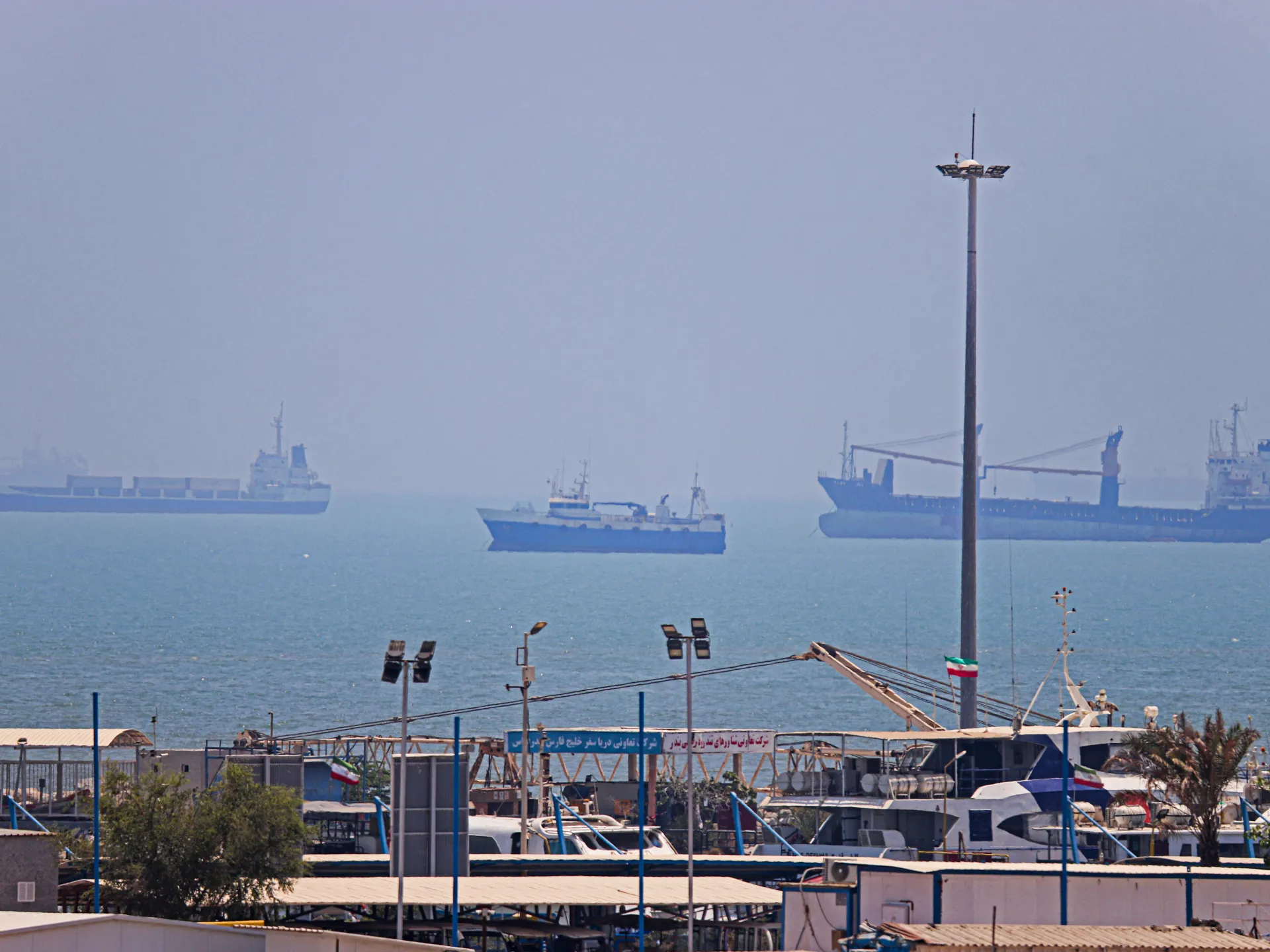
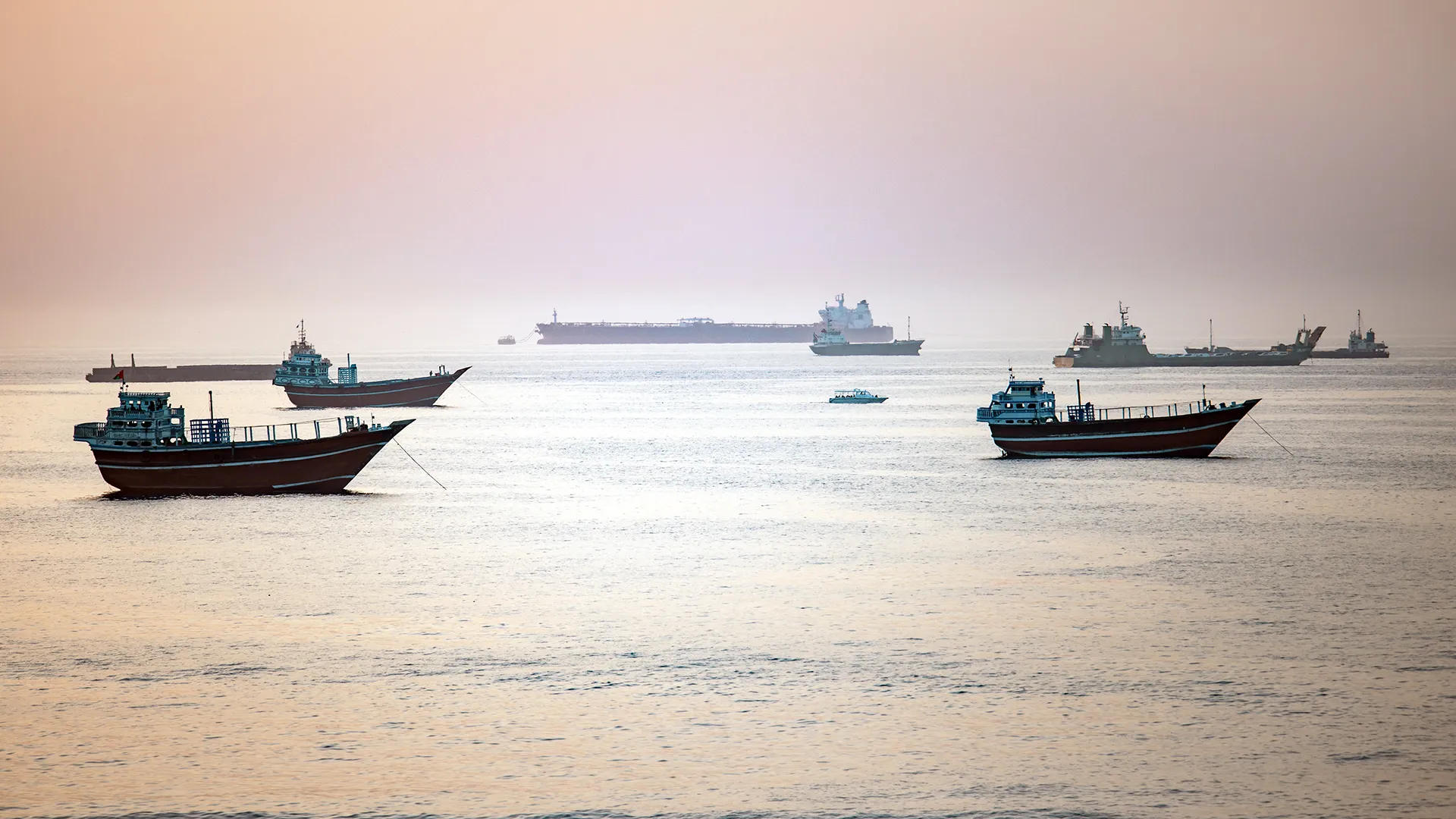
The United Nations’ International Maritime Organization (IMO) has suspended plans to evacuate more than 11,000 sailors stranded in the Strait of Hormuz after a cargo ship transiting the waterway was struck by a projectile.
IMO Secretary-General Arsenio Dominguez said several crews had already been evacuated, but the agency had decided to pause the operation until there were “necessary safety guarantees” for those involved.
Recommended Stories
list of 4 itemsend of list
The United Kingdom Maritime Trade Operations (UKMTO), a Royal Navy maritime security agency, said on Thursday that a cargo vessel had been struck by “an unknown projectile” about 7.5 nautical miles (14km) southeast of Dahit, Oman. No casualties were reported.
The incident comes despite a memorandum of understanding (MoU) signed by the United States and Iran last week that ended hostilities and included provisions aimed at reopening the strategic waterway. Iran had restricted passage through the strait in early March after the US and Israel attacked it on February 28. In April, the US imposed a naval blockade on Iran-linked vessels trying to pass through the waterway.
Since the MoU was signed, commercial traffic has restarted through the strait, but key disagreements remain over which shipping routes vessels should use — and whether Iran gets to charge a toll or fee.
Oman and the IMO have proposed a new shipping corridor that would partially bypass waters under Iran’s direct control. Tehran has rejected the plan, saying it was announced without consultation and raises safety concerns while demining operations are still under way. While Iran has not claimed responsibility for Thursday’s attack on the ship off Oman, it has not denied any role, either.
The latest attack has heightened concerns that tensions over navigation through the strait remain unresolved. Here’s what we know.
Why is the UN evacuating sailors?
Following the outbreak of the US-Israel war on Iran on February 28, Tehran and Washington imposed counter restrictions on the passage of ships through the Strait of Hormuz, leaving thousands of seafarers unable to leave vessels trapped in the waterway.
More than a dozen sailors have also been killed in attacks on ships — some from American missiles, others from Iranian projectiles. Most of those killed were from India.
Even with last week’s agreement between Washington and Tehran to end the conflict, more than 11,000 sailors remain stranded in the strait.
Announcing the evacuation plan on Tuesday, the IMO’s Dominguez said the operation would be conducted in “close cooperation with Iran, Oman, all other coastal states in the region, the United States and the maritime industry”.
Oman’s Ministry of Defence said the operation, which had been under discussion for months, would be carried out in phases.
Denmark also announced on Tuesday that it would join a multinational maritime mission led by France and Britain to help restore safe navigation through the strait.
Why was the ship attacked?
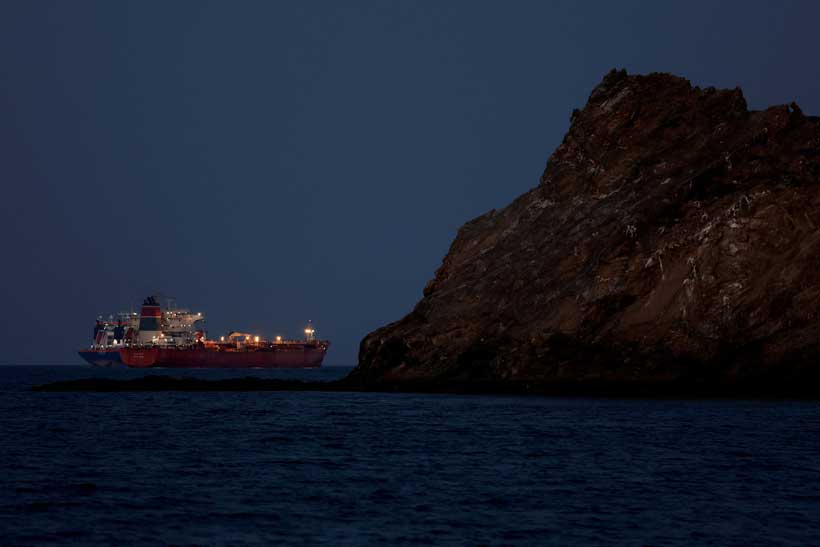
The Singapore-flagged cargo vessel Ever Lovely was struck by what authorities described as an “unknown projectile” while transiting the Strait of Hormuz on Thursday.
Ship-tracking data from MarineTraffic showed the vessel had been following the southern shipping route proposed by the IMO earlier that day, a corridor that passes closer to Oman’s coastline and has been rejected by Iran.
Singapore’s Maritime and Port Authority (MPA) said the vessel had since completed its transit through the strait and was continuing its voyage, adding that all 21 crew members were safe.
The authority said it was “deeply concerned” by an attack it described as “unprovoked, unjustifiable, and a breach of international law”.
“All actions affecting international shipping must fully comply with international law, in particular the United Nations Convention on the Law of the Sea, and not endanger the safety of seafarers and ships at sea,” the MPA said.
The incident prompted the IMO to suspend its planned evacuation of stranded sailors. Dominguez said the Ever Lovely “did not transit under IMO’s evacuation framework”.
“I have always reiterated that the safety of the seafarers remains paramount. Therefore, to ensure a coordinated approach and navigational safety, the evacuation plan will be paused until further clarity is obtained,” he said.
What has Iran said?
While it remains unclear if the attack was carried out by Iran, the country’s Islamic Revolutionary Guard Corps had criticised the new shipping corridor announced by Oman and the IMO, while also warning that passage through the strait, “is only possible via routes announced by Iran,” the state broadcaster IRIB reported.
Kazem Gharibabadi, Iran’s deputy foreign minister, has said safe passage through the Strait of Hormuz cannot be guaranteed for vessels transiting “with ambiguous arrangements, parallel routes, or decision-making outside of Iran’s considerations as the coastal state”.
“Any credible framework must be based on coordination with Iran and the provisions of paragraph five of the Islamabad Memorandum of Understanding,” he said in a statement on X. “Otherwise, the outcome will be the suspension of the designated parallel route.”
Iran first published its own map of approved navigation routes in April, directing ships to sail much closer to the Iranian coastline than before the conflict.
The IRGC’s latest warning came after a Liberian-flagged oil tanker transited the strait on Thursday using a route closer to Oman’s coast.
On Friday, a further three foreign oil tankers that attempted to cross the Strait of Hormuz “without authorisation” were turned back after a warning from the IRGC, Iranian state TV reported.
Analysts say control over the Strait of Hormuz has long been one of Tehran’s most important sources of strategic leverage, allowing it to exert pressure on the US, whose economy is inextricably tied to global markets.
Why was the evacuation suspended?
Reporting from Tehran, Al Jazeera’s Resul Serdar Atas said the attack appeared to show Iran was prepared to enforce its warnings over navigation through the Strait of Hormuz, after Tehran insisted vessels using either the Iranian or Omani route must coordinate with its authorities.
“Yesterday, Oman announced new routes for the passage of the ships. But then the IRGC released a statement, saying that whether the ships go through the Iranian or Omani territorial waters, they need to be in full coordination with Iranian authorities,” Atas said.
“And if they violate that, then Iran is going to act accordingly. So the question was whether Iran is going to really act or not?
“The answer is yes. Now, we have seen that a tanker has been attacked by some projectiles in the Strait of Hormuz. The Revolutionary Guards did not claim responsibility but did not deny it either.”
Atas added that Gharibabadi, Iran’s deputy foreign minister, had also warned that any shipping arrangements made without taking Iran’s position as a coastal state into account would be unacceptable.
“Perhaps, in the coming days and weeks, we are going to see that the Strait of Hormuz will be one of the main sticking points.”
What other disputes remain?
Under last week’s memorandum of understanding, Iran agreed it would “make arrangements using its best efforts for the safe passage of commercial vessels with no charge, for 60 days only, from the Persian Gulf to the Sea of Oman and vice versa”.
Although the agreement says commercial traffic should resume immediately, it also acknowledges that mines laid during the conflict must first be cleared, stating that “demining by the Islamic Republic of Iran will be instated within 30 days”.
It also provides for discussions between Iran, Oman and other Gulf states over future arrangements for managing navigation through the waterway.
However, the agreement does not specify what will happen after the initial 60-day period.
Last week, Tehran announced it would waive any transit fees during those 60 days while negotiations with the United States continue in Switzerland, raising the possibility that charges could be introduced if no broader agreement is reached.
Iran’s chief negotiator, Mohammad Bagher Ghalibaf, has also suggested Tehran does not intend to return to the pre-war status quo.
“Hormuz will never return” to how it operated before the conflict, he said. The proposal has also faced resistance from the United States and several Gulf states.
Are ships still moving through the strait?
Commercial shipping has gradually resumed, although traffic remains well below normal levels. Before the conflict, between 120 and 140 vessels typically passed through the Strait of Hormuz each day.
According to maritime analytics firm Kpler, 54 verified commercial and energy-related vessels transited the strait on Thursday, down from 70 verified crossings the previous day.
“West-to-East movements dominated, while the Omani Route accounted for the largest share of identified passages. Yet route transparency remains incomplete, with several Dark or Unknown crossings recorded.
“A reported projectile strike on a cargo vessel southeast of Dahit, Oman, adds fresh operational risk, underscoring the gap between improving physical flows and still-fragile maritime security conditions,” Kpler added.
President says his country will readmit genuine nationals but insists Europe must first verify deportees’ identities.
Published On 26 Jun 202626 Jun 2026
Mogadishu, Somalia – The European Union has imposed visa restrictions on Somali citizens, escalating a dispute with Mogadishu over the return of Somalis living in Europe illegally.
The bloc’s member states approved the measures on Thursday, acting on a report that Somalia was not doing enough to take back nationals who had been refused the right to stay.
Recommended Stories
list of 3 itemsend of list
Somalia’s President Hassan Sheikh Mohamud pushed back, saying his government would readmit its citizens, but said that many returnees were not Somali nationals.
“We haven’t rejected our people; they own this country. And we cannot reject them,” the president said at an Independence Day event on Thursday, adding that Somalia had “questions about how those people would be returned.”
People across the Horn of Africa share a similar appearance, he said, and some present themselves as Somali to claim asylum in Europe. He pointed to past cases in which individuals sent back as Somalis turned out not to be, including some who “don’t know the Somali language.”
“If they are Somali, then we’ll take them. If they aren’t, we’ll help you find out where they are from, and you can send them there,” Mohamud said.
The pressures driving people to leave are rooted in decades of upheaval.
Somalia is still rebuilding after the collapse of its central government in 1991 and the long civil war that followed.
Recovery efforts have been stifled by the ongoing armed rebellion of al-Shabab, an al-Qaeda-linked armed group that has waged deadly attacks since 2006.
Those conditions have pushed many young Somalis to attempt the dangerous journey to Europe, often through Libya, where migrants have faced detention, extortion and violence.
The prime minister regularly handled such cases, Mohamud said, adding that Somali embassies had been instructed to help citizens return.
Magnus Brunner, the bloc’s migration commissioner, said countries of origin had to meet their commitments “otherwise, there can be consequences.”
A European Commission assessment concluded that Somalia’s cooperation on readmission was insufficient.
Under the new rules, member states can no longer issue multiple-entry visas to Somalis, and the fee waiver for holders of diplomatic passports has been removed. The standard processing time for visa applications has also been extended from 15 to 45 days.
The suspension has no fixed end date and is intended as leverage to push Mogadishu towards closer cooperation.
Somalia now joins a short list of countries hit with such measures.
The EU imposed similar restrictions on The Gambia in 2021 and Ethiopia in 2024, lifting the Ethiopian curbs in May after deciding cooperation had improved.
The visa restrictions add to a run of setbacks for Somali travellers.
The United States imposed a sweeping travel ban in 2025, after President Donald Trump returned to office, covering citizens of a dozen countries, including Somalia.
The policy drew attention this month when Omar Abdulkadir Artan, named Africa’s referee of the year in 2025, was denied entry to the US and couldn’t officiate at the World Cup, despite holding a valid visa.
The standoff comes as the EU tightens its wider approach to migration, pursuing return centres beyond its borders and faster deportations for people refused the right to stay.
Casablanca court delivers landmark verdict in ‘Escobar of the Sahara’ case: up to 12 years for top figures.
Published On 26 Jun 202626 Jun 2026
A Moroccan court has handed prison sentences of up to 12 years to 29 individuals – including prominent politicians and sports figures – concluding a major international drug trafficking and corruption trial.
The verdicts, delivered late on Thursday in Casablanca following a two-year trial, mark one of the largest anti-corruption operations in Morocco’s history.
Recommended Stories
list of 3 itemsend of list
Among those convicted were Abdennebi Bioui, a construction tycoon and former regional council president, Said Naciri, former president of Casablanca’s Wydad AC football and sports club and former MP Belkacem Mir – all senior members of the governing PAM party. Naciri received 10 years, Bioui 12 and Mir 10.
Besides the three main defendants, sentences for the remaining ranged from two to nine years, depending on their individual role in the network.
The wide-ranging case was triggered by courtroom testimony from El Hadj Ahmed Ben Brahim, a notorious Malian drug trafficker nicknamed the “Pablo Escobar of the Sahara”.
Currently serving a 10-year sentence in Morocco, Ben Brahim told judicial investigators that his former Moroccan political and business associates had betrayed him, seizing millions of dollars worth of his luxury real estate and vehicles following his arrest in 2019.
The trial involved more than 20 defendants, 18 witnesses and two civil parties which centred on a sophisticated network that transported tonnes of Moroccan cannabis resin across North Africa to Europe, alongside Latin American cocaine shipments.
Family members of Moroccan public figures Said Naciri and Abdennabi Bioui react as they are given 10 and 12 year prison sentences for a major drug trafficking scheme [Abdel Majid Bziouat/AFP]
Defendants were convicted on charges including drug and gold trafficking, corruption, forgery and money laundering.
The court also ordered the seizure of assets and levied hundreds of millions of dollars in customs and exchange fines against the principal ringleaders.
Moroccan media reported that families of the convicted, present without legal representation due to a lawyers’ strike, were left in shock, with some collapsing in the courthouse.
The scandal reached the highest levels of state, prompting King Mohammed VI to demand a legally binding code of ethics aimed at “moralising” parliamentary life.
Jorge Rodríguez, the president of Venezuela’s National Assembly, said 250 buildings had been damaged or lost, mostly in La Guaira.
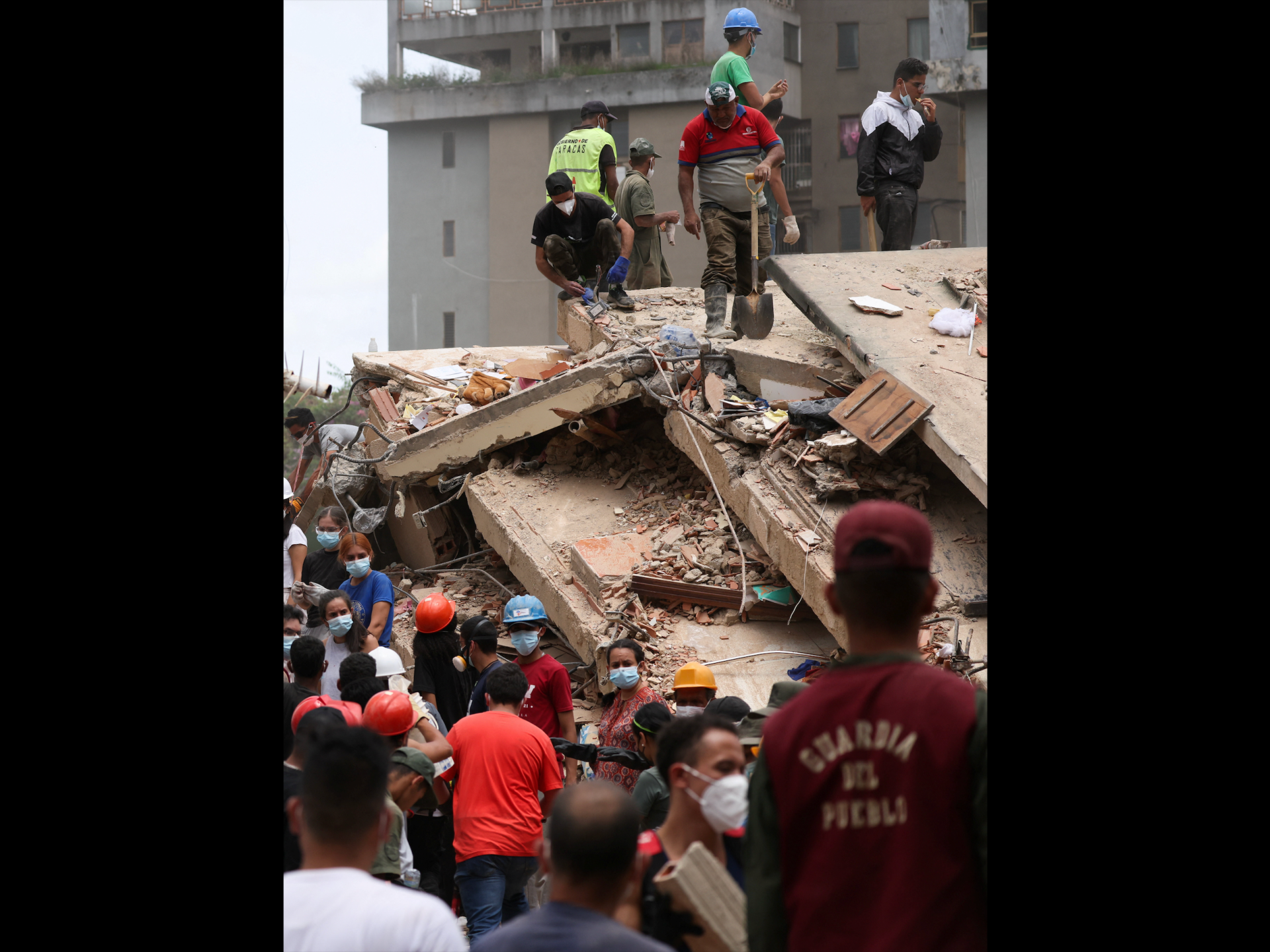
Photos and videos showed debris strewn on the streets. In some footage, people can be heard calling for help.
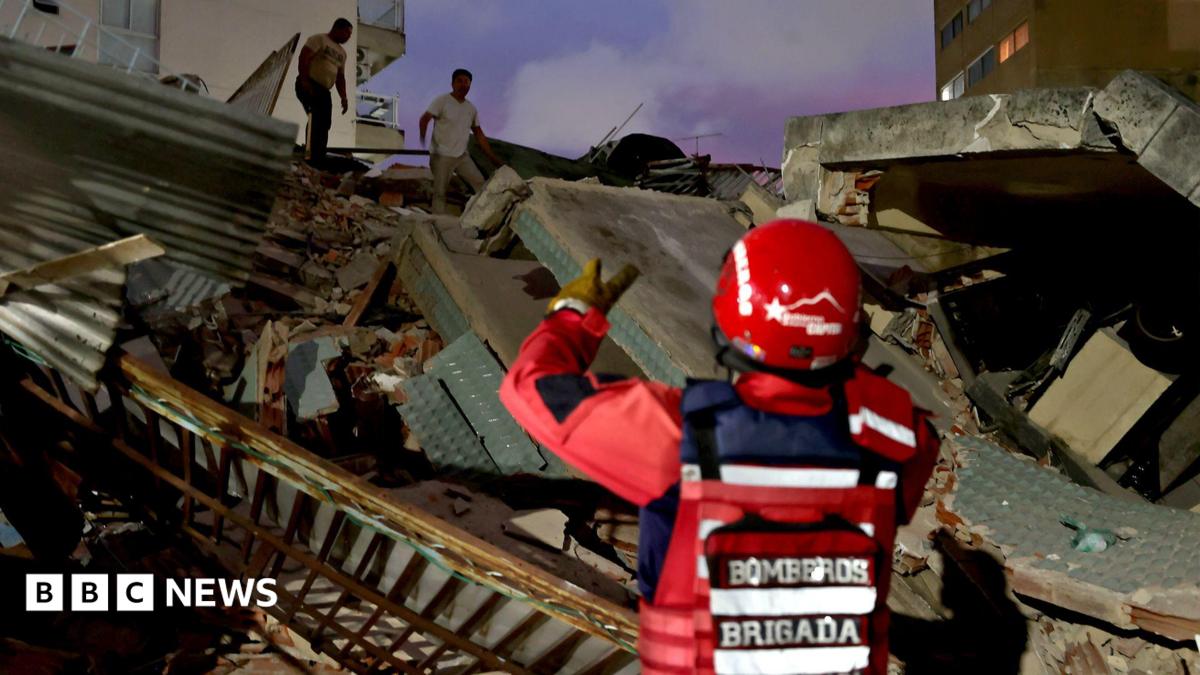
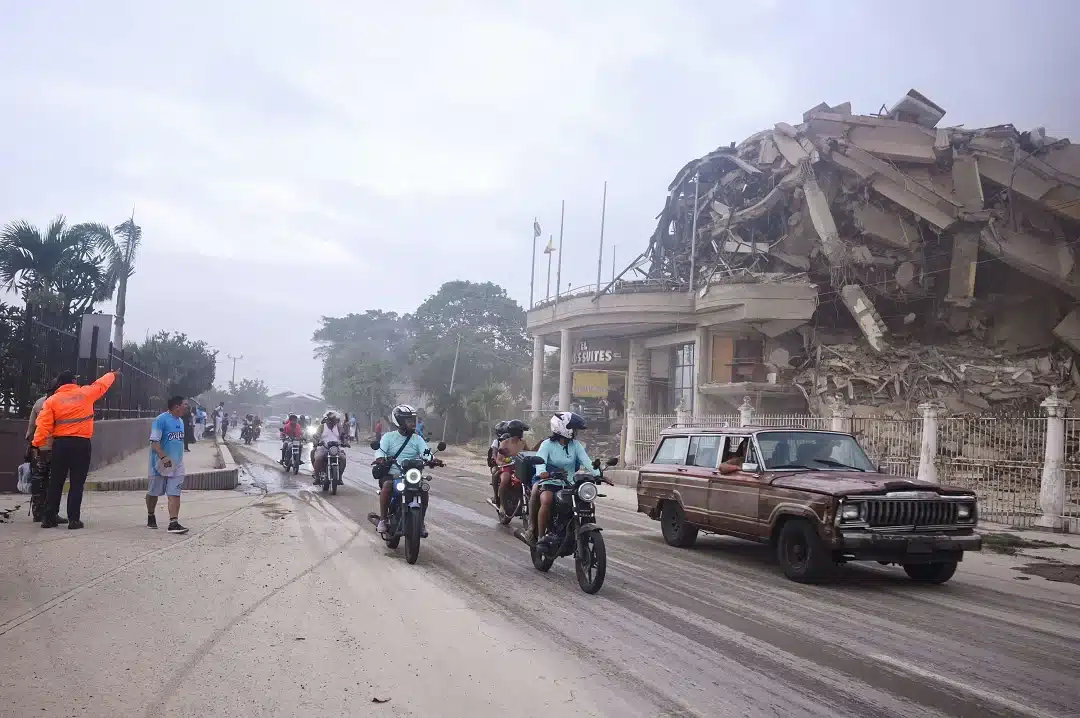
The BBC has verified footage of a 10-storey hotel reduced to rubble in La Guaira, and another video that recorded people screaming and fleeing as a multi-storey collapses in El Junquito, west of Caracas.
Other verified footage shows destruction further from the capital. One video shows a multi-storey building, reportedly a hotel, totally collapsed in Tucacas, on Venezuela’s coast, about 250km (155 miles) northwest of Caracas.
Mayor Gustavo Duque of Chacao, which forms part of the greater metropolitan area of Caracas, said on Thursday outside the rubble of one collapsed building that 11 people had died there and 23 had been rescued.
In an Instagram video, he said the team was trying to clear the rubble so that specialists could go in “to reach people who are hopefully still alive”.
“We’re trying to rescue as many people alive as possible,” he said.
Fuel supplies into the city have been cut off and internet blackouts have also been reported.
Activists have used thermal cameras to show the extreme temperatures outdoor workers are facing during Europe’s summer heatwaves, with one construction worker shown enduring surface temperatures above 65°C.
Weekly insights and analysis on the latest developments in military technology, strategy, and foreign policy.
The Turkish Air Force looks set to receive a major boost to its fighter fleet, with the delivery of dozens of F110 engines required to power the homegrown TF Kaan combat jet. This would be one of the most significant positive developments in U.S.-Turkish defense relations since Turkey was ejected from the F-35 program in 2019, and may even pave the way for Ankara to rejoin that effort.
Citing four sources familiar with the matter, Reuters reports that President Donald Trump’s administration plans to go ahead with the engine sale, said to be worth more than $700 million, despite some resistance from Congress.
Reporter: Türkiye wants the F-110 jet engines, and they want their F-35 fighter jets. Are you going to Türkiye with a big gift bag?
Trump: I think so. He’s a member of NATO. Some people don’t consider himself, but he really is.
Ahead of his July trip to a NATO summit in Turkey, Trump was asked by a reporter whether Turkish President Tayyip Erdogan would be provided with a “big gift” in the form of F110 engines and potentially F-35 fighter jets.
“He’s a member of NATO,” Trump replied. “He really is a strong member of NATO. Yeah, I’m going to probably do something that’s going to make him very happy.”
Speaking alongside Trump, Vice President JD Vance said a review was underway to see if Turkey could receive the F-35.
JD Vance on Türkiye’s F-35 jets:
Pete and the entire team are reviewing this right now, because there are certain things that we have to certify have happened — that have happened in order to comply with American law. The president has asked us to do that.
“Pete and the entire team are reviewing this right now, because there are certain things that we have to certify have happened … in order to comply with American law,” Vance said, referring to Secretary of Defense Pete Hegseth.
The question of whether Turkey might receive F-35s has long been a fraught one, with Ankara kicked out of the program back in 2019, a development we will return to later.
For now, however, Turkey’s priority seems to be securing F110 engines.
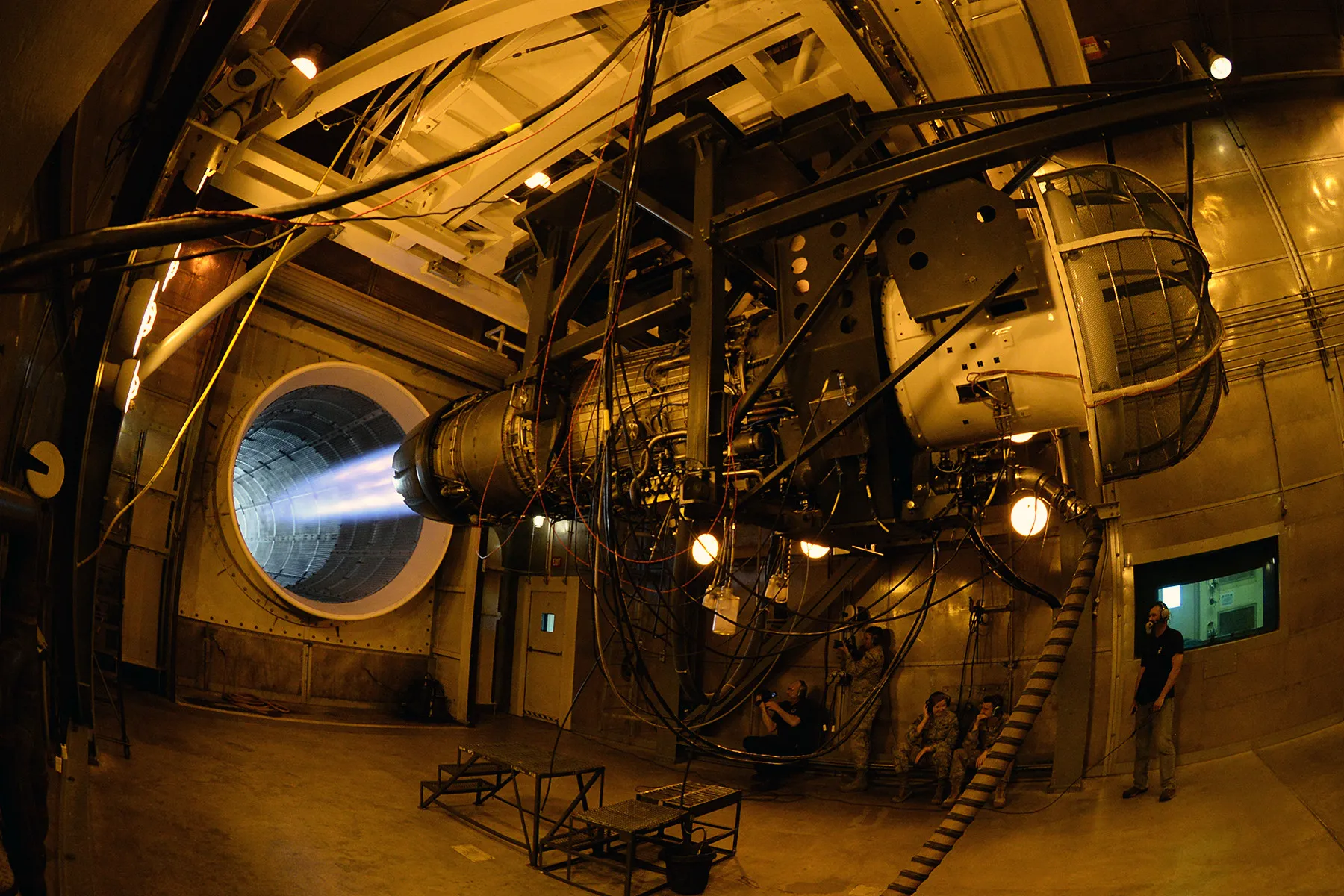
The F110 engine for an F-16 at max power during a test in the hush house engine facility at Hill Air Force Base, Utah. U.S. Air Force photo by Alex R. Lloyd
Turkey’s TF Kaan next-generation fighter is a flagship program of the country’s burgeoning aerospace industry. The program was launched in 2010, and the first prototype took to the air in early 2024.
Reportedly, Turkey plans to complete three pre-production prototypes, to be followed by 250 series-production aircraft, incorporating various refinements.
Last month, a contract was reportedly signed for 20 examples of the initial Block 10 versions of the Kaan.
The twin-engine Kaan was developed with a reduced radar signature in mind, as well as a high level of performance and modern avionics and other systems. As a result, it doesn’t offer the same level of low observability as the F-35, while its sensor fusion, electronic warfare capabilities, and other ‘fifth-generation’ features lag behind the U.S.-designed jet.
One of the F-35s that was completed for Turkey before its ejection from the program. Lockheed Martin
Critically, the Kaan is powered by U.S.-supplied General Electric F110 turbofans.
F110s are assembled under license in Turkey by TUSAS Engine Industries (TEI) but are still governed by U.S. export restrictions. These engines are already used in significant numbers by the Turkish Air Force F-16 fleet, the third-largest in the world. Outside of the F-16, the F110 is also used in the F-15E Strike Eagle and F-15EX Eagle II, among other F-15 variants. An F110 comes with a typical flyaway unit cost of $10 to $15 million.
The Kaan program has long been overshadowed by the question of whether Washington will make available in larger numbers the F110 turbofans used in the prototype. Reportedly, an initial batch of 80 engines is required.
While Turkish officials have expressed hope of ultimately switching to a domestically produced engine type for the Kaan, TEI’s TF35000, it’s unclear how realistic this is, at least in the near term. Turkey has also looked at acquiring alternative engines, too, including those from Russia or Rolls-Royce in the United Kingdom.
In the meantime, the importance of the Kaan to the Turkish Air Force increased significantly in 2019, when it became clear that Ankara would be kicked out of the F-35 program, in which it had a considerable industrial stake, and a plan to buy around 100 of the fighters. Washington took that decision after Turkey refused to abandon its purchase of Russian-made S-400 long-range air defense systems.
A Russian Ilyushin Il-76, carrying the first batch of equipment for the Turkish S-400 missile defense system, arrives at Murted Air Base in Ankara on July 12, 2019. Photo by Turkish National Defense Ministry / Handout/Anadolu Agency/Getty Images
As well as the S-400, U.S. lawmakers were unhappy with Turkey’s worsening relations with Greece, its other connections with Russia and Azerbaijan (which included the deployment of F-16s to the latter country), its conduct in the Syrian civil war, and human rights abuses. Turkey’s opposition to Sweden joining NATO also proved to be a significant hurdle.
In the wake of all this, the chances of Turkey receiving F110 engines were dramatically reduced. At the same time, Turkey’s request to buy additional F-16 fighters was also turned down. Turkey reportedly also began stockpiling spare parts for its F-16 back in 2019, fearing the effects of U.S. sanctions.
Turkish Air Force F-16 fighters at Balikesir, Turkey, in May 2022. Photo by Ali Atmaca/Anadolu Agency via Getty Images
Toward the end of the Biden administration, U.S.-Turkish relations began to improve, and Washington moved to push through sales of new F-16s and upgrade kits for older jets to Turkey. There also began to be suggestions that the F-35 was potentially back on the table for Turkey.
Under the Trump administration, Washington’s relationship with Ankara has become closer, with Erdogan frequently praised by the U.S. leader.
At the same time, the issue surrounding the S-400 and the sanctions that followed that acquisition remains.
As it stands, U.S. law does not permit Turkey to operate or possess the S-400 system if it wishes to rejoin the F-35 program, as a result of security concerns around the Russian-made system.
The first F-35 for Turkey was rolled out during a ceremony at the Lockheed Martin plant in Fort Worth, Texas, on June 21, 2018. Photo by Atilgan Ozdil/Anadolu Agency/Getty Images
During a visit to Turkey in early 2024, the U.S. Acting Deputy Secretary of State Victoria Nuland reportedly suggested that the United States might be willing to offer Patriot air defense systems if it were to give up its S-400s, which could also clear the way to re-entering the F-35 program.
“Frankly, if we can resolve this S-400 issue, which we want to do, the United States would be pleased to welcome Turkey back into the F-35 family,” Nuland said. “But we must solve this other issue first, and while we solve it, we must also ensure that Turkey has a strong air defense.”
The apparent decision to clear the F110 sale certainly represents a further softening of Washington’s stance, and it could be a stepping-stone to Ankara eventually being readmitted to the F-35 program.
Turkey’s desire for F-35s has only been intensified by the fact that Greece, its major strategic rival, has been approved for a purchase of the jets. You can read all about how tensions between Greece and Turkey are reflected in the countries’ respective air forces in this previous feature.
Presentation ceremony of the Kaan on May 1, 2023, in Ankara. Photo by Yavuz Ozden/ dia images via Getty Images
Even regarding the F110 transfer, some opposition to defense sales to Turkey remains in Washington.
In particular, Representative Gregory Meeks of New York, the leading Democrat on the House of Representatives Foreign Affairs Committee, has reportedly stood in the way of the engine sale during an informal review process.
However, according to the four sources who spoke to Reuters, the F110 deal should be “finalized in the coming days, followed by a formal notification from the State Department to Congress.”
While lawmakers can use the congressional review process to raise their concerns over big-ticket defense exports, the administration can override these.
According to the Wall Street Journal, the Trump administration is expected to override Meeks’ effort to block the engine deal.
For the Kaan program, the F110 is vital.
Denied the F-35 and with F-16 deals moving forward only slowly, Turkey has been forced to look elsewhere to meet its short-term fighter needs. Most significantly, it signed a deal for 20 Eurofighter Typhoon jets last October.
U.K. Prime Minister Keir Starmer and Turkish President Tayyip Erdogan sign the Typhoon deal in Ankara in October 2025. Eurofighter
Turkey has also been investing heavily in drones, including the ANKA-3, a low-observable flying wing uncrewed combat air vehicle (UCAV), and the fighter-like Bayraktar Kizilelma. Still, these are viewed as adjuncts to advanced crewed fighters, like the Kaan.
Whether securing the F110 engines means the Kaan meets its target of service entry around the 2030 timeframe remains questionable.
However, it is a major step in that direction.
As well as being fielded by the Turkish Air Force, the Kaan could have significant potential for export, although sales would be governed by U.S. restrictions on its engines. It is one of a number of medium-weight fighters that feature low-observable characteristics and advanced avionics. These include China’s FC-31 and South Korea’s KF-21.
The Chinese Shenyang FC-31 fighter prototype. via Chinese internet
Perhaps most importantly, the F110 deal would get back on track what is very much the flagship of Turkey’s military aerospace industry. At the same time, a U.S. decision to provide Ankara with these engines will also be welcomed by those in Turkey who still wish for a way back into the F-35 program.
The extreme June temperatures would have been ‘virtually impossible’ 50 years ago, says the World Weather Attribution group.
Published On 26 Jun 202626 Jun 2026
The historic heatwave gripping Europe is part of a dangerous weather trend that can only be explained by human-caused climate change, scientists have said.
The extreme temperatures sweeping across much of Europe mark the region’s “most severe” heatwave ever tracked for the month, and would have been “virtually impossible” half a century ago, the World Weather Attribution group of scientists said in a report released on Friday.
Recommended Stories
list of 3 itemsend of list
Millions in France, Italy, Spain, the United Kingdom and elsewhere in Europe have been experiencing blazing heat this week, with daytime temperatures topping 40 degrees Celsius (104 Fahrenheit) in many places.
The heatwave was reported on Friday to be moving eastwards, threatening Germany and central Europe with similar conditions to those which killed dozens in the western reaches of the continent, strained medical services and stressed the economy.
The World Weather Attribution estimated that a heatwave with similar characteristics occurring in the climate of June 1976 – when Europe was also hit by persistently high temperatures – would have been about 3.5 degrees Celsius cooler.
During another episode in 2003, temperatures would have been about 2 degrees Celsius cooler, the research suggests.
The analysis shows that intense heat is increasing rapidly, even within living memory, “with such events tens to hundreds of times more likely since only 2003 and virtually impossible just 50 years ago,” the study says.
“This event would not have been possible in June without climate change,” the study’s lead author, Theodore Keeping from Imperial College London, told reporters.
Phasing out fossil fuels ‘critical’
The planet has warmed about 1.4C above pre-industrial times, driven by the burning of coal, oil and gas.
Scientists agree this is making extreme weather events like heatwaves more frequent and intense, and that limiting warming is vital to avoid the worst impacts of climate change.
Of the nearly 850 cities the World Weather Attribution’s study analysed in Europe, some 45 percent had broken – or were expected to break – their all-time heat stress records in June.
“The weather pattern itself is not particularly unusual, but the temperatures are – or at least they used to be without human-induced climate change,” said Friederike Otto, the cofounder of World Weather Attribution.
The June heatwave in Europe is the second such episode this year. An early-season period of heat in May brought temperatures more typical of high summer to central and western parts of the continent.
World Weather Attribution said the rapid phase-out of fossil fuels is “critical if we are to avoid even higher temperatures and their consequences in the future”.
The reopening of the Strait of Hormuz has restored the flow of oil and natural gas after more than 100 days of disruption, but the crisis has already left a lasting mark on global energy markets. The prolonged closure exposed the vulnerability of the world’s energy supply chain and has prompted governments to reconsider how they secure fuel supplies.
Analysts say the crisis mirrors the impact of the 1973 Arab oil embargo, which transformed global energy policy by encouraging conservation, diversification, and strategic stockpiling. While today’s energy system proved more resilient, the Hormuz disruption may accelerate a broader shift away from fossil fuels.
What Happened?
The Strait of Hormuz, through which nearly 20 percent of global oil and liquefied natural gas supplies normally pass, remained effectively closed for more than three months during the US Israeli conflict with Iran.
Despite the disruption, global markets avoided a severe supply crisis through rapid rerouting of cargoes, the release of strategic reserves, reduced Chinese imports, and shifting demand patterns.
However, analysts say these emergency measures were only temporary. Energy inventories fell sharply during the crisis, and markets were approaching a critical point before shipping resumed.
Why the Crisis Matters
The Hormuz disruption demonstrated that even today’s highly interconnected global energy system remains vulnerable to geopolitical conflict.
Unlike previous crises, the world avoided a complete energy collapse because governments, traders, and shipping companies quickly adapted. Nevertheless, the episode exposed the limits of those emergency responses and reinforced concerns about overreliance on a single strategic chokepoint.
The crisis is expected to influence long term energy investment decisions far beyond the Middle East.
Lessons From the 1973 Oil Embargo
The 1973 Arab oil embargo fundamentally changed global energy policy after oil producing nations restricted exports to countries supporting Israel during the Yom Kippur War.
The embargo caused oil prices to surge, triggering inflation and prompting governments to adopt fuel efficiency standards, develop domestic oil production, establish strategic petroleum reserves, and create the International Energy Agency.
Rather than ending fossil fuel use, the crisis encouraged countries to consume energy more efficiently while reducing dependence on imported oil.
A New Energy Strategy Emerges
The Hormuz crisis appears to be driving another major strategic shift, particularly across Asia.
Countries heavily dependent on Middle Eastern oil and gas are increasingly prioritizing energy security over low fuel costs. Governments are expected to expand strategic petroleum reserves while accelerating investment in domestic renewable energy, nuclear power, and alternative fuel sources.
India, Pakistan, Japan, and South Korea are among the countries reviewing long term strategies aimed at reducing exposure to overseas energy disruptions.
Europe Continues Its Energy Transition
Europe entered the Hormuz crisis after already reshaping its energy system following Russia’s invasion of Ukraine in 2022.
The loss of Russian energy supplies forced European countries to cut gas consumption, diversify imports, and rapidly expand renewable energy capacity.
The latest Middle East disruption is expected to reinforce that trend by encouraging further investment in clean energy and energy efficiency while reducing dependence on imported fossil fuels.
Investment Trends Support the Shift
Global investment patterns already suggest that energy markets are evolving.
According to the International Energy Agency, worldwide energy investment is projected to reach 3.4 trillion dollars this year, with much of the growth directed toward renewable energy, electricity infrastructure, battery storage, and grid resilience rather than new oil production.
Electric vehicle sales continue to rise rapidly across Europe, Latin America, and Asia Pacific, while Chinese solar panel exports have surged across Africa and Southeast Asia.
Governments are also increasing spending on energy efficiency, with around 20 countries introducing new conservation measures directly in response to the Hormuz crisis.
Why It Matters
The Hormuz crisis has reinforced that energy security is becoming just as important as energy affordability.
Rather than relying solely on global oil markets, governments are increasingly pursuing diversified energy systems that combine fossil fuels with renewables, nuclear power, strategic reserves, and domestic production.
This transition is expected to influence investment, industrial policy, and international trade for years to come.
Future Outlook
Oil and natural gas are expected to remain central to the global economy for decades, particularly in transportation, manufacturing, aviation, and power generation.
However, future growth in fossil fuel demand may become significantly slower as governments invest more heavily in renewable energy, electric vehicles, battery storage, and efficiency improvements.
The Hormuz crisis may ultimately be remembered not as the event that ended the oil era, but as the moment many countries accelerated preparations for a more diversified energy future.
Implications
The Hormuz crisis is likely to have consequences that extend far beyond the immediate recovery in oil and gas flows. Governments that experienced supply disruptions are expected to place greater emphasis on energy security, even if it comes at a higher economic cost. This could accelerate the expansion of strategic petroleum reserves, diversify import sources, and increase investment in domestic energy production, including renewables, nuclear power, and critical energy infrastructure.
For oil exporters in the Gulf, the crisis may strengthen the case for developing alternative export routes that bypass the Strait of Hormuz, reducing dependence on a single maritime chokepoint. Import dependent economies, particularly across Asia, are also likely to rethink long term procurement strategies by securing more flexible supply contracts and expanding storage capacity.
Financial markets are also expected to assign a higher geopolitical risk premium to energy prices. Even after shipping has resumed, investors may continue to price in the possibility of future disruptions, increasing volatility across oil, gas, shipping, and insurance markets. The crisis could also accelerate capital flows into technologies that reduce dependence on imported fossil fuels, including electric vehicles, battery storage, hydrogen, and energy efficiency.
Analysis
The Hormuz crisis may ultimately prove more significant for what it revealed than for the physical disruption it caused. Although global energy markets demonstrated remarkable resilience, that resilience depended on temporary measures such as drawing down inventories, rerouting cargoes, reducing consumption, and relying on spare production capacity. These mechanisms bought time rather than solving the underlying vulnerability of the global energy system.
Unlike the 1973 Arab oil embargo, which primarily forced consuming nations to improve efficiency while expanding fossil fuel production elsewhere, today’s crisis occurred at a time when commercially competitive alternatives to oil and gas already exist. Renewable energy, electric vehicles, battery storage, and advanced power grids have matured into viable strategic assets rather than purely environmental investments. As a result, governments are increasingly viewing clean energy not only as a climate policy but also as a national security priority.
Another important distinction is the shift in investment behavior. Historically, supply disruptions often encouraged greater investment in oil exploration and production. Following the Hormuz crisis, however, a growing share of capital is moving toward energy diversification instead of simply increasing fossil fuel output. This suggests policymakers increasingly see reducing oil dependence as a more sustainable way to improve resilience than expanding strategic reserves alone.
The crisis also exposed a structural imbalance in global energy markets. While production remains concentrated in politically sensitive regions, demand growth is increasingly centered in Asia, leaving major importers highly exposed to geopolitical instability. Countries such as India, Pakistan, Japan, and South Korea may therefore pursue parallel strategies of securing diversified hydrocarbon supplies while rapidly expanding domestic renewable generation, nuclear power, and energy storage.
Perhaps the most important takeaway is that energy security has overtaken cost as the dominant driver of policy decisions. For decades, governments largely optimized their energy systems for affordability and efficiency. The Hormuz disruption demonstrated that the cheapest energy source can quickly become the most expensive if geopolitical events interrupt supply. That realization is likely to reshape government policy, corporate investment, and global energy trade for years to come.
The crisis does not signal the immediate end of the oil era. Oil and natural gas will remain indispensable for transportation, petrochemicals, aviation, heavy industry, and electricity generation in many regions. However, it may represent an inflection point where the trajectory of fossil fuel demand begins to flatten as countries systematically reduce their strategic dependence on imported hydrocarbons. In that sense, the Hormuz crisis could be remembered less as an energy supply shock and more as the catalyst that accelerated the next phase of the global energy transition.
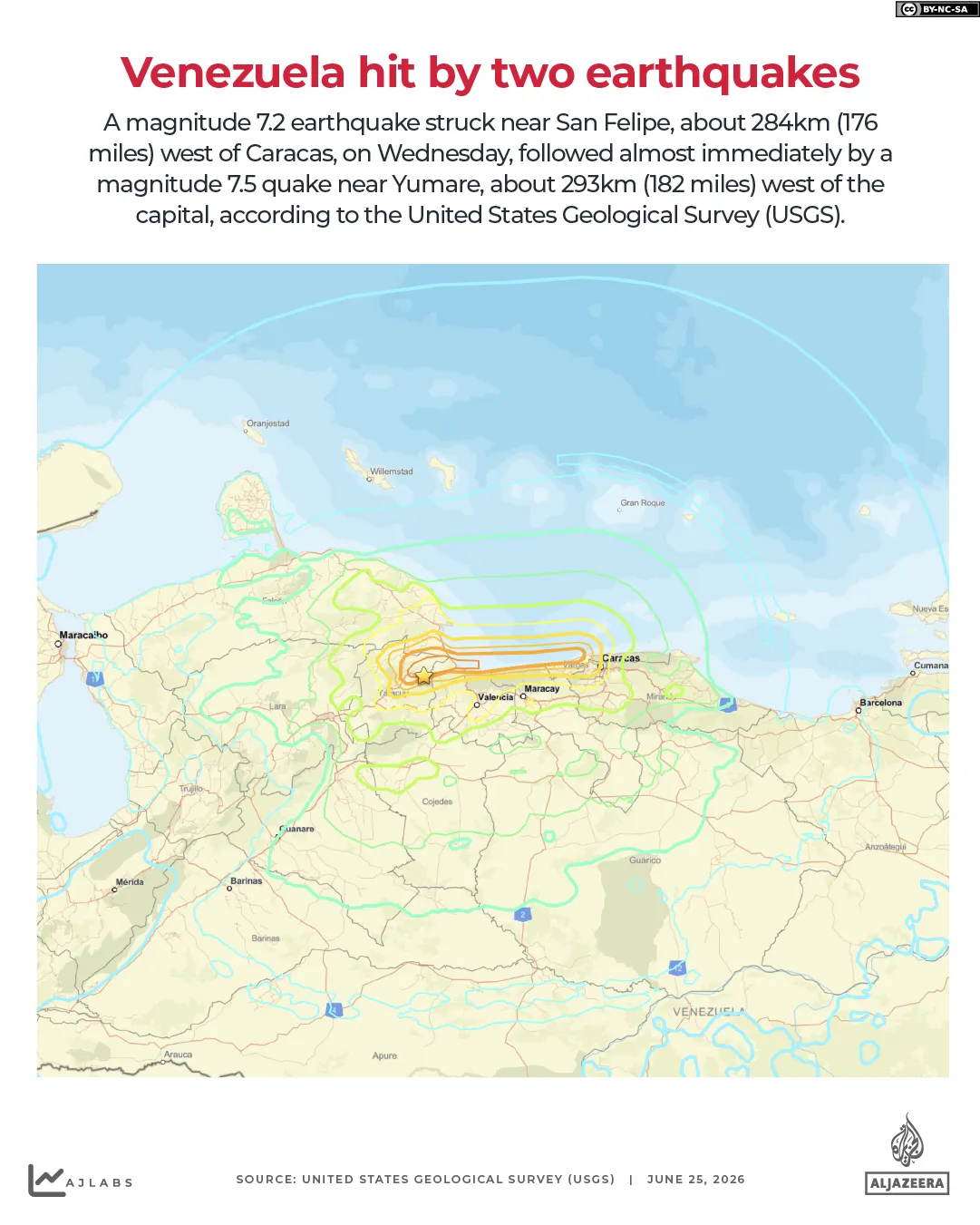
As two powerful earthquakes hit Venezuela, west of Caracas, in quick succession on Wednesday, the country’s capital sustained extensive damage.
Authorities were continuing to search for people under the rubble of collapsed buildings on Friday as 235 people were confirmed to have been killed, with 4,300 more injured.
Here is more about why Caracas has sustained so much damage.
How badly damaged is Caracas?
A magnitude 7.2 earthquake struck about 160km (100 miles) west of Caracas, followed less than a minute later by a magnitude 7.5 tremor, the strongest since 1900, according to the US Geological Survey (USGS).
Jorge Rodriguez, head of Venezuela’s national assembly and brother of interim President Delcy Rodriguez, said earlier in the day that 200 people had been trapped, with 250 buildings damaged or destroyed nationwide.
In Caracas and nearby coastal areas, at least eight hospitals, the headquarters of the Venezuelan Red Cross and the French embassy were among buildings reported to have been badly damaged.
Initial assessments released on Thursday put the estimated economic damage at between 1 and 7 percent of Venezuela’s $111bn gross domestic product (GDP). Authorities have not yet provided a separate estimate for losses in the capital.
However, the heaviest damage has been reported in Caracas itself, Al Jazeera’s Teresa Bo, reporting from Bogota in neighbouring Colombia, said on Thursday.
Public infrastructure was also heavily damaged, with acting President Rodriguez reporting power outages in Caracas.
Health Minister Carlos Alvarado said late on Thursday that 235 people had been confirmed dead at medical centres across Venezuela. He also told state media that about 4,300 people had been reported injured so far. Hundreds more are feared trapped or missing under the rubble.
How badly has the city been damaged in previous earthquakes?
This is not the first time Caracas has suffered heavy damage in an earthquake.
In 1812, a powerful earthquake roiled the cities of Merida and Caracas, killing about 30,000 people, according to the USGS. The tremors caused near-total destruction of Caracas’s colonial architecture, flattening homes, churches and public institutions.
In 1967, another earthquake hit the city, causing several high-rise buildings to collapse and killing 240 people.
(Al Jazeera)
Why has Caracas been so hard-hit?
Venezuela has a long history of devastating earthquakes because it is located along the boundary between the Caribbean and South American tectonic plates.
Caracas is also in a deep sedimentary basin, which amplifies the seismic waves from earthquakes, Vashan Wright, a geophysicist at the University of California in San Diego, told Al Jazeera.
Another reason Caracas is so vulnerable to damage from earthquakes is that its buildings and infrastructure are not specifically designed to withstand tremors and are often standing on insecure ground.
Al Jazeera’s Teresa Bo said the heaviest damage in Caracas occurred in the Altamira district, where emergency crews pulled survivors from the rubble of a 22-storey building while relatives searched for missing family members. Officials said they are still assessing the full extent of the destruction.
“For example, in the [hard-hit] area of Altamira in Caracas, many of the buildings that collapsed are built on sediments, and this makes them much more vulnerable to seismic waves,” Bo said.
“Also, there’s lots of informal housing in several areas across the country, and those types of buildings are not prepared to sustain very strong earthquakes,” she added.
Adequate urban planning and building codes, which incorporate seismic activity, require substantial funding, which Venezuela can ill afford as it has long been subject to heavy sanctions from the United States and other Western countries.
While some sanctions have been lifted since the US abducted former President Nicolas Maduro in a military strike on Caracas in January and he was replaced by Rodriguez, Caracas is still grappling with the effects of decades of underinvestment.
Another issue for Caracas is that at about 7.8km, the earthquakes were shallow, which means they were more destructive than deeper quakes of the same magnitude would have been.
In deeper earthquakes, much of the energy dissipates as it moves through layers of rock. By contrast, shallow ones release their energy closer to the ground, producing stronger shaking and greater damage in populated areas.
How many people live in informal housing in Caracas?
People living in informal housing are more at risk than others during earthquakes because low-cost, self-built housing structures, often built on hillsides and other slopes, are not resilient against tremors.
The slums in Caracas are known as barrios and are densely populated, lacking proper infrastructure. They comprise self-constructed housing or structures built with unreinforced cinderblocks or bricks, often without formal foundations or steel reinforcement, mostly on the mountainous hillsides surrounding the capital.
The lack of proper urban planning, coupled with construction on steep slopes, makes the barrios vulnerable to natural disasters.
While there is no official figure for the number of Venezuelans living in informal settlements in Caracas, academic estimates suggest they account for 40 to 50 percent of the city’s nearly five million residents.
According to the latest National Survey of Living Conditions (ENCOVI), about 55 percent of Venezuelans are living in poverty.
Which countries are better prepared for earthquakes?
Many parts of the world have adapted infrastructure with seismic engineering. Many earthquake-prone countries now plan and construct buildings with damage mitigation from tremors in mind.
Japan, one of the most quake-prone nations in the world, has strict building codes, which means many structures survive shaking that would devastate poorly built homes in parts of Indonesia or Central America. In most inland earthquakes, the majority of deaths and injuries are caused when poorly built structures collapse rather than by the shaking itself.
Japan has made enormous public investments in seismic research and has superior access to advanced engineering technologies like base isolation, which involves the installation of massive steel or rubber shock absorbers beneath the foundations of buildings.
This is why global deaths and destruction from earthquakes have reduced in the past decades. For instance, in 1556, the deadliest earthquake in recorded history in China’s Shaanxi killed about 830,000 people. In 2023, an earthquake hit northwestern China near the Shaanxi province, killing 127 people.
The US Supreme Court has sided with the Trump administration in its bid to end Temporary Protected Status (TPS) for Haitians and Syrians. The ruling allows the policy to take effect before the courts have reached a final decision on its legality.
Israeli and Lebanese delegations will continue their talks on Friday.
Published On 26 Jun 202626 Jun 2026
Israel continues to attack southern Lebanon on Friday as Israeli Prime Minister Benjamin Netanyahu pledges that the Israeli military is “not going to withdraw” from occupied areas.
Israel currently occupies about one-fifth of Lebanon.
This comes amid progress on the interim peace accord between the United States and Iran aimed at ending the US-Israel war on Iran, which began on February 28.
Here is what is happening:
In Iran
IAEA chief says inspectors to return to Iran: The interim US-Iran peace accord – also being referred to as the Memorandum of Understanding (MoU) – gives inspectors from the International Atomic Energy Agency (IAEA) access to Iran, the agency’s chief Rafael Grossi said, after Tehran indicated that key sites would remain off-limits until a final deal with Washington is reached and sanctions are lifted.
“There is an agreement and to comply with that agreement, the IAEA will have to have access and inspect,” the UN nuclear watchdog chief Grossi said at a news conference in Japan. “We hope to be there soon.”
UN halts escort of ships through Hormuz: The UN International Maritime Organization (IMO) paused its operation to escort ships through the Strait of Hormuz on Thursday after a vessel reported an attack, reigniting concerns about whether a preliminary deal to end the Iran war will hold. The cargo ship said it was hit close to Oman by a projectile, the British Navy agency UKMTO said.
On Thursday, Iran’s Islamic Revolutionary Guard Corps (IRGC) warned vessels not to attempt to pass the strait without its express permission, despite Oman and the IMO releasing details of a new safe route. In April, the IRGC released its own safe-transit route for approved ships, showing shipping lanes much closer to its own coast.
(Al Jazeera)
In the US
Trump says unfrozen Iranian assets will be used to buy US agricultural products: US President Donald Trump reiterated during an event for US farmers that unfrozen Iranian assets will be spent on buying wheat, soya beans and corn from the US. Iran has not confirmed this.
In Lebanon
Two killed in Israeli raid: Two people were killed and another person was wounded in an Israeli raid on the town of Mayfadoun, in southern Lebanon’s Nabatieh district, the National News Agency reported, citing the country’s Ministry of Public Health.
An Israeli air raid also hit the town of Nabatieh al-Fawqa, according to Al Jazeera Arabic.
Talks to continue: A US State Department official has told Al Jazeera Arabic that Israeli and Lebanese delegations will resume their meetings on Friday.
(Al Jazeera)
Global economy
India ends commercial gas restrictions: India has lifted restrictions on supplies of commercial liquefied petroleum gas (LPG) imposed during the war, when energy supplies were hit by the closure of the Strait of Hormuz, the global energy chokepoint.
Aramco resumes oil loading: Saudi Aramco, the world’s largest oil company, has resumed oil loading at its Ras Tanura terminal in the Gulf after a nearly four-month halt, shipping data showed.
Weekly insights and analysis on the latest developments in military technology, strategy, and foreign policy.
The U.S. Air Force is set to hold a classified meeting with defense contractors to share its requirements for a new air-to-air missile with a maximum range of at least 1,000 nautical miles. This is roughly 10 times the reach afforded today by the latest versions of the AIM-120 Advanced Medium Range Air-to-Air Missile (AMRAAM). An anti-air missile with this kind of extreme range would be especially well-suited for attacks on critical airborne early warning and control planes, as well as tankers and other high-value aerial assets operating in rear areas. The Air Force is also already interested in an air-to-surface version of this new weapon, which it has dubbed the Air Force Long Range Weapon (AFLRW).
The Air Force Life Cycle Management Center’s (AFLCMC) Armament Directorate (EB) issued a notice yesterday regarding the planned AFLRW industry day gathering. The two-day meeting is currently scheduled to take place at the Guided Weapons Evaluation Facility (GWEF) at Eglin Air Force Base in Florida on August 25 and 26. The Air Force says the event will be held at the Secret classification level and that all attendees have to have appropriate security clearances.
“The AFLRW is aimed at addressing the next generation of Air-Launched Standoff Weapon variants in line with Department of War priorities,” according to the industry day notice. “AFLRW may select multiple vendors for both the Air-to-Air (A/A) and Air-to-Surface (A/S) variants with a focus on A/A solutions for Initial Operational Capability.”
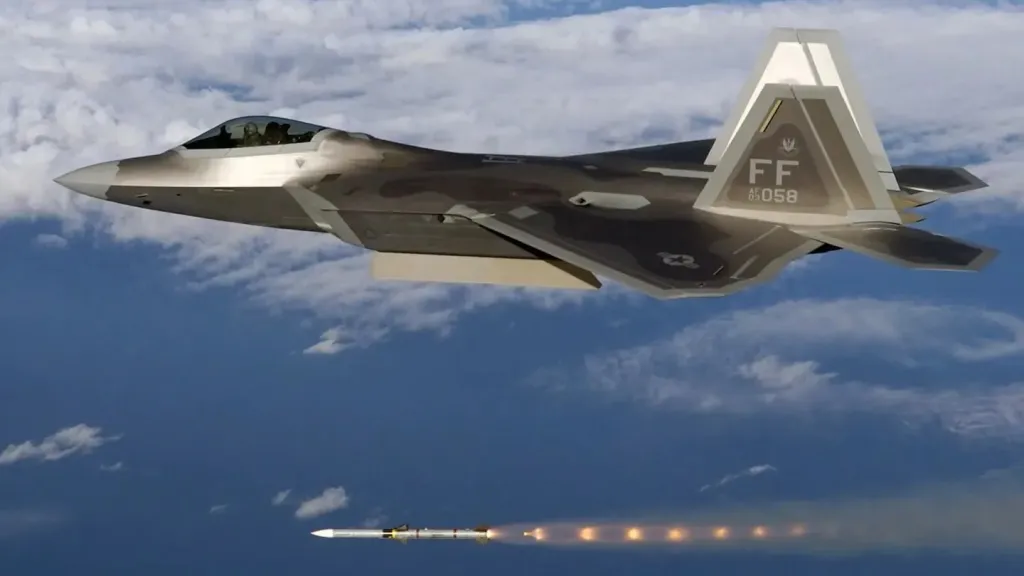
A stock picture of a US Air Force F-22 Raptor firing an AIM-120 AMRAAM. USAF
“Both [AFLRW] variants will have a threshold minimum range of 1,000 NM [nautical miles] and be capable of striking respective A/A and A/S targets in Defense Planning Scenario 2.1 and 7.1 environments in a responsive manner,” the notice adds. It does not elaborate on what those specific scenarios entail.
The notice also puts particular emphasis on modular components and open-architecture systems, and finding a “Master Integrator” to combine the various elements into a complete missile, or all-up-round.
“Industry should expect a quick-turn Whitepaper Request for Information following the event focused on the 2 solution types above for both variants,” per the notice. “AFLCMC is seeking the next generation of Air-Launched Long-Range Weapon variants that expand the United States’ ability to hit priority air, land, and sea targets far and fast!”
Beyond the range threshold, the notice does not include any other details about requirements the Air Force may have now for the AFLRW. That being said, a desire for an anti-air missile able to hit targets at least 1,000 nautical miles away is very notable by itself.
Though the exact figures are classified, the AIM-120D-3 version of the AMRAAM, the latest model in widespread U.S. service, is generally understood to have a maximum reach of around 100 miles (close to 87 nautical miles). There have been hints that it may be able to fly out further than that, at least against targets in certain envelopes. Longer-range versions of the AIM-120 may now be in development. A known key requirement for the new AIM-260A Joint Advanced Tactical Missile (JATM) has also been extended reach over the AMRAAM. Still, even the JATM, which the U.S. Navy and Air Force are developing together, is not expected to have anywhere near the range required for the AFLRW.
An annotated image showing a US Navy F/A-18F Super Hornet carrying an AIM-260. Jonathan Tweedy/ @flightline_visuals
It is worth noting here that the Air Force almost adopted a very long-range, high-speed missile designed to engage both air and surface targets during the Cold War. However, the maximum range of that Advanced Strategic Air-Launched Missile (ASALM) was still only expected to be 300 miles (260 nautical miles).
An artist’s depiction of an ASALM after launch from a B-52 bomber. McDonnell Douglas
Starting in the mid-2000s, the Air Force and the Navy also worked together on a Joint Dual-Role Air Dominance Missile (JDRADM), intended as a single weapon to supplant the AIM-120 and variants of the AGM-88 anti-radiation missile. This evolved into the Next Generation Missile (NGM), which came to a close, at least publicly, in 2013, ostensibly over rising costs. A more secretive Triple Target Terminator (T-3) program, which had initially been conducted in parallel with JDRADM/NGM, continued afterward for at least some period of time. In 2017, a possible successor to T-3, the Long Range Engagement Weapon (LREW), but the fate of that effort is unclear.
In February, the Navy put out its own new call for a long-range anti-radiation missile capable of engaging air and surface targets, dubbed the Advanced Emission Suppression Missile (AESM). However, the service did not say what its desired range for this weapon might be at that time. The Navy has already started fielding an air-launched version of the multi-purpose Standard Missile-6 (SM-6), designated the AIM-174B. TWZ has previously assessed the AIM-174B to likely be in the same range category, broadly speaking, as the Cold War-era ASALM. We have previously explored in detail how the AIM-174B slots into the Navy’s long-range kill chains.
How The Navy’s New Very Long-Range AIM-174 Will Pierce China’s Anti-Access Bubble
Nothing approaching a range of 1,000 nautical miles appears to have ever been discussed, at least openly, in relation to any of these programs. Interestingly, the Air Force did publicly talk about the prospect of anti-air missiles with ranges of up to 1,000 miles in a report to Congress in December 2024. However, the report mentioned them as part of a projected threat ecosystem the service envisions taking shape by 2050.
“Counterair weapons with ranges out to over 1,000 miles and supported by space-based sensors will place aircraft, such as tankers, that have traditionally operated with impunity, at risk,” the Air Force’s 2024 report said. This offers a hint at the kinds of capabilities it is looking to add to its own arsenal through the AFLRW effort.
After the Navy put out its AESM contracting notice, TWZ also highlighted the value of such a missile for targeting vital airborne early warning and control assets. This is often referred to as the ‘AWACS killer’ role, which references the E-3 Sentry Airborne Warning and Control System (AWACS) aircraft. As we previously wrote:
“All that being said, the value of an ‘AWACS killer’ missile is clear-cut. AEW&C are critical surveillance and battle management assets. Shooting them down deprives an opponent of those capabilities, inherently reducing their ability to effectively maneuver air assets and share important information, including with other nodes on the ground or at sea, as well as in the air. Knocking out these flying radar stations, which can be especially well-suited to spotting lower flying threats from their high perches, just hampers an enemy’s overall situational awareness.”
“The issue, of course, is that AEW&C planes typically orbit well behind the front edges of a conflict, creating additional challenges for targeting them. This is where something like AESM could come into play. A weapon of this type could engage other aerial targets by zeroing in on the radiofrequency emissions they pump out. This could include electronic warfare aircraft, and potentially other aerial targets. AESM might be able to take on a more general anti-air role with the addition of an active radar and/or imaging infrared seeker, as well as datalinks allowing for the use of networked targeting data. [The AGM-88E] AARGM and [AGM-88G] AARGM-ER both feature an active millimeter-wave radar seeker to enable them to hit fleeing ground targets, but a similar concept could be adapted for air-to-air use.“
The KJ-500 seen here is just one example of the multitude of different airborne early warning and control aircraft currently in Chinese service. Taiwan Ministry of National Defense
In that piece, we also touched on the potential for the AIM-174B to help meet U.S. military needs for an ‘AWACS killer’ missile. With the ability to hit targets in the air, as well as down below, out to at least 1,000 nautical miles, AFRLW would be a dramatic step above even the AIM-174B in capability.
The Pacific region offers a host of practical examples to give a better sense of what this kind of reach means. The distance between U.S. bases on the Japanese island of Okinawa and Taiwan is roughly 390 nautical miles. The distance between Andersen Air Force Base on Guam and Taiwan is around 1,500 nautical miles. AFLRW-armed aircraft flying over the East China Sea or the northern end of the South China Sea would conceivably be able to engage targets with hundreds of missiles inside the Chinese mainland, as long as suitable targeting data was available. The AFLRW’s range would be relevant on other potential hotspots globally, as well.
AFLRW would give the Air Force a way to pick off airborne early warning and control aircraft, as well as tankers, bombers, other kinds of surveillance and reconnaissance aircraft, and potentially even unsuspecting tactical jets. The missiles would be able to do so without necessarily alerting them to the fact that they are being targeted at all, at least till it’s too late to escape. Having air-to-air missiles that can go after targets at such great ranges means the need to project tactical airpower and support aircraft far forward and deep into harm’s way for the counter-air mission would be less critical, at least during the first opening stages of a conflict. By eliminating key force multiplying aircraft with long-range weaponry, conditions would be better for the survivability of traditional counter-air packages.
A US Air Force B-2 bomber flies over a part of the Pacific Ocean together with a quartet of Japanese F-35A Joint Strike Fighters. USAF
On top of offering a new way to hold higher-value targets in rear areas at risk, AFLRW would give Air Force aircraft added flexibility to engage targets closer to the tactical edge, but not necessarily near where they might be flying at any one time. In the aforementioned Pacific scenario, areas of active combat in the air and on the surface could easily be dotted across a broader zone spanning thousands of square miles.
As mentioned, the Air Force also sees anti-air threats being able to reach further and further out. This means stand-off munitions, in general, will need greater reach to help reduce the risk to launch platforms. The AFLRW’s range recommendation is a tacit admission that the U.S. military will face growing challenges piercing adversary anti-access and area denial (A2/AD) bubbles, especially the ones that China has established and is continuing to expand on. It also highlights the increasing risks to friendly airborne early warning and control aircraft, tankers, and other supporting aerial assets needed for sustained air combat operations. Chinese air-to-air missiles are already outreaching their American counterparts, and the U.S. is working to change that now with AIM-174, AIM-260 and other programs.
There are still questions about what it might take to develop a feasible AFLRW with at least a 1,000 nautical mile range, and what might be able to carry a missile with that kind of reach. It is worth remembering here that the Air Force has openly talked about the possibility of the B-21 Raider bomber taking on a greater role in air-to-air combat in the future, which might include acting as a ‘weapons truck’ loaded with anti-air missiles. The aforementioned ASALM was also intended primarily for employment from bombers. For bombers like the B-21, the AFLRW would also just offer a valuable organic way to address threats in the air and down below, potentially hours ahead of arriving over the target area.
A pre-production B-21 Raider bomber seen during aerial refueling testing. USAF
The AFLRW will also have to cover the very long distances it flies at least relatively quickly, especially to be relevant for attacking time-sensitive or otherwise fleeting targets. This might require a multi-stage or air-launched ballistic missile-like design or even something more exotic.
There is also the question of targeting at such extreme distances. These weapons will not rely on the sensors and targeting information generated by the platforms they are launched from. Above all else, the AFLRW will, by default, have to be tied into a deeply networked ‘kill web’ that brings together tertiary sensors and other supporting elements across vast networking layers. That ‘web’ would be spread across the air, land, sea, space, and even cyberspace domains, and incorporate assets from other branches of the U.S. military beyond the Air Force.
Above all else, the space-based aircraft tracking layer will be very important when it comes to enabling this weapon. The Air Force’s 2024 report on future threats confirmed this. The U.S. military itself is actively working to field new distributed satellite constellations to provide potentially game-changing persistent air and ground moving-target indicator (AMTI/GMTI) capability globally, with exactly these kinds of long-range kill chains in mind, as you can read more about here. Very stealthy aircraft working farther forward that are in line-of-sight of potential targets are another way these weapons can be employed. The USAF also has just such a platform.
Much remains to be learned about the Air Force’s plans for the air-to-air and air-to-surface versions of the AFRLW, and what other requirements the service has for those missiles. The industry day gathering scheduled for August will provide the service with additional information about what options might be available and on what timeframe.
Regardless, the Air Force has now made clear publicly that it wants a solution that can kill planes a thousand miles away from the launch aircraft. This matches all the signals that the Pentagon has been sending indicating it is very concerned about its ability to pierce an enemy’s protective bubble in the years ahead. Above all else, it points to a new era of net-centric warfare where the kill web is truly king.
A hospital has launched an investigation after the medical details of a child seriously injured in a crocodile pit were accessed by up to 40 members of staff.
Cambridge University Hospitals (CUH) said it was exploring if there were legitimate reasons for the records to be accessed and it had referred itself to the Information Commissioner’s Office (ICO).
“Where any member of staff is found to have accessed patient records without legitimate clinical or operational reasons we take robust disciplinary action,” it added.
Officers said they were called to the zoo at 13:34 BST on 18 June.
Police said the boy, who was from Cambridgeshire and visiting the zoo with his family, sustained serious injuries “while in the enclosure” and was pulled out by members of staff.
A 30-year-old man from Norfolk was subsequently arrested and bailed on suspicion of attempted murder.
Thousands have been reported missing following the collapse of dozens of buildings in La Guaira. (Archive)
Caracas, June 26, 2026 (venezuelanalysis.com) – Venezuelan casualties from Thursday’s double earthquake continue to rise amid ongoing search and rescue efforts to remove survivors from flattened buildings.
On Thursday night, Venezuelan authorities reported 235 people dead and over 4,300 injured. There are 250 buildings with serious damage or completely collapsed.
The death toll is expected to rise sharply with unofficial missing people databases compiling more than 40,000 unaccounted persons. However, the figure has steadily decreased in recent hours, while organizers have also pledged to remove duplicate filings.
Social media channels have been flooded with reports of missing friends and relatives.
The Caribbean nation was struck by 7.2 and 7.5-magnitude earthquakes in quick succession on Wednesday. The tremors were concentrated in central and northern states, including the capital. Coastal La Guaira State was the worst affected, with government officials reporting over 100 collapsed buildings.
Search and rescue efforts continued on Thursday as civil protection teams and volunteers rushed to locate survivors and remove them from under the rubble. The Venezuelan government called on the private sector to collaborate with heavy machinery. Several areas of La Guaira are also hard to reach.
Venezuelan grassroots organizations also mobilized, organizing the collection of food, clothes and medicines for displaced families and setting up makeshift shelters.
Videos on social media showed the Venezuelan armed forces likewise moving equipment and mobile surgical units to the coastal area. Commercial flights to and from Simón Bolívar International Airport airport in La Guaira, the main air hub serving Caracas, have been temporarily suspended following damage to a major runway and the air traffic control tower.
Acting President Delcy Rodríguez visited the most affected areas on Thursday afternoon and oversaw ongoing efforts to deploy heavy machinery and provide food and shelter for displaced families.
“We express our support and solidarity to all those affected and we hope to find as many survivors as possible,” she told reporters. “We are working around the clock and we have called for international assistance.”
Venezuelan efforts were reinforced on Thursday night with the arrival of emergency teams from Mexico, the Dominican Republic, and El Salvador. Additional brigades are reportedly on the way from Colombia, Brazil, and the US, among others.
Alongside search and rescue teams, the US Department of War announced a deployment of logistical support assets.
In a statement, the US Southern Command (SOUTHCOM) announced the deployment of the amphibious transport ship USS Fort Lauderdale and the littoral combat ship USS Billings alongside Hercules transport aircraft. Marine Corps Major General Kevin J. Jarrard landed on Thursday night and will reportedly oversee the efforts.
The Trump administration is providing $150 million in humanitarian aid to be channeled through “assistance” partners including Catholic Relief Services and multiple UN agencies.
Washington has, however, opted to maintain its punishing economic sanctions regime against the South American country. On Thursday, the US Treasury Department issued General License 60 (GL60) authorizing transactions related to earthquake relief efforts. However, Venezuelan assets abroad, including bank accounts, remain frozen, meaning that aid efforts will still face hurdles or require US approval.
Caracas has also been unable to access around $4.8 billion in gold held by the Bank of England as well as nearly $5 billion in IMF Special Drawing Rights issued during the Covid-19 pandemic.
Since January, the Trump administration has issued multiple sanctions waivers to allow Western corporations to secure favorable energy and mining agreements with the acting Rodríguez government. Transactions between Caracas and its historic allies in China, Russia, Cuba, and Iran continue to be prohibited by the waivers and subject to secondary sanctions. The White House has likewise seized control of Venezuelan export revenues, disbursing a portion back to Caracas at US officials’ discretion.
Edited and with additional reporting by Lucas Koerner in Caracas.
Weekly insights and analysis on the latest developments in military technology, strategy, and foreign policy.
The Pentagon and the U.S. Air Force have fully abandoned an attempt to axe the acquisition of E-7 Wedgetail airborne early warning and control aircraft, and to use E-2D Hawkeyes to help fill the resulting gap. In something of a twist, the Pentagon has proposed cutting U.S. Navy E-2D purchases, as well as raiding a classified Air Force account, to keep the E-7 program going. The House Appropriations Committee has now pushed back on the E-2D part of that plan. The back-and-forth underscores the critical importance of airborne early warning and control aircraft and the strain on existing U.S. fleets.
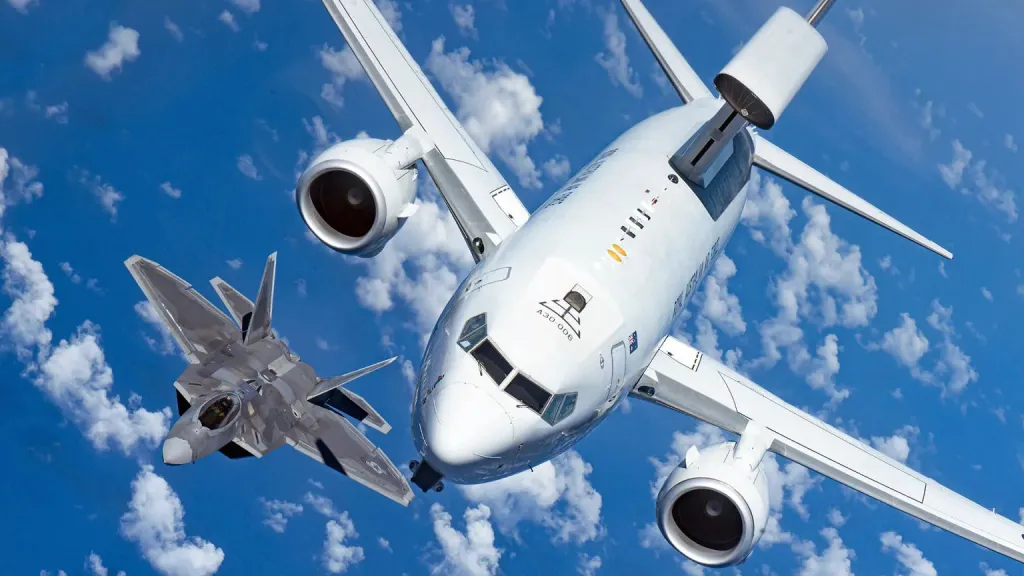
A Royal Australian Air Force E-7 Wedgetail flies together with a U.S. Air Force F-22 Raptor during an exercise. USAF
To recap quickly, roughly a year ago, the Pentagon and the Air Force disclosed their intention to axe the E-7 program, which had suffered delays and cost overruns, and acquire additional E-2Ds as an interim gap-filler. Questions about the future survivability of the Wedgetail were also raised. The Air Force’s long-term goal was then and still is now to eventually push most air moving-target indicator (AMTI) tasks into space, though that is still years away from truly becoming a reality. Congress subsequently intervened to save the Wedgetail, appropriating billions for the effort in Fiscal Year 2026. The E-7 was again missing from the Air Force’s proposed 2027 Fiscal Year budget, which raised the prospect of a new battle with Congress.
Top Pentagon and Air Force officials subsequently said that the viewpoint on the Wedgetail had fundamentally changed, and submitted an amendment to the budget request to include funding for the program. Per a memo earlier this month from Russell Vought, Director of the Office of Management and Budget (OMB) at the White House, this was done in two ways. $898,549,000 was taken from “Other Procurement, Air Force” section of that service’s budget proposal, while another $650,549,000 came out of “Aircraft Procurement, Navy.”
The combined $1,549,098,000 was moved into the “Research, Development, Test and Evaluation, Air Force” account. According to Vought’s memo, the funding would go toward “priority requirement to deliver two E-7 Wedgetail prototype aircraft and continue Engineering Manufacturing and Development activities for a program of record.”
The Air Force already has seven E-7s on order now, including the two jets to support rapid prototyping efforts. It is unclear when the service expects to begin flying Wedgetails operationally. Before the attempt to cancel the program, the target date for initial operational capability had already slipped from 2027 to 2032. It should be noted here that variants of the E-7 are already in service in Australia, South Korea, and Turkey, and that the United Kingdom is set to field a fleet of Wedgetails, too.
A Royal Australian Air Force E-7 Wedgetail. Australian Department of Defense
The report the House Appropriations Committee released yesterday included important additional context about the latest funding plans.
“While the President’s budget request for fiscal year 2027 did not include funding for the E–7 Wedgetail program, the Secretary of the Air Force and Secretary of Defense testified before the House Defense Appropriations Subcommittee that they support this critical platform and have submitted a budget amendment to the Office of Management and Budget to restore funding for the platform,” it explained. “The shift in mindset at the Department of Defense translated to requested transfers from the Special Update Program in Other Procurement, Air Force, and the E–2D program in Aircraft Procurement, Navy for a total investment of $1,549,098,000 for E–7 in Research, Development, Test and Evaluation, Air Force in fiscal year 2027.”
“While the Committee wholly supports the E–7 program and funding realignment, the Committee also restored the E–2D program to six aircraft for fiscal year 2027,” the report added. “The Committee understands the operational necessity of the E–2D platform; the complementary nature of the E–2D and E–7; and believes that more aircraft, not fewer, are necessary to support our warfighters now and in the future.”
A pair of E-2D Hawkeyes. Lockheed Martin
It is not immediately clear whether the draft spending plan that the House Appropriations Committee has now put forward still includes the full $1,549,098,000 for the E-7 program, as well as the restoration of funding for the E-2D purchases. The memo from OMB had stressed that its intent in shifting funding around was not to add to the roughly $1.5 trillion topline for its proposed 2027 Fiscal Year defense budget. Congress can, of course, appropriate additional funds as it sees fit, and often does.
Regardless, this new debate over how and where to find funding for the E-7 highlights larger issues surrounding airborne early warning capacity within the U.S. Air Force and the U.S. Navy.
“The conflict in Iran has reinforced the need for the Air Force to maintain a credible airborne battle management capability, currently being met with the Air Force’s E–3 Airborne Warning and Control System and the Navy’s E–2D Hawkeye programs,” the House Appropriations Committee’s report also notes. “As the E–3 is set to retire, the E–7 Wedgetail will serve as [a] modern replacement for lost battle management capability, commensurate and interoperable with assets already being utilized by key allies.”
U.S. Air Force E-3 Sentry aircraft at Prince Sultan Air Base in Saudi Arabia in 2022. USAF
The House Appropriations Committee report also leaves out any broader context about the planned E-2D purchases for Fiscal Year 2027. When it released its proposed budget for Fiscal Year 2025 back in 2024, the Navy had no plans to order more Hawkeyes, at least over the next five years. In its 2026 Fiscal Year budget request, the service asked for funding for four E-2Ds, presumably as part of the plan to cancel the E-7. Congress subsequently appropriated funding for three Hawkeyes in that fiscal cycle.
When it rolled out its latest budget request earlier this year, the Navy outlined all-new plans to buy 12 E-2Ds – six in Fiscal Year 2027, two in Fiscal Year 2028, and four in Fiscal Year 2029 – explicitly “to replenish accelerated service life burn down of existing force structure due to Overland Airborne Early Warning (AEW) tasking.” This underscores operational strain on the Hawkeye fleet, which can only have been further added to by operations in relation to Iran over the past few months. This also points to E-2Ds supplementing E-3s in providing overland coverage.
An E-2D Hawkeye comes in to land on the U.S. Navy supercarrier USS Gerald R. Ford after a sortie in support of Operation Epic Fury against Iran in March, 2026. CENTCOM
How exactly the E-7 program gets funded in Fiscal Year 2027, as well as what happens to the plans to order more E-2Ds, remains to be seen. The House Appropriations Committee’s draft defense spending plan could still evolve in various ways in the coming weeks and months, and will need to be reconciled with companion legislation making its way through the Senate. Once Congress passes the bill, President Donald Trump will still need to sign off on it, too.
What is clear is that both the E-3 Sentry and E-2D Hawkeye fleets remain as critical as ever, but have been even more stressed by recent operations against Iran, with new E-7s still years away from entering service.
AFTER years of writing about politics, technology and the chaos of the modern world, Matt Bellamy wanted something different for Muse’s tenth album.
“The theme was to get back into mystery a little bit,” he says. “The mysteries of the universe, mysteries of spirituality and returning to the rawness of the unknown.”
Sign up for the Showbiz newsletter
Thank you!
Matt, Chris and Dom are back with their tenth album, The Wow! SignalCredit: SuppliedThe veteran band in a photo shoot for their new albumCredit: Tim Saccenti
Inspired by the 1977 Wow! Signal — an unexplained radio signal from space once seen as possible evidence of alien intelligence — and a turbulent period in his personal life, the record finds Bellamy searching for meaning on both a cosmic and personal level.
“I’ve turned completely apolitical,” he admits. “It’s weird when you go through things in your personal life — the news just becomes an annoying noise.
“When your life’s going great, you get drawn into the news and what’s going on in the world.
“But when you’re actually going through something yourself, the news and politics just become a headache.
“I’m a little bit gloriously out of touch. I’ve normally been so in touch, my finger’s always been on the pulse, and a lot of the albums I’ve made talk about the rise of populism. But this album and my life for the last year-and-a-half has been different.”
“I’ve been through a separation involving two young kids,” he says carefully.
“I can’t really talk about the reasons behind it, but it was not your normal run-of-the-mill situation. I became a full-time single parent for a period of eight months.
“She’s doing a lot better now and she’s getting better, but it was an unusual situation to go through. It made writing the album so much easier.
“It’s hard to talk about what’s behind the album because I don’t throw people under the bus. And I don’t want my kids to grow up reading stuff.”
Bellamy, 48, is in London for band rehearsals and when we meet, he’s just back from the gym in a bid to shape up for the tour.
“I’m not that old,” he laughs. “But I met Mick Jagger at a party and I went straight in on the fitness. I was, like, ‘What is your secret?!’ He said when he was in his 30s, he started working out a few weeks before a tour.
The record finds frontman Bellamy searching for meaning on both a cosmic and personal levelCredit: Getty – ContributorDominic Howard, Matthew Bellamy and Chris Wolstenholme in LondonCredit: Getty Images – Getty
“By the time he got to his 40s, he was working out for the same length as the tour.
“If it was a three-month tour, he’d work out for three months before. And by the time he got to his 50s, he was just working out all the time, all year round.”
The 1977 Wow! Signal fascinates Bellamy because it remains unexplained and happened around the time the band members were born.
“The Wow! Signal is probably, to this day, still the most interesting signal that’s ever been seen in space,” he explains.
“It happened in 1977, which is basically within 12 months of all the band being born.
“Chris [Wolstenholme] and I were born in 1978 and Dom [Howard] in 1977, so I just thought it was funny that this little Wow! Signal appeared around the time we came into this world.
“I think this album was really me letting go a little bit and engaging with the unknown.
“What is this thing inside me, or all of us, that wants to not be alone? I don’t mean with a partner or friends. I mean this thing in the universe. At the moment, we appear to be so alone, and we have this drive, which you see through religion and science.
“Behind all of it, we just don’t want to be alone.”
That search drew Bellamy back to one of his formative influences.
“I grew up watching Contact, the Jodie Foster film from the 90s,” he says. “I used to read Carl Sagan’s books and that film really stayed with me.”
It has also led him into the world of AI.
He adds: “I’ve spent time in the tech world, in California’s Silicon Valley and the Bay Area, and I had some involvement in that world.
“I went to a private talk where Sam Altman (CEO of OpenAI) was talking off the record about his thoughts on AI.
“I saw (Meta CEO Mark) Zuckerberg talking about it, too, and I was interested in what they were saying.
“When you really hear them, they know they’re ushering in an intelligence which is beyond us. They start to see it as, ‘Well, we’re just kind of messengers bringing in this thing that is going to be more intelligent than us’.”
Matt, pictured performing at Reading festival, was brought back to one of his formative influences for the albumCredit: GettyThe new album also explores artificial intelligenceCredit: Getty – Contributor
Bellamy says he enjoys asking AI philosophical questions — and that is where Hexagons began.
“That’s actually my favourite thing to do with AI, and where I got the idea for Hexagons,” he says. “And again, I think that is part of the same human condition.
“Whether it be religion, looking for aliens in space or trying to bring in artificial intelligence, it’s kind of all the same thing.”
Epic, organ-led Be With You was the first song that made the album’s direction clear.
“You can look at it as a love song, or you can look at it as a religious song, almost,” he says.
“I’m not a religious person, but I decided to play the song on a church organ.
“I went to the biggest church organ in Los Angeles, so the song was recorded in this church-like setting.
“I liked the idea that it could be perceived as searching for alien life, or searching for alien intelligence of some kind, or God. That was the first song that felt right, lyrically and musically.
“There are a lot of personal elements in the album that are quite unusual for me.”
Bellamy says the album came from a difficult period, but that made the music flow.
“This was actually the easiest album for me to write and make for 15-plus years,” he says.
“Space Debris is probably the biggest reveal of what I went through, especially lyrically at the end,” he says.
“It’s the rawest moment of explaining what really happened over the last year. I like using space analogies — space debris, things breaking up and falling apart in gravity — to describe the chaos and feeling in your life.
“It also fits the theme of connecting this search into outer space for a higher power with the chaos and feeling in your own life.
“I hope the fans don’t ask me to play that one live.”
If Space Debris is the album’s rawest confession, Bellamy says it also opened the door to bigger questions running through the record.
“What I went through threw me off into the unknown,” he explains.
“When things go wrong in your life, that’s when you’re most likely to seek meaning or search for answers.
“In my case, it was a blend between religious thought, alien intelligence and AI.
“I don’t know what it is, but you’re searching for this higher power to guide you, or to give you answers.
“Music became my catharsis. It became my way to understand my situation.
“Making this album gave me flashbacks to these periods where music was my everything.
“It wasn’t something I had to do to pay the bills. It wasn’t something I had to do for the record label. It was something that I had to do for myself.
“That’s why I think this album is probably, since the 2000s anyway, the most raw, emotionally raw and honest album I’ve done.”
Bellamy says despite the personal nature of the album, Chris and Dom were central to every song.
“I’ve always been in charge of the lyrics, and I’m the leader in terms of the concepts,” he says.
“But musically, this is the most equal album we’ve had for a long time.”
The Wow! Signal includes some of the best tracks Muse have made in years.
Cryogen has already been compared to early Muse, while Shimmering Scars shows off the vulnerability in Bellamy’s voice.
“Cryogen is deliberately Muse from 2001,” he says.
With Shimmering Scars, he explains: “I felt like I needed to do five or six takes, so we could edit the best bits in.
“But producer Dan Lancaster was, like, ‘Nah, let it be raw, let it be weird.’
“To me, it sounded a bit off — not quite what I wanted it to be. But he was, like, ‘No, that’s the whole point. That sounds a little bit raw’.
“This is the first album where we said, ‘Let’s give Dan a go at producing it’. The last two albums were self-produced, so it was nice to hand the reins to someone else.
“He did a great job keeping us towards that more raw, vulnerable state in the performances.”
Bellamy believes AI is pushing younger listeners back towards authenticity.
“My stepson with Kate [Hudson], Ryder, is 22 and he’s just graduated from NYU,” he says. “Then Bing is 14, and I’ve got the two little ones as well.
“Having a boy who’s 22 and a boy who’s 14 means I get a real sense of what’s going on in their generation.
“I think that generation is turning away from pop, hip-hop and dance a little bit. They’re seeking raw, chaotic-sounding music.
“I think the reason why is because that generation is drowned by AI. AI is dominating everything they do, from schoolwork to music and the arts.
“I could be wrong but from what I sense from them, they’re gravitating towards what they know to be real.”
Recent single Nightshift Superstar was the band wanting to go French disco.
“I love Daft Punk, Justice and ABBA,” Bellamy says. “I went to see ABBA’s show and I loved it. They’re some of the best songs ever written. So after that and seeing Justice in Paris, I was, like, ‘How do we do that? Let’s just go there’.
“The song has a late-70s feel but with a more cutting-edge tone associated with modern dance music.
“But the good thing about it is that it really is us playing.”
One surprise on The Wow! Signal is Hush — a collaboration with pop star Ellie Goulding.
“Ellie was in the studio next-door, working with Marshmello on something,” says the singer.
“We have known each other for years and always wanted to try and do something together.
“Muse fans will read online that we’ve done a song with Ellie Goulding and think it’s going to be a pop song.
“But it’s got one of the biggest, heaviest riffs we’ve done in a long time. To me, it sounds a bit like New Born or something from 2001.
“The verses get a little bit poppy, I guess, but the main riff is pretty hard rock, so I thought it was quite fun to get Ellie’s voice over that kind of heaviness.
“I think it’ll be a nice surprise.”
Bellamy says the song came together by chance.
“This was an experiment,” he says. “It’s the only song on the album that really involves multiple writers.
“Ellie popped her head in towards the end of the day, at about 11pm, and went, ‘Hey, what are you guys up to?’ We played the song and she said, ‘Oh, can I sing on it?’ We tweaked the lyrics and turned it into a duet.
“It came completely by chance. It wasn’t planned to be a collaboration.”
Bellamy says the reaction from Muse fans to the new songs has “been the best we’ve had for at least 15 years” and he’s looking forward to getting back on the road following their special Brixton Academy show in April to launch the album.
The show marked Muse’s first appearance at the venue in 25 years, just before the release of Origin of Symmetry.
“I didn’t realise it had been so long,” Bellamy says.
“I remember the last time we played there, it was around the second album and I was so nervous because it was the biggest show Muse had ever done.
“We got to debut Be With You for the first time, and we had a great time.”
Visually, Bellamy says the full Wow! Signal world will come to life properly when Muse return to Europe in November.
“The American tour starts with what I’d call a medium-level production,” he says.
“But when we come to Europe, including London and Manchester in November, that’s when we’re going to ramp it up to a really sophisticated production.
“I think there’ll be a lot of geometry, a lot of hexagons, shapes and lasers, and strange, interesting visuals.
“Hopefully we’ll build the spaceship you see on the album cover in the arena.”
Brent crude rises after cargo ship comes under attack in key waterway.
Published On 26 Jun 202626 Jun 2026
Oil prices have jumped after the United Nations maritime agency called off its planned evacuation of ships stranded around the Strait of Hormuz following an attack on a cargo vessel in the waterway.
Brent crude, the international benchmark, rose as much as 4 percent on Thursday after the International Maritime Organization paused its evacuation plan amid renewed violence in the strait.
Recommended Stories
list of 4 itemsend of list
Brent futures for August delivery stood at $74.89 per barrel as of 02:00 GMT, after earlier dropping below $72.48, their closing price the day before the United States and Israel launched their war on Iran.
After dropping sharply following the US and Iran’s signing of a memorandum of understanding on ending the war last week, the price of Brent currently stands at about 3 percent above its pre-war level.
Asian markets opened lower on Friday, with key indices in Japan, South Korea, Hong Kong and Taiwan seeing steep losses.
Tokyo’s Nikkei 225 and Seoul’s Kospi both fell more than 3 percent in morning trading, while the Taiex dropped about 1 percent.
In Hong Kong, the Hang Seng Index was down about 1 percent.
The latest attack in the strait, through which about one-fifth of global oil and liquified natural gas supplies transit in peacetime, dealt a blow to hopes for a return to normal shipping in the region after a recent resurgence in traffic.
On Wednesday, 70 vessels transited the waterway, a more than twofold increase from the previous day and the highest daily figure since March 1, according to ship tracking platforms MarineTraffic and Kpler.
The United Kingdom Maritime Trade Operations (UKMTO) centre said on Thursday that a cargo vessel reported being struck by an “unknown projectile” on its starboard side while attempting to cross the strait near the Omani coast.
Multiple media outlets, including The New York Times, CBS News and the Reuters news agency, cited unnamed US officials as saying the attack had been carried out by Iran.
Iran’s Persian Gulf Strait Authority, which claims the right to regulate shipping in the strait, said after the attack that any vessel attempting to use routes outside its designated “framework” would not be guaranteed safe passage.
“The consequences arising from passage through unauthorized routes shall be the responsibility of the owner, operator, and vessel commander,” the authority said on X.
June Goh, a senior oil market analyst at Sparta in Singapore, said the attack was a reminder to markets of the fragility of peace in the strait amid the tenuous US-Iran ceasefire.
“There is a pressing need for tankers to enter and offload the high crude stocks from onshore tanks in order for normal production to resume again,” Goh told Al Jazeera.
“Thus, security of the passageway is paramount to recover the lost supply.”
Former German player’s comments that ‘African football’ is ‘a bit unorthodox sometimes, a bit wild’ sparked controversy.
Published On 26 Jun 202626 Jun 2026
Even in one of the most joyous moments in his country’s footballing history, Ivory Coast manager Emerse Fae found himself managing sadness over the remarks of a former role model that have sparked debate about potential racist connotations.
But afterwards, Fae was asked to respond to analysis given by former German midfielder Bastian Schweinsteiger on German public TV ahead of Germany’s 2-1 win over the Ivorians in both teams’ second Group E match in Toronto.
Here is how DW.com characterised what Schweinsteiger said: “Ahead of the Group E clash in Toronto, which Germany won 2-1, Schweinsteiger said in his role as a pundit for German public broadcaster ARD that the Ivorians played ‘African football’, which he characterised as ‘a bit unorthodox sometimes, a bit wild, not quite as tactical.’”
In his response, Fae noted how he once admired the former Bayern Munich man so much that he sometimes was called “Bastian” by his friends.
“I think it’s sad,” said the 42-year-old Fae, who is only several months older than the 41-year-old Schweinsteiger. “He was a very, very good player; a great player.
“I’ve always loved him, personally. As a midfielder, I’ve always liked the way he played, the way he understood football. … So when I heard his comments, I was disappointed, disappointed in the man.
“Because when you know football the way he knows it, it’s odd that you would speak that way, which we could call racist if we were calling a spade a spade, but that’s the way it is.”
Schweinsteiger played parts of 13 seasons for Bayern Munich, helping the German club giants win eight league titles and one UEFA Champions League crown. Internationally, he was a key contributor to Germany’s 2014 World Cup-winning squad.
He has not publicly commented on the remarks in the days since.
On Thursday, Fae’s side got the better of one of the game’s most famous managers, the 78-year-old Dick Advocaat, who, in guiding Curacao, was managing in his third World Cup.
Fae’s group also earned a 1-0 victory to open the tournament against Ecuador, a team that came into this World Cup unbeaten in 19 matches and hailed for its defensive solidity.
“I can’t change the way he talks,” Fae said of Schweinsteiger.
“But all I can do is show on the pitch that Africa is not just the physical game. We are very technical as well, very tactical. And all I can hope is that this was just a clumsy statement, that it wasn’t particularly reflective of what’s in his mind.”
Weekly insights and analysis on the latest developments in military technology, strategy, and foreign policy.
The U.N. International Maritime Organization (IMO) paused its plan to evacuate hundreds of ships stuck in the Persian Gulf after a vessel was attacked in the Strait of Hormuz on Thursday. A U.S. official told us the attack was carried out by an Iranian drone, which was confirmed by Iranian officials.
The evacuation plan, which IMO developed with Oman, was designed to provide safe passage to vessels in the Persian Gulf that are still unable to transit the Strait, which has been largely closed since Iran was attacked by the U.S. and Israel. The announcement came as traffic was beginning to move through the Strait again amid ongoing, albeit tense peace talks between the U.S. and Iran. However, these transits represent a tiny fraction of what took place before the war.
IMO pauses evacuation plan. “I have been informed of an attack today in the Gulf of Oman. Seafarer safety remains paramount. To ensure coordinated approach & navigational safety, the IMO evacuation plan will be paused until further clarity.” – @IMOSecGenhttps://t.co/UtvKjTtG5Npic.twitter.com/29m2lMkt1V
— International Maritime Organization (@IMOHQ) June 25, 2026
The IMO decision today also came after a warning earlier on Thursday by the Islamic Revolutionary Guard Corps Navy (IRGC-N) that safe passage through the Strait was limited to routes designated by Tehran and that other routes were “unacceptable and completely dangerous,” according to The Washington Post. The publication cited Iranian state-run media. The IRGC-N also claimed it turned back several ships trying to transit the Strait through the southern route suggested by IMO. There is also a northern route, near the Iranian coastline while concerns remain about mines in the main route, down the middle of the Strait.
IMO said it is pausing its evacuation plan even though the ship that was attacked was not taking part in that nascent effort.
“Following the launch of the IMO’s evacuation plan, through which several vessels have already been successfully evacuated, I have decided to temporarily pause its implementation in order to reconfirm that the necessary safety guarantees continue to be in place for the ships on our evacuation list and all those in the region,” IMO Secretary-General Mr. Arsenio Dominguez said in a statement. “I have been informed of an attack today in the Gulf of Oman on a vessel which passed through the Strait of Hormuz. This vessel did not transit under IMO’s evacuation framework. I have always reiterated that the safety of the seafarers remains paramount. Therefore, to ensure a coordinated approach and navigational safety, the evacuation plan will be paused until further clarity is obtained.”
“Today marks the Day of the Seafarer, underlining the importance of ensuring that the continued evacuation of the thousands of seafarers stranded in the Persian Gulf can proceed without the risk of them becoming collateral victims in this geopolitical conflict,” Dominguez added.
“To all seafarers: thank you. Your work is essential to the functioning of the global economy and the daily lives of people around the world. While it may not always seem visible, your safety, security and welfare remain our highest priority.” @IMOSecGen#DayoftheSeafarerpic.twitter.com/qcNPU6Rv9U
— International Maritime Organization (@IMOHQ) June 25, 2026
A maritime security official told us the ship that was attacked was the Ever Lovely, a Singapore-flagged cargo ship, according to MarineTraffic. The incident occurred about 7.5 nautical miles southeast of Dahit, Oman, according to the United Kingdom Maritime Trade Operations (UKMTO) center.
“A cargo vessel has been hit on the starboard side by an unknown projectile, causing damage to the bridge,” UKMTO stated on X. “Master has reported no casualties and no environmental impact. Authorities are investigating. Vessels are advised to transit with caution and report any suspicious activity to UKMTO.”
As we reported yesterday, IMO along with Oman devised a plan to allow vessels to leave the Persian Gulf through a southern route along the Omani coastline. The southern route is clear of mines and is the preferred route, according to the Joint Maritime Information Center.
A second route, to the north along the Iranian coastline, is controlled by the Islamic Republic.
Some guidelines for ships transiting the Strait of Hormuz in the corridor made available by the Sultanate of Oman in coordination with the International Maritime Organization (IMO). pic.twitter.com/x5hUx0TkKS
— مركز الأمن البحري| MARITIME SECURITY CENTRE (@OMAN_MSC) June 24, 2026
In its initial unveiling of the evacuation plan, IMO said “this large-scale operation will be carried out in close cooperation with Iran, Oman, all other coastal States in the region, the United States and the maritime industry.”
We reached out to IMO for more information given that the IRGC-N is apparently not cooperating.
As we noted earlier in this story, there has been a spike in traffic through the Strait since last week’s signing of the Memorandum of Understanding (MoU) between Washington and Tehran.
Hormuz traffic sees a sharp d/d uptick
Confirmed Strait of Hormuz crossings rose to 70 on 24 June, up 105% day on day, as demining efforts advanced and operators increasingly used the Omani route. Commercial traffic accounted for most activity, with 53 transits, while low-risk… pic.twitter.com/Afhj0gqoHt
However, the IRGC-N’s new stance “marks a reversal in the normalization trajectory building since the MoU signing,” the Windward maritime intelligence firm warned on Thursday.
“The IRGC published a claim on its official Telegram channel that three tankers transiting the southern corridor had been ordered to turn back. Windward identified five vessels exhibiting behavior consistent with that claim, with a sixth losing AIS signal during the incident,” the intelligence firm noted.
“A VHF Channel 16 broadcast warned all vessels that transit without AIS or IRGC permission would be at their own risk,” Windward added. “The southern corridor, previously described as not requiring Iranian approval, is now subject to active IRGC enforcement, eliminating the only route operators believed to be free of Iranian control.”
Ships are turning around again in the Strait of Hormuz following Iranian reiteration that only ships with Iranian permission may transit.
Sepah Navy (IRGC) continues to broadcast that the Strait is closed and warns of consequences should vessels continue to pass.
It remains to be seen how or if this latest turn of events will alter what has been a positive trajectory for commercial shipping in the Strait. Simmering frictions between the IRGC and Iranian government that have emerged in recent months make it difficult to assess just who is in control in Iran and who has the final say in operations on this strategic waterway. Regardless, a pause in the evacuation plan and a new kinetic strike on shipping are not good omens.
The UN says it is scaling up its response after twin earthquakes devastated Venezuela, warning the disaster will deepen an already severe humanitarian crisis. Speaking to Al Jazeera, UN spokesperson Stéphane Dujarric said hundreds of UN staff are supporting the response, adding that recovery efforts are expected to continue for months.