Two years after deadly Gen Z protests forced Kenya’s government to withdraw a tax bill, lawmakers have approved another controversial package of financial measures. President William Ruto’s administration says it is needed to raise $770 million ahead of the 2027 elections.
Al Jazeera’s Reem Takieddine has more.
Hundreds of migrants in Paris are left exposed as a heatwave sweeps Europe. Some have taken to unsafe swimming to cope with the record-breaking temperatures.
BBC Sport will continue to broadcast Wimbledon until 2033 after signing a new deal with the All England Club.
The agreement means the Grand Slam tournament will remain free to air for audiences in the UK across BBC television, radio and digital platforms.
Next year’s tournament will mark 100 years since the BBC first broadcast Wimbledon in 1927.
Under the new deal, audiences will continue to enjoy comprehensive live coverage of the Championships across BBC TV, BBC iPlayer, BBC Radio 5 Live, BBC Sounds, and the BBC Sport website and app, as well as across BBC Sport’s extensive social channels.
The 2026 tournament gets under way on Monday with champions Jannik Sinner and Iga Swiatek defending their singles titles.
This year’s Wimbledon coverage will usher in a fresh new editorial and creative approach from BBC Sport, featuring new voices and personalities, deeper storytelling, enhanced analysis, and technology across TV, radio, online and social platforms – all designed to bring audiences closer to the Championships than ever before.
The announcement follows record-breaking digital audiences for Wimbledon on BBC platforms last summer.
In 2025, the tournament generated 69.3 million online requests across BBC iPlayer, the BBC Sport website and app – the highest digital engagement for the Championships ever recorded.
That figure surpassed the previous record of 54.3 million set in 2023 and marked a significant increase on the 50.1 million online requests recorded in 2024.
Three Brazilians with a combined age of 316 have been recognised as the world’s longest-living trio of sisters. Researchers are studying their DNA to better understand the genetic factors behind healthy aging and exceptional genetic longevity.
Thousands gathered in Tehran on the eve of Ashura, the first since the killing of Iranian supreme leader Ali Khamenei. Mourners carried flags, banners and images of Khamenei as Iran prepared to commemorate one of the most significant events in the Shia calendar.
NATO chief Mark Rutte visited the White House to ease tensions with US President Trump ahead of next month’s NATO summit. Trump has said NATO isn’t doing enough, ordering a review of US forces in Europe after saying allies did not support the US war on Iran.
The UK has experienced its hottest June day on record after temperatures soared to 36.1C (97F) in Gosport, Hampshire, on Wednesday afternoon.
Hundreds of schools shut across England and Wales and transport has also been disrupted, with train passengers advised to avoid all non-essential travel.
The heatwave is forecast to continue into Friday, with a further high of about 38C possible, the Met Office said.
A red extreme heat warning issued by the Met Office across parts of south and central England and south Wales remains in place until 23:59 BST on Thursday.
Wednesday’s high came between 15:00 and 16:00, breaking the previous June record of 35.6C recorded in Southampton in 1976 and Camden in 1957.
This new record is described as “provisional” by the Met Office, which now has to conduct checks to ensure the measurement is reliable.
The next highest temperatures of the day were all recorded in southern England, including Wisley, Surrey, on 36C, Wiggonholt, West Sussex, on 35.9C, and Charlwood, Surrey, on 35.7C. And Wales had its hottest day of the year so far, with a high of 33.3C at Cardiff Bute Park.
Stephanie says she has also started sprinkling her seven-year-old daughter’s bed sheet with water and putting it in the freezer for about half an hour before bedtime – long enough for it to be cool for falling asleep on, but not long enough for it to actually freeze.
Gordon Cooper, 73, from High Wycombe, told BBC Your Voice that he hangs a wet bath towel in his bedroom and places his fan nearby to help cool down the room.
Others have been changing where they sleep to escape the stifling heat.
During the last heatwave, Anabelle Holschuh, 30, found it so hard to sleep in her attic bedroom that she picked up a blanket and cushion and slept on the floor in the hallway.
This time round, Anabelle, who lives in London, is sleeping on her living room sofa, which is north-facing and in a room with tall ceilings and an electric fan. “Last night I slept fairly well on the sofa, so no need to wander further downstairs to the hallway,” she says.
Weekly insights and analysis on the latest developments in military technology, strategy, and foreign policy.
The California Science Center (CSC) in Los Angeles gave a sneak peek today of its long-awaited, much anticipated attraction — the towering Space Shuttle Endeavour in its ‘full stack’ configuration. The spacecraft was the last of five orbiters ever built and the most advanced. After a long wait, the public will soon be able to view it in all its glory inside its purpose-built permanent display building.
Endeavour is the centerpiece of The Samuel Oschin Air and Space Center. It is a 200,000-square-foot expansion of the museum and will be “the only place in the world to see a complete, authentic space shuttle system, displayed in a 20-story launch position,” CSC said in a media release on Wednesday.
The exhibit is set to open on Nov. 13, 2026.
California Science Center California Science Center California Science Center Mike Kelley Mike Kelley
Endeavor was born out of the tragic loss of Challenger on January 28, 1986. NASA had to figure out how to replace the doomed orbiter. It looked at several options.
Feb. 1, 2003: Space shuttle Columbia disaster
The first shuttle, Enterprise, was built as a developmental test vehicle and made its first independent flight from the back of the converted 747 Shuttle Carrier Aircraft (SCA) on Aug. 12, 1977. Enterprise was also used for fit checks on the launch pad and many other engineering and testing activities, but it was not built to fly into space. Although it was available for modification and could feasibly be altered for full duty, NASA decided converting it for orbital work was not the best move. Instead, the all new orbiter that would be named Endeavor was authorized for construction in 1987.
Endeavour lifted off on its maiden voyage on May 7, 1992, and flew 25 times, with its final flight coming in May 2011. As the last of its breed, it incorporated new features and upgrades, including being the first shuttle to carry a Station-Shuttle Power Transfer System (SSPTS), according to Space.com. Endeavour also had “the first fully activated Advanced Health Management System to watch over the shuttle’s three main engines during launch, as well as a three-string global positioning system (GPS) for pinpoint navigation during landings,” the publication added. In addition, the last of the orbiters was built with the most advanced avionics, with glass displays, when it entered service.
Space Shuttle Enterprise – Free flight Test – ABC News – 8/12/1977
During its time in space, Endeavour performed a variety of tasks, including helping to construct and sustain the International Space Station. Throughout its career, it spent 299 days in space, orbiting the Earth nearly 4,700 times and logging close to 123 million miles, according to NASA.
“Among Endeavour’s missions was the first to include four spacewalks, and then the first to include five,” the space agency added. “Its STS-67 mission set a length record almost two full days longer than any shuttle mission before it. Its airlock is the only one to have seen three spacewalkers exit through it for a single spacewalk. And in its cargo bay, the first two pieces of the International Space Station were joined together.”
The Space Shuttle Endeavour, docked to the Pressurized Mating Adapter (PMA-2) on the International Space Station, is featured in this photograph taken by a crewmember during the mission’s first planned session of extravehicular activity (EVA) August 15, 2007 in Space. (Photo by NASA via Getty Images) NASA
During an 11-day mission in 2000, the astronauts “used the radar instruments in Endeavour’s payload bay to obtain elevation data on a near global scale,” NASA noted about the mission with a military connection. “The data produced the most complete, high-resolution digital elevation model of the Earth. The SRTM comprised a cooperative effort among NASA with the Jet Propulsion Laboratory (JPL) in Pasadena, California, managing the project, the Department of Defense’s National Imagery and Mapping Agency [now the National Geospatial Intelligence Agency], the German space agency, and the Italian space agency. Prior to SRTM, scientists had a more detailed topographic map of Venus than of the Earth, thanks to the Magellan radar mapping mission.”
Endeavour, like the rest of the orbiters, always captured the public’s imagination. In December 2008 the spacecraft made its voyage back to Kennedy Space Center in Florida after landing at Edwards AFB. A photo of that trip, taken from an F/A-18B Hornet flying overhead, was once described by TWZ as “Arguably The Most Spectacular Photo Of NASA’s Shuttle Carrier Aircraft Ever.” You can read more about that picture and the flight in our story from the time here.
While plans had been in the works for a while to house Endeavour in a purpose-built exhibit, a major issue developed.
“An earthquake-resistant building large enough to house a 184-foot-tall Shuttle stack had a staggering cost estimate of $400 million,” AmericaSpace.com explained. “The California Science Center was unable to raise enough money to build the facility prior to Endeavour’s arrival. The museum still needed to protect the orbiter from the elements, so it built a metal hangar to temporarily house the spacecraft. The more aspirational exhibit would be conducted at a later date.”
That later date will be in November, as we noted earlier.
Space shuttle Endeavour’s trek across LA: Timelapse
The CSC is one of four locations where the surviving shuttle fleet is being displayed.
How has US imperialism targeted Venezuela and Iran? How have years of hybrid warfare shaped resistance? What role does China play in the emerging multipolar world?
In Episode 46 of the VA Podcast, Venezuelanalysis editor Ricardo Vaz is joined by VA co-editor Lucas Koerner and scholar Matteo Capasso to discuss sanctions, sovereignty, deterrence, and international anti-imperialist solidarity.
Constitutional amendment will keep President Mnangagwa in office until 2030 and allow parliament to elect the president.
Published On 24 Jun 202624 Jun 2026
Zimbabwe’s Senate has overwhelmingly approved a constitutional amendment that will keep President Emmerson Mnangagwa in office until 2030.
According to Senate President Mabel Chinomona, the controversial amendments were passed on Wednesday after 75 senators voted in favour and four against extending the term for Mnangagwa, 83.
Recommended Stories
list of 3 itemsend of list
The raft of sweeping changes, which critics have called a “constitutional coup”, includes a provision that extends presidential and parliamentary terms from five to seven years.
The bill also includes a provision for the president to be elected by parliament rather than by direct popular vote.
With parliament’s backing, the bill now has to be signed by Mnangagwa to become law.
Mnangagwa’s Zimbabwe African National Union-Patriotic Front (ZANU-PF) party holds a strong majority in parliament and has ruled since independence in 1980.
Last year, the ruling party resolved to change the constitution to prolong presidential terms, and the plan received cabinet backing in February.
The bill then passed through the National Assembly last week, with 216 lawmakers voting in favour of the draft legislation and 42 against it.
Mnangagwa came to power after a 2017 military coup ousted longtime leader Robert Mugabe, who had been in power since independence in 1980.
Still, the country’s opposition, which has been weakened by years of repression, charges that the measures would entrench ZANU-PF’s control over the country.
Moreover, activists who have tried to mobilise in the country have reported intimidation and violence, including arrests or assault by suspected agents of the state.
Legal challenges have also failed to stop or invalidate the amendment process.
In March, Human Rights Watch said that Zimbabwe’s authorities were using violence and intimidation against those who were opposing the amendments.
“Over the last few months, the police and unidentified armed men have threatened, harassed, and beat up several people who are opposed to the proposed constitutional amendment,” it said in a statement.
Lawsuit claims Tesla’s Autopilot shortcomings led to fatal crash; family seeks $1m in damages and punitive measures.
Published On 24 Jun 202624 Jun 2026
The family of a Texas woman who was killed has filed a lawsuit against Tesla after a driver using a Model 3’s automated driving assistance system crashed into a suburban Houston home last week.
The complaint, filed on Tuesday, argues that Tesla should be held liable for the wrongful death of 76-year-old Martha Avila. The family alleges that the automaker, led by Elon Musk, failed to adequately warn drivers about alleged defects in its Autopilot and Full Self-Driving systems.
Recommended Stories
list of 4 itemsend of list
Avila’s daughter, Jennifer Barbour, and her husband, Justin Barbour, said the Model 3’s driver, Michael Butler, told law enforcement he engaged Autopilot before ploughing through the front wall of Avila’s home in Katy, Texas, the United States, on June 19, pinning her before she succumbed to her injuries at a nearby hospital, according to the complaint.
Video obtained by KHOU – Houston’s CBS affiliate — shows the car travelling at top speed over the front lawn of Avila’s home in the Houston suburb before slamming into the front room.
The driver told the Harris County Sheriff’s Office that he was using the technology at the time of the accident. The driver in the incident was not under the influence of alcohol and is cooperating with authorities.
Butler is also a defendant in the Barbours’ lawsuit. It is unclear whether he has a lawyer.
Musk, the world’s richest person, posted on X on Monday night: “FSD drives slowly through neighbourhood streets and this was a high-speed crash!”
Ashok Elluswamy, vice president of AI software at Tesla, posted on X in response, saying that “the driver manually overrode self-driving by pressing the accelerator all the way to 100% of the accel pedal in this residential area.”
The lawsuit filed in a Harris County, Texas, state court seeks more than $1m in damages, and punitive damages reflecting Tesla’s alleged “reckless disregard for a substantial risk of severe bodily injury”.
The National Highway Traffic Safety Administration (NHTSA) has been investigating the crash.
Since 2016, the NHTSA has opened nearly 50 special investigations of Tesla crashes believed to involve advanced driver assistance systems. About two dozen deaths were reported.
In March, the NHTSA escalated its probe into 3.2 million Teslas equipped with Full Self-Driving, on concern the system may fail to detect or warn drivers in poor visibility. In 2023, Tesla recalled about two million vehicles, nearly all of its electric vehicles on US roads, to better ensure that drivers pay attention when using Autopilot.
Tesla has said Autopilot enables vehicles to steer, accelerate and brake within their lanes, while Full Self-Driving lets vehicles obey traffic signals and change lanes.
The carmaker has also said both technologies require “fully attentive” drivers whose hands are on the wheel.
The incident comes as the Musk-owned company is rolling out robotaxis using automated software in several US cities this year and plans to invite Tesla owners across the country to put their cars into the fleet using the same system.
US Secretary of State Marco Rubio said Washington will be “completely aligned” with Gulf allies in Iran peace talks. Rubio met Kuwait’s Crown Prince Sheikh Sabah Al Khalid Al Sabah during a visit to the region after the US and Iran signed an MoU.
Bethlehem, occupied West Bank – In the narrow alleyways of the Dheisheh refugee camp, three children debate which of their encounters with the Israeli military is worth telling, and who gets to tell it.
Yanal, 14, wins the opening round on language skills alone. He speaks three languages: Arabic, English and Spanish, and insists on telling his story in English.
Recommended Stories
list of 3 itemsend of list
“Life in the camp is complex,” he says, because, as he explains, there is nowhere to run away to when the army comes.
Yanal keeps returning to one memory: a football match, soldiers entering the field, and there being no way out.
Mustafa Abu Aliyah, 13, counters with a raid that he ran into as he was on his way to his grandfather’s house. The Israeli army fired live rounds and tear gas, he says. “We were in the middle of the fire.”
He can’t remember his first encounter with soldiers, “but I definitely saw them when I was little, because they are always coming here”.
His sister Diyar, 12, was mid-piano lesson the last time the army came through.
“Whenever the army comes, there will be tear gas,” she says. “People will be beaten. There’s usually someone injured or killed.”
She compares it to life elsewhere. “I see children in other countries, in other worlds, living in safety, but we can’t even leave our front door without suffering.”
The raids happen so often that the children often can’t remember the dates of specific incidents. But what they do remember is the fear they experienced and the aggression displayed by the Israeli soldiers.
In the first nine months of 2025 alone, Israeli forces carried out nearly 7,500 raids across the occupied West Bank, or about 27 a day, and a 37 percent increase compared with the same period in 2024.
‘Essence of childhood destroyed’
The children in the Dheisheh refugee camp reflect a wider pattern of childhood experiences under Israeli occupation, set out in a report the UN’s Independent International Commission of Inquiry on the Occupied Palestinian Territory released on Tuesday.
It examines Israel’s treatment of Palestinian children in Gaza and the occupied West Bank since October 2023.
Titled, “The essence of childhood has been destroyed”, it found that Israeli forces have killed at least 20,179 Palestinian children and wounded more than 44,000 across the occupied territory, most of them in Gaza – where it said that the deliberate targeting of children constituted part of the genocide in the Palestinian territory.
The report also documents a pattern of killings, mass arrests, torture, sexual violence and attacks on schools and hospitals.
In the West Bank, it records a sharp rise in settler violence against children and killings by Israeli forces, among them a two-year-old girl shot dead in January 2025. Children, the report notes, are held in Israeli detention, with no lawyer and no word sent to their parents, a separation it says can amount to enforced disappearance. Schools, too, are targets: 85 across the West Bank are under demolition or stop-work orders, and others have been closed or attacked by soldiers and settlers.
Mustafa Abu Aliyah, 13, and his sister Diyar, 12, sit in the alleyways of Dheisheh refugee camp in the occupied West Bank [Leila Warah/Al Jazeera].
Beyond the casualty count
The UN commission argues that Israel has created conditions in which Palestinians live in a constant state of “diffused, ambient terror, that does not require constant bombing to remain effective”.
“We are talking about repeated shocks, about continuous events that never end,” says Lemis Farraj, a psychologist and the project coordinator at Shorouq in Dheisheh, emphasising that a child’s physical and mental health cannot be separated from each other.
The report calls this continuous traumatic stress, distinct from Post-Traumatic Stress Disorder (PTSD), because there is no single event to recover from. The danger does not just come from experiencing one raid, but from the fear that comes with waiting for the expected raids that will likely come in the future.
Diyar explains that when the army enters her neighbourhood, she has to stay home and wait, no matter what her plans were. “Our life stops,” she says.
Her brother, Mustafa, says that the repetition has worn the fear flat.
“When I see the army, I [am] used to it and I stop being afraid.”
Farraj sees the same in the young children she treats: a startle at an ordinary sound, certainty that a raid has begun, and regression – skills already learned suddenly lost again.
Five-year-old Khour Hammad, who lives a few alleys away from the older children, has experienced the same raids.
She explains that both of her parents are in prison. Israeli forces arrested her father in July 2023 and her mother last March, according to the family.
Khour remembers the night the army came for her mother. Half-asleep, she heard a man’s voice and thought her father had finally come home. She climbed out of bed expecting him. Instead, she found soldiers inside the house.
The soldiers tried to question Khour. She says that she “felt like I was going to throw up”.
Handed an old family photo, she brightens at once, pointing out her mother, Islam Amarna, and her father, Osama Hammad, and rattling off memories in bursts.
Khour Hammad, 5, stands on a rooftop overlooking Dheisheh refugee camp in Bethlehem, in the occupied West Bank. Both of her parents have been arrested by Israeli forces [Leila Warah/Al Jazeera].
Generational trauma
While Palestinian children in Gaza and the West Bank face different lived experiences, the UN finds the same cause behind the harm: a military occupation described as a “long-term mechanism of domination, subjugation and oppression”.
Farraj adds that children are affected not only by their own experiences of trauma, but also by what is passed down from parents and grandparents.
“The first generation of the Nakba lived in shock and passed it on to their children,” she says, referring to the ethnic cleansing of at least 750,000 Palestinians following the formation of the state of Israel in 1948.
The report similarly notes that Palestinian refugees, now in their fifth generation, have internalised a sense of “dispossession from the Nakba” alongside present-day experiences of occupation.
In the West Bank, roughly one in four Palestinians are refugees; in Gaza, it is about 70 percent.
Israeli violence and forcible displacement have been carried through generations of Palestinians, compounding as the cycle repeats. Farraj says trauma recovery depends on stability: family support, schooling, safe spaces and a predictable routine, all of which remain precarious under Israel’s occupation.
For Khour, that stability begins with her parents.
“I want the whole world to listen and see my picture,” Khour says, “and get my mom and dad out of prison.”
Presidential candidate Ivan Cepeda accepted the victory of his opponent Abelardo de la Espriella.
Published On 24 Jun 202624 Jun 2026
Bogota, Colombia – Colombian presidential candidate Ivan Cepeda officially conceded defeat to hard-right populist Abelardo de la Espriella this morning following a tight run-off race.
While Cepeda had recognised the legitimacy of the preliminary results on Sunday, which gave de la Espriella a less than 1 percent lead, he said he would wait for the final, legally binding vote count, known as the scrutiny, before accepting defeat.
Recommended Stories
list of 3 itemsend of list
“I have decided to accept the result of this process, which indicates that Abelardo de la Espriella is the new president of the Republic,” said Cepeda in a livestreamed address on Wednesday.
While the voting verification process has not been fully completed, the National Registry, which oversees the elections, said yesterday that Sunday’s preliminary vote count was “99.997 percent” accurate after revision by judges at the municipal level. The vote must now be verified at the departmental and national levels.
There had been doubts among the Cepeda camp about the legitimacy of the vote process, with President Gustavo Petro – who was closely involved in the leftist candidate’s campaign – openly alleging fraud and foreign interference before and after the election.
“Electoral manipulation has been proven; I cannot say for certain that what has been uncovered guarantees an electoral victory [for Cepeda], but it is a fact,” wrote Petro on Monday.
For months, the president has warned about vulnerabilities in vote-counting software and clashed with the National Registry.
The president’s mistrust is largely based on the 2022 legislative election, in which his Historic Pact coalition recouped roughly half a million votes following the scrutinised vote count.
The recent memory of that vote led Petro and many Cepedistas (supporters of Cepeda) to believe that the roughly 250,000-vote margin between Cepeda and de la Espriella on Sunday could be overturned.
But the National Registry recorded high accuracy in both the preliminary count for March’s legislative election and the first round of the presidential race on May 31.
Petro also said that Washington’s interference in the election undermined the final result because President Donald Trump had endorsed Abelardo, breaking with tradition.
“President Donald Trump’s direct intervention nullifies the elections in Colombia,” wrote Petro in an X post yesterday.
But Cepeda’s concession appears to put distance between him and the president, who founded the Historic Pact movement.
“This suggests some sort of schism between Petro and Cepeda. While Petro’s term is sunsetting, Cepeda will likely become the leader of the opposition,” said Sergio Guzman, director of political risk consultancy Colombia Risk Analysis.
Cepeda, who is now expected to lead the Historic Pact party in the Senate, struck a conciliatory tone in his speech this morning: “I am doing this as an act of democratic responsibility, to contribute to harmony, peace and dialogue among Colombians.”
Activist Greta Thunberg appeared in a Copenhagen court on Wednesday to face trespassing charges stemming from a 2024 pro-Palestinian demonstration at Copenhagen University. Thunberg pleaded not guilty. A verdict is expected by Thursday.
Weekly insights and analysis on the latest developments in military technology, strategy, and foreign policy.
Aurora Flight Sciences is now putting the wings on the X-65 experimental drone. This is an important step forward for the X-65, which is designed to maneuver with bursts of air rather than traditional control surfaces. This is technology that could have significant implications for future military and civilian aircraft developments, especially when it comes to stealthy designs.
“The wings have arrived — the next big milestone for X‑65!” Aurora Flight Sciences wrote in a post on its official account on X today. “Built at our WV [West Virginia] facility, the triangular wings enable active flow control testing across multiple sweeps. Integration is underway in VA as we push toward first flight for the @DARPA CRANE program.”
A look at one of the wing sections for the X-65. Aurora Flight Sciences
The X-65 has a so-called Co-Planar Joined Wing (CJW) planform that includes two sets of wings attached that merge together at the tips, creating the triangular shape on either side. They also have small extensions that extend from those tips, giving the drone a 30-foot wingspan. The design also has a twin vertical tail arrangement.
There is a chin air intake under the forward fuselage, as well as a single exhaust. Renderings have shown that the design will have on t op of the forward end of the fuselage. At the time of writing, neither Aurora nor DAPRA appear to have disclosed details about the drone’s main propulsion arrangement. The X-65 is said to have a gross weight of approximately 7,000 pounds.
This wind tunnel model offers a good general sense of X-65’s planform. Aurora Flight Sciences
As noted, the most intrigueing aspect of the X-65 is the banks of active flow control (AFC) “effectors” that use bursts of highly pressurized air to roll, pitch, and yaw. Traditionally, fixed-wing aircraft use a mixture of flaps, rudders, and other surfaces that physically move to maneuver in flight.
“The AFC system supplies pressurized air to fourteen AFC effectors embedded across all flying surfaces,” according to a press release Aurora put out last year. “The triangular wing design enables testing across multiple wing sweeps and is modular with replaceable outboard wings and swappable AFC effectors to allow for future testing of additional AFC designs.”
“The X-65 will be built with two sets of control actuators – traditional flaps and rudders as well as AFC effectors embedded across all the lifting surfaces,” a 2024 press release from DARPA also notes. “This will both minimize risk and maximize the program’s insight into control effectiveness. The plane’s performance with traditional control surfaces will serve as a baseline; successive tests will selectively lock down moving surfaces, using AFC effectors instead.”
This rendering of the X-65 highlights the banks of AFCs, in light gray, along the edges of the wings. DARPA
“The X-65 conventional surfaces are like training wheels to help us understand how AFC can be used in place of traditional flaps and rudders,” Dr. Richard Wlezien, then the CRANE program manager at DARPA, also said at that time. “We’ll have sensors in place to monitor how the AFC effectors’ performance compares with traditional control mechanisms, and these data will help us better understand how AFC could revolutionize both military and commercial craft in the future.”
“We’re building the X-65 as a modular platform – wing sections and the AFC effectors can easily be swapped out – to allow it to live on as a test asset for DARPA and other agencies long after CRANE concludes,” Wlezien also noted.
A DARPA briefing slide showing how the designs of traditional control surfaces, at their core, have remained largely unchanged after more than a century of other aviation technology developments. DARPA
Being able to eliminate traditional moving control surfaces presents a host of potential benefits, as TWZ has detailed in past reporting on the CRANE program:
“Getting rid of traditional control surfaces inherently allows for a design to be more aerodynamic, and therefore fly in a more efficient manner, especially at higher altitudes. An aircraft with an AFC system doesn’t need the various actuators and other components to move things like ailerons and rudders, offering new ways to reduce weight and bulk.”
“A lighter and more streamlined aircraft design using an AFC system might be capable of greater maneuverability. This could be particularly true for uncrewed types that also do not have to worry about the physical limitations of a pilot.”
“The elimination of so many moving parts also means fewer things that can break, improving safety and reliability. This would do away with various maintenance and logistics requirements, too. It might make a military design more resilient to battle damage and easier to fix, as well.”
All of this could be especially valuable for stealthy aircraft designs, as we previously wrote:
“While all of this could be beneficial for many aircraft type, AFC technology could be especially significant when applied to stealth designs. Designers of stealthy aircraft have to be mindful of any joints or other gaps between exposed surfaces, and try to generally keep them to a minimum, to ensure the radar cross-section remains as low as possible.“
“As such, traditional control surfaces, which by definition cannot always be flush with the rest of the aircraft’s external shape, are a major and currently inescapable issue. Fly-by-wire designs also keep these surfaces fluttering at all times to keep the stealthy aircraft stable in forward flight. AFC technology holds the promise of being able to change this reality and make it easier to optimize the radar-evading qualities of a stealthy design. Other technologies, like the ability to dynamically warp wing structures to provide flight control, could also help in future stealthy aircraft radar signature control.”
A US Air Force B-2 bomber flies together with four Japanese F-35A Joint Strike Fighters. USAF
A design like the X-65 that has the option of using either traditional control surfaces or AFCs could offer further flexibility.
Deeper exploration of the potential of an AFC design is exactly the point of DARPA’s CRANE program, which is now aiming to kick off actual flight testing next year. As mentioned, there have been multiple delays in work on the X-65 over the years. The original goal was for the drone to fly for the first time in 2025.
“The costs to produce the prototype aircraft for test flights ended up being higher than expected” and “DARPA chose to ‘strategically pause’ the X-65’s development and reevaluate the program,” Defense News reported in November 2025. Aurora also “confirmed technical and supply chain challenges were a factor in the program delays, as well as the inherent riskiness involved in working on a DARPA project.”
It should be noted here that this is not the first time AFC technology has been experimented with. U.K.-headquartered BAE Systems, which also submitted a design for CRANE, tested a flying subscale AFC-equipped design called MAGMA in the 2010s, which you can learn more about here.
MAGMA first flight, September 2017
Pentagon budget documents show that DARPA has received nearly $63 million in funding for CRANE since Fiscal Year 2024, when the program entered its third phase. DARPA is not asking for any additional money for this effort in Fiscal Year 2027, which it says reflects the expectation that it will conclude by the end of next year. As DARPA has said in the past, future programs could further continued use of the X-65 drone, as well as the technology it demonstrates.
“We’re excited to continue our longstanding partnership with DARPA to complete the build of the X-65 aircraft and demonstrate the capabilities of active flow control in flight,” Larry Wirsing, Aurora’s Vice President VP of aircraft development, said in a statement last year. “The X-65 platform will be an enduring flight test asset, and we’re confident that future aircraft designs and research missions will be able to leverage the underlying technologies and flight test data.”
With its wings finally delivered, the X-65 continues to take shape as Aurora and DARPA push toward finally getting the drone and its novel control arrangement into the air.
US Secretary of State Marco Rubio has said Iran will not be permitted to charge tolls or fees for vessels transiting the Strait of Hormuz under any final agreement with Washington, exposing one of the biggest points of friction in negotiations aimed at ending months of conflict across the Middle East.
The dispute comes after Iran announced it would waive planned transit fees through the strait that crosses through its territorial waters for 60 days while talks with the United States continue in Switzerland, suggesting charges could be introduced once the negotiating period expires.
Recommended Stories
list of 4 itemsend of list
Washington and Tehran signed a preliminary agreement in Switzerland this week to halt hostilities and launched a 60-day diplomatic process focused on sanctions relief, Iran’s nuclear programme and the future administration of the Strait of Hormuz.
Pakistan, which helped mediate the talks alongside Qatar, has said negotiations to end the four-month US-Israel war on Iran are expected to resume early next week, likely on Tuesday.
The future of Hormuz has already emerged as a key sticking point after Iran effectively closed the waterway during the war, severely disrupting maritime traffic through one of the world’s most important energy chokepoints and causing the price of oil to soar.
In peacetime, one-fifth of the world’s oil and natural gas supplies are shipped for export by Gulf producers through the waterway.
In April, the US imposed a corresponding naval blockade on Iranian naval ports in a bid to stem Iranian oil exports.
While a number of ships have crossed through the strait since the US-Iran agreement was signed last week, uncertainty remains over whether Tehran intends to impose permanent fees or service charges on shipping operators using the route. Here’s what we know – and what else is happening in the Strait of Hormuz this week.
(Al Jazeera)
What are the US and Iran saying?
On Friday, Iran’s Persian Gulf Strait Authority (PGSA) said planned fees for ships using the waterway would be suspended during the 60-day negotiation period established under the memorandum of understanding (MoU) signed with the US.
Earlier this week, Iran and Oman said in a joint statement that they would study the future administration of the trade route as well as possible charges for services provided there, while maintaining their sovereignty claims over territorial waters bordering the strait.
Speaking at the start of a regional tour in the United Arab Emirates, Rubio rejected the idea of transit fees. “It’s an international waterway. No country is allowed to charge tolls or fees on an international waterway,” he said, adding that he believed “all the countries in this region would agree”.
Iran’s chief negotiator, Mohammad Bagher Ghalibaf, has signalled that Tehran views the post-war arrangement as fundamentally different from the status quo that existed before the conflict, however. Experts also say that Iran will not give up control of the strait, which has proved to be its greatest point of leverage in the conflict with the US.
“Hormuz will never return” to its prewar status, Ghalibaf said, despite both sides agreeing on Monday to establish “communication mechanisms” aimed at keeping the waterway open.
What does international law say?
International law protects the right of transit through strategic waterways such as the Strait of Hormuz, preventing coastal states from imposing explicit tolls simply for passage through international shipping lanes, even when they are passing solely through territorial waters.
However, countries can charge for specific services, including inspections, navigation assistance, security measures and certain insurance-related requirements, insurance experts say.
Examples include fees associated with transit through the Suez Canal and Panama Canal, as well as some services provided in Turkiye’s Bosporus and Dardanelles straits.
Mohammad Reza Farzanegan, an economist at Germany’s Philipps-Universitat Marburg, told Al Jazeera last month that Iran, like Turkiye, could justify a negotiated mechanism for transit fees or service-based contributions through natural straits as payment for maintaining a safe passageway, reducing environmental risks and providing predictability in a waterway that supports global energy, food and technology supply chains.
A key difference, however, is that while those waterways pass through the territory of a single state in each case, the Strait of Hormuz passes through the territorial waters of both Iran and Oman, while also connecting to waters used by the United Arab Emirates and other Gulf states.
“This sort of arrangement is unprecedented, and there would not be such an outcome, unless there is a complete coordination between the GCC [Gulf Cooperation Council] countries and Iran, with the approval of major international powers, such as China and the United States,” Nader Habibi, an Iranian American economist, told Al Jazeera.
How many ships are getting through the strait now?
Ship movements through the Strait of Hormuz remain well below prewar levels, when between 120 and 140 ships transited the passage each day, including tankers carrying about 20 million barrels of oil from the Gulf.
As the strait begins to open up, Oman says it is working with the United Nations’ International Maritime Organization (IMO) on temporary arrangements to facilitate safe transit through the strait, launching an operation to evacuate more than 11,000 sailors stranded in the area after the conflict left hundreds of vessels trapped for months.
Traffic through the strait has also been held back by ongoing concerns about the possible presence of sea mines in the central shipping channels used by international vessels before the war.
The Joint Maritime Information Center (JMIC), which includes representatives from the US and other maritime partners, has warned ships to avoid the area “due to the existence of mines”.
Other countries, including Japan, are currently weighing up whether to send ships to help with efforts to remove mines from the strait.
While Iran has never confirmed the presence of mines in the strait, when it first issued a map of the waterway for vessels it had approved for transit while the conflict was ongoing, it ordered ships to pass close to its coast to avoid possible mines. Ships had previously passed much closer to the coast of Oman.
The graphic below illustrates how much shipping through the strait dropped off as a result of the US-Israel war on Iran.
Could the dispute over strait fees derail a peace deal?
Mostafa Khoshcheshm, a professor at the University of Applied Sciences in Tehran, told Al Jazeera that Iran is unlikely to abandon plans to introduce long-term service fees in the strait.
“According to the MoU, Iran is not going to charge service fees for 60 days, but afterwards, Iran is definitely going to do that,” Khoshcheshm told Al Jazeera.
He said many Iranians were already unhappy that Tehran had agreed to suspend fees for the duration of the negotiating period.
“The money is not the real core of the issue,” he said. “The point here is how to impose your new protocols in the region. This is highly important for the Iranians.”
Cyrus Schayegh, professor of international history and politics at the Geneva Graduate Institute, told Al Jazeera the success of any new administrative arrangement would depend heavily on regional support.
“I think this is a very big question, and the biggest question is whether they will be able to sell it to the Emirates,” Schayegh told Al Jazeera.
“I think the Emirates will need to be involved in a really substantive way for any sort of new authority to actually work.”
More broadly, he said, the future of Hormuz forms part of a wider debate over Gulf security architecture following the war.
“It is only one piece of a much larger puzzle,” Schayegh said, adding that several regional states now accept that Iran has strengthened its deterrence capabilities following the conflict.
What other issues remain unresolved?
Hormuz is far from the only serious obstacle to a peace deal.
Questions also remain over the future of Iran’s nuclear programme, with Kazem Gharibabadi, Iran’s deputy foreign minister for legal and international affairs, saying that access for international inspectors to nuclear facilities damaged during the war would only be addressed as part of a final agreement with Washington.
His comments came after US President Donald Trump claimed Iran had agreed to “the highest level” of nuclear inspections.
Iranian officials insist no commitments were made in Switzerland regarding Tehran’s nuclear programme and say they did not meet representatives of the International Atomic Energy Agency (IAEA), including Director-General Rafael Grossi.
Regional security remains another major source of disagreement, with Israeli Defence Minister Israel Katz insisting Israeli forces will not withdraw from southern Lebanon “even if there is an American demand” to do so.
Meanwhile, Ghalibaf has identified the withdrawal of foreign military forces from the Middle East as one of Tehran’s strategic objectives in the negotiations.
The future of Iran’s frozen assets also remains a sticking point, with Trump indicating Washington is reluctant to release large sums of Iranian funds directly, arguing that money could ultimately benefit the Islamic Revolutionary Guard Corps (IRGC).
Instead, he has suggested a mechanism under which some funds would be used to purchase US goods.
“Food is desperately needed in Iran, and we will be purchasing it for them exclusively from the United States,” Trump said. Iran has not confirmed plans to do this.
Weekly insights and analysis on the latest developments in military technology, strategy, and foreign policy.
Many questions remain about the complex mission to rescue the crew of the U.S. Air Force F-15E Strike Eagle that came down over Iran in April of this year and what led to it. Now, the reported testimony of the Strike Eagle pilot involved describes a ‘jellyfish-like’ swarm of drones in the sky, moments before they ejected from the stricken jet.
According to a report from CNN, the pilot recounted seeing “multiple Iranian drones hovering in the air, moving as one, in a formation that resembled a jellyfish.” The report is based on statements from four unnamed sources said to be familiar with the matter.
A US fighter jet pilot rescued by special forces after being shot down over Iran in April described a shocking sight before ejecting from his aircraft: multiple Iranian drones hovering in the air, moving as one, in a formation that resembled a jellyfish, according to four sources… pic.twitter.com/RiAEUzEI3b
Needless to say, the veracity of the report should be treated with caution, especially bearing in mind the highly dynamic and confused nature of the situation. However, CNN claims that the account was taken seriously enough to prompt debate within the U.S. intelligence community. It should also be noted that the testimony relates only to the pilot and not the Weapon Systems Officer (WSO).
The report suggests that, during a post-incident debriefing, the F-15E pilot told intelligence officials that they saw:
“Multiple drones interconnected and moving as one with smaller drones below the bigger drones like legs. Real alien shit.”
Those words are not from the pilot themselves, but are said to be from one of the sources familiar with the witness account.
Another source told CNN that the same pilot described seeing a “minefield of drones” in the air.
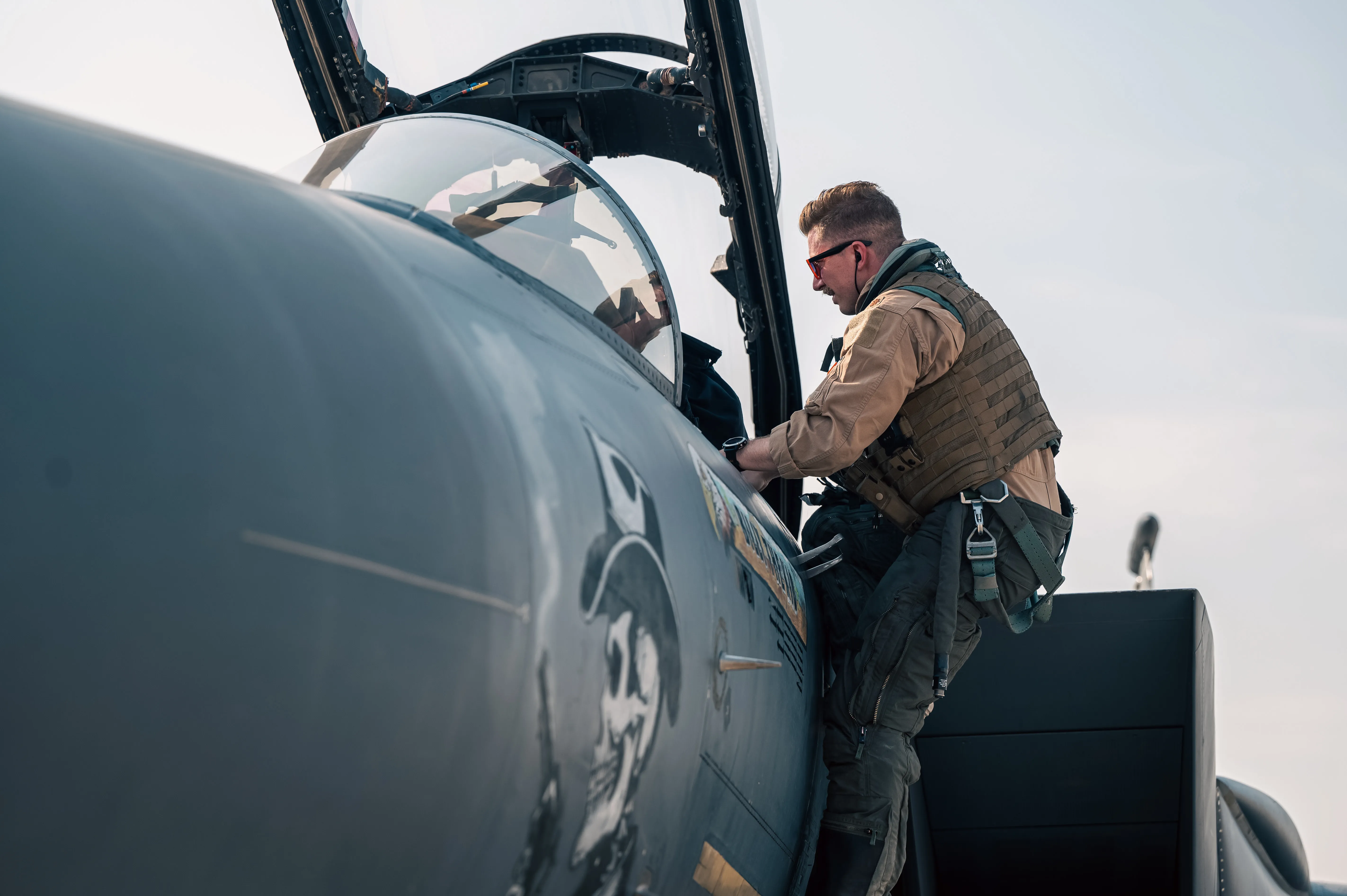
In a library photo, a pilot assigned to the 391st Expeditionary Fighter Squadron climbs into the cockpit of an F-15E Strike Eagle in the U.S. Central Command area of responsibility. U.S. Air Force photo by Senior Airman Grace Turpin
Again, provided these accounts are correct, we cannot say for sure that the pilot actually saw what they described. After all, this was during an extremely high-stress period, and the pilot also ended up with a concussion. Even the U.S. intelligence officials involved in the debrief reportedly disagreed on how to interpret what the F-15 pilot described, and whether the pilot could recount the incident clearly, according to CNN.
The same report also repeats the assertion that the pilot had previously been shot down in the same conflict, during a friendly-fire incident that left three Strike Eagles downed over Kuwait in March. The High Side, a publication on Substack, first reported this detail, citing unnamed current and former Air Force officials. CBS News also subsequently reported this, citing anonymous individuals familiar with the events.
As for the F-15E incident over Iran, you can read our analysis of what was previously revealed about what happened here.
While the exact cause of the loss of the F-15E hasn’t been revealed, NBC News previously quoted three unidentified officials who said the jet “was probably struck by a Chinese-made shoulder-launched missile” and that the engagement may have been supported by a “long-range early-warning radar that spots stealth aircraft,” which Iran received in the “early days” of the war. U.S. President Donald Trump also reportedly said that the Iranians used a shoulder-fired missile, and that “they got lucky.”
Furthermore, while the pilot was rescued within hours, the WSO hid out in a crevice as both rescuers and Iranians frantically searched for him. They were picked up around 50 hours after ejection, aided by a rescue mission involving hundreds of troops, scores of aircraft, and diversion operations over more than a half dozen different parts of Iran. The effort also saw the loss of a second aircraft, an A-10 attack jet in the air, as well as two MC-130J Commando II special operations cargo planes and several H-6 Little Bird special operations helicopters that were destroyed on the ground.
The wreckage of an MC-130J Commando II and an H-6 Little Bird after it reportedly got stuck during the operation to rescue the downed F-15E WSO and later was blown up by U.S. forces so it would not fall into Iranian hands. Iranian state media
The most dramatic interpretation, that a drone swarm directly participated, even if by happenstance, in the shootdown of the Strike Eagle, cannot be entirely ruled out, but there is no publicly available evidence supporting it. There is the description of this formation being a “minefield,” as in something the F-15 could stumble into. This is an interesting note and it may just be how it was mentioned figuratively. At the same time, putting up some sort of a drone screen formation along a known route, especially if it is being used for low-level transits, or near a high-risk facility, could make some sense. Basically, the aircraft would fly into it and be destroyed if it hits a drone, the drones are detonated in close proximity to the aircraft or even if they are connected physically somehow and the aircraft hits the cables. This would match with the description, to a degree, and it would not require any sort of real swarming capability. This would be something of a new ‘barrage balloon’ concept that is more flexible and easier to deploy on demand. China is using balloons in a similar manner to protect key installations today. In addition, Iran certainly has employed its fair share of bizarre tactics and weapons concepts to that point that this doesn’t seem that implausible, but still, it is just a guess.
Returning to the new report, if the pilot really did see a ‘jellyfish-like’ group of Iranian drones that were truly swarming, that would point to previously unknown capabilities within that country, but this is technology that is certainly within the realm of credibility.
Swarms, in this context, are groups of vehicles or guided munitions that are interconnected via datalink and work cooperatively to maximize their combined abilities to accomplish an objective or set of objectives. It is important to note that a major role is played by the nature of a swarm’s computing and autonomy capabilities, and the supporting communications architecture. Swarms can range from ones offering basic cooperative capabilities to far more advanced and dynamic, advanced AI-driven ones. Swarms are not to be confused with a group of drones that are simply sent on a mission together, but have no true cooperative capabilities. These can be best viewed, at least in the aerial sense, as formations of drones or ‘flocks’ of drones that are basically preprogrammed, with tactical planning and large numbers providing an advantage, not the ability to react to external stimuli and make decisions as a team in real-time.
Regardless, based on two of its sources, CNN asserts that “initial reports indicated that it was possible the drone formation had in some way enabled Iran to shoot down the American jet.”
This would raise questions about what type of performance and configuration these drones had, including what altitude the drones were at when they were supposedly sighted, as well as the flight level of the Strike Eagle.
Previously, U.S. officials disclosed that Iran had made use of smaller drones in the hunt for the missing F-15E WSO, but there was no mention of any kind of drone swarms.
An F-15E Strike Eagle pilot and weapon systems officer assigned to the 335th Expeditionary Fighter Squadron prepare to receive fuel from a KC-135 over the CENTCOM area of responsibility. U.S. Air Force photo
For China and Russia, to name just two nations, both of which have provided military assistance to Iran, drone swarming is very much an area of focus. Swarms have many uses, not just to overwhelm the enemy, but also to sense broad areas cooperatively and to work as a highly efficient group offering mixed capabilities that equate to a sum greater than their parts.
The potential of this kind of warfare has not been lost on the U.S. military either, which has been working on it for decades. These efforts date back many years, with the public disclosure of the Perdix having come nearly a decade ago now, and cooperative swarming trials have been carried out repeatedly in the open since then. These efforts have since become ‘mainstream’ as the drone revolution has taken hold of the defense industry. Some of these technologies are now being operationalized in a publicized manner. All this is on top of what is likely an extreme level of development in the classified realm.
Only last month, TWZreported on how the Defense Advanced Research Projects Agency (DARPA) was looking into drones with a high degree of autonomous operation, as well as remotely-operated containerized systems to launch, recover, and otherwise support them. The end result would be a largely self-sustaining “autonomous constellation” capable of supporting networked swarms consisting of as many as 500 drones at once.
❗️Footage of testing by the Swiss-American company “Auterion” on the application of a swarm of FPV drones for striking armored vehicles pic.twitter.com/HgI3Fz4A7O
At this point, it is worth noting that Iran has already demonstrated “loitering” surface-to-air missiles, an unusual category of weapon that blurs the distinction between a kamikaze drone and a more traditional surface-to-air missile. As far as we know, Iran has not attempted to use these weapons in swarms, although having them operate in larger groups would clearly boost the probability of success.
Russia’s Defense Minister Sergei Shoigu, in the front row, second from the right, is shown a 358 “loitering” surface-to-air missile at an Islamic Revolutionary Guard Corps (IRGC) exhibition in Iran. Russian Ministry of Defense
There is also the possibility that what the F-15E pilot saw was some kind of previously unknown drone technology fielded by the U.S. or Israeli military, before the Strike Eagle came down. Clearly, Israel and the United States deployed certain systems in the conflict that had not been seen before, and both countries have the ability to field platforms with swarming capabilities. Releasing a group of drones that can hunt and even kill over the Iranian countryside, looking for targets of opportunity over large areas, like air defenses and standoff weapons launchers, is exactly the kind of concept that swarms were envisioned as being so capable at realizing.
Subsequently, while the rescue effort was underway, the U.S. military certainly was making use of drones in the vicinity. Air Force Gen. Dan Caine, chairman of the Joint Chiefs of Staff, previously described how “A-10s and […] drones and other tactical aircraft were violently suppressing and engaging the enemy in a close-in gunfight to keep them away from the front-seater and allow the pickup force to get into the objective area.”
The use of drones for suppression and destruction of enemy air defenses, as well as stand-in jamming of those systems, is a very real component of modern air warfare dating back decades. Israel was a pioneer in it, which you can read all about here. Those capabilities are far more advanced today, especially for long-range systems dedicated to those missions and for the emerging ‘launched effects’ segment of drone warfare. It’s hard to imagine that these proven capabilities were not put to some use over Iran during the war. The U.S. military even employed its own one-way attack munition, the LUCAS drone, with similar capabilities.
LUCAS drone launching off a ship in the Middle East. (CENTCOM)
With all that being said, there is the possibility that the pilot experienced something else entirely, perhaps related to their concussion or another kind of phenomenon. Even a flock of birds or a group of balloons, the latter of which can be used as decoys to confuse enemy radar and bait fighter aircraft and other air defenses, could appear as a drone swarm, for example. Iran had every reason to use such cheap, but potentially effective tactics. While an experienced fighter pilot would normally be able to tell the difference between drones or birds, these were very much abnormal circumstances. Then there is the matter of Unidentified Aerial Phenomena (UAP), which this could fall into, just for the reason that what was seen may be hard to identify. We don’t know what the description of the configurations of the drones was, or if any was provided, which could help narrow down the possibilities. Also, did the aircraft’s sensors detect these craft? We just don’t know.
A U.S. Air Force F-15E Strike Eagle performs a flare check over the U.S. Central Command area of responsibility. U.S. Air Force photo by Senior Airman Zachary Willis
For now, the reported drone sighting remains an intriguing but unverified element of a much larger story, many important details of which are still to emerge.
From Broderick Turner: In the first round of Tuesday night’s NBA draft, the Lakers made a trade with the New York Knicks, acquiring Cameron Carr, who the Knicks had selected with the 24th overall pick.
The Lakers then took guard Sergio De Larrea from Spain with the 25th pick and traded him to the NBA champion Knicks, along with cash considerations. The Lakers went to Spain recently to watch De Larrea work out.
Lakers president of basketball operations Rob Pelinka didn’t talk about the trade because the NBA had not made it official as of late Tuesday night. Carr was in New York at the draft, but he also didn’t speak with the media.
In need of athletic wing players on a team that could have up to nine free agents, the Lakers got one with 21-year-old Carr.
The 6-foot-5 Carr averaged 18.9 points per game at Baylor, 5.8 rebounds and 2.6 assists. Carr shot 49.4% from the field and 37.4% from three-point range.
Get the latest on L.A.’s teams in the daily Sports Report newsletter.
By continuing, you agree to our Terms of Service, which include arbitration and a class action waiver. You agree that we and our third-party vendors may collect and use your information, including through cookies, pixels and similar technologies, for the purposes set forth in our Privacy Policy such as personalizing your experience and ads.
The Clippers picked Wagner fifth overall in the NBA draft Tuesday at Barclays Center, using the franchise’s highest draft pick since 2009 on the former Illinois guard. During a hectic draft process in which some top players don’t speak to the team that ultimately picks them, Wagler said the Clippers showed consistent interest and communicated with him and his agent, giving him confidence he could hear his name called early during Tuesday’s loaded first round.
“I’m just super excited to get out there,” Wagler said. “They have a great front office and coaching staff and players, and I just can’t wait to get out there and get going.”
The 6-foot-6 guard was named Big Ten freshman of the year after averaging 17.9 points, 5.1 rebounds and 4.2 assists per game. Under-recruited out of high school, the Kansas native held college offers from schools including Oral Roberts, DePaul and Murray State before starring at Illinois.
When NBA Commissioner Adam Silver read Wagler’s name aloud, he hugged everyone at his table, walked between two smoke towers and grabbed a Clippers hat with a bedazzled team logo before shaking Silver’s hand.
From Maddie Lee: Chuckie Robinson hadn’t recorded a hit yet as a Dodger. As the third-string catcher, joining the major league squad midseason, his main focus had to be the defensive side. Anything on offense was a bonus.
Because of a rash of injuries, he was the only Dodgers catcher available Tuesday. And in the fourth inning, Robinson stepped up to the plate and lined a single into shallow left field, moving Alex Call to third, and setting up Shohei Ohtani for a sacrifice fly.
That’s how the Dodgers routed the Twins 12-3 on Tuesday, with contributions from up and down the lineup. And that’s how the Dodgers (51-29) have claimed the best record in the majors, despite injuries to key players.
“The depth,” first baseman Freddie Freeman said when asked what that record reflected. “We’ve got really good depth, we’ve got really good players, guys that care. Doesn’t matter what’s happening; we’ve got a lot of guys injured right now, and you’ve got guys stepping up, making big plays, big at-bats.”
Freeman himself went three for five with a pair of doubles and two RBIs on Tuesday. But Robinson, with starting catcher Will Smith still on the injured list with a neck injury and backup catcher Dalton Rushing temporarily unavailable after a concussion scare Monday, also had two hits and brought in a run with a sacrifice bunt.
Rookie right-hander Ryan Johnson gave up one hit over six scoreless innings, Nolan Schanuel hit an early two-run home run and the Angels beat the Baltimore Orioles 5-1 on Tuesday night.
In his third career start, Johnson (1-2) carried a no-hitter into the sixth inning before Jeremiah Jackson hit a line drive single to center with one out. Johnson allowed one walk with career highs of eight strikeouts and six innings, while throwing 90 pitches.
A second-round draft pick by the Angels in 2024, Johnson earned his second career win against a Baltimore offense which combined to score 18 runs over its previous two games.
World Cup: Matt Freese took different path to become U.S. goalie
United States goalkeeper Matt Freese.
(Kelvin Kuo / Los Angeles Times)
From Kevin Baxter: Playing in goal for the U.S. men’s national soccer team is a little like playing right field for the Yankees. You’re following a long line of great players, making the comparisons — and the high expectations — unavoidable.
Matt Freese is the latest to be thrown into that crucible. But he considers that pressure to be a privilege, not a problem.
“I wouldn’t say it’s intimidating, I would say it’s inspiring,” he said before the U.S. training session Tuesday morning in Irvine. “It’s a long line of goalkeepers that I’ve looked up to for my whole life — and there were some before my life as well.”
Two games into this summer’s World Cup he’s certainly held his own with that group, giving up just one goal for a team that’s unbeaten and already through to the next round. However Thursday’s group-stage finale with winless Turkey will be far from meaningless for Freese since his first start for the U.S. came against Turkey 55 weeks ago, bringing his whirlwind international team career full circle.
Group K Portugal 5, Uzbekistan 0 Colombia 1, Congo DR 0
Group L England 0, Ghana 0 Croatia 1, Panama 0
Today’s World Cup TV schedule
All times Pacific Noon, Bosnia-Herzegovina vs. Qatar, FS1, Telemundo Noon, Switzerland vs. Canada, Fox, Telemundo 3 p.m. Morocco vs. Haiti, FS1, Universo 3 p.m., Scotland vs. Brazil, Fox, Telemundo 6 p.m., Czechia vs. Mexico, Fox, Telemundo 6 p.m., South Africa vs. South Korea, FS1, Universo
World Cup Group standings
Group A Country, W-D-L, Goal Differential, Points x-Mexico, 2-0-0, +3, 6 South Korea, 1-0-1, 0, 3 Czechia, 0-1-1, -1, 1 South Africa, 0-1-1, -2, 1
Group B Canada, 1-1-0, +6, 4 Switzerland, 1-1-0, +3, 4 Bosnia-Herzegovina, 0-1-1, -3, 1 Qatar, 0-1-1, -6, 1
Group C Brazil, 1-1-0, +3, 4 Morocco, 1-1-0, +1, 4 Scotland, 1-0-1, 0, 3 Haiti, 0-0-2, -4, 0
Group D x-United States, 2-0-0, +5, 6 Australia, 1-0-1, 0, 3 Paraguay, 1-0-1, -2, 3 Turkiye, 0-0-2, -3, 0
Group E x-Germany, 2-0-0, +7, 6 Ivory Coast, 1-0-1, 0, 3 Ecuador, 0-1-1, -1, 1 Curacao, 0-1-1, -6, 1
Group F Netherlands, 1-1-0, +4, 4 Japan, 1-1-0, +4, 4 Sweden, 1-0-1, 0, 3 Tunisia, 0-0-2, -8, 0
Group G Egypt, 1-1-0, +2, 4 Iran, 0-2-0, 0, 2 Belgium, 0-2-0, 0, 2 New Zealand, 0-1-1, -2, 1
Group H Spain, 1-1-0, +4, 4 Uruguay, 0-2-0, 0, 2 Cape Verde, 0-2-0, 0, 2 Saudi Arabia, 0-1-1, -4, 1
Group I x-France, 2-0-0, +5, 6 x-Norway, 2-0-0, +4, 6 Senegal, 0-0-2, -3, 0 Iraq, 0-0-2, -6, 0
Group K x-Colombia, 2-0-0, +3, 6 Portugal, 1-1-0, +5, 4 Congo DR, 0-1-1, -1, 1 Uzbekistan, 0-0-2, -7, 0
Group L England, 1-0-1, +2, 4 Ghana, 1-0-1, +1, 4 Croatia, 1-0-1, -1, 3 Panama, 0-0-2, -2, 0
x-clinched round of 32
The top two teams in each group plus the next eight best third-place teams advance to the next round.
Note: The U.S. is locked into a July 1 knockout stage game against the third-place team from either Group B, E, F, I or J at Levi’s Stadium in Santa Clara.
This day in sports history
1910 — James Braid wins his fifth British Open with a four-stroke victory over Sandy Herd.
1911 — John McDermott becomes the first American-born winner of the U.S. Open when he beats Michael Brady and George Simpson in a playoff. McDermott finishes two strokes better than Brady and five strokes better than Simpson.
1913 — John Henry Taylor wins his fifth and final British Open Championship at Royal Liverpool Golf Club at Hoylake, England.
1922 — American Professional Football Assn. is renamed the National Football League.
1922 — Charter NFL club Chicago Staleys renamed Chicago Bears by team founder, owner and head coach George Halas.
1928 — John Farrell beats Bobby Jones by one stroke in a 36-hole playoff to win the U.S. Open.
1947 — Jim Ferrier wins the PGA championship by defeating Chick Harbert 2 and 1 in the final round.
1958 — Brazil, led by 17-year-old Pele, beats France 5-2 in a semifinal of the World Cup. With Brazil up 2-1 in the second half, Pele scores three consecutive goals.
1968 — Joe Frazier stops Mexican challenger Manuel Ramos in 2nd round TKO at NYC’s Madison Square Garden in his first heavyweight boxing title defense.
1968 — Canada’s Sandra Post beats Kathy Whitworth by seven strokes in a playoff to become the first non-U.S. player and rookie to win the LPGA championship.
1980 — The Atlanta Flames relocate to Calgary, Alberta. The NHL team keeps the name “Flames.”
1990 — Criminal Type becomes the first horse to win consecutive $1 million races after capturing the Hollywood Gold Cup. He had previously won the $1 million Pimlico Special on May 12.
1991 — The NHL’s Board of Governors adopts instant replay.
1992 — NBA Draft: LSU center Shaquille O’Neal first pick by Orlando Magic.
1995 — Stanley Cup Final, Meadowlands Arena, East Rutherford, NJ: New Jersey Devils beat Detroit Red Wings, 5-2 for a 4-0 series sweep; Devils’ first Stanley Cup finals appearance.
1998 — NBA Draft: Pacific center Michael Olowokandi first pick by Los Angeles Clippers.
2000 — Rick DiPietro is the first goalie drafted No. 1 when the New York Islanders select the 18-year-old star from Boston University at the NHL Draft.
2001 — Karrie Webb, 26, captures the LPGA Championship by two strokes to become the youngest woman to complete the Grand Slam.
2004 — NBA Draft: Southwest Atlanta Christian Academy power forward Dwight Howard first pick by Orlando Magic.
2010 — John Isner outlasts Nicolas Mahut in the longest match in tennis history. Isner hits a backhand winner to win the last of the match’s 980 points, and takes the fifth set against Mahut 70-68. The first-round match took 11 hours, 5 minutes over three days, lasting so long it was suspended because of darkness — two nights in a row. Play resumed at 59-all and continued for more than an hour before Isner won 6-4, 3-6, 6-7 (7), 7-6 (3), 70-68.
2010 — John Wall is selected as the No. 1 pick in the NBA draft by the Washington Wizards, and a record number of Kentucky teammates follow him. Four more Wildcats are among the top 30 selections, making them the first school ever to put five players in the first round.
2011 — NHL Draft: Red Deer Rebels (WHL) center Ryan Nugent-Hopkins first pick by Edmonton Oilers.
2013 — Bryan Bickell and Dave Bolland score 17 seconds apart in the final 1:16 of the third period and the Chicago Blackhawks win the Stanley Cup with a stunning 3-2 comeback victory in Game 6 over the Boston Bruins.
2016 — NHL Draft: ZSC Lions (NLA) center Auston Matthews first pick by Toronto Maple Leafs.
2018 — Harry Kane scores a hat trick to propel England to its most emphatic World Cup victory and into the knockout stage. With John Stones heading in twice and Jesse Lingard curling in a shot, England beats Panama 6-1 and scores its most goals ever in a World Cup game.
2022 — American Katie Ledecky wins the 800m gold medal in 8:08.04 at the World Swimming Championships in Budapest; completes 400/800/1500m treble for unprecedented 4th time at a single worlds.
2024 — The Florida Panthers win their first title in franchise history defeating the Edmonton Oilers 2-1 in Game 7. MVP: Connor McDavid (Oilers C).
Compiled by the Associated Press
This day in baseball history
1936 — Rookie Joe DiMaggio hit two homers in the fifth inning and added two doubles in the New York Yankees’ 18-4 victory over the St. Louis Browns.
1950 — Wes Westrum of the New York Giants hit three home runs and a triple in a 12-2 victory over the Cincinnati Reds.
1955 — Harmon Killebrew hit his first major league homer, off Billy Hoeft at Griffith Stadium, but the Detroit Tigers beat the Washington Senators 18-7.
1962 — Jack Reed, a substitute outfielder, hit a homer off Phil Regan in the 22nd inning to give the New York Yankees a 9-7 win over the Detroit Tigers in a game that lasted 7 hours, 22 minutes. It was the only homer Reed hit in the majors.
1968 — Jim Northrup tied a major league record by hitting two grand slams in one game as the Detroit Tigers beat the Cleveland Indians 14-3.
1983 — Don Sutton of the Milwaukee Brewers became the eighth pitcher in major league history to strike out 3,000 batters. Sutton’s 3,000th victim was Cleveland’s Alan Bannister in a 3-2 win over the Indians.
1984 — Oakland’s Joe Morgan hit his 265th home run as a second baseman, breaking Roger Hornsby’s career home run record for that position. Morgan’s homer off Frank Tanana was the 267th of his career and led the A’s to a 4-2 win over Texas.
1993 — Carlton Fisk of the White Sox, plays his 2,226th and final major league game, surpassing Bob Boone’s record of 2,225 for most games caught.
1993 — The Marlins obtain OF Gary Sheffield and P Rich Rodriguez from the Padres for P Trevor Hoffman, Andres Berumen and Jose Martinez.
1994 — Jeff Bagwell hit three homers, two in one inning to tie a major league record, as the Houston Astros beat the Dodgers 16-4.
1997 — Randy Johnson of the Seattle Mariners struck out 19 batters — one short of Roger Clemens’ major league record for a nine-inning game. He became the first AL left-hander to fan 19, but the Oakland Athletics won 4-1.
2002 — Both starters in the first game of the Angels-Texas doubleheader — Joaquin Benoit and Aaron Sele — threw 96 pitches, 53 strikes and 43 balls. Benoit and the Rangers won 8-5.
2003 — Brad Wilkerson hit for the cycle, going 4-for-4 with four RBIs, in Montreal’s 6-4 win over Pittsburgh. It was the first cycle in the majors this season and was performed in sequence — single, double, triple and homer.
2014 — Brothers B.J. and Justin Upton tied the major league record for brothers homering in the same game as teammates, accomplishing the feat for the fourth time, in Atlanta’s 3-2 win over Houston. Other brothers who had homered in the same game four times were Jeremy and Jason Giambi for the Oakland A’s and Vladimir and Wilton Guerrero for the Montreal Expos.
2015 — Pavin Smith homered and drove in three runs and Brandon Waddell turned in another strong College World Series pitching performance, leading Virginia over Vanderbilt 4-2 for the school’s first baseball national championship.
2017 — Three Oakland A’s players, Matt Olson, Jaycob Brugmand and Franklin Baretto, hit their first career home run in a 10-2 win over the White Sox.
2019 — The Yankees tie a record belonging to the 2002 Rangers by homering in their 27th straight game on their way to defeating the Blue Jays.
2018 — The Dodgers set a National League record with seven solo home runs in an 8-7 win over the Mets.
2021 — The Chicago Cubs throw the first combined no-hitter in franchise history beating the Dodgers 4-0. It was the seventh no-hitter of the season.
Compiled by the Associated Press
Until next time…
That concludes today’s newsletter. If you have any feedback, ideas for improvement or things you’d like to see, email me at houston.mitchell@latimes.com. To get this newsletter in your inbox, click here.
Paris and other European cities are experiencing temperatures above 40C (104F), reaching levels normally seen across the Middle East.
A blistering heatwave has gripped much of Europe, prompting the highest-level red alerts in parts of the United Kingdom, France, Spain and Italy.
Authorities have warned of health risks, wildfires and travel disruptions as extreme temperatures persist.
Recommended Stories
list of 3 itemsend of list
With temperatures approaching record highs, officials have taken emergency measures, including a localised alcohol ban in parts of France under red alert, nationwide heat warnings in Germany and the cancellation of a World Cup fan zone screening in Madrid, where temperatures hit 39C (102F).
Why is it so hot in Europe?
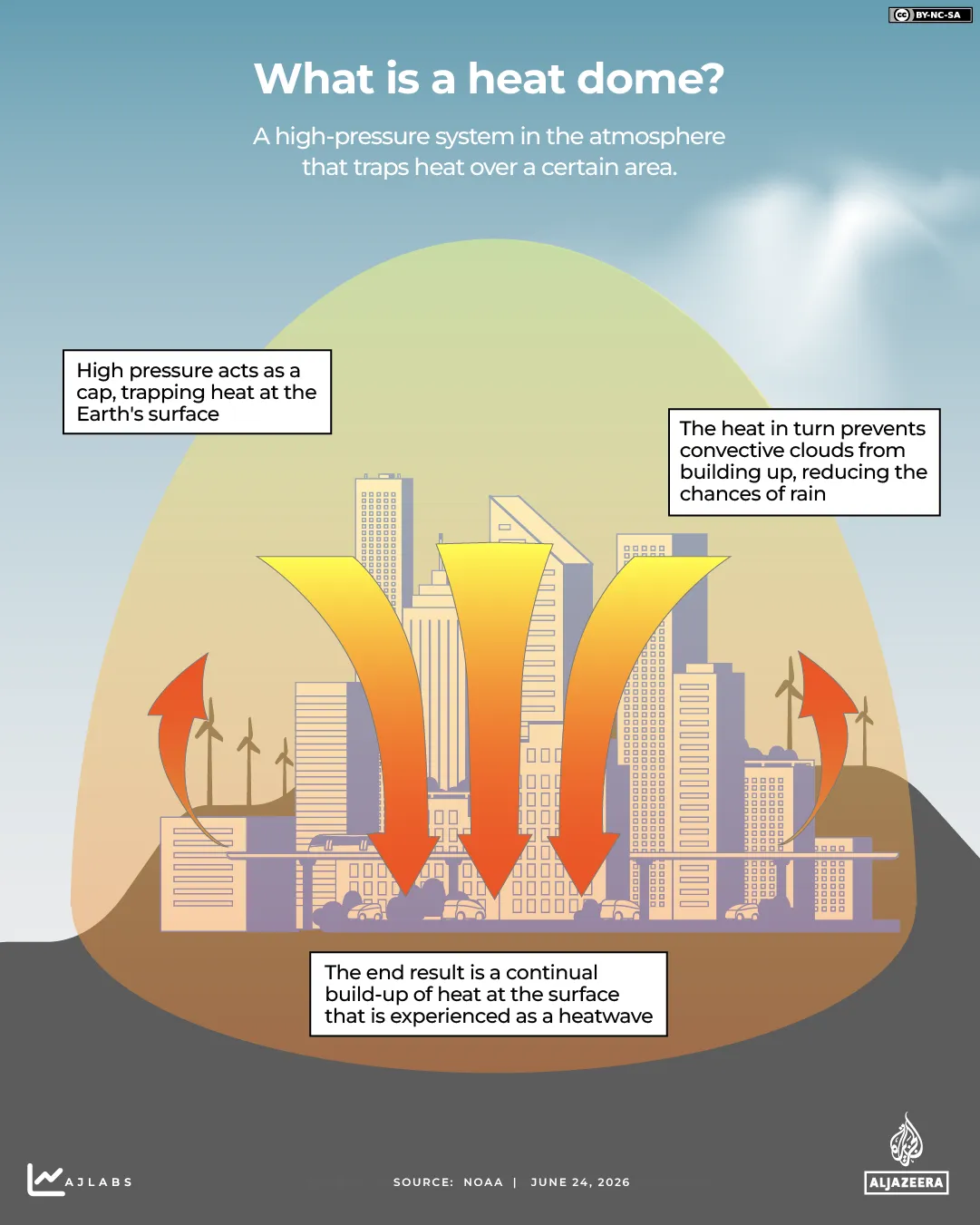
A persistent area of high pressure, known as a heat dome, has trapped hot air over Western Europe, bringing clear skies, weak winds and prolonged sunshine. Hot air moving north from North Africa has added to the extreme temperatures.
(Al Jazeera)
Unusually warm seas around the UK, Ireland, France and the western Mediterranean have also helped keep coastal areas hot, especially at night. Coastal waters around Spain have reached record warm levels, according to Spain’s port authority.
In the worst-affected areas – western France, England and Wales – daily average temperatures have soared more than 12C above the 1991-2020 baseline, according to Copernicus data.
(Al Jazeera)
Scientists say the early-season heatwave is part of a broader warming trend. Europe is the world’s fastest-warming continent, with temperatures rising by approximately 0.56C per decade since the mid-1990s, more than double the global average.
Climate change is making heatwaves more frequent, more intense and likely to occur earlier and later in the year.
How hot are European cities today?
To contextualise the temperatures Europe is dealing with, Al Jazeera looked at the maximum temperatures in five European capitals on June 24 and compared them with cities across the Middle East, North Africa and Asia, where high temperatures are more typically experienced.
Europe is particularly vulnerable – much of its housing and infrastructure was not built for prolonged extreme heat, and only about 20 percent of European homes have air conditioning.
The graphic below shows how European cities’ maximum temperatures today compare with some other cities around the world:
(Al Jazeera)
How is temperature measured?
The temperature you see on the news or the weather app on your phone relies on a network of weather stations positioned around the globe.
To ensure accurate readings, weather stations typically use specialist platinum resistance thermometers placed inside shaded instruments known as a Stevenson screen.
Measurements are taken at a standard height of 1.25-2 metres (4-6.5 feet) above the ground. This provides a reading that reflects the air temperature that people actually feel.
(Al Jazeera)
There are two well-known scales used to measure temperature: Celsius and Fahrenheit.
Only a few countries, including the United States, use Fahrenheit as their official scale. Most of the world uses the Celsius scale, named after Swedish astronomer Anders Celsius, who invented the 0-100 degree freezing and boiling point scale, although originally inverted, in 1742.
Why does the temperature feel hotter than the forecast says?
Air temperature alone often doesn’t match how hot it feels to your body. That is why forecasts report a “feels like” temperature, which adjusts air temperature based on factors like humidity, wind speed and sun exposure.
(Al Jazeera)
Humidity
Humidity measures how much water vapour is in the air. This moisture slows the evaporation of sweat, so your body can’t cool itself as effectively.
Wind speed
In hot weather, a light breeze can help evaporate sweat, making it feel cooler.
Sun exposure
Even if the thermometer reads the same, direct sunlight adds extra warmth, which is why shaded areas feel cooler.