Tax the rich? California voters are divided, according to new poll
The slate of statewide measures on the Nov. 3 ballot provides voters two opportunities to tax the rich, which in past years has proved tantalizing to California’s left-leaning electorate.
Only one of those measures has strong voter support, however, and it’s not the proposition that’s attracted nationwide attention, ignited a nearly quarter-billion-dollar political slugfest and created a rift among top leaders in the Democratic Party.
Likely voters expressed middling support for Proposition 40, a one-time 5% tax on billionaires’ assets intended to compensate for an impending $100 billion in federal healthcare funding cuts. They were far more likely to back Proposition 3, a ballot measure that would make permanent a tax increase on the wealthy that funds schools and healthcare, according to a poll released Friday by UC Berkeley’s Institute of Governmental Studies that is co-sponsored by The Times.
Proposition 3 appears to be a much less controversial endeavor, which may explain why it has more voter support. The ballot measure would extend a tax enacted in 2012 on individuals who earn at least $360,000 a year that is set to expire in 2031. Proposition 40 proposes a brand-new tax on billionaires and is opposed by Gov. Gavin Newsom, who fears that it could hurt the state’s finances in the long run.
“When you’re going about taxing the billionaires’ assets, I mean that’s something kind of new and different, and it’s risky, and the governor’s against it, and you know a lot of people are expressing caution about it,” said Mark DiCamillo, director of the poll.
Voters are deeply concerned about income disparity but also skeptical about the unusual approach of the billionaire tax.
Proposition 40 has drawn the greatest attention and campaign spending of the 14 ballot measures voters will decide on Nov. 3.
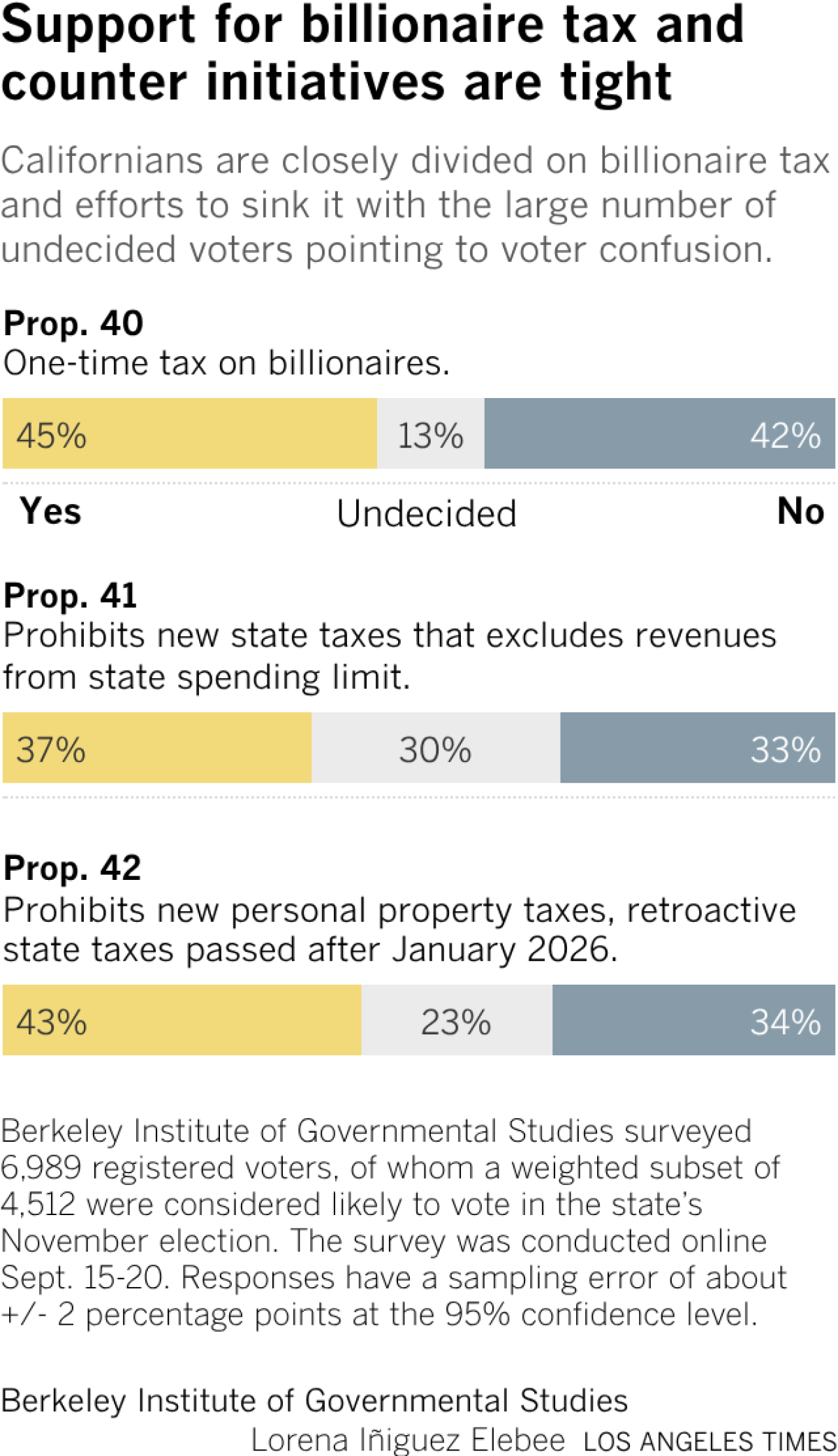
In the poll, 45% of likely voters support the proposal, while 42% oppose it and 13% are undecided. That’s a decline in support compared with six weeks ago, when 48% of likely voters supported it while 41% opposed it, and comes after nearly $100 million of spending on television ads, social media messages and mailers, largely from opponents.

The billionaire tax was crafted by a healthcare union in response to legislation passed by congressional Republicans and signed by President Trump last year that could result in millions of Californians losing Medi-Cal coverage, rural hospitals shuttering and other healthcare services being slashed unless a new funding source is found.
The proposal would retroactively apply to billionaires who lived in California as of Jan. 1, prompting some to preemptively move out of the state. Ninety percent of the revenue would fund healthcare programs, and the remaining funds would be spent on education programs and food assistance.
There are two counterproposals on the ballot that would nullify the wealth tax if either receives more votes than Proposition 40, and they have raised $144 million. Voters are torn about Proposition 41, which would prohibit any new state taxes from being excluded from a voter-approved cap that restricts how much tax revenue the state can spend each year. The billionaire tax would have such an exclusion. Voters also are divided on Proposition 42, which would prohibit new taxes on personal property, intellectual property, retirement accounts and other assets and would limit situations in which a ballot measure or state lawmakers can impose or raise taxes retroactively — both of which are essential parts of the billionaire tax initiative.
Proposition 42 has greater support, with 43% backing it, 34% opposing it and the remainder undecided, according to the poll. Even more voters were uncertain about Proposition 41: 3 in 10 said they were undecided, while 37% said they supported it and 33% said they planned to vote against it.
The large number of undecided voters this close to the election points to voters being overwhelmed by the sheer number of statewide ballot measures, DiCamillo said.
“It’s confusion,” he said, adding that many voters may make a decision once they receive more ballot information.
That said, the fact that none of these proposals has the support of more than 50% of likely voters doesn’t bode well for their prospects, DiCamillo said.
Ballots will begin arriving in the mailboxes of the state’s 23.2 million voters in days.
Democratic voters outnumber Republicans by nearly 2 to 1 in California, but the party’s leaders are deeply divided about the billionaire tax, given the volatile state budget’s reliance on the wealthy. Newsom, who is pondering a 2028 presidential campaign, and the two men vying to replace him — Democrat Xavier Becerra and Republican Steve Hilton — oppose it. Rep. Ro Khanna (D-Fremont), a potential 2028 White House contender, supports it, as does the California Democratic Party.
Additionally, Dave Regan, president of Service Employees International Union-United Healthcare Workers West and architect of the ballot measure, has come under scrutiny. Regan has been accused of threatening and intimidating women who worked for the union’s parent organization, and of physically assaulting one, according to reporting by The Times. He was also accused of trying to extort SEIU’s state council, suggesting that it could face an investigation over “governance issues” if it did not support Proposition 40, according to an investigation commissioned by SEIU.
Regan has denied these claims, describing them as a “smear” campaign orchestrated by Proposition 40 opponents.
Much less attention has been paid to Proposition 3. Californians who earn more than $360,000 now are subject to a 10.3% tax, while those who earn more than $721,000 face a 12.3% levy. The vast majority of the billions raised through this tax go to K-12 schools, while the remainder is spent on community colleges and healthcare.

The other ballot measure that is receiving national attention is Proposition 39, which would require voters to present a government-issued identification document to cast a ballot or provide a PIN or the last four digits of their Social Security number when submitting mail-in ballots.
The measure also would require the California secretary of state and county election officials to verify that registered voters are U.S. citizens by “using government data,” which according to supporters could include information in the federal Social Security Administration database, jury summons information and other government records.

The proposal comes as Trump has continued to make claims that elections, notably in California, are being rigged by Democrats. Americans are increasingly alarmed about the security and sanctity of voting, and growing fears about intimidation efforts at polling places in the midterm elections.
Fifty-two percent of likely California voters oppose the voter ID proposal, while 39% support it and 9% are undecided, according to the poll.
“It doesn’t look like it’s in a strong position,” DiCamillo said, noting that while voters have opposed it in prior polls, the opposition has grown.
Nearly one-third of voters were undecided about two other propositions:
- Likely voters were evenly split about Proposition 4, which would repeal a ban on public funding of campaigns, with 35% supporting it and 35% opposing it, and the remainder undecided.
- Four out of 10 likely voters opposed Proposition 43, which would increase the threshold necessary to pass local taxes from a simple majority to two-thirds, while 31% supported measure and 29% were undecided.
Voters will also face questions about environmental policy, housing, recall elections and other matters, as well as statewide, congressional and local elections. Californians are fatigued by the length of the ballot.
The Berkeley IGS/Times poll findings are based on an online survey in English and Spanish of 6,989 registered California voters, 4,512 of whom are considered likely voters, on Sept. 15-20. The results are estimated to have a margin of error of about 2 percentage points in either direction in the overall sample, and larger numbers for subgroups.