new district

Missouri’s U.S. House map goes to court; 2 other states weigh new maps

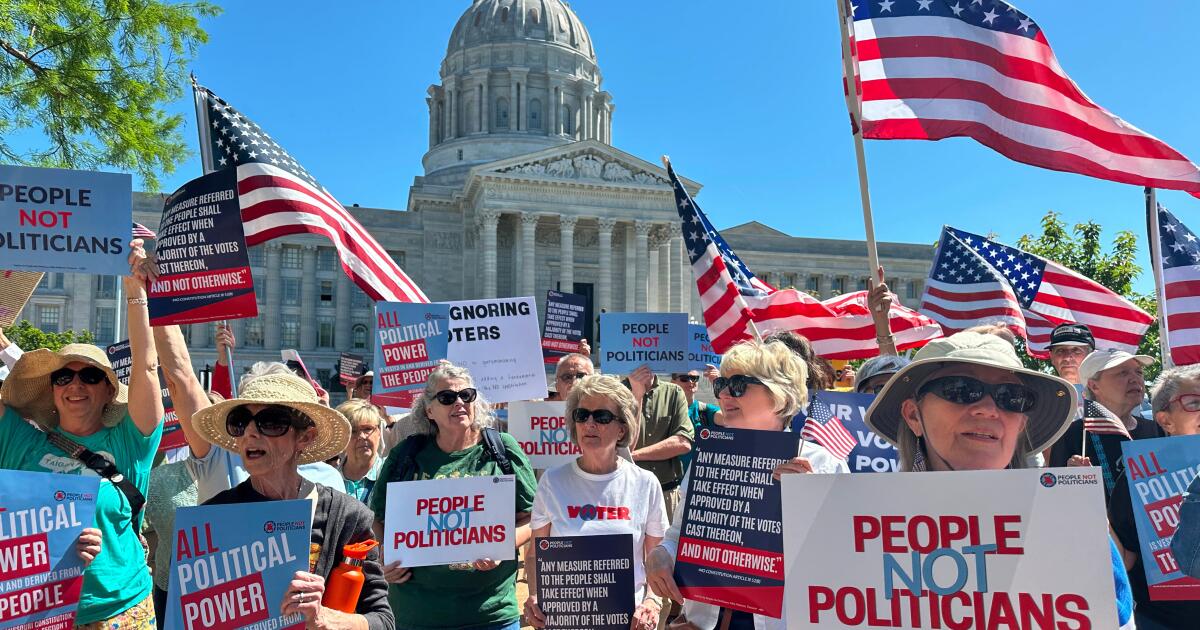
President Trump’s push to redraw the nation’s U.S. House districts received mixed results Tuesday as South Carolina senators defied his desires, but Missouri’s top court upheld a new map that could help Republicans win an additional seat in the November midterm elections.

Rather than waning, a national redistricting battle that began 10 months ago has intensified — inflamed by a recent U.S. Supreme Court ruling that weakened the federal Voting Rights Act and provided grounds for states to try to eliminate voting districts with large minority populations.

Republican lawmakers in Louisiana are wrestling with how politically aggressive to be when redrawing House districts after the U.S. Supreme Court invalidated a majority-Black district as an illegal racial gerrymander.

The ripples of the Louisiana ruling already have led to new U.S. House districts in Tennessee and have extended to Alabama, where Republican Gov. Kay Ivey announced an Aug. 11 special primary for four of the state’s seven congressional districts. That came after the U.S. Supreme Court on Monday overturned an order mandating use of a map with two largely Black districts. The state plans to switch to a map passed in 2023 that has only one majority-Black district.

Republicans think they could gain as many as 14 seats from new House maps enacted so far in Texas, Missouri, North Carolina, Ohio, Florida and Tennessee. Democrats, meanwhile, think they could gain six seats from new maps in California and Utah. The Virginia Supreme Court last week struck down a redistricting effort that could have yielded four more winnable seats for Democrats.

Missouri map splits Kansas City district

Missouri was the second Republican state, after Texas, to redraw its congressional districts at Trump’s urging last year. Since then, numerous other states have joined the redistricting battle.

During arguments earlier Tuesday, attorneys for voters challenging Missouri’s new map focused on changes to a Kansas City-based district long represented by Democratic U.S. Rep. Emanuel Cleaver, who previously was the city’s mayor, the first Black person to hold the post.

The new map takes a compact urban district that covered 20 miles and two counties and stretches it 200 miles over 15 counties, distorting it “into a sprawling behemoth that cuts clear across the state to unite territories that share nothing in common,” said Abha Khanna, an attorney who has represented Democrats in voting and redistricting cases across the country.

A lower court ruled in March that the map as a whole satisfied the compactness requirement, even though the Kansas City district is less compact. No Missouri court has ever struck down a congressional map for not being compact, said attorney John Gore, who defended the districts on behalf of the Republican Party.

A second case heard by the high court centered on whether the new map took effect in December, as asserted by Republican Atty. Gen. Catherine Hanaway and Republican Secretary of State Denny Hoskins, or whether it should have been suspended when referendum signatures were submitted.

To suspend the map before validating the signatures would let activists temporarily undercut laws by submitting boxes of fraudulent signatures, Missouri Solicitor Gen. Lou Capozzi argued.

But to not immediately suspend the map “would dilute the referendum right, if not destroy it altogether,” said attorney Jonathan Hawley, arguing for voters who sued.

Republican officials contend the new districts can be suspended only after Hoskins determines the petition meets constitutional requirements and has enough valid signatures. Hoskins has until Aug. 4, the day of Missouri’s primary elections, to make that determination. The Supreme Court upheld the decision of a state judge in March who agreed with Republicans’ position.

Louisiana hearing leads to death threats

Louisiana state Sen. Jay Morris, a Republican who drafted redistricting bills that would eliminate one or both of the state’s majority-Black districts, told lawmakers Monday that he received death threats after Friday’s contentious hearing in which he told members of the public to “shut up.”

Morris acknowledged the outburst but denied the Louisiana Democratic Party’s assertion — blasted across social media and in a news release — that he also used the derogatory term “boy” toward its executive director, Dadrius Lanus, who is Black.

State Sen. Gary Carter, one of three Black Democrats serving alongside six white Republicans on the Senate committee overseeing redistricting, told the Associated Press on Tuesday that he had withdrawn from the committee “to help restore the decorum and focus that this moment demands” after shouting at Republicans during Friday’s hearing. Carter publicly apologized Monday to Morris and his Senate colleagues for having “lost my temper” and for any remarks that were taken as “personal attacks.”

Carter is the nephew of U.S. Rep. Troy Carter, a Democrat who represents New Orleans and is at risk of losing his seat in the redistricting process. Gary Carter is being replaced on the committee with state Sen. Royce Duplessis, a Democrat representing New Orleans.

South Carolina weighs political risks of redistricting

The Republican push for South Carolina to join the national redistricting battle by redrawing its U.S. House map fizzled Tuesday as an initial vote in the state Senate fell short.

Trump had urged South Carolina to redraw its congressional districts ahead of the November elections in an attempt to help Republicans win another seat in the closely divided chamber. The state House had voted in favor of letting lawmakers return after the regular session ends this week to consider redistricting, and had proposed a new map that could eliminate the state’s only Democratic-held seat.

But the Senate had to give permission to take up redistricting, too.

The 29-17 vote failed, with just two votes short of the two-thirds needed. Five Republicans joined all the Democrats in the chamber to reject the proposal.

Trump said Monday on social media that he was closely watching the redistricting vote, urging South Carolina senators to “be bold and courageous” and to delay the House primaries so new districts can be drawn.

Although Republicans have a supermajority in the chamber, some GOP senators weren’t sure the proposed map would guarantee the party could unseat longtime Democratic U.S. Rep. James E. Clyburn. They also said it could push enough Democrats into other districts to backfire, resulting in a 5-2 or even a 4-3 Republican split.

Republican Senate Majority Leader Shane Massey acknowledged the pressure from Trump, but said he doesn’t like being asked to bend to someone’s will instead of doing what’s best for his state.

“I got too much Southern in my blood,” Massey said. “I’ve got too much resistance in my heritage.”

Lieb, Collins, Brook and Chandler write for the Associated Press. Brook reported from Baton Rouge, La.; Chandler from Montgomery, Ala.; Collins from Columbia; and Lieb from Jefferson City, Mo.

Source link

Florida Legislature approves new congressional map intended to boost Republicans in midterms

The Florida Legislature approved a new congressional map intended to maximize Republicans’ advantage in the state as part of the national redistricting battle that President Trump launched ahead of this year’s midterms.

The vote came just two days after Gov. Ron DeSantis unveiled his proposal and the same day that the U.S. Supreme Court rolled back a key provision of the Voting Rights Act. The decision could make it harder for Democrats to challenge Republican efforts to redraw congressional districts in ways that limit the influence of nonwhite voters.

DeSantis’ map could increase Republicans’ advantage in Florida’s House delegation to 24 to 4, up from the current split of 20 to 8. The potential four-seat gain is the same as what Virginia Democrats expect from a recent redistricting referendum, which is being challenged in state court there.

Florida’s new districts are certain to face lawsuits as well, especially because the state constitution prohibits redistricting for explicitly partisan purposes. DeSantis and his aides believe those provisions will not be a legal barrier because they have been weakened previously by the Florida Supreme Court and again by Wednesday’s U.S. Supreme Court ruling.

Florida Republicans, comfortable in their supermajority in both legislative chambers, said little about the new districts during the whirlwind special session. The measure’s sponsor, Rep. Jenna Persons-Mulicka (R-Fort Myers), limited her remarks to careful answers about an “evolving legal landscape” as Democrats’ asked her about the redistricting effort.

“I believe that there is a likelihood that that map will be upheld against legal challenge,” Persons-Mulicka said.

Opposition was vocal but futile

Democrats, activists and some citizens to decried the process as a partisan power play to satisfy Trump, boost DeSantis’ future ambitions and hurt the majority of registered Florida voters who are not Republicans.

“Y’all are doing this because y’all’s daddy in the White House is injecting national political objectives into what should be a state-driven process,” Rep. Michele Rayner (D-St. Petersburg) told her Republican colleagues before an 83-28 vote in favor of the measure.

The Florida Senate later approved the plan in a 21-17 vote.

Rep. Angie Nixon, a Jacksonville Democrat, chided Republicans for yielding the redistricting process to DeSantis, whose second term expires in January.

“Last time I checked, we’re the ones who were supposed to be drawing the map,” she said, “and yet we are allowing y’all to continue to hold the water of the governor, who is a lame duck and just trying to figure out what his next job is going to be.”

Democrats diminished in metro areas

The new map reshapes districts in Democratic areas around Orlando, the Tampa-St. Petersburg area and in south Florida around Palm Beach, Fort Lauderdale and Miami. The changes could cost Reps. Jared Moskowitz and Debbie Wasserman Schultz, among others, their seats.

DeSantis and his aides said before and during the session that new map is necessary to account for population growth in suburban and exurban areas since the 2020 census and to ensure Florida has a “race-neutral” congressional plan.

The proposal presumed the outcome of the U.S. Supreme Court’s Wednesday decision, which specifically struck down a Louisiana congressional district drawn for the electorate to be majority-Black. Historically, Black voters have aligned more with Democrats, while a majority of white voters lean toward Republicans.

The changes in Florida include the effective elimination of one nearly majority Black south Florida district that was represented by Rep. Sheila Cherfilus-McCormick, a Black Democrat, until her resignation earlier this month.

Lawmakers fast-tracked the measures

From the session’s opening bell Tuesday morning, Republican leaders moved swiftly.

In one of just two committee hearings, Senate Rules Chair Kathleen Passidomo (R-Naples) said she wanted “everybody who has taken the time and effort to come to Capitol to have an opportunity to speak.” Then she declared each speaker would have 30 seconds.

“I know that doesn’t seem like a lot but it actually is, uh, if you’re concise,” she said.

Deborah Courtney drove more than two hours from from Jacksonville and noted that all citizen speakers expressed opposition.

“Why are you doing this redistricting now?” she asked senators. “I doubt that your phone have been ringing off the hook from your constituents going, hey, we need some new maps.”

Rob Woods came from the Tampa area, which under the new map could have no Democratic representation in the U.S. House. A Black man, Wood told senators he was a veteran who said he “bought in from elementary school” on notions of the U.S. as an equal-opportunity democracy.

Now, he said, “it seems as if we are back in that period of Reconstruction, moving back to Jim Crow.”

On the House floor, Persons-Mulicka sidestepped specifics about what factors went into the map. She repeatedly called it “race-neutral,” citing testimony from DeSantis aide Jason Poreda, who took sole credit for the map during the session and did not disclose the names of any architects. But asked about Poreda’s admission that he examined party affiliation and voting patterns, Persons-Mulicka balked.

“I cannot speak to the intent of the map drawer,” she said.

DeSantis unveiled the map on Fox News

Persons-Mulicka and Sen. Don Gaetz, who sponsored the map in the Senate, deflected questions about why DeSantis unveiled the plan on Fox News.

Gaetz, a Crestview Republican, confirmed he had no part in drafting the map and forwarded the governor’s proposal to other senators as soon as he received it late Monday morning.

There’s no guarantee that new maps across the country will play out the way two parties hope. For example, Texas based its revised lines largely on Trump’s performance in 2024, redistributing the president’s voters across more districts to pull them into the Republican column. But Trump’s popularity has waned since his reelection, including among Latino voters who figure prominently in the state.

Florida could face a similar conundrum. Creating more majority-Republican districts could leave margins thin enough to allow for Democratic victories, especially if there’s an anti-Trump backlash at the polls this year.

Some Republicans have expressed worry about that possibility, and a handful voted against the measure in the Florida Legislature.

The governor already took a hit because of the session. He had wanted lawmakers to adopt state regulations on artificial intelligence, ostensibly protecting minors from harmful material, while rolling back vaccine mandates for students in Florida’s public schools. House Speaker Daniel Perez, a Republican but not a DeSantis ally, spiked both ideas.

DeSantis called it “political shenanigans.”

House Minority Leader Fentrice Driskell (D-Tampa) lamented that Republicans still delivered DeSantis the big-ticket item that he wanted.

“On destroying our democracy, they’ve been aligned,” she said, “and that’s what we did here today.”

Barrow writes for the Associated Press.

Source link

Virginia Supreme Court considers whether to block voter-approved U.S. House map favoring Democrats

Virginia Supreme Court justices on Monday questioned whether the state’s Democrat-led legislature complied with constitutional requirements when it sent a congressional redistricting plan to voters, in a case that could help decide the balance of power in the U.S. House.

The new districts, which could net Democrats four additional seats, won narrow voter approval last week. But a Republican legal challenge contends the General Assembly violated procedural rules by placing the constitutional amendment before voters to authorize the mid-decade redistricting. If the court agrees that lawmakers broke the rules, it could invalidate the amendment and render last week’s statewide vote meaningless.

The Virginia court proceedings mark the latest twist in a national redistricting battle between Republicans and Democrats seeking an advantage in a November midterm election that will determine whether Republicans maintain their narrow majority in the U.S. House.

President Trump kicked off a tit-for-tat round of gerrymandering last summer when he urged Texas Republicans to redraw districts to their favor in an attempt to win several additional House seats. That set off a chain reaction of similar moves in other states, leading to the voter approval last week of Virginia’s new map.

Next up is Florida, where Republican Gov. Ron DeSantis has included congressional redistricting on the agenda for a special session of the GOP-controlled Legislature beginning Tuesday.

Virginia arguments focus on what counts as an `election’

During Monday’s arguments, the Virginia Supreme Court focused on whether the new congressional districts should be invalidated because of the process used by lawmakers. The justices issued no immediate ruling.

Because the state’s redistricting commission was established by a voter-approved constitutional amendment, lawmakers had to propose an amendment to redraw the districts. That required approval of a resolution in separate legislative sessions, with a state election sandwiched in between, to place the amendment on the ballot.

The legislature’s first vote occurred in October — while early voting was underway but before it concluded on the day of the general election. Judicial questioning focused on whether that was too late, because early voting already had begun.

Attorney Matthew Seligman, who defended the legislature, argued that the “election” should be defined narrowly to mean the Tuesday of the general election. In that case, the legislature’s first vote on the redistricting amendment occurred before the election and was constitutional, he told judges.

But an attorney arguing for the plaintiffs, Thomas McCarthy, said “election” means the entire period during which people can cast ballots, which lasts several weeks in Virginia. If that’s the case, then the legislature’s initial endorsement of the redistricting amendment came too late to comply with the state constitution, he said.

Attorneys argue over the rights of voters

The purpose of Virginia’s two-step amendment process, with an intervening election, is so voters can know whether legislative candidates support or oppose a proposed constitutional amendment, McCarthy said.

He pointed to the case of Democratic voter Camilla Simon, one of the plaintiffs in the lawsuit alongside Republican state lawmakers, who cast an early vote last fall for Democratic Del. Rodney Willett. After she voted, Willett sponsored the Democratic redistricting amendment, and Simon wished she could have undone her vote, McCarthy said.

“None of these voters had any idea this was coming, and that’s not how this process is supposed to work,” McCarthy told the justices.

Those defending the Democratic redistricting plan also contend that the voters’ will should be respected.

The people voted to ratify the constitutional amendment, “and the challengers are asking to overturn that democratic result,” Seligman told reporters after the arguments.

Nationwide redistricting battle has no clear winner so far

So far, the two major parties have battled to a near draw in the states that have redrawn their congressional maps for this year’s midterms.

Republicans think they could win up to nine more seats under revised districts in Texas, Missouri, North Carolina and Ohio. Democrats think they could win as many as 10 additional seats under new districts in California, Utah and Virginia. But legal challenges remain in both Virginia and Missouri.

Virginia currently is represented in the U.S. House by six Democrats and five Republicans who were elected from districts imposed by a court after a bipartisan redistricting commission failed to agree on a map after the 2020 census. The new districts, which narrowly won voter approval on April 21, could give Democrats an improved chance to win 10 districts.

Some candidates already have begun campaigning based on the new districts in advance of the state’s Aug. 4 primary election.

More court battles could remain in Virginia

In January, a judge in rural Tazewell County, in southwestern Virginia, ruled that lawmakers failed to follow their own rules for adding the redistricting amendment to a special session last fall. Circuit Judge Jack Hurley Jr. also ruled that lawmakers failed to initially approve the amendment before the public began voting in last year’s general election and that the state had failed to publish the amendment three months before the election, as required by law. As a result, he said, the amendment is invalid and void.

The Virginia Supreme Court placed Hurley’s order on hold and allowed the redistricting vote to proceed before hearing arguments on the case.

During Monday’s arguments, justices also raised questions about the ability of lawmakers to expand the agenda for their special session and whether the three-month public notice requirement was important enough to thwart a voter-approved amendment.

Republicans have filed at least two additional legal challenges, which also are winding their way through the courts.

Robertson and Lieb write for the Associated Press. Lieb reported from Jefferson City, Mo. AP writers Allen G. Breed in Richmond and Nicholas Riccardi in Denver contributed to this report.

Source link