Neills

‘Jurassic Park’ and beyond: Sam Neill’s legacy in 7 movies

Rarely would Sam Neill, who died Monday, carry a film on his own, but what he did in several of them, modestly and dependably, was equally as important. His nuanced supporting work allowed some of the greatest actresses of their moment attain their first fireworks. And even though he starred in one of Hollywood’s hugest blockbusters, it takes a certain kind of confidence to share the spotlight with a dinosaur. Here are Neill’s highlights, all worth rewatching for the sake of better appreciating a sophisticated presence often on the sidelines.

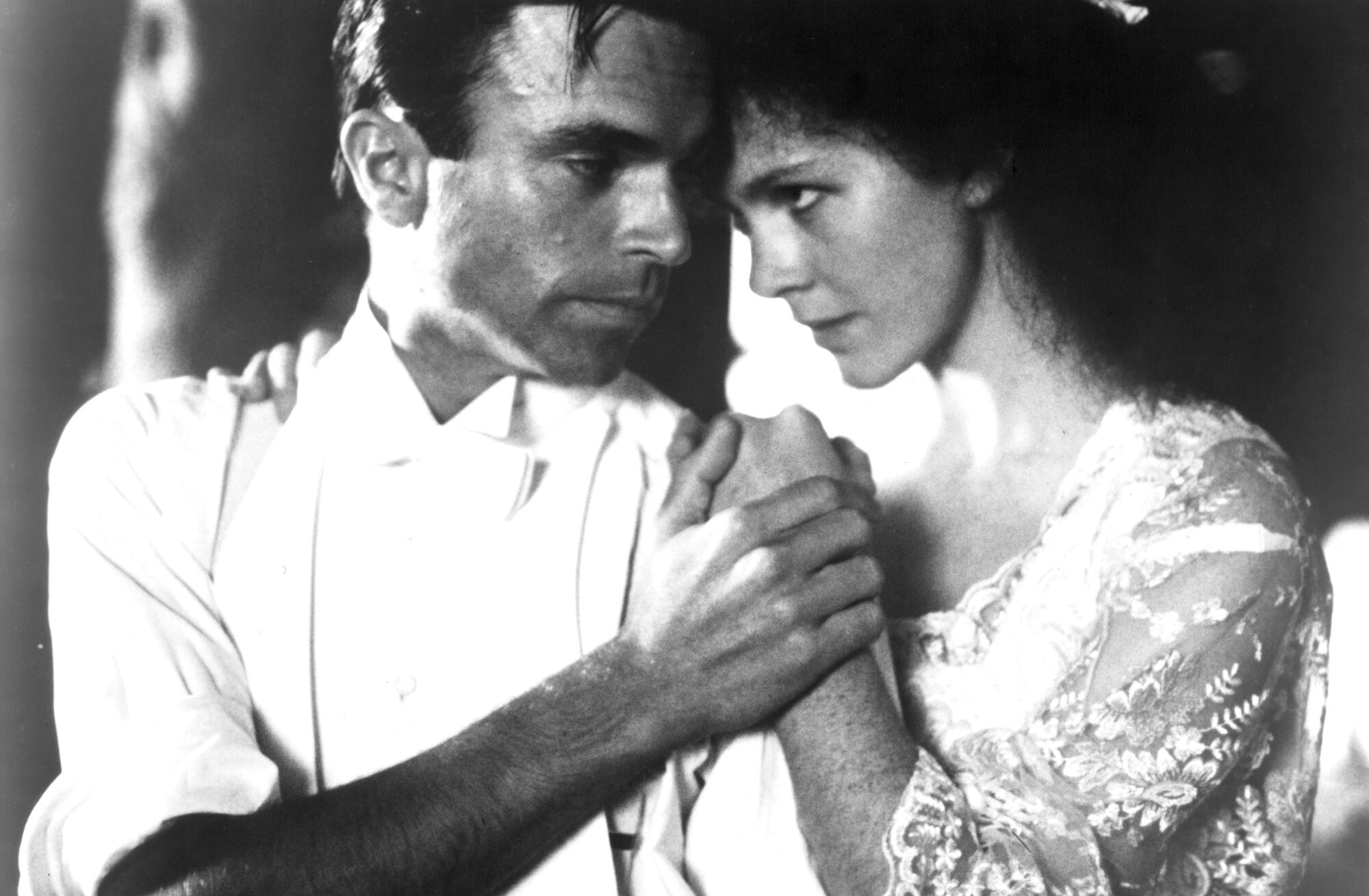
‘My Brilliant Career’ (1979)

A man tenderly holds a woman's hand.

Sam Neill and Judy Davis in the movie “My Brilliant Career.”

(Michael Ochs Archives / Getty Images)

Gillian Armstrong’s first feature is a landmark of the Australian New Wave and feminist cinema, signaling the arrival of the great Judy Davis and containing the most erotically charged (and quite possibly the longest) pillow fight in movie history. It works splendidly for countless reasons, not the least of which is Neill’s presence as the charming suitor of Davis’ headstrong heroine. Set in 1897 in rural Australia, the film follows Davis’ Sybylla, who dreams of becoming a writer, an unconventional aspiration given her family’s poverty and societal norms. Then she meets a wealthy charmer, played by Neill, and he proposes. It should be an easy decision, particularly since Sybylla loves him and Neill makes him so irresistible. That Sybylla does, in fact, resist, choosing independence over love and the possibility of perennial pillow fights, makes “My Brilliant Career” so daring and thrilling. — Glenn Whipp

‘Possession’ (1981)

A woman with a bloody mouth is pursued by her husband.

Isabelle Adjani and Sam Neill in the movie “Possession.”

(Metrograph Pictures)

It’s being remade with Margaret Qualley and the main reason for the movie’s notoriety remains Isabelle Adjani’s unhinged, incantatory performance, a collection of freak-outs that’s still unmatched. But one can argue that Adjani couldn’t have gotten there without the slightly milquetoast banality of her character’s husband, played by Neill as one of the least exciting on-screen spies of the 1980s. (She’s already cheating on him when the movie begins.) He doesn’t seem cut out to be a family man either, but Neill’s cuckolded complaining, hard to pull off this confidently, may be what’s driving her to self-harm in the first place. — Joshua Rothkopf

‘The Final Conflict’ (1981)

More than a decade before his “Jurassic Park” role, Neill delivered a chilling turn as the Antichrist in “The Final Conflict,” better known as the third film in “The Omen” franchise, about a couple that unwittingly adopts the son of Satan. In this second sequel, Neill plays an adult Damien Thorn, now a U.S ambassador to the United Kingdom who is determined to stop the second coming of Christ. With sinister smiles and steely glares, Neill makes Damien his own, waging a murderous campaign against a group of priests, his voice dripping with contempt as he vows to slay “the Nazarene” when he is born. — Greg Braxton

‘Dead Calm’ (1989)

A man with a flare gun stands with a woman on a boat.

Sam Neill and Nicole Kidman on the set of the movie “Dead Calm.”

(Michael Ochs Archives / Getty Images)

We remember Philip Noyce’s claustrophobic cat-and-mouse thriller primarily as Nicole Kidman’s big-screen breakthrough. But, and you may be noticing a theme here, the movie would not work without Neill, who had a gift for playing opposite strong-minded women. Kidman and Neill are a married couple embarking on an ocean adventure to work through the loss of their child. They happen upon a crazy-eyed stranger (Billy Zane) on a sinking schooner, take him aboard and things go south from there. Part Cary Grant, part MacGyver, Neill gives a great physical performance, which he parlayed into well-paying Hollywood action roles for the rest of his career. None came close, though, to his flare-gun theatrics here. — Glenn Whipp

‘Jurassic Park’ (1993)

You go for the dinosaurs and there’s no shame in that. But credit Neill for both understanding the assignment and not quite settling for those awed stares of Spielbergian wonder. His Alan Grant is distinct enough to register as prickly and a little inside himself. He absolutely hates children, even as the whole plot, somewhat obviously, steers him in the opposite direction. He’s not Jeff Goldblum-level rascally, but he’s confident enough to go his own way and make a killer joke at a high-voltage fence. Acting-wise, Neill has already held his own opposite several forces of nature (see above). Raptors were nothing. — Joshua Rothkopf

‘The Piano’ (1993)

A man looks at a small photograph.

Sam Neill in the move “The Piano.”

(The Criterion Collection)

So many of Neill’s most memorable movies feature him supporting the singular vision of great directors, as is the case with Jane Campion’s 1993 landmark. Neill plays the awkward, ignorant Scottish farmer who arranges for a mail-order marriage with Holly Hunter’s mute pianist and then becomes possessive and driven to jealous despair. We hate him. Which was fine by Neill, as he wrote in his 2023 memoir: “There is honour to be found in the second fiddle. Or fourth. No one notices you much, you don’t get nominated for things. But you served. I was there in an important feminist film. It’s a work of art. And look, that tiny little figure in the fabric — see down there on the right — that’s me. It’s a film that will always have a place in cinema history. And I served in it.” — Glenn Whipp

‘In the Mouth of Madness’ (1994)

Finally, a leading role. Granted it’s one in which Neill, strapped in a straitjacket, screams things like “I’m not insane!” But if you’re a fan of his brand of slightly unconvinced heroism, John Carpenter’s horror movie — about an insurance investigator on the hunt for a missing Stephen King-like author — is an enjoyable watch. Carpenter was never one to overexplain things to his actors (it’s why you find so many rich, self-directed performances in his movies) and Neill’s snoop definitely goes through the looking glass, from disbelieving cynic to true believer. Genre movies thrive on his kind of total commitment. — Joshua Rothkopf
Source link

Sam Neill’s family: From his ex-wife and parents to his children, what you need to know about the late actor

TRIBUTES are pouring in for screen icon Sam Neill, who passed away aged 78 on Monday, July 13.

The acclaimed actor died suddenly surrounded by his loved ones, just months after revealing he was cancer-free.

Sam Neill as Dr Alan Grant in Jurassic Park Credit: Alamy
The screen icon also played Major Chester Campbell in Peaky Blinders Credit: Alamy

Sam Neill’s family confirmed the news in a statement: “It is with immense sadness that the whanau of Sam Neill share the news of his passing on Monday 13th July, in Sydney, Australia.

“Sam was surrounded by family and passed with the dignity that has characterised his whole life.

“The loss was sudden and unexpected but blessed by the fact that Sam remained cancer-free.

“They would like to express their deepest gratitude to the staff at St Vincent’s Private Hospital for their incredible care.

‘ANOTHER DAY’

Final photo shows Sam Neill beaming at awards event weeks before his death


TOUGH LOSS

Richard E Grant & Australian PM lead tributes to Sam Neill after death at 78

“More details will be shared later, but for now, on behalf of the family, we ask that you respect their privacy as they navigate this immeasurable loss.”

Australian Prime Minister Anthony Albanese paid tribute, writing on X: “Sam Neill starred in so many beloved Australian stories and he earned a special place in Australian hearts.

“Wry and dry, thoughtful and laconic, Sam fought illness with the same dignity, humour and conviction that gave strength to his every performance.

“He will be much mourned and long remembered. May he rest in peace.”

Fellow actor Richard E. Grant posted: “Knew @samneilltheprop for 3 decades and finally worked with him on PALM BEACH in 2018. An officer and a Gentleman in the truest sense.

“Guided and helped me through a very difficult time in my Life. Pictured beside producer @deb_bal & @ladyheathermitchell. Sail on, kind Sir.”

While Jurassic World: Dominion director Colin Trevorrow said Sam was “a friend and collaborator at a challenging time”.

He continued: “His strength gave us all strength. I’ll remember him for his tranquility, his love of wine, and for the calm assuredness he brought to his characters.”

Scottish actor Alan Cumming wrote: “Ahhh Sam, what a glorious beautiful man. You are missed. Sorry to the family for your immense loss.”

The Boys’ Karl Urban posted: “Heartfelt condolences to your whanau.
Sam was truly brilliant. An inspiration for many who followed in his trailblazing footsteps.

“A beautiful man, A national treasure who gave so much to New Zealand and the to world. God speed Sam.”

At the time of writing, no cause of death has been given.

Who were Sam Neill’s parents?

Sam was born Nigel John Dermot Neill in Omagh, Northern Ireland, to English mother Priscilla Beatrice Ingham and New Zealand father Dermot Neill, an army officer.

The family emigrated to New Zealand when Sam was seven, settling in Dunedin, and he later went to boarding school in Christchurch.

He took the name Sam when he was a youngster because there were too many Nigels at school.

In his memoir Did I Ever Tell You This?, Sam wrote: “The one thing I resent about my parents, the only thing, is that they called me Nigel.

Sam pictured with his ex-wife Noriko Watanabe in 2006 Credit: Getty
He also had a relationship with actress Lisa Harrow, whom he met on the set of 1981’s The Final Conflict – the pair later had a son together Credit: Alamy

“Changing my name to Sam at the age of 11 was probably the best decision I made in my life.”

He added: “I found I moved more easily in the world as a Sam. Nigel is an awkward fit in most circumstances. Imagine being a movie actor called Nigel Neill.”

His dad’s family had deep roots in the wine trade, having founded the Dunedin merchant firm Neill & Co generations earlier, which Sam later drew on when he established his own Central Otago winery, Two Paddocks, in the 90s.

Who was Sam Neill married to?

Sam had a long relationship with New Zealand actress Lisa Harrow, whom he met while filming 1981’s The Final Conflict. The pair had a son together, Tim, born in 1983.

Later on life, he went on to marry Japanese make-up artist Noriko Watanabe, whom he met on the set of the 1989 film Dead Calm.

The couple welcomed a daughter, Elena, in 1991, and Sam also adopted Noriko’s daughter from an earlier relationship, Maiko.

Sam and Watanabe separated in 2017.

Who are Sam Neill’s children?

Sam is survived by four children. Alongside Tim, Elena and Maiko, he also had a son named Andrew.

He was placed for adoption when Sam was in his early twenties and was reunited with his father in 1994.

Sam previously told The Times: “I’ve got a slightly unusual family – it’s more extended than most.

“My first son, Andrew, was given up for adoption when he was very small. I was quite small, too – in my early twenties.

“I didn’t see him for 25 years and then we went looking for each other.”

What movies did Sam Neill appear in?

Sam’s career spanned more than 50 years and around 150 screen credits. Among his biggest film roles were:

  • Dr Alan Grant in Jurassic Park (1993)
  • Alisdair Stewart in The Piano (1993)
  • Vasili Borodin in The Hunt for Red October (1990)
  • John Ingram in Dead Calm (1989)
  • Damien Thorn in The Final Conflict (1981)
  • Michael Chamberlain in Evil Angels (1988)
  • Dr Alan Grant in Jurassic Park III (2001)
  • Dr William Weir in Event Horizon (1997)
  • Dr Alan Grant in Jurassic World: Dominion (2022)
  • Cliff Buxton in The Dish (2000)

On television, Neill played corrupt Major Chester Campbell in Peaky Blinders.

He also featured as Cardinal Thomas Wolsey in The Tudors, among many other roles.

Sam was awarded an OBE in 1991 for services to acting, and in 2022 accepted redesignation as a Knight Companion of the New Zealand Order of Merit (KNZM), the second-highest grade in the New Zealand royal honours system.

He previously turned down the KNZM when knighthoods were first restored to the New Zealand honours system in 2009.

Source link