WARNING – DISTRESSING CONTENT: New Netflix documentary Freefall: A Reckoning for Boeing, investigates the story of Boeing whistleblower John Barnett, who was found dead in his truck in 2024
John Barnett was found dead on March 9 from a ‘self-inflicted’ wound
John Barnett worked for Boeing for 32 years before turning whistleblower and dying in mysterious circumstances.
New Netflix documentary, Freefall: A Reckoning for Boeing, explores the story of Barnett, who publicly condemned Boeing’s safety processes before he was found dead in his truck. He was in the process of testifying against the company.
From 2010, Barnett was employed as a quality manager at the North Charleston plant, which built the longhaul 787 Dreamliner, before retiring in 2017 on health grounds.
After Boeing merged with a former rival McDonnell Douglas, several former Boeing employees alleged the company started focussing more on increasing profits rather than safety and quality.
Barnett told the Today Show before his death: “From day one, it’s just all been about schedule, and hurry up, and just get it done. Push a plane out. We’re behind schedule. We don’t have time to worry about issues that y’all bring up.”
He alleged there were severe production and safety flaws such as defective oxygen systems and metal shavings near critical wiring on the 787 Dreamliner program.
Just before he left Boeing in 2017, Barnett filed a complaint against the company, accusing bosses of retaliating against him for raising safety concerns. He was outspoken on the issue with journalists – and in 2022 appeared in acclaimed director Rory Kennedy’s investigative film Downfall: The Case Against Boeing.
But then, on March 9, 2024, Barnett was found dead in his truck with a gunshot wound to his head.
Deeply affected by Barnett’s death and ongoing concerns about Boeing’s safety culture, Kennedy reunited with her team to produce the documentary sequel, Freefall: A Reckoning for Boeing, which is being released on August 19, 2026.
Speaking to the Guardian about Barnett’s death, Oscar-nominated filmmaker Kennedy said: “I was horrified and heartbroken. I spoke to his mom pretty immediately after we had heard that news. She said to me, ‘We need to make sure John’s story gets out there,’ and that was a big part of why we decided to revisit this.
“I’ve never done a documentary follow-up in this kind of way, but we all felt that Boeingis such a big company, and we all fly these airplanes all over the world. I don’t want one of these planes falling out of the sky, and I feel like I have a lot of inside knowledge and also connections to understanding what’s going on inside of Boeing, and I just felt like we’ve got to stay at this.”
Details of the circumstances surrounding Barnett’s death came to light when his mother sued Boeing in a wrongful death suit in March 2025. The complaint alleged that Barnett was subjected to a campaign of harassment, abuse and humiliation after he raised concerns about safety issues. It further claimed that the conduct of the company was “the clear, foreseeable cause” of his death. In September that year, Boeing settled the lawsuit, agreeing to pay at least $50,000 to Barnett’s mother, who, in return, agreed to drop her claims that the company contributed to her son’s death by suicide.
The complaint contained a copy of Barnett’s suicide note, and the annexes presented the full police report concluding that he died by his own hand.
In conversations with Fortune in March 2025, the family’s longstanding counsel Rob Turkewitz added further details on his client’s last hours.
He said that on the evening of March 8, 2024, Barnett left the law offices of Boeing’s outside counsel in Charleston after testifying for two days in his OSHA case against the company. OSHA rules make it unlawful to retaliate against a whistleblower.
Barnett was giving his account of how Boeing allegedly violated its own policies and procedures, and FAA rules, during his seven years as a quality inspector at the North Charleston plant.
He’d delayed a trip back to his home in Louisiana to finish his deposition the next day, which was a Saturday. Videos cited in the police report show Barnett leaving the hotel around 8:30pm, and getting in his orange Dodge truck.
When Barnett failed to show up the next morning for his final round of testimony, Turkewitz called the Holiday Inn to conduct a welfare check. It was then that a hotel employee saw Barnett slumped in the front seat of his vehicle.
Charleston police arrived to discover Barnett barefoot and clutching a Smith and Wesson pistol in his right hand. His right temple showed a bullet entry wound, and an exit wound appeared in the back of his head.
On the seat next to Barnett’s body lay a message written on a single page of a red-covered notebook, with sentences written in all directions.
It contained phrases including: “America come together or die!!! Pray that the motherfk…ers who destroyed my life pay!!! I pray that Boeing pays!!! Bury me face down so that Boeing and their lying ass leaders can kiss my ass.”
Elsewhere: “I can’t do this any longer!!! F-k Boeing!!! Family and friends, I love you’ll [sic].”
“To my family and friends, I found my purpose! I am at peace! I love you more John/Mitch Barnett aka Swampy Fununcle Mitch.”
The complaint also included a heartbreaking email that Barnett sent Turkewitz in 2021, which read: “I can understand the direct costs that we can establish, ie lost pay, bonuses, etc. What I’m struggling with is how do you restore a person’s overall outlook on life? I used to be a very happy-go-lucky guy who loved his job and the products he built. I had a very positive outlook on life. Boeing absolutely destroyed my outlook on life. What is a person’s ‘outlook on life’ worth? How to put a price on that?'”
Freefall: A Reckoning for Boeingis scheduled to debut onNetflixonAugust 19, 2026.
Weekly insights and analysis on the latest developments in military technology, strategy, and foreign policy.
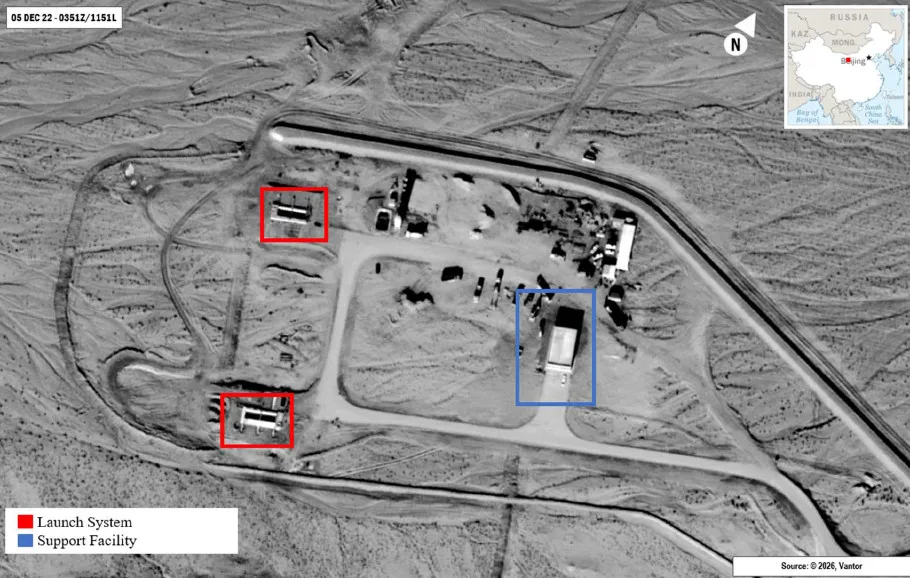
Satellite imagery shows China has built what looks to be a new pattern of hardened structures with retractable roofs at a key missile test and training base in Inner Mongolia. Since the late 2010s, this base has also played a key role in the Chinese People’s Liberation Army’s (PLA) dramatic expansion of its silo-based intercontinental ballistic missile (ICBM) capabilities. The more recent additions to the facility appear to be too small and shallow for this purpose. A new report posits they could be used to fire smaller ballistic and/or cruise missiles, and might point to plans for a new “conventional quick-strike capability.”
The China Aerospace Studies Institute (CASI), part of the U.S. Air Force’s Air University, first called attention to the two new structures yesterday. Though CASI published the report, it stressed that the “opinions, conclusions, and recommendations expressed or implied within are solely those of the author,” Eli Tirk, and “do not necessarily represent the views of the Air University, the Department of the Air Force, the Department of Defense, or any other U.S. government agency.” Tirk is a member of CASI’s staff.
“The People’s Liberation Army Rocket Force (PLARF) has constructed an unknown type of fixed launch system at the 1st Test and Training District in Jilantai that appears capable of launching multiple missiles,” Tirk writes. “Construction began sometime in late 2022, and, at least externally, appeared to be near completion by late 2023.”
A satellite image of the site in question, taken on December 5, 2022. Vantor via the China Aerospace Studies InstituteA close-up look at one of the new hardened structures with a retractable roof, as seen on January 28, 2026. Vantor via the China Aerospace Studies Institute
The report includes satellite images of the site taken in September and December 2022, as well as January of this year, as seen above and below.
“The excavation for the northern launcher … measures roughly 12.5 meters [40 feet] deep when the image was captured [in September 2022]. While it is possible that this foundation was dug deeper, it is not likely that it would have been significantly deeper, given the potential size of the finished interior of the launch system,” according to Tirk. “The limited imagery available of the finished structure prior to the installation of the launcher closure door restricts more accurate measurement, but this structure appears to be somewhere between 6.4 meters and 11.8 meters [21 to 38 feet] in depth.”
Another satellite image of the site while it was under construction, taken on September 10, 2022. Vantor via the China Aerospace Studies Institute
Additional satellite imagery TWZ has reviewed from PlanetLabs shows the rectangular retractable roofs to be approximately 65.5 feet (20 meters) long and just over 21 feet (6.5 meters) wide. The roofs also look to open by sliding sideways along three large rails.
There is at least one other large structure at the site, which could be used for various support functions. There may be additional infrastructure underground. It is also worth noting here that the area with the new hardened structures is connected by road to an earlier facility immediately to the northeast. The tertiary site has several additional large structures contained within a clearly visible perimeter wall.
The roof design, at least, has some broad similarities to the covers on silos associated with older DF-5-series ICBMs, which are also rectangular in shape. For further comparison, the cover on a known ICBM test silo at Wuzhai, some 350 miles to the East of Jilantai, is nearly 74 feet (22.5 meters) long and around 29.5 feet (9 meters) wide. It also slides open to one side along two large rails. Underneath is a tubular silo that would have to be at least around 131 feet (40 meters) deep based on the dimensions of DF-5.
A satellite image of the test silo in Wuzhai taken in October 2025. Google EarthAnother lower-quality satellite image of the silo in Wuzhai, taken in October 2009, which shows the cover retraced and the tubular silo underneath. Google Earth
Silos constructed at Jilantai and other sites in China since the late 2010s, associated with newer DF-31 and DF-41 ICBMs, have completely different lid designs.
The new structures appear “to have a shorter depth than silos intended for intercontinental ballistic missiles (ICBMs), suggesting that it may support short-range ballistic missiles (SRBMs), medium-range ballistic missiles (MRBMs), and cruise missiles,” per Tirk’s assessment. “Assuming the actual depth of the launch system is closer to the maximum range, these measurements suggest that these structures would likely be able to support up to an MRBM-class missile, assuming the roughly 10-meter length [nearly 33 feet] of a DF-21 or 11-meter length [approximately 36 feet] of a DF-17. It is also highly likely that this launch structure could easily accommodate SRBMs and cruise missiles.”
The DF-21 is a traditional MRBM design, and there is an anti-ship variant with a reentry vehicle capable of a certain degree of maneuvering in the terminal phase of flight. Though MRBM-sized, the DF-17 is topped with a hypersonic boost-glide vehicle and functions in a completely different manner from typical ballistic missiles. In general, hypersonic weapons of this type offer benefits when it comes to penetrating past enemy defenses and for prosecuting time-sensitive targets at long ranges, as you can learn more about here.
“While there may be space within this launch structure to store a small number of missiles horizontally that are erected vertically prior to launch, a more efficient configuration appears to be a vertical launch system,” Tirk adds. “A vertical launch system would enable the massing of fires for effect, reduce signatures, and maintain the flexibility to employ a variety of different munitions from a single launcher simultaneously, enabling these units to conduct rapid strikes against numerous target types.”
How missiles would be loaded into the launch system is unclear and would depend on its exact design. A specialized loading vehicle or at least a crane might be necessary. There is no indication that the structures allow for road-mobile transporter-erector-launchers to simply drive inside and fire through the open roof.
However, Tirk also notes that the base at Jilantai primarily serves the PLARF. This branch of the PLA is not known to have a major missile or air defense role. That responsibility largely falls to the PLA Air Force (PLAAF). There are no signs of radars or other features associated with these missions, either. As TWZ has previously reported on in detail, we have seen different types of hardened and unhardened structures with retractable roofs emerge near the border with India and on islands in the South China Sea that do look to be air defense sites.
A US military graphic detailing ICBM silo construction at three new sites China in recent years. US military
Overall, Tirk posits that the new structures at Jilantai might reflect “an intent to field a conventional quick-strike capability for a counter-intervention mission set, or possibly to conduct strikes against Taiwan, both of which would provide the PLA with additional capabilities to influence U.S. strategic decision-making.”
“A conventional quick strike capability, like that provided by a vertical launch system, could make PLA leadership more confident in their ability to compel Taiwan and U.S. behaviors during a crisis by threatening or conducting rapid preparatory strikes or counterintervention fires in the early stages of a conflict,” he adds. “Building out these launch systems in sufficient quantities could allow the PLA to rapidly escalate from a quarantine or blockade of Taiwan to conducting elements of a massive preparatory fires campaign against targets on Taiwan, U.S. bases in the first island chain, or U.S. Navy task groups if positioned along the coast.”
A graphic included in the Pentagon’s 2025 report on Chinese military developments showing the general ranges of various shorter-range ballistic missiles and surface-to-air missiles in relation to Taiwan. US military
“Fixed launching options, however, are difficult to conceal, protect with active defenses and – depending on their location – potentially of limited utility for continued use after their first launch. Expansive investment in this type of system may provide significant “use or lose” incentives to the PLA leadership in the event of an escalating crisis,” he also notes. “It is currently unclear how many of these systems the PLARF intends to construct, which PLARF Base they will be deployed under, and the specific mission set they are intended to support.”
There is still the possibility that these structures could serve another purpose, even just within the PLARF. In particular, if the foundation was dug deeper, this could fundamentally change the assessment. From the outside, the roofs do still look to be too narrow for there to be a traditional silo underneath for any of China’s known ICBMs. That being said, a deeper foundation could accommodate intermediate ballistic missiles (IRBM) or hypersonic types that use larger ballistic missile-type boosters, but that are still smaller than an ICBM. The DF-26 family of IRBMs, at least some variants of which are understood to be capable of carrying conventional or nuclear warheads, is a particularly key component of the PLARF’s arsenal, and might also benefit from a new fixed launch infrastructure. Like the DF-21, there is also an anti-ship version of the DF-26.
China tests DF-26 missile destroying Mock Aircraft Carrier
The hardened structures with retractable roofs could conceal other assets beyond launchers for any kind of missile. They could have a more specialized testing role, rather than one intended to lead to an operational capability, too. TWZ has previously highlighted other hangar-like structures with retractable roofs, some of which are camouflaged, in an area known as Korla East in the western end of the country. PLAN facilities in this region have been tied to work on missile defense, anti-satellite, directed energy weapon, and electromagnetic pulse technologies, as you can read more about here.
Regardless, the new structures at the base in Jilantai do reflect a broader trend when it comes to hardened military infrastructure in China, as well as elsewhere globally. As we wrote last year, after the emergence of the apparent new pattern of hardened air defense sites near China’s border with India:
“The shelters with retractable roofs at the sites in Gar County and near Pangong Lake also highlight a larger trend when it comes to physical hardening, or at least ‘enclosing,’ that has been observed at Chinese military facilities in recent years. There has been a particularly visible surge in the construction of new hardened aircraft shelters, as well as unhardened, but fully enclosed hangars, at air bases across China, including ones situated on the Tibetan Plateau.”
China has completed the construction of 36 hardened aircraft shelters,new administrative blocks& a new apron at its Lhunze airbase in Tibet. Gives China the option of forward-deploying fighter aircraft & drone systems in its arsenal & reduces the response time needed for the IAF pic.twitter.com/g3kRXpyuRg
PLA Air Force had 370 Hardened Air Shelters (HAS) and 1100 regular ones in 2010. This increased to 800+ and 2300+ respectively in 2024, according to Hudson Institute.
Storage tunnels dug up in mountains and hardened storage sites for missiles and other war supplies are extra. pic.twitter.com/DQeQbXnGN9
“Chinese construction of new hardened and unhardened aircraft shelters, in particular, is reflective of larger global trends, including in Russia, North Korea, and Iran, as well. It has also stood in notable contrast to the lack of such developments in the United States, something that has become a topic of heated debate, which TWZ has been tracking very closely.”
“Growing threats posed by long-range, one-way attack drones, which offer a relatively low-cost way to launch large volume strikes, especially against fixed targets like air bases and air defense sites, have become a particularly significant factor in the hardening debate. Ukraine’s Operation Spiderweb also underscored the threats that smaller, shorter-range drones can pose to aircraft and other assets out in the open, and in areas far away from active combat zones. Drones could also be layered in with the many other methods of attack that would be used against the same array of targets.”
Though questions remain about their exact purpose, and the concepts of operations behind them, the new hardened structures with retractable roofs in Jilantai might be a sign of things to come.
I wanted to know more the moment I read “Sister Elsie Peak” on an old map.
I discovered the name while researching trails around Mt. Lukens, the highest peak in Los Angeles proper. Looking at the peak’s location on a historical map of L.A. County’s mountains, I noticed that it was previously named for a woman I’d never heard of.
Few of Southern California’s mountain peaks are named after women, so Sister Elsie Peak stuck with me. Who was she? And why was her mountain renamed to instead honor local leader Theodore Lukens?
In this edition of The Wild, our weekly outdoors newsletter, I will take you with me on my arduous journey to find the origins of the first known name for Mt. Lukens. Over the past week, I enlisted help from multiple librarians, map experts and one gracious historian (who you’ll meet later). We all scoured newspaper archives and history books, catching the fever of curiosity that seems to consume anyone who tries to find out who Sister Elsie was.
You are reading The Wild newsletter
Sign up to get expert tips on the best of Southern California’s beaches, trails, parks, deserts, forests and mountains in your inbox every Thursday
By continuing, you agree to our Terms of Service, which include arbitration and a class action waiver. You agree that we and our third-party vendors may collect and use your information, including through cookies, pixels and similar technologies, for the purposes set forth in our Privacy Policy such as personalizing your experience and ads.
What we collectively found was this: Sister Elsie was most likely not a real person, and her legend was most widely shared in the early 20th century by a local landowner who was known to embellish, including claiming that Josephine Peak near Mt. Lukens was named after his daughter. (It wasn’t.)
There appears to be no record anywhere — in newspapers, in history books, in Catholic Church records — as to the existence of a Sister Elsie or, as you’ll learn more about below, an alleged orphanage, ranch or school that she ran in the Tujunga area for Indigenous children or the broader Indigenous community.
In that same vein, I want to call something out before we begin: Stories about the relationships between colonizers and Indigenous peoples often get romanticized (see: Thanksgiving), with storytellers and early historians intentionally leaving out any details of forced assimilation or the American genocide. I cannot report anything concrete about how Sister Elsie actually treated Indigenous people in large part because I don’t believe she was real.
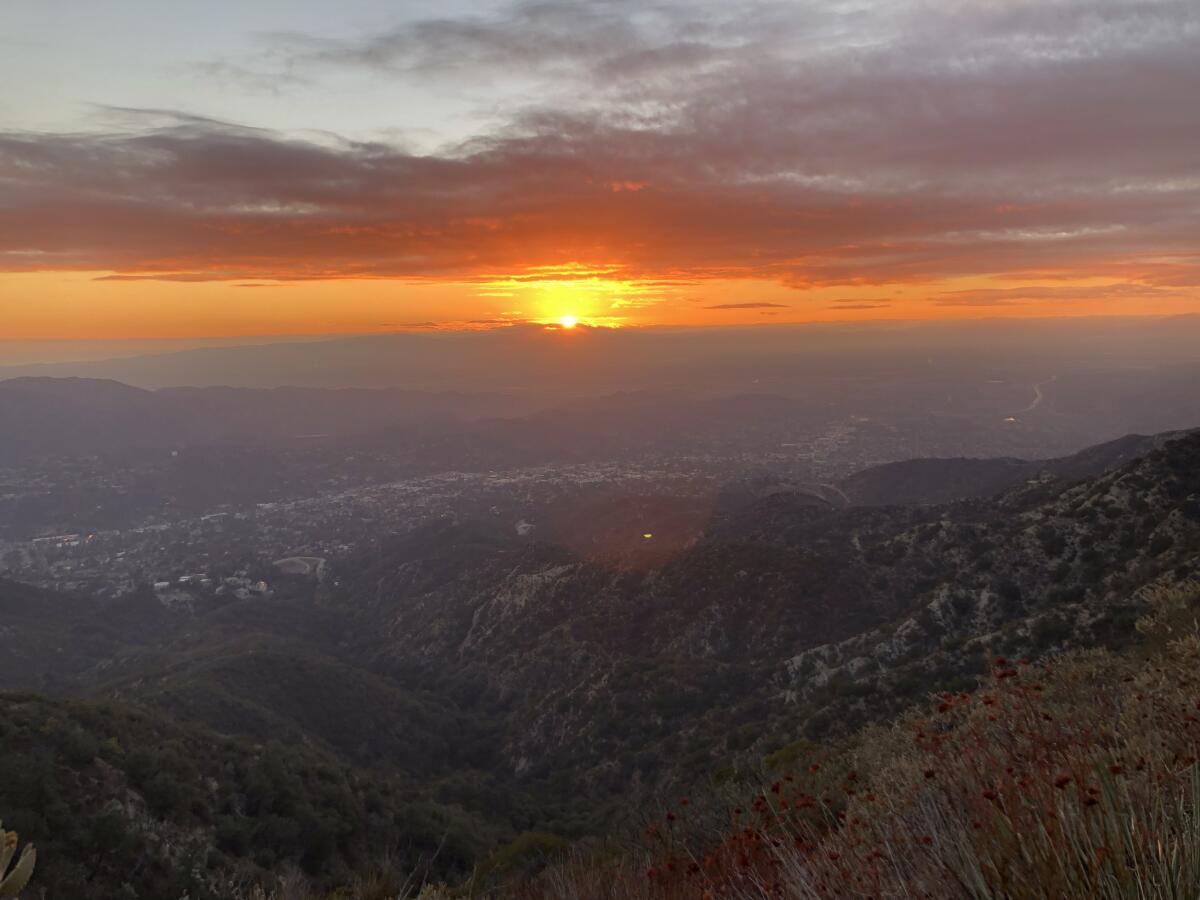
The sunset as viewed from a trail near Mt. Lukens in the San Gabriel Mountains.
(Jaclyn Cosgrove / Los Angeles Times)
OK, I’ve held you in suspense long enough. Let’s jump into everything under the actual sun that I could find about Sister Elsie Peak.
To begin my reporting, I contacted Times editorial library director Cary Schneider, who is always eager to help me with prospective stories (i.e. highly specific internet rabbit holes I’ve fallen down).
Cary found what might be the earliest mention in a local newspaper: A story in the Monrovia Daily News on April 23, 1910, in which a writer mentions a new trail leading to Sister Elsie Peak, but tragically gives no details of its namesake.
Next, we jump 20 years into the future when The Times and the Pasadena Star-News covered the dedication of Sister Elsie’s Well in Tujunga. Both publications described the well in their stories on April 28, 1930, as named after “the Catholic nun” who ran a school for Indigenous children “in the days of the Spanish missions.” The Times called her a “pioneer nun and teacher.”
Multiple radio towers and other infrastructure sit at the top of Mt. Lukens, as seen on a 2022 hike there.
(Jaclyn Cosgrove / Los Angeles Times)
The dedication occurred on the land of Philip Begue, a crucial character to understand in the Sister Elsie legend, as he’s believed to have either spread or made up the story, according to a local historian. Begue’s family bought land around Tujunga and La Crescenta in 1882, and later, Begue was an early pioneer and one of the first forest rangers in what would later become Angeles National Forest.
Throughout the late 1920s and 1930s, Begue seemed set on sharing the story of Sister Elsie. In 1934, he told the Pasadena Star-News that the sister “ministered to the sick and needy” Indigenous people.
A Times story on Sept. 29, 1935, announced a barbecue fundraiser for a local Catholic institution at the “old Basque rancho” owned by Begue. “The ranch on Honolulu avenue was famous in early days when Los Angeles was a pueblo and Sister Elsie had a children’s home where the ranch now stands.” The Begue family planned to cook “hundreds of pounds of meat for the affair.”
Times columnist Harry Carr offered in his column, the Lancer, a completely different take. Carr wrote on April 3, 1935, that Sister Elsie Peak was named “for a nun who lost her life trying to walk from San Fernando to San Gabriel.” No, he doesn’t provide a source for where he learned that information. Trust me: I too shook my fist at the sky.
The last rays of sun blanket across Mt. Lukens, as seen from Dunsmore Canyon in Deukmejian Wilderness Park near Glendale.
(Jaclyn Cosgrove / Los Angeles Times)
I would be remiss to mention that the oldest reference to a “Sister Elsie” in The Times’ archives appears to be an 1889 story about — buckle up — a psychic medium in Azusa. For a brief and beautiful moment, Cary and I hoped Sister Elsie Peak would turn out to be named after Elsie Wheeler, a spiritualist medium whose own story relates to an astrological tool. Alas, the peak was named before she was born (which doesn’t work unless she was a really good psychic). That said, a peak named after a mythical nun and a clairvoyant feels arguably appropriate for the highest point in L.A.
Cary also discovered one of my favorite facts about the Sister Elsie legend — that it was turned into a play titled “Sister Elsie in Tujunga.” It was written by Frances Muir Pomeroy, superintendent of summer school at Our Lady of Lourdes Catholic Church. It was said to be about “the experiences of Sister Elsie when she conducted an orphanage here many years ago,” according to a 1938 Times story.
There are other references to Sister Elsie in The Times’ archives over the next several decades, but nothing that gives concrete evidence that she actually existed.
Cary advised me to contact the Los Angeles Public Library. Librarian Kelly C. Wallace, who specializes in California history, quickly got back to me.
Knowing that Cary had already scoured The Times’ archives, Wallace sifted through the agency’s Los Angeles Area Historical Newspapers database, which contains the Los Angeles Daily Star (1870-1879), the Los Angeles Evening Post-Record (1896-1936) and the Los Angeles Star (1851-1871), along with community newspapers such as the Eagle Rock Sentinel and the Highland Park Herald. She found little there.
The trail through Stone Canyon to reach Mt. Lukens.
(Mary Forgione / Los Angeles Times)
This is especially puzzling if Sister Elsie did exist because, before the advent of television, newspapers reported seemingly everything that we now post on social media — detailed trip reports, the attendees of parties, birth announcements, and even basic road repairs.
Wallace did discover a few interesting tidbits in books, but curiously nothing before 1930.
The earliest reference that Wallace found was in the 1938 book “History of La Crescenta-La Canada Valleys” by Grace J. Oberbeck. She spoke to Begue, who spun quite the yarn:
“On El Rancho de las Hermanas, the ranch of the sisters, a group of nuns who had an orphanage not far distant, kept a herd of cows which was looked after by” local Indigenous people “who supplied milk to the school whenever needed. Sister Elsie was the much loved nun in charge of” the Indigenous dairy workers, “and her name was given to the well. Almost directly north from here towers a high peak of the Sierra Madre range and this bears the name of Sister Elsie Peak.”
Legendary outdoors writer and historian John W. Robinson, Wallace found, told the Sister Elsie story in his 1977 book “The San Gabriels,” but followed it up with a correction in his 1983 tome, “The San Gabriels II”: “The derivation of Mt. Lukens’ original name, Sister Elsie Peak, is clouded in uncertainty. Exhaustive research into Catholic Church records fails to find any evidence of a nun named Sister Elsie nor an orphanage named El Rancho de Dos Hermanas.”
You’re telling me, John!
Wallace also found an entirely different story about Sister Elsie on page 47 of “The San Fernando Valley” by Jackson Mayers, published in 1976.
“Sister Elsie, a Sister of Charity, came to Tujunga from Los Angeles between 1850 and 1875 to work with” Indigenous people “at a school and orphanage. Near Haines Canyon was Sister Elsie’s well; Sister Elsie’s Peak was named, it is said, because when troubled she would gain strength by raising her eyes to that eminence, one whose top she was to be buried. Others held that two nuns on their way from Mission San Fernando to Mission San Gabriel lost their way in Tujunga and died atop the peak.”
There is tragically no footnote on the page, so I have no idea who Mayers’ source was.
I hoped that finding out when Sister Elsie Peak was named would help, but that also proved to be a dead end.
Local historian Mike Lawler, former president of the Historical Society of the Crescenta Valley, told Realtor Sharon Hales in a 2016 interview that cartographer George M. Wheeler and his team named the mountaintop Sister Elsie Peak during their survey of California in the late 1800s.
“We don’t know why he named it Sister Elsie Peak,” Lawler said. “The reasons why he named everything are lost to history. They were destroyed in the 1906 San Francisco earthquake.”
This led me to contact the staff at the David Rumsey Map Center at Stanford University Library, as its collections are vast, and I hoped maybe they’d somehow find half a charred page of notes with Sister Elsie’s biography scrawled in quill pen.
Instead, Kristina Larsen, the center’s associate curator, came up short, finding only that a misspelling, “Sister Else Pk” was on the 1881 land classification map from Wheeler.
Evan Thornberry, the center’s head and curator, unearthed “Vignettes of California Catholicism,” a 1988 book by Monsignor Francis J. Weber, longtime archivist for the Archdiocese of Los Angeles at the San Fernando Mission.
Weber conducted an exhaustive search for the existence of Sister Elsie and found no proof of any existence of Sister Elsie or a Catholic orphanage in the Tujunga area at the time.
Weber offered my favorite suggestion for why no one can find any hint of Sister Elsie’s existence: “Maybe the good Sister was kidnapped by Martians!”
If so, I hope someone there takes better care to protect knowledge regarding the names of that planet’s mountains.
You’d think I’d give up here, right?
Instead, I contacted historian Kristine Gunnell, who wrote “Daughters of Charity: Women, Religious Mission and Hospital Care in Los Angeles, 1856-1927” (Vincentian Studies Institute).
I hoped Gunnell would have an answer, as Sister Elsie was said to be in the Sisters of Charity, an American version of the Daughters of Charity, a group that was founded in France in the 1600s with an aim of serving low-income and sick people.
The Daughters group eventually inspired American Catholic women to serve in a similar way, first forming the Sisters of Charity until the groups essentially merged. In the 1850s, as more people moved to the American West, a bishop in the L.A. area requested that Daughters of Charity come to L.A., Gunnell said.
But, there’s no Sister Elsie referenced in Gunnell’s book.
Gunnell said after hearing from me, she contacted a history professor from DePaul University who is compiling a database about all the Daughters of Charity who served in California. He found no one referred to as “Sister Elsie” between 1850 and 1900.
A 1931 news story references that Sister Elsie treated Indigenous children diagnosed with typhoid fever.
Tujunga “was only a day’s wagon ride from Los Angeles, and if these Tongva were Catholic or had Catholic connections, the sisters may have considered their request,” Gunnell wrote to me. “I was hoping that I’d be able to find a record of the typhoid outbreak in Tujunga in the 1860s or 1870s and cross reference it with the Daughters’ records. It’s a good story, and the sisters likely would’ve reported it if it’s true. However, I can’t isolate a specific outbreak.”
Later, Gunnell and I hopped on a Zoom call to commiserate.
With all of our research before us, we reached the same conclusion: A Catholic sister could have feasibly traveled to Tujunga at the request of a bishop to help Indigenous people, but currently there is no record of a woman known as Sister Elsie who did so. There’s no record of much of anything told in the Sister Elsie story. It seems, instead, to have been an urban legend of its time.
At least for now.
Hikers in Elysian Park.
(Dania Maxwell / Los Angeles Times)
3 things to do
1. Reach for the rainbow in L.A. One Down Dog, an L.A. yoga and fitness studio, will host a Pride hike from 10:30 a.m. to noon Saturday in Elysian Park. Guests will hike a loop trail through the park. For more details, register at eventbrite.com.
2. Marvel at mollusks in Malibu The Wishtoyo Chumash Foundation will host a tidepooling event from 8 a.m. to 1 p.m. June 19 near the Wishtoyo Chumash Village (33904 Pacific Coast Highway) in Malibu. Guests will learn about Wishtoyo Village, which is typically not open to the public. All experience levels welcome. Learn more at the foundation’s Instagram page.
3. Learn along the L.A. River in Downey The California Native Plant Society and Friends of the L.A. River will host a guided bike ride along the L.A. River. Naturalist Cris Sarabia will teach participants about local ecology during the ride. Binoculars will be provided. Guests should bring safety gear and water. Learn more at the group’s Instagram page. Register at folar.org.
The must-read
Burn damage to the Torrey pine grove at Santa Rosa Island.
(Kayla Bartkowski / Los Angeles Times)
The length of time that it will take for Santa Rosa Island to recover after a blaze scorched about one-third of the island remains unclear, Times staff writer Grace Toohey wrote after a recent visit to the island. The fire, which grew to 18,379 acres, is now fully contained. Firefighters faced vicious winds and, at times, 30-foot flames. “They held the line, and we have them to thank for saving housing, saving the island, saving the history of the Santa Rosa Island,” said Ethan McKinley, superintendent of Channel Islands National Park. The island has long been a respite for hikers and backpackers, including Times staff writer Lila Seidman, who shared her experiences on the island and her grief that came in the wake of the blaze. “Now fear clouds the memories: Does the rugged, magical place of my mind’s eye still exist?” Seidman wrote.
Happy adventuring,
P.S.
I have a flurry of good California animal news to share. First, three mule deer were the first animals to walk over California’s first wildlife crossing over State Route 97 in Siskiyou County. Second, scientists have feared that the population of endangered steelhead trout in the Santa Monica Mountains were killed in massive debris flows after the Palisades fire. However, researchers recently spotted the fish — and their babies — in Topanga Creek. And finally, the California Department of Fish and Wildlife shared earlier this week that five orphaned black bear cubs that were rehabilitated and released into northern California in November successfully hibernated through the winter and returned to the landscape this spring healthy and active, according to recent data reviewed by the agency’s scientists.
For more insider tips on Southern California’s beaches, trails and parks, check out past editions of The Wild. And to view this newsletter in your browser, click here.