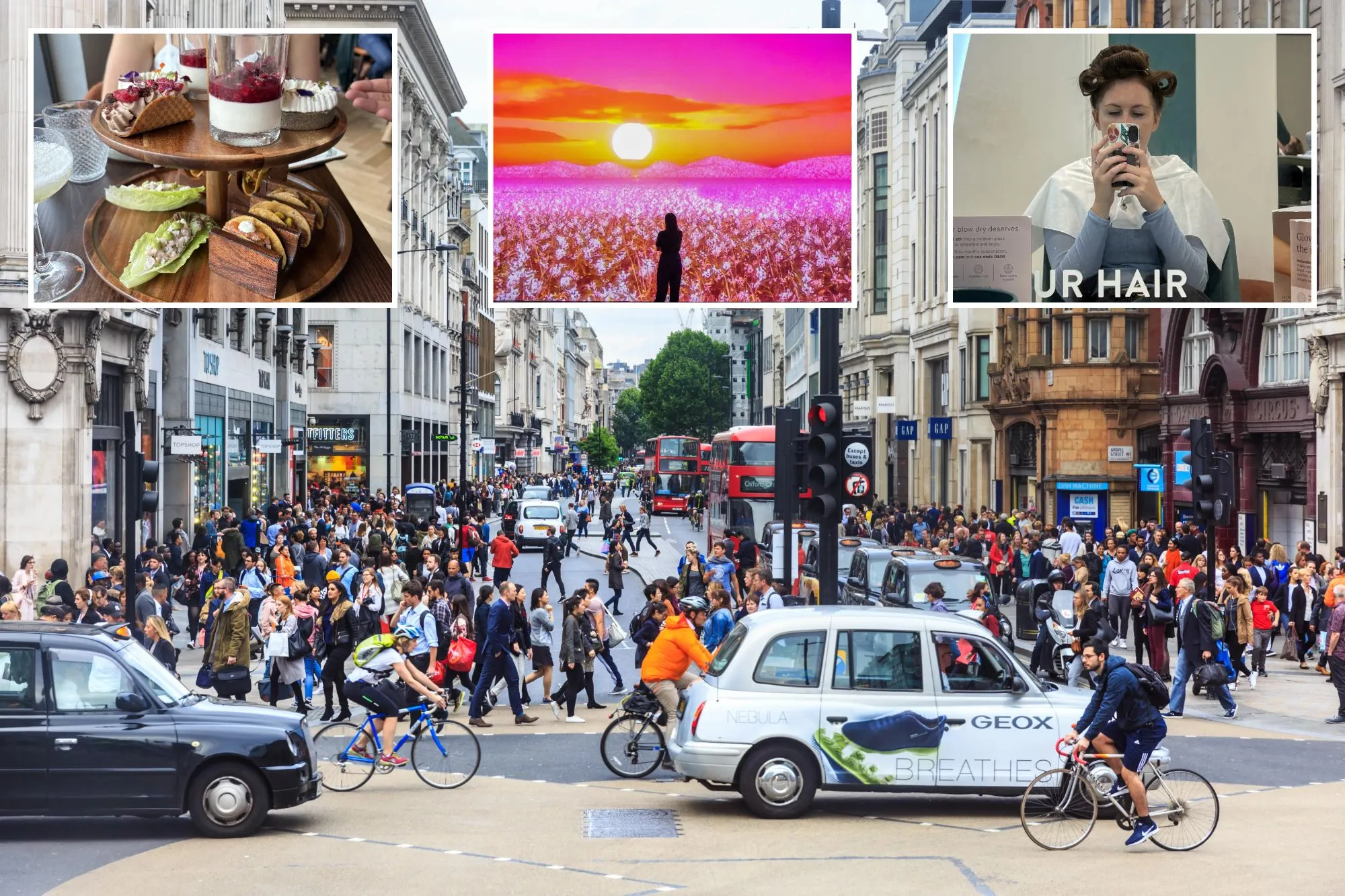
Forget shopping – the lesser-known side to the UK’s busiest high street from Mexican afternoon teas to illusion museums

YOU SAY Oxford Circus, you think crowded streets and busy shops – but there is a whole other side to it you might not have known about.
So we’ve taken it on in two different way – as a busy mum looking to keep her kid busy, to a girly weekend in the city without going to the shops.
Blow dry bars, Mexican afternoon teas and gorgeous Italian dinners
Kara Godfrey, Deputy Travel Editor, explores the busy centre on a girly weekend wanting some pampering.
Growing up in the countryside, my first impression of London was the hubbub of Soho, with bustling streets full of eager shoppers elbowing each other out of the way.
Yet 20 years later, having since moved to (and left) the crazy capital, I know there is more to the iconic city centre than its shops.
And with the announcement that it is about to become pedestrianized, it’s about to become an attraction in its own right.


If you want to explore the centre of London without actually dipping into the shops, it also makes for the perfect girly day out either with your best mate or your mum – if you know where to go as a local.
It is a fantastic destination for a pamper, with affordable nail salons and hairdressers – and did you know one of London’s most famed blow dry bars is found at the bottom of the John Lewis department store?
Having first launched in Chelsea back in 2014 (becoming a fave with the Made in Chelsea stars), Duck & Dry has become an institution for the place to go before a big event.
I sank into the plush chairs, laidback music overheard while I chatted to my hairdresser as my hair was massaged and washed.
As a woman in my mid-30s, I’ve realised that it’s the little luxuries that make life worth it and a person kneading all of my worries away is one of them.
Just 30 minutes later, I left a new woman with a fresh new do so gorgeous, I even bought a blow dry brush on my way out to try and replicate it at home.

(Don’t stop there though, one of my favourite nails bars, Cona, is just around the corner, with the hidden salon tucked behind the bold oranged painted cafe front).
Hair done, nailed fixed – we needed something to line our stomach and gone are the days of our 20s where we opted for a bottomless brunch.
Being more afternoon tea gals, one of the more unique ones is found in the Treehouse Hotel just off the main high street.
This isn’t your usual afternoon tea, however, (although you will still find a scone or two on top) – it’s called the Afternoon Te-Quila, so expect a Mexican fusion.
Starting with a freshly made margharita, we gorged on fresh fish tacos, pumpkin pies and even a unique chocolate taco, pumped full of decadent chocolate mousse.
The views are just as amazing, looking out over London from the top floor, but as I sat under a ceiling of green hanging plants, I was transported to somewhere much more tropical.
There is so much to do outside of this as well that doesn’t require you to lug shopping bags around town.
Or how about catching a West End show? The Palladium has some fantastic shows coming up including Delta Goodrem, Michael Ball and of course the Christmas panto.
(While I might have said there is so much to do along the high street without the shops, I would still recommend popping into the new M&S flagship, with four entire floors of homeware, clothes and a Food Hall. I may have left with both new linen trousers and some Percy Pigs…)
Don’t think I forgot about dinner, because London isn’t one of the world’s best food capitals for no reason.
And with more than 600 restaurants to choose from, according to OpenTable, where do you even start?
Well I’ve found just the place, if you want somewhere slightly quieter away from the crowds, but with fantastic service, a low-key atmosphere and hearty, Italian portions.
Enter Lavo at the BoTree.
Start at the bar for a cocktail – while the menu might sound confusing, it explains which cocktail they are similar to, so I had their version of a negroni.
On weekends there is also a live DJ who toes the line of great, lo-fi music without being so loud you can’t hear each other.
Slightly woozy at this point, my direction to my table was welcome before gorging on towering piles of tuna tartare and large bowls of penne a la vodka.
Our extremely funny server even tempted us into sharing what is now going down as one of the best tiramasus we’ve ever eaten.
And when you need to rest your weary feet from a day of pounding the pavements, you can’t get much more central than the Radisson Blu Bond Street.
Currently undergoing a renovation, it is just steps from the main road, with some of the best views of the high street from my room overlooking the shops.
With Oxford Circus not having many late night openings, don’t worry about not getting any sleep, as it was super quiet once everything had closed.
The cosy restaurant – with that brand new smell – also had a fantastic breakfast spread to refuel, from pancakes and avocado toast to all of the pastries and trimming of a Full English.
So while Oxford Circus will always be known at the shopping high street, there is so much more to it to bring your out of town friend, siblings or parents to without having to step into a shop.
Unless you get a Percy Pig craving, that is.
Illusion museums, kid-friendly food halls and ‘treehouse’ hotels
Caroline McGuire, Head of Travel (Digital), explores as a mum with a seven-year-old to keep occupied
As a London mum, I regularly take my seven year old into the city centre for theatre, museums, parks and all the other awesome attractions it has to offer kids.
But Oxford Street? Are you mad? It’s somewhere I’d actively avoided, assuming it was the worst place for a very active kid who loves running around and touching everything in sight.
How wrong I was. Because we recently spent an overnight stay on Europe’s most famous high street… and it was one of our best 24 hours in the capital.
Oxford Street has changed a lot since I was a kid, coming up from the home counties to spend my Christmas money at Topshop.
In some ways for the bad (those many American candy stores), but in many other ways for the good.
As some of the big chain stores have departed, enterprising new ventures have opened up that are perfect for a family day out.
Take for instance, the Twist Museum. A brilliantly fun illusion museum – even though the grumpy middle aged woman in me still insists it’s not a museum.
We had such a great time exploring all of the mind-bending activities, our favourites being the 3D hologram creator, the mirror room and the ‘big and small room’.
It was so cool that I now have three pictures from there alone on my fridge at home – high praise.
Equally fun was Swingers Golf and Carnival Games, which I’d always written off as an adults-only venue for big kids at heart to have fun with a beer.
Not so, as during the day in the school holidays it was packed with families enjoying easily the best crazy golf I’ve ever done in my life.
Then you get a half-hour pass to play as many games as you can in a retro-style arcade.
As a parent who’s forked out more pound coins than I care to remember at amusement arcades, it was a total joy to do it all for free… and with a time limit. Plus, I got to sip on an extremely good frozen marg while I did it.
If the kids are feeling hungry, their food offering is a godsend. Several high-end food trucks like Patty and Bun burgers and Breddos tacos mean you can all pick what you want to eat.
If you’re looking for something every so slightly more highbrow, we ended our day at Frameless – the very cool digital art experience where you’re put inside famous paintings, as they surround you on huge screens and come to life.
It was really surprising to see how much my son engaged with such old paintings, which he may have dismissed as stuffy in a gallery, by bringing them to life.
Of course after pounding the streets for so long, we were in need of some refreshments, so we headed to Market Halls, which has every food any foodie or fussy kid would want.
I dined on Malaysian Nasi Goreng and Thai soup, while my son had savoury crepes for main… and Nutella crepes for pudding.
Thankfully, with our extremely full stomachs we didn’t have far to go to lay our heads, as we were booked into the Treehouse Hotel, an achingly cool and modern property on Langham Place, with some of the best views of London I’ve ever seen.
Our room was very Scandi-style, with a lovely window seat so we could look out over the city.
The next morning, we managed to find space in our stomachs for brekkie, at the Mexican inspired Madera restaurant, where I had a bagel topped with scramble tofu, vegan cheese and jalapeno pickled red onions, while my son opted for the waffles with whipped cream and berries.
We lingered far too long over breakfast, sad to tear ourselves away from the stunning views from our table.
All that fun of museums, art exhibitions, golf, arcades, and some fantastic food and drink, without stepping foot into a shop?
Teenage me would never believe it.
The New West End Company represents 100 streets in the district including Oxford Street, Regent Street and Bond Street.
They explain: “New West End Company is solely focused on representing and keeping the West End thriving. Established more than two decades ago, today our 800+ membership includes the most respected names in global retail, leisure, hospitality, real estate and business.
“We keep our West End streets clean and safe, promote world-class experiences, provide trusted data and insight, and make the case for policies that support growth. Between 2026-2031, we are investing £60 million to make the district stronger, safer and even more competitive.
“Together with our partners – including Westminster City Council, the Metropolitan Police, the Mayor of London – we are proud to shape the district our members thrive in.“