
murky

ITV true crime series delving into ‘murky’ deals and murder returns tonight 

The ITV documentary series first aired three years ago and follows world-leading forensic scientist Dr Angela Gallop delving into complex cases.

Forensic scientist Dr Angela Gallop is back once again for a fresh crime series on ITV.

The harrowing true crime docu-series will see Dr Gallop and her team revisit complicated cold murder cases using advanced scientific techniques that may not have been available at the time of the crime.

Through the re-examinations, Dr Gallop and her team have helped bring notorious killers to justice in Cold Case Forensics, which is airing a brand new season.

On Tuesday night (July 28), ITV viewers will see the forensic scientist look into the chilling death of Italian banker Roberto Calvi, also widely known as ‘God’s Banker’

A synopsis for the episode reads: “Return of the documentary delving into the casebook of world-leading forensic scientist Angela Gallop and her team.

“When the body of Italian banker Roberto Calvi was found hanging under Blackfriars Bridge in London in 1982, the investigation led to a murky world of financial deals with the Vatican and the Mafia. Nicola Walker narrates.”

Roberto Calvi was the chairman of the largest private bank in Italy and also had connections to the Roman Catholic Church.

However, the 62-year-old went missing in 1982 for nine days before his body was discovered hanging.

At the time, the coroner’s report didn’t find evidence of foul play on his body and ruled his death as a suicide.

Although UK police were puzzled by the strange circumstance, as his pockets were stuffed with bricks, he had a fake passport in a different name and had £10,000 ($14,000) in cash in different currencies.

It wasn’t until 2002 that Roberto Calvi’s case was officially reopened by Italian prosecutors, with the City of London Police opening it as a murder inquiry in September 2003.

As a result, Dr Gallop was hired by Roberto’s family in a bid to prove he had been killed and didn’t die by suicide decades ago.

Other cases explored in this series includes solicitor Cheryl Lewis and ten-year-old Damilola Taylor.

The first series included the cases of Rachel Nickell, Lynette White and Stephen Lawrence.

Cold Case Forensics airs on Tuesdays on ITV from 9pm
Source link

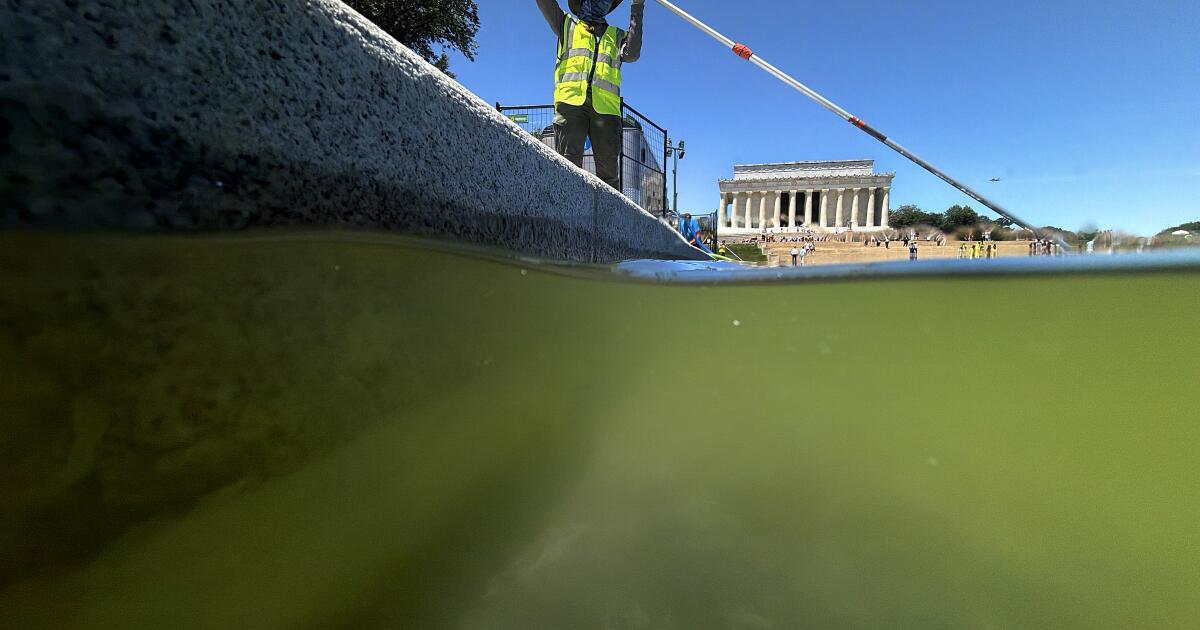
Algae persist in Washington, D.C.’s Reflecting Pool, despite administration’s efforts to clear murky waters.

Just days after the Trump administration completed millions of dollars in renovations on the Lincoln Memorial Reflecting Pool to make it American flag-blue, residents and online users noted it had turned a phosphorescent green.

Here’s why:

The calm, still waters of the Reflecting Pool make it an ideal nursery for algae growth. Algae need nitrogen and phosphorus to grow, and the Reflecting Pool is primarily fed by the Potomac River, which gets heavy doses of those nutrients from nearby urban and agricultural lands.

The Potomac also absorbed one of the largest sewage spills in U.S. history earlier this year when a pipe burst five miles upstream of Washington, although that event probably happened too long ago to contribute to the algal bloom today.

Untreated sewage is high in nitrogen and phosphorus. When nutrient levels are high, feasting algae can quickly reproduce.

The Department of the Interior said when the algae first appeared that it was “residual,” from the supply lines to the pool.

Experts also speculate that the darker blue color may be helping the Reflecting Pool absorb more heat. The higher temperatures promote algae growth by allowing their metabolisms to shift into overdrive.

Summer temperatures in D.C. aren’t helping. This week, temperatures are as high as 95 degrees in the city, prompting a heat alert.

The combination probably explains the excessive growth, turning the water surface an opaque green and preventing onlookers from seeing the new blue hue of the concrete basin.

Algae are important and beneficial organisms when the ecosystem is in balance. They’re the base of the aquatic food chain, fed on by herbivores of all shapes and sizes, including shrimp and juvenile fish, which in turn feed organisms higher up the food chain. The single-celled organisms use the power of the sun to produce energy through photosynthesis, similar to houseplants on your balcony.

In an effort combat the algae in the Reflecting Pool, employees of the National Park Service were seen pouring in gallons of hydrogen peroxide, a chemical commonly used in pool maintenance.

The Department of the Interior also is employing a “high-tech nanobubble ozone technology” to destroy the cells of the algae.

Ozone — yes, the same irritant that is in smog — is a gas composed of three oxygen molecules, and the small size of the bubbles allow the most gas transfer into the water, where it can damage algal cells, similar to how it irritates our lungs.

This only treats the symptoms, however. Generally, ozone nanobubbling is effective as a temporary solution for algae blooms. Longer-term fixes would have to address what makes the Reflecting Pool so ideal for algae, such as its depth, darker color and inflow of nitrogen and phosphorus.

In California, ozone nanobubbles also have been used in a project to improve water quality in the Tijuana River. The 120-mile river that runs near the border in northern Mexico and Southern California was the site of a pilot study in 2025. The U.S. section of the International Boundary and Water Commission reported that the nanobubbling reduced “odors and bacteria,” but the project concluded prematurely after a flood swept some of the instrumentation into the river.

Source link