mundial

In must-win match against Ecuador, Mexico looks to advance

Mexico advances to the second round of the World Cup backed by its strong record in the group stage and a formidable fortress — Azteca Stadium — where it will host Ecuador on Tuesday at 6 p.m. PDT in a knockout match airing on Fox and Telemundo.

El Tri became the first Mexican team to win all three of its group stage matches at a World Cup — a perfect finish accompanied by fan support rarely seen before, with more than 80,000 packing Azteca Stadium for two of its games and more than 800,000 surrounding El Ángel de la Independencia statue to celebrate wins.

Coach Javier Aguirre’s third stint leading the national team, which began in 2024 amid skepticism, has sparked World Cup fever in the streets of Mexico City, which have filled with fans wearing green jerseys, along with their dogs, cats and even ducks decked out in the national team colors.

“We’re motivated, but nothing is decided yet,” Mexico forward Armando González said. “Earning points is useless because now comes the important part — do-or-die matches. We’re focused on that.”

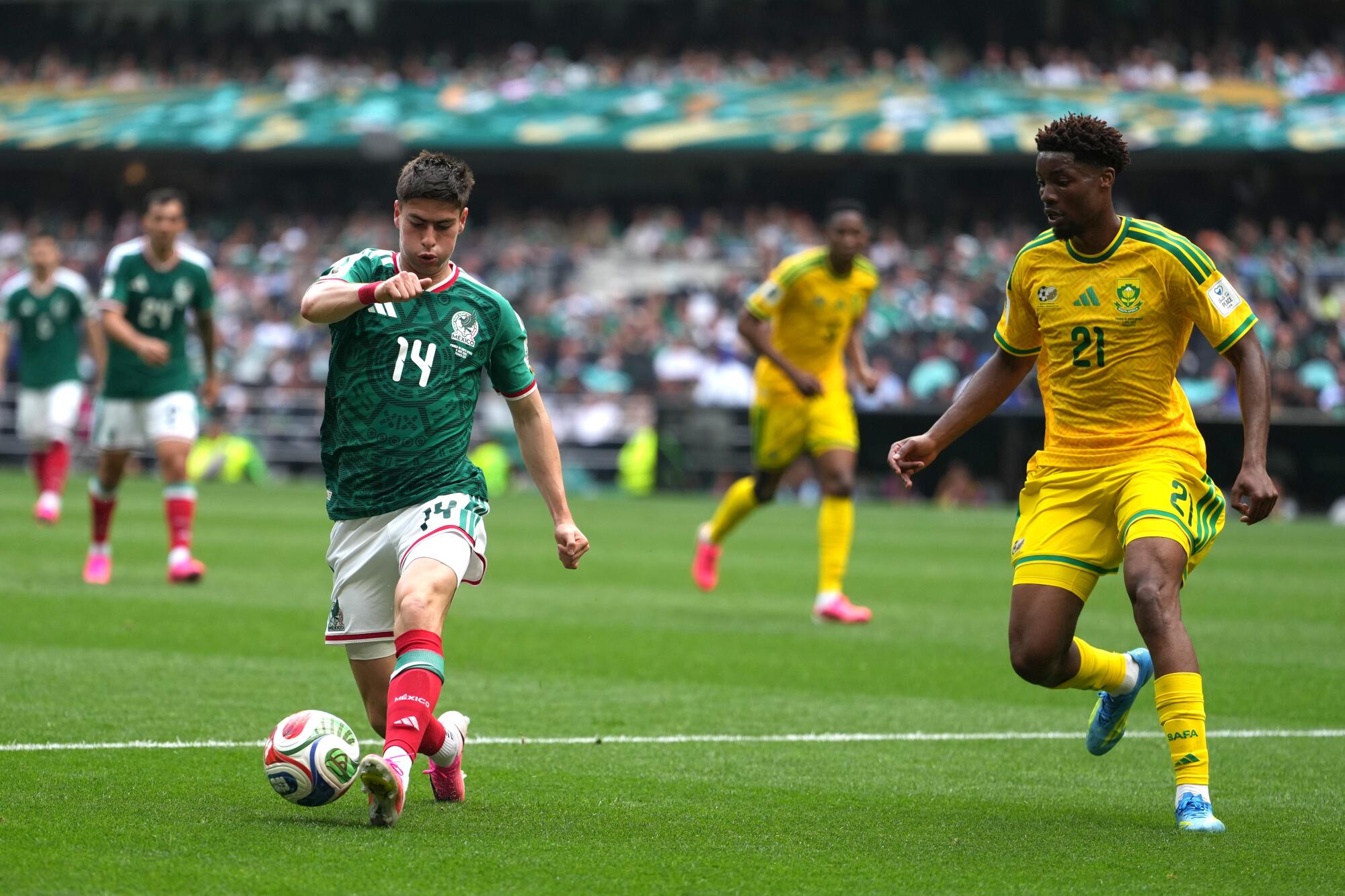
Mexico's Armando González controls the ball in front of South Africa's Ime Okon during on a World Cup match on June 11.

Mexico’s Armando González controls the ball in front of South Africa’s Ime Okon during on a World Cup match on June 11 at Azteca Stadium.

(Eduardo Verdugo / Ap Photo/eduardo Verdugo)

The winner of the match will face the winner of the contest between England and Congo on July 5 at Azteca Stadium.

Mexico has also been solid on defense, keeping three clean sheets while scoring six goals.

“We respect all our opponents,” said Mexico defender Jesús Gallardo, who sat out the last group stage match against Czechia. “We know this is the World Cup and every team is playing to win. We’ve won our three matches, and we’re proud of that. But we haven’t won anything yet. Ecuador has played well. We know they’re a very dynamic, very strong team.”

Erik Lira, Raúl Jiménez and Brian Gutiérrez will join Gallardo returning to the lineup after sitting out Mexico’s last match. Gutiérrez had a yellow card and was held out against Czechia to avoid a second yellow card and suspension. Gilberto Mora, 17, started in place of Gutiérrez and had a tremendous performance.

“We have to focus on what we do on the field; we want the fans to cheer us on,” Gallardo said. “We want to bring them a lot of joy.”

Following the convincing 3-0 victory over Czechia while resting some starters, the atmosphere on the Mexican team has been very relaxed, with several videos showing the players joking around with each other. Some of them have been training together for nearly two months because Aguirre arranged a monthlong training camp ahead of the World Cup.

“That’s why these past few months have gone by so quickly. Even though they’re always joking around, we know that we have a brother right beside us who would give his life for us,” González said.

On the other side, Ecuador arrives after advancing as one of the best third-place finishers, having closing Group E competition with four points — a stark contrast to its performance in the South American qualifiers, where Ecuador finished second only to world champion Argentina.

At the World Cup, Ecuador began the tournament with a tough last-minute loss to Ivory Coast and then failed to score against debutant Curacao. But when Ecuador had its back against the wall and needed to beat Germany in the final group-stage match, it pulled off a stunning upset, defeating the German team 2-1 to secure its spot in the next round.

That inconsistency makes Ecuador a wild card.

Mexico's Luis Romo celebrates with Jesus Gallardo, Erik Lira and Johan Vasquez after scoring against South Korea.

Mexico’s Luis Romo celebrates with Jesus Gallardo, Erik Lira and Johan Vasquez after scoring against South Korea during a World Cup match at Guadalajara Stadium on June 18.

(Silvia Izquierdo / Ap Photo/silvia Izquierdo)

“That’s what life is all about — having faith, having confidence. The team is very united,” said Sebastián Beccacece, Ecuador’s Argentine coach. “We’ve always remained calm and cautious in the face of adversity.

“The team is united, obviously full of enthusiasm and energy — like all national teams — but also tired, especially due to the schedule. Still, that’s no excuse. We’re driven by enthusiasm and the desire to make history; we’ll build our efforts on these foundations.”

Ecuador has also had to move quickly to plan for the match against Mexico. Following Thursday’s victory, Ecuador didn’t know it would be facing Mexico until Saturday morning. The team tried to travel to Mexico City on Sunday, but it ran into logistical problems and had to do so on Monday.

“Traveling to the Azteca Stadium is going to be a bit of a challenge,” Agustín Delgado, the all-time leading scorer for the Ecuadorian national team, said in an interview with Claro Sports. “That ultimately takes its toll in a match of this magnitude.

“This generation has what it takes for this World Cup and another one after that. They’re very young players. They haven’t reached their full potential yet; they have a lot to give.”

Unlike the game against Czechia, altitude won’t be as big a factor, since the Ecuadorian national team plays its home games in Quito, which sits at an elevation of 9,350 feet — making it the second-highest capital city in the world and more than 2,000 feet higher than Mexico City. It also has players who compete for clubs accustomed to playing at Mexican altitudes, such as Pedro Vite of Pumas and Enner Valencia of Pachuca.

Ecuador boasts proven talent such as Moisés Caicedo of Chelsea in England; William Pacho of Paris Saint-Germain in France; Piero Hincapié of Arsenal; and Joel Ordóñez of Club Brugge in Belgium.

“It’s a close match; there are star players on both teams,” said Álex Aguinaga, a former Ecuadorian player and Liga MX legend who is now a commentator for Fox Sports. “Ecuador’s defense is much more solid; it has players who handle the defensive zone very well.

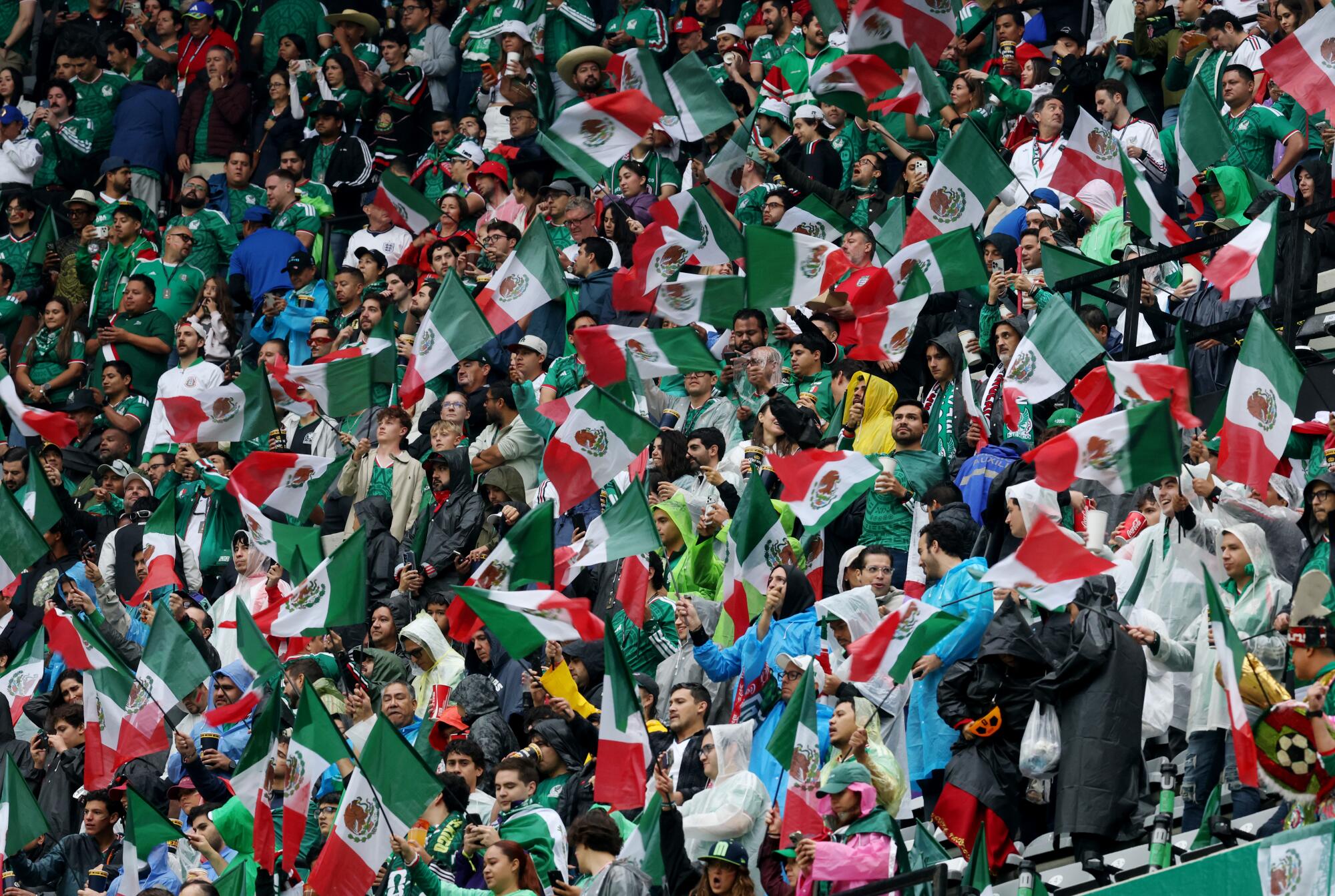
Mexico fans cheer during a World Cup game against Czechia at Azteca Stadium on June 24.

Mexico fans cheer during a World Cup game against Czechia at Azteca Stadium on June 24.

(Alex Slitz / Getty Images)

“It’s so close, but I think it’s going to come down to a single goal.”

Ecuador will also try to capitalize on the pressure stemming from the fact that Mexico has won only one match in its entire history in knockout rounds — in 1986 when it played at home against Bulgaria and won 2-0. Between 1994 and 2018, Mexico was eliminated in the second round of the World Cup on each of the last seven occasions it reached that stage.

Mexico has never lost a match at Azteca Stadium in a World Cup, and its last defeat in an official match was against Honduras in a qualifying match in 2013.

“I think right now all the opponents are going to be tough; none of them will be easy,” said Obed Vargas, an Atlético Madrid player who has come off the bench for Mexico. “We’re taking it one game at a time, but for me, we have to make it to the final.”

Source link

Guadalajara protesters accuse Hyundai of hiding behind World Cup

While Mexico defeated South Korea at Guadalajara Stadium on Thursday in front of an elated crowd, protesters outside expressed a very different view of the World Cup’s impact on the city.

Community leaders, climate advocates and workers took to the streets to protest what they describe as “greenwashing through sports” by one of the official sponsors of the World Cup amid allegations of irregularities in its supply chain.

The protest organizers argue that Hyundai-Kia should hold its supplier, Ternium, accountable and issue it a “red card.” Protesters accuse Ternium of human rights violations, including alleged links to the disappearance of two environmental activists.

The demonstrations began with a rally at 5 p.m. in Plaza de la Liberación. Participants sought to draw attention to cases of missing persons in Guadalajara, stating they went missing after protesting Ternium’s iron ore mining activities.

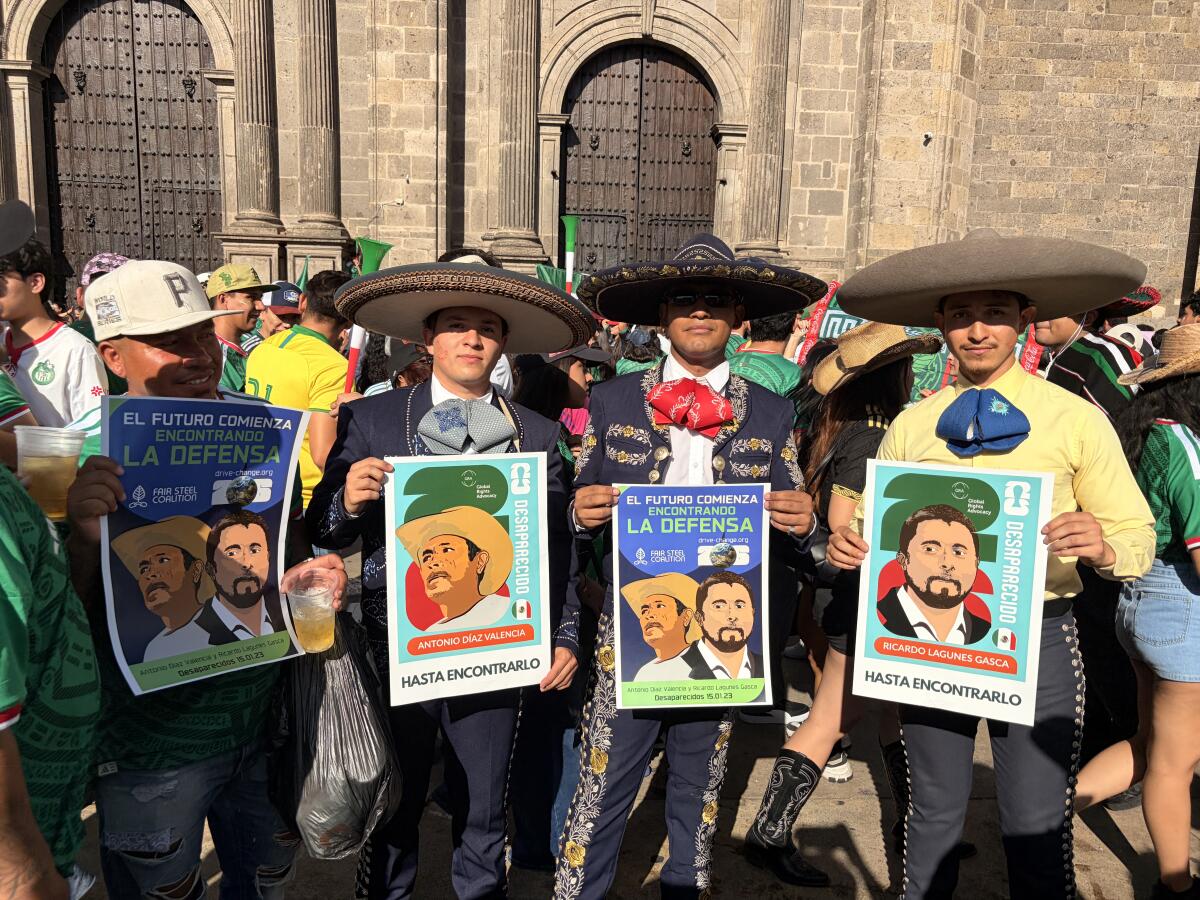
Mariachis hold posters commemorating the disappearance of two environmental activists in Guadalajara

Mariachis hold posters commemorating the disappearance of two environmental activists in Guadalajara: Ricardo Lagunes Gasca, a lawyer and human rights defender, and Antonio Díaz Valencia, a Nahua community leader and activist.

(Courtesy of Fair Steel Coalition)

A 2025 report by the environmental group Mighty Earth criticized Hyundai’s involvement in what it described as a “dirty steel supply chain,” as the South Korean automaker is one of Ternium’s main buyers of iron ore for use in steel production. Ternium has been the target of repeated criticism from activist groups for its alleged destructive environmental impact and corporate governance policies, as well as for the disappearance of activists Ricardo Lagunes Gasca and Antonio Díaz Valencia, which occurred three years ago in Mexico.

Ternium did not respond to the protesters’ allegations, while Hyundai did so in a statement.

“At Hyundai, we are committed to requiring our suppliers to meet the highest standards, and we enforce a strict Supplier Code of Conduct. Both we and our subsidiaries continue to conduct ongoing training, audits, and due diligence processes throughout the supply chain to identify and address potential issues across all our global operations,” said Michael Stewart, Hyundai’s director of communications.

Protesters carried signs bearing the names and photographs of environmentalists who disappeared.

More than 130,000 people have disappeared in Mexico in the past 20 years, according to the National Registry of Missing and Unlocated Persons. The kidnappings have been linked to run-ins with drug cartels and corrupt government officials, while there have also been cases involving young women who worked at the country’s many factories.

Protesters hold up signs featuring images of missing environmental activists ahead of Mexico's World Cup.

Protesters hold up signs featuring images of missing environmental activists ahead of Mexico’s World Cup match in Guadalajara.

(Fair Steel Coalition)

“[Hyundai] is trying to clean up its image through its sponsorship of the World Cup. But the facts are clear: Hyundai is linked to human rights and environmental abuses in Mexico, Brazil, the United States and other countries. By partnering with steel suppliers like Ternium, its slogan of ‘doing the right thing for humanity’ loses credibility,” said Diana Figueroa, a representative of the Fair Steel Coalition, one of the organizers of Thursday’s protests. She said the disappearance of a half dozen environmental activists in southern Mexico and deadly air pollution in Rio de Janeiro and Monterrey are attributed to Ternium.

The group plans to stage more protests throughout the World Cup.

On July 5, a symbolic soccer match and a concert will be held in Monterrey’s Fundidora Park to protest Ternium as one of the city’s most polluting companies.

On July 9, ahead of a World Cup quarterfinal match in Los Angeles, protests will focus on alleged human rights and labor rights violations in Hyundai’s supply chain, including reports of child labor, labor trafficking and documented prison labor.

Protesters also questioned Hyundai’s use of robots at World Cup venues and the tournament’s impact on local workers, including allegations of labor exploitation and rising housing costs in host cities. The organizations Public Citizen and Jobs to Move America demanded transparency from Hyundai regarding the type of data collected by the robots at World Cup stadiums.

Hyundai, in response to the allegations of data collection, said in a statement that it is focusing on the “Next Starts Now” campaign, in which it is “using mobility, robotics, technology, and engagement programs to connect people with the excitement of the event.”

Source link

Mexico set to kick off 2026 World Cup against South Africa

The Mexican national team will kick off the 2026 World Cup against South Africa on Thursday with the weight of entertaining 83,000 at iconic Azteca Stadium and soccer fans around the globe.

The match at the venue known as Mexico City Stadium during the World Cup will kick off at noon PDT and air on Fox and Telemundo.

Once the ball starts rolling, the stadium’s altitude — 7,216 feet above sea level — will be one of the biggest assets for the Mexican lineup led by coach Javier Aguirre.

It will be Mexico’s eighth opening match in a World Cup, and El Tri carries a historical burden. It has never won a tournament opener, with a record of 0-5-2, including a 1-1 draw against South Africa in the opening match of the 2010 World Cup in Johannesburg.

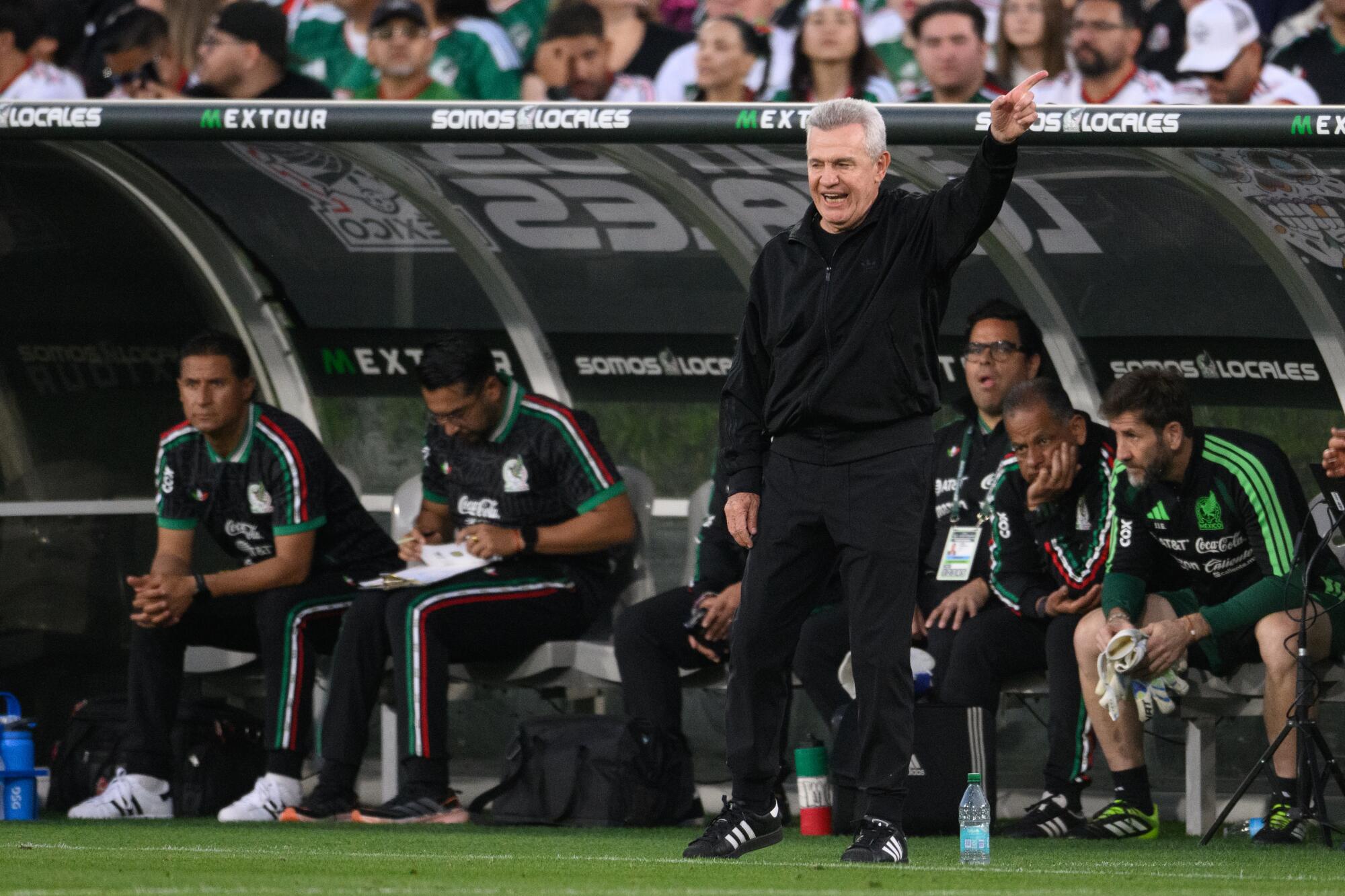
Mexico coach Javier Aguirre directs his players during a friendly against Australia on May 30 at the Rose Bowl.

Mexico coach Javier Aguirre directs his players during a friendly against Australia on May 30 at the Rose Bowl.

(Kyusung Gong / Ap Photo/kyusung Gong)

Aguirre will likely deploy the 4-3-3 formation he used during Mexico’s final warm-up match against Serbia.

“We’re ready; we’ve been working for 22 months,” said Aguirre, 67, who took the reins of the national team on Aug. 1, 2024, following Jaime Lozano’s failure at that year’s Copa América, when Mexico was knocked out in the group stage.

Since his arrival, Aguirre has led the team to its first Concacaf Nations League title and the Gold Cup. Mexico enters the tournament on an eight-game unbeaten streak, though several of those results came against lower tier opponents and at home. The two most encouraging highlights of that streak were the draws against Belgium and Portugal.

“If my teams are known for anything, it’s for their character,” Aguirre said. “My team is just like me.”

The starting goalkeeper position remains a topic of debate, but it appears Aguirre has already made his decision. Guillermo Ochoa, who will be playing in his sixth World Cup with Mexico, is considered by many to be the ideal experienced goalkeeper to use during the opener, when nerves are sure to be high. However, Raúl Rangel has been the starting goalkeeper during Mexico’s past three warm-up matches, playing the full 90 minutes each time.

Rangel, who was 10 years old when Mexico tied South Africa in the opening match of the 2010 World Cup and who fondly remembers El Tri’s victory over France that tournament, is confident between the posts.

Mexican goalkeeper Guillermo Ochoa shouts to his teammates during a friendly against Australia at the Rose Bowl.

Mexico could turn to veteran goalkeeper Guillermo Ochoa to calm nerves during the World Cup opener on Thursday.

(Ronaldo Bolanos/Los Angeles Times)

“We’re in great shape; we proved it against Portugal and Belgium, two teams that are among the world’s elite,” said Rangel, who noted that Ochoa has instilled a sense of calm in the team.

“I do believe we can be champions. We have to start keeping that in mind and believe that it’s possible. Not everyone can boast that they played in a World Cup on home soil.”

The Mexican team’s lack of elite club experience, however, is obvious and could be a problem. El Tri has few players in top-tier leagues and lacks game-changers on the wings, as Diego Lainez, Uriel Antuna and Hirving Lozano were left off the final roster. Offensive output is a cause for concern. In tight matches, goals have come mainly from defenders, with César Montes and Johan Vásquez being the primary threats on set pieces.

The commitment to youth appears to be a key factor in Aguirre’s approach to building the roster. Mexican American Brian Gutiérrez brings freshness and dynamism to the midfield, alongside Erik Lira’s energy. As an option off the bench, Aguirre could turn to 17-year-old Gilberto Mora, the youngest player in the tournament, who is sure to draw cheers from the crowd.

For his part, South Africa’s 74-year-old head coach, Hugo Broos, knows the Azteca Stadium well, having marked Maradona during the 1986 World Cup semifinals. To acclimate his players to the altitude, he held training camp in Pachuca, at an elevation of 7,979 feet.

“This game is special. I’ve played in European championships, but there’s nothing like a World Cup. And we’re going to play at the Azteca Stadium — it’s incredible that this is going to happen,” Broos said.

South Africa coach Hugo Broo talks with Nigeria's players during a World Cup qualifying match against Nigeria.

South Africa coach Hugo Broo talks with Nigeria’s players during a World Cup qualifying match against Nigeria in Bloemfontein, South Africa, on Sept. 9.

(Themba Hadebe / Associated Press)

He expects to be challenged by Mexico.

“They’re a very well-rounded team, with great mobility and teamwork,” Broos said of El Tri. “You can tell they want to be world champions.”

South Africa will pose a real threat with Mbekezeli Mokoena driving the midfield and the speed of Oswin Appollis and Relebohile Mofokeng on the wings. The team’s main weakness lies in finishing, as Lyle Foster is their only striker, and if he doesn’t perform well, the South African side will suffer.

“We can’t say we don’t have a chance against Mexico, because that’s not true,” said Broos about his team, which is ranked 60th in FIFA rankings and will tangle with a Mexican squad ranked No. 14.

Pregame entertainment will kick off at 10:30 a.m. PDT with performances by Shakira, Burna Boy, Maná, J Balvin, and Alejandro Fernández. As a new ceremonial feature, all 26 players from each team — starters and substitutes — will participate in the ceremony by lining up around the tournament’s central emblem on the field, rather than in the traditional pregame formation.

The match is expected to be played in the rain. Protests are expected around the stadium throughout the day, including demonstrations by the teachers’ union and groups representing the families of missing persons.

Source link

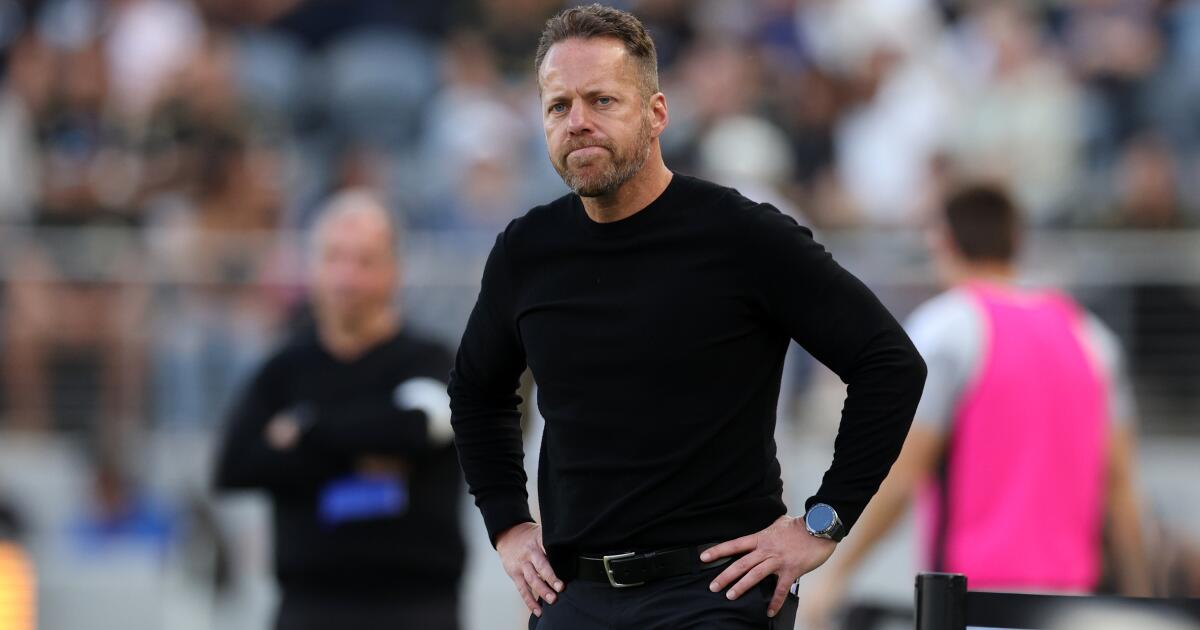
LAFC’s Marc Dos Santos to restore attacking identity after World Cup

Recent losses, outside criticism and a sense that the team’s identity has strayed from its original path have left LAFC in an uncomfortable position.

As the team prepares to host the Seattle Sounders on Sunday at BMO Stadium before a mandatory break for the World Cup, coach Marc Dos Santos shared his thoughts on the team’s adversity and goals for the future.

The coach said one of his main self-criticisms involved straying from the attacking identity he intended to build at LAFC since taking over as head coach.

“Outside criticism when the team loses isn’t that important to me because I’ve learned in my life that if you’re going to build a life based on what outsiders think of you, you’re going to be very unhappy,” Dos Santos said. “But in self-reflection, I’ll tell you one thing: I’m hard on myself. I believe we were building something with a clear identity, and after the series against Cruz Azul — in the Concacaf Champions League quarterfinals — I thought about switching to a three-man backline to defend more. I went in a more defensive direction, and I don’t want to be like that.”

The coach said the tactical change was the wrong move for LAFC.

“It was a mistake on my part, and it doesn’t reflect LAFC’s identity — it’s not what I want to build here,” Dos Santos said. “I want to make sure that this summer I thoroughly analyze what we need to change, and I have to stay true to LAFC’s identity.”

The comments come at a delicate time for LAFC, which has let potential MLS wins slip away despite showing competitive moments recently against St. Louis City SC and Nashville SC.

LAFC had hoped to once again be one of the dominant teams in the Western Conference, but offensive inconsistencies and tactical adjustments have led to questions about the coaching staff. The Los Angeles side sits in seventh place in the West with 21 points, eight points behind the leader, the Vancouver Whitecaps.

Dos Santos dismissed the idea that the problem is solely related to the tactical scheme and insisted that the most important change involves reclaiming aggressive principles with and without the ball.

“When we have the ball, we have to show the character to go after it — we can’t be afraid,” he said. “And when we don’t have the ball, we can’t just sit back. Look at one of the best teams in the world, Paris Saint-Germain F.C. Look at how they run without the ball. That’s soccer today.”

Amid this soccer overhaul, one of the most closely watched names remains Denis Bouanga. The Gabonese forward hasn’t made the same dominant influence as in previous seasons, though Dos Santos insisted that his relationship with the player remains solid and transparent.

“Denis knows what I want. I’ve always been very honest with him,” the coach said. “Last year we played a lot of games in a 3-5-2, defending a lot with Denis and Son [Heung-min,] but the club and I want to move to a different model. We’re all on the same page.”

Son Heung-min will temporarily leave LAFC after the match against Seattle to join South Korea’s training camp ahead of the World Cup, which will be played in the United States, Mexico and Canada.

The Asian forward said his full focus remains on this weekend’s match.

“I’m not thinking about that yet,” Son said of the World Cup. “The most important match is on Sunday. I just want to make sure we get a great result before heading to the World Cup and arrive in good physical condition.”

Son expects to be tested when South Korea travels to Mexico to play some of its World Cup matches.

“It’s not easy in Mexico, honestly,” he explained. “The altitude and conditions are different, but you have to love those big challenges. We’re really excited.”

As Son prepares to leave, LAFC faces a second-half schedule filled with intense competition. Following the match against Seattle, the club will return from the break to play against the rival Galaxy on July 17.

For Dos Santos, these challenges define the demands of managing LAFC.

“LAFC is a club that wants to win and whose fans want to see it win,” Dos Santos said. “Here, there’s always the responsibility to perform at a [high level]. If you don’t want to be in big games, you don’t coach at LAFC.”

The coach said external criticism isn’t influencing his plans.

“The pressure we feel is the pressure we put on ourselves,” Dos Santos said. “Pressure is when a doctor calls you and tells you you have a problem, or when your child has a problem. Soccer is a sport. You can win or lose. What you can control is improving the team during the week.”

Dos Santos said the World Cup break will serve as a key opportunity for internal analysis before redefining the club’s soccer direction. With the season barely halfway through, the coach said that regaining the team’s identity will be just as important as earning points when MLS returns in the summer.

This article first appeared in Spanish via L.A. Times en Español.

Source link