Shepard Fairey tells Mark Mothersbaugh he’s not afraid of AI art
Legendary street artist and activist Shepard Fairey was omnipresent at the High Desert Art Fair, which unfolded in and around Pioneertown over two unseasonably hot days last weekend. Founded more than seven years ago by art dealer Nicholas Fahey and artist manager Candice Lawler, the event has morphed from a few dozen people in Lawler’s living room to a few thousand roaming the dusty, sunny environs of the kitschy Old West town, with ancillary events in Twentynine Palms and Joshua Tree.
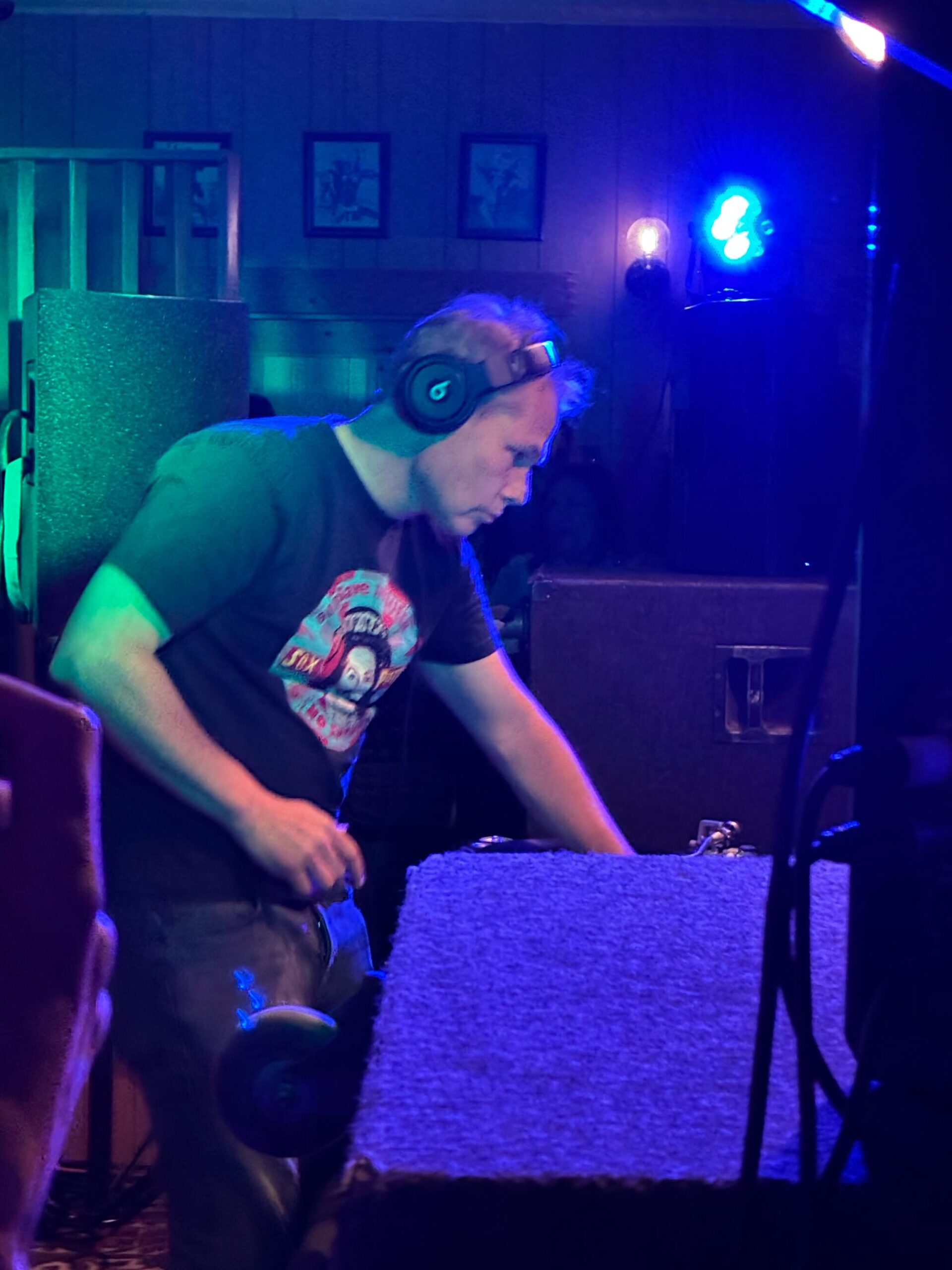
Fairey, who bought a home in the area during the COVID-19 pandemic, DJ’d a spirited opening night party at the Red Dog Saloon — spinning punk, post-punk and new wave hits by Joy Division, Fugazi and Black Flag to a packed house of art fans wearing paint-splattered DIY couture — and he spoke during the weekend’s most anticipated panel alongside Devo frontman and gallery owner Mark Mothersbaugh in a conversation moderated by singer-songwriter Harper Simon, son of folk icon Paul Simon.

Artist Shepard Fairey DJ’d the opening night party of High Desert Art Fair at the Red Dog Saloon in Pioneertown. The set was heavy of punk, post-punk and new wave.
(Jessica Gelt / Los Angeles Times)
Fairey was forthcoming about his opinions on art, politics and technology, drawing applause at one point for saying that using AI in art is not something to be afraid of. His assessment came after he lamented the fact that social media algorithms punish “decency” and reward “flamboyant narcissism and controversy.” He then joked that the “algorithm’s gonna love this. S— is gonna go nuts,” before talking about his recent collaboration with the digital artist known as Beeple who’s notorious in the art world for selling an NFT of his art in 2021 for $69.3 million.

The Red Dog Saloon was packed with art and music fans during the Friday night opening party of the High Desert Art Fair, which drew thousands of people to Pioneertown during the last weekend in March.
(Jessica Gelt / Los Angeles Times)
“He’s either the vanguard of a new way of working, and a maverick, a trailblazer, or he’s the worst thing that’s happened to art ever, or in between, or both, or neither,” Fairey said as the crowd laughed. “That’s totally my opinion.”
During a late-March event held in Fairey’s hometown of Charleston, S.C., Beeple Studios presented “Shepard Fairey: Obey and Resist,” which leveraged AI to help guests create their own Fairey-inspired paintings. During the panel, Fairey called the results “almost idiot-proof.”
He then elaborated on his feelings about AI’s encroachment on the art world, saying that if he were part of the “traditional art world thinking” he wouldn’t dare “go over to the dark side of digital art and AI, because that’s cheating.”
“All those same people a few hundred years ago when Da Vinci was using the camera obscura were like, ‘Get your proportions right, just by eye. Don’t use a cheating tool,’” Fairey said before taking the analogy to cave paintings and noting that those same types of naysayers would’ve been unhappy when it was discovered that horse hairs at the end of a stick were useful for distributing pigment and might have said, “That’s not keeping it real, bro. Use bloody elbow like everyone else.”
Fairey called that type of thinking “idiotic.”
“A tool in service of someone with a genuine vision that bends the tool to their will, rather than having themselves bent to the tool — that’s what creativity is about,” Fairey said.
The conversation about AI art started when Mothersbaugh, who was headlining a music set at Pappy & Harriet’s later that night, admitted that he was “fooling around with AI” and “just making myself laugh, like mutating old Devo photos and videos. It cracks me up. … I don’t know what is ever going to happen with it. Maybe they’ll just always live on my phone and eventually get thrown away or lost or something.”

The stage is set for an experimental music show by the General, featuring the stylings of Devo frontman Mark Mothersbaugh.
(Jessica Gelt / Los Angeles Times)
It’s a rock ‘n’ roll art fair
The idea that AI won’t cannibalize artists and their work on a massive scale is refreshingly utopian, but in many ways so was the fair itself. It takes magical thinking to grow anything in the harsh desert environment, which is why artists have been making the trek for decades. There was a youthful, rock ‘n’ roll vibe to the proceedings that was punk in quality but earnest in its quest to be seen.
Mothersbaugh’s gallery, MutMuz, occupied one of 20 rooms reconfigured as show spaces at the Pioneertown Motel, as did Gross!, a Chinatown gallery founded by former Liars drummer Julian Gross and populated with the work of musicians such as Karen O, O’s costume designer Christian Joy and TV on the Radio’s Tunde Adebimpe.

A work of painted fabric by Karen O‘s costume designer Christian Joy hangs in Gross! Gallery at the Pioneertown Motel during High Desert Art Fair. The gallery is owned by former Liars drummer Julian Gross who features plenty of work by fellow artists.
(Jessica Gelt / Los Angeles Times)
Desert pioneers are key to the spirit of the place
The fair featured tours of a number of the most interesting attractions in the area, including the Noah Purifoy Desert Art Museum of Assemblage Art in Joshua Tree and artist Andrea Zittel’s arts outpost and residency program, High Desert Test Sites.

Old computers are stacked at the center of an installation titled “Carousel” (1996) by Noah Purifoy at the Noah Purifoy Desert Art Museum of Assemblage Art in Joshua Tree.
(Jessica Gelt / Los Angeles Times)
Purifoy’s fantastical assemblages made of found objects and unloved detritus provided the most fitting example of the creative desert mindset. Outsider art in every sense of the word, and laden with scathing political and social commentary, Purifoy’s installations morph and change in the elements. A nonprofit exists to preserve them, but tour guide Teri Rommelmann said preservation efforts aren’t meant to alter the course of nature and time, but rather to save the work from sinking into the sand.

Noah Purifoy’s 2001 installation “White/Colored” is the most frequently vandalized piece in the outdoor Joshua Tree museum dedicated to his work.
(Jessica Gelt / Los Angeles Times)
Another aspect of the preservation work is erasing vandalism, which happened most during the pandemic, and was quite telling in its main target: An installation featuring a water fountain marked “White” next to a toilet affixed with a water fountain mouthpiece and labeled “Colored.”

Noah Purifoy’s sculpture “Ode to Frank Gehry” (2000) stands in the sand as part of the Noah Purifoy Desert Art Museum of Assemblage Art. The piece was once featured in a show at the Los Angeles County Museum of Art, and transporting it can be quite tricky.
(Jessica Gelt / Los Angeles Times)
At High Desert Test Sites, Zittel’s famous A-Z West escape pods are no longer used for camping after the city said the nonprofit would have to attain a commercial camping permit to continue. Nonetheless, the organization’s 80 acres are home to a variety of artist residencies, which use the windswept isolation of the desert to activate dormant ideas. It was just announced that environmental artist Lita Albuquerque will have a residency at the site.

Andrea Zittel’s famous A-Z West escape pods at High Desert Test Sites can no longer be used for camping, but they still dot the nonprofit’s 80 acres of land as an example of the creativity that the desert environment unleashes.
(Jessica Gelt / Los Angeles Times)

The tiled kitchen that artist Andrea Zittel designed for the main residence at High Desert Test Sites, which she lived in for nearly 20 years and can now be rented by artists in residence.
(Jessica Gelt / Los Angeles Times)
Art is everywhere in the desert — and growing
The success of this year’s High Desert Art Fair bodes well for the future of the area as a cultural destination.
Next year will see the return of Desert X, which for the first time will keep its large-scale, site-specific installations up for six months, timed to coincide with other SoCal cultural happenings including the Coachella Valley Music & Arts Festival and Frieze. There are also semi-permanent art installations everywhere in the area, including along driveways and the roadside. This includes a hair salon and museum in Joshua Tree, and the recently opened Reset Hotel in Twentynine Palms features dozens of rooms in retrofitted shipping containers, some with outdoor bathtubs and firepits. The hotel has also carved desert trails in its backyard, with plans to build an art park filled with installations.

The shipping container rooms at the new Reset Hotel in Twentynine Palms feature outdoor living spaces with firepits and bathtubs. Some overlook trails that will lead to a planned art park on the property.
(Jessica Gelt / Los Angeles Times)
An influx of artists, collectors and art fans will surely have an impact on an area that is already wary of gentrification and the rising cost of living that accompanies it. But there will be no stopping progress, only a utopian, Fairey-like hope that those who come will be inspired to keep and nurture the magical qualities of the place.