Moore

USC loses to Oregon in another letdown of the Lincoln Riley era

It was nearly a half decade ago now that Lincoln Riley, dressed in a slick blue suit and glossy cardinal tie, stood atop the Coliseum’s rooftop deck, grinning as he gazed out across the field below. He’d just been introduced as USC’s new head coach, and in that moment, anything felt possible for the future of Trojan football. Riley, at the time, was one of the most renowned young coaches in college football. And as he surveyed the scene, he painted the picture of a day when the Trojans were back on top and the Coliseum was hallowed ground once again.

“This place,” Riley said that day, “is going to be the mecca of college football.”

But less than five years later, as final seconds ticked away on a 41-27 loss to Oregon on Saturday, fans trudged towards the exits, and that very same stadium sat in hushed disbelief. The Trojans’ season wasn’t over by any means — not after a single loss to No. 20 Oregon — but in that moment, the future that Riley had envisioned felt as far away as ever.

There would still be chances for Riley and his Trojans to make their statement this season. But the stakes on Saturday had arguably never been higher for USC’s coach, who spent all off-season explaining how this season would be different. There were no more excuses, no more explanations for why USC was still falling short — even he seemed to agree to that. Everything he’d been pointing towards in the distance was now here, culminating all at once.

With a gauntlet of a Big Ten schedule ahead, there was no better time for Riley to prove he had USC moving in the right direction and no better matchup to help catapult the Trojans into College Football Playoff conversation than Oregon, its newest — and still maybe most bitter — rival. The whole college football world was watching, waiting to see if USC’s coach could deliver in the most critical of moments.

Instead, the Trojans found themselves in an all-too-familiar, all-too-painful position, one they’d experienced many times before during Riley’s tenure. Mistakes piled up. Ill-timed penalties, too. And worst of all, USC’s defense still couldn’t get a stop. It gave up 505 yards to Oregon, the third-most it had allowed over the past three seasons.

The Ducks would score on six of their last seven drives, almost all of which featured their backup quarterback at the helm. That was after Oregon star quarterback Dante Moore was knocked out of the game early in the second quarter following a brutal hit by USC linebacker Desman Stephens. The hit started a shoving match between players from both teams.

Stephens, who was seen celebrating after the play, was kicked out of the game, but remained on the sideline in the second half.

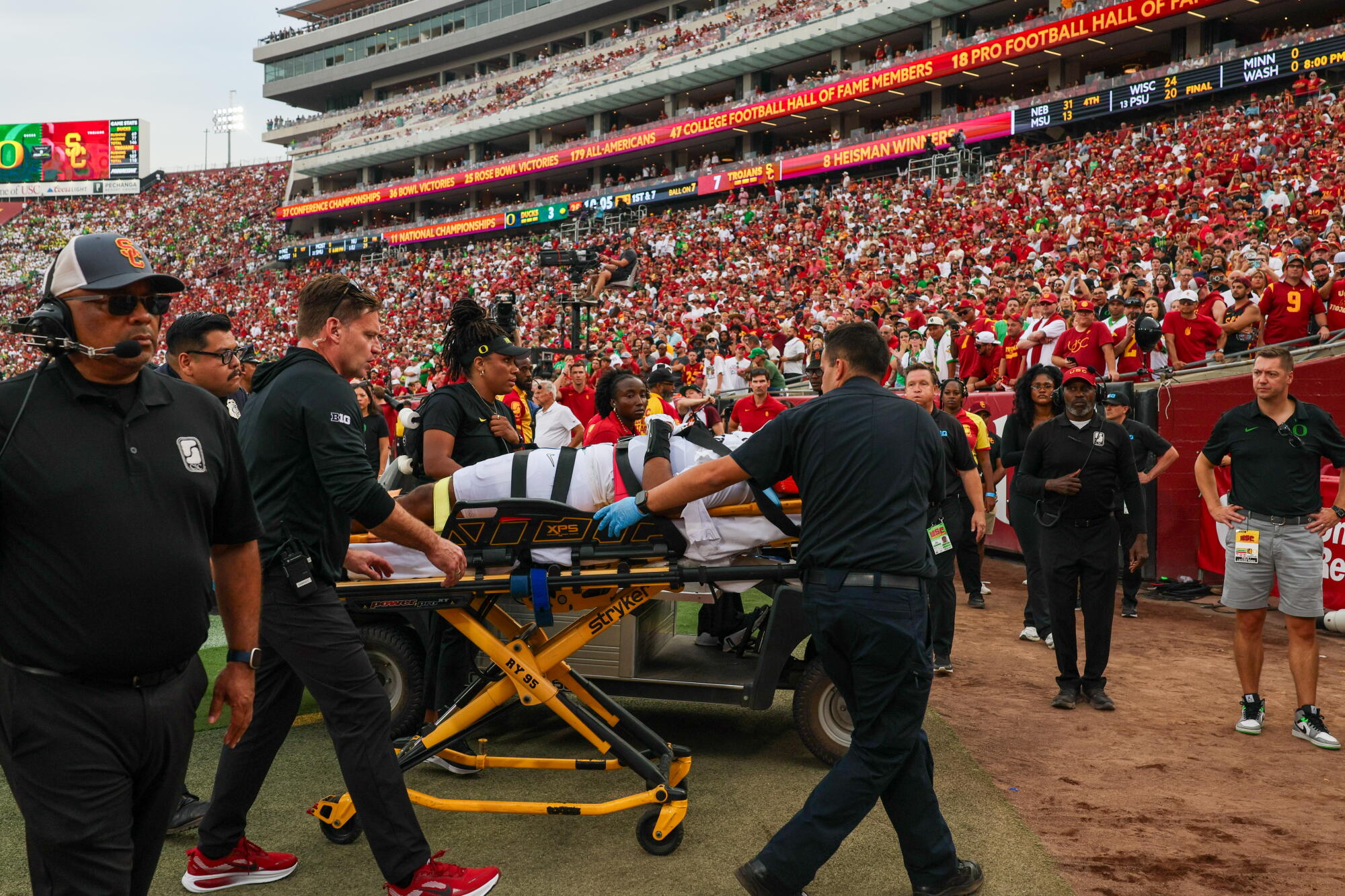
Oregon quarterback Dante Moore is taken off the field on a stretcher before being transported to the hospital.

Oregon quarterback Dante Moore is taken off the field on a stretcher before being transported to the hospital after taking a hit from USC linebacker Desman Stephens in the second quarter. Stephens was ejected from the game.

(Ronaldo Bolanos / Los Angeles Times)

The play would cast a pall over the whole game, but Raiola managed to throw for 289 yards and two touchdowns against USC’s defense. Jayden Maiava, meanwhile, had 326 yards and two touchdowns, but completed just 23 of 42 passes.

The rushing attack wasn’t much better, as the Trojans averaged a mere 3.6 yards per rush.

The afternoon began on a bitter note for USC. After marching down the field on a 13-play opening drive, a third-down sack forced the Trojans to settle for a field-goal attempt. But Caden Chittenden missed an easy kick wide right. It was just the latest in a string of recent special teams slip-ups for the Trojans.

The defense, however, would hold early. Even after Oregon running back Jordon Davison burst out of the backfield for a 45-yard run on the Ducks’ first play. Oregon finished that drive with a field goal, the only points either high-scoring offense managed in the first quarter.

Unable to get anything going on the ground, the Trojans turned to their stud freshman receiver to pace the offense. Five of Maiava’s first seven completions went to Kayden Dixon-Wyatt, one of which came on a 31-yard strike down the seam to the freshman, who reeled in a touchdown in spite of tight coverage.

USC quarterback Jayden Maiava passes during the first quarter against Oregon on Saturday.

USC quarterback Jayden Maiava passes during the first quarter against Oregon on Saturday.

(Ronaldo Bolanos / Los Angeles Times)

Oregon was mounting a response when Moore took off on a quarterback scramble. But as he slid, Stephens decked Moore with a direct hit to his helmet, even after he already gave himself up. Moore spent several minutes on the field before being loaded onto a cart and taken to Los Angeles General Medical Center by ambulance.

Raiola, the backup, would take the reins of Oregon’s offense in Moore’s place, leading the Ducks to the doorstep of the goal line. But once again USC’s defense stood tall in the red zone, holding Oregon to a field goal.

It wouldn’t have as much luck in the second half, as Raiola found a rhythm. He led the Ducks on two consecutive touchdown drives in just 11 total plays.

But USC responded with three straight scoring drives of its own, and even added a stop from its defense in between. The third — an 11-yard strike to Tanook Hines — tied the score 27-27 with less than 13 minutes remaining.

USC looked to have Oregon stopped in its tracks on the ensuing possession. Then, on a third-and-long incompletion, defensive tackle Jide Abasiri was flagged for rushing the passer. The penalty gave Oregon just the opening it needed. The Ducks scored five plays later, as Raiola lofted a prayer to the corner of the end zone that was answered by one of his wideouts, Dakorien Moore.

A failed fourth-down attempt for USC would all but end it, as Maiava’s desperation pass was swatted away, along with the Trojans’ hopes.
Source link

Christian Moore delivers for Angels in walk-off win over Twins

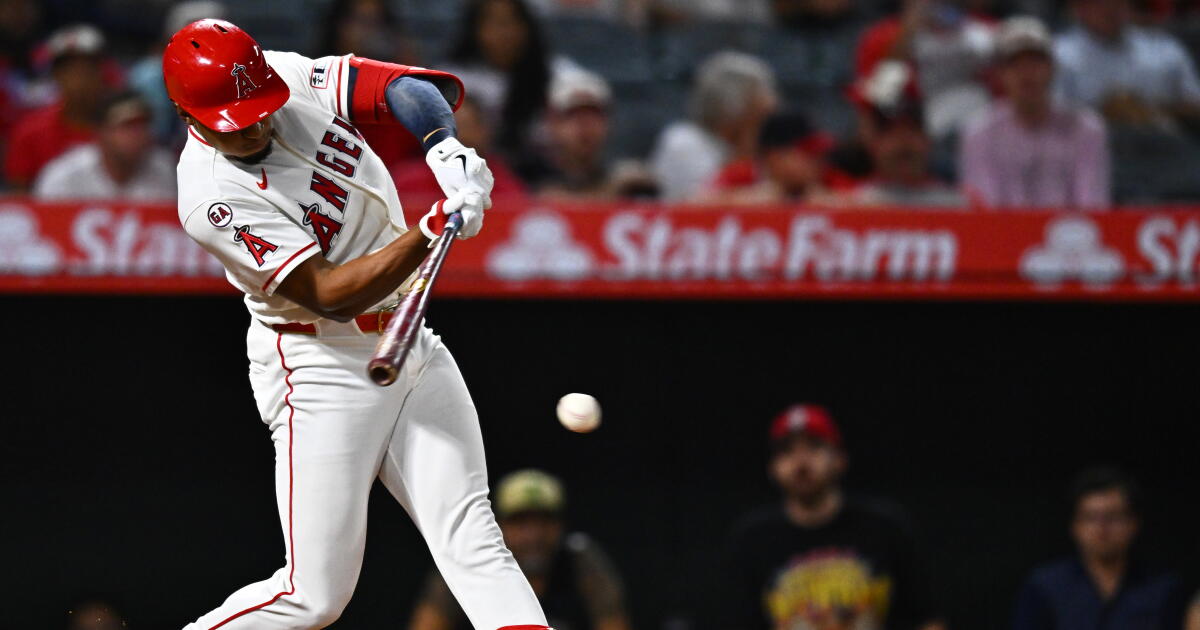
Christian Moore hit an infield single with two outs and the bases loaded that bounced off reliever Taylor Rogers’ leg to score Zach Neto and give the Angels a 6-5, 11-inning victory over the Minnesota Twins on Saturday night.

Vaughn Grissom hit a solo homer in the ninth off Twins reliever A.J. Minter to tie it at 5.

In the 10th with one out, the Twins’ Royce Lewis hit a shallow flyball out to Angels right fielder Josh Lowe. Ben Ross tagged at third, but Lowe’s strong one-bounce throw got to catcher Moisés Ballesteros in time for a sweeping tag of Ross at home to end Minnesota’s threat.

In the eighth, Angels’ pinch-hitter Adam Frazier doubled down the right-field line against reliever Yoendrys Gomez to drive in two runs to narrow the Twins’ lead to 5-4.

Angels reliever Tayler Saucedo (1-1) got the win an inning of scoreless relief. Rogers (6-4) took the loss in 1⅔ innings of work.

Minnesota remains technically still in the race for the American League wild card, but has almost no chance. The Twins are at least 6½ games behind five teams for the last wild-card spot with seven games remaining.

The Angels’ Jose Siri hit a two-run homer in the fourth and the Twins’ Ryan Kreidler launched a solo shot in the fifth.

Twins starter Joe Ryan gave up two runs and seven hits while striking out five in five innings.

Angels starting pitcher Reid Detmers lasted five innings, surrendering four runs and six hits while striking out five. He has 204 strikeouts this season, the most of any Angels pitcher since Shohei Ohtani had 219 in 2022.

Source link

Julianne Moore, Paul Giamatti on making the funniest scene of the year

Standing ovations at film festivals are a rite: part appreciation, part obligation, part a need to stretch your legs after sitting for a couple of hours.

But for an audience to explode and roar their approval in the middle of a movie? That rarely, if ever, happens.

Except it did, midway through the Telluride Film Festival world premiere of Jesse Eisenberg‘s delightful comedy “The Debut.” The applause followed a scene between Julianne Moore and Paul Giamatti that took its audience on such an exhilarating journey that there was almost no choice but to cheer in admiration, as if to say: What did we just see?

Sitting in the theater, Eisenberg, producer Emma Stone and Paul Giamatti looked at each other and asked themselves the same question but for a different reason.

“It was hard to process and, at the same time, just so affirming,” Eisenberg told me a couple of hours after the premiere.

The next day, sitting down to grab a quick bite with Moore and Giamatti, that giddy feeling had not dissipated, though, truth be told, they knew this scene was an all-timer from the moment they read it.

Let’s set the stage for you in a way that won’t spoil this constantly surprising film when it arrives in theaters in December and starts piling up acclaim and awards for all concerned.

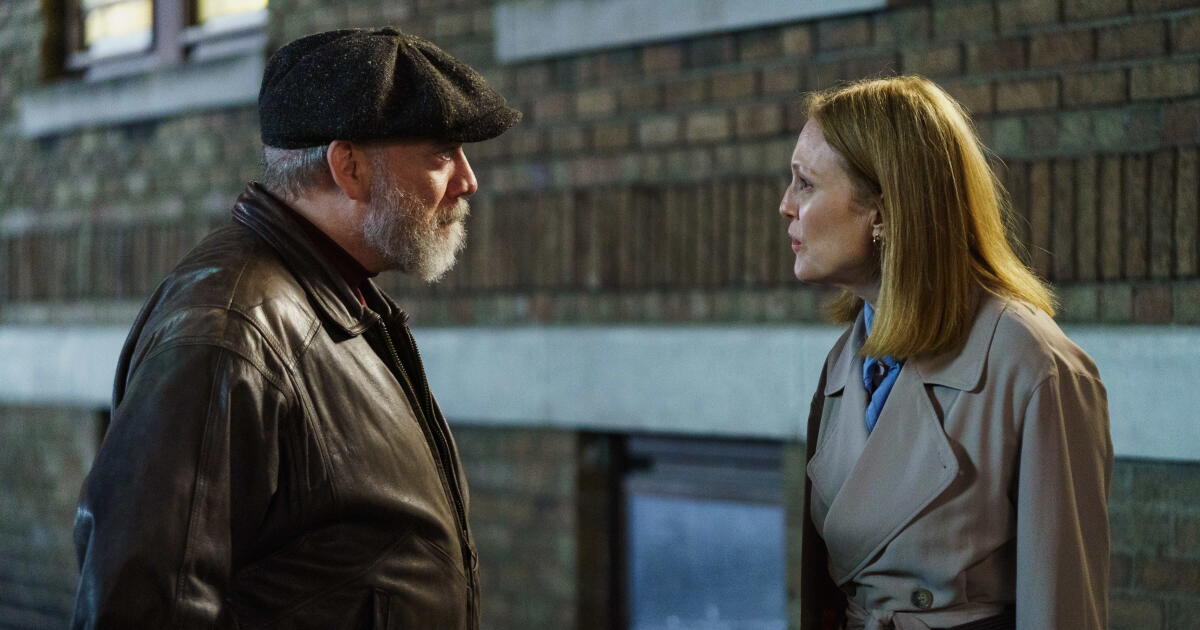
Moore plays Mona, a meek, thoroughly unseen wife and mother who impulsively decides to audition for a community theater production of a musical titled “Nosy Neighbors,” despite having no experience apart from singing in the church choir when she was 13. The director Jerry (Giamatti) cuts her tryout short, sending her home, only to relent when the woman he’d already cast (Bernadette Peters!) drops out and he has nowhere else to turn.

Mona is, as Moore puts it, a “nice lady.” But she’s not a natural performer. She can’t get into character playing Miss Danielle, the show’s tough, toolbelt-wearing building super. So Jerry takes Mona aside because that’s what he does. As her cast mates note, “He’s going to drag you through the s— and the mud and you have to be ready for the s— and the mud.”

It turns out, though, that Jerry is the one who isn’t ready for what’s about to happen. Sitting in a chair on the theater stage, Jerry holds an envelope containing cash, telling Mona that it’s her job to make him hand over the rent. It’s an acting-class exercise designed to make you listen, react and dig into your character’s truth. Moore begins with a whisper and builds to a roar as Mona improvises a manic rant that involves rats and the plague.

Suffice to say, Jerry hands over the rent.

“When I read that scene, I stood up, put my iPad down and started doing laps around my dining room table,” Moore remembers. “I couldn’t believe how beautiful it was. I was just like, ‘Oh my God! Aaaaaaagh!‘”

“It was five pages long,” Giamatti marvels. “Jerry just needs Mona to be better. And then he sees that maybe she could actually be kind of great. He cracks her open and he’s like, ‘Oh wow, who is this lady? Who the hell is this?’ The funny thing about that scene is s— like that happens in classes.” He turns to Moore. “Did that ever happen to you?”

“I had an audition for a university, actually, where they threw chairs in front of me while I did the monologue and made me climb over the chairs,” Moore says, laughing. “I look back on that now. I was 18 years old and I was like, “What?’ Yeah. It was really strange. They’re trying to get you to react authentically and be alive.”

She smiles at Giamatti. “Hopefully when you get to be our age, you don’t need that.”

Though the scene has Mona improvising, it was performed as written, down to every last pause.

“Everyone keeps asking if we improvised and I’m like, ‘Hell, no,’” Moore says. “Jesse’s like the Coens. Everything’s there on the page.”

Adds Giamatti, “It’s incredibly specific. You follow his punctuation. The commas matter in his writing.”

“What’s so f—ing delightful about about working with Paul is that his sense of timing and rhythm is so tight,” Moore continues. “That scene is a set piece that requires you to work in tandem and you need somebody to hit it back with the same intensity and the same speed.”

When Eisenberg first met Moore, he told her flat-out, “I don’t want you to worry about this scene.” He knew it was a bear, with pages and pages of lines, so he told her he’d have a teleprompter on set.

“That section, all that crazy s— she goes off on, that would be really hard,” Giamatti says.

“And I was like, ‘Phew, that’s fantastic,’ because I knew all I would do would be to worry about all those lines and be so scared,” Moore says. “But because he said that to me, I never worried. And I didn’t need the teleprompter.”

They shot the scene in one morning, just Moore and Giamatti alone on the stage with the rest of the crew downstairs in the video village. There was an energy on set, spiked by an unusual number of visitors (“People knew,” Giamatti says) and then they went to work.

“I remember the first time you really hit that speech and they called cut, I just couldn’t stop grinning,” Giamatti tells Moore. “And I reached out and just kind of held you for a second because I was like, ‘That was amazing.’ I wanted to convey just how great it was, what you were doing.”

Moore beams. “I just love him. Just love him, love him, love him. I have so much gratitude for Paul.”

“To watch you be a bad actor was so hilarious and then you would you would modulate it and change it,” Giamatti continues. “Watching her was the experience that Jerry was having. It was such a joy.”

The scene is the beginning of a simpatico relationship between Jerry and Mona, mentor and protege, predicated on the power of imagination and how it can make outcasts feel seen and heard.

“Everyone wants to be known as who we are, even though it’s so scary for us to really reveal it,” Moore says. “There’s a real mind-altering power in just being yourself.”

Source link