Modis

How US sinking of Iranian warship blew hole in Modi’s ‘guardian’ claims | Israel-Iran conflict

New Delhi, India — Dressed in a blue Navy uniform and sleek sunglasses, Indian Prime Minister Narendra Modi, in late October, addressed a gathering of the country’s sea warriors.

He listed out the strategic significance of the Indian Ocean — the massive volumes of trade and oil that pass through it. “The Indian Navy is the guardian of the Indian Ocean,” he then said, to loud, proud chants of “Long Live Mother India” from his audience.

Less than five months later, India has been shown up as a “guardian”, unable to protect its own guest.

On Wednesday, the Iranian warship, IRIS Dena, was torpedoed by a US submarine just 44 nautical miles off (81km) southern Sri Lanka, as it was returning home from naval drills hosted by India. During the “Milan” biennial multilateral naval exercise, Indian President Droupadi Murmu had posed with sailors from the Dena.

Yet it took the Indian Navy more than a day after the Iranian warship was struck to respond formally to the attack, which US officials made clear was a sign of how the Donald Trump administration was willing and ready to expand its war against Iran.

“An American submarine sank an Iranian warship that thought it was safe in international waters,” US Defense Secretary Pete Hegseth said at the Pentagon on Wednesday. “Instead, it was sunk by a torpedo. Quiet death.”

Tehran is furious over the attack on its warship hundreds of miles away from home. And Iran made sure to note that the IRIS Dena warship was  “a guest of India’s navy”, returning after completing the exercise it joined upon New Delhi’s invitation.

“The US has perpetrated an atrocity at sea, 2,000 miles [3,218km] away from Iran’s shores,” Iran’s foreign minister Abbas Araghchi said, referring to the sinking of the frigate. “Mark my words: The US will come to bitterly regret [the] precedent it has set.”

Now, the IRIS Dena is at the bottom of the Indian Ocean, and more than 80 Iranian sailors, who marched during joint parades and posed for selfies with Indian naval officers during their two-week visit, are dead.

What has also fallen, said retired Indian naval officers and analysts, is India’s self-image as a net security provider in the Indian Ocean. Instead, they said, the US attack on the Dena has exposed the limits of India’s power and influence in its own maritime back yard.

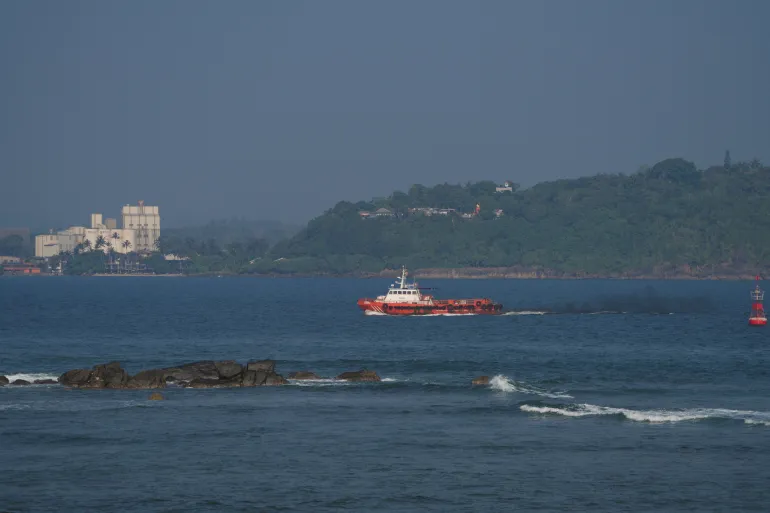
A vessel sails off the Galle coast after a submarine attack on the Iranian military ship, Iris Dena, off Sri Lanka, in Galle, Sri Lanka, March 4, 2026. REUTERS/Thilina Kaluthotage
A vessel sails off the Galle coast after a submarine attack on the Iranian military ship, Iris Dena, off Sri Lanka, in Galle, Sri Lanka, March 4, 2026 [Thilina Kaluthotage/Reuters]

‘War reaches India’s backyard’

After participating in the naval exercises, IRIS Dena left Visakhapatnam on India’s eastern coast on February 26. It was hit in international waters, just south of Sri Lanka’s territorial waters, in the early hours of March 4, local time.

In response, Sri Lankan Navy rescuers recovered more than 80 bodies and picked up 32 survivors, reportedly including the commander and some senior officers from the warship. More than 100 men are still missing.

In a tweet welcoming the Dena to the naval drills, the Indian Navy’s Eastern Command had posted: “Her arrival … [reflects] long-standing cultural links between the two nations [Iran and India]”.

Vice Admiral Shekhar Sinha, the former vice chief of India’s naval staff, told Al Jazeera that he attended the Iranian parade at the function.

“I met and really liked them, especially their march for sailors travelling thousands of miles,” Sinha said. “It is always sad to see a ship sinking. But in a war, emotions don’t work. There’s nothing ethical in a war.”

Sinha said that the Indian Ocean — central to the strategic and energy security of the nation with the world’s largest population — was thought to be a fairly safe zone earlier. “But that is not the case, as we are learning now,” he told Al Jazeera.

“The unfolding battle [between the US and Israel on the one hand, and Iran on the other] has reached India’s back yard.
New Delhi has to be concerned,” Sinha, who served in the Indian Navy for four decades, added. “The liberty we enjoyed in the Indian Ocean has apparently shrunk.”

iris dena
Security personnel stand guard as an ambulance enters inside the Galle National Hospital, following a submarine attack on the Iranian military ship, IRIS Dena, off the coast of Sri Lanka, in Galle, Sri Lanka, March 5, 2026 [Thilina Kaluthotage/Reuters]

India’s Catch-22 situation

Only on Thursday evening did the Indian Navy issue any formal statement on the attack — more than 24 hours after the Dena was hit by a torpedo.

The Navy said that it received distress signals from the Iranian ship and had decided on deploying resources to help with rescuing sailors. But by then, it said, the Sri Lankan Navy had already stepped to lead the rescue effort.

Neither New Delhi nor the Navy has criticised — even mildly — the decision by the US to sink the Iranian warship.

Military analysts and former Indian naval officers say India is caught in a classic catch-22: Was India aware of the incoming US attack in the Indian Ocean on an Iranian warship, or was it blindsided by a nuclear-submarine in its backyard?

Admiral Arun Prakash, the former chief of India’s naval staff, told Al Jazeera that if New Delhi was blindsided, “it reflects on the US-India relationship directly.”

“If it is a surprise, then that’s a great concern since we have a so-called strategic partnership with the USA.”

And if India knew about the attacks, it would be seen by many as strategically siding with the US and Israel over their war on Iran.

C Uday Bhaskar, a retired Indian Navy officer and currently the director of the Society for Policy Studies, an independent think tank based in New Delhi, said that the US sinking an Iranian warship in the Indian Ocean muddies the Indian perception of itself as a “net security provider” in the region.

Bhaskar said the incident is a “strategic embarrassment” for India and weakens New Delhi’s credibility in the Indian Ocean, while its moral standing “takes a beating” because of the Indian government’s near-silence.

IRIS Dena
An injured Iranian sailor is moved on a stretcher at Galle National Hospital, where the sailors are receiving treatment, following a submarine attack on the Iranian military ship, IRIS Dena, off the coast of Sri Lanka, in Galle, Sri Lanka, March 5, 2026 [Thilina Kaluthotage/Reuters]

‘India on aggressor’s side’

In the post-colonial world order, India was a leader of the non-alignment movement, the Cold War-era neutrality posture adopted by several developing nations.

India now no longer calls its approach non-alignment, instead referring to it as “strategic autonomy”. But, in reality, it has inched closer to the United States and its allies, most importantly, Israel.

Merely two days before the US and Israel bombed Iran, Modi was in Israel, addressing the Knesset and warmly hugging Prime Minister Benjamin Netanyahu, who called his Indian counterpart a brother.

But Iran, under the late Supreme Leader Khamenei, was a friend of India as well, with New Delhi making strategic, business, and humanitarian investments in the country.

However, Modi has not said a word in condolence after Khamenei’s assassination. On Thursday, Indian Foreign Secretary Vikram Misri visited the Iranian embassy in New Delhi to sign a memorial book. Indian governments normally deploy ministers — not bureaucrats or diplomats — for such sombre occasions.

It is against that backdrop that India’s response to the attack on the Dena has come under scrutiny.

Because the frigate was hit when it was in international waters, India had “no formal responsibility”, said Srinath Raghavan, an Indian military historian and strategic analyst.

“But the US Navy’s actions underline both the spreading geography of this war and the sharp limits of India’s ability to manage, let alone control, its fallout,” Raghavan told Al Jazeera.

Diplomatically, India has “objectively positioned itself on the side of the aggressors in this war,” he said, by “acts of commission — visit to Israel on the eve of war — and of omission, with not even [an] official condolence, let alone condemnation, of the assassination of the Iranian head of state.” Modi visited Israel on February 25-26.

Mallikarjun Kharge, the president of India’s opposition Congress party, said the Modi government had recklessly abdicated “India’s strategic and national interests”. And the government’s silence “demeans India’s core national interests and destroys our foreign policy, carefully and painstakingly built and followed by successive governments over the years.”

In addition, Raghavan highlighted that Modi has only criticised Iran’s retaliation, which threatens to drag the Gulf region to the brink of war.

“It is difficult not to conclude that India has drastically downgraded its interests in the relationship with Iran,” he said.

“All of this detracts from India’s credibility as a player in the region and will have short and long-term consequences for the equities in West Asia [as the Middle East is referred to in India],” Raghavan told Al Jazeera.
Source link

In Modi’s India, scandal still embarrasses but rape has become ordinary | Sexual Assault

As court documents tied to the late financier Jeffrey Epstein continue to surface, the scandal has become an international embarrassment, exposing how quickly powerful men can turn into reputational liabilities. That discomfort reached New Delhi, where Microsoft cofounder Bill Gates was expected to deliver the keynote address at the AI Impact Summit but ultimately did not attend amid criticism and apparent unease within the Modi government over his past meetings with Epstein. The spectacle was revealing. Public moral outrage travels swiftly when scandal threatens reputations and diplomatic optics. Yet that sensitivity to association sits uneasily beside a domestic reality in which sexual violence against women unfolds with brutal regularity, drawing neither comparable embarrassment nor consequence. The contrast is grotesque. A political culture capable of signalling discomfort towards a global scandal remains strikingly untroubled by the everyday brutality faced by women at home.

Under the Modi administration, the news cycle churns with reports of gang rapes like factory output — steady, relentless, and numbing in repetition. The rapes have become so common that they are reported like the weather. Heatwave deaths. Flash flood. Five-year-old abducted, raped, murdered. And like the weather, only God is responsible. Not the rapist. Not the court. Not the police. Definitely not the prime minister.

Between the time this piece was commissioned and published, a five-year-old was gang-raped in Meerut, a 26-year-old was gang-raped in Faridabad, and a 17-year-old was gang-raped in Odisha. A 42-year-old was gang-raped in Delhi’s suburbs. A 12-year-old girl was kidnapped and gang-raped in Bikaner. There were more gang rapes in Bihar, Chhattisgarh, Rajasthan, and Kanpur. I could give you statistics, but numbers could never convey the larger, all-encompassing terror of living with predators. The threat of sexual violence is as constant as gravity. The cases are gruesome — intestines pulled out, rods inserted, tongues cut out, acid thrown, decapitation, strangulation, and burning. When I look at government data about rape — an average of 86 women are raped every day — it feels as grisly as stumbling upon a mass grave in Excel sheets.

Prime Minister Narendra Modi and his home minister, Amit Shah, ostensibly obsessed with restoring law and order at any cost, seem entirely unconcerned that India is the gang rape capital of the world on their watch.

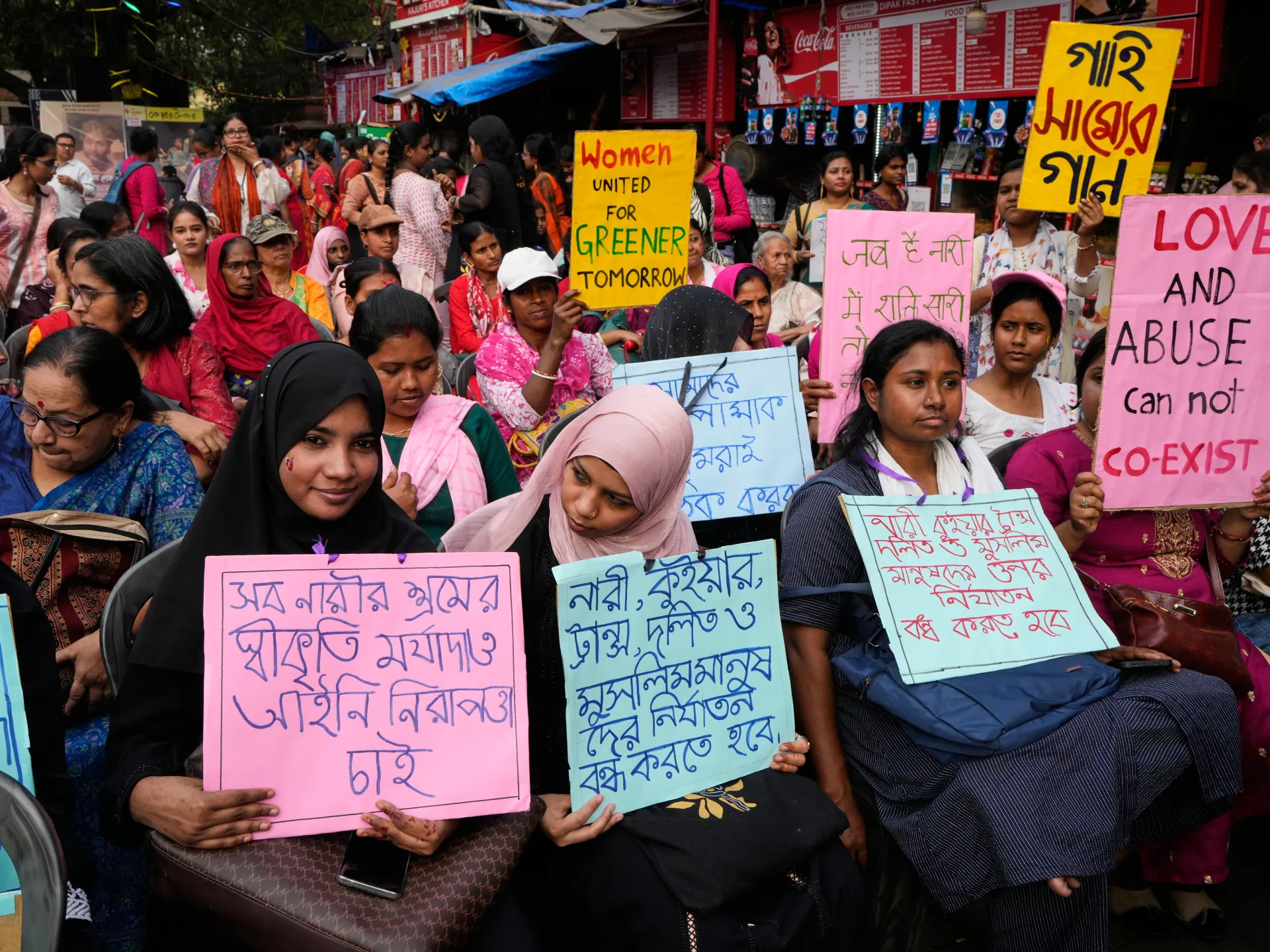
The most alarming instance of this was when convicted rapist and Bharatiya Janata Party politician Kuldeep Singh Sengar, found guilty of raping a minor in 2017 and a native of Makhi village in Unnao district of Uttar Pradesh, was granted bail by a high court, raising the possibility of his reintegration into the very social and political landscape that had once enabled his impunity. A high court granted him bail in December. Thankfully, it was stayed by the Supreme Court, but only after infuriated women gathered in Delhi to protest. Sengar had raped a teenager, who was also gang-raped by his associates. Her father was murdered in police custody. A case was registered only after she threatened to burn herself in front of the chief minister’s residence. Her tragic story showcases how Indian men, like the Modi administration, remain remarkably unembarrassed about the state of affairs.

Sadly, this is not an aberration; it is the system speaking in its mother tongue.

Public memory matters because each new case unfolds against the residue of the ones we were told would change everything. In 2012, I read about the “Nirbhaya” gang rape three days after the incident, on my way from the airport. I had been deliberately avoiding the news until she ended up at Safdarjung Hospital, and my editor needed a health update from me. After I learned all the details of what men had done to this young woman, I thought the world would stand still. A threshold had been crossed. Something told me the world would start anew. There were protests, and people everywhere would know her name, and something like this would never happen again.

All of my naivety was drowned in a chorus of “Not All Men”, as the gang rape was turned into something viral to hang a hashtag on. The refrain did not defend innocence so much as redirect attention away from accountability and back towards male comfort.

It is impossible for me to hear of such cases and not think: What if it were me? My body. That rod. Those men. The suffering and mutilation of women’s bodies is so reliable that there is now a market to help ease our fear. Security apps. Pepper sprays and wearable panic alarms. Every time I write about this subject, I sit with the absolute inadequacy of the written word in the face of men who film the rapes, brag about them, and get rehabilitated nevertheless.

It wouldn’t be out of place to call this moment unprecedented, but it is beyond that. It is existential. Whether it is the United States or India, women are watching the same choreography of power protecting itself, as men of consequence close ranks and wait out the storm. The similarity lies not in scale or context, but in the recurring spectacle of institutions cushioning powerful men while survivors fight alone. For a while now, both countries — allegedly the biggest and the oldest democracies — have been on a trajectory of self-destruction, with men leading the way. Under Modi as well as Trump, rape has become an extension of politics. Women are violated no longer by men alone, but by courts, hospitals, and newsrooms, too. It is the age of monsters. It did not begin with Epstein, Gates, or Sengar, of course, but they are the symbols of it.

While the middle class was busy buying into the dream of upward mobility, careerism, and two bedrooms in a gated suburb, we let thugs cultivate a wholesale misogynist empire that runs on hate for women. I do not know what to do with the rage I feel. What do you do when you are constantly told that your body, your people, your gender are disposable? I don’t know.

What I do know is that the teenager who survived Sengar is still fighting for justice. I know that the survivors of Epstein’s sex trafficking network are fighting for justice, too. These women are fighting with heart and soul and sweat and muscle. I know that I have no right to be despondent while they stand tall, looking every inch the hero they are. I also know that nobody puts up a fight like that unless you love your sisters.

At this dark hour, it feels important to place on record that as the Modi administration recoils theatrically from the shadow of the Epstein scandal at the summit stage, the satire writes itself. A government that cannot, or will not, protect its women should be far more ashamed of what is ordinary than of what is scandalous.

The views expressed in this article are the author’s own and do not necessarily reflect Al Jazeera’s editorial stance.

Source link

Epstein’s shadow: Why Bill Gates pulled out of Modi’s AI summit | Technology News

Microsoft founder Bill Gates has cancelled his keynote speech at India’s flagship AI summit just hours before he was due to take the stage on Thursday.

Gates, who has faced renewed scrutiny over his past ties to the late sex offender Jeffrey Epstein, withdrew to “ensure the focus remains on the AI Summit’s key priorities”, the Gates Foundation said in a statement.

Recommended Stories

list of 4 itemsend of list

The five-day India AI Impact Summit 2026 was meant to showcase India’s ambitions in the booming sector, with the country expecting to attract more than $200bn in investment over the next two years.

India’s Prime Minister Narendra Modi had billed the summit as an opportunity for India to shape the future of AI, drawing high-profile attendees, including French President Emmanuel Macron and Brazilian President Luiz Inacio Lula da Silva.

Instead, it has been dogged by controversy, from Gates’s abrupt exit to an incident in which an Indian university tried to pass off a Chinese-made robotic dog as its own innovation.

So, what exactly went wrong at India’s flagship AI gathering and why has it drawn such intense scrutiny?

Why Gates’s appearance became an issue

Bill Gates was due to deliver a short but high-profile speech highlighting the opportunities and risks posed by artificial intelligence.

However, in recent weeks, several opposition figures and commentators in Indian media weighed in after emails featuring his name were released in the Epstein files in late January, questioning whether his presence was appropriate.

Despite the discussion, all appeared to be proceeding as planned earlier in the week. On Tuesday, the Gates Foundation’s India office posted on X that Gates would attend the summit and “deliver his keynote as scheduled”.

Then, on Thursday, hours before the scheduled speech, it released a statement saying that “After careful consideration, and to ensure the focus remains on the AI Summit’s key priorities, Mr Gates will not be delivering his keynote address.”

It added that Ankur Vora, president of the Gates Foundation’s Africa and India offices, would deliver the speech instead.

Bill Gates was named in documents related to Epstein released in January by the US Department of Justice.

In a draft email included among the documents, Epstein alleged Gates had engaged in extramarital affairs and sought his help in procuring drugs “to deal with consequences of sex with Russian girls”.

It was unclear whether Epstein actually sent the email, and Gates denies any wrongdoing.

The Gates Foundation, in a statement to The New York Times, called the allegations “absolutely absurd and completely false”.

What has India’s government said?

Very little.

Despite criticism and calls from opposition figures to explain the invitation to Gates, the Indian government has not directly addressed the controversy that culminated in Gates’s withdrawal.

While unnamed government sources told local media he would not attend the summit, officials stopped short of explaining why.

Asked about Gates’s participation, Information Technology Minister Ashwini Vaishnaw declined to give a clear answer to reporters, while Modi made no reference to the issue in his public remarks.

Why are the Epstein files a sensitive subject for India?

The controversy surrounding Gates’s planned participation comes close on the heels of a series of disclosures in the Epstein files that have forced the Modi government on the backfoot.

In one email to an unidentified individual he referred to only as “Jabor Y”, Epstein referred to Modi’s historic visit – the first by an Indian prime minister – to Israel in July 2017.

Epstein wrote: “The Indian Prime minister modi took advice. and danced and sang in israel for the benefit of the US president. they had met a few weeks ago.. IT WORKED. !”

Modi’s visit to Israel – and his subsequent embrace of the Benjamin Netanyahu government, with military, intelligence and other ties strengthened over the past decade – had already drawn criticism from the opposition Congress party and others, who have accused him of reversing decades of Indian support for the Palestinian cause. India was the first non-Arab nation to recognise the Palestine Liberation Organization in 1974, and did not establish full diplomatic relations with Israel until 1992.

But the Epstein email turbocharged the opposition criticism of Modi’s Israel policy – with questions now also asked about whether it was influenced by Washington.

The Indian Ministry of External Affairs dismissed the Epstein email in an unusually sharply worded statement.

“Beyond the fact of the prime minister’s official visit to Israel in July 2017, the rest of the allusions in the email are little more than trashy ruminations by a convicted criminal, which deserve to be dismissed with the utmost contempt,” spokesperson Randhir Jaiswal said.

But the Epstein cloud continues to hover over India.

The files also show that India’s current oil minister, Hardeep Singh Puri, exchanged dozens of emails with Epstein after he joined Modi’s Bharatiya Janata Party in 2014.

In many of them, Puti appears to be taking Epstein’s help in getting US investors, such as LinkedIn’s Reid Hoffman, to visit India. In others, he appears to suggest that he had a fairly comfortable personal relationship with Epstein.

“Please let me know when you are back from your exotic island,” Puri wrote in December 2014, for instance, asking to set up a meeting in which Puri could give Epstein some books to “excite an interest in India”.

Puri, in a new conference, has claimed that he only met Epstein “three or four times”, but the Congress party has argued that the emails suggest a much closer relationship.

Gates’s work in India

The Gates Foundation has long been a key partner in India’s public health and development sectors, backing major vaccination drives, disease prevention campaigns and sanitation programmes.

At the same time, he has had vocal critics, including environmental activist Vandana Shiva, who has argued that Gates’s brand of “philanthro-imperialism” uses wealth to control global food systems.

Gates also faced heavy criticism after a 2024 podcast in which he said India was “a kind of laboratory to try things … that then, when you prove them out in India, you can take to other places” when discussing development programmes and the foundation’s work there.

‘Orion’ the robodog and other controversies

Beyond the fallout over Bill Gates’s cancelled keynote, the AI Impact Summit has faced several controversies.

One incident involved a robotic dog named “Orion”, which Galgotias University, based in the New Delhi suburban town of Greater Noida, presented as its own innovation.

Online users quickly identified the machine as a commercially available Chinese-made model, prompting organisers to ask the institution to vacate its stall.

The event also drew criticism on its opening day after facing logistical issues, including long queues and confusion over entry procedures, according to local media.

On Wednesday, large crowds were seen walking for miles after police cordoned off roads for VIP access.

Dhananjay Yadav, the CEO of a company exhibiting high-tech wearables, made headlines after he reported on social media that devices had been stolen from the company’s stand.

The Times of India later reported that two maintenance workers at the event had been arrested for allegedly stealing the wearables.

Source link