Modern Day Marine 2026

New Cruise Missile-Armed MV-75 Tiltrotor Concept For The Marines Shown Off

Bell has put forward a new concept for a next-generation tiltrotor aircraft armed with anti-ship cruise missiles and other munitions for the U.S. Marine Corps. The design is based on what has been newly named the MV-75A Cheyenne II, which is in development for the U.S. Army. This comes as the Corps has said “everything is on the table” as it starts to formulate a new vision for what will succeed its AH-1Z Viper and UH-1Y Venom helicopters.

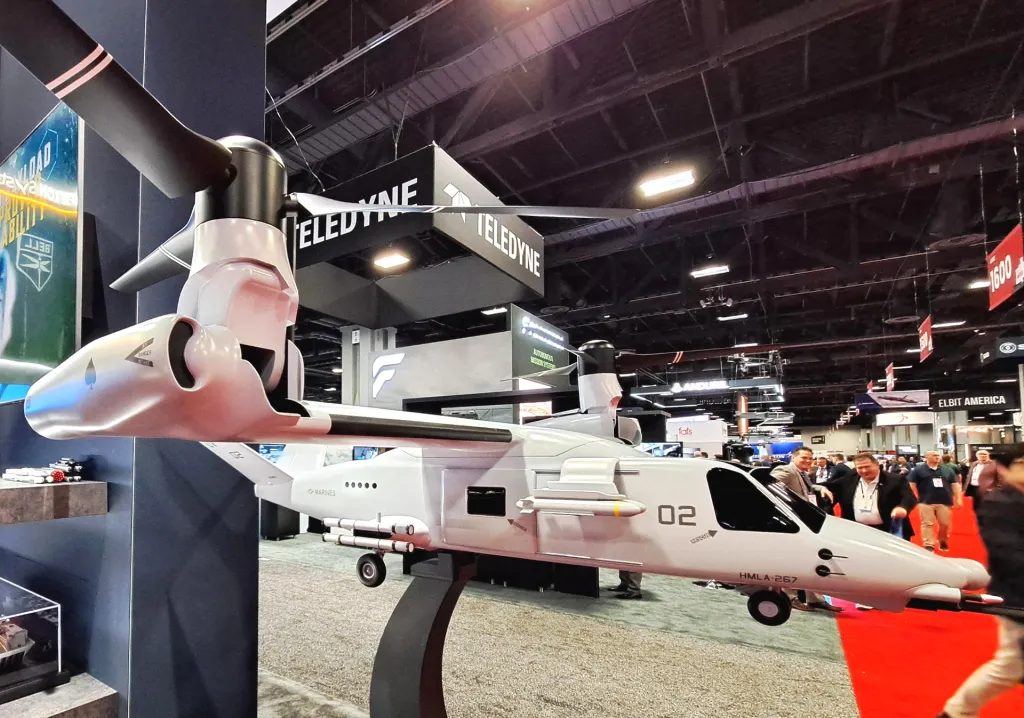
A model of the new armed MV-75 concept for the Marines is currently on display at the annual Modern Day Marine conference in Washington, D.C., at which TWZ is in attendance. It is painted in the markings of Marine Light Attack Helicopter Squadron 267 (HMLA-267), a unit currently equipped with AH-1Z and UH-1Y helicopters, which perform attack and armed utility mission sets, respectively.

Another view of Bell’s new MV-75 concept model at this year’s Modern Day Marine. Eric Tegler

The model’s most immediately eye-catching details are its armament. This includes two stub wings, each with a single pylon, mounted on either side of the top of the forward fuselage, situated between the main wing and the cockpit. A Naval Strike Missile (NSM), a stealthy anti-ship cruise missile with secondary land capability, is loaded on the left side. The Marine Corps is already fielding NSM in a ground-launched configuration. The missile is also in U.S. Navy service as a sea-launched weapon, as it was originally designed.

A close-up look at the NSM on the MV-75 model at the 2026 Modern Day Marine exposition, at left, and a full-size model of the NSM on display at a previous trade show. Eric Tegler / Joseph Trevithick

On the right side of the model, there is a pair of missiles, which are intended to reflect the Marine Corps’ forthcoming Precision Attack Strike Munition (PASM) capability. PASM is a version of L3Harris’ Red Wolf, a small, lower-cost cruise missile that you can read more about here.

A close-up look at the missiles on the stub wing on the right side of the model. Phil Hladky

It is interesting to note that the missiles on the model also look similar in broad strokes to Lockheed Martin’s Common Multi-Mission Trucks (CMMT, pronounced ‘comet’). Red Wolf and CMMT are just a few examples of a growing field of missile-shaped ‘air vehicles,’ many of which can be readily reconfigurable to perform a host of different tasks, including acting as a kinetic munition, an expendable electronic warfare system, or a decoy. Designs in this general category increasingly blur the line between uncrewed aerial systems, especially longer-range kamikaze drones, and traditional cruise missiles.

The stub wings could be used to carry other stores, such as AGM-114 Hellfire missiles or Advanced Precision Kill Weapon System II (APKWS II) laser-guided rockets, per Bell.

Two additional launchers are attached to the sides of each of the main landing gear sponsons. These are intended to depict launch tubes for the ALTIUS-700M loitering munition or something similar, according to Bell. This is a general category of uncrewed systems now commonly referred to as launched effects. There are also five apertures on either side of the fuselage through which additional munitions or drones could be fired via Common Launch Tube (CLT).

A look at the launchers attached to the right side main landing gear sponson. A row of apertures is also visible on the side of the fuselage. Eric Tegler

“There are some restrictions of [sic] where you can place them [launchers and/or pylons for munitions and other stores], because anything that’s forward firing would need to have the clearance to get past the [rotor] tip path plane and [have] it fit inside the fuselage,” Bill Hendricks, Senior Strategy Manager at Bell, told our Eric Tegler on the show floor at Modern Day Marine. “Our assumption is that, should the Marine Corps pursue something like this, they would want to be able to employ ordnance while in airplane mode with the nacelles forward. So the weapons that we have currently on that conceptual model would be something that you could fire in airplane mode.”

The design also has a three-barrel Gatling-type cannon or machine gun in a turret under the nose. What is depicted is in line with the M197 20mm Gatling-type cannon found on Marine AH-1Zs today. An improved, lightweight evolution of that cannon, the XM915, was also expected to arm the Army’s now-canceled Future Armed Reconnaissance Aircraft (FARA).

The video below shows a live-fire flight test of the XM915 mounted on a UH-60 Black Hawk helicopter.

XM915 20mm firing thumbnail

XM915 20mm firing


The model of MV-75 derivative for the Marines also has a sensor turret in the nose with a pair of large apertures in front, which typically reflect electro-optical and/or infrared video cameras inside. It has a retractable in-flight refueling probe, as well. The Army’s plans for in-flight refueling capability for the Cheyenne II are evolving. This is also a feature expected to be found on a special operations version of the MV-75.

A close-up look at the nose-end of the model showing the gun, in-flight refueling probe, and sensor turret. Phil Hladky

Compared to the AH-1Z and UH-1Y, with this tiltrotor design, “now you have additional range, you have additional speed, more operational flexibility, you can cover more area with one platform,” Bell’s Hendricks highlighted at the Modern Day Marine show.

“If that was something that we were asked to look at, then we can certainly explore that,” he added when asked about the possibility of extra fuel carried externally for even greater reach. “That’s not something that we’ve looked at with that conceptual design, because an MV-75 variant in that configuration with internal fuel would still have a range, after a short takeoff or a running takeoff, in excess of 1,000 nautical miles.”

As a single replacement for the AH-1Z and UH-1Y, an armed MV-75 derivative would come in a larger and more expensive package, which would present additional tradeoffs for the Marines to consider. As an aside, the service is also now in the process of charting a separate course to a replacement for the MV-22 Osprey.

A U.S. Marine Corps AH-1Z Viper attack helicopter, in front, flies together with a UH-1Y Venom armed utility helicopter, at rear. USMC

As noted, the Marine Corps has now begun to lay out a new vision for what will succeed its AH-1Z and UH-1Y helicopters. The service has previously told TWZ that this effort, currently known as Future Attack Strike (FASt), will also help fill certain capability gaps created by the retirement of the AV-8B Harrier jump jet and legacy F/A-18C/D Hornet fighters. The Marines have long said the main replacements for the AV-8Bs and F/A-18C/Ds will be variants of the F-35 Joint Strike Fighter.

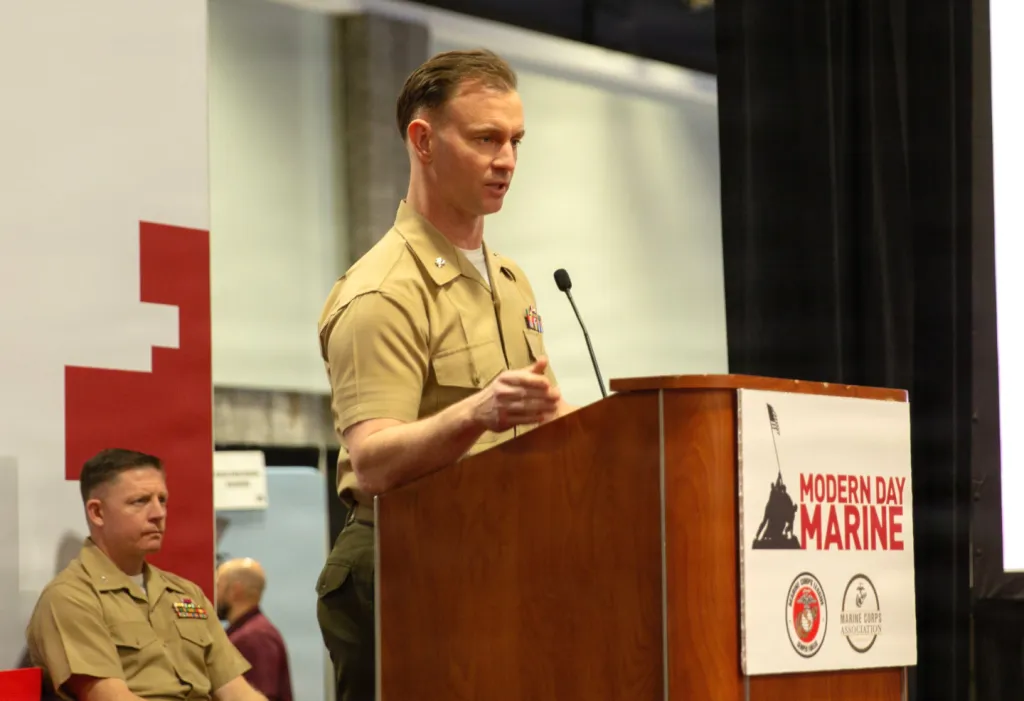
“So, right now, for FASt, everything is on the table. Manned, unmanned, optionally-piloted, I think, are good avenues to take a look at. Conventional rotary-wing, tiltrotor. Maybe there’s something else out there,” Col. Scott Shadforth said in response to a question, also from Eric Tegler, while speaking today at Modern Day Marine. “There is no steadfast, solid response to that.”

Shadforth is currently Director of the Expeditionary Maritime Aviation-Advanced Development Team (XMA-ADT) within Naval Air Systems Command (NAVAIR). XMA-ADT focused on rapid prototyping and experimentation to help refine future Marine Corps aviation requirements in cooperation with the Navy.

“So, as we look at unmanned, manned-unmanned teaming, air-launched effects, all the capabilities to help extend the range of various assault support or attack type platforms, all of those are on the table for consideration by the Marine Corps at this time,” he added.

Another view of the MV-75 concept model at Modern Day Marine 2026. Eric Tegler

In the meantime, the Marines are notably working to integrate a standoff strike capability onto the AH-1Z through the aforementioned PASM, which will open up significant new operational possibilities. The service has also been looking at ways to expand the roles and missions of the UH-1Y, to include anti-submarine warfare capability and acting as an airborne drone controller.

It is important to note that this is not the first time Bell has shown models and renderings of armed variations of this design, originally branded as the V-280 Valor, that could perform sea control and other maritime mission sets. This has included versions with internal bays, as well as pylons under the wings and ones mounted on the sides of the rear end of the fuselage.

From ‘Hook: Bell showed this seriously armed variant of its MV-75/FLRAA it is offering for the USMC’s AURA, and reminding the Navy of its paid-for engineering for FVL-MS pic.twitter.com/fs9r2m7IxT

— Brian Everstine (@beverstine) August 25, 2025

Previous navalized concepts have also included folding main wings and rotors, similar in form and function to those features on the V-22 Osprey tiltrotor, to help reduce the aircraft’s physical footprint when operating from ships. Bell has said previously that the ‘stowed’ configuration of the V-280 could be small enough to fit inside the hangars on Arleigh Burke class destroyers, as well as those on larger naval vessels.

A rendering of V-280-based naval tiltrotors on the stern flight deck of an Arleigh Burke class destroyer. Bell

Bell has also pitched navalized V-280/MV-75 designs in the past, paired together with its uncrewed V-247 Vigilant tiltrotor drone. This has included previous proposals specifically aimed at meeting future Marine Corps aviation requirements, which have evolved significantly in recent years.

V-280 and V-247-based designs depicted operating from an amphibious assault ship. Bell
A rendering of a V-247 carrying a pair of Joint Strike Missiles (JSM), a design derived from the NSM. Bell

“I can see conceptually, where the Navy could, if this is what they wanted, adopt like this to [meet] their sea control, or ASW [anti-submarine warfare], or ASuW [anti-surface warfare] mission set [sic], because of the additional range that it gives you,” Bell’s Hendricks said when asked about whether this concept could also be relevant to that service’s needs. “It would outperform the speed and range of an H-60, and so that would give them more operational reach.”

In recent years, the Navy has been exploring options for replacements for its MH-60R and MH-60S Seahawk helicopters, as well as its MQ-8C Fire Scout drone helicopters. However, at least in the near term, the service seems to be leaning more toward a major evolution of the Seahawk platform rather than an entirely new platform.

The Marine Corps has made clear that all options are currently on the table, including a tiltrotor like Bell’s MV-75 or a derivative thereof, as the service works to firm up requirements for a replacement for its AH-1Z and UH-1Y helicopters.

Eric Tegler and Phil Hladky contributed to this story.

Contact the author: joe@twz.com
Joseph has been a member of The War Zone team since early 2017. Prior to that, he was an Associate Editor at War Is Boring, and his byline has appeared in other publications, including Small Arms Review, Small Arms Defense Journal, Reuters, We Are the Mighty, and Task & Purpose.


Source link

Light Uncrewed Cargo Helicopters Based On Robinson R66 And Bell 505 Compete For USMC Contract

The U.S. Marine Corps is set to test at least two new autonomous cargo helicopters, as it seeks to field platforms that can rapidly resupply Marines in contested environments. The service recently awarded contracts for two such platforms, one being the R66 Turbinetruck that inserts Sikorsky’s MATRIX autonomy system in the proven Robinson R66 airframe. The second is the Uncrewed 505, a development of the Bell 505 in a program led by Near Earth Autonomy, in collaboration with Bell Textron, Moog Inc., and XP Services.

This is all part of ongoing efforts to develop uncrewed logistics platforms that the Marines can use in contested environments, something that is of particular relevance as the branch looks to the requirements for a future conflict with China in the Pacific.

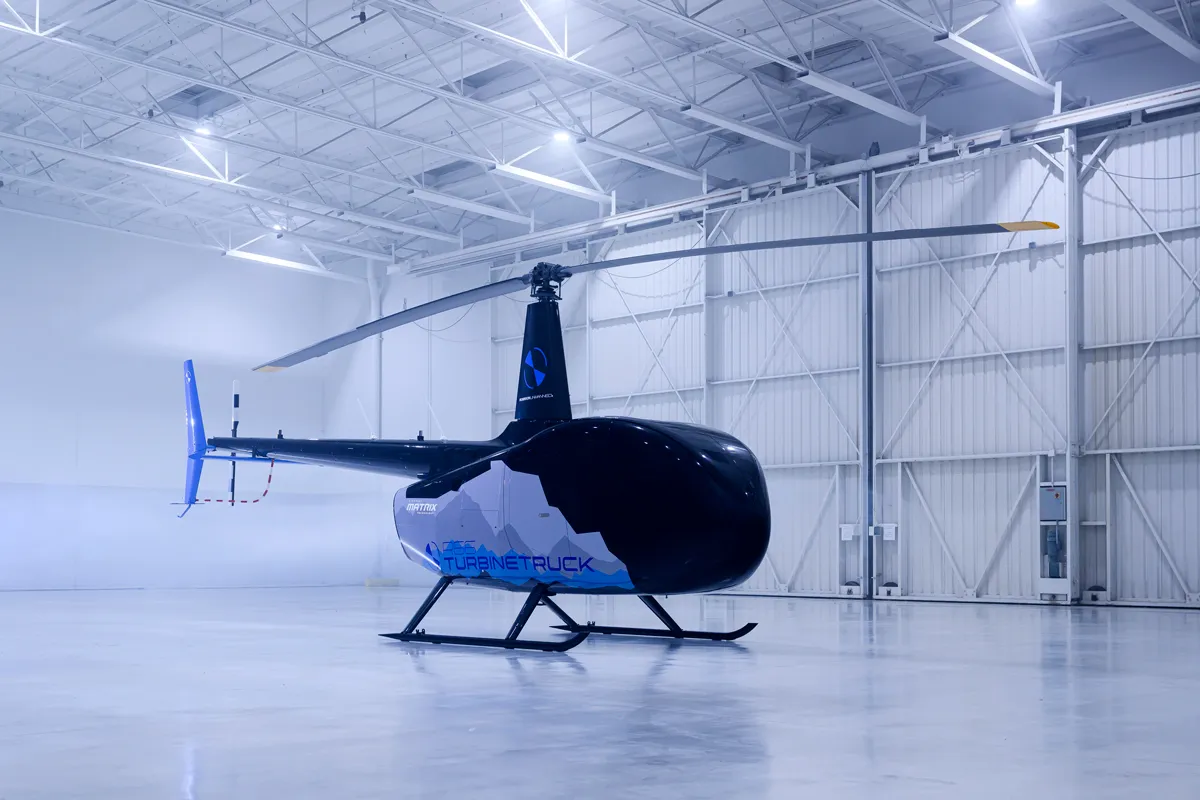
The R66 Turbinetruck that combines the Robinson R66 airframe with Sikorsky’s MATRIX autonomy system. Robinson Unmanned

Lockheed Martin announced yesterday that its Sikorsky subsidiary and Robinson Unmanned had received a contract for the Turbinetruck from the Marine Corps. This comes under the Marines’ new-look Autonomous Aerial Logistics Program Medium Aerial Resupply Vehicle — Expeditionary Logistics (MARV-EL). The contract is worth $15.5 million and covers Increment 2 of MARV-EL.

“As we expand the MATRIX family, we also extend the reach of uncrewed solutions for both civil and military customers,” said Rich Benton, vice president and general manager of Sikorsky. “The commercially developed R66 Turbinetruck is simple, economical, and re-configurable; ideal for high-risk, hard-to-reach environments, where keeping personnel out of harm’s way is essential.”

“Our partnership with Sikorsky brings the trusted performance and reliability of the R66 platform into the unmanned logistics arena,” added David Smith, president and CEO of Robinson Helicopter Company. “The R66 Turbinetruck represents a significant step forward in expanding proven rotorcraft into scalable, autonomous cargo solutions for demanding operational environments. Together, we are delivering a game‑changing capability that will enhance warfighter readiness and open new opportunities for safe, reliable, and affordable autonomous transport.”

Robinson Unmanned | The Future of Autonomous Rotorcraft is Here thumbnail

Robinson Unmanned | The Future of Autonomous Rotorcraft is Here


The R66 Turbinetruck puts together the R66 airframe from the Robinson Helicopter Company, a single-turbine engine design that is best known as a five-seat light rotorcraft on the commercial market. The R66 was selected for the Turbinetruck application primarily on account of its reliability, low maintenance demands, and high level of versatility. The aircraft is currently in widespread civilian service as a trainer, passenger, and utility helicopter.

Combining the R66 airframe with Sikorsky’s MATRIX system provides the ability to perform autonomous uncrewed operations. MATRIX has previously been proven in a U.S. Army UH-60M helicopter, giving it a ‘robotic brain,’ and the culmination of a series of tests stretching back years now that have been steadily working on ever-greater pilot-optional capabilities for the Black Hawk family. As we have noted in the past, the same technology could easily find its way onto other aircraft, as evidenced by the Turbinetruck.

Sikorsky and DARPA Autonomous Black Hawk Flies Logistics and Rescue Missions Without Pilots on Board thumbnail

Sikorsky and DARPA Autonomous Black Hawk Flies Logistics and Rescue Missions Without Pilots on Board


Lockheed Martin says the Turbinetruck is intended to give the Marines “flexible, affordable and rapid combat sustainment,” with its primary roles including the delivery of ammunition, medical supplies, and other essential equipment directly to the troops that need it. These critical loads need to be supplied “regardless of terrain, weather, or enemy threat,” the company adds.

According to Robinson Helicopter, the Turbinetruck can carry a load of 1,300 pounds internally, or external loads supported via a cargo hook. The internal cargo compartment is accessed via front clamshell doors and a right-hand baggage door. A total useful load of 1,500 pounds can be transported, and the aircraft has a range of more than 325 nautical miles.

The Turbinetruck features two clamshell doors in its nose, allowing a forklift truck to place loads directly in it. Robinson Unmanned

When it comes to MARV-EL, this now stipulates an uncrewed aircraft that can carry a logistic payload of between 1,300 and 2,500 pounds to a combat radius of 100 nautical miles, operating through a common digital handheld device.

In an operational scenario, the mission objectives would be entered into the Turbinetruck using a digital tablet. The system would then automatically create a flight plan, using sensors and algorithms to guide the helicopter safely to the target location.

The Turbinetruck would allow the Marines to conduct critical logistics missions without having to put any additional personnel at risk, as would be the case if crewed rotorcraft were employed at the tactical edge of the battlefield. Crewed rotorcraft also come with increased demands on maintenance and availability. Meanwhile, crew-rest cycles might mean that the aircraft have to stay on the ground during high-tempo operations, while these assets will inevitably be in heavy demand for all kinds of other missions in any kind of high-end fight.

A video outlining the Robinson R66 Army Trainer, a crewed version of the helicopter offered to the U.S. Army schoolhouse:

Robinson R66 Army Trainer Helicopter | Press Conference & Official Reveal | AAAA in Nashville thumbnail

Robinson R66 Army Trainer Helicopter | Press Conference & Official Reveal | AAAA in Nashville


At the same time, the MARV-EL concept is especially tailored for the Indo-Pacific theater, in which Marines and other U.S. military forces would be expected to fight from and around austere forward operating bases — a concept known as Expeditionary Advanced Base Operations — as well as unimproved landing zones, and from the decks of ships.

In this context, the Turbinetruck, and the MARV-EL program, more generally, hope to fill a notable capability gap between small tactical drones and larger crewed airlifters. This is something that Lockheed Martin describes as a “middleweight” uncrewed logistics platform capable.

Another view of the Turbinetruck with the nose cargo doors open. Robinson Unmanned

Robinson Unmanned will deliver the first R66 Turbinetruck to Sikorsky for integration, test and evaluation, and demonstration. At that point, the aircraft will undertake capability demonstrations to prove out the MATRIX system in the R66 airframe.

Since MATRIX is platform-agnostic and has an open architecture design, it is intended to be easily integrated into various airframes.

As for the rival Uncrewed 505, this takes the Bell 505 Jet Ranger X helicopter and combines it with Near Earth’s Captain autonomous system, and Moog’s Genesys avionics. The 505 is also a single-turbine helicopter that is in use in similar training, passenger, and utility roles as the R66.

A rendering of the Uncrewed 505. Near Earth Autonomy

The MARV-EL Increment 2 program will also see the Uncrewed 505 prototype developed for the Marine Corps. Near Earth says it will spend the next 36 months integrating and flight-testing the autonomous flight system in the Uncrewed 505, before progressing from early demonstrations to full mission capability.

“The program is to develop an uncrewed aerial logistics aircraft for where the risk and need are highest,” said Lyle Chamberlain, CTO of Near Earth. “We are combining our Captain autonomy architecture with a proven Bell 505 platform to move cargo without putting Marines in harm’s way. To be as intuitive as possible, we are designing the aircraft around existing Marine Corps workflows. Operators will be able to request, dispatch, and manage missions through familiar command-and-control pathways, including MAGTAB and MANGL integration. At the same time, cargo can be loaded with standard pallet jacks and forklifts. This approach reduces infrastructure burden and helps make autonomous resupply practical for expeditionary operations.”

A diagram shows the basic operating concept for the Uncrewed 505. Near Earth Autonomy

Near Earth says the Uncrewed 505 is optimized for efficient transportability, with two aircraft fitting inside a C-130 cargo aircraft with minimal disassembly.

Other aircraft have previously emerged out of the MARV-EL program.

These included the Kargo UAV, a rotary-wing drone from the Kaman Corporation, which previously developed an optionally crewed version of its K-Max helicopter.

KARGO UAV | Transforming Expeditionary Logistics thumbnail

KARGO UAV | Transforming Expeditionary Logistics


Notably, Kaman partnered with Near Earth Autonomy for the autonomy system for both the Kargo UAV and the optionally crewed K-Max.

Another competitor for MARV-EL was the SeaOnyx from Leidos. In 2023, it was announced that Leidos had won a Marine Corps contract to develop a prototype of this autonomous resupply vehicle under the Medium Unmanned Logistics Systems — Air (MULS-A) program, which later became MARV-EL.

The SeaOnyx from Leidos. Leidos

However, neither of these platforms met Marine Corps requirements, leading to MARV-EL being recompeted. At the same time, the previous requirements (including delivering a logistics payload of 300-600 pounds within a radius of 25 to 100 nautical miles to a combat area) were made more ambitious, increasing cargo payload and range.

Overall, MARV-EL again highlights the Marines’ growing focus on expeditionary warfare in contested environments, in the Pacific theater especially. With their versatile airframes, the R66 Turbinetruck and the Uncrewed 505 could be adapted for other missions, including intelligence, surveillance, and reconnaissance (ISR), electronic warfare (EW), communications relay, and search and rescue. All of these are growth areas for the Marines specifically and the U.S. military more generally.

A video outlining the Bell 505, as offered for the U.S. Army Flight School Next requirement:

Bell 505: Ideal Trainer thumbnail

Bell 505: Ideal Trainer


At the same time, the R66 already has a foothold with the U.S. military, with TH-66 Sage used to train U.S. Army and Navy helicopter operators, under contract. The Army is also now looking at both the R66 and the Bell 505 for its Flight School Next training helicopter program.

Whichever design or designs are ultimately selected for the MARV-EL requirement, the Marines can expect a new medium-weight logistics platform that bridges the gap between smaller drones and larger crewed aircraft currently in use. At the same time, it will help reduce risk by keeping more fixed-wing and helicopter crews out of harm’s way.

Contact the author: thomas@thewarzone.com
Thomas is a defense writer and editor with over 20 years of experience covering military aerospace topics and conflicts. He’s written a number of books, edited many more, and has contributed to many of the world’s leading aviation publications. Before joining The War Zone in 2020, he was the editor of AirForces Monthly.


Source link