Saildrone’s Missile-Toting Spectre Enters Navy’s Medium-Sized Unmanned Ship Competition
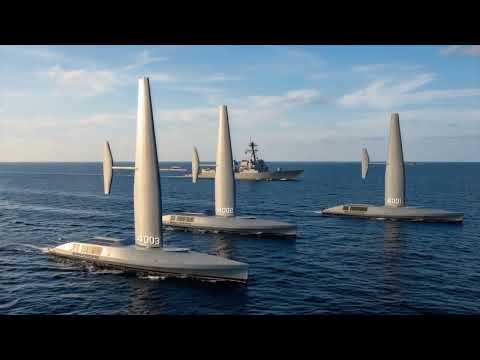
A collaboration between relative military newcomer Saildrone and defense contracting giants Lockheed Martin and Fincantieri has resulted in Spectre, a 170-foot drone boat capable of traveling nearly 35 miles per hour and optimized for anti-submarine warfare.
Spectre can also come loaded for bear for a multitude of missions, with space for an optional payload of two Lockheed Mk 70 vertical launching system (VLS) containers. These are capable of slinging everything from Tomahawk cruise missiles to long-range SM-6s air defense and surface strike missiles. Other potential payloads, according to Saildrone, include twin-line towed sonar arrays like the TB-29 and Lockheed’s Joint Air-to-Ground Missile (JAGM) Quad Launcher (JQL, pronounced jackal), which is in the process of being integrated on Saildrone’s smaller Surveyor platform. Total payload is two 40-foot containers, five 20-foot containers, or a configurable mixture of both.

Saildrone Spectre: A new class of unmanned surface vessel
The Navy’s work with far smaller Saildrone platforms dates to 2021. In the Middle East, the 33-foot Voyager, specializing in persistent surveillance, has been at the heart of testing and experimentation by the service’s Task Group 59, focused on unmanned capabilities and teaming.
In the U.S. 4th Fleet area of responsibility, which includes the Caribbean and Central and South America, solar-powered Voyagers have been the USV of choice for Operation Windward Stack. This is an effort to integrate uncrewed systems into the work of apprehending drug trafficking and illegal fishing.

The Spectre design, which was unveiled Monday at the Sea-Air-Space Exposition near Washington, D.C., at which TWZ was in attendance, is the result of two years of work. It precedes the Navy’s current competition for a family of Medium Unmanned Surface Vessels, which formally launched last month. However, company executives said they now plan to enter Spectre.
“We didn’t fit to that. We didn’t change our course,” Saildrone founder and CEO Richard Jenkins said. “Now it’s changed, MUSV … it actually fits perfectly. We meet 100% of all the specs.”
Spectre comes in two variants. One is the Silent Endurance variant with the trademark sail, or “wing.” The other is the Stealth Strike variant that relies totally on its more powerful internal propulsion. While the sail-equipped variant is more focused on anti-submarine warfare and surveillance, it too can be equipped with modular VLS cells or other “concealed payloads.” The Stealth Strike variant possesses “higher-speed” and is capable of “low observable missions,” according to the company.

Powered by a 5,000-horsepower Caterpillar diesel engine, the Stealth Strike variant is designed to cruise at around 25 knots, or just under 29 miles per hour. The 30 knot, or around 35-mile-per-hour, speed that the company cites as the maximum for Spectre is likely reserved for brief “sprints” that the Stealth Strike variant may execute during operations.
The Silent Endurance variant is optimized for “infinite endurance,” Jenkins said, with an electric engine that can maintain speeds of 12 knots, or about 14 miles per hour, or the signature wing, a 43-meter composite structure made by yacht racing team American Magic Services that can harness the wind for propulsion “without any engine at all.”

Tony Lengerich, vice president of Naval Programs at the United Kingdom-based Thales Defense and Security, which made the active sonar for Spectre, described the drones as a forward lookout presence for conventional Navy ships.
“We’re looking forward to bringing that capability in active sonar … to the Navy fleet, particularly in the theater ASW context, where you really need a vessel that can take a sensor far out ahead of the battle group, if you will, loiter there, deploy the sensor and then move again,” he said. “That’s exactly what Saildrone brings to the table, and it’s exactly what we think the Navy needs.”
Paul Lemmo, vice president and general manager for sensors, effectors & mission systems (SEMS) at Lockheed Martin, called the drones a cost-effective way of “putting more players on the field.”
“The Chief of Naval Operations [Navy Adm. Daryl Caudle] has said it’s an important thing, so you’ve got more shooters on a fairly inexpensive platform instead of a multi-billion dollar destroyer,” he said.

From an ASW perspective, Lengerich said, the platform works for clearing and assessing “broad ocean areas” before moving a manned battle force in.
“This provides that capability to take an active sonar source forward – ping, if you will, and then your shooters … pick up the ping and identify where you have an adversary in an area that you eventually want to move the force to. So we think of this as a theater asset, one that means far ahead of the force, both in time and space, and then advances the ability for the battle force to move in and be certain of what’s waiting for them.”
The unit price of Spectre is around $40 million, Jenkins said. That’s compared to about $7.5 million for the unarmed, much smaller 20-foot Surveyor.

The Navy has struggled to get its arms around what it wants out of its drone ships and how exactly they will integrate with the manned fleet. One of its earliest unmanned surface vessel test articles, Sea Hunter, was christened a decade ago. Navy officials announced earlier this year that Sea Hunter, a medium-sized USV, and its sister ship, Seahawk, would finally leave experimental status in 2026. One of these vessels, reportedly Seahawk, is expected to deploy this year with a carrier strike group.
Last year, the Navy unveiled plans for a family of uncrewed Modular Surface Attack Craft (MASC), emphasizing containerized missile launchers and highly configurable payloads. The service replaced this strategy last month, however, with what it called a “marketplace” for MUSVs, giving would-be competitors a matter of weeks to submit proposals for mature vessels that could be fielded in Fiscal Year 2027. Core requirements were laid out for seakeeping, long range and endurance, and cargo capabilities, as you can read more about here. The need to be able to carry two forty-foot equivalent unit (FEU) containerized payloads is a key demand, though the Navy has not yet specified publicly what might go in them.

“Honestly, inside you could have a sensor, you could have repair equipment for ships,” Rebecca Gassler, the Navy’s Portfolio Acquisition Executive for Robotic and Autonomous Systems (PAE RAS), told TWZ and other outlets during a press call in March. “You could have any number of payloads inside those, and you basically are able to just swap them on.”
Navy officials have said they want 11 operational MUSVs by next year, and have projected that half the surface fleet will be uncrewed by 2045.
Saildrone has plans to demonstrate the ability of Surveyor to carry a JAGM launcher at the joint Rim of the Pacific exercise in July. Lemmo said the team plans to demonstrate the same capability on Spectre soon. The company says construction on Spectre is about to begin shortly, with sea trials for the first vessel set for early next year.

Contact the editor: Tyler@twz.com