The U.S. Navy is preparing to sign a contract with Lockheed Martin to integrate the stealthy AGM-158C Long Range Anti-Ship Missile (LRASM) onto the Air Force’s B-52 Stratofortress bombers, according to an October 7 government notice. The effort would add another long-range maritime strike option to the U.S. bomber force as the military looks to counter increasingly capable adversary naval forces, especially in the Indo-Pacific theater.
The planned contract comes months after the Air Force revealed that the stealthy B-2 bomber can also launch LRASM, a capability that had not previously been publicly disclosed. You can read more about that here.
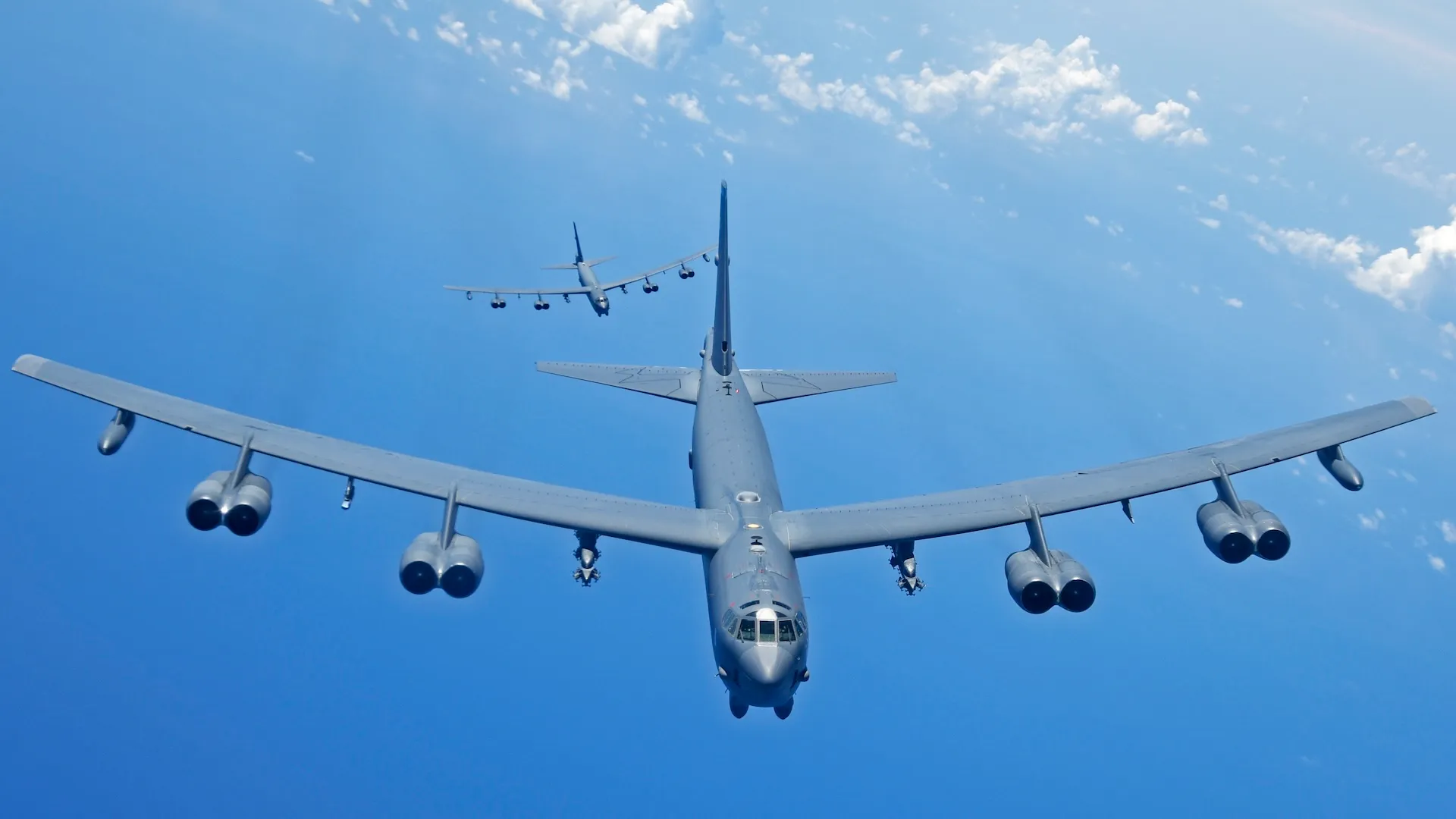
Two U.S. Air Force B-52s fly over the Pacific Ocean during a routine training mission. U.S. Air Force photo by Airman 1st Class Gerald R. Willis
The latest Naval Air Systems Command (NAVAIR) notice says the command intends to enter into sole-source negotiations with Lockheed Martin and subsequently award a cost-plus-fixed-fee delivery order covering LRASM integration on the B-52. The work would include missile software updates, associated testing, repairs to test assets, and failure review boards.
The notice does not provide a schedule for completing the integration or fielding the capability.
Long Range Anti-Ship Missile (LRASM)
The B-52 is already capable of carrying large numbers of air-launched cruise missiles, including the AGM-158 Joint Air-to-Surface Standoff Missile (JASSM) family. LRASM is derived from that family, sharing a similar general form factor while incorporating features specifically designed to find and attack ships in contested maritime environments.
The B-52 can carry up to 20 JASSMs, and the weapons have the same dimensions, but the government notice does not specify how many LRASMs the bomber would ultimately carry.
A B-52 flies across the Atlantic Ocean on June 17, 2019, for a flight in support of Exercise BALTOPS 2019, the largest multinational maritime exercise of the year in the Baltic Sea. U.S. Air Force photo by Senior Airman Stuart Bright
This is not the first time the B-52’s LRASM integration has been in the works.
As long ago as November 2019, Naval Newsreported that $10 million in Fiscal Year 2019 funding had been allocated to study integrating the missile onto the bomber, with Lockheed Martin and the Navy and Air Force expected to work on the effort. At the time, officials said the fielding timeline and the bomber’s eventual missile capacity had yet to be determined.
The U.S. Air Force’s Fiscal Year 2027 budget proposal further outlines plans to integrate the latest variants of LRASM and JASSM onto the B-52, including versions not yet cleared for use on the bomber. According to the document, the effort, which is intended to enable the deployment of next-generation stealthy cruise missiles against targets protected by sophisticated integrated air defense systems, will focus on engineering and manufacturing development, software updates, and weapons integration. Planned work in FY2027 includes incorporating the missiles’ operational flight programs into the B-52’s baseline bomber software, validating safe weapon separation from both wing-mounted stations and the internal carriage launcher, updating armament interfaces, and completing system-safety testing.
Joint Air-to-Surface Standoff Missiles are prepared to be loaded onto a U.S. Air Force B-52 on Andersen Air Force Base, Guam, on April 24, 2023. U.S. Air Force photo by Airman 1st Class Spencer Perkins
LRASM is designed to attack high-value surface vessels at long distances while reducing the exposure of the aircraft launching it. Its guidance combines GPS-assisted inertial navigation with onboard sensors and autonomous target-recognition capabilities intended to help it operate in heavily defended environments. Its imaging infrared seeker supports terminal target acquisition without relying on active radar emissions in that phase of flight. The missile operates with a high degree of autonomy, enabled by an integrated route-planning capability linked to its onboard electronic support measures (ESM) system. LRASM also has a datalink that allows it to get threat updates while in flight. It can also work cooperatively with other LRASMs during coordinated strikes.
The missile’s precise operational range is not publicly disclosed. However, the baseline LRASM is reported to be able to strike targets at between 200 and 300 miles, in line with the AGM-158A JASSM. The forthcoming C-3 version is expected to have the same reach as the JASSM-ER, which is reported to be around 600 miles.
An AGM-158C Long Range Anti-Ship Missile is seen under the wing of an F/A-18, with another missile in the foreground. U.S. Navy
For the B-52, the addition of LRASM would provide a dedicated anti-ship weapon alongside its established land-attack arsenal. A bomber operating at a considerable distance from a hostile fleet could launch multiple missiles toward maritime targets, complicating an adversary’s air-defense and interception problem. The aircraft’s payload capacity could also allow it to contribute substantial missile volume to a coordinated strike.
The B-52 was previously adapted to carry AGM-84 Harpoon anti-ship missiles, although the weapon is not listed among the bomber’s current publicly documented armament. Compared to the Harpoon, however, LRASM represents a quantum leap in capability, offering drastically greater range, a stealthy design, and the ability to react to threats and adapt in real time. Combined, these traits make for a far more survivable and lethal anti-ship capability.
The B-52 also has a demonstrated naval mine-laying capability through the Quickstrike family of aerial mines. This includes carrying 2,000-pound Quickstrike-ER mines fitted with GPS-aided, winged guidance kits, allowing them to glide to designated points in the water from more than 40 miles away. The system enables the bomber to seed minefields with greater precision while remaining farther from potentially defended waters, threatening enemy shipping routes, port access, and naval movements.
A B-52 conducts an operational demonstration of the Quickstrike-ER naval mine project in the Pacific Ocean, on May 30, 2019. U.S. Navy photo by Mass Communications Specialist 1st Class Holly L. Herline
The B-52 effort comes against the backdrop of the Air Force’s newly acknowledged use of LRASM on the B-2, which adds a different dimension to the service’s anti-ship capabilities.
A U.S. Air Force B-2 deploys an AGM-158C Long Range Anti-Ship Missile to support a live-fire sinking exercise as part of Valiant Shield 2026 over the Philippine Sea, June 27, 2026. U.S. Air Force photo by Tech Sgt. Thomas Barley
LRASM was also previously integrated on the B-1B, meaning that all three of the Air Force’s strategic bombers will eventually be able to employ it.
The renewed focus on bomber-launched anti-ship weapons reflects the challenges posed by modern naval forces, particularly in the Indo-Pacific. China’s expanding surface fleet, increasingly sophisticated air defenses, and layered anti-access/area-denial capabilities have made the ability to attack ships from a distance an important consideration for U.S. military planning.
U.S. airmen transport a live AGM-158C Long Range Anti-Ship Missile toward a B-1B Lancer at Dyess Air Force Base, Texas, June 2, 2026. U.S. Air Force photo by Airman 1st Class Caleb Schellenberg
LRASM is designed to help address those challenges by combining long-range flight with reduced observability and autonomous terminal targeting. Its onboard sensors and navigation capabilities are intended to help it identify and engage appropriate targets in environments where communications and external targeting support may be limited or contested.
Bomber integration also offers a way to increase the number of potential launch platforms without relying exclusively on tactical aircraft or surface combatants. A B-52 carrying a substantial missile load could contribute to a coordinated attack alongside B-1s, stealth bombers, naval aircraft, and other forces.
The B-52’s payload capacity would make it particularly useful for delivering larger quantities of weapons from outside the most heavily defended areas.
The planned B-52 integration also fits into a broader effort to expand LRASM’s availability across the U.S. military. Publicly discussed integration efforts have included the F-15E, F-15EX, F-16C/D, certain variants of the F-35, and the Navy’s P-8A Poseidon, in addition to established launch platforms, namely the Navy’s F/A-18E/F Super Hornet fighters and the B-1.
Sailors assigned to Patrol Squadron (VP) 30 transport an AGM-158C Long Range Anti-Ship Missile prior to installation on board a P-8A Poseidon maritime patrol aircraft. U.S. Navy photo by Mass Communication Specialist 1st Class Curtis D. Spencer
Meanwhile, the B-52 fleet is currently preparing for a slew of major upgrades. These include a critical radar overhaul alongside new engines, enhanced communications systems, and other improvements. The scope of these changes is significant enough that the aircraft will be redesignated from B-52H to B-52J. The bombers are also slated to further expand their weapons capabilities, including through the addition of the Long-Range Stand Off (LRSO) nuclear cruise missile. The upgraded B-52Js are expected to remain in service through at least 2050.
B-52 Future Stratofortress: The Upgrades That Will Transform The B-52H Into The B-52J
Even in its current configuration, the B-52 is particularly well suited to carrying the LRASM, given its substantial payload capacity and ability to launch weapons from standoff distances beyond the reach of enemy air defenses. Its upgraded networking capabilities will greatly enhance its effectiveness by allowing it to operate as part of a broader kill web, drawing on data from multiple platforms and sensors to support targeting over vast distances. In more dynamic operational environments, the bomber’s new radar can generate its own targeting information in real time. The B-2, B-1, and the B-52 all offer distinct levels of penetration and weapons-delivery capability, with the forthcoming B-21 able to push deeper into contested airspace; it will certainly employ LRASM too.
The integration of LRASM onto the B-52 could prove critical to generating the volume of sorties needed to counter China’s expanding naval fleet. With its substantial payload capacity and ability to launch missiles from standoff distances, the B-52 could deliver significant anti-ship firepower across the vast distances of the Indo-Pacific. These missions would likely involve very long-range sorties, making the bomber’s payload capacity, endurance and networking capabilities particularly valuable in sustaining operations against Chinese naval forces.
If the LRASM integration proceeds as planned, the result would be another addition to the U.S. military’s long-range anti-ship arsenal, giving the Air Force’s venerable B-52 a more explicit role in the growing emphasis on striking hostile fleets at a distance.
Germany is moving ahead with plans to give its unusually large F125 frigates a medium-range air-defense capability, helping address one of the most conspicuous weaknesses of a four-ship class that has long attracted attention for having relatively little combat power for its size.
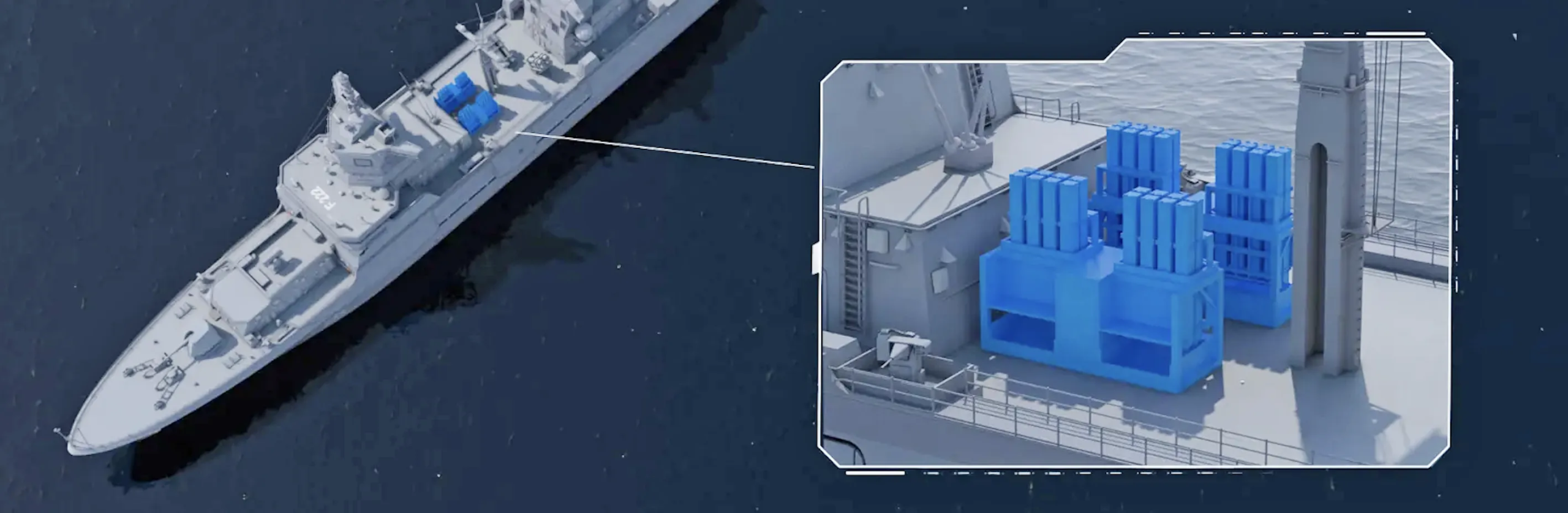
Diehl Defense and Germany’s Federal Office of Bundeswehr Equipment, Information Technology and In-Service Support (BAAINBw) have signed a contract to adapt and develop the IRIS-T SLM surface-to-air missile system for operational use aboard the German Navy’s F125 frigates. Under the agreement, Diehl will build prototypes and conduct comprehensive test firings intended to validate the system’s integration and performance within the existing F125 architecture. Each frigate will be fitted with two new launchers, each capable of holding 16 missiles, for a total of 32.
A rendering showing the location of the 32-cell IRIS-T SLM launchers on an F125 frigate. Diehl Defense
“The aim is to make the system mission-capable on the German Navy’s F125 frigates,” Diehl said in today’s announcement. The company described the prototype construction and test-firing phase as necessary to ensure “the seamless integration and maximum performance” of IRIS-T SLM within the frigate’s existing architecture.
The program has moved notably quickly, reflecting the urgency of the requirement.
Germany began examining the feasibility of integrating IRIS-T SLM with the F125 in 2024, with BAAINBw and Diehl studying the technical risks and requirements of adapting the normally land-based system for shipboard use. That effort led to the development of a navalized demonstrator in 2025. In October of that year, the F125 frigate Baden-Württemberg took part in a German Navy Maritime Firing Exercise off Andøya, Norway, carrying an experimental anti-air warfare module based on IRIS-T SLM. Diehl says the module went from concept to firing in less than 10 months and met all established test and evaluation objectives.
The IRIS-T SLM launcher on the frigate Baden-Württemberg. Bundeswehr
The Bundeswehr subsequently reported that Baden-Württemberg fired three live IRIS-T SLM missiles during the exercise. The ship’s radar supplied target data to the missile system, demonstrating the basic integration between the F125’s sensors and the navalized air defense architecture.
The exercise established that the concept could work at sea; the contract signed now is intended to turn that demonstration into a qualified fleet capability.
A night-time test of the IRIS-T SLM air defense missile system during the Maritime Firing Exercise 2025 in Andøya. Diehl Defense
The German parliament’s Budget Committee approved the adaptation effort on September 23, with the German Defense Ministry describing it as a means of expanding the F125’s self-defense capabilities in response to the current air threat. The ministry also pointed to IRIS-T SLM’s combat experience in Ukraine.
The effort needs to be seen in the context of why the F125 has been such a controversial warship in the first place.
As TWZexamined in 2017, the F125 is a roughly 7,200-ton, 490-foot warship with an unusually small core crew and a concept of operations centered on long-duration deployments, stabilization missions, crisis management, conflict prevention, and international intervention rather than high-end fleet combat. The class was designed to spend long periods away from Germany and operate with relatively modest manpower requirements.
German Navy frigate Baden-Württemberg sails in formation off the coast of Hawaii during Exercise Rim of the Pacific (RIMPAC) 2024. U.S. Navy photo by Mass Communication Specialist 1st Class John Bellino
But its armament does not remotely match the size and sophistication of the hull. A completed, the ships were equipped with eight RGM-84 Harpoon anti-ship missiles, a 127mm gun, remotely operated guns and, for close-quarters air defense, two RIM-116 Rolling Airframe Missile launchers. The F125 has no medium- or long-range surface-to-air missile capability and no organic sonar or dedicated anti-submarine warfare weapon system.
At the same time, the TRS-4D/NR radar and other sensors can see far beyond the engagement envelope of the close-in air-defense weapons, but there is little the ship itself can do with that information against an aircraft or incoming missile at medium range.
Nearly a decade later, IRIS-T SLM is emerging as an answer to at least part of that problem.
Even with IRIS-T SLM, the F125 is well short of being an air warfare destroyer. It also still lacks an organic anti-submarine warfare capability or the kind of large vertical-launch missile battery found on Germany’s F124 frigates.
However, it does fill a gap between the F125’s originl short-range defenses and the capabilities of other ships or aircraft operating around it.
IRIS-T SLM is designed as a medium-range surface-to-air system, with an engagement range of around 25 miles and an altitude envelope of approximately 65,000 feet. As shown in the 2025 demonstration, the F125’s radar can feed information directly into the missile system, exploiting the ship’s existing sensor capabilities.
IRIS-T SLM (Medium Range Ground-Based Air Defence)
Rather than rely heavily on escorts for protection against airborne threats outside the short range of RAM, an IRIS-T-equipped F125 could at least contribute to its own medium-range air defense. Recent operations in the Middle East hve underscored the importance of this in contested maritime environments.
It also gives the ships a more useful role in a task group. The threat environment has changed substantially since the F125’s original concept was drafted. Cruise missiles, drones, loitering munitions, and increasingly sophisticated aircraft mean that even ships operating away from a major naval war can face threats well beyond the range of their existing close-in defenses.
German Navy frigate Baden-Württemberg. U.S. Navy
In November 2024, Germany confirmed that the F125 frigate Baden-Württemberg, returning from an Indo-Pacific deployment, would avoid the Red Sea and sail around Africa because of the Houthi missile and drone threat. The German Defense Ministry explicitly cited the ship’s limited air defense capability and its inability to provide an effective air-defense umbrella for itself or its accompanying replenishment ship.
Ironically, the F125’s large hull, extensive electrical power, sophisticated radar, substantial aviation facilities, long endurance and relatively spacious mission areas were always supposed to provide room for a flexible approach to future missions. Yet the class’s original weight and integration constraints made adding major weapons difficult, a concern TWZ also highlighted in 2017.
IRIS-T SLM offers Germany a way to add a meaningful capability without undertaking the much more invasive redesign associated with installing a conventional vertical-launch system. The 2025 demonstration used an AAW module mounted on the ship’s deck rather than a conventional VLS installation, and today’s program is focused on adapting the system to the F125 architecture.
Once IRIS-T SLM is installed, the F125 will still be an unusual frigate. It is enormous by the standards of its mission, optimized for endurance, and lacks some of the weapons traditionally associated with a high-end surface combatant. But it will bring more to a contested fight.
The program should give the class a credible medium-range air-defense role, and provide Germany with a way to get considerably more utility out of four ships whose original design philosophy was always somewhat controversial.
No response by Yemen’s Houthis to a claim by the coalition forces that its missiles targeted Taif and Yanbu.
Published On 24 Sep 202624 Sep 2026
Saudi-led coalition forces fighting Yemen’s Houthis say they have intercepted six ballistic missiles allegedly fired by the Iran-allied group towards cities in Saudi Arabia.
The missiles were destroyed on Thursday in the direction of the Saudi cities of Taif and the strategically important port of Yanbu, according to Major General Turki al-Malki, the spokesman for the Saudi-backed Coalition to Restore Legitimacy in Yemen.
Recommended Stories
list of 3 itemsend of list
Saudi air defences intercepted some of the missiles attempting to target the cities, Al-Malki told the Saudi Press Agency (SPA).
There was no immediate claim of responsibility from the Houthis or other groups.
The coalition statement came as the Reuters news agency reported that an air defence system operated by Greek military personnel in Saudi Arabia intercepted a ballistic missile and a drone on Thursday in the wider Yanbu region, home to major oil refining facilities.
“Both were shot down,” a Greek security source told Reuters, adding that the Greek Patriot system launched two missiles but did not give details on the origin of the drone and the ballistic missile. A second source confirmed the information to the news agency.
Yanbu port is key to Saudi crude when shipments through the Strait of Hormuz are disrupted.
Earlier on Thursday, Saudi Arabia’s General Directorate of Civil Defence issued alerts warning of potential danger in the holy city of Mecca, the northwestern area of Tabuk, the Red Sea areas of Jeddah and Yanbu and the southern area of Taif. They later said the threat had passed and the cities were out of danger.
It was the first time in nearly 10 years that a security alert had been activated in Mecca, home to the Kaaba, Islam’s holiest site.
The Houthis have largely attacked southern areas of Saudi Arabia.
They stepped up attacks on the kingdom after declaring a naval blockade in July, a second theatre for the US-Iran war. The Houthis also seized the whole of Yemen’s western coast in a lightning offensive nearly two weeks ago that brought them to the shores of the Red Sea’s strategic Bab al-Mandeb waterway.
Forces with Yemen’s Saudi-backed internationally recognised government said on Thursday they repelled Houthi attacks along several fronts in Yemen’s southwestern Taiz governorate.
Colonel Majid al-Nuzaili, spokesman for the Yemeni government forces, said that the Houthis launched coordinated attacks on Wednesday night in a bid to reach positions on a key road connecting the Aden, Lahj and Taiz governorates.
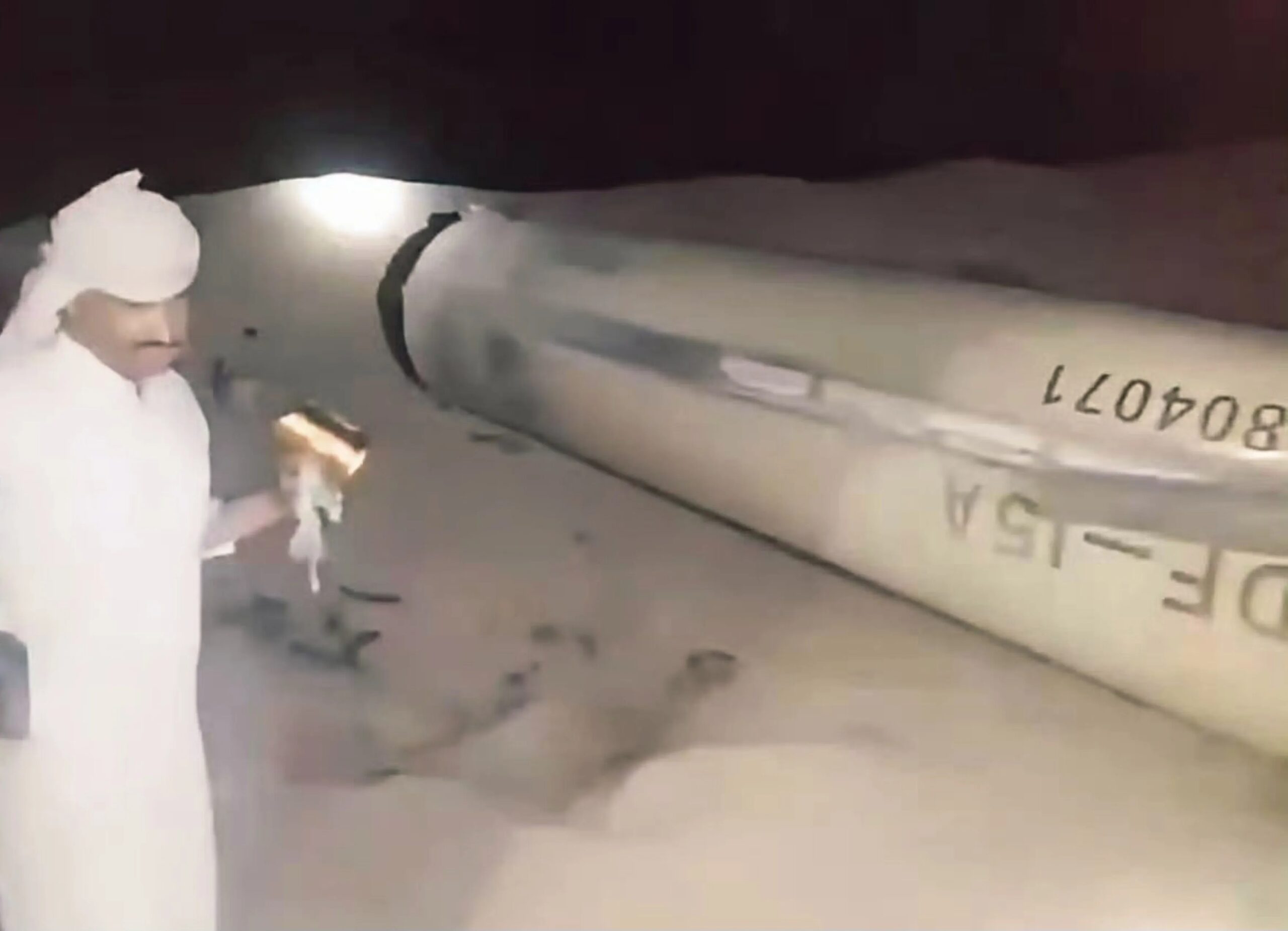
Debris from a Chinese-made ballistic missile found in Yemen could have inadvertently revealed a previously undisclosed addition to Saudi Arabia’s secretive ballistic missile arsenal. Imagery circulating online appears to show the wreckage of a Chinese DF-15A short-range ballistic missile (SRBM), potentially marking the first known Saudi combat use of a weapon in this class, although both the identification and ownership remain unconfirmed.
The booster stage of a Chinese-made DF-15A (Dong Feng-15A) ballistic missile operated by Saudi Arabia fell in Raghwan District, Marib Governorate, northern Yemen. pic.twitter.com/dfSXMOiCzQ
It is also unclear what happened to the missile itself. The debris suggests a stage separation or the missile broke apart or crashed before reaching its target. The Houthis are not known to possess any weapons that could have intercepted it.
A screenshot from a video clearly shows the DF-15A name applied on the side of the missile. via X
The development comes amid a sharp escalation in the long-running Saudi-Houthi conflict. After years of relative de-escalation following the 2022 truce, fighting has intensified in recent weeks as Houthi forces have dramatically overrun Saudi-backed Yemeni government positions, including around strategically important Marib and Taiz. The Houthis have also escalated missile and drone attacks against southern Saudi Arabia, targeting military and energy infrastructure while threatening the kingdom’s ability to move oil through the Red Sea. The group has declared the Bab el-Mandeb closed to Saudi oil traffic, adding a direct threat to one of Riyadh’s critical energy-export routes.
You can catch up with our latest coverage of the fighting here.
As for the DF-15, also known by its NATO designation CSS-6, this is a road-mobile, solid-fueled SRBM developed by China during the 1980s. The system formed part of Beijing’s effort to develop a new generation of conventionally armed mobile ballistic missiles, including systems primarily intended for export.
As you can read about here, the DF-15 family has evolved through several variants, although open-source information concerning their capabilities remains inconsistent.
The DF-15A reportedly entered Chinese service in the mid-1990s. Estimates of these missiles’ maximum range vary substantially, from roughly 600 kilometers (373 miles) for the original DF-15 to as much as 900 kilometers (559 miles) for later versions.
Among the later versions of the DF-15 family is the DF-15B. A more substantial redesign, its most obvious external change is its triconic reentry vehicle fitted with control fins, a configuration widely interpreted as incorporating a maneuverable reentry vehicle (MaRV) warhead. Photo by GREG BAKER / AFP via Getty Images GREG BAKER
China is the only confirmed operator of the DF-15 family. There have been longstanding reports of Chinese transfers of the DF-15 or the related M-9 export version to Egypt, Iran, Pakistan, and Syria, but in each case, the export record is heavily disputed, with some reports likely conflating the DF-15 with the broadly similar DF-11.
While Saudi Arabia has never publicly acknowledged operating the DF-15 family, it has a well-established history of acquiring Chinese ballistic missiles.
In 2013, Prince Fahd bin Abdullah bin Mohammed, Deputy Minister of Defense, visited the Strategic Missile Forces of Saudi Arabia, and was given this model. YEARS of speculation on the smaller missiles (The large is DF-3). Now we know – they are DF-15 and DF-15A. pic.twitter.com/oOn8qiCgye
Saudi Arabia imported Chinese ballistic missiles to expand its long-range strike options. Its desire for a land-based strategic deterrent was initially driven by concerns over Iran, regional missile proliferation, and nuclear hedging. More recently, however, it shifted toward fielding more accurate, mobile systems with greater conventional military utility.
Riyadh secretly obtained DF-3A missiles from China beginning in the late 1980s, establishing a strategic ballistic-missile capability that remained largely outside public view.
The kingdom has also subsequently been linked to the DF-21 family. Satellite imagery and other open-source intelligence have provided evidence of Chinese-designed ballistic-missile infrastructure in Saudi Arabia.
While the Houthis have their own ballistic-missile arsenal, this is principally associated with Iranian technology, captured Yemeni systems, and locally produced or modified weapons.
Saudi employment of an SRBM in the current fighting would represent a notable expansion of the kingdom’s response options. If Saudi Arabia did indeed do this, its main advantage would be speed and responsiveness. A solid-fueled ballistic missile could reach targets deep inside Yemen within minutes while keeping Saudi aircraft and crews out of the immediate engagement area, providing Riyadh with a rapid strike option against fixed Houthi targets. That could be particularly valuable as the conflict expands and Saudi forces face pressure to respond quickly to Houthi attacks on military and energy infrastructure.
Saudi F-15 Eagles Live Missile Firing in Pakistan | Naseem Al-Bahr 13 Exercise
Previous losses at the hands of Houthi ground-based air defenses could also dissuade Riyadh from relying on crewed aircraft to strike targets on the ground deep inside Yemen. Houthi air defenses, while pathed together in many ways, are capable enough to give even U.S. airpower a serious run for their money.
At the same time, a conventional SRBM like the DF-15A can deliver a large warhead at very high speed, imparting significant kinetic energy, making it particularly useful against fixed, high-value, or hardened targets.
Use of an SRBM would also be in line with the current pattern of escalation, with the Houthis conducting missile and drone attacks against Saudi military and energy targets while Saudi-backed Yemeni forces are engaged in renewed ground fighting. Riyadh’s demonstration of an SRBM capability in this campaign would also signal that it is is willing to draw more heavily on its strategic missile inventory as the conflict intensifies, potentially further raising the stakes of the confrontation.
Such a move would carry a message beyond Yemen. Using a previously unacknowledged ballistic missile capability in combat would signal to Iran that Riyadh is now willing to employ this arsenal, after decades of keeping it very much in the shadows.
If the evidence ultimately points to a Saudi DF-15A launch, the discovery would offer a rare look at the operational use of an extremely secretive part of the kingdom’s arsenal, and add a significant new dimension to the rapidly escalating Saudi-Houthi war.
Iran-backed Houthi militants in Yemen say they carried out drone and ballistic missile attacks on the Saudi capital Riyadh, as well as energy sites on the country’s Red Sea coast.
Saudi authorities said they intercepted and destroyed a ballistic missile fired at Riyadh earlier that day, without confirming any further strikes or causalities.
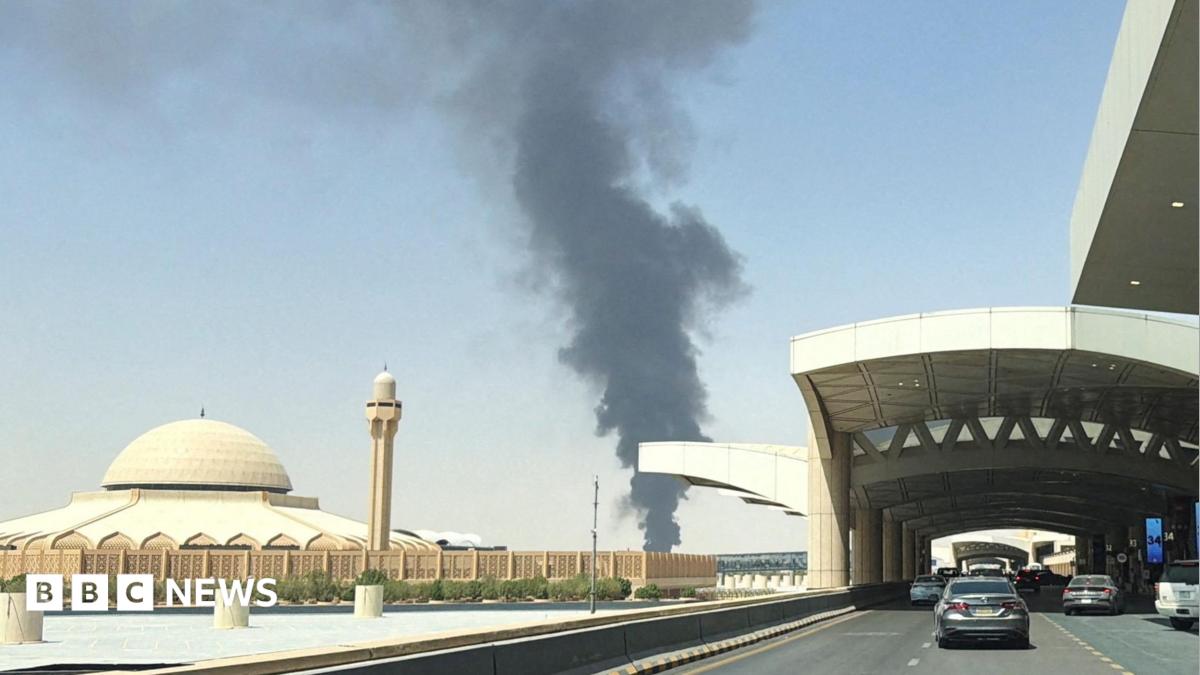
Earlier, a column of black smoke was seen rising from fuel tanks near the Saudi capital’s international airport, where flights were disrupted temporarily on Saturday.
Air raid alerts had sounded in the capital for the first time since the Iran-backed Houthis increased their attacks on Saudi Arabia in July.
Air defences also stopped “hostile attempts to target civilians” in the cities of Bish, Taif, Farasan and Yanbu, an official spokesperson for the Saudi-led coalition said in a statement.
In a statement posted online, Houthi military spokesman Yahya al-Sarea said a “large number of ballistic and cruise missiles and drones” had been used to attack “sensitive sites” in Riyadh and Aramco state oil and gas company facilities in Yanbu on the coast.
He added that the attacks were “in response to the Saudi enemy’s criminal attempts” to target the Yemeni capital Sanaa.
Earlier, Sarea had accused Saudi Arabia of carrying out 300 strikes across Yemen during the past week.
The Houthis are locked in a civil war with Yemen’s internationally recognised government, which is backed by Saudi Arabia.
They have attacked targets inside Saudi Arabia on several occasions in recent months, and said this week that they were responsible for downing a Saudi fighter jet over Yemen.
According to an unconfirmed report from AFP news agency, quoting military sources on both sides of Yemen’s civil war, fighting between the Houthis and Saudi-backed government forces claimed 48 lives on Saturday.
The Houthis said 31 of their fighters had been killed while government sources said their side had lost 17 soldiers, according to the news agency.
WASHINGTON — The governor of a Japanese territory where the Pentagon is thinking about basing missiles capable of threatening China has a message for the United States: Not on my island.
“I firmly oppose the idea,” said Gov. Denny Tamaki, the governor of Okinawa, in an email to The Times.
Officials in other Asian countries are also signaling they don’t want them.
But Pentagon planners aren’t backing down after the Trump administration withdrew last year from a 33-year-old arms control treaty that barred U.S. land-based intermediate-range missiles in Asia.
Senior officials now say that putting hundreds of American missiles with nonnuclear warheads in Asia would quickly and cheaply shift the balance of power in the western Pacific back in the United States’ favor amid growing Pentagon concern that China’s expanding arsenal of missiles and other military capabilities threaten U.S. bases in the region and have emboldened Beijing to menace U.S. allies in Asia.
The missile plan is the centerpiece of a planned buildup of U.S. military power in Asia projected to consume tens of billions of dollars in the defense budget over the next decade, a major shift in Pentagon spending priorities away from the Middle East.
But it also highlights the complex relationship between the U.S and its Asian allies, many of whom feel increasingly threatened by China but are reluctant to back new U.S. military measures that might provoke Beijing, which has built the biggest navy in the world in the last decade.
Australia and the Philippines publicly ruled out hosting American missiles when the Trump administration first floated the idea last year. South Korea is also considered an unlikely location, current and former officials say.
In Japan, the decision on whether to allow U.S. missiles on its territory will be made by the central government in Tokyo. Gov. Tamaki said officials at the Pentagon and in Tokyo have told him there are no definite plans to put missiles on Okinawa. But Tamaki isn’t reassured.
With a Japanese mother and an American father who served with the Marines on Okinawa before abandoning the family, Tamaki personifies the complex relationship between the U.S. and its allies in Asia. He was elected two years ago after pledging to oppose expansion of the already-substantial U.S. military presence on the island.
More than half of the 50,000 U.S. military personnel stationed in Japan are in Okinawa, most concentrated at a Marine base surrounded by residential areas in the largest city. Opposition to the 70-year-old U.S. military presence has sparked local protests for years, which would probably intensify if there were a move to base missiles there.
“If there is such a plan, I can easily imagine fierce opposition from Okinawa residents,” Tamaki said.
For the last year, the Pentagon has been testing several new types of short- and intermediate-range missiles — those with ranges up to 3,400 miles — including a ballistic missile that could be placed in Guam, a U.S. territory, and mobile missiles carried on trucks.
The first of the new weapons could be in operation within two years, though no decision has been announced about where they will be based. Similar missiles are now carried on U.S. warships and planes based in Asia, but there are no land-based systems.
U.S. officials say that many allies are privately supportive of the missile plan and may come around to permitting them on their territory but don’t want to provoke opposition from Beijing and their own public before decisions are on the table.
The U.S. has a defense treaty with Japan, as it does with South Korea, the Philippines and Australia. Taiwan is not a formal ally but has close, unofficial defense ties with Washington.
“We are very attentive to our allies’ concerns, and we recognized their political challenges,” said a senior defense official, who agreed to discuss Pentagon planning if he was not identified. “Everything that’s said in the media is not necessarily what’s said behind closed doors.”
To lessen the political opposition, the U.S. could rotate missile batteries in and out of locations around the region or place them in strategic locations without publicly disclosing it.
“It wouldn’t make much sense to announce plans now, which would stoke Chinese anger and possibly play into the domestic politics,” said Randy Schriver, who was a senior Pentagon official responsible for Asia until his resignation last year.
A decision to go ahead in Asia would intensify an arms race between the region’s two biggest powers whose relations — already tense over President Trump’s confrontational trade agenda and Chinese President Xi Jinping’s hawkish policies — have nosedived since the coronavirus outbreak.
“It’s naïve and dangerous,” said Alexandra Bell, a former Obama administration arms control official and a critic of deploying U.S. missiles. “Instead of looking at how we can prevent a full-out arms race, that’s our opening salvo?” added Bell, a senior policy director at the Center for Arms Control and Nonproliferation in Washington.
Putting land-based missiles in Asia capable of attacking China is not a new strategy.
In the 1950s and 1960s, the U.S. kept them at bases across the region, including in Okinawa, where hundreds of nuclear-armed warheads were stored secretly for decades even though Japan’s constitution prohibited the presence of nuclear weapons on its territory.
The missiles were gradually taken out of service in the 1960s and 1970s, because of budget cuts and a shift in U.S. strategy away from defense of the region focused on nuclear weapons. In 1987, the Reagan administration signed an arms control treaty that prohibited the U.S. and the Soviet Union (and later Russia) from deploying any land-based intermediate range missiles, including in Asia.
China was not a signatory, leaving it free to build up its missile arsenal.
The Trump administration withdrew from the treaty last year after accusing Russia of developing new land-based missiles that violated its terms. The exit opened the way for the Pentagon to consider reintroducing ground-launched missiles in Asia.
With mobile missiles around the region, the U.S. could pose an even bigger challenge for China, forcing it to hunt for hundreds of launchers capable of targeting its planes, ships and bases, strategists say.
“Ground-based missiles aren’t some kind silver bullet,” said Eric Sayers, a former consultant to U.S. commanders in the Pacific and a fellow at the Center for a New American Security, a Washington think tank. “But they are a way in the near term … to create dilemmas for the [People’s Liberation Army] planners.”
Although the risk of large-scale conflict with China seems low, tensions have continued to ratchet up over Beijing’s crackdown in Hong Kong, its military maneuvers near Taiwan, its border dispute with India and its offshore maritime claims in the East China Sea and South China Sea.
Nearly a quarter of world trade travels through the South China Sea, making the contest between Beijing and Washington over control of its maritime lanes and rich resources especially tense and certain to continue, no matter who wins the U.S. presidential election in November.
The U.S. Navy for decades dominated the “first island chain,” as strategists call the area of the western Pacific stretching from Japan to Taiwan to the Philippines that fell within America’s defense umbrella after World War II.
But American reliance on bases, warships and airfields in the region has become increasingly risky, officials and analysts say.
Sign up for alerts
Get breaking news, investigations, analysis and more signature journalism from the Los Angeles Times in your inbox.
By continuing, you agree to our Terms of Service, which include arbitration and a class action waiver. You agree that we and our third-party vendors may collect and use your information, including through cookies, pixels and similar technologies, for the purposes set forth in our Privacy Policy such as personalizing your experience and ads.
China has developed its own missiles, sophisticated radars and anti-satellite weapons as well as a growing fleet of warships and submarines in recent decades that could threaten American bases and other targets early in a conflict, said Collin Koh, a research fellow in Asian maritime security at the S. Rajatnam School of International Studies in Singapore.
China’s People’s Liberation Army can project significant firepower on U.S. and allied military installations in the western Pacific and “threaten to overwhelm” American forces “in times of armed conflict,” Koh said.
The Chinese weapons in many cases have ranges that exceed those on U.S. warships, though the U.S. retains a significant advantage in attack submarines and in advanced fighters and bombers armed with cruise missiles that can be fired from long distances.
“Their capability and their reach have created vulnerabilities for our legacy basing structure,” said the defense official, who agreed to discuss U.S. planning on condition that he not be identified.
Earlier this year, an Iran-linked actor used Anthropic’s Claude artificial intelligence model to scrape and analyze data with the aim of helping target U.S. naval forces in the Middle East. A group in Yemen – very likely Iranian-backed Houthi militants – also used Claude to assist with work on guidance systems for ballistic and hypersonic missiles.
These are just some of the revelations about how adversaries and other malign actors have been using one of the premier pieces of AI software being developed in the United States that were contained in a new report Anthropic released late yesterday. The 154-page document also details instances where Claude was used directly and indirectly to support intelligence gathering and surveillance, cyberattacks, influence operations, and even worrisome biological research over the past eight months. In addition to Iran and Yemen, the human actors behind these activities were based in Russia, China, and a host of other countries.
Anthropic has shared details about what it calls the “misuse” of its models in the past, but describes the new report as its “most detailed” to date. The company has clearly been cataloging these case studies, and has assigned each one a control number. Though the entire contents of the report are cause for concern, the explicit attempt to use Claude to target American forces, as well as to develop new higher-end missiles and other military technology, are particular standouts and signs of what’s to come, as we will highlight below.
GTG-30005: Military reconnaissance
GTG-30005 is the case study dealing with the targeting of U.S. naval forces, and the summary is as follows:
“In another investigation, we identified and disrupted an Iran-nexus threat actor that used Claude to collect and analyze publicly accessible data to develop targeting recommendations against US naval forces in the region. The threat actor used Claude to compile targeting handbooks, through a Python pipeline the threat actor built with Claude’s assistance, to identify and track naval positions based on open-source information. The compiled material included a roster of US personnel scraped from captions on public military photographs; publicly accessible ship and aircraft transponder identifiers; commercial satellite-imagery query scripts; and an inventory of public websites that exposed US naval movements. The threat actor also directed Claude to compile vulnerability research on shipboard systems, cataloging known CVEs in maritime VSAT terminals, Cisco communications equipment, and industrial control products.”
“We banned the actor’s account, developed detections to reduce the risk of future misuse, and shared threat intelligence with government authorities to disrupt the threat.”
The Nimitz class aircraft carrier USS George H.W. Bush and several other US Navy warships sail together in the Arabian Sea in June 2026. CENTCOM
How exactly Anthropic defines the term “nexus” here is not immediately clear, and other entries in its new report also use “state-nexus” in addition to country-based variations. However, in this specific case, an addendum is added to the entry that explicitly says that the same account was separately tied to “domestic mass surveillance” software development work “for Iranian state systems,” clearly pointing to an actor directly linked to the regime in Tehran.
The use of AI technology by nation-state armed forces to develop target sets and engage them is already known to be growing globally. The Israel Defense Forces (IDF) have been a pioneer in this regard, but the U.S. military, China’s People’s Liberation Army (PLA), and others are also known to be developing and fielding these capabilities.
GTG-87001: Disrupting a Yemen-based guided weapons engineering cell using Claude to develop guidance software
Anthropic’s new report details an instance where an individual in Yemen used Claude as part of missile guidance work, which is given the control number GTG-87001.
“We identified a cell of threat actors based in northern Yemen running three weapons development programs: a guided rocket that used a commodity phone-class flight computer with final-phase homing guidance; a multi-stage ballistic missile with a stated range goal above 2,000 km; and a multi-variant missile (referred to as the “R2000” set) that included a hypersonic glide vehicle variant.”
“The actors used Claude Code in place of human software engineers to develop the guidance, navigation, and control (GNC) software that steers and stabilizes a flying vehicle. For example, they used Claude to integrate an open-source autopilot onto a phone-class flight computer, writing the control and position estimation software, tuning the control settings, running a firmware build pipeline, and performing a flight simulation. The actors managed several Claude instances at once, assigning each one a role, much as a lead would delegate work on a small engineering team: the actors tasked one instance with writing the code, another with research, and a third with reviewing the code the first instance produced.”
A graphic included in Anthropic’s new report summarizing the ways in which Claude was used by the actors in Yemen to support missile guidance system development. Anthropic
“Our safeguards blocked many of their requests, but not all of them. The actors used a variety of tactics to evade our safeguards, including hiding their goals and the products the software was meant for, and they split their work across multiple sessions so no single session revealed their full intent.”
“These actors carried out a sustained effort to develop guided weapons, including using Claude to design guidance software. We do not have evidence the actors succeeded in fielding an operational device; but they did test-fire a guided rocket. This field test appears to have failed: within hours, the actors returned to Claude to work out why it failed.”
“We identified this activity as part of our internal investigations into suspected weapons development. We banned accounts associated with the actors and shared threat information with public- and private-sector partners to mitigate risks posed by the actors. Nevertheless, we have evidence that the actors had already built an offline simulation toolkit that does not rely on Claude or other engineering computing environments such as MATLAB.”
As mentioned earlier, the report does not name the Houthis, but that group has historically been based primarily in the northern end of Yemen. It is also the only entity in the country known to have active missile development programs, which are conducted with critical support from Iran.
Whether this particular work directly resulted in any new capabilities is unknown. Anthropic notes that there looked to be at least one failed test launch before the accounts were banned, which would have occurred sometime after the beginning of this year, based on the stated cutoff dates for the report. By the end of 2025, the Houthis had already amassed a wide array of very real ballistic missiles, including types with at least claimed ranges of 2,000 kilometers (approximately 1,242 miles). The group also has a variety of cruise missiles and one-way attack drones that it has employed operationally.
An example of just one of the many types of ballistic missiles in the Houthis’ arsenal. Houthi-controlled media
Still, being able to leverage Claude could only have helped any domestic missile development efforts in Yemen, which might help reduce dependency on Iran, at least to a degree. Furthermore, developing functional hypersonic glide vehicles capable of prolonged stable flight has historically been notoriously difficult, even for entities with extensive relevant knowledge bases on an organizational level.
GTG-17001: Disrupting a China-based operation using Claude to draft a fire control specification and acquisition documents for undersea warfare
Use of Claude in foreign military endeavours goes beyond the Middle East, as evidenced by case study GTG-17001. This involved a Chinese actor conducting work related to a naval counter-torpedo defense system.
“We identified a China-based threat actor who used Claude to advance three parallel tracks of work on an anti-torpedo weapons system:”
“First, the actor used Claude to draft a Chinese-language specification for an anti-torpedo fire control system (the core logic that aims and times an anti-torpedo weapon’s response). The document was written to win approval from a Chinese defense manufacturer, which would move the work on to technical certification and operational testing.”
“Second, the actor used Claude to produce a Chinese-language technical proposal of more than 200 pages, accompanied by an executive briefing deck.”
“Third, the actor used Claude to benchmark their own system against specific US anti-torpedo and anti-submarine programs based on publicly accessible information. They then generated a Chinese-language briefing on US Navy systems derived from open-source reporting.”
“The actor presented themselves as an original equipment manufacturer in the US defense sector. We assess the actor was associated with a Chinese defense industry manufacturer aiming to produce a weapons specification and acquisition proposal for the People’s Liberation Army Navy.”
This picture shows a test of an anti-torpedo system fitted experimentally to a Nimitz class aircraft carrier in the 2010s. USN
“The actor used Claude to write the acquisition proposal, refining it over many drafts. After each draft, the actor instructed Claude to role-play a hostile expert reviewer to critique the proposal, then used that feedback to sharpen the next version. In parallel, the actor used Claude to build pieces of the anti-torpedo weapons system’s fire control software and a test matrix to validate them.”
“The operational lift the actor achieved was a function of using Claude to automate complex technical outputs. The actor leveraged the model to compress the development timelines for the certification registry, compliance documentation, and automated fire control logic. The actor also accelerated the traditional human review cycle by having Claude critique the acquisition proposal across multiple rounds of review while role-playing a persona.”
“We uncovered this activity as part of our internal investigations into suspected weapons development. We cannot attribute the activity to a specific entity or actor. But we have banned the account for violating our Supported Regions Policy and our Usage Policy, which prohibits weapons design and development, and incorporated our investigative findings into our safeguards to mitigate the risk of future misuse.”
Anthropic’s report does not name the U.S. programs leveraged here, but does note the information in question was publicly available. Anti-torpedo systems for surface warships and submarines have been an area of significant interest for the U.S. Navy for years now. Those developments have also produced compact torpedo designs for use in other applications.
A Very Lightweight Torpedo (VLT), a compact torpedo design developed by Northrop Grumman. Northrop Grumman
The PLAN’s interest in these same kinds of capabilities is not at all surprising. Underwater threats and countermeasures to them, broadly speaking, would play a central and vital role in any future conflict between the United States and China across the broad expanses of the Pacific.
GTG-27005: Disrupting a Russia-based operation using Claude to engineer an autonomous military drone swarm
Another case study, GTG-27005, details the use of Claude by Russian actors working on drone swarming technology.
“We identified likely freelance Russia-based threat actors who set out to build a full-stack autonomous first-person-view (FPV) kamikaze drone swarm. The actors used Claude Code to write and test the code and save it directly into the actors’ own project files. In addition to Claude Code, the actors used a software-in-the-loop simulation stack and a rented graphics processing host for model training. They called the operation ‘DronDoc’ or ‘Serafim.’”
“The actors used Claude to build the core software system, including the drones’ shared swarm memory and fault-tolerant coordination logic (FTCL); an onboard small language model to govern attack, observe, and return-to-base behaviors; a terminal guidance software system to steer drones to their target (using the onboard camera) and issue the call to detonate; a control-link geolocation module to find opposing drone operators; a passive acoustic detection layer; and low-level logic for the drones’ programmable chips. The actors designed the platform for autonomous lethal engagement; the onboard model could select targets (including a ‘person’ target class) and issue detonation commands without a human in the loop. The actors’ activity—including flashing the low-level firmware to live development boards, provisioning single-board computers, and wiring up a simulation environment over a mesh network—confirmed that they were using real hardware-in-loop testing within their sessions.”
Many were surprised yesterday by the news that a Russian fiber-optic FPV drone flew into Kramatorsk and attacked a car.
But there is nothing surprising here. The war of 2025 is already very different from the war of 2024. From LBZ to Kram — 20 kilometers. Enemy FPVs can fly even… pic.twitter.com/hTfhJFPcxZ
“The actors trained a computer vision classifier on scraped Ukrainian combat footage, splitting the target classes into “enemy” and “friendly,” and allow-listing Russian systems. They also repeatedly used a fixed coordinate in Donetsk Oblast as the demonstration strike point, with front-line cities and corridors in Ukraine as the mission geography.”
“The actors created their accounts between late 2025 and early 2026 and started the operation in mid-May 2026. The actors circumvented our geographic access controls by routing traffic through commercial virtual private servers.”
“We assess the actors were a small, specialized freelance team doing a mix of civilian and military work, not a Russian state entity. We identified nine accounts associated with this group; eight were used only for ordinary freelance work, not weapons-related software development. Based on our investigation, we assess the actors had ties to a regional university with a federal research center associated with the Russian Academy of Sciences. The actors claimed to have received funding from Russia’s Advanced Research Foundation, National Technology Initiative, and Ministry of Defence, though we cannot verify those claims. We identified this activity as part of our internal investigations into suspected weapons development, we banned accounts associated with the actors, and have incorporated our investigative findings into safeguards to reduce the risk of future misuse.”
Anthropic’s report included a table, reproduced below, detailing different types of drones and other capabilities that were fed into the model as part of this work.
GTG-17002: Disrupting a China-based operation using Claude to build targeting software for electronic warfare and air defense suppression
The last case study in the Conventional Weapons section of Anthropic’s new report, GTG-17002, covers electronic warfare-related work by a Chinese actor, with a particular focus on potential air defense targets in Taiwan.
“We identified a China-based actor who used Claude’s chat, coding, and agentic work tools to design, build, and iterate on a Chinese-language suite of about 16 modules for electronic warfare, using the electromagnetic spectrum to detect, jam, or deceive an opponent’s radar and communications, and for suppressing an opponent’s air defenses.”
“The actor used Claude to build the software system, from the underlying logic to the user interface, and iterated through 12 versions. This included implementing and optimizing the system’s radar detection and jamming physics, generating a vulnerability analysis module, and drafting Chinese-language targeting instructions. The software suite the actor built analyzed an opponent’s radars, surface-to-air missile sites, command posts, and communications nodes, then computed their detection coverage, assessed the effectiveness of jamming, ranked targets by value and vulnerability, including which to suppress first, and determined how best to assign jammer sorties to targets across multi-day campaigns. The suite also ranked which of an opponent’s assets to suppress first, and modeled specific engagement envelopes, including those of Patriot and THAAD-class [Terminal High Altitude Area Defense] systems.”
“Mid-project, we observed the actor change the simulation’s default scenario to 12 targets in Taiwan. The targets included a command bunker in Taiwan, an early warning radar site, Patriot and Tien Kung [surface-to-air missile] batteries, major air bases, and a regional combatant command headquarters.”
NCSIST – Tien Kung III Air Defense Missile & Hsiung Feng III Anti-Ship Missile Live Firing [480p]
“The actor also ran a self-hosted model on an internal network alongside Claude and connected the software suite to this model through a tool-use integration.”
“Based on our investigation, we assess the actor is a China-based defense and military-industrial researcher. Account-level metadata and content flagged by our safeguards indicated the actor was linked to PRC research institutions, including the PLA Academy of Military Sciences. We detected this activity as part of our internal investigations into suspected weapons development, we banned accounts linked to the actor, and have incorporated our investigative findings into our safeguards to reduce the risk of future misuse.”
An accompanying table, seen below, mentions several specific types of U.S.-made air defense radars, as well as the Link-16 datalink network, as having come up in the course of this work. Electronic warfare variants of the Chinese Y-8 and Y-9 aircraft, as well as the J-16D electronic warfare jet, and what appears to be a reference to the Golden Eagle drone helicopter, are also mentioned.
A Chinese Y-8GX-11, one of several electronic warfare variants of the Y-8/Y-9 design. Chinese internet via X
China’s J-16D Shows Versatility Across Reconnaissance, Attack, Defense: Designers
The suppression of enemy air defenses is an essential part of any modern air campaign, whether conducted independently or as a part of a larger operation. This would be no less critical in any military intervention against Taiwan from the mainland, or any other larger-scale conflict the PLA might find itself in.
Guardrails and ethics
Beyond the details in any of the specific case studies, Anthropic’s new report underscores growing broader concerns about guardrails for the use of AI and general ethics surrounding the technology. As noted in the instances above, Anthropic has also implemented various safeguards to try to block access to Claude from certain regions and/or to prevent the model from conducting certain types of work. At the same time, what the company has now shared makes clear that those protections can still be circumvented to a significant degree, at least for now.
TWZ has noted in the past that America’s adversaries are likely to be less worried about ethics, in general, when it comes to AI. Anthropic’s new report also shows there are few bounds to what state-aligned or even non-state actors might seek to use this technology for, including the development of potential weapons of mass destruction.
At the same time, AI models like Claude are not going away, and developments continue to advance at an ever-quickening pace, opening the door to further proliferation. Developments are rapidly intermingling globally, with companies in China notably leveraging models created in the U.S. to further their own work, which is then released publicly. The technology will increasingly become more integrated and critical to most aspects of military operations and weapons development, alongside its commercial and civilian applications. It is just as much a superweapon as anything else, and the country with the more capable models, and the willingness to deploy them, will have a major edge in future conflicts.
With all this in mind, it seems very plausible, if not probable, that the case studies described in Anthropic’s new report are just the tip of an approaching iceberg that will need a concerted effort to tackle.
South Korea said it boosted its surveillance posture and was closely exchanging information on the launches with the US and Japan.
Published On 12 Sep 202612 Sep 2026
North Korea has fired ballistic missiles towards the sea off its eastern coast, according to South Korea’s military.
South Korea’s Joint Chiefs of Staff (JCS) said that it detected several missiles launched from North Korea’s eastern coastal area of Wonsan about 5:20am on Saturday (20:20 GMT on Friday), which flew about 250 kilometres (155 miles). It added that it is closely exchanging information on the launches with the United States and Japan.
Recommended Stories
list of 4 itemsend of list
South Korea’s presidential National Security Office said it held an emergency security meeting with the Defence Ministry, the JCS and other relevant agencies following the launch.
The US Pacific Command said North Korea’s launch event does not pose an immediate threat to US territory or to its allies, adding that Washington remains committed to the defence of South Korea and its other allies in the region.
The missiles were launched a day after South Korea concluded five days of joint maritime drills with the US and Japan that were focused on North Korea.
Hours after the exercises began on Monday, North Korea’s defence minister, Kim Song Gi, criticised the exercise and warned North Korea was capable of taking “strong and reflective countermeasures from the standpoint of power”.
Late last month, North Korea slammed plans for the so-called Freedom Edge exercises in international waters off South Korea as a “threat” to Pyongyang and other countries in the region.
The North also fired a barrage of missiles into the sea on August 20, despite an overture from US President Donald Trump, who said he planned to meet this year with North Korean leader Kim Jong Un.









![NCSIST - Tien Kung III Air Defense Missile & Hsiung Feng III Anti-Ship Missile Live Firing [480p] thumbnail](https://i0.wp.com/i.ytimg.com/vi/uPq4iC70U0Y/hqdefault.jpg?w=640&ssl=1)


