New Cruise Missile-Armed MV-75 Tiltrotor Concept For The Marines Shown Off
Bell has put forward a new concept for a next-generation tiltrotor aircraft armed with anti-ship cruise missiles and other munitions for the U.S. Marine Corps. The design is based on what has been newly named the MV-75A Cheyenne II, which is in development for the U.S. Army. This comes as the Corps has said “everything is on the table” as it starts to formulate a new vision for what will succeed its AH-1Z Viper and UH-1Y Venom helicopters.
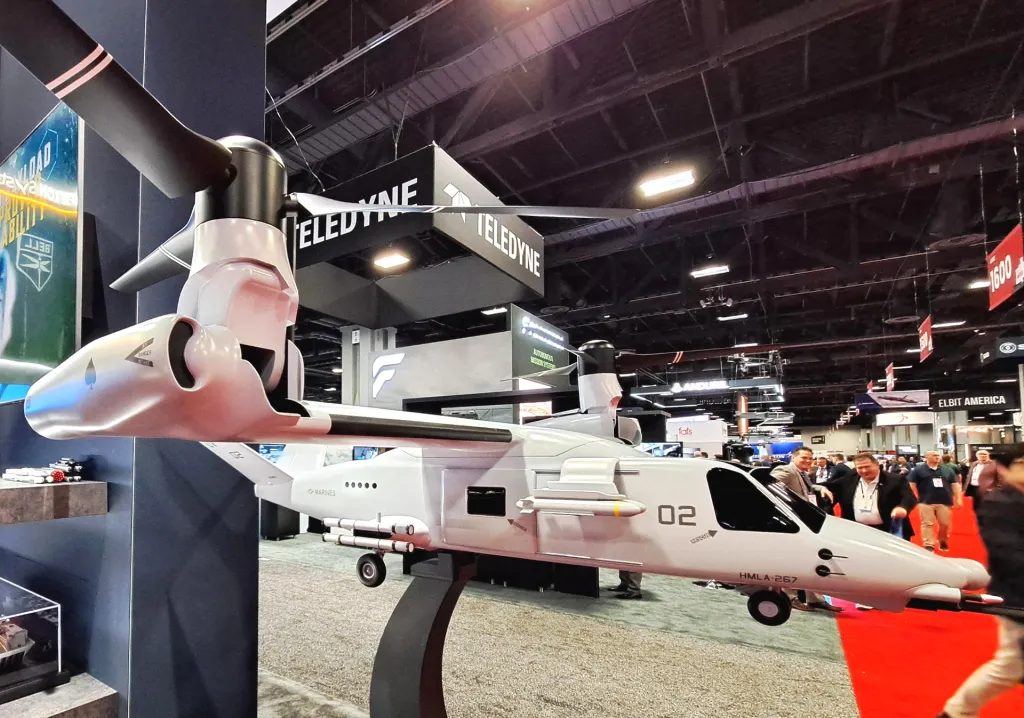
A model of the new armed MV-75 concept for the Marines is currently on display at the annual Modern Day Marine conference in Washington, D.C., at which TWZ is in attendance. It is painted in the markings of Marine Light Attack Helicopter Squadron 267 (HMLA-267), a unit currently equipped with AH-1Z and UH-1Y helicopters, which perform attack and armed utility mission sets, respectively.

The model’s most immediately eye-catching details are its armament. This includes two stub wings, each with a single pylon, mounted on either side of the top of the forward fuselage, situated between the main wing and the cockpit. A Naval Strike Missile (NSM), a stealthy anti-ship cruise missile with secondary land capability, is loaded on the left side. The Marine Corps is already fielding NSM in a ground-launched configuration. The missile is also in U.S. Navy service as a sea-launched weapon, as it was originally designed.

On the right side of the model, there is a pair of missiles, which are intended to reflect the Marine Corps’ forthcoming Precision Attack Strike Munition (PASM) capability. PASM is a version of L3Harris’ Red Wolf, a small, lower-cost cruise missile that you can read more about here.

It is interesting to note that the missiles on the model also look similar in broad strokes to Lockheed Martin’s Common Multi-Mission Trucks (CMMT, pronounced ‘comet’). Red Wolf and CMMT are just a few examples of a growing field of missile-shaped ‘air vehicles,’ many of which can be readily reconfigurable to perform a host of different tasks, including acting as a kinetic munition, an expendable electronic warfare system, or a decoy. Designs in this general category increasingly blur the line between uncrewed aerial systems, especially longer-range kamikaze drones, and traditional cruise missiles.
The stub wings could be used to carry other stores, such as AGM-114 Hellfire missiles or Advanced Precision Kill Weapon System II (APKWS II) laser-guided rockets, per Bell.
Two additional launchers are attached to the sides of each of the main landing gear sponsons. These are intended to depict launch tubes for the ALTIUS-700M loitering munition or something similar, according to Bell. This is a general category of uncrewed systems now commonly referred to as launched effects. There are also five apertures on either side of the fuselage through which additional munitions or drones could be fired via Common Launch Tube (CLT).

“There are some restrictions of [sic] where you can place them [launchers and/or pylons for munitions and other stores], because anything that’s forward firing would need to have the clearance to get past the [rotor] tip path plane and [have] it fit inside the fuselage,” Bill Hendricks, Senior Strategy Manager at Bell, told our Eric Tegler on the show floor at Modern Day Marine. “Our assumption is that, should the Marine Corps pursue something like this, they would want to be able to employ ordnance while in airplane mode with the nacelles forward. So the weapons that we have currently on that conceptual model would be something that you could fire in airplane mode.”
The design also has a three-barrel Gatling-type cannon or machine gun in a turret under the nose. What is depicted is in line with the M197 20mm Gatling-type cannon found on Marine AH-1Zs today. An improved, lightweight evolution of that cannon, the XM915, was also expected to arm the Army’s now-canceled Future Armed Reconnaissance Aircraft (FARA).
The video below shows a live-fire flight test of the XM915 mounted on a UH-60 Black Hawk helicopter.

XM915 20mm firing
The model of MV-75 derivative for the Marines also has a sensor turret in the nose with a pair of large apertures in front, which typically reflect electro-optical and/or infrared video cameras inside. It has a retractable in-flight refueling probe, as well. The Army’s plans for in-flight refueling capability for the Cheyenne II are evolving. This is also a feature expected to be found on a special operations version of the MV-75.

Compared to the AH-1Z and UH-1Y, with this tiltrotor design, “now you have additional range, you have additional speed, more operational flexibility, you can cover more area with one platform,” Bell’s Hendricks highlighted at the Modern Day Marine show.
“If that was something that we were asked to look at, then we can certainly explore that,” he added when asked about the possibility of extra fuel carried externally for even greater reach. “That’s not something that we’ve looked at with that conceptual design, because an MV-75 variant in that configuration with internal fuel would still have a range, after a short takeoff or a running takeoff, in excess of 1,000 nautical miles.”
As a single replacement for the AH-1Z and UH-1Y, an armed MV-75 derivative would come in a larger and more expensive package, which would present additional tradeoffs for the Marines to consider. As an aside, the service is also now in the process of charting a separate course to a replacement for the MV-22 Osprey.

As noted, the Marine Corps has now begun to lay out a new vision for what will succeed its AH-1Z and UH-1Y helicopters. The service has previously told TWZ that this effort, currently known as Future Attack Strike (FASt), will also help fill certain capability gaps created by the retirement of the AV-8B Harrier jump jet and legacy F/A-18C/D Hornet fighters. The Marines have long said the main replacements for the AV-8Bs and F/A-18C/Ds will be variants of the F-35 Joint Strike Fighter.
“So, right now, for FASt, everything is on the table. Manned, unmanned, optionally-piloted, I think, are good avenues to take a look at. Conventional rotary-wing, tiltrotor. Maybe there’s something else out there,” Col. Scott Shadforth said in response to a question, also from Eric Tegler, while speaking today at Modern Day Marine. “There is no steadfast, solid response to that.”
Shadforth is currently Director of the Expeditionary Maritime Aviation-Advanced Development Team (XMA-ADT) within Naval Air Systems Command (NAVAIR). XMA-ADT focused on rapid prototyping and experimentation to help refine future Marine Corps aviation requirements in cooperation with the Navy.
“So, as we look at unmanned, manned-unmanned teaming, air-launched effects, all the capabilities to help extend the range of various assault support or attack type platforms, all of those are on the table for consideration by the Marine Corps at this time,” he added.

In the meantime, the Marines are notably working to integrate a standoff strike capability onto the AH-1Z through the aforementioned PASM, which will open up significant new operational possibilities. The service has also been looking at ways to expand the roles and missions of the UH-1Y, to include anti-submarine warfare capability and acting as an airborne drone controller.
It is important to note that this is not the first time Bell has shown models and renderings of armed variations of this design, originally branded as the V-280 Valor, that could perform sea control and other maritime mission sets. This has included versions with internal bays, as well as pylons under the wings and ones mounted on the sides of the rear end of the fuselage.
Previous navalized concepts have also included folding main wings and rotors, similar in form and function to those features on the V-22 Osprey tiltrotor, to help reduce the aircraft’s physical footprint when operating from ships. Bell has said previously that the ‘stowed’ configuration of the V-280 could be small enough to fit inside the hangars on Arleigh Burke class destroyers, as well as those on larger naval vessels.

Bell has also pitched navalized V-280/MV-75 designs in the past, paired together with its uncrewed V-247 Vigilant tiltrotor drone. This has included previous proposals specifically aimed at meeting future Marine Corps aviation requirements, which have evolved significantly in recent years.


“I can see conceptually, where the Navy could, if this is what they wanted, adopt like this to [meet] their sea control, or ASW [anti-submarine warfare], or ASuW [anti-surface warfare] mission set [sic], because of the additional range that it gives you,” Bell’s Hendricks said when asked about whether this concept could also be relevant to that service’s needs. “It would outperform the speed and range of an H-60, and so that would give them more operational reach.”
In recent years, the Navy has been exploring options for replacements for its MH-60R and MH-60S Seahawk helicopters, as well as its MQ-8C Fire Scout drone helicopters. However, at least in the near term, the service seems to be leaning more toward a major evolution of the Seahawk platform rather than an entirely new platform.
The Marine Corps has made clear that all options are currently on the table, including a tiltrotor like Bell’s MV-75 or a derivative thereof, as the service works to firm up requirements for a replacement for its AH-1Z and UH-1Y helicopters.
Eric Tegler and Phil Hladky contributed to this story.
Contact the author: joe@twz.com