Missile

Red Wolf Cruise Missile Eyed To Give OA-1K Skyraider II Standoff Strike Capability

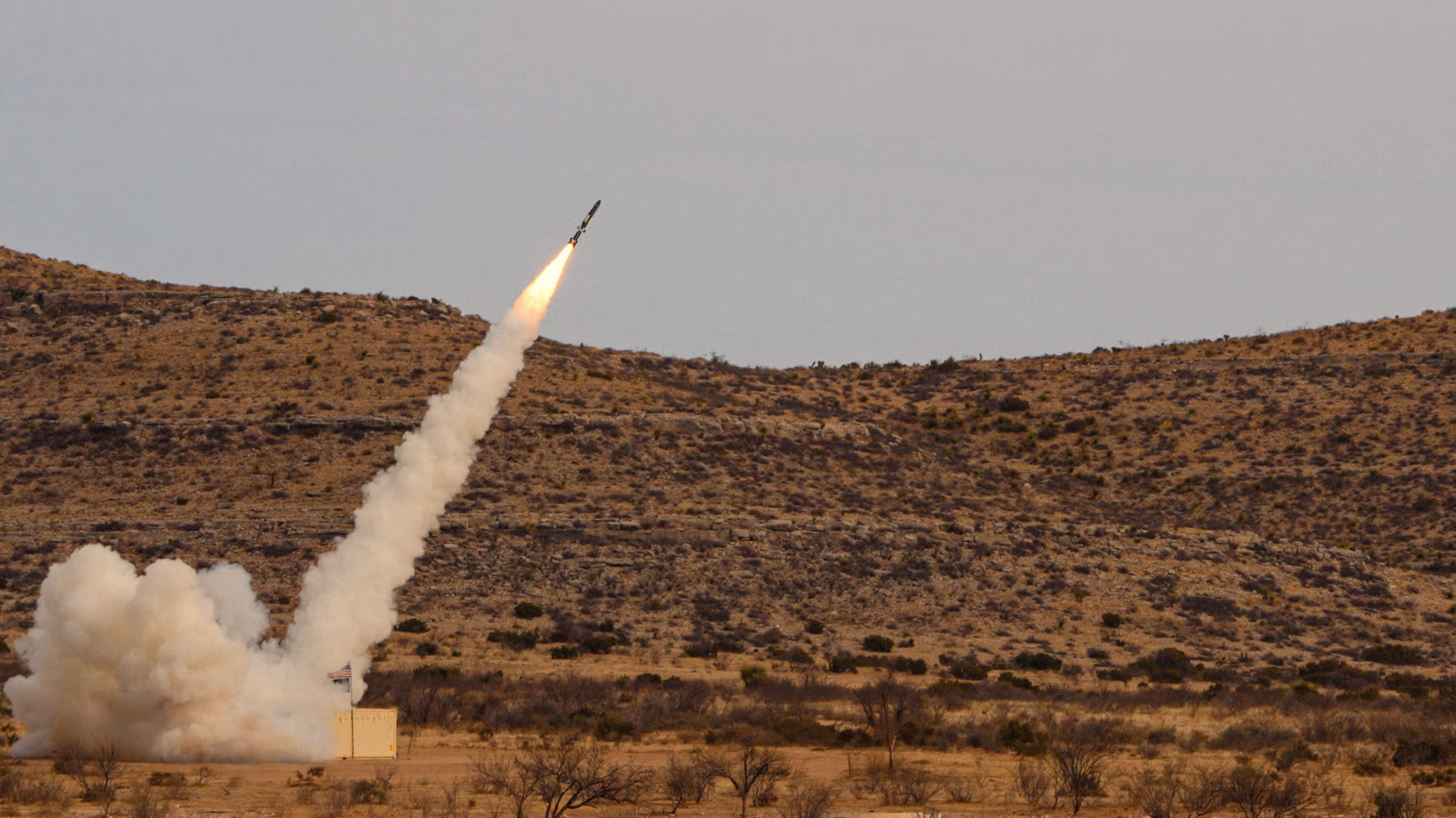
L3Harris has highlighted the potential benefits of pairing its Red Wolf miniature cruise missile with the U.S. Air Force’s OA-1K Skyraider II. Standoff munitions like Red Wolf could help the OA-1K, originally designed for close air support and surveillance and reconnaissance in support of low-intensity operations, find a role in future high-end conflicts, but questions about the value of doing so remain. The U.S. Marine Corps is already acquiring the Red Wolf to provide a boost in capability for its AH-1Z Viper attack helicopters for the same general reasons.

L3Harris announced today that it had shown “the ability to integrate” Red Wolf on its Sky Warden aircraft. The Sky Warden is based on the Air Tractor AT-802 single-engine turboprop crop duster. In 2022, the Air Force declared the two-seat Sky Warden the winner of its Armed Overwatch competition, subsequently giving the plane the designation OA-1K and the official nickname Skyraider II. The Air Force is planning to eventually acquire 75 OA-1Ks, which will be operated by units under the umbrella of Air Force Special Operations Command (AFSOC).

A U.S. Air Force OA-1K Skyraider II. USAF

L3Harris officially unveiled Red Wolf, as well as the companion Green Wolf (fitted with an electronic warfare payload instead of a high-explosive warhead), last July. However, the development of the “Wolf” family of systems dates back to 2020.

“Our customers demand a lean, agile aircraft that can fly, take off and land anywhere, anytime, outfitted with a wide range of payloads,” Jason Lambert, President for Intelligence, Surveillance and Reconnaissance, Space and Mission Systems at L3Harris, said in a statement today. “Bringing together Red Wolf and Sky Warden demonstrates the rapid reconfiguration and customization of key L3Harris capabilities.”

The OA-1K can carry up to 6,000 pounds of munitions and other stores on as many as eight pylons, four under each wing. L3Harris has also said in the past that aircraft has a “robust suite of radios and datalinks providing multiple means for line-of-sight (LOS) and beyond line-of-sight (BLOS) communications.”

OA-1K Skyraider II Walk-Around Tour With Its Test Pilot


Adding Red Wolf to the Skyraider II’s arsenal would turn the aircraft into a true standoff weapons delivery platform. This, in turn, would help keep the aircraft further away from potential threats, reducing the risk to the crew.

The members of the “Wolf” family are all in the 250-pound class. They have a missile-like core design, powered by a small turbojet, and with at least a degree of low-observability (stealthiness). They are in the 250-pound weight class. “Their endurance has been proven in flight testing, demonstrating high subsonic speeds – 200+ nautical mile range at low altitudes and 60+ minutes duration,” per L3Harris.

Side-by-side renderings of the Red Wolf and Green Wolf, showing them to be functionally identical, at least externally. L3Harris

Details about how Red Wolf or Green Wolf are guided are limited, but L3Harris says they are capable of “autonomous over-the-horizon engagements.” The Marine Corps, in cooperation with the U.S. Navy, has used tablet-based control systems as part of the engagement process in past testing of Red Wolf.

L3Harris has also talked in the past about how members of the Wolf family could work together. The Green Wolves could help locate targets, especially hostile air defense assets, by zeroing in on their signal emissions, as well as clear a path for Red Wolves to actually strike them.

A graphical rendering of a notional concept of overland operations involving the employment of Red Wolf and Green Wolf systems. L3Harris has also shown similar concepts for use of the Wolf family in support of maritime missions and expeditionary operations in a littoral context. L3Harris

Red Wolf or Green Wolf are also only the start of what L3Harris hopes to be a larger family of configurations based around the central design. At least one Red Wolf was reportedly employed at the U.S. Army’s Experimentation Demonstration Gateway Event in 2021 (EDGE 21) configured as an airborne signal relay node rather than a munition.

“We can adjust the size of the warhead, the fuel tank, we can even put a parachute on the back of it, and we have,” Matthew “Guicci” Klunder, Vice President for Business Development at L3Harris, said in a promotional video released last year, seen below. “It can be a kinetic effect, it could be a non-kinetic effect, it could even be a decoy.”

Meet the “Wolf Pack”


Changing the size of the warhead would have impacts on range and endurance, as well as the terminal effect on the target. This also opens up the possibility of fitting different types of warheads, including ones with increased penetrating capability. A parachute system would allow for recovery and, by extension, potential reuse.

Overall, L3Harris describes the “Wolf” family collectively as “launched effects vehicles.” The U.S. military uses the term “launched effect” to refer to a broad swatch of uncrewed aerial systems that can be deployed from platforms in the air, on the ground, and at sea, and that can be configured as one-way attackers or to perform other missions. The Wolf family is just one of a growing number of modular, relatively cheap, and small systems that fall under that broad umbrella. Many of them increasingly blur the line between uncrewed aerial systems, especially longer-range kamikaze drones, and cruise missiles, as well as decoys.

As mentioned, just integrating Red Wolf onto the OA-1K would give it a standoff strike capability it currently does not have. Adding Green Wolf to the mix would further expand its capability, including adding a valuable, if not potentially critical, way to suppress hostile air defenses that might suddenly pop up.

An OA-1K seen operating from a dirt field during developmental testing. USAF

In general, standoff capabilities for the Skyraider II could open up important new avenues to employing the aircraft in the context of future large-scale conflicts, including across the broad expanses of the Pacific. When the Air Force first initiated the Armed Overwatch program, U.S. military operations globally were defined by counter-terrorism operations in countries like Afghanistan, Iraq, and Syria with entirely permissive airspace. By the time the decision was made to acquire the OA-1Ks, a shift was underway across the U.S. military to reorient toward preparing for high-end fights.

“How could we support them [friendly forces] if it’s in the Pacific or anywhere else? The OA-1K certainly has some roles and missions that can [provide] support there. And then in a large-scale combat operation, we are looking at, in partnership with other components of SOCOM [U.S. Special Operations Command], what are some of the things that it could do,” a high-ranking Air Force official told TWZ in an interview last year. “Can it employ air-launched effects, at range, at standoff, in a flexible way that would provide value?”

“The beauty of the OA-1K is that it’s modular, it’s adaptable, and for a relatively small aircraft can carry a lot of payload. And so in a perfect world, in a resource-unconstrained world, I want to be able to have as big a menu as possible of things that I could hang from a hardpoint on there, or attach as a sensor,” Air Lt. Gen. Michael Conley, head of AFSOC, also told TWZ later in the year on the sidelines of Air & Space Forces Association’s main annual ocnference. “I’d love to be able to use long-range standoff mission munitions on multiple airframes.”

Conley was responding to a question specifically about integrating Black Arrow, also known as the Small Cruise Missile (SCM), onto the Skyraider II. Leidos is developing Black Arrow for AFSOC now, but primarily as a new standoff capability for the AC-130J Ghostrider gunship. Questions have also been raised about how to ensure the future relevance of the Air Force’s AC-130 fleets in high-end fights.

Leidos completes successful test launch of a Small Cruise Missile


At the same time, exactly how great the benefit would be to making the OA-1K into a standoff shooter is a matter of debate. A key benefit the Skyraider II offers is its ability to operate with a very small logistical footprint from far-flung locales, including ones that are very austere and close to or even within contested areas. As such, an OA-1K would be able to launch munitions like the Red Wolf from within the enemy’s own weapon engagement zones or from other surprise vectors, and fly low and slow to literally stay out of the gaze of distant radars.

At the same time, the OA-1K’s range and speed are limited, with the aircraft said to have a combat radius of roughly 200 miles with six hours of loitering time once arriving on station. The Skyraider II’s ability to survive in a highly contested areas, even with a standoff capability like that offered by Red Wolf, is also questionable at best.

OA-1Ks could still provide useful support during a high-end fight, but in areas further away from hostile threats. As TWZ has pointed out in the past, in a Pacific scenario, the aircraft could provide force protection and surveillance on a localized level around forward operating locations, including island outposts.

AFSOC’s Conley, among others, has also stressed in the past that AFSOC will still continue to be called upon to conduct lower-intensity missions that require the kinds of capabilities that the OA-1K was originally designed for, as well.

Regardless, the market space for munitions like Red Wolf and Black Arrow is steadily growing, and includes many other designs already that might also find their way onto the OA-1K, as well as other platforms in the air, ground, and maritime domains.

Red Wolf does have the additional benefit of already being elsewhere in the U.S. military ecosystem. As noted, the U.S. Marine Corps and U.S. Army have been testing it in recent years. In January, L3Harris announced that the Marine Corps (by way of the Department of the U.S. Navy) had chosen Red Wolf for its Precision Attack Strike Munition (PSAM) requirement for a new air-launched standoff weapon primarily to arm the AH-1Z Viper attack helicopter. The Marines have been facing their own questions about how to keep the AH-1Z, as well as the companion UH-1Y Venom armed utility helicopter, relevant in future high-end fights.

A US Marine Corps AH-1Z carrying a Red Wolf under each of its stub wings seen during a test in 2025. USMC

Further orders for different members of the Wolf family from other branches of the U.S. military, and potentially foreign operators, could be advantageous when it comes to sharing the cost burden and driving down unit prices through economies of scale. There could be interoperability and other operational benefits from multiple services operating versions of the same platform, as well.

Whether Red Wolf or Green Wolf ultimately become part of the OA-1K’s arsenal, the demand for launched effects like this only looks set to grow across the U.S. military and globally. For the Skyraider II, some mixture of standoff capabilities increasingly looks to be in the plane’s future to expand its relevance beyond lower-intensity conflicts.

Contact the author: joe@twz.com

Joseph has been a member of The War Zone team since early 2017. Prior to that, he was an Associate Editor at War Is Boring, and his byline has appeared in other publications, including Small Arms Review, Small Arms Defense Journal, Reuters, We Are the Mighty, and Task & Purpose.


Source link

Rusty Dagger Low-Cost Cruise Missile Hits Its Target

The U.S. Air Force has released details of a live-fire test of the Rusty Dagger, one of two new Extended Range Attack Munitions (ERAM) being developed under a crash program. The milestone suggests that Ukraine is a step closer to getting its hands on thousands of air-launched ERAMs that will provide the country with a powerful new and relatively low-cost standoff strike capability. The event is also significant in terms of the Pentagon’s focus on rapidly developing and bringing into operational service new, less-expensive weapons that can be built at scale.

The Air Force recently confirmed that the ERAM standoff cruise missile was tested at the Eglin Test and Training Range in Florida on January 21, 2025, less than 16 months from the program’s initial contract award. The service’s statement doesn’t mention the Rusty Dagger by name, but the weapon is clearly seen in a sequence of photos that show the missile heading vertically down to engage a static target before its live warhead detonates. It’s unclear what platform was used to launch the missile during the test.

Engineers and test conductors in the Central Control Facility monitor the Extended Range Attack Munition live-fire test Jan. 22, 2025, at Eglin Air Force Base, Florida. U.S. Air Force photo by Kayla Prather Samuel King Jr.

ERAM is understood to have a range of between 150 and 280 miles. It is in the 500-pound class and has a blast/fragmentation warhead with at least some degree of penetrating capability.

Alongside industry, the Eglin test was run by the Air Force Life Cycle Management Center’s Armament Directorate and the 96th Test Wing, a unit that you can read more about in this TWZ article.

The manufacturer of the Rusty Dagger, Zone 5 Technologies, also announced the test on its LinkedIn page.

“The event, which met all primary objectives including a full warhead detonation, gathered critical data to mature a new, cost-effective, long-range strike capability,” the Air Force said.

“Moving from a contract to a live-fire demonstration in under two years proves we can deliver lethal, cost-effective capability at the speed of relevance,” said Brig. Gen. Robert Lyons III, Portfolio Acquisition Executive for Weapons, in an Air Force statement. “This is how we rebuild our military — by empowering our teams and industry partners to cut through bureaucracy and deliver the tools our warfighters need to prevail.”

A full, unedited view of the Extended Range Attack Munition live-fire test on Jan. 22, 2025, at Eglin Air Force Base, Florida. via U.S. Air Force Samuel King Jr.

“The future fight demands we create an asymmetric advantage by developing cost-effective, attritable systems like ERAM that give commanders the ability to generate mass,” added Brig. Gen. Mark Massaro, 96th TW commander. “This test is a critical milestone on that path. The expert teams who executed this complex mission provided the high-fidelity data we need to validate this system, ensuring that when it reaches the warfighter, it is a proven and ready tool for the right target. This is the cornerstone of building a more lethal and effective Joint Force.”

In January 2024, the U.S. Air Force issued its first public contracting notice regarding ERAM, a request for information (RFI), but made no mention at that time about any connection to Ukraine.

A slide from an April 2025 U.S. Air Force briefing laying out a shared timeline for projected “Other Transaction” (OT) type contracting actions for various low-cost air-launched munitions programs, including ERAM and ETV. USAF

It was reported in August 2025 that Washington had approved the sale of 3,350 ERAM missiles to Kyiv. That package is said to be worth around $850 million, with most of the funds coming from Ukraine’s European allies.

As well as the Rusty Dagger from Zone 5 Technologies, CoAspire developed the Rapidly Adaptable Affordable Cruise Missile (RAACM) under the ERAM program. It’s unclear if Ukraine will receive only one of these designs or a mixture of both types. You can read more about the implications of the ERAM for Ukraine and the Ukrainian Air Force platforms that might be in line to carry the munitions here.

Two candidate weapon prototypes competing for the US Air Force’s Extended-Range Attack Munition program 👇. Both Coaspire and Zone 5 Technologies were awarded contracts late last year in support of the #ERAM program. Both are expected to enter testing this year. https://t.co/9cGBuB9z3s pic.twitter.com/gc3ZDtX54m

— AirPower | MIL-STD (@AirPowerNEW1) February 9, 2025

RAACM Cruise Missile Video Long Range Flights Summer 2025 Cleared for Public Release


Suffice it to say, the ERAM will provide the Ukrainian Air Force with an important new capacity to strike targets beyond the reach of many of the weapons currently in its arsenal, including Western-supplied precision-guided bombs. It will make Ukraine better able to hold at risk a range of Russian targets far from the front lines — command-and-control facilities, air defenses, logistics hubs, military-industrial capacity, and airfields, for example — helping offset Russian advantages in terms of manpower, weaponry, and resources.

However, it remains unclear whether or not Kyiv will be able to use ERAM to strike targets deep within Russia, with these previously having been designated off-limits, at least for the U.S.-donated Army Tactical Missile System (ATACMS).

In addition to what it will provide Ukraine, the ERAM effort could well prove to be a big deal for other U.S. allies and partners, and the U.S. military itself.

In the RFP, it was said that ERAM would be “pivotal for accelerating Ukraine’s capability to meet warfighter needs efficiently and effectively and provides an affordable mass weapon to be produced at scale.” The Air Force added: “The Government is seeking to prototype and adapt commercial autonomous modular open-architecture vehicle [sic] that can deliver affordable long-range effects. The resultant prototype will provide a platform that is mass producible.”

Exactly the same concerns are increasingly at the front of war planners’ minds in the United States, too.

When it comes to planning around a potential future high-end conflict with China, the U.S. military is now looking closely at new kinds of weapons with standoff range. Importantly, these need to be rapidly developed and then their production capacity and stockpiles scaled up.

A number of U.S. efforts are now underway with the aim of reducing costs and speeding up large-scale production of weapons systems, especially uncrewed platforms. In parallel to these are plans to prepare missile stockpiles resilient enough for any future high-end conflict, especially one against China.

The original RFI for ERAM included the requirement that 1,000 examples of the new missile could be built within two years, for an average production output of around 42 missiles per month.

As such, ERAM is very much a test case for this kind of program.

Notably, Zone 5 is also involved in the U.S. Air Force’s Enterprise Test Vehicle (ETV). Under this program, four companies — the others are Anduril, Leidos subsidiary Dynetics, and Integrated Solutions for Systems, Inc. — were tapped to design and deliver prototype ETVs. Ostensibly low-cost cruise missiles, the designs in question skirt an increasingly blurry line separating traditional cruise missiles from uncrewed aerial systems, especially longer-range kamikaze drones, as well as decoys.

A rendering of the ETV design from the Zone 5 company. Zone 5 via DIU

Looking at the same kind of space more broadly, it is clearly a growth area among defense contractors, both well-established ones like Lockheed Martin and relative newcomers such as Anduril and Kratos.

A Lockheed Martin rendering of a group of notional lower-cost air-launched stand-off munitions. Lockheed Martin

In August of last year, it was reported that the first ERAM missiles were expected to be delivered to Ukraine “in around six weeks.”

So far, there’s no sign that the missiles have arrived, but that possibility cannot be ruled out, especially bearing in mind an end-to-end test of the Rusty Dagger a little more than a year ago.

Whether it’s now in Ukrainian hands or not, the combat experience of ERAM in Ukraine will be hugely valuable, not just in terms of the technology that will be employed, but also as a prototype program for how the U.S. military might develop and field its next generation of weapons in this class.

Contact the author: thomas@thewarzone.com

Thomas is a defense writer and editor with over 20 years of experience covering military aerospace topics and conflicts. He’s written a number of books, edited many more, and has contributed to many of the world’s leading aviation publications. Before joining The War Zone in 2020, he was the editor of AirForces Monthly.


Source link

Meteor Long-Range Air-To-Air Missile In The Works For Ukraine, But There’s A Catch

Good news for Ukraine: it looks increasingly likely that it will get its hands on European-made Meteor beyond-visual-range air-to-air missiles, a class of weapon that it badly needs to redress the balance against Russian fighter jets. Bad news: the Meteors would likely only be made available once Kyiv acquires Saab Gripen fighters, a plan that remains questionable, especially in terms of the timelines for when they might materialize.

Earlier this week, the Ukrainian Ministry of Defense confirmed that the Meteor was one of the weapons being lined up for the next Swedish security aid package for Ukraine. Also on the agenda were the Gripen E and undisclosed air defense systems, Saab radars, electronic warfare systems, and drones, including long-range one-way attack drones. The announcement came after talks between the Ukrainian Minister of Defense Mykhailo Fedorov and his Swedish counterpart, Paul Jonsson.

A Gripen E loaded with seven MBDA Meteor missiles. Saab

At the Singapore Airshow this week, a Saab official told Defense News that transfer of the Meteor was under discussion and that it would be “natural” for it to be included in any Gripen package.

“The Meteor missile would be a natural content in a weapon package for any Gripen user […] discussions are taking place with several export nations, including Ukraine,” said Jussi Halmetoja, operations advisor in the air domain at Saab.

The Ukrainian Air Force’s need for a weapon in the Meteor class has long been apparent.

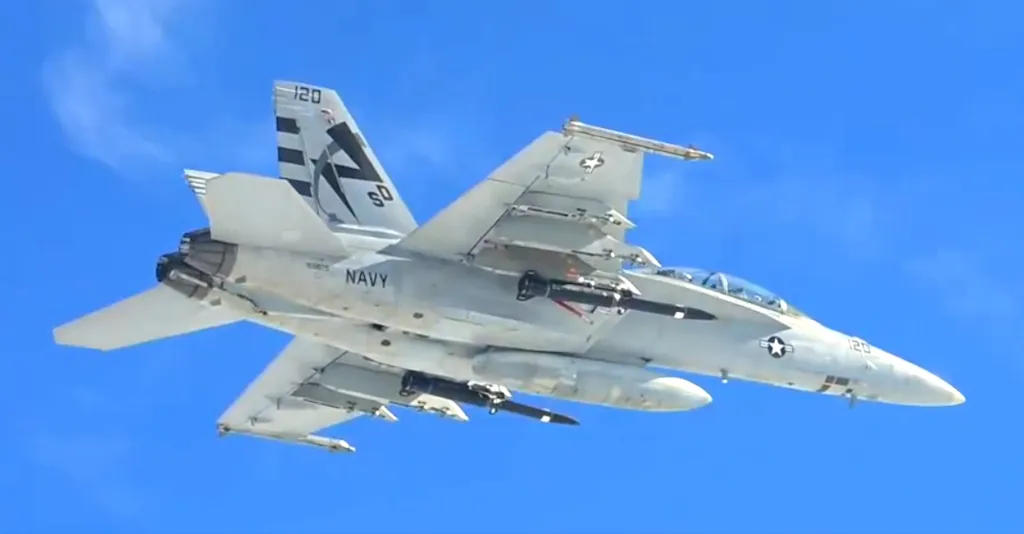
As we have discussed in the past, the Meteor is one of the most capable air-to-air missiles in operational service anywhere in the world.

Its key feature is its unique ramjet propulsion system, which can be throttled during different phases of flight. This ensures the missile still has considerable energy reserves during the terminal attack — it’s at this point that more conventional air-to-air missile motors lose energy, leading to a decrease in agility.

Meteor


Propelled by its ramjet motor, the Meteor’s all-important ‘no-escape zone’ is therefore far greater than for comparable weapons. This means the target has a much-reduced chance of evading the missile at the endgame of the engagement, something that would otherwise be far more realistic, using high-energy maneuvering. Another advantage of being able to throttle the motor is that the missile’s autopilot can calculate the most efficient route to the target for very long-range shots.

Highly significant for Ukraine is the fact that the Meteor is among the longest ranged of any Western air-to-air missile, generally considered to be able to engage certain types of targets out to around 130 miles.

A Meteor is fired during testing. Dassault

The Meteor has an active radar seeker for the terminal phase and a two-way datalink. The datalink feeds the missile with in-flight updates as it flies out to its target and provides the pilot in the launch aircraft with information on the Meteor’s fuel, energy, and tracking state. That data can help determine if and when to fire another, disengage, or even assign a different target of opportunity.

Currently, the Ukrainian Air Force’s most capable air-to-air missile is the AIM-120 Advanced Medium-Range Air-to-Air Missile (AMRAAM), which arms its F-16 fighters.

A Ukrainian Air Force F-16 with wingtip-mounted AMRAAMs. Ukrainian Air Force

Ukraine’s AMRAAMs include the AIM-120C version, which, as we’ve discussed in the past, offers some significant advantages over the earlier AIM-120A/B models. Most importantly, the AMRAAM is Ukraine’s first active-radar-guided air-to-air missile. This is a class of weapons that was long sought after by Ukraine. Early on in the conflict, one of its fighter pilots, the late Andrii Pilshchykov, better known by his callsign “Juice,” told TWZ: “The lack of fire and forget missiles is the greatest problem for us.”

According to data from one of its operators, the AIM-120C-5 subvariant provides a maximum range of around 46 miles, although the actual range of the missile is tightly controlled information and based on many engagement factors.

For all its capabilities, the AMRAAM’s reach is far outstripped by Russia’s long-range R-37M air-to-air missile, known to NATO as AA-13 Axehead. Typical Russian tactics involve firing the R-37M from outside the range of the missiles carried by Ukrainian fighters.

A Russian Su-35S launches an R-37M air-to-air missile. Russian Ministry of Defense screencap

Mainly used by Su-35S Flanker multirole fighters and MiG-31BM Foxhound interceptors, the R-37M is a missile we have examined in detail in the past.

Last week, we discussed a video showing the shootdown of a Ukrainian Air Force Su-25 Frogfoot close air support jet, apparently by an R-37M.

The loss of a Ukrainian Su-25. The aircraft was hit by an R-37 missile; the responsibility likely lies with either a MiG-31BM or a Su-35S fighter, as these are the types that typically patrol with such long-range missiles. The pilot lost his life during the action. Blue skies to… pic.twitter.com/lNXZPuzHXS

— Zsiguli🇭🇺 (@GZsgallos2007) January 27, 2026

With a reported range of 124 miles against certain types of targets, the R-37M flies to its target on a lofted trajectory, controlled by an inertial navigation system with mid-course radio correction, and uses an active radar seeker for its terminal phase attack.

Speaking to TWZ back in 2022, Ukrainian MiG-29 Fulcrum pilot Pilshchykov said that the R-37M, typically fired from within Russian airspace, was “limiting our capabilities to conduct our missions. Of course, if you’re maneuvering, we are not able to provide an airstrike or something else, so the game is still very, very, very tough in the air and very, very risky. If you’re not aware of the launch of a missile, you’re dead.”

As it stands, the Meteor is the best candidate for Ukraine to try and redress the balance in the air war when faced by the far-reaching R-37M, and would finally put Russian aircraft at risk within their own missile ranges.

The Meteor is a product of the European MBDA missile house, with manufacture undertaken by its U.K. branch. Other partners in the Meteor program are France, Germany, Italy, Spain, and Sweden, which placed an order for more of the missiles last year. All of these nations are firm supporters of Ukraine, but whether they approve a transfer of the missiles to Kyiv will also depend on how they judge the intelligence risk. After all, the wreckage of such a long-range weapon is very likely to end up on Russian territory, which would expose its technologies to analysis and exploitation.

The then U.K. Secretary of State for Defense, Gavin Williamson (center), is shown a Meteor missile by MBDA staff at their factory in England. Crown Copyright

However, Ukraine will only be able to use the Meteor once it starts to receive Gripens (or, alternatively, Dassault Rafales offered by France).

As it stands, Ukraine has signed letters of intent to acquire as many as 150 Gripen E fighters from Sweden and up to 100 Rafales from France over the next 10 years.

Ukrainian President Volodymyr Zelensky and Swedish Prime Minister Ulf Kristersson announced the signature of the letter of intent in front of a Gripen E at Linköping, Sweden, in October 2025. Swedish Ministry of Defense

For Ukraine, the Gripen and Meteor could be used in a very powerful combination with the two Saab 340 airborne early warning and control (AEW&C) aircraft equipped with Erieye radar that have been donated by Sweden.

The Saab 340 AEW&C will be able to work as a fighter control asset, detecting targets, prioritizing them, and then assigning them to the fighters for interception. Using its datalink, the radar plane can also directly provide the missile with mid-course guidance updates. In fact, the fighter pilot may never have to use their own radar to engage a target. Instead, the missile is assigned a target, is fired, and then gets continuous updates from the AEW&C platform.

Erieye explained


As we have discussed in the past, either the Rafale or Gripen E would become the most advanced combat aircraft in Ukraine’s inventory, but there remain glaring questions about whether the acquisition of one of these aircraft types, let alone two, is actually feasible, especially in such numbers.

A Dassault Rafale bristling with weapons, including the Meteor. Dassault

The letters of intent underscore Ukraine’s political commitment to buy these fighters, but don’t constitute a purchase deal. For Ukraine, there’s nothing to lose here, and it can cement its relationships with the nations that support it by showing interest in huge arms buys without any liability.

The same applies to the Meteor.

However, official discussions about the missile, together with the Gripen and Rafale, once again signal the scope of Kyiv’s ambitious re-equipment plans, especially when it comes to its air force.

A faster route to getting Meteor operational in Ukraine might involve Sweden providing secondhand Gripen C/Ds, something that has been proposed in the past.

A Swedish Air Force Gripen C at a remote base. Saab

Swedish officials have said it would take around three years for new-build Gripen Es to arrive in Ukraine. With an urgent need for fighters, Ukraine has said in the past that it wants to get its first Gripens delivered by 2026. The earlier Gripen C/D is also compatible with the Meteor.

While we wait for any final Gripen or Rafale deals to be concluded, Ukraine has at least made a first step toward acquiring an air-to-air missile that would finally allow its pilots to engage Russian aircraft at extended ranges, which would offer a powerful challenge to Russia’s current freedom of movement in the air war.

Contact the author: thomas@thewarzone.com

Thomas is a defense writer and editor with over 20 years of experience covering military aerospace topics and conflicts. He’s written a number of books, edited many more, and has contributed to many of the world’s leading aviation publications. Before joining The War Zone in 2020, he was the editor of AirForces Monthly.


Source link

China’s Massive PL-17 Air-To-Air Missile Seen Up Close

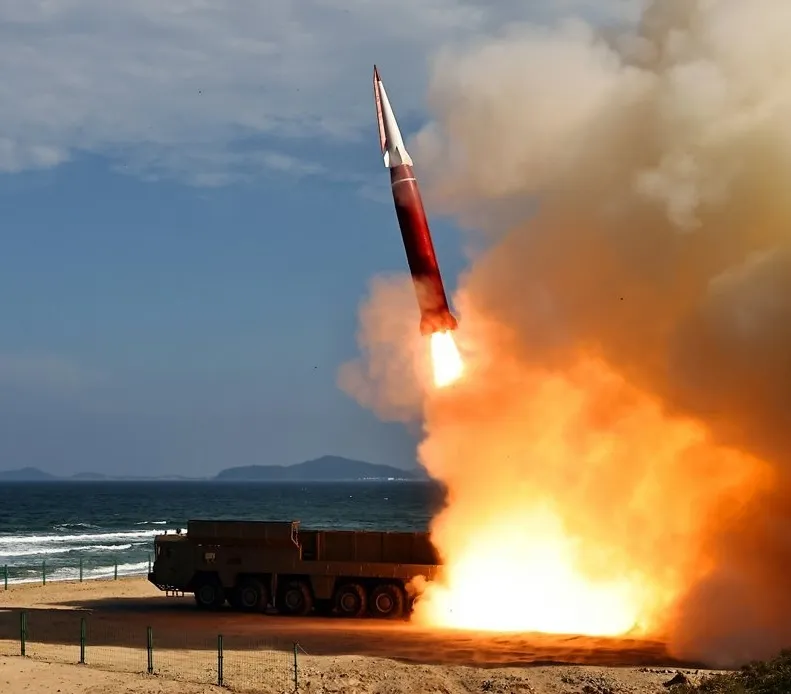
One of the most enigmatic weapons in the arsenal of the Chinese People’s Liberation Army Air Force (PLAAF), the PL-17 very long-range air-to-air missile, appears to have been shown for the first time at close quarters. The missile has been around for a relatively long time, but next to no official details about it have been released. Meanwhile, the threat that it and other Chinese air-to-air missiles pose has triggered a flurry of weapons development in the United States.

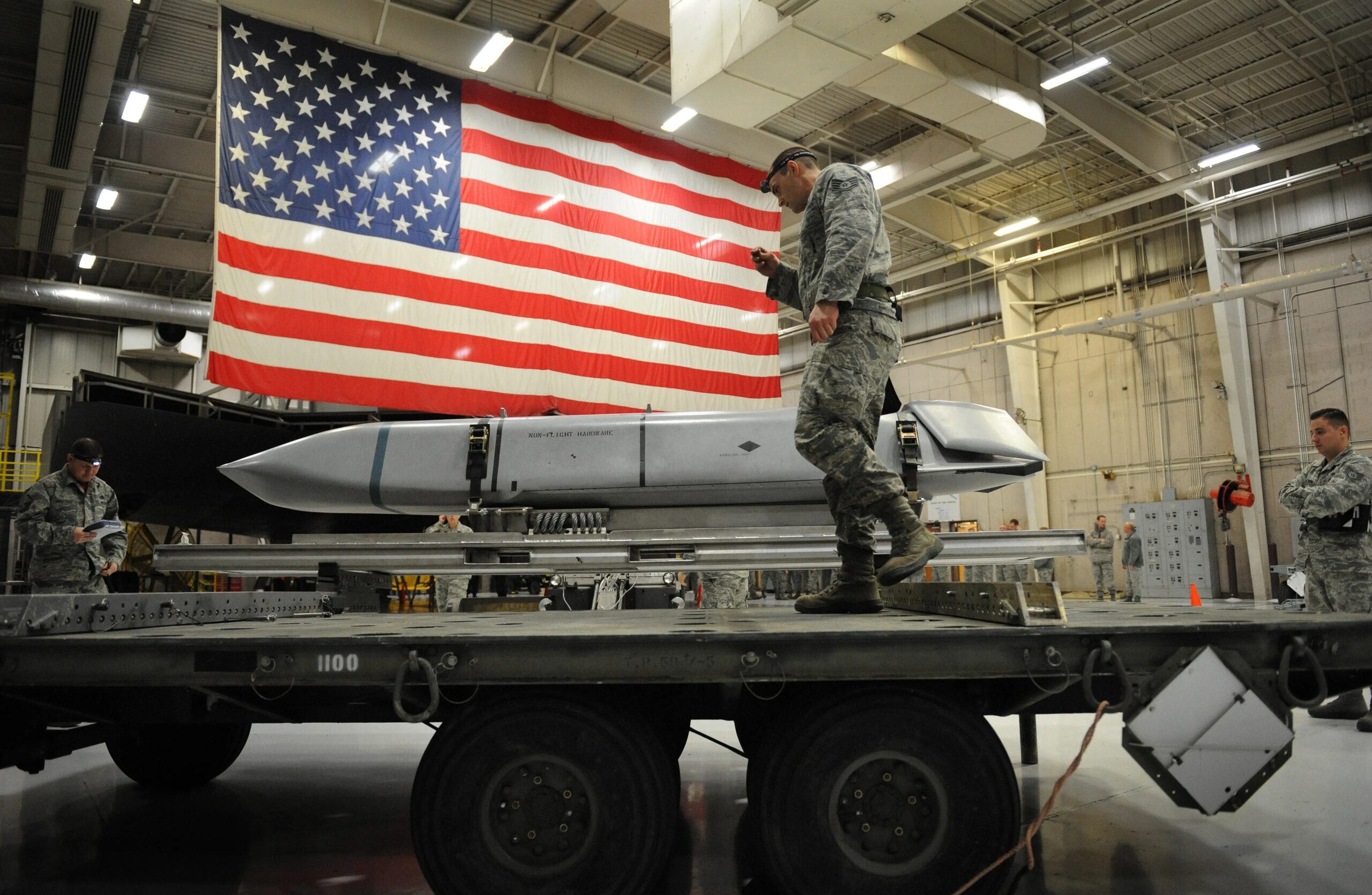
As is often the case with such images, we must note that the photo of the PL-17 appears authentic, but we cannot be certain of that. The date and location of the image are also unclear, but it shows a PL-17 (more accurately, a full-size mock-up of one) on a display stand at a tradeshow or exhibition. A man poses in front of the missile, face censored, while behind the weapon is a board promoting the J-20 stealth fighter.

As it seems, this is indeed the first legit image of the PLAAF’s ULR-AAM PL-17, even if it’s only a model.

However, it would be most interesting to know when this image was taken and where? 🤔 pic.twitter.com/CjPI4rO6sJ

— @Rupprecht_A (@RupprechtDeino) January 27, 2026

We have become accustomed to ‘leaks’ out of China over many years when it comes to new military aircraft designs and their weaponry. Combined with the fact that the PL-17 was first publicly revealed in a blurry photo close to 10 years ago, its appearance at a tradeshow at this point might not be entirely surprising.

For its part, the PLAAF has published official imagery of the PL-17 (albeit showing the missile at a considerable distance, with no real detail visible). The release of the PLAAF photo, seen below, in 2023, was taken as confirmation that the missile was in operational service, or close to it, arming the J-16 Flanker.

The PLAAF image showing a formation of four J-16s with varying configurations of air-to-air missiles. Two of the fighters in question carry four PL-10s, one PL-12, four PL-15s, and one big PL-17. This loadout spans short to very long-range engagement envelopes, with the PL-17 providing unprecedented reach. PLAAF

When the missile first appeared in public, in 2016, it was dubbed PL-XX in the West; subsequently, the PL-20 designation was suggested, but PL-17 is now confirmed, at least based on the new photo. There are reports that the missile received the Western reporting name CH-AA-12 Auger when it entered service.

From the start, the PL-17 was considered to be a very long-range AAM, based on its prodigious size, roughly 20 feet long. For a missile with this reach, key targets are likely high-value, larger assets, including tankers and airborne early warning aircraft.

This 2016 image provided our first look at the PL-17. Chinese internet
Another 2016 image shows the PL-17 in more detail. Chinese internet

In detail, the PL-17 features a dual-pulse rocket motor, while control is provided by four relatively small tail fins and a thrust-vectoring nozzle. Reportedly, the missile has a range of around 250 miles, although that number is dependent on a huge array of factors, and actual range can vary dramatically based on the engagement circumstances. It is thought to have a top speed of at least Mach 4.

Guidance is thought to be achieved through a combination of a two-way datalink and an active electronically scanned array (AESA) seeker, which is said to be highly resistant to electronic countermeasures. There are also reports of a passive anti-radiation seeker to supplement the main seeker. This could be especially useful against airborne early warning and ground moving target indicator (GMTI) radar aircraft.

However, using the PL-17 to its full potential, in terms of range, engagements would likely involve targeting data provided by standoff assets, such as friendly airborne early warning aircraft (a capability set that China has invested heavily into), other aircraft closer to the target, ground and surface-based radar, or even satellites.

In the past, there had been speculation about a possible optical window on the side of the nose of the missile that could indicate an additional infrared seeker, although there is no sign of that in the full-size mock-up version.

So far, the PL-17 has only been seen carried by the J-16, although there has been an assumption that it would be adapted for external carriage on the J-20, too.

A J-20 with eight external missiles, not, in this case, PL-17s. Chinese internet

Certainly, it seems too large to be used to arm the J-10 series or even the J-35, which would seem to raise a big question about its potential export prospects. On the other hand, the missile may well be envisaged as armament for forthcoming Chinese combat aircraft, most notably the J-36 sixth-generation jet, which features extensive internal weapons capacity.

Regardless, the existence of the PL-17, along with other advanced Chinese air-to-air missile developments, has become a very serious issue for the U.S. military. Concerns about China eroding the ‘missile gap’ with the West have driven work on the still highly classified AIM-260 Joint Advanced Tactical Missile, among other long-range air-to-air missile initiatives.

Last year, the U.S. Navy introduced, at least on a limited scale, an air-launched version of the Standard Missile-6 (SM-6) under the AIM-174B designation. The range of this weapon is classified but should be far in excess of that of the AIM-120D Advanced Medium-Range Air-to-Air Missile (AMRAAM), probably at least double and perhaps even triple the range, against large targets. This would imply an ability to hit some types of aerial targets over multiple hundreds of miles.

How The Navy’s New Very Long-Range AIM-174 Will Pierce China’s Anti-Access Bubble


For now, many questions remain about the full capabilities and technical features of the PL-17. Should the new photo be genuine, however, it would confirm that Beijing is willing to expose at least some aspects of the big missile to a broader audience. With that in mind, we might well learn more about this weapon soon.

Contact the author: thomas@thewarzone.com

Thomas is a defense writer and editor with over 20 years of experience covering military aerospace topics and conflicts. He’s written a number of books, edited many more, and has contributed to many of the world’s leading aviation publications. Before joining The War Zone in 2020, he was the editor of AirForces Monthly.


Source link