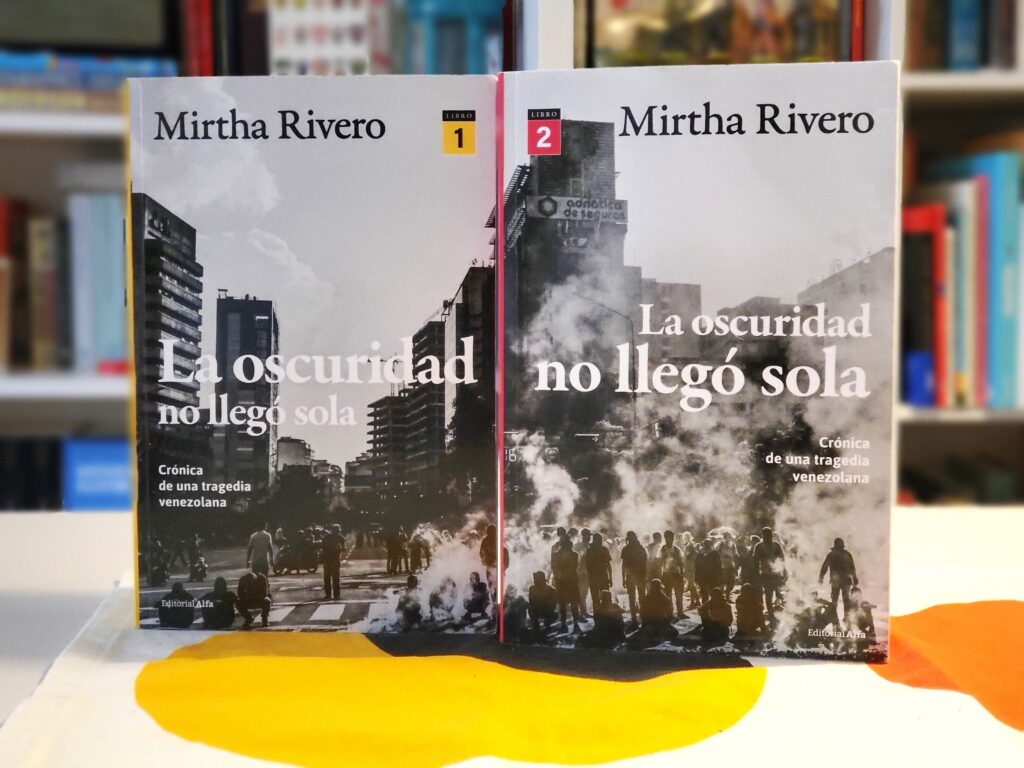
Mirtha Rivero Maps The Night That Shrouded Venezuela’s Institutions
In an era of 150-page novels in 14-point font, and books on Venezuela’s recent history that feel like overly long opinion pieces, Ulises Milla’s Editorial Alfa opted for something entirely different: a chronicle of how chavismo took over the Venezuelan State between 1999 and 2004, the product of ten years of research, divided into two volumes totaling more than 1,400 pages.
It is titled La oscuridad no llegó sola (no English translation yet), taken from a line by a Colombian poet, and has a subtitle that speaks volumes: “chronicle of a Venezuelan tragedy.” Yes, it is a chronicle in the broadest sense of the term, a systematic and multifaceted account that protects a series of events from oblivion in a specific era. It is also a Venezuelan tragedy, one among many, in which everything leads to an unhappy ending that seems inevitable, as in those of Aeschylus or Sophocles.
There is a classical feel to Mirtha Rivero’s new work, not only because she has drawn on literary genres that are over two millennia old, but also because it is a book that took a long time to write, one made to transcend time. For this reader, it is another essential text about our past, like José Domingo Díaz’s chronicles of the First and Second Republics or Lisandro Alvarado’s Historia de la Revolución Federal, and certainly like Rivero’s previous work: the bestseller La rebelión de los náufragos, published in 2010. It does not attempt to impose a personal thesis, defend one side or one figure, or propose a solution to the nation’s ills. It is an effort to understand how things happened, on a scale vast enough to allow the patterns of behavior developed by political actors over those years to emerge.
For those of us who experienced these events firsthand, through the media, La oscuridad no llegó sola still reveals aspects of the story we didn’t know, thanks to the quantity and quality of its sources. For those who were too young, it is an unparalleled document on how the traditional political class underestimated chavismo, how chavismo took advantage of the negligence and frivolity of its adversaries to seize control of institutions, and how the anti-politics we saw explode in La rebelión de los náufragos helped demolish what little remained of that democracy, which committed suicide, or allowed itself to die. A tragedy that, with its variations, has happened before. And that will very likely happen again. La oscuridad no llegó sola by Mirtha Rivero is available on Amazon and in bookstores in Spain. From Monterrey, Mexico, where she has lived for several years, the economics journalist who is showing how Venezuela’s contemporary history must be written spoke with Caracas Chronicles.

I want to start with the moment when La rebelión de los náufragos was published, had the impact it did, and you began the journey that led to these two volumes. You addressed this in the preface to La oscuridad no llegó sola, but what was the process like for defining not only the 1999-2004 timeframe, but also the questions you wanted to answer?
After La rebelión de los náufragos was published, I didn’t immediately consider any other topics. It was the third book I had written, but it was the first one that was published, and its reception changed my way of working. It was like a shock. For a year and a half, I couldn’t think about another “topic” because I was adapting to that new reality. It was in mid-June 2011 that another topic emerged. I wanted to answer a question: What happened in the 2004 recall referendum? For me, it was personally very important because, as a result, my husband and I began looking for a new place to live. Did voting fraud occur or not? What was it like? How did we get to that point? So I marked the period: from Chávez’s inauguration on February 2, 1999, until the day of the referendum, August 15, 2004.
It wasn’t so much that chavismo was pressuring the Supreme Court, but rather that a large part of society favored a Constituent Assembly.
I had to go back quite far because Chávez didn’t appear out of nowhere. Nor did other figures: the architects who helped him set up his political machine, those who accompanied him from that day forward, and those who had been with him even before the 1992 uprisings didn’t appear out of nowhere. They all have a past and a reason for being there, just like the people who kept appearing in my research. I confirmed along the way that during those years, the foundations were laid and the entire structure that allows chavismo to endure was built. As I guide my narrative, I realize that I not only have to look back, but that I often force myself to project into the future. For example, I look back when I discuss the oil industry, which is an important topic in my chronicle, but I also look forward when someone talks about the changes in the judicial sphere that the 1999 Constitution imposed, and I’m going to the trial against Judge Afiuni in 2009.
I see. For me, La oscuridad no llegó sola is a twin of La rebelión de los náufragos, in its structure, its tone, and its intention: first, you show how the political class sacrificed democracy with Carlos Andrés Pérez and paved the way for chavismo, and now we see how it overestimated its own strength and underestimated Chávez. Was describing this hall of mirrors the plan, or did it emerge during the research?
It wasn’t the plan. I didn’t see it as a continuation, nor as a hall of mirrors: it turned out that way, the story led me there. Exploring the recall referendum was actually a pretext for me to delve into that era, which I was afraid of. What was important was what happened before the referendum. How the referendum was repeatedly postponed until Chavismo had all institutions and powers under its control, which culminated in the expansion of the Supreme Court, and how it was able to regain popular support through direct subsidies via the social missions. How the opposition promoted the recall referendum without having a candidate to challenge Chavismo if Chávez lost and elections were held.
What did you learn, while writing this book, about the ability of the various opposition leaders to interpret reality? Do you share the common opinion that popular support for Chávez was underestimated in 1998 and 1999?
I was very surprised by their inability to see what was right in front of them. We had already seen how short-sighted the political parties were, their reluctance to form and renew themselves, since the 1980s. This is evident in the conspiracy against Carlos Andrés Pérez in 1993, based on a check from the secret fund that had been annulled in 1989 and was used against him in 1992; in the corruption accusations made by (future chavista minister) José Vicente Rangel; in the resistance to the reforms of the Presidential Commission for State Reform; and in the insistence of the old leaders on remaining political bosses.
There were people who knew who this Hugo Chávez they were opposing really was, but even so, there were those clumsy last-minute maneuvers in the 1998 campaign, and they weren’t prepared for the scenario in which Congress would be eliminated, as Chávez himself had said would happen. They acted with great carelessness in the face of Chávez’s rise: society, the political parties, and even a political animal like Teodoro Petkoff underestimated him. I was very surprised that they didn’t know how to confront the lieutenant colonel, the authoritarian tendencies that came with him, the power-hungry Left that accompanied him, the people who applauded the military coup attempts of 1992. They offered no resistance when Chavismo abolished Congress, taking advantage of the anti-political sentiment that had also been brewing since the 1980s. The lack of vision, and even of any statesman-like discourse, on the part of the politicians, did surprise me greatly.
One of the book’s many achievements was to unearth and trace a somewhat forgotten but key episode: how the Supreme Court accepted the Constituent Assembly’s suspension of the Legislative Branch. Did that also surprise you, how they paved the way for the dissolution of the separation of powers? How much pressure was chavismo exerting on the Supreme Court?
It didn’t surprise me that much, because we experienced it firsthand. The chavistas had just come to power and were barely learning how to use it, and they couldn’t exert pressure before Chávez took office on February 2, 1999. It wasn’t so much that chavismo was pressuring the Supreme Court, but rather that a large part of society favored a Constituent Assembly, even though a constitutional reform would have sufficed. Many people believed that this Constituent Assembly would save the country, to create a new, bright, efficient nation. Everyone was riding that wave. As Simón Alberto Consalvi said, we cannot absolve the people of their decisions.
Some of your interviewees, as expected, fall into hindsight bias: assigning to certain moments a meaning that we see today but that wasn’t easy to discern then. For example, everyone in your book says they knew the 2002-2003 strike was a bad idea, but that “the majority decided”: Didn’t you yourself fall into hindsight bias? Because when I write about those years, I have to tell myself, “Remember what you thought then about the 2002 general strike, not what you think today.”
One can always fall into that bias because one isn’t objective, pristine, but I was very careful about that and made an effort to compare the accounts. Because many interviewees told me things that didn’t happen as they said; they were mixing what others had told them with what they would have liked to have happened. My own interpretations of a particular moment fell apart as I investigated. Sometimes the same scene had six different testimonies, and I had to cross-reference them, sometimes going back to the witnesses to confirm or discuss parts of their story. The good thing is that I encountered very little reluctance from the interviewees, although of course there were people who didn’t want to talk, who stood me up, and I even made trips for nothing.
Both the oil workers and the dissident military officers were convinced they were right and that they could convince some people, while these people already had a plan in place.
With those I did talk to, I sometimes confronted them, because now it turns out, for example, that nobody agreed with the national civic strike, or as we called it then, the “oil strike.” But the investigation was able to determine who truly resisted, and how society pressured for a repeat of what happened on April 11, even though it was so unlikely to have any effect.
April 11, 2002, is like the novel Rashomon; the same event is seen differently depending on many perspectives. But it’s quite well documented; much less known is what happened within PDVSA, and you contributed a lot to those of us who aren’t familiar with the oil world. How do you see today the role played by the oil executives when they decided to step outside their bubble?
Within that bubble were people like Edgar Paredes and Juan Santana who, having been involved in university politics, were politically savvy. They knew their place and what might happen, but also what they needed to do. They created that protest movement to rescue PDVSA. Society joined them because, in reality, it used the PDVSA conflict as an excuse to protest many other things, but the oil workers were trying to defend their company because, ever since Chávez was elected in ’98, they saw him as a threat. Naively, they believed they could change the policies because they came from a school of thought where debate and consensus were reached. But even during the 2002 strike, they continued fighting to rescue PDVSA. They were fighting for the country too, but to rescue the country, they believed, PDVSA had to be rescued. The same was true for the soldiers in Plaza Altamira. Right or wrong, they wanted to rescue the FAN (National Armed Forces) where they had made their careers, without understanding that they couldn’t, because the first political prisoners of chavismo were military personnel.
The idea that Chávez also provoked the April 11th march, or the movement to crush it, is a narrative he fabricated after those events.
Both the oil workers and the dissident military officers were convinced they were right and that they could convince some people, while these people already had a plan in place. They thought that the truth would prevail and that the people would act for the good of the country. But that wasn’t meant to happen. They suffered a lack of understanding of the country’s political history, of what the 1992 coups meant. Because they were caught up in their own business, in what they knew. In fact, not all the oil workers or the military saw Chávez as a threat and voted for him in 1998, like a large part of the country.
Reading the book, I came to feel more empathy for what the oil workers and even certain military personnel, did than for what the politicians did.
Because they actually did more than the politicians in terms of trying to rescue their respective organizations. With all their naiveté, the oil workers and the military did force others to act. They gave their all to try to save not only their professional world, but democracy itself.
The book makes it clear that Chávez sought out conflicts, he provoked them. Even the massacres, not to mention the strikes: he sought out battles because he saw them (and he was right) as opportunities to wipe out pockets of resistance. Right? Do you see this as a pattern that connects everything from the 2001 enabling legislation to the recall referendum?
Chávez sought out battles because it was his way of life. He always said, like Pinochet, that he was a soldier. I believe he launched the enabling legislation package in 2001 to impose his agenda, not to provoke, because I don’t think he knew it would generate such strong resistance, even though there had already been protests since 2000. He introduced those laws at the last minute and without consulting anyone because he was an authoritarian who believed he was the center of the world. The idea that he also provoked the April 11th march, or the movement to crush it, is a narrative he fabricated after those events. He knew there were disaffected military officers and expected a classic coup, which he planned to counter with civilians, but he didn’t provoke it, because in fact, his intelligence services ultimately failed him. Just as there are people who, after the strike failed, said they never agreed with it, he rewrote history to impose the narrative that everything was his agenda. But many things surprised him, even though he eventually managed to navigate each situation. However, after April 11th, he did dedicate himself to provoking conflicts, now with the advice of Fidel Castro, and surrounded by radicals like Alí Rodríguez Araque.
Another pattern I noticed is the persistence of anti-politics, how distrust of political parties shaped different situations. And you get the feeling that this still resonates with people, that three decades after the 1990s, anti-politics continues to define us, right?
The parties were already badly weakened, following a decline that began in the mid-1980s, and even more so after what happened with Pérez II. Their crisis became impossible to hide by the second year of Chávez’s presidency, but anti-politics was very much present during Chávez’s election itself, before that night of April 11, 2002, when decisions were made driven by the desire to remove politicians from important matters. Although politicians met, participated in discussion groups, and sought solutions on their own, such as promoting Adán Celis as transitional president, anti-politics was pervasive across all sectors and prevailed among the main actors who attempted to remove Chávez from power in 2002. The book includes testimonies from politicians who recount how the media favored the opinions of emerging civil society actors who viewed politicians as corrupt and stuck in the past. And yes, as you say, this continues today. Those in power still promote this idea of politicians as a corrupt caste that led the country to ruin. Because it’s very easy to blame politicians for something in which the citizenry also played a part.