Arab News | Antimigrant protesters bringing militancy to UK’s streets

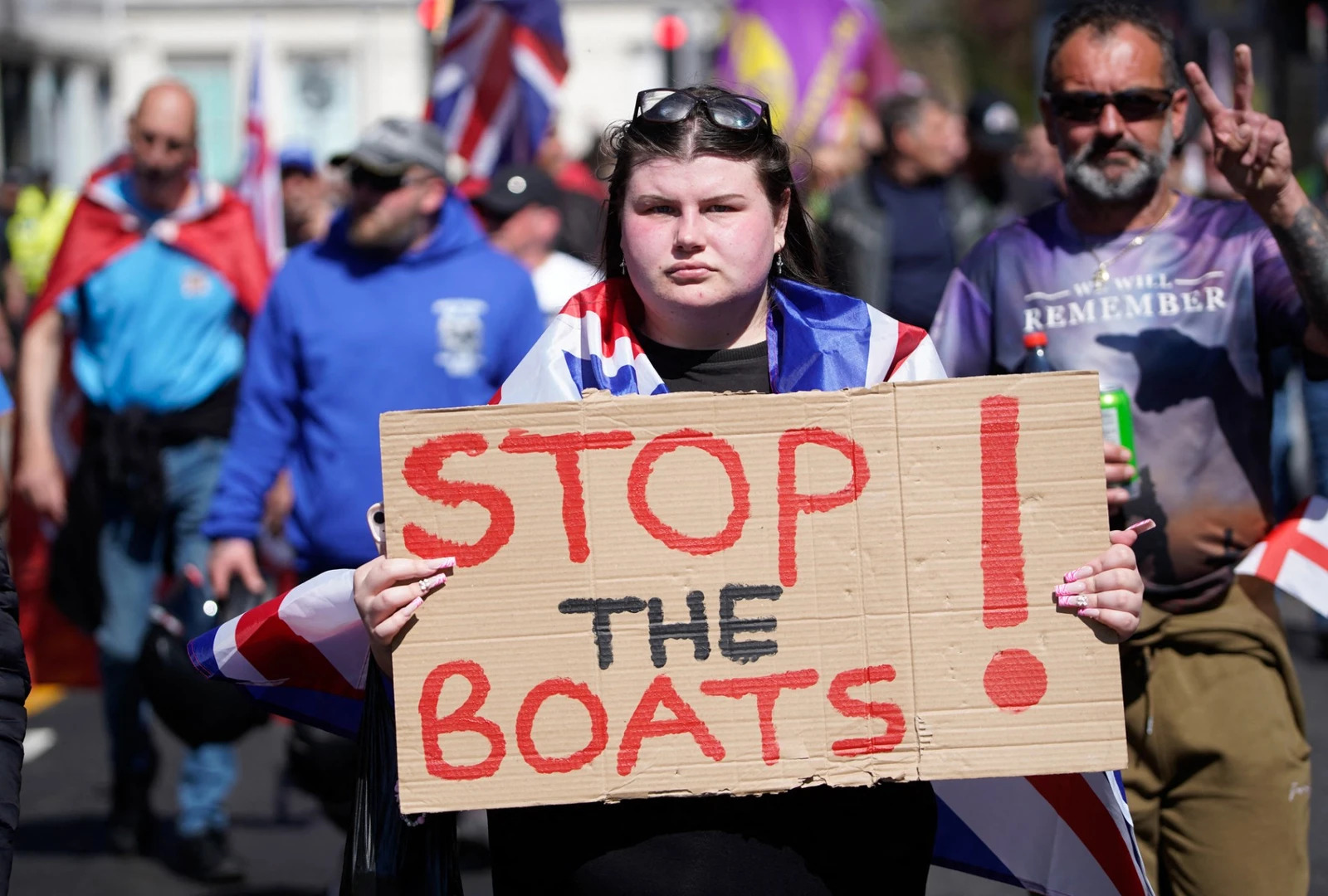
The number of migrants arriving on British shores in small boats so far this year has fallen by more than 40 percent compared to the same period last year, with the people smugglers being forced into a change of tactics due to the French and British police’s closures of many gaps. However, the last week has seen alarming incidents of “intimidating and thuggish behavior” — as described by a government spokesperson — by far-right activists.
On Sunday, roads in Portsmouth were blocked after a boat carrying 140 migrants was brought ashore there. This came the day after similar scenes of direct action had blocked roads and disrupted travel in and out of the Port of Dover. In both incidents, organized men in black, with some wearing balaclavas, blocked traffic and even smashed the windscreens of police cars.
Though largely peaceful, the protests reflect a change in tactics, raising questions about policing, intelligence gathering and the lack of robust measures taken against them. The threat posed by these groups should not be belittled. There is the potential not just for a climate of fear among immigrants but also a threat to law and order and the standing and reputation of the UK as a tolerant country.
The police, the government and officials from all parties condemned the protests. Many rightly questioned the scale of Kent police’s failure after it emerged a tipoff was received the day before the far-right agitators blocked Dover’s roads. Details were apparently passed to police after residents of a nearby village heard individuals boasting in a pub about going to Dover to “attack Muslims.” That information fell on deaf ears and Kent police even later described the protest as “spontaneous.”
Far-right groups are of the opinion that no action taken or policy adopted by the government is good enough
Mohamed Chebaro
Nick Lowles, the chief executive of Hope Not Hate, an organization that charts far-right activity, told the BBC: “To have 300, 400 people with balaclavas marching down the streets, stopping traffic. You know, it’s not just good enough. We need to call these people out for their politics and for the type of Britain that they want to see.” He added: “We’ve got different ways to register our protest. We do not go on the street. We do not burn people out of their houses. We do not cause trouble and threaten to fight the police.”
We should be careful about the repercussions of these images and videos being widely shared and the normalization of those scenes and the messages they convey. They are not viewed only by people in the UK but are also disseminated around the world.
Hope Not Hate was quicker than the police to inform the public that the Dover disturbances were organized by a far-right group called Patriot Platform. This new network was launched in June, uniting smaller, localized antimigrant groups. It claims to represent a Christian “army of patriots,” rallying around a vision of reclaiming the country’s borders and a message that Britain belongs to the British. It seems its adherents are ready to adopt vigilante methods to combat immigration in an effort to revive the country’s Christian values, as the group claims.
After winning power in July 2024, the Labour governments of first Keir Starmer and now Prime Minister Andy Burnham have fought to curb the arrival of small boats across the Channel, using a variety of laws and tactics to deter people from making the dangerous journey. But the past two years have also shown that far-right groups are of the opinion that no action taken or policy adopted by the government is good enough, as if antimigrant agitation could be a conduit to replacing Labour with Reform UK, the party led by colorful euroskeptic politician Nigel Farage.
Surely those that marched in Dover and Portsmouth are not like the Blackshirts just yet. But the resemblance is there
Mohamed Chebaro
After two nights of vigilante, militant-style action against migrants, people have begun to question whether the UK is witnessing the rise of fascism. What we saw at the weekend was a reminder of Italy’s Blackshirts, the violent private army and paramilitary wing of Benito Mussolini’s National Fascist Party, which was founded in 1919. Not long after them came the Hitler Youth of the 1930s, which transitioned from a fringe, violent paramilitary wing into a powerful, mandatory state apparatus.
Surely those that marched in Dover and Portsmouth are not like the Blackshirts of Oswald Mosley’s British Union of Fascists just yet. But the resemblance is there to be seen. This time, the “enemy” is not the Jews of the 1930s but migrants, who are seemingly considered to all be of the Muslim faith.
How the government can act against this clear and present danger is not obvious, as it could end up with more ugly scenes. Already, citizens have taken it upon themselves to “defend the realm” through encircling hotels and government facilities housing migrants or wearing black uniforms and balaclavas and blocking roads and ports. Surely the obvious thing to ask is who is behind them? Who is financing and organizing these acts, which we are told are only the beginning?
It is going to be very difficult for the British government to undo the damage caused by the men in black at Dover and Portsmouth. Launching an investigation to find any lapses of intelligence or policing should be the first step.
Governments across Europe seem to be increasingly at the mercy of far-right forces that are riding high in a changing world. This emerging threat rests on three aspects: the far-right nativist ideology; a warped digital realm that magnifies and spreads toxic, hate-filled content; and an unexplained financial lifeline.
The task ahead is daunting. The so-called patriotic drive of the far right is not aimed at migrants alone — its real enemies are democracy, liberties and the rule of law. Its methods are not peaceful protests but organized activism bordering on vigilantism and militancy.
-
Mohamed Chebaro is a British-Lebanese journalist with more than 25 years of experience covering war, terrorism, defense, current affairs, and diplomacy.
Mohamed Chebaro is a British-Lebanese journalist with more than 25 years’ experience covering war, terrorism, defense, current affairs and diplomacy. He is also a media consultant and trainer.