milan-cortina winter games

Caribbean sprinters are hoping to transform Winter Olympic bobsledding

Axel Brown, the pilot of Trinidad and Tobago’s bobsled team, came to the Milan-Cortina Winter Games with a simple goal.

“Just don’t come last,” he said. “We know that there is a 0% chance of us contending for medals. It doesn’t matter if we have the absolute best day we’ve ever had.

“That’s just the reality of it. It’s not defeatist, it’s not negative. It’s just being realistic.”

But it’s also realistic to believe that Trinidad, just by being in the competition, is furthering something of a revolution in the Winter Olympics in general, and in bobsledding in particular.

When Jamaica debuted in the event in 1988, it was so novel it inspired the 1993 Disney movie “Cool Runnings.” Now, it’s no longer unusual to see a team from a tropical climate competing in the Winter Games; there are 11 Caribbean and South American countries, plus Puerto Rico, competing in the Milan-Cortina Olympics.

When the bobsled competition in Cortina begins Sunday, Trinidad will have teams in the two- and four-man events for the first time, while Jamaica will compete in both those events as well as the monobob. Brazil will also be there.

And Brown says it’s only a matter of time — and money — before others join and start contending for medals.

“There’s a very deep talent pool in Caribbean bobsled, one that could make a world-class bobsled program without a doubt,” he said.

That’s because bobsled races are often won or lost at the start, where speed, explosive power and acceleration are vital in getting the 400-pound sled moving. Sprinters have all those traits.

“Even more specific, it’s usually big sprinters,” said Curtis Tomasevicz, a former football player at Nebraska who won Olympic gold and silver medals in the bobsled before becoming a coach with the U.S. team. “They’ve got just an athleticism that is very applicable to pushing sleds.”

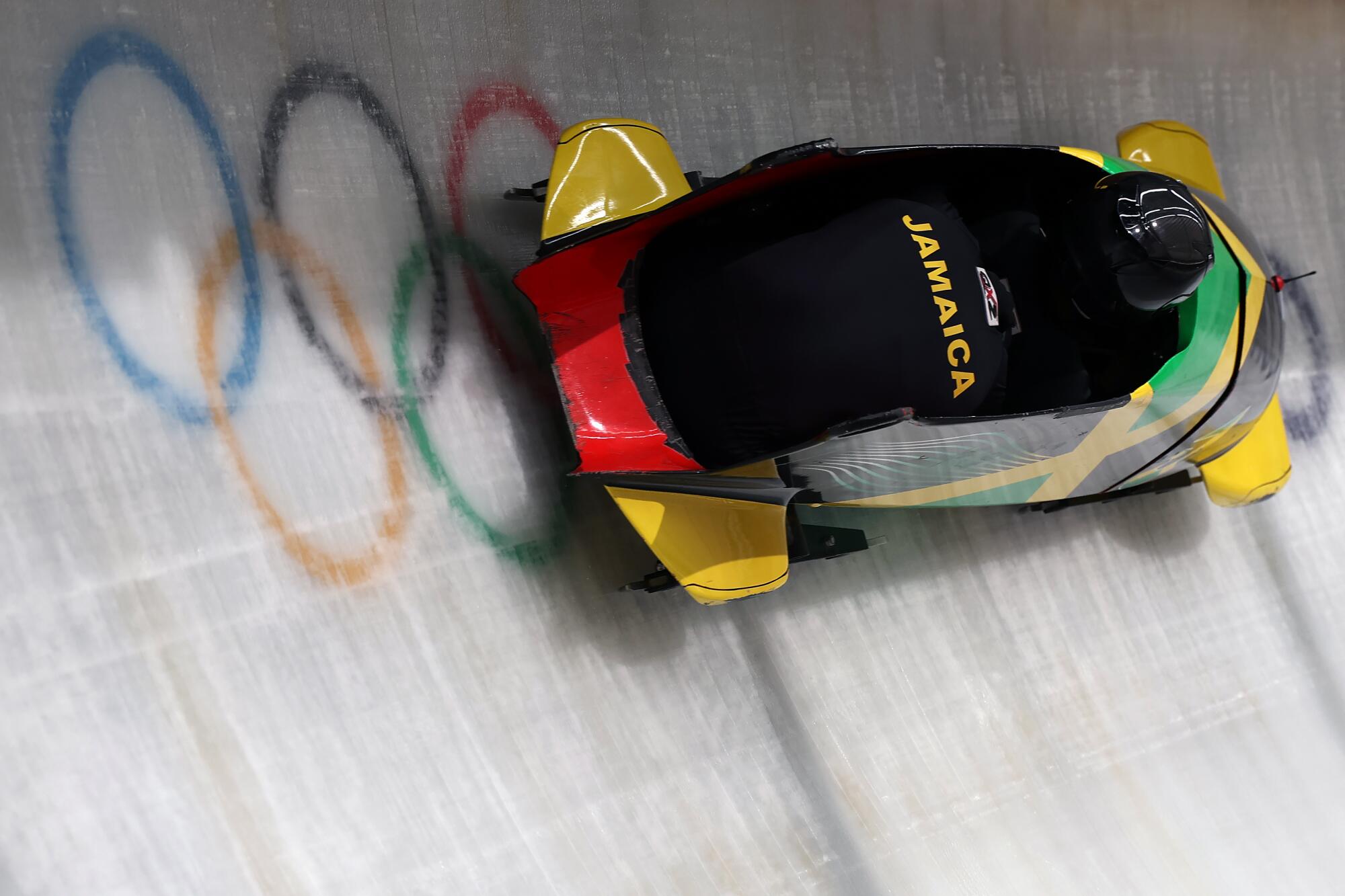
Jamaica takes part in a training run at the Milan-Cortina Olympic Games on Friday.

Jamaica takes part in a training run at the Milan-Cortina Olympic Games on Friday.

(Al Bello / Getty Images)

And the best sprinters in the world come from the Caribbean — so many, in fact, that trying to make a national team for the Summer Olympics can seem like trying to win the lottery. The Winter Games offer another path.

“In Trinidad and Tobago, there’s a wealth of sprinting talent. So an athlete that in another nation may be the best in the country doesn’t necessarily get a look in Trinidad,” Brown said. “What we’ve been able to do is kind of give those athletes that were maybe on the fringe an option at achieving all of their sporting goals, just doing it in a different way.

“They’ve been training for bobsled their entire lives. They just didn’t know it.”

The transition can be difficult just the same. The first time Trinidad’s Micah Moore, a former sprinter, rode a sled, he said he thought he was going to die.

“I was scared out of my mind,” he said. “I was legitimately feeling, ‘I just want this to be over.’

“After that feeling came off, I was like, ‘Let’s go again.’ It’s an adrenaline rush. There’s no amount of words I could put to say how it felt in that moment.”

If Caribbean bobsledders are deep in talent, what they lack are world-class facilities and funding. In the former they’re hardly alone, said Tomasevicz.

“There are a lot of other nations that obviously don’t have a home track to practice on,” he said. “Even Great Britain, they don’t have a track in their country. So they have to spend time in other nations actually training for the sport.”

Trying to find the money is an even bigger problem — especially for Trinidad, which Brown said was the only team in Cortina that didn’t receive government funding.

“Bobsled is an expensive sport,” Trinidad’s Xaverri Williams said. “We’ve been trying to negotiate with our [national Olympic committee], our Ministry of Sport, reaching out to individuals who are willing to help us.”

Trinidad doesn’t even have a decent sled; it will be racing Sunday with an old secondhand one the team owes money on. Getting a new one that would be competitive with the best in the world could easily cost $250,000 or more.

“You need the funds to further develop the broader program, the recruitment, the [research and development] of the equipment. Everything that there is involved in bobsled,” said Brown, was born in England to a Trinidadian mother, which allows him to compete for the island in the Olympics. “And you need to be able to sustain that.”

You also need the belief that it’s possible to succeed in an icy winter sport even though you’re from a sun-washed country where the average annual temperature is 80 degrees. Jamaica provided that.

“We do in fact look up to them,” Williams said. “When those guys initially slided, it was an eye-opener for the rest of the world, that a Caribbean nation could actually compete. They inspired us.”

“I’m very proud of that,” said Chris Stokes, a four-time Olympian and member of the “Cool Runnings” team who is now president of the country’s bobsled federation.

The next step is to outgrow the novelty and become medal contenders, something Stokes says Jamaica can do by the 2034 Games in Salt Lake City. A top-12 finish in Cortina would keep them on pace to do that, he said.

As for Trinidad and Tobago, Brown said they faced so many challenges just getting to Italy that they considered it a victory when they checked into the Olympic village.

“Our gold medal,” he said “was qualifying.”


Source link

Puerto Rico’s lone Winter Olympian on a quest to inspire

The Puerto Rican team at the Milan-Cortina Winter Games isn’t large.

In fact, Kellie Delka stands just 5-foot-3 and weighs about 120 pounds. That’s it; that’s Puerto Rico’s entire team.

Her only event is skeleton, in which athletes travel at about 80 mph down an icy mile-long track with 16 turns. And she won’t be in the hunt for a medal in Saturday’s final rounds after finishing 24th of 25 athletes in Friday’s two heats.

Yet her presence is important just the same because it means Puerto Rico has a team here, even if it was just one person. For most of the century, that wasn’t the case.

“I was approached by the federation. They’re like, ‘hey, they’re trying to grow their winter federation. Maybe that would be something you’d be interested in helping,” she said. “So in 2018, I dropped everything, and I’ve been living on the island ever since.”

That was the first step of what Puerto Rico hopes will be a rebirth of a Winter Olympics program that had been razed to the ground.

In 2002, the island was set to send a bobsled team to the Winter Games in Salt Lake City but one of its sledders couldn’t prove he met Puerto Rico’s residency requirement. Embarrassed, the local Olympic committee didn’t just withdraw its two-man team, it ended recognition for all of the island’s winter sports.

No athlete would represent the territory in the Winter Games for another 16 years, until Charles Flaherty, a teenage American-born skier who moved to Puerto Rico when he was nine, competed in the 2018 Winter Games. A year later an ice hockey federation was established and in 2023 a curling federation.

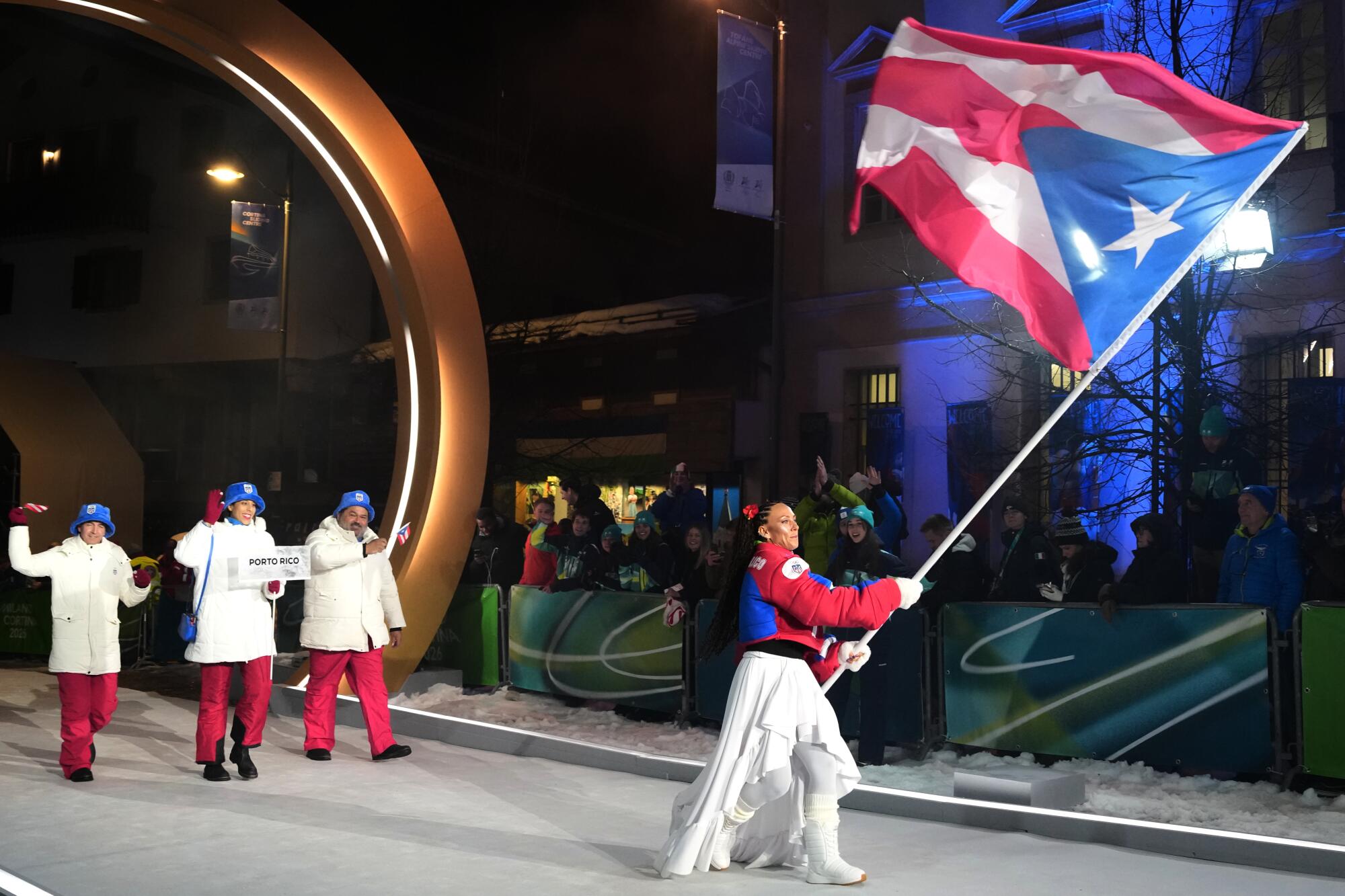
In between those two things Delka, 38, made her Olympic debut, carrying the Puerto Rican flag with William Flaherty, Charles’ younger brother, in the opening ceremony in Beijing.

She carried it by herself in Italy.

Kellie Delka waves the flag of Puerto Rico during the Winter Olympic opening ceremony on Feb. 6.

Kellie Delka waves the flag of Puerto Rico during the Winter Olympic opening ceremony on Feb. 6.

(Misper Apawu / Associated Press)

Because Puerto Rico is an unincorporated U.S. territory, its residents are citizens of the U.S., but to represent the island in the Olympics, you must be born in Puerto Rico, have a parent or grandparent who was born there or live there for at least two years.

It was that final requirement that Delka, a native Texas, was seeking to fulfill when she moved to the island.

“I love the island, I love the people,” she said. “I’ll probably live there forever.”

A pole vaulter and cheerleader at the University of North Texas, Delka was introduced to skeleton by Johnny Quinn, a fellow North Texas alum who competed in the bobsled. She made her international debut in 2013 and was competing for the U.S. through the end of 2017, when Puerto Rico’s federation called.

Leaving a team to go it alone was more difficult than she expected.

“That was the hardest part,” she said. “When you go by yourself, like, it’s a pretty lonely journey. And then not having a coach the whole time, because you have to pay for that as well.

“I love the sport. I wouldn’t be here if I didn’t love it, because you definitely don’t make money from it.”

Eight years later, Delka speaks no Spanish but says she feels intensely Puerto Rican. She gets some financial support from an International Olympic Committee scholarship fund and small, intermittent assistance from the federation. But mostly she supports herself in the sport, in part by selling bikinis she designed on the beach in Luquillo, the tiny community on the northeast tip of the island where she lives.

Puerto Rico's Kellie Delka poses for a photo in Italy.

Puerto Rico’s Kellie Delka hopes she can inspire other athletes to represent the island in the Winter Olympics.

(Alessandra Tarantino / Associated Press)

“I love to sew, I like to make jewelry. I like to make bikinis, and I like to be involved in the community,” she said. “That’s how you meet people.”

Next she wants to inspire them. Because there’s no use in starting an Olympic team if no one else wants to join.

“I would love a teammate,” she said. “I don’t want it to just be me forever, like right now it is.

“I want to start mentoring younger people because I want kids to know that you don’t have to have everything to make it. I don’t have anything. I’m doing this by myself. I’m going to the gym by myself, I’m going to the track by myself, I’m traveling by myself.

“You can do it too, and I can help you do it.”

Sometimes all you need is one person to get started.

Source link

IOC president calls Casey Wasserman emails, ICE sad distractions

Two years before the Los Angeles Olympics, the United States is already dominating the narrative in the run-up to the opening ceremony of the Milan-Cortina Winter Games.

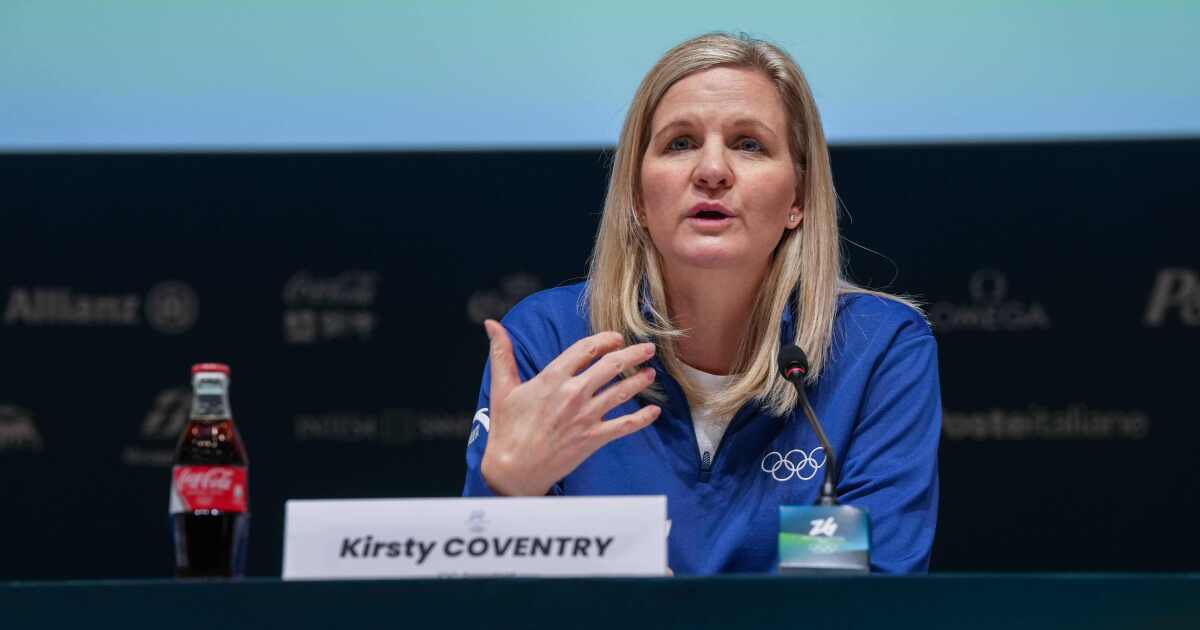
International Olympic Committee officials, including President Kirsty Coventry, couldn’t avoid questions relating to ICE and the Jeffrey Epstein files at a news conference in Milan, Italy, on Sunday.

Coventry tried to fend them off by saying it was not the IOC’s place to comment on the issues, but when pressed remarked it was “sad” that such stories were deflecting attention away from the upcoming Olympics.

“I think anything that is distracting from these Games is sad, right? But we’ve learned over the many years … there’s always been something that has taken the lead, leading up to the Games,” Coventry said. “Whether it has been Zika, COVID, there has always been something.

“But what is keeping my faith alive is that when that opening ceremony happens and those athletes start competing, suddenly the world remembers the magic and the spirit that the Games have and they get to suddenly remember what’s actually important and they get to be inspired, and so we’re really looking forward to that.”

Hundreds of demonstrators gathered Saturday in Milan to protest the deployment of U.S. Immigration and Customs Enforcement agents during the upcoming Winter Olympics, although agents would be stationed in a control room and not operating on the streets.

Meanwhile, the latest collection of government files released on Epstein includes emails from 2003 between Casey Wasserman, the head of the Los Angeles Olympics organizing committee, and Epstein’s one-time girlfriend, Ghislaine Maxwell.

“From all the information that we have and I believe that the U.S. authorities, as the other authorities, have made all the clarifications needed, so from our side that’s not for us to further comment on that part of the security. But we’re really looking forward to the Games,” Coventry said when asked about the presence of ICE agents in Milan.

She was even less responsive when asked about Wasserman.

“We didn’t discuss it yesterday and I believe Mr. Wasserman has put out his statement and we now have nothing further to add,” said Coventry, who was elected just over 10 months ago as the first female IOC president.

The upcoming Olympics run from Friday through Feb. 22. U.S. Vice President JD Vance will lead an American delegation to the Milan-Cortina Games and attend the opening ceremony.

Matar writes for the Associated Press.

Source link